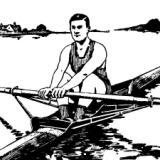
Reading my little ‘obituary’ of Bert Bushnell, Tim Koch in London has sent me a link from the archives of British Pathe, showing Bushnell in a nice film from 1947 teaching sculling. Tim writes, “I'm not sure that you would know anything more about sculling after viewing it, but it is strange to think that it was shown to the general public in cinemas.”
To view Bert in the boat, please click here.
Tuesday, January 26, 2010

Tuesday, January 19, 2010
Bert Bushnell Dies at 88

The other day, the local newspaper in Henley-on-Thames, the Henley Standard, reported that Bert Bushnell, the oldest surviving rowing gold medalist, had died on the 9th, at the age of 88 years. Bushnell (b. 1921) won the gold in the double sculls together with Richard ‘Dickie’ Burnell (1917-1995) at the 1948 Olympic rowing events held in Henley.
Bushnell and Burnell were the two best single scullers in Britain after the war. They were thrown in a double only six weeks before the Olympic races began on 5 August, 1948. At first they seemed to be a very odd couple. The 31-year-old Burnell was a giant at 6ft 4in, educated at Eton and a winning Blue at Oxford, while Bushnell, 26 and only 5ft 9in, was educated at Henley Grammar School. In an interview some years ago, Bert Bushnell revealed that, after their third or fourth outing, they had a couple of arguments. Bushnell wanted to re-rig his riggers as they were rigged for a much heavier oarsman, but Burnell told him not to touch the boat. When Burnell walked off, Bushnell re-rigged the boat and that did the trick!
Bushnell was rowing bow and Burnell stroke, or as Bushnell puts it in the article: “I was on the bridge and ‘Dickie’ was in the engine room.” In the interview Bushnell also made public that they deliberately lost their first Olympic race against the French boat, as they did not want to meet their main opponents, Denmark, in their semi-final race. Through an easy repecharge and semi-final, the Brits met the Danes in the final. At one point during the race, Bushnell saw the anxious face of the Danish bowman; Bushnell called out to Burnell, “Now!”, and they spurted away from the Danes and won with two lengths.
A year later, the Danes beat the British double at the Henley Royal Regatta.
What the British newspapers also like to tell about Bert Bushnell is that he befriended the American sculler Jack ‘Kell’ Kelly, Jr., and actually asked Kelly’s sister out on a date. At that time she had dreams of becoming an actress, she told Bushnell when they were walking on the towpath along the river. A couple of years later she went to drama school, and would eventually hit the big screen. Her name? Grace Kelly.
Bert Bushnell’s Olympic gold medal is now kept at the River and Rowing Museum in Henley.
Monday, January 18, 2010
For 'Bravery'


Talking about rowing medals, to be really honest, during my active time as a competitive oarsman in Sweden, I did not win any grand pots or medals. I did, however, on a few occasions, receive marks of honour for valuable work in the service of the sport on club, regional, and national levels.
Above are two of the medals I was given. The one on the left is my club’s highest honour, Malmö Roddklubb’s gold medal, showing the seal of the city of Malmö, and the band in the colours of the club, blue and white. One of the regulations for this medal is that it can only be given to someone who has received the bronze and the silver medals, but in my case, it seemed, the club committee made an exception.
Earlier the same year, 1993, I received the medal on the right, För Tapperhet i Rodd anno 1993 for my work with the Boat Race between the Universities of Lund and Uppsala. This race is equivalent - well sort of - to the races between Oxford and Cambridge, or Yale and Harvard, as it is between the two oldest universities in Sweden. Before this year, the medal (‘For Bravery in Rowing in [the year] 1993’) had never been handed out, nor has it been offered to anyone thereafter. Of course, this piece of tin is an academically feigned curiosity that different intellectual, literary, sport, etc. groups at the University of Lund furnish among the students and researchers.
The medal was handed out to three of us chaps who had coached the crews, organized the race, supplied the boats and the manpower to see that the race was accomplished without any obstruction, and to raise awareness on a high university level which allowed us to end the race day with an ostentatious tail-coat banquet at the Academic Society’s ‘castle’ in the middle of the medieval small town of Lund. After dinner, and rather tipsy, I have to admit, I received the medal in the men’s loo, together with my two accomplices.
Friday, January 15, 2010
Doggett's And Rowing Medals
In my previous entry, on 13 January, I asked the question where the Doggett’s winner W.H. Campbell got all those nice medals that he so proudly displays on his chest. Chris Partridge (of Rowing for Pleasure) suggested in a comment that they might have been from the Crimean War. Tim Koch of Auriol Kensington RC in London, who sent the photograph to me, is of another opinion. In a message, Tim writes:
 “Chris Partridge thought that Mr. Campbell’s medals may be military ones. It is more likely that they were prizes from Watermen’s Regattas. The ’Portcities’ website shows some nice examples www.portcities.org.uk/london/server/show/ConW... Another reason that they are unlikely to be military is that Campbell has too many of them. Her Majesties armed forces hand out medals very reluctantly. Most American enlisted (wo)men have more decorations than a British Field Marshall!”
Tim continues, "a photograph [on the left] of Frederick Dawson of Mellish Street, Isle of Dogs, waterman and lighterman, is showing him in his rowing vest, standing beside a prize cup and wearing the prize medals won in rowing competitions. He was bound apprentice as a waterman at Wapping from 1877 to 1884 and later won many rowing prizes, including the Veterans Cup in 1904. - Date: c. 1895."
 Tim, who is not only a rowing historian, but also a collector of rowing artefacts, writes, "in my collection of rowing memorabilia I have an example of the only Waterman’s medal still issued. Until 2000, the winner of the Doggett’s got the Coat and Badge and the rest of the competitors got nothing. To celebrate the Millennium, the Fishmongers’ Company decided to give miniature Doggett’s medals to all participants, silver for the winner and bronze for the rest. This was so successful that the practice continues."
 "As an aside," Tim continues, "we must remember that, until the 1939-1945 War, there were many other Coat and Badge races, often run as an event within an otherwise amateur regatta. London RC warded (I think) a blue coat. A Richmond Regatta Coat and Badge from 1921 is in the possession of Auriol Kensington RC
  (on the left). The 1920s cutting from The Times newspaper shows that even the fairly lowly Hammersmith Regatta had one of the splendid items as a prize."
The National Maritime Museum in London has some beautiful rowing stuff. "At the Eastern Thames Regatta of 1902, M.J. Mears won this gold medal [below; photo credit NMM] together with a waterman’s coat and a silver arm badge," Tim also mentions.
 Many thanks to Tim and Chris for your thoughts and input.
 “Chris Partridge thought that Mr. Campbell’s medals may be military ones. It is more likely that they were prizes from Watermen’s Regattas. The ’Portcities’ website shows some nice examples www.portcities.org.uk/london/server/show/ConW... Another reason that they are unlikely to be military is that Campbell has too many of them. Her Majesties armed forces hand out medals very reluctantly. Most American enlisted (wo)men have more decorations than a British Field Marshall!”
Tim continues, "a photograph [on the left] of Frederick Dawson of Mellish Street, Isle of Dogs, waterman and lighterman, is showing him in his rowing vest, standing beside a prize cup and wearing the prize medals won in rowing competitions. He was bound apprentice as a waterman at Wapping from 1877 to 1884 and later won many rowing prizes, including the Veterans Cup in 1904. - Date: c. 1895."
 Tim, who is not only a rowing historian, but also a collector of rowing artefacts, writes, "in my collection of rowing memorabilia I have an example of the only Waterman’s medal still issued. Until 2000, the winner of the Doggett’s got the Coat and Badge and the rest of the competitors got nothing. To celebrate the Millennium, the Fishmongers’ Company decided to give miniature Doggett’s medals to all participants, silver for the winner and bronze for the rest. This was so successful that the practice continues."
 "As an aside," Tim continues, "we must remember that, until the 1939-1945 War, there were many other Coat and Badge races, often run as an event within an otherwise amateur regatta. London RC warded (I think) a blue coat. A Richmond Regatta Coat and Badge from 1921 is in the possession of Auriol Kensington RC
  (on the left). The 1920s cutting from The Times newspaper shows that even the fairly lowly Hammersmith Regatta had one of the splendid items as a prize."
The National Maritime Museum in London has some beautiful rowing stuff. "At the Eastern Thames Regatta of 1902, M.J. Mears won this gold medal [below; photo credit NMM] together with a waterman’s coat and a silver arm badge," Tim also mentions.
 Many thanks to Tim and Chris for your thoughts and input.
Wednesday, January 13, 2010
Three Proud Doggett Winners
 As I have written about the Doggett Coat and Badge Race recently, Tim Koch of London has sent me a wonderful photograph of three old Doggett winners: J.J. Turferry (winner in 1900), W. H. Campbell (1850), and A.H. Brewer (1901). I love how Mr. Campbell holds his pose. I wonder where he got all those medals from…
Tuesday, January 5, 2010
Peter Mallory's "Evolution Of The Rowing Stroke"
Yesterday on Row2k, renowned rowing historian Peter Mallory published yet another installment of his gigantic work Rowing and Sculling: The Comprehensive History (work title).
 Mallory, who has done a tremendous work, writes: “The book has grown to three volumes and will cover the worldwide evolution of rowing technique since rowing as a sport was invented at Eton College during the late 18th Century. By now I have collaborated with several hundred people around the world and traveled more than 50,000 miles over five years to do my research. I have amassed perhaps the largest digital video collection in the world, read hundreds of books and recorded hundreds of hours of oral history.”
 Mallory, who has done a tremendous work, writes: “The book has grown to three volumes and will cover the worldwide evolution of rowing technique since rowing as a sport was invented at Eton College during the late 18th Century. By now I have collaborated with several hundred people around the world and traveled more than 50,000 miles over five years to do my research. I have amassed perhaps the largest digital video collection in the world, read hundreds of books and recorded hundreds of hours of oral history.”
The latest part is about the American Olympian Conn Findlay (see picture, which I borrowed from The Rowing Hall of Fame web site). To read Peter Mallory’s article on Row2k, please click here.
Sunday, January 3, 2010
More Marvellous Rowing Pictures, At Shorpy 3
One of my favorite photographs from the Shorpy archive is ‘Jocks in Socks,’ which is showing an eight of the Potomac Boat Club on 20 September, 1919. I do not know what race the crew won, but the oarsmen look happy for the prize ‘pot’ standing on the right.
 Anyone browsing around the Shorpy photo archive can leave comments which are posted below the image. This picture, called ‘Jocks in Socks’, has quite a few of funny comments, especially for a rower. Most of the people leaving comments have no idea how to row, or the rowers’ ‘dress code’, so the oarsmen’s wet socks create a little stir, together with whom is the ‘hottest’ oarsman… To read the comments, please click here.
 Anyone browsing around the Shorpy photo archive can leave comments which are posted below the image. This picture, called ‘Jocks in Socks’, has quite a few of funny comments, especially for a rower. Most of the people leaving comments have no idea how to row, or the rowers’ ‘dress code’, so the oarsmen’s wet socks create a little stir, together with whom is the ‘hottest’ oarsman… To read the comments, please click here.
More Marvellous Rowing Pictures, At Shorpy 2
Here Tim Koch continues to talk about some photographs from the Shorpy archive:
“It is interesting to compare these American pictures with those of British University crews of the time. The Brits would not row or be photographed with their shirts off and would mostly be using ‘fixed pins’ and not the swivel rowlocks that all these crews have (except Penn Varsity 1914 below).”
 Penn varsity crew, 1914.
Tim continues: “I Britain in 1926 these women would have covered their arms and legs.”
 1 May, 1926. Washington, D.C. Eight-oar shell crew of the Capital Athletic Club on the Potomac between the Francis Scott Key and Aqueduct bridges.
“Is this leather or chamois on the seats of these men's shorts? When I started rowing in 1984 we would sew bar towels to the seats or our rowing shorts.”
 Cornell varsity crew at Poughkeepsie. June 18, 1911.
To be continued...
“It is interesting to compare these American pictures with those of British University crews of the time. The Brits would not row or be photographed with their shirts off and would mostly be using ‘fixed pins’ and not the swivel rowlocks that all these crews have (except Penn Varsity 1914 below).”
 Penn varsity crew, 1914.
Tim continues: “I Britain in 1926 these women would have covered their arms and legs.”
 1 May, 1926. Washington, D.C. Eight-oar shell crew of the Capital Athletic Club on the Potomac between the Francis Scott Key and Aqueduct bridges.
“Is this leather or chamois on the seats of these men's shorts? When I started rowing in 1984 we would sew bar towels to the seats or our rowing shorts.”
 Cornell varsity crew at Poughkeepsie. June 18, 1911.
To be continued...
More Marvellous Rowing Pictures, At Shorpy 1
Rowing historian Tim Koch of Auriol Kensington RC in London has been busy during the Holidays. He has found another photo archive with beautiful, old rowing pictures. In an e-mail, Tim writes: “I have recently discovered a delightful archive photograph site at shorpy.com They have high resolution pictures often taken from 5x7 glass plate negatives so the detail is marvellous.” Of course, he typed in ‘rowing’ in the search and came up with some great pictures.
“In these three photographs,” Tim continues, “one or two members of the crew have plasters on their stomachs. Is this rowing related? The first one also shows the famous coach James Ten Eych who took Syracuse to ten National Championships in his time at the University, 1903-1938, including this Varsity Crew of 1908. His son, Edward, coached Syracuse 1939-1946.” Ten Eych Senior, Tim writes “won the Diamond Sculls at Henley Royal in 1897, the first American to do so.”
 Syracuse varsity crew team at the boathouse with coach Ten Eyck circa 1908.
 Washington Varsity 8.
 Syracuse second varsity crew, June 11, 1914.
I am not sure about the plasters, but a good guess is, I think, that if you row without your shirt on, you might scratch your skin where the oar loom comes into your body. Some of the fellows in these pictures are having their plasters low. My old coach at Malmö Roddklubb in Sweden would yell his head off if we boys in the eight would pull in our oars too low. I distinctively remember him saying something about our balls…
But, over to Tim again: “This unusual shot [below] shows a thoughtful James Ten Eyck with his 1908 Freshman Crew. It is a very evocative picture and reminds me of the times I coxed a Thames Cup Crew at Henley Royal. We rented a house near the course and the crew seemed to spend most of their time eating and talking rowing. Great days.”
 Syracuse freshmen on the rowing team sit around the dinner table
on June 19, 1908.
To be continued...
“In these three photographs,” Tim continues, “one or two members of the crew have plasters on their stomachs. Is this rowing related? The first one also shows the famous coach James Ten Eych who took Syracuse to ten National Championships in his time at the University, 1903-1938, including this Varsity Crew of 1908. His son, Edward, coached Syracuse 1939-1946.” Ten Eych Senior, Tim writes “won the Diamond Sculls at Henley Royal in 1897, the first American to do so.”
 Syracuse varsity crew team at the boathouse with coach Ten Eyck circa 1908.
  Washington Varsity 8.
 Syracuse second varsity crew, June 11, 1914.
I am not sure about the plasters, but a good guess is, I think, that if you row without your shirt on, you might scratch your skin where the oar loom comes into your body. Some of the fellows in these pictures are having their plasters low. My old coach at Malmö Roddklubb in Sweden would yell his head off if we boys in the eight would pull in our oars too low. I distinctively remember him saying something about our balls…
But, over to Tim again: “This unusual shot [below] shows a thoughtful James Ten Eyck with his 1908 Freshman Crew. It is a very evocative picture and reminds me of the times I coxed a Thames Cup Crew at Henley Royal. We rented a house near the course and the crew seemed to spend most of their time eating and talking rowing. Great days.”
 Syracuse freshmen on the rowing team sit around the dinner table
on June 19, 1908.
To be continued...
Thursday, December 31, 2009
5th Rowing History Forum Is Coming Up!
On the Friends of Rowing History’s site, Bill Miller has just posted information about the upcoming 5th Rowing History Forum on Sunday, 21 March, 2010. As usual the Forum is going to be held at Mystic Seaport Museum in Mystic, Connecticut. Special guest speaker is Kent Mitchell, coxswain of the Olympic pair in 1960 and 1964. Other speakers are rowing historians Chris Dodd, Thomas E. Weil, and Bill Miller. Hart Perry will take everyone on a tour of the National Rowing Foundation’s National Rowing Hall of Fame, and Weil and Miller will take the attendees on a tour of the rowing exhibit “Let Her Run”.
More detailed information is given on the Friends of Rowing History’s site, where you will also find information about the National Rowing Foundation’s “Hall of Fame Induction Banquet”, which is going to be held in the evening of Saturday, 20 March. Hope to see you there!
Happy New Year!
Wednesday, December 30, 2009
Something Big And Useless
In the current issue of British Rowing’s Rowing & Regatta, No. 40, rowing historian and writer Chris Dodd has an article with a photograph showing members of Stavanger Roklub getting ready to participate in the town’s parade on Norway’s National Day on 17 of May.
This made me think of a funny story about Norway, from a Swedish point of view; and it has a very loose tie to rowing.
At the Peace Conference in 1814, Denmark, being an ally to France, lost the territory of Norway to Sweden. The Norwegians protested and nominated Kristian Fredrik to be King of Norway on 17 of May the same year. This led to a war declaration from the Swedish King and the Swedish army immediately attacked Norway. After a couple of weeks fighting, Norway surrendered, and was from thereon in a political union with its eastern neighbour, and technically run by the Swedish king.
 Then in 1897, King Chulalongkorn of Siam visited King Oscar II of Sweden. The King of Siam was rowed up on the Royal Barge to meet King Oscar. Among the many gifts that King Chulalongkorn brought to the Swedish king was a big, white elephant.
To get some advice how to reciprocate this gift, King Oscar called in his friend Count Sven Lagerberg, who was a general and the supreme commander of the Swedish Army. Count Lagerberg, who was a witty man, was commonly known as “Sven - Hell, No”. He got the nick-name after his younger brother, also an army officer, happened to call him by his first name, not by his military rank, in front of the troops. General Lagerberg then barked at his brother, “Sven – Hell, No!” [“Sven – i helvete!”]
When King Oscar asked Lagerberg what he would suggest that the king could give to the King of Siam, adding, “What do I have that is big, and totally useless?” General Lagerberg replied, “Your Majesty, how about giving him Norway?”
Poor Norway! The country peacefully separated from Sweden in June 1905.
This made me think of a funny story about Norway, from a Swedish point of view; and it has a very loose tie to rowing.
At the Peace Conference in 1814, Denmark, being an ally to France, lost the territory of Norway to Sweden. The Norwegians protested and nominated Kristian Fredrik to be King of Norway on 17 of May the same year. This led to a war declaration from the Swedish King and the Swedish army immediately attacked Norway. After a couple of weeks fighting, Norway surrendered, and was from thereon in a political union with its eastern neighbour, and technically run by the Swedish king.
 Then in 1897, King Chulalongkorn of Siam visited King Oscar II of Sweden. The King of Siam was rowed up on the Royal Barge to meet King Oscar. Among the many gifts that King Chulalongkorn brought to the Swedish king was a big, white elephant.
To get some advice how to reciprocate this gift, King Oscar called in his friend Count Sven Lagerberg, who was a general and the supreme commander of the Swedish Army. Count Lagerberg, who was a witty man, was commonly known as “Sven - Hell, No”. He got the nick-name after his younger brother, also an army officer, happened to call him by his first name, not by his military rank, in front of the troops. General Lagerberg then barked at his brother, “Sven – Hell, No!” [“Sven – i helvete!”]
When King Oscar asked Lagerberg what he would suggest that the king could give to the King of Siam, adding, “What do I have that is big, and totally useless?” General Lagerberg replied, “Your Majesty, how about giving him Norway?”
Poor Norway! The country peacefully separated from Sweden in June 1905.
Sunday, December 20, 2009
Happy Holidays!
 Dear Friends,
The Holidays are arriving rapidly with all that entails. I will take some time off from researching and writing on my blog to be able to catch up and spend a relaxing time* with my family. I will be back with more interesting rowing stories in January!
MERRY CHRISTMAS
&
HAPPY NEW YEAR!
&
HAPPY NEW YEAR!
* It was probably premature to write a “relaxing time” as, during the night, we got hit by a blizzard, so now there is tons of snow outside. Time to find the shovel and start digging!

Wednesday, December 16, 2009
'Jazz Rowing'
Among the top five rowing oddities is ‘syncopated rowing’, or, as it was also called after the popular music tune of that day, ‘jazz rowing’. What it meant was that, in an eight, the oarsmen were divided up in four pairs, so that their stroke cycle would be in shifts, meaning there would always be 2 oars in the water at all times.
However, syncopated rowing was probably first tried out by the former professional rower, later coach and 'rowing appliance manufacturer', Michael Davis around the year 1880.
Dr. Gilbert C. Bourne did not have any high thoughts of syncopated rowing in his book A Textbook of Oarsmanship, which was published in 1925. He writes, “Mathematicians frequently assure me that, if only we could rig out and train a crew that one pair of oars was always at work, the boat would go much faster. An oarsman can only plead his experience in mitigation of his ignorance of mathematics and say politely that he is quite sure it would not.”
 Of course, it would need a specially built boat with more space, especially in the middle of the craft to allow the different pairs more room to move back and forth without smacking their oar looms in the back of the fellow seated in front of them. In autumn 1929, this technique was actually tried out on the Thames by a crew of the London RC, trained and lead by F.E. Hellyer.
One newspaper, The Sydney Morning Herald, had a correspondent present, who wrote on 3 October “The crew starts together as usual till the boat is moving. Then stroke and No. 7 slide a shade ahead of the next pair, and so on down the boat. Consequently there is always a pair of oars in the water. It is dreadfully ugly.”
To view an almost 2 min. newsreel of these trials, please click here.
It was also tried out with the coxswain steering from the middle of the shell, and in Chris Dodd’s eminent book about the London RC, Water Boiling Aft (2006), there is a funny photograph of coxswain Edwin Phelps seated in the centre of an eight, looking terribly baffled. There were also some trials made at Cambridge in the 1930s.
In Dodd’s The Story of World Rowing (1992) the author notes that syncopated rowing has been tried out in the late 1970s and the beginning of the 1980s by the Russians (aka Soviets). Some Soviet women crews competed in fours with the coxswain in the centre of the shell at the World Championships and the Olympics, even taking medals in these boats. It was, however, concluded, both in the 1930s and 1980s, that there was no actual speed advantage to rowing this way.
Dr. Volker Nolte had an article about syncopated rowing published in Rowing News in May 2007, and to read the on-line article, click here.
Browsing around on the web, I actually found a patent for ‘stroke cycle phase shift rowing’ on ‘free patent online’ with the filing date 3 March 2003, and publication date 19 April 2005.
This entry shows two things: nothing is new under the rowing sun; and we never learn...
However, syncopated rowing was probably first tried out by the former professional rower, later coach and 'rowing appliance manufacturer', Michael Davis around the year 1880.
Dr. Gilbert C. Bourne did not have any high thoughts of syncopated rowing in his book A Textbook of Oarsmanship, which was published in 1925. He writes, “Mathematicians frequently assure me that, if only we could rig out and train a crew that one pair of oars was always at work, the boat would go much faster. An oarsman can only plead his experience in mitigation of his ignorance of mathematics and say politely that he is quite sure it would not.”
 Of course, it would need a specially built boat with more space, especially in the middle of the craft to allow the different pairs more room to move back and forth without smacking their oar looms in the back of the fellow seated in front of them. In autumn 1929, this technique was actually tried out on the Thames by a crew of the London RC, trained and lead by F.E. Hellyer.
One newspaper, The Sydney Morning Herald, had a correspondent present, who wrote on 3 October “The crew starts together as usual till the boat is moving. Then stroke and No. 7 slide a shade ahead of the next pair, and so on down the boat. Consequently there is always a pair of oars in the water. It is dreadfully ugly.”
To view an almost 2 min. newsreel of these trials, please click here.
It was also tried out with the coxswain steering from the middle of the shell, and in Chris Dodd’s eminent book about the London RC, Water Boiling Aft (2006), there is a funny photograph of coxswain Edwin Phelps seated in the centre of an eight, looking terribly baffled. There were also some trials made at Cambridge in the 1930s.
In Dodd’s The Story of World Rowing (1992) the author notes that syncopated rowing has been tried out in the late 1970s and the beginning of the 1980s by the Russians (aka Soviets). Some Soviet women crews competed in fours with the coxswain in the centre of the shell at the World Championships and the Olympics, even taking medals in these boats. It was, however, concluded, both in the 1930s and 1980s, that there was no actual speed advantage to rowing this way.
Dr. Volker Nolte had an article about syncopated rowing published in Rowing News in May 2007, and to read the on-line article, click here.
Browsing around on the web, I actually found a patent for ‘stroke cycle phase shift rowing’ on ‘free patent online’ with the filing date 3 March 2003, and publication date 19 April 2005.
This entry shows two things: nothing is new under the rowing sun; and we never learn...
Sunday, December 13, 2009
Boat Race Attractions
 Late this evening, I opened an e-mail from the inimitable Tim Koch of Auriol Kensington RC, who writes,
“Dear Göran - I just came across this attached print on the internet and was reminded of your posting of 3rd December, 'A Suitable Bachelor?'. This one, 'Attractions of the Boat Race', is a little less innocent. The 'gentleman' looks like a cad and the 'lady' is, perhaps, 'no better than she should be'. The other people in the picture are more interested in what is happening on the river though the older gentleman in the bottom left hand corner looks as though he has seen it all before. I think they are on Putney Rail Bridge (built 1889) looking at Putney Road Bridge (built 1886).”
Many, many thanks for your contribution, Tim!
More Laurie
 Talking about Hugh Laurie, when I was writing my previous entries about Hugh Laurie and his famous rowing father, Ran Laurie, I was desperately looking for an old issue of the Telegraph Magazine, which I knew that I should have in my archives (please read “messy piles of rowing stuff which is all over the place…”). I remember that Hugh Laurie was on the cover of the magazine, which was in the published mid-1990s.
Well, the other day, when I was looking for some rowing things in the closet off my Rowing Room, I found a box with old magazines – and there it was! The magazine, from 4 May 1996, which was a supplement to The Daily Telegraph, has a feature article about Laurie written by Lynn Barber Tangles. This is the time when he and Stephen Fry had finished their fourth round of the very popular Jeeves and Wooster series, and Laurie’s novel The Gun Seller had just been published.
Laurie says in the article that he thinks it is his Presbyterian upbringing that has made him feel guilty that he never had to pay any great price for being successful. He says about his father, who was still alive at that time, “my father, who is a man of extraordinary gifts and great accomplishments and really a heroic figure […] is the most modest man alive. If there is any queue that he can stand absolutely at the back of, he will find it. So that was the prevailing attitude. And I still admire that, I admire it in my father and I admire it generally, but it just so happens that in this particular career I’ve chosen it’s not actually very practical.”
In the interview, Hugh Laurie mentions that he showed his father The Gun Seller, which he dedicated to him, before it was published. Ran Laurie got upset on the number of invectives in the book, so Hugh Laurie decided to re-read the novel, “Oh God,” he says in the article, “there are quite a few, actually. More than my father would like to read.” So, being a good son, he took them out.
That is one thing I like about Hugh Laurie, he is such a nice and decent chap.
Subscribe to:
Posts (Atom)