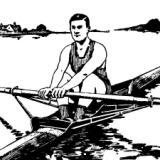
The master of “sayings” when it comes to rowing is without doubt the Australian Steve Fairbairn, who coached Jesus College, Cambridge, Thames RC, and The London RC. Although he died seventy years ago, his books on rowing, which are now all out of print, are very sought after. Be prepared to pay a lot of money for second-hand copies. Fairbairn’s famous maxims were compiled by his friend Freddy Brittain, and given the title
 Slowly Forward
. The following is a piece about Fairbairn and Brittain.
In 1929, Steve’s loyal friend Freddy Brittain, then a year away from a lectureship at Jesus College, selected and arranged 366 of Steve’s sayings, a maxim for each day of the year, starting with “Don’t start the next stroke too soon” (1 January), and ending with “Sit back at the finish till the cows come home” (31 December). I have many favorites among the 366 aphorisms, but if I have to pick only one, it is “Enjoy your rowing, win or lose”, which is what I have done ever since I began to row. It was much later, that I realized that this saying actually falls on my birthday.
Freddy gave the book the title
Slowly Forward, which surprised Steve. To Steve’s question where the title came from, Freddy answered that it was Steve’s favorite expression when he was coaching his crews. Steve denied this, saying that he always said “Slow Forward.” Freddy explained that an adverb was essential in that position. “Adverb!” Steve blurted out, amused. “Adverbs! You are like the bloody dons – specialized idiots.”
Steve never seemed to forget this, Freddy tells in [his autobiography]
It’s a Don’s Life, “whenever he introduced me to anyone – in the Stewards’ Enclosure at Henley, or anywhere else – he used to add solemnly, ‘He knows a lot about adverbs, he does’; and when he wrote to me he often ended his letter with
‘Yoursly everly,
Stevely’ “
The following year, in 1930, Freddy was going to publish his
Oar, Scull, and Rudder, and offered it first to Cambridge University Press, who required financial assistance from the author. Freddy did not have any money to spare, so he sent his manuscript to Oxford University Press, who decided to publish it. Steve immediately offered to write the introduction to the book.
Freddy mentions in his autobiography that he was worried about Steve’s offer as “his style of writing, influenced as it inevitably was by years spent in the backwoods of Australia out of touch with books or educated men, was hardly in keeping with a staid University Press, but I could not refuse his offer.” A couple of days later Steve handed his piece to Freddy to read. Steve sat down opposite Freddy when he read it. When Steve saw Freddy getting some twitches around his eyes and evidently saw his face drop, he said, “You don’t like my Introduction?” Freddy began to stammer, “These University Presses are a rather a highbrow lot, you know.”
Then Steve got an idea. Both Steve and Freddy knew another Jesus don, the King Edward VII Professor of English Literature, Sir Arthur Quiller-Couch - know as “Q” - who was a famous poet, novelist, literary critic, and anthologist (
The Oxford Book of English Verse, 1900; 1939); and for certain a real man of letters. Q had, as an undergraduate, rowed at Trinity College at Oxford and written the introduction to
The Jesus College Boat Club, Vol. I. He was also, according to Freddy in his
Arthur Quiller-Couch - A Biographical Study of Q (1947; 2nd ed. 1948), “the best-dressed man in Cambridge.”
“All right. I will tell you what to do,” Steve said. “Q knows something about English. Get him to knock it into shape.” Freddy went to Q’s room and said, “Steve says you know something about English.” Q answered that it was very kind of Steve to say so, and what could he help him with. Freddy handed Steve’s introduction to Q and said that Steve wanted him “to knock it into shape.” Q started to read, and Freddy could now see how Q’s face dropped. Q turned to Freddy and, letting out a deep sigh, said it was impossible to make anything out of it. However, Q took a second look at the manuscript. “All right,” he said. “Tell Steve I will knock it into shape.”
“When the book was published,” Freddy writes in
It’s a Don’s Life, “the title-page asserted that it had an Introduction by Steve Fairbairn. It is true that Q had used the same twenty-six letters of the alphabet as Steve, but he had re-arranged them in his own inimitable style.” Steve’s opening sentence had been something like “Me and Freddy have had a lot of talks about rowing,” which in the printed Introduction reads “In our discussions ‘frequent and full’ on the principles of Rowing it has occurred to my friend Mr. Brittain, as to me, to wonder why a scientific Bibliography of the great Art has never yet been compiled.”
Extract from a yet unpublished essay, “Freddy and Stevely – and the Quest for Perfect Rowing”, about the Cambridge rowing coach Steve Fairbairn (1862-1938) and his friend Frederick “Freddy” Brittain (1893-1969), a don at Jesus College, Cambridge.

.jpg) Nowadays, eighty years after it was published, Oar, Scull and Rudder is hard to come by in the antiquarian book trade. So are almost all of the publications that Brittain mentions in his book. One example is Reginald S. de Havilland’s Elements of Rowing, a little pamphlet published in 1913 by Eton College where de Havilland, or “Harvvy” as he was known, was the rowing coach. The pamphlet is only 11 pages [Brittain states 77 pp, but that must be a misprint] and it has “suggestions […] to helping those boys who are engaged in coaching junior fours at Eton” as stated in the foreword. It has short chapters on: “body”, “feet”, “hands”, “swing”, “forward like a spring bent down”, “finish”, “straps”, “the oar”, and “summary”.
Nowadays, eighty years after it was published, Oar, Scull and Rudder is hard to come by in the antiquarian book trade. So are almost all of the publications that Brittain mentions in his book. One example is Reginald S. de Havilland’s Elements of Rowing, a little pamphlet published in 1913 by Eton College where de Havilland, or “Harvvy” as he was known, was the rowing coach. The pamphlet is only 11 pages [Brittain states 77 pp, but that must be a misprint] and it has “suggestions […] to helping those boys who are engaged in coaching junior fours at Eton” as stated in the foreword. It has short chapters on: “body”, “feet”, “hands”, “swing”, “forward like a spring bent down”, “finish”, “straps”, “the oar”, and “summary”.