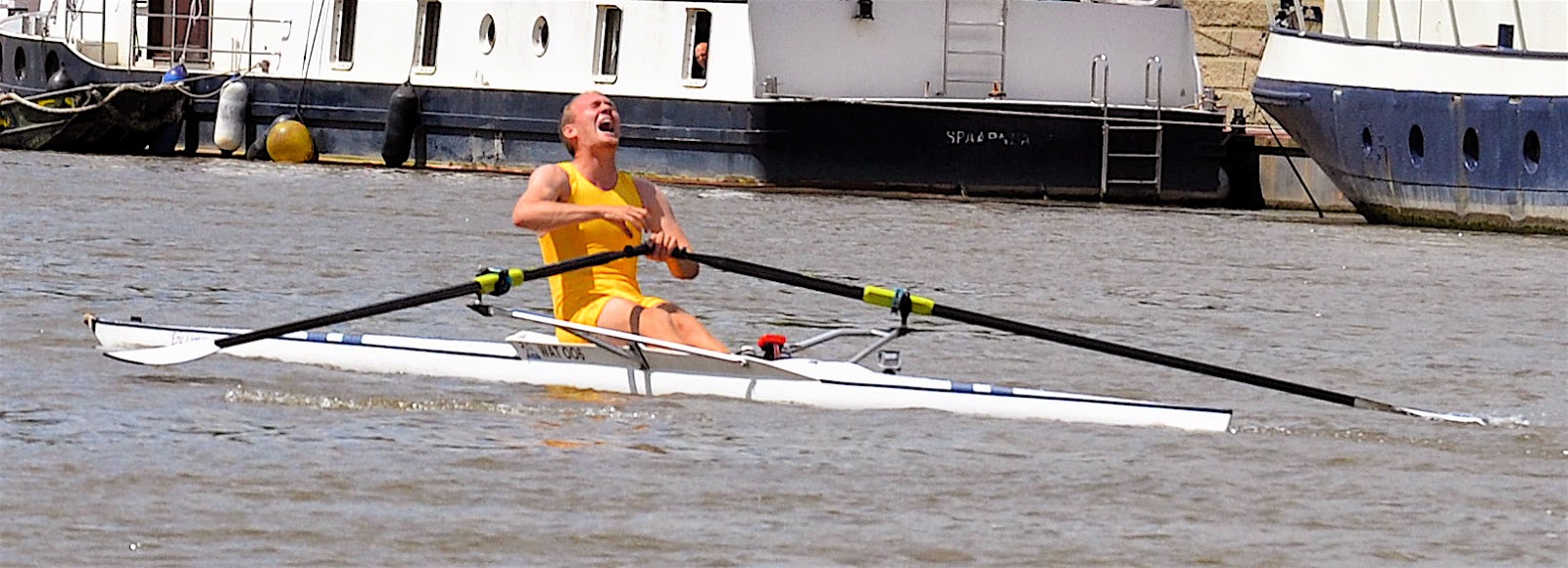
Photograph: Werner Schmidt
Showing posts with label Chris Dodd. Show all posts

Wednesday, August 6, 2014

Henley Literary Festival 2014


Greg Denieffe writes:

The 8th Henley Literary Festival beginning 29 September and running to 5 October is now open for bookings. The exciting news for rowing enthusiasts is that there are three opportunities to catch up with the authors of recent publications on the subject. Dodd, Carlson and Mowbray may sound like the name of a dodgy firm of solicitors but the only thing dodgy about their contribution to the world of rowing literature is that Chris Dodd touches on some dodgy dealings in his book Bonnie Brave Boat Rowers.

Dodd will be the first of the trio to grace the festival when on Monday 29 September he literally takes to the water on board Hibernia to discuss Geordie Rowers.

A canny good read!

From the festival programme (FP):

As fitting an author to appear at Henley (and on the Hibernia) as you can imagine. Christopher joins us from the River & Rowing Museum to recall the rowing culture that thrived in the north east of England through the 19th and early 20th century. Rowing was a professional sport inspiring innovative design of racing boats, while the music hall roared with songs to honour the oarsmen’s prowess.

You can read HTBS editor Göran Buckhorn’s review of the book here, order a copy here and read a review of Chris’ 2012 appearance at the festival here.

Also on Monday 29 on the Hibernia immediately after Chris, Jack Carlson will tell the story of his book Rowing Blazers.

Rowing Blazers, British edition

Rowing Blazers, American edition

Cambridge University’s Lady Margaret Boat Club has the honour of wearing the first blazers, so called as they were (and still are) bright red. But the jacket has gone on to become a worldwide rowing uniform and one that brightens the Thames banks during our Royal Regatta in July. So join Jack, winner of last year’s Regatta, aboard the Hibernia with his stunning book on the history and development of the rowing blazer, featuring designs from around the globe. He is wonderfully qualified as an oarsman who has represented the USA at the World Rowing Championships and rowed [sic] for Oxford in the University Boat Race. So that is two blazers he is entitled to wear! (FP).

Tim Koch recently reviewed the book for HTBS. He also features within its pages. Read his review here and watch a video that tells the story of the authentic striped, piped, trimmed and badged rowing blazer, through the oarsmen and women who wear them here.

Whilst these two events follow each other on board the Hobbs & Sons Hibernia, separate bookings which can be made here are required for each.

If these two rowing events can be said to top the festival, you will have to wait until the final day (Sunday 5 October) for the tail. It is an event that I am particularly looking forward to as I have already received a ‘pass out’ for the day and my ticket is booked!

Recipe book?

Alison Mowbray won a silver medal in the women’s quadruple scull at the Athens Olympics in 2004. Her autobiography Gold Medal Flapjack, Silver Medal Life was the first rowing book published in 2014, with a publication date of 2 January.

From the official press release:

“Alison Mowbray wasn’t a sporty kid and thought that being good at sport was a pre-requisite for going to the Olympics. She thought she might be a doctor, a teacher, a Blue Peter presenter or maybe the first ever female naval submariner.

Then at 18 I discovered rowing. From that point on, for the next 15 years, I didn’t have a choice anymore. She made the British team at 27, by which time she had already lived a whole other life.

I never planned to be inspiring so really this is just the story of how I did the things I love, the very best I could do them, and how very far it took me. You don’t choose to go to the Olympics. You lay out everything you have and let the Olympics take it no deals, no bargains, no questions asked, no hope of return. Maybe it will be enough and the Olympics will choose you, and maybe it won’t.

That’s what you do. That is this story. This is a Silver medal life of achievement, addiction, alcoholism, anorexia and Alzheimer’s. But a Gold medal story of passion and perseverance, and not letting anything or anybody get between yourself and your dream. And of what happens next perhaps the most Olympian journey of all after the blaze of glory with the medal held high. Because what do you do when you’ve achieved everything you ever wanted to achieve? Where do you go from there?

This started out as a recipe book with a few stories from my life, and then the story took over. It also became really important to me to write this as a history of British women’s rowing because I don’t think many people on the outside really understand how incredibly self-motivated and tough us women have had to be pull ourselves up, often in defiance of the first fledgling attempts at some sort of system”.

Alison will once again take to the water on the beautiful river Thames on the final day of the festival as the Hibernia is also the setting for her talk. Martin Cross, aka The Blogging Oarsman gives his take on the book in a short video which you can watch here.

Monday, August 4, 2014

1974 World Championships on Rotsee

On 1 August rowing historian and journalist Christopher Dodd wrote here on HTBS about the 1976 Henley Royal Regatta. Just a couple of weeks earlier, on 13 July, he had written a 'prelude' to that piece on his own blog Rowingvoice. In that article he remembers how he, as the rowing correspondent for The Guardian, and Jim Railton of The Times had arrived at Rotsee in Lucerne for the 1974 World Championships. Dodd's "Hot times in the Cold War" is an entertaining story about Henrietta's bar and the hostess's party trick, the British eight's disastrous race in the semi-final, how the eight's cox, Pat Sweeney, worked his boat through the other nations' crews one by one in the final and how the Championships ended with a tear gas attack by Swiss police trying to break up the athletes' after-race party - while the party band continued to play on.... They don't make regattas like that anymore.

In June earlier this year, a video on the eights final at the 1974 World Championships was uploaded on YouTube, see below. (There are no race commentaries, but close to the 500-metre mark, at 2:32 min., Bachman-Turner Overdrive's "Takin' Care of Business" - released in January 1974 - starts to play and will follow the race to the finish line.)


Please see also HTBS's post "The Story of the Martini Achter" on the American 1973 and 1974 crews, and the 1974 crew's reunion earlier this year.

Friday, August 1, 2014

Chris Dodd: Henley Royal Regatta 1976

Thames Tradesmen leading Leander in the final of the Grand. Photo: Rowing August 1976.

As HTBS readers know by now, YouTube is a real treasure trove when it comes to film clips on rowing. HTBS’s Tim Koch found two wonderful films from the 1976 Henley Royal Regatta on YouTube. HTBS asked rowing historian Christopher Dodd to write a commentary about Henley for that year. As many of you are aware of, Dodd is an authority on British rowing and he paid special attention to the country’s rowing progress during the 1970s in his book Pieces of Eight: Bob Janousek and his Olympians (2012).

Christopher Dodd writes:

Henley Regatta took place on 1-4 July 1976 at the end of a heat wave. The temperature reached over 90° Fahrenheit*, humidity was at its wettest, the river low and the stream minimal. There was a new hazard to Henley, clearly visible in the YouTube video clips – swimmers on the booms and on the course. See the following film:


The open events were devoid of national crews, including the entire British team, who were in Canada preparing for the Montreal Olympics. Britain’s best hopes for medals that summer were the men’s eight, hand-picked three years before by Bob Janousek, the national coach, and the double scullers Chris Baillieu and Mike Hart. The eight’s last pre-Olympic regatta was Lucerne, held before Henley that year, and there was no opportunity to thrill the home crowd at Henley.

So the open events were short of class if not of competition. Janousek’s eight was a blend of Leander Club and Thames Tradesmen, and it was these two clubs who finished up contesting the Grand. Both contained men who had missed Olympic selection. 

Leander reached the final by beating the University of British Columbia (three quarter length) followed by London University (half length). Tradesmen arrived there by beating London RC by a third of a length. London were effectively the national lightweight eight (no Olympic lightweight events in 1976). London University were coxed by John Boultbee, who later became the first Australian to be elected a Henley Steward.

As the clip shows, Tradesmen won a close final by two thirds of a length. This was the second attempt after a re-row was ordered by the umpire after Leander stopped at the top of the Island during the first attempt when their rudder hit a submerged object.

The race was re-scheduled for 4.15 p.m. (three and a quarter hours after the first start), and Tradesmen went out to three quarters of a length at Fawley and saw off Leander’s attempts to get even.

The crews in the Grand final were:

Thames Tradesmen: Mallin, K. Cusack, Burch, Wilson, Bayles, Roberts, Milligan, Brown, cox Sherman.

Leander: D. and G. Innes, Tatton, Hardingham, King, Woodward-Fisher, Gregory, Rankine, cox Lee.

The commentaries on these clips are by Jim Railton, the rowing correspondent of The Times, who had been the ARA’s trainer in the late 1960s and who, a sprinter by sport, had blooded himself in rowing as a volunteer coach at Tradesmen.

Railton has a comfortable, warm voice with a trace of his Liverpudlian origin, and he doesn’t make mistakes. But his performance highlights the problems of commentating on rowing and filming on the Henley course. He is caught between the producers’ paranoia of silence breaking out even when the viewer can see what is happening, and the commentator’s paucity of information. Although he had coached some of these men – producing a famous ‘Beatle’ four of Mason, Clark, Robertson and Smallbone who morphed into Janousek’s Olympic squad – Railton doesn’t furnish us with their record, past performance or personal history. Added to which, he’s talking to a monitor in a trailer somewhere. It’s unfair to throw all the blame for lack lustre at him. The same challenges face the Stewards today as they seriously consider getting the tv cameras in.

The Thames Cup in 1976 was electric because the local club, Henley RC, were on the brink of winning their first Henley medal. They beat Saxon, Vesta, Rollins College and the selected University of Pennsylvania to reach a final against Harvard. Their race with Penn was hairy because Henley lost an oar from a rowlock on the 18th stroke, but recovered to take the lead.

A year before, Harvard had lost the first round of the Thames to Garda Siochana, the Irish police, who went on to win the cup. It was the first time Harvard had lost in the Thames, and in 1976 they were keen to recover their record. They were selected and reached the final by way of wins over Molesey, Imperial College, Hansa Dortmund and Christiania of Norway.

The final was a cracker. Henley had a canvas at the quarter mile signal and kept it to the Barrier and stretched it to a third of a length at Fawley, over-rating Harvard. Then Harvard drew level at the three quarter signal. Henley rose to 41 and Harvard to 43 to bring the latter home first by a canvas.

The crews in the Thames Cup final were:

Harvard: McGee, Templeton, Wood, Moore, Wiley, Perkins, Porter, Gardiner, cox You.

Henley RC: Maffre, Bushnell, Smith, Allen, Marsden, Pankhurst, Glenn, Richardson, cox Woodford.

After Hansa Dortmund withdrew, the Stewards’ was a straight final between University of British Columbia and Thames Tradesmen. Both crews had also rowed in the Grand, with Tradesmen having covered extra mileage that day because of the Grand re-row. The Canadians took the lead off the start and had a length and a half at the mile. Tradesmen then reduced the gap and pulled a desperate splurge out of their hat to finish a third of a length down.

The crews in the Stewards final were:

UBC and Vancouver RC: Rea, Bodnar, Moran, Allester.

Thames Tradesmen: Mallin, Roberts, Milligan, Cusack.

The Princess Elizabeth for schools was marred by the exam timetable again, complained the Henley recorder. Why these people who arrange A levels cannot conduct their affairs to avoid the Henley timetable, he couldn’t imagine. There were two selected crews – Holy Spirit High School (U.S.) and Emanuel School from Wandsworth, and they duly met in the final. Holy Spirit beat Hampton and Tabor Academy to get there, and Emanuel disposed of Abingdon and Eton.

In the final Holy Spirit led to the Barrier, where Emanuel drew level. Not for long, however. The Americans had half a length at the three quarters signal and drew away at the end to win by two thirds of a length.

The crews in the Princess Elizabeth final were:

Holy Spirit HS: McDevitt, Millar, Bibik, Foerster, Guenther, Welsh, White, Brown, cox Maguire.

Emanuel School: Tollitt, Ridgley, Lemmens, G. Roberts, Field, Downie, N. Roberts, C. Roberts, cox Upton.


The other half of the Tradesmen Grand eight won the Prince Philip for coxed fours by a row-over. Leander, the other finalists, withdrew because they were also rowing in the re-scheduled Grand and refused to contest the Philip before it. So the Philip was a damp squib – not the only one on the Sunday afternoon. With a fork of lightning and a clap of thunder, the weather broke, and all thoughts turned to Montreal.

Christopher Dodd’s Pieces of Eight is available from the River & Rowing Museum here and Richard Way Bookseller, 54 Friday Street, Henley-on-Thames or give them a call at INT+44+(0)1491-576663.

*Editor's Note: In an unsigned article about the 1976 Henley Regatta in the magazine Rowing, August 1976 issue, it was stated about the warm weather:

On two days in the nineties the rule about jackets was relaxed in the Stewards’ Enclosure, although ties were still required and shirts had to stay on in the public enclosure. On the banks it was bikini tops which came off, making paddling up to the start more interesting than usual.

Friday, July 18, 2014

The 300th Coat, the 300th Badge: The 2014 Doggett’s

Welcome to the club. Henry (‘Harry’) McCarthy, the 2014 winner of the Doggett’s Coat and Badge with, from left to right: Nick Beasley (who won Doggett’s in 2001), Ralph Humphrey (1989), Henry, Lenny Grieves (1969), acting Bargemaster, Robert Dwan (2004) and Tom Woods (1999).

Tim Koch reports from London (with some help of Chris Dodd):

Ask anyone involved in rowing and sculling what the sport’s oldest event is and most would suggest either the Oxford – Cambridge Boat Race (1829) or Henley Royal Regatta (1839). Few would know that it is, in fact, a 300-year-old single sculling race, the curiously named ‘Doggett’s Coat and Badge Wager’, a contest that has been run continuously since 1715. The HTBS reports on this unique event and on its fascinating history cover 2010, 2011, 2012 and 2013.

Competitor Ben Folkard boats from Fishmongers’ Hall which is next to London Bridge. The Fishmongers’ Company have had a Hall on this site since 1434.

While 2014 saw the 300th race, it has been decided that the big celebrations will be held in 2015 to mark the 300th year. Nonetheless, this year’s Doggett’s still attracted a Royal visitor in the person of the Queen’s husband, His Royal Highness Prince Philip, Duke of Edinburgh. As this Pathe Newsreel shows, he last saw the race in 1951 (though the film’s commentary is particularly ill-informed).

A tense moment as a 93-year-old member of the Royal family is transferred into the umpire’s launch (though, as a career naval officer from 1939 to 1952, Prince Philip is no stranger to ladders, boats and water).

Colin Middlemiss, Clerk to the Company of Watermen and Lightermen (who organise the event in conjunction with the Fishmongers’ Company) said:

It has been 500 years this year since the earliest Act of Parliament for regulating watermen, wherrymen and bargemen received Royal Assent from King Henry VIII. It’s an extremely special year for us, and we are thrilled the Duke of Edinburgh will be joining one of the oldest and most important celebrations of the river.

The Doggett’s obscurity is in large part due to the fact that it is only open to those under the age of 26 who, in the previous three years, have completed the long apprenticeship to qualify them to carry goods and people on the River Thames. If that were not enough of a barrier to entry, the course itself should dissuade all but the brave or the foolish. It runs from London Bridge to Chelsea, 7,400 metres of unsettled and unsuitable water containing washes, bends, bridges and currents. The prize for this winner of this mad event is suitably eccentric – the scarlet costume of an 18th-century Waterman, a sleeve of which sports a solid silver badge the size of a dinner plate. The less tangible prize is the honour of joining a very exclusive club. The ‘Coat and Badge’ continues to have enormous prestige in the tightly knit community of the Thames Watermen and their families, many of which have worked the river together for generations.
In the shadow of HMS Belfast with Tower Bridge behind them and the Tower of London beside them, the five competitors wait to go onto the start. From left to right: McCarthy, Coughlin, Petipher, Folkard and Maynard.

The competitors drew lots for their colours and stations at Fishmongers’ Hall on 23 June. In traditional style (with my additions in italics), it was announced:

The names of the five young Watermen who are to row on Tuesday, 15th July 2014, in the 300th Race for the Livery and Badge provided yearly under the will of the late MR. THOMAS DOGGETT, a famous Comedian, in commemoration of the happy Accession of His Majesty, George I, to the Throne of Great Britain in 1714, are:

Ben Folkard, Poplar, Blackwall and District Rowing Club. Colour: Green.
Age 23, height 6'3'', weight 76kg. His first attempt at Doggett’s but he comes from a family of Watermen and his grandfather is his Apprentice Master.

Dominic Coughlin, Medway Towns Rowing Club. Colour: Blue.
Age 23, height 6'0'', weight 74kg. First in his family to compete, came 6th in last year’s race.

Louis Pettipher, Medway Towns Rowing Club. Colour: Orange.
Age 23, height 6'0'', weight 79kg. The other first time competitor, though his brother raced three times. He has been sculling for eight months.

Charlie Maynard, Poplar, Blackwall and District Rowing Club. Colour: Red.
Aged 22, height 5'9'', weight 79kg. He came fourth last year and an ancestor, George Maynard, won Doggett’s in 1833.

Henry McCarthy, Poplar, Blackwall and District Rowing Club. Colour: Yellow.
Aged 22, Height 6'1'', weight 77kg. He came second last year. His father, Simon, won in 1984 and an uncle, Jeremy, won in 1992.

Harry McCarthy indulges in some form of meditation perhaps? The ‘Mercia’ behind him was for members of the Watermen's Company to follow the race. Only Doggett's winners are allowed to watch from the privileged position on the roof.

When the 2014 race lined up just below London Bridge at 12.45 it was a warm, calm day and, by Doggett’s standards, the tide was reasonably low and slack. It was McCarthy who got off to the best start and took an immediate lead. Folkard moved close to the north bank from the start while the others stayed to the south or centre.

At the first bridge, the Cannon Street Rail Bridge, the early order was already established: McCarthy (Yellow) then Maynard (Red), Pettipher (Orange), Folkard (Green, not in the picture) and Coughlin (Blue).

By Southwark Bridge the order was McCarthy, Maynard, Pettipher, Folkard and Coughlin. This order was maintained through the Millennium Footbridge and onto Blackfriars Bridge, though the leader’s advantage increased and last two scullers, Folkard and Coughlin, fell increasingly behind the leading pack of three.

At Southwark Bridge, about 500 metres in, the early order was maintained though the field had spread out more.

McCarthy navigates one of the many of the obstacles that it is best not to hit if you want to do well in the Doggett’s.

By Waterloo Bridge (about 1,900 metres) the leading pack had reshuffled slightly resulting in McCarthy leading Pettipher who in turn led Maynard. At the half-way point, the Houses of Parliament, the order was unchanged but the distances between the boats increased. Around this point the umpire ‘dropped’ Coughlin and overtook him.

Approaching Waterloo Bridge. Pictured here, McCarthy leads Pettipher (centre), Maynard (left) and then Folkard (right).

Going under the Golden Jubilee and Hungerford Bridges with the Houses of Parliament and Big Ben in the background, McCarty (right) leads Pettipher (left) and Maynard (centre).

Lambeth Bridge. Folkard in the foreground, in the background, left to right, is Pettipher, McCarthy and Maynard. Around the next bridge (Vauxhall) Folkard was dropped by the umpire.

At the old Battersea Power Station, 6,500 metres into the 7,400-metre race, McCarthy had about fourteen lengths on Pettipher who was about four lengths up on Maynard.

Approaching Battersea Power Station (far left) and the last 1,000 metres, the finish positions look certain.

The umpire’s launch with the man in charge, Bobby Prentice. Prince Philip (just behind the driver) looks on.

Coming up to the last two bridges, Grosvenor Railway and then Chelsea, it’s McCarthy, Pettipher and then Maynard.

At the finish the gap between the second and third placed boats was decreasing but Harry McCarthy sculled home to win convincingly in 24 minutes and 35 seconds. Second place was Louis Pettipher, third Charlie Maynard, fourth Ben Folkard and fifth Dom Coughlin.

Still pulling hard in the last few strokes, McCarthy approaches his supporter’s boat, the appropriately named ‘Pride of London’.

Passing the finish line, McCarthy quickly goes through a series of emotions. This is ‘Elation’.

‘Joy’

‘Relief’

While congratulations to the winner of the Doggett’s Coat and Badge are always in order, I must single out McCarthy for special praise. In my report on last year’s race I wrote:

Despite McCarthy maintaining form and never giving up, a calm and efficient Brice kept a lead which varied between three and four lengths...... Brice was a worthy winner but I confidently predict that McCarthy, in his first Doggett’s race today, will cross the line first in 2014 or 2015.

What particularly impressed me in the 2013 race was that, even when he clearly could not win, McCarthy continued to hurt himself and give his all. I wish some of the competitors at Henley in particular would give such displays of sportsmanship. Again this year, Harry continued to row hard and feel the pain even when it was obvious that he would win. The pictures of him at the finish tell far better than words what the victory meant to him.

Applause from the Umpire’s Launch and the Royal Party.

Charlie Maynard congratulates his friend and rival.

The press launch drew up alongside McCarthy’s scull a few seconds after the finish and the 300th Doggett’s man told us his feelings about winning, especially as he follows his father who won in 1984 and his uncle who won in 1992:

I wanted to keep it in the family. My Dad has done the Lord Mayor’s Show and things like that and it’s been my dream to walk alongside him...... I came second last year so I had a couple of months off, went on holiday with Charlie (Maynard), one of my best mates, and when we came back we started training (I haven’t had a drink since New Year’s Eve) and you train six days a week, twice a day.... My Dad doesn’t give me grief, he’s like my best mate, he’s helped me through everything this year, I couldn’t have done it without him.....

Later, in the pub, I asked him about his future plans:

I want to row at Henley, I saw this year’s finals and I want to carry on now.... I want to get into a crew boat...... I hate training but I love racing..... I grew up with (my opponents).... and when we train we are still mates but with about three weeks to go..... you don’t really talk to each other..... but you finish the race, give each other a big cuddle and we’re friends again.....

The finish is at Cadogan Pier where there was a brief, informal ceremony where the Duke congratulated the competitors and gave each a bottle of Champagne (apparently with the instruction not to drink it all at once). Here he shakes hands with McCarthy. The main ceremony is in November where the winner is presented with his tailor made costume and, of course, his badge. On race day itself, the Fishmongers’ finish with a splendid luncheon at their Hall – while most Watermen go to the pub. Picture: onthethames.net via @greenwichcouk.

The Duke congratulates Ben Folkard. Prince Philip also gets a prize, the HTBS ‘well dressed gent’ award for his wonderfully shiny shoes. They were probably a fifty-year-old pair of Lobbs, the bespoke footwear also favoured by his son, Prince Charles. 

Dom gives Harry his first alcohol in seven months in an unconventional way.

On the boat back to Fishmongers’ Hall, I asked Robert ‘Bobby’ Prentice, who as Bargemaster of the Fishmongers’ Company is the race umpire, for his take on the this year’s Doggett’s:

The lads did us all proud, it was one of those races where you want everyone to win..... The one that stood out to me was Louis Pettipher, he rowed such a good race. Charlie (Maynard) was always there, in with a great chance, and Harry did the business.... Ben (Folkard) pulled up on the north shore, if he had come over, he would have been a lot closer. And, as always, Dominic (Coughlin) gives value for money. Great competitors all....

Bobby never lets on, but at the end of every race perhaps he is quietly relieved that he still holds the course record. His comments on Pettipher were interesting. If someone who has been sculling only since last November comes second, they must be a very strong contender for winning next year.

Rowing historian and journalist Chris Dodd and I were delighted to be invited to attend the post-race luncheon at Fishmongers’ Hall. As befits a livery company with 700 years of history, the opulent Hall has a wonderful collection of paintings, furniture and silverware. I loved this little silver mustard pot supported by a mermaid and a merman that was tantalisingly placed in front of me. I resisted the temptation to give it a new home.

People in ‘conventional’ rowing and sculling sometimes wonder how good ‘Doggett’s Men’ really are. No doubt, the general standard was probably better in the days when Watermen powered their craft by oars, not engines. Today, the best competitors are of a good ‘club standard’. For example, the 2012 winner, Merlin Dwan, rowed in that year’s Henley Wyfolds for London Rowing Club and the 2011 victor, Chris Anness, sculled in the lightweight single and also the quad for London at that year’s National Championships. The least able competitors will perhaps train just enough to be able to finish the course – though, this in itself is no mean achievement considering the distance and the typical conditions.

Chris Dodd (trying to look like he has not just enjoyed a good lunch) tries out a nice ‘Doggett’s Chair’ that we found in a corner of Fishmongers’ Hall.

Like many things in Britain, the Doggett’s has a bit of a ‘class divide’. For historical reasons, both the Waterman’s Company and the Fishmongers’ Company are involved in its organisation. The former is composed mostly of working men whose trade is ‘the river’, while these days the latter’s members are more likely to be involved with ‘The City’ (London’s financial district) than with fish (with the exception of the occasional smoked salmon canapé). The twain tend not to meet and both have a different appreciation of the event and different ideas on its future. The Fishmongers’ probably see Doggett’s in the same way that non-rowers see Henley, that is as a predominantly social event. There is nothing wrong with this, indeed both Henley and Doggett’s would be the poorer without this aspect to them. The Watermen have a much more emotional tie to a race that they see as part of their heritage, something that any HTBS reader must be able to appreciate. The Fishmongers’ would like to ‘raise the profile’ of the event and market it in a modern way. The Watermen want to leave it pretty much as it always has been. As an historian and a blogger, I can appreciate both points of view.

One of the several paintings of Doggett’s winners in Fishmongers’ Hall. I think this is of Kenny Dwan, who won in 1971. He was one of Britain’s best scullers from the mid-1960s to the mid-1970s. There are five Dwans living, who have won the Coat and Badge.

In his will, the founder of the race, Thomas Doggett, stipulated that the event should continue ‘for ever’. That is a long time but, whatever the problems of maintaining this curious anachronism, I cannot but help feel confident that it is good for at least another 300 years.

My thanks to Chris Dodd for his help in producing the race summery (though any mistakes are mine). 

Photographs © Tim Koch

Wednesday, May 21, 2014

Book Review: Bonnie Brave Boat Rowers

Two years ago, Christopher Dodd, rowing writer and historian at the River & Rowing Museum in Henley-on-Thames, published his Pieces of Eight: Bob Janousek and his Olympians about the coach from Prague who ‘saved’ British rowing, which had hit rock bottom at the end of the 1960s. While Pieces of Eight is a 224-page book about amateur oarsmen going to the World Championships and the Olympic Games, Dodd’s most recently published book, Bonnie Brave Boat Rowers, is a thin 97-page book about, as the sub-title reads, ‘The Heroes, Seers and Songsters of the Tyne’. So not only has the author swapped rivers, so to say, instead of amateur rowers, in his new book, he is telling stories about England’s professional oarsmen and the boat builders of the Tyne during the 1800s and the beginning of the 1900s – indeed, a far cry from any Olympic Games in modern time.

By now, there is a fairly good amount of published books about the most famous professionals who started to ply their oars and sculls on the Tyne before they travelled the world for world titles and high wages, especially the latter. Of course, Harry Clasper and James Renforth are mentioned in the book, but in the first chapter Dodd writes about Jack Hopper of Hexham, a nowadays forgotten professional sculler (unless you remember Dodd’s article about him in the Regatta magazine of December 1987; which, as a matter of fact, I do).

Hopper, alias Smith of Scotswood, entered as a 20-year-old in the 1922 Newcastle Christmas Handicap with his eyes on the £100 prize money, quite a nice sum for a working lad at this time. He entered under both his real and false names to confuse the organisers and the other contenders. Though, this would be his first Christmas Handicap, Hopper was the fastest mover in any of the bookmakers’ books. He reached the semi-final, but there he was found guilty of a foul. He was also unlucky in the other Christmas Handicap races he entered, in 1923, 1924, 1927 and 1933. He never won any of these races, though he did reach the final in 1933 when he raced against Bert Barry of Putney, who, earlier in December that year, had beaten the Australian Major Goodsell for the world title. Hopper got a 15 second handicap, which would be impossible even for Barry to catch up. However, Hopper ran into the Redheugh Bridge – it seems his ‘flagger’ had lost him in the fog – so the world champion finished the race alone and claimed the prize money. Soon thereafter the handicap ‘fizzled out’.

Jack Hopper left an epitaph in 1983, Dodd writes. Hopper said: ‘As regards professional racing, there’s nothing honest about it, nothing at all.’

In the second chapter, before Christopher Dodd (on the right) embarks on telling the story of the famous boat builders on the Tyne, most of whom had been, or still were, professional rowers when they were crafting their boats and shells, he beautifully writes about the Tyne, Newcastle, its industries and the bridges in the city in a short account. When he gets to the boat builders, it is Matthew Taylor who starts the list. Taylor, a ship carpenter, who was hired by Royal Chester Rowing Club for £2:5s a week as a trainer in 1854, built an outrigger fixed-seat four, the Victoria, which had a smooth bottom, a boat with which the club took Stewards’ Challenge Cup at Henley in 1855. Taylor is credited for introducing the keel-less boat (that is with the keel inboard).

However, it is not certain that Taylor was the first one to build a keel-less boat, Dodd writes. J. B. Littledale, Royal Chester’s captain, stroke and benefactor, has also been claimed for the design, and so has Harry Clasper, whose son, Jake Clasper (a boat builder in his on right), once wrote that he coxed his father and his crew in a smooth-bottom boat at the Thames Regatta in 1849. Boat builder Robert Jewitt had a dispute with Clasper in a newspaper saying that he was the one, who in 1843, built a boat with the keel inboard. It is clear that we will never know who the first keel-less boat builder was. The Victoria – now at the River & Rowing Museum – is not the only boat mentioned in this chapter. Other famous ones, St Agne’s, The Five Brothers and Lord Ravensworth, to mention a few, are also to be found in this chapter. Another boat building company that is brought up is Swaddle and Winship, which built some famous eights for Oxford and Cambridge in the 1870s.

In “Pulling clivor on the coaly river”, the third and last chapter in Bonnie Brave Boat Rowers, we meet songwriters and singers whose songs were sung in pubs and music halls to celebrate the local professional sports heroes who by the 1860s were almost all oarsmen. As much as the writers praised the Tynesiders, they ridiculed the oarsmen from the Thames. Dodd writes: ‘They sold their latest works as pamphlets, and they did for Tynesiders what newspaper columnists, bloggers and chat shows do today.’

James Renforth

As the songwriters rejoiced in the local oarsmen’s victories, they dismayed in their defeat. When James Renforth, a former iron worker, who became world champion in the single sculler by beating the ‘southerner’ Harry Kelley on the Thames in November 1868, died at the oar during a world championship race in the four in Canada in 1871, the cable that reached the people by the Tyne was first not understood. The songwriter Joe Wilson, a friend of Renforth’s, wrote:

Ye cruel Atlantic cable,
Whay’s myed ye bring such fearful news?
When Tynesdie’s hardly yeble
Such sudden grief to bide.
Hoo me heart it beats iv’rybody greets,
As the whisper run throo dowley streets
We’ve lost poor Jimmy Renforth,
The Champein O’Tyneside!


It is always such a delight to pick up a book by Christopher Dodd, who is a master of telling stories. No one can spin a yarn of a rowing tale as well as he can. Not only is this little book incredibly well-written, some passages are even beautifully written. Congratulations and well done, Chris!

Do yourself a favour now, drop what you have in your hands, and order a copy of this book immediately – unless, you can wait till you are in Henley-on-Thames next time, which better be soon.

Bonnie Brave Boat Rowers is published by AuthorHouse: eBook: ISBN 9781491895535. Softback: ISBN 9781491895528.

eBook or Softback available from www.bonnierowers.com ; www.bookstore-authorhouse.com and all good book stores on the web.

Softback copies are also available from these shops in Henley: River & Rowing Museum, Richard Way Book Shop, Bell Bookshop, Leander Club, and Henley Royal Regatta, and all other good book shops.

Signed copies can be ordered direct from the author – send mail address and cheque for £9.95 plus postage (UK £1.17; EUR £3.70; Rest of World £4.75) to:

Christopher Dodd, River & Rowing Museum, Mill Meadows, Henley-on-Thames, RG9 1BF, UK

For more about Dodd’s books please visit www.doddsworld.org

This review was updated on 21 May, at 4:30 p.m., as I, in the first version, wrongly made Major Goodsell an American. He was an Australian, of course, which was kindly pointed out by Tom Weil ~ thanks.

Friday, May 9, 2014

Graham Hill: English Gentleman, Oarsman and King of Monaco

Graham Hill at the 1971 Dutch Grand Prix. Picture: Wikipedia.

Tim Koch writes:

Veteran British readers and anyone interested in motor sport will know of the English racing driver, Graham Hill (1929-1975). He was one of those sportsmen who were held in great affection long after their career ended, not only by fans of the sport in question but also by ‘the general public’. In the days (not so long ago) when Britain was a more deferential country, this widespread affection was gained not so much by simple sporting success – it was most assured if the athlete in question was thought of as ‘a gentleman’ who seemed to win ‘effortlessly’. It was popularly supposed that Hill was such a man. When his perceived wit, charm, charisma and his reputation as a ladies’ man par excellence was added to the mix, the legend was assured. It was a legend that rowing can take some credit for.

I have no real knowledge of motor racing and consequently am reliant on the writings of those who do claim to know something of it. There seems to be some sort of consensus among such people that Hill was not the most naturally talented of drivers but he achieved a genuinely unique success by force of will, hard work and an attention to detail. There were certainly no ‘effortless’ wins, whatever the public may have thought, but the fact is that Graham Hill is the only man to have achieved the ‘Triple Crown’ of Motorsport. The original definition is that the Crown’ is made up of the Indianapolis 500 (won by Hill in 1966), the 24 Hours of Le Mans (won in 1972) and the Monaco Grand Prix (won in 1963, 1964, 1965, 1968 and 1969, hence the ‘King of Monaco’ epithet). A newer definition replaces Monaco with the Formula One World Championship but, as Hill won this in 1962 and 1968, he is still the only man to achieve the Triple, however defined.

Graham the ladies’ man ‘practising for Monaco’, 1968. Picture: autoinjected.com.

The internet has many affectionate (though rarely totally uncritical) takes on the man, his sport and his life.

Formula1.com:

Graham Hill’s iron-willed determination, fierce pride and great courage enabled him to overcome the odds against more naturally gifted drivers. None of them was more popular with the public than the moustachioed extrovert with the quick wit, who loved the limelight, was a natural entertainer and became one of the first Formula One media stars. His fans remained loyal, even when he damaged his reputation by racing too long past his prime.

The Slog:

When Graham Hill became something of a hero for me around 1964, he already looked out of date. Despite the long hair and sideburns that later transformed him into a racing rock star as the Sixties progressed, his laconically courageous speaking style, refusal to take much beyond mechanics seriously, and appalling pencil moustache made him more of an archetypal Spitfire pilot than a racing driver.

The Gentleman's Digest:

Racing, in the 1950s and 1960s, was a different sport than the modern Formula 1. Drivers used to be more involved in...... the more messy tasks of the behind-the-scenes mechanics than the professional pilots of the modern circus. Often, drivers would drive their own cars to the track, towing their race cars on a trailer. Hill, like other stars of his time, was therefore much more than a pilot in the modern sense; he was also a mechanic, a technician, and a developer. As an ambassador of style, Hill was famous for his iconic sideburns with the pencil thin moustache and the sleek, combed back hairstyle. Even after a full race of 60 laps under a helmet, Hill's haircut would be perfectly put together. He would combine his signature style with the fine sense of fashion inherent to an English gentleman.

8x.forix.com:

Graham Hill was the face of motor racing in Britain in the 1960s – extrovert, fun-loving, dashing, rakish, moustachioed and handsome he was the public's idea of what a racing driver should look like........ he might have been a throwback to the 30s when chaps went racing for fun and could afford to spend large amounts of money on their hobby. Yet he had worked his way up from nothing..... he did not have enthusiastic parents who could dispense large amounts of money....... He was a late starter too: his first sporting love was rowing....... And rowing was to be an ever-present part of his motor racing career too – the familiar dark blue and white helmet which he always wore was based on the colours of the London Rowing Club – in his autobiography he remarked that he seemed only to excel at sports which allowed him to sit down while competing and that he could even do one of them facing the wrong way.

Hill in his iconic racing helmet sporting the colours of London Rowing Club. Picture: hooniverse.com

Hill’s entry into the world of competitive sport was through rowing. Some sources state that he started at London RC where he was an active member from 1952 to 1954. Some say that he first took up rowing at Southsea Rowing Club on the south coast of England while doing his National Service with the Royal Navy in Portsmouth from 1950 to 1952. The truth is that he was introduce to the sport at Auriol Rowing Club in Hammersmith, West London, by a cousin, John Ward. The club minute books record that his membership was approved at the committee meeting of 25 August 1949. The twenty year old must have been a quick learner as his first sporting success came nine months later when he rowed at ‘4’ in the crew that won Junior Eights at Hammersmith Amateur Regatta on 6 May 1950. His first taste of international competition came two weeks later when the crew raced ‘Junior International Eights’ at the 60th Terdonck Regatta, near Ghent in Belgium. It was a seven boat race which included crews from Belgium, Holland and France. Auriol led all the way but were beaten on the line by Antwerp Sculling Club who won by 1/5 of a second. Rowing also proved beneficial to an old leg injury that Hill had sustained in a motorbike accident some years before.

The winning crew in Junior Eights at the 1950 Hammersmith Amateur Regatta. Hill is top right. (Excuse the camera flash.)

Hill’s first trophy (albeit shared) The Hammersmith Cup for Junior Eights.

A close up of the Hammersmith Cup. It is engraved ‘N Hill’ as Hill’s first name was actually ‘Norman’.

There are few people left from Hill’s time at Auriol but Colin Cheney (who joined in 1945) remembers that at that time bad arguments were settled by impromptu boxing bouts in the clubroom and that Hill took part in at least one of these fights. Cheney also recalls that the Auriol clubroom was frequently strewn with motorcycle parts as members found it a convenient place to rebuild and maintain the only affordable form of motorised transport at the time, something that Hill would clearly have enjoyed. Speaking at the Auriol Club Dinner after winning his first major title in 1962, Hill said:

People ask me, ‘What’s the best thing about becoming World Champion?’ I say it’s that when I visit Auriol, I am now known as ‘Graham Hil’ and not as ‘Johnny Ward’s cousin’.

The ARC crew for Ghent pictured in Rowing Magazine No. 7, Spring 1950. It was Tony Kay, the stroke, that Hill boxed in the Auriol clubroom. History does not record what the dispute was about though I could imagine that Hill coveted the stroke seat.

Probably Auriol’s biggest contribution to Hill’s life was through the fact that it was where he met his wife, Bette, inevitably described as ‘long suffering’ due to her husband’s flirtatious character. Interviewed by Cars for the Connoisseur magazine in 2002, she recalled how she and Graham met:

In 1950 at a Boxing Day rowing regatta at Auriol Rowing Club at Hammersmith while Graham was still in the Navy doing his National Service.... I worked with a girl who was engaged to one of his crew members and they had a Boxing Day engagement party which she took me along and things sort of clicked.

Bette rowed for Stuart Ladies' Rowing Club (now part of Lea RC) on the River Lea in East London and Graham coached her and her crewmates. They won the Women’s Head of the River for three consecutive years and Bette rowed for Britain in the Amsterdam International Regatta in 1952.

The 21-year-old Hill in his Auriol colours.

In 1952, even before the completion of his National Service, Hill applied to join one of the biggest and best clubs of the day, London RC. With his determination to win, he clearly did not wish to return to the small and relatively uncompetitive Auriol Rowing Club where high level success was unlikely. According to Chris Dodd’s history of LRC, Water Boiling Aft:

John Pinches, the captain, thought quizzically about 'gentlemen' but like the cut of his jib, and when Hill said that he was willing to ride his motorcycle from Chatham barracks each day for training, Pinches took him on....... From joining London until 1954 he rowed in twenty finals, usually as stroke, eight of which resulted in wins. He also stroked the Grand eight at Henley in 1953.....

Graham Hill in London RC cap and tie at Henley.

One of the major advantages of rowing at London was that it provided the impecunious young instrument maker with a bedroom in the clubhouse. In the 1954 Head of the River, Hill at 11 stone, 6 lbs / 160 lbs / 72.5 kg stroked the London boat that won the Vernon Trophy for the fastest Tideway crew. This was to be Hill’s last significant rowing achievement as, in the previous year, he had paid £1 to drive four laps of the Brands Hatch in a F3 car and was ‘immediately bitten by the racing bug’. Soon, one sport’s loss was to be another sport’s gain.

Chris Dodd:

Throughout his racing career he continued to support rowing and London (and Auriol - TK), turning out to make accomplished speeches, beginning the demolition to make way for the extension to the boathouse by driving an old Morris car into the wall and opening the new Fairbairn room when the work was done. He famously adopted London's blue-and-white colours on his racing helmet, attributing his driving success to what he learned from rowing.

As a member of Hill’s first rowing club, now called Auriol Kensington, I may be biased, but I cannot but think that his motor racing colours should have been the dark green and light blue of Auriol.

Hill demolishing part of the London RC clubhouse in 1968. I think modern attitudes to driving a car into a brick wall for a stunt may be different.

In his autobiography, Life at the Limit (1969), Graham Hill wrote:

I really enjoyed my rowing. It really taught me a lot about myself, and I also think it is a great character-building sport....... You have to have a lot of self-discipline and a great deal of determination. You not only get to know about yourself, but you get to know about other people - who you would like to have in a boat with you over the last quarter-mile of a race when you are all feeling absolutely finished. With seven other fellows relying on you, you can't just give in. The self-discipline required for rowing and the 'never say die' attitude it bred obviously helped me through the difficult years that lay ahead.....

Millions were shocked when Hill was killed, not in a racing car, but when the light aircraft that he was piloting crashed in fog on 29 November 1975. The helmet in the colours of London Rowing Club were, however, seen again on racing circuits when Graham and Bette’s son, Damon, entered Formula 1 in 1992 and became World Champion in 1996, the only son of a former Champion to do so. In 2013, Damon’s son, Josh, also competed wearing the blue and white while racing in Formula 3. The legend lives on.

Tuesday, February 18, 2014

The Glittering Prize

Esther Momcilovic (President, CUWBC) and Maxie Scheske (President, OUWBC) with the trophy that each hope to hold aloft on 30 March.

Tim Koch writes:

As a postscript to yesterday’s post on the new trophy commissioned by sponsor Newton Investment Management for the Oxford-Cambridge Women’s Boat Race, I can report that yesterday morning it was officially unveiled and presented to both Boat Clubs and to the Boat Race Company.

A press release informs us:

The trophy is four sided and handmade in silver, each side the shape of a blade’s spoon with chased embossed patterns of flowing water. Imposed on each spoon is the bow of a boat cutting through the water. The main body is supported by four ebony columns representing the looms of four blades. Several of the chased details on the trophy are inlaid with pure gold. The base has four sides. Two of the sides represent the Clubs with symbolism chosen by themselves, a lion for Cambridge and a crown for Oxford; while the other two sides are chased with apples balanced on a scale, these are representative of the sponsor’s involvement and their belief in balance, equality and diversity in sport. On the underside there is a silver plate with records of all previous winners dating back to 1927, and from this year the new winners will be engraved visibly on the top of the trophy. The trophy weighs 5.5kgs and measures 50cms high.


From left to right: Rod Kelly, the designer of the trophy and one of the UK’s leading silversmiths, Helena Morissey, CEO of Newton Investment Management and campaigner for gender equality in business, Richard Gillespie, Chairman of The Boat Race Company Ltd, and Chris Dodd, writer on rowing and historian at the River and Rowing Museum. Chris is accepting the former prize for the Women’s Boat Race, a wooden shield, on behalf of the museum. Helena Morissey said that the shield looked like it was purchased at a heel bar and I though it resembled something awarded to a pub darts team.

Designer Rod Kelly shows the underside of the trophy where the winners of all the races held between 1927 and 2013 are recorded.

While Newton must be thanked for making this fine piece of work possible, their real contribution since 2011 has been to invest in coaching and equipment for OUWBC and CUWBC, ultimately to prepare them for 2015 and beyond when they will race on the Tideway on ‘Boat Race Day’ proper. The real importance of the new trophy is that it compares equally with the prize for the men’s race. The picture below was taken in 2013 and shows the shield then awarded to the winner of the women's race next to the impressive trophy given to the men. The unavoidable implication was that the women’s contest was the poor relation of the two. The new trophy, however, sends out a very different message.

March 2013: article writer Tim puts on his ‘unimpressed face’ when comparing the two prizes.