Photograph: Werner Schmidt
Showing posts with label Gloriana. Show all posts

Tuesday, April 22, 2014

The King is Dead - Long Live the King

A banner announcing the arrival of the Royal Barge carrying George I (looking very well for a man who has been dead for 287 years).

Tim Koch writes:

This year marks the 300th anniversary of the establishment of the House of Hanover, the royal dynasty that ruled Britain and Ireland from 1714 to 1901, that is from the accession of George I to the death of Queen Victoria via the reigns of Georges II, III and IV and William IV. To mark the tercentenary, ‘Historic Royal Palaces’, the charity that looks after the Tower of London, the Banqueting House, Hampton Court Palace, Kensington Palace and Kew Palace, is organising a ‘Glorious Georges Season’. The Season consists of a series of events with the life of George I marked at Hampton Court, the life of George II at Kensington Palace and the life of George III at Kew Palace. Hampton Court was originally built for Henry VIII in 1514 and is sited on the Thames, 20 km from central London. Over the Easter holiday weekend, I was there to see ‘George I’ arrive in the Queen’s Row Barge, Gloriana, the magnificent vessel that HTBS has written about many times before.

Gloriana arrives at Hampton Court.

‘King George’ and his courtiers disembark.

George I (1660 - 1727) was a most unlikely British King. In 1714, at the age of 54, he had never been to Britain and ruled the lands belonging to the Hanover dynasty in Lower Saxony, now part of modern Germany. However, on the death of the British Queen Anne, George inherited her throne as he was her closest living Protestant relative. Although over fifty Roman Catholics had a closer blood relationship to Anne, the 1701 Act of Settlement prohibited Catholics from becoming Kings or Queens of Britain and Ireland.

History has not been kind to George but in recent years he and his reign has been seen in a more positive light. He was not popular with his British subjects who ridiculed him for his supposed stupidity and inability to speak English (though it is rather ironic that the largely monolingual English should criticise someone for not speaking a foreign language). In fact, George spoke good French and Latin and so had no problem communicating with important people. His shyness and the fact that ‘his heart was in Hanover’ may have been somehow interpreted as a lack of intelligence. Today he is seen as a progressive ruler in the Age of Reason, a time when ideas grounded in tradition and faith were challenged. During George’s rule the powers of the King diminished and Britain began the move to the system of government it has today. In the words of one biographer:

.....he ascended a precarious throne, and either by political wisdom and guile, or through accident and indifference, he left it secure in the hands of the Hanoverians and of Parliament.

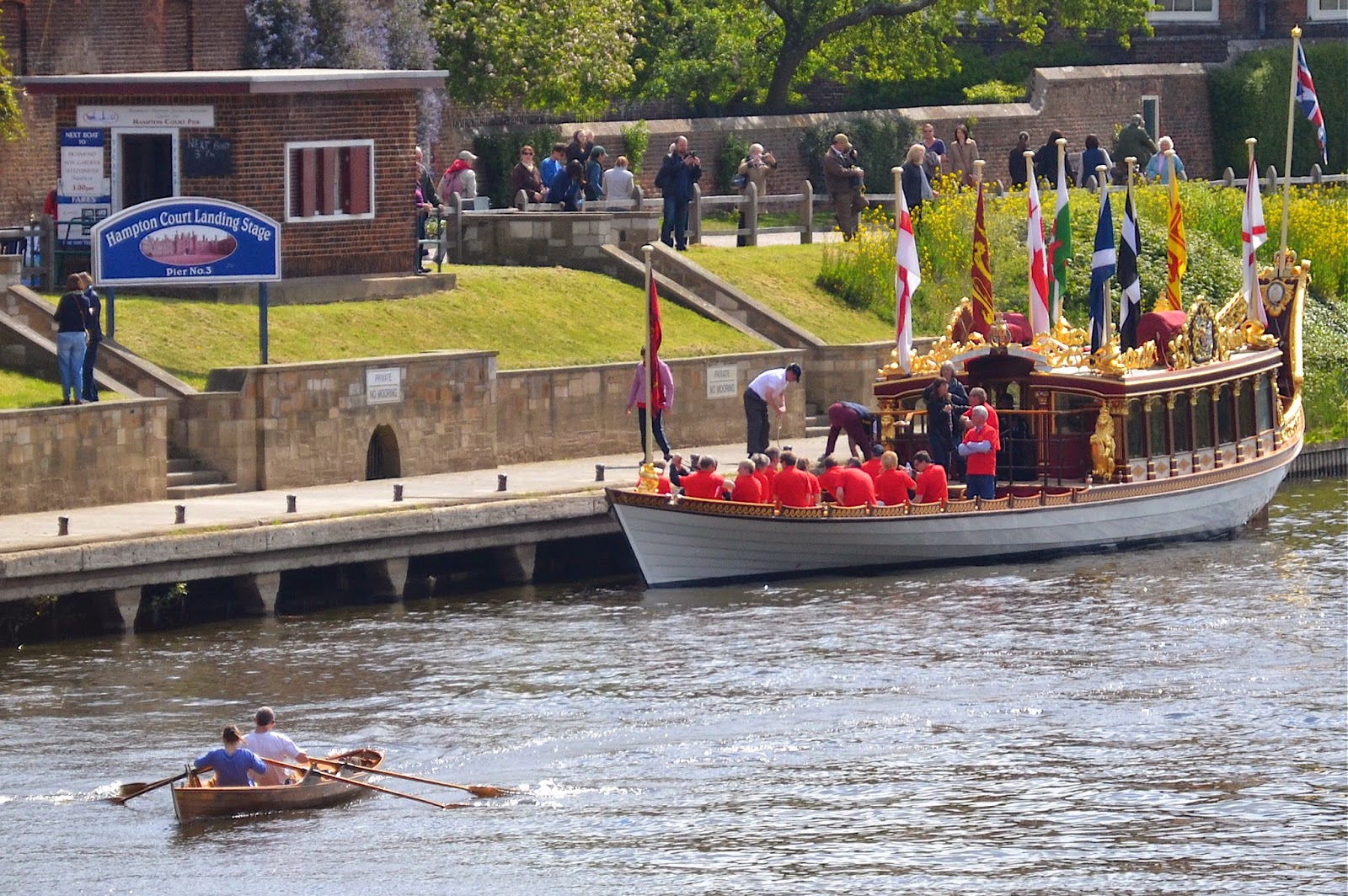
Gloriana was not the only thing on the water at Hampton Court. These boats were from the nearby Kingston RC. Molesey BC is nearer to the Palace but its boats tend to stay upriver of this point on the other side of Molesey Lock.

The skiff is probably from Dittons Skiff and Punting Club based a little way downriver.

As an aside, most people tend to think of the Royal Family as the epitome of Britishness or Englishness. However, from 1714 to 1901, they were Hanoverians from the House of Brunswick and Lüneburg and, through Queen Victoria’s husband, were members of the House of Saxe-Coburg and Gotha, a branch of the House of Wettin, from 1901 to 1917. In the First World War the obvious German ancestry was a bit embarrassing and the totally made up name of ‘Windsor’ was adopted. On hearing this, it is alleged that the German Emperor said that he would like to see the Shakespeare play, ‘The Merry Wives of Saxe-Coburg-Gotha’. In more recent times, Queen Elizabeth’s husband, Prince Philip, is popularly supposed to be Greek/Danish, but he is a member of the House of Schleswig-Holstein-Sonderburg-Glücksburg. When the then Lady Diana Spencer married Queen Elizabeth’s son, Prince Charles, it was noted that she was far more British or English than he was. It could be argued that the Royals are as British as lederhosen made from bratwurst.

Strangely, when looking at the legacy of George I, most historians seem to concentrate on such things as Parliamentary Democracy and Cabinet Government or the forging of an anti-Spanish alliance and ignore his contribution to rowing, albeit a rather indirect one. In 1714, Thomas Doggett instituted a race with a prize of a coat and a silver badge to be rowed annually by six watermen within a year of completing their apprenticeships ...all which I would have to be continued yearly forever in Commemoration of His Majesty King George’s happy Accession to the British Throne...

George distrusted the conservative Tory Party and so the liberal Whig Party prospered under his rule and also for many years after. As a staunch Whig, Doggett was passionately devoted to the Hanoverians and laid down that the race was to be held each ‘1st day of August forever’ to commemorate the accession of George I on 1st August 1714, and had the 'running' White Horse, the symbol of the House of Hanover, embossed on the silver badge. Three hundred years later, the ‘Doggett’s Coat and Badge’ continues to be raced and the White Horse still adorns ‘The Badge’.

The 1982 Doggett’s winner, Gary Anness, at the 2013 Coat and Badge Race, showing the silver badge with the White Horse of Hanover commemorating the ‘happy accession’ of George I.

Malcolm Knight, the Events Manager for Gloriana, has more space than the average coxswain, but still uses a ‘cox box’ to give instructions to the eighteen rowers. As there is also a steersman in the stern, it could be said that there are two coxes on board – a rower’s nightmare.

Gloriana heads for home.

Photography © Tim Koch

Wednesday, August 21, 2013

A Royal Tea Cruise

Gloriana flies the Royal Standard on the bow indicating that the Queen is on board. Photo © Sue Milton.

The tireless Malcolm Knight, a great promoter of traditional rowing, reports on a special event that took place on the River Thames on a hot day last July. HTBS has previously written about Malcolm in our report on the Tudor Pull.

Malcolm writes,

After six months, the plans were finally in place for the most important event so far in the life of the Queen’s Row Barge Gloriana.

The Royal Watermen who rowed wearing their heavy woolen costumes on one of the hottest days of the year.

On 9 July, Her Majesty Queen Elizabeth II in the company of the Duke and Duchess of Wessex, the Duke of York, the Duke and Duchess of Gloucester and the Duke of Kent boarded QRB Gloriana at Albert Bridge, Home Park, Windsor, to be rowed by eighteen of the Royal Watermen under the helm of HM Barge Master Paul Ludwig for an afternoon tea cruise to celebrate the 60 years since her Coronation.

The Queen’s Barge Master, Paul Ludwig, and Malcolm Knight.

The Countess of Wessex chats to the Watermen. Sir Steve Redgrave, on the right, looks on.

The flotilla of four invited craft, under the control of Malcolm Knight aboard the Gentleman’s launch Verity, moved off upstream to the surprise and delight of other boats on the river. The QRB went up the weir stream to Eton College where invited members of staff and their families cheered the spectacle.

Malcolm Knight meets The Queen. On the right is Lord Sterling, the man who initiated the Gloriana project as a tribute to the Queen on Her Diamond Jubilee. He also provided much of the finance.

Whilst the Watermen took a well-earned breather, tea was provided to the Royal guests by the Waterside Inn after which the QRB turned and returned downstream to moor below Victoria Bridge where the Royal party went ashore.

The Queen and the Royal Party on the deck of the Gloriana. On the left is the Duke of Kent, a cousin of the Queen. Next to him is Brigitte, the Danish-born Duchess of Gloucester. To her left is Prince Edward, Earl of Wessex, the Queen’s forth child. In the centre, Queen Elizabeth and a Waterman acting as coxswain. On the right of the group is Prince Richard, Duke of Gloucester, also a cousin of the Queen. Behind Richard, but obscured by a flag, is Prince Andrew, Duke of York, the Queen’s third child. His other rowing engagement this year in Vancouver, Canada, was also covered by HTBS. On the far right is Sophie, Countess of Wessex, the wife of Prince Edward.

The Queen thanks her Watermen at the end of her day on the river. The Earl of Wessex and the Duke of York followed on behind.

A ‘little piece of history’ was made as it is believed that this was the first time in nearly 200 years that a reigning monarch had been rowed in an 18-oared Royal barge by the Royal Watermen – a memorable day for all of us involved and one that has confirmed Gloriana as The Queen’s Row Barge.

Monday, May 6, 2013

Oars Of The Roses: The Tudor Pull

Tim Koch reports from London,

The British are very fond of their ceremonial and welcome any excuse to don knee britches, big shirts and strange hats. If this can be combined with rowing and ancient and obscure institutions of state and trade, so much the better. The ‘Tudor Pull’ is just such an occasion. This event involves getting a piece of medieval water pipe (the ‘Stela’) from Hampton Court (Henry VIII’s Palace of 1514) twenty-five miles downriver to the Tower of London, a building nearly five hundred years older. This year the archaic bit of plumbing was carried on the magnificent Royal Barge Gloriana, rowed by eighteen Queens Watermen and escorted by twenty three shallops and cutters, many from Livery Companies of the City of London. Other river craft such as skiffs and gigs also joined in.

Now, you may be asking, ‘Why?’ Our friend Chris Partridge at ‘Rowing For Pleasure’ has one theory involving the Duke of Edinburgh. Another suggestion that it (somehow) commemorates the sinking of Queen Eleanor’s royal barge under London Bridge in 1256. The modern idea behind the Pull is that the present organisers, The Thames Traditional Rowing Association, use it ‘to support and promote the sport of fixed seat rowing and sculling on the River Thames in Waterman’s Cutters’. The event is also supported by ‘Thames Alive’, an organisation which ‘celebrates and promotes’ the river and events held on it. Whatever the reason for it, this unlikely story is perhaps best told in pictures.

This photograph was actually taken at the end of the day at Tower Bridge but it clearly shows the Stela in its glass case. It is held by Paul Ludwig, the Queen’s Bargemaster, who commands the twenty-four Royal Watermen. The gentleman on the right is John Redmond, the Master of the Company of Watermen and Lightermen.

Hampton Court: On the left is a procession from the Palace bringing the Stela to the Queen’s Bargemaster, the Queen’s Watermen and representatives of the Watermen’s Company, all on the right.

The two Queen’s Watermen on the left are wearing a modern, lightweight version of their traditional heavy woolen costume, something which is much more comfortable to row twenty-five miles in. The gentleman on the right is the Beadle of the Waterman’s Company. The office of beadle is a very old one, he is an official of an organisation who assists in its running in various ways and may also be charged with keeping order. The most famous holder of such an office is Mr. Bumble, the workhouse beadle in ‘Oliver Twist’ (thankfully the Waterman’s Beadle is much more generous than the Dickens’s character). A 1708 description of his duties is here.

The Gloriana is followed by the Royal Shallop Jubilant. Bob Crouch, a Doggett’s winner, past master of the Watermen’s Company and past Queen’s Bargemaster writes about shallops on the Jubilant Trust website.

The oarsman on Gloriana’s port side here is Bob Prentice, a Doggett’s Coat and Badge winner who HTBS has written about before.

The Worshipful Company of Founder’s cutter at Richmond. The 32-foot, fixed-seat Thames cutters are normally rowed by six people but, for events such as the Tudor Pull, two rowing positions are replaced with passenger seating and a canopy. Flags and sometimes sideboards are also mounted.

The flotilla passes Brentford. Having gone past Richmond it is now on the tidal Thames.

A cutter from the Royal Naval Reserve shore establishment, HMS President. It is the only boat in the flotilla that is entitled to fly the ‘White Ensign’ of the Royal Navy. Six naval ratings provide the power, a Lieutenant does the steering and a Commander and a dog provide the dead-weight. The canine is part of a theme of ‘dogs in boats’ on HTBS. This is from June 2012 and this is from March 2013.

Passing St Mary’s Church, Battersea. The present building dates from 1777 but there has been a church on this site for 1200 years. Here William Blake was married and Benedict Arnold is buried. The shallop (Royal Thamesis) belongs to the Worshipful Company of Drapers. Read about its history here. Despite its light blue and gold colouring and flag bearing three crowns it has no connections with Sweden.

The cutter of the Worshipful Company of Scientific Instrument Makers passes the Buddhist ‘Peace Pagoda’ in Battersea Park.

The flotilla reaches the Albert Embankment and the Headquarters of the Secret Intelligence Service (better known as MI6), the British equivalent of the American CIA. MI6’s most famous operative, James Bond, is a Commander in the Royal Naval Reserve – so the Commander in the Royal Navy cutter on the left may be more than he seems... The cutter on the right belongs to the Worshipful Company of Barbers.

The Tudor Pull reaches the end of its journey at Tower Bridge. It is a common misconception that this structure is ‘London Bridge’ and there is a popular myth that when a gentleman from Arizona bought the 1831 London Bridge in 1967, he thought that this was what he was getting.

The Tower of London. On the right is the Resident Governor of The Tower and Keeper of the Jewel House, Colonel Richard Harrold, and one of his ‘Yeoman Warders’. The latter are commonly known as ‘Beefeaters’ but officially are ‘Yeomen Warders of Her Majesty’s Royal Palace and Fortress the Tower of London, and Members of the Sovereign’s Body Guard of the Yeoman Guard Extraordinary’. Governor Harrold is presented with the Stela by Paul Ludwig in his capacity as Queen’s Bargemaster.

My thanks to the man behind this event, Malcolm Knight, the tireless Secretary of the Thames Traditional Rowing Association and a Director of Thames Alive. A retired Metropolitan Police Sergeant (specialising in riot training and self-defence) Malcolm has five world records for distance rowing and now gets paid to mess about in boats with Marine Film Services, a company that provides ‘all things boaty’ for the film and TV industry. Malcolm is evangelical about the Thames and traditional rowing and has also been heavily involved in organising things such as the Lord Mayor’s Show Flotilla (the first in 156 years), the Thames part of the Olympic Torch Relay and the manpowered section of the Queen’s Diamond Jubilee Pageant.

© Photographs Tim Koch 

Saturday, July 28, 2012

London Is Ready

Gloriana passes under Kingston Bridge.

HTBS's Tim Koch reports from London:

It takes a great politician to unite a country and in the last couple of days Mitt Romney has achieved just that. Unfortunately, the country in question is Britain and he has united it against himself.  Romney questioned if the British people were truly behind the Games and went onto say ‘…. it’s hard to know just how well it will turn out’. When a right wing British tabloid  criticises a Republican, he should be worried. Further, someone on Twitter pointed out that it was a new experience for Mitt to be booed by rich white people.

In the wake of Gloriana.

The Brits like to complain (except in restaurants) and the run up to the Olympics has given them plenty of material. But the problems that give rise to often justified complaints are not unique to the London Games, they are inevitable in an event where 26 world championships have to be organised to take place at the same time by people who have never done it before in venues that usually have to be especially built. Rowing should have caused the organisers fewer problems than most sports. Dorney Lake was virtually ready the day it was announced that London was to host the 2012 Olympics. ‘Legacy’, the buzz word of the modern Games, is assured as the course is owned by, and built for, Eton College (who also allow other schools, colleges and clubs to train and race there).

Kingston Grammer School.

As the Olympics have got nearer the British national sport of complaining has decreased and another national pastime, that of uniting to celebrate a national event, has increased. The support for the 70 day Olympic Flame Relay has been tremendous with 13 million people lining the route, the  Flame passing within ten miles of everyone in the country. HTBS has already reported from the Henley stage and on Friday the 27 July, the final day of the relay, it was rowing that had the honour of carrying the flame to the end of its nationwide journey.

The Bobby and the bunting. There is a lot of both in London at present.

Starting at Hampton Court Palace, the Flame was transferred to a cauldron on the bow of the Gloriana. With a crew including Matthew Pinsent, James Cracknell and Jonny Searle the rowbarge made its way to Tower Bridge in the centre of London, escorted by a flotilla of boats, mostly powered by oars. HTBS pictured the action at Kingston on Thames, a couple of hours into the final journey. The Flame was then taken to the Olympic Stadium for the Opening Ceremony, where the Olympic Cauldron was lit and stayed alight until it extinguished on the final day of the Games.

The Flame. Gloriana’s engine was used for part of the journey.

The rowing runs from Friday 28 July to Saturday 4 August with the finals held on Wednesday 1 to Saturday 4. The timetable is here.

London is ready, Eton Dorney is ready, the Brits are ready and everyone is welcome to the party (even Mitt).

 The Floatilla

Tower Bridge Olympic Rings.

Wednesday, July 4, 2012

Gloriana's Outing At 2012 HRR


HTBS’s Hélène Rémond was lucky to be invited on board the press launch during the Gloriana’s outing on the regatta course at the Henley Royal Regatta. Hélène writes,

At 11 a.m. on Sunday, 1 July, the day of the Finals at the Henley Royal Regatta, 18 former Olympians representing Great Britain between 1948 and 2008 rowed the royal barge the Gloriana, which was the lead vessel at the Diamond Jubilee Pageant last month, past the regatta’s spectators. They were a great attraction on the river. A few members of the press have been invited to follow the row-past, being a good film and photo opportunity. My film and photographs can be seen above and below.

In the Gloriana Olympic crew were :

Louis Attrill who attended the 2000 Olympic Games in Sydney
Chris Baillieu, 1976 Montreal and 1980 Moscow
Bill Barry, 1964 Tokyo
Guin Batten, 1996 Atlanta and 2000 Sidney
Paul Bircher, 1948 London
Catherine Bishop, 1996 Atlanta, 2000 Sidney, 2004 Athens
Ed Coode, 2000 Sydney, 2004 Athens
Tim Crooks, 1972 Munich, 1976 Montreal
Simon Dennis, 2000 Sydney
Rowley Douglas, 2000 Sydney
Adrian Ellison, 1984 Los Angeles, 1992 Barcelona
Mike Hart, 1972 Munich, 1976 Montreal
Ben Hunt Davis, 1992 Barcelona, 1996 Atlanta, 2000 Sydney,
Mike Lapage, 1948 London
Gillian Lindsay, 1992 Barcelona, 2000 Sydney
Alison Mowbray, 2000 Sydney, 2004 Athens
Fred Scarlet, 2000 Sydney
Jonny Searle, 1992, Barcelona, 1996 Atlanta
Elise Sherwell, 2000 Sydney, 2004 Athens, 2008 Beijing
Steve Trapmore, 2000 Sydney
Kieran West, 2000 Sydney, 2004 Athens
Sarah Winckless, 2000 Sydney, 2004 Athens, 2008 Beijing

And then some still photographs from the event:


(Photograph & copyright: Hélène Rémond)

Glorious Gloriana

The silver and the grey. Former Olympians sit behind the Henley Trophies.

HTBS’s Tim Koch saw the marvellous barge Gloriana at Henley Royal Regatta. Tim writes,

HTBS has previously reported on the Gloriana, the 18-oared, 88 foot / 27 metre ‘rowbarge’  produced for the Queen’s Diamond Jubilee Celebrations. While it looks magnificent from a distance, it is only close up that one can fully appreciate how it cost £500 000 / $785 000 and why £4000 / $6300 was spent on gold leaf. At this year’s Henley Royal Regatta, the Gloriana was moored at the pontoon and boat tent area for everyone to see.

On the day of the finals it was rowed over the course by 18 British rowing Olympians dating from the 1948 to the 2008 Games. They were part of a remarkable gathering of 170 men and women who have rowed for Britain in past Olympic Regattas. Their number included Paul Bircher and Michael Lapage from the 1948 GB Eight. At the prize giving ceremony this exclusive group sat behind the trophies, adding even more lustre to the occasion.

Lord Stirling, who underwrote the cost of the Gloriana project, has said that the craft will be around for ‘a couple of hundred years’. See it in close up and you can only agree.

Gloriana moored by the boat tent area at Henley.

 Gloriana oars

Gloriana Royal Arms

Gloriana Rudder

Gloriana seat

Gloriana stern

 Gloriana window

Gloriana Jack Staff

(Photograph & copyright: Tim Koch)