Photograph: Werner Schmidt
Showing posts with label Cambridge University Women’s BC. Show all posts

Tuesday, April 1, 2014

Putting It On The Tab: Credit To Oxford Women

Henley’s most famous woman, a marble nymph, observes the Henley Boat Races from under her cupola on Temple Island.

Tim Koch reports from the Oxford - Cambridge ‘Henley Boat Races’.

When most people talk of THE Oxford - Cambridge Boat Race, they are usually referring to the event first rowed in 1829 and which nowadays is the race between the top heavyweight men of Oxford University Boat Club and of Cambridge University Boat Club over the 4 1/4 mile Putney to Mortlake Course on the Thames in London. However it is (arguably) correct to say that today there are in fact nine Oxford - Cambridge Boat Races.

The second race started in 1965, 136 years after the first, when the men’s heavyweight reserves (Isis/Oxford and Goldie/Cambridge) raced each other over the Tideway Course, shortly before the main event.

The only other Dark Blue - Light Blue clash on the Tideway is the Veterans’ Race which is run over a shortened course, Putney to Hammersmith on a day in the week before the main race. It is the ‘least serious’ of the nine races with victory usually going to whoever managed to organise a few practice rows beforehand. It is also an historic parade of past sponsors’ kit (much of which seems to have shrunk over the years).

The other six races have been held at Henley and the ‘2014 Henley Boat Races’ took place on Sunday 30 March. The main event was the (heavyweight) Women’s Boat Race. The others were the heavyweight Women’s Reserves (Osiris/Oxford - Blondie/Cambridge), the Lightweight Women and the Lightweight Men. There were also the two newest races involving the men and the women who are the current holders of the Headship of the Lent bumping races in Cambridge and of the Torpids bumping races in Oxford. A nice video promo for the Women’s Boat Race is on YouTube:


(It could be argued, though not by me, that there are really ten events if you include the Oxford - Cambridge Goat Race.)

Cambridge supporters decorated Henley Bridge with ‘inspirational’ banners. Tamesis looks as though he has seen it all before.

As someone who was supposed to be covering these races for HTBS, I was a bit of a failure. I missed the first race, Osiris v Blondie, while I was sorting out camera trouble. The other races proved difficult to follow due to the density of the crowds lining the course which started at Phyllis Court, near the Royal Regatta finish, and ran 2,000 metres to half way along Temple Island, near the HRR start. It was unfortunate that, as the crews had to pass on the Bucks side of the Island, the finish was out of sight of all but a privileged few. I would have though it better to run a slightly shorter course and finish in sight of the spectators. However, full marks to sponsors Newton for generating enough excitement to draw such a large crowd (aided by the exceptionally warm weather). The ‘unique selling point’ of the 2014 Henley Boat Races was that this was the last year that the heavyweight women would race there, as they will be joining the men on the Tideway in 2015. This has got some interest from the non-rowing press and one of the better resulting articles is in the Telegraph.

Young spectator Jess shows her support.

Luckily, more talented people than I managed to see what was happening and links to their work are below. Also included are YouTube links to excellent coverage of the Women’s Boat Race and the Osiris - Blondie Race. In summery, the results were as follows:

Heavyweight Women - Oxford 4 lengths, 5 minutes and 50 seconds.
Reserve Heavyweight Women - Oxford 1/2 a length, 6 minutes and 1.5 seconds.
Lightweight Women - Oxford 3 1/2 lengths, 6 minutes and 8 seconds.
Lightweight Men - Cambridge 3 1/2 lengths, 5 minutes and 30 seconds.
Intercollegiate Men - Downing College, Cambridge.
Intercollegiate Women - Wadham College, Oxford.

In the absence of real words, I hope that my pictures paint a thousand of them.

Blondie return from their defeat by Osiris. I presume that ‘four’ had an oar during the race.

The start of the Women’s Lightweight Race. Cambridge were up at the start but it was not to last.

Men’s Lightweights: Beginning.

Men’s Lightweights: Middle.

Men’s Lightweights: End.

The Newton Women’s Boat Race: Oxford approach the (hidden) finish half way down Temple Island. Their four length lead meant that I could not get both crews in the same picture!

The Newton Women’s Boat Race: Cambridge follow in the Dark Blue wake to the finish.

Returning from the finish, Oxford, winners of the Women’s Boat Race, pause for a photo opportunity by the Temple.

The defeated Cambridge crew return to the boathouse.

The prizes were presented by Olympic Gold Medalist, Sophie Hosking (right). Here, Oxford University Women’s Lightweights receive their prize.

The Cambridge Lightweight Men salvage some honour for the Light Blues.

Osiris add to Oxford’s silverware collection.

A jubilant Oxford plus coach Christine Wilson (with trophy) do not have to try too hard to smile for the cameras.

Oxford shake it up. Please note, with the exception of when you have won a major sporting event, the removal of a Champagne cork should only produce a noise described by my grandfather as ‘'a maiden’s sigh'’ (not these maidens, obviously).

Teamwork. OUWBC President Maxie Scheske, reluctant to let go of the trophy in her left hand, gets some assistance to lift what may have been the first of many bottles of Champagne.

If you take two small people, get them very excited, fill them with Champagne and throw them in the river, this is what you get. Osiris cox Olivia Cleary, left, and OUWBC cox Erin Wysocki Jones, right, huddle together for warmth.

Rachel Quarrell’s report for the Telegraph is here. She concludes:

The job now for both women’s clubs is to raise their standard again before next year, when their race will join the men’s on the Tideway over a full 4.25 miles. The distance itself is not a problem for women, but spectators, sponsors Newton and the BBC, who have just signed a new deal to televise the races until 2021, will all be hoping for a contest which lasts considerably longer in what is likely to be a 19 - 20 minute event.

Rachel’s pre-race report is also online. The Boat Race website has its official report and nice videos of both of the Newton sponsored races are here for Oxford - Cambridge and here for Osiris - Blondie.

The flag is lowered to half-mast for Cambridge Women’s rowing? Well, no, but it must feel like it for them.

On the same day, Sunday 30th March, the Veterans’ (Masters’) Head of the River Race took place on the Tideway. Following the abandonment of the (younger men’s) Head the previous day due to a number of ‘sinkings’, there was obviously much concern about an event for perhaps less resilient participants. In the end, the event managed to run from start to finish and without major incident. However, I received this from a participant:

The tide turned late (as expected) so lots of people didn’t know where they should be, so marshalling was chaos – the river between the Black Buoy and the Crabtree was jammed solid with boats. Then the flood tide heavily favoured the crews at the back – the provisional results are hilarious 4 out of the top 50 start crews finished in the top 50 (Monmouth who had start number 21 and finished first actually started in position 209). We had a great row though and it was lovely weather so all good fun!

To be fair to the organisers, they say:

This year’s overall Vets Head results were severely impacted by the effects of the tide. We realised several weeks before the event that the scheduled start time was too early and that the low tide was going to be later than we originally calculated. After discussions with the Port of London Authority over the river closure, they insisted that the original Notice To Mariners could not be changed. We shifted the start to be as late as that window allowed. Additionally, after the cancellation of yesterday’s HoRR, we could not risk the safety of our competitors and officials by holding marshalling crews any longer before we actually started the race. The end result is that the later you started the more assistance you got from a very strong flood tide.

They should have held it in Henley!

Tuesday, March 11, 2014

Battles with the Blues

Tim Koch writes:

The Oxford and Cambridge Tideway fixture season is in full swing with the men’s and women’s Blue Boats taking on various challengers over the Thames Championship Course. Unfortunately, I have not been able to post coverage of these as soon as I would have wished (this is due to my employers expecting me to do what they pay me for, a sad state of affairs). I have previously reported on the races between Oxford and Molesey women on 1 March and now, a little late, can bring you coverage of the Cambridge and Thames women’s races of 2 March and, from the men, the Oxford v German Under-23s clash held on 8 March

(Click on the pictures to enlarge them.)

2 March: Cambridge women passing the Mile Post, the monument to the great Cambridge coach, Steve Fairbairn. The Highland Cow in the left middle ground must be lost.

Tony Reynolds (Regional Rowing Safety Adviser), Ann-Louise Morgan (Race Director) and Judith Packer (Umpire) survey the presently unpredictable Thames.

CUWBC and Thames RC did two races, both between the Boat Race start (above Putney Bridge) and Hammersmith Bridge, about forty per cent of the full course. The first piece was a walkover for Cambridge who went off strong, immediately went in front, were a length up before the end of Putney Embankment and continued to extend their lead to the finish.

Thames in an embarrassing position in front of their club house.

Passing Harrods and approaching the finish at Hammersmith Bridge.

Rob Baker, CUWBC Chief Coach.

The second piece was a very different race. Both crews went off well and were initially level. By the time they approached the football ground, Cambridge were a couple of seats up but it was still anyone’s race. As the bend worked in favour of Thames (on Middlesex), they drew level and were for a brief time in the lead. Excitement was added when both boats moved together, which produced the threat of a clash, and by the water being very rough, it became a real test of boatmanship. Ultimately however, Cambridge showed their class and moved ahead and away from their opposition.

D-R-A-W! Cambridge on their first stroke.

Cambridge go up.

Thames go up.

Cambridge pull away.

The 8 March saw a German Under-23 crew take on OUBC. While the Germans were big lads with international experience, it was a lot to ask them to take on a crew like Oxford, particularly with three Olympic medalists (Malcolm Howard, Constantine Louloudis and Storm Uru) on board.

Oxford. Bow: Storm Uru, 2: Chris Fairweather, 3: Karl Hudspith, 4: Tom Swartz, 5: Malcolm Howard, 6: Michael DiSanto, 7: Sam O’Connor, Stroke: Constantine Louloudis, Cox: Laurence Harvey.

Germany, Under-23 and Under Pressure. Bow: Jonas Wiesen, 2: Finn Knuppel, 3: Malte Daberkow, 4: Maximilian Korge, 5: Johannes Weissenfeld, 6: Arne Schwiethal, 7: Ole Schwiethal, Stroke: Eike Kutzki, Cox: Torben Johannesen.

Oxford will be using the same boat that they used last year, the Empacher Acer, named after the late Acer Nethrcott.

The press launch was full but I was lucky enough to get a seat in the umpire’s launch. In the stern was, on the left, Peter McConnell, Boat Race Archivist and the man who writes the excellent race reports that appear on the Boat Race website and, on the right, Liz Box of the Boat Race Company. Among many other things, Liz Tweets the progress of the races for @theboatrace. She is well qualified to do this as she coxed Goldie in 2010 and CUBC in 2011.

The first piece was from the Boat Race start to Chiswick Steps. Underrating the visitors for most of the way, a composed Oxford led a rushed-looking German crew by half a length by the end of Putney Embankment. By Barn Elms the lead was over a length and this continued to grow in the approach to Hammersmith Bridge. The pictures tell the story.

Germany (left) and Oxford (right) at the end of Putney Embankment. Umpire Phelps was kept busy.

Both crews went wide at Hammersmith Bridge as they had just taken avoiding action around another boat.

Germany trails Oxford near the finish above Chiswick Eyot.

The second piece from below the Chiswick crossing to the Boat Race finish was more exciting, the Germans having a length start. Peter McConnell’s report on the Boat Race website captures it succinctly:

Oxford got off slightly quicker, pulling back half of the German advantage within the first 30 strokes. The Germans were tenacious on this occasion though, keeping the rate at 37 and with the advantage of the Surrey bend made a competitive race of it. However Oxford’s cohesion and power saw them creep back onto terms, man by man. At Barnes Bridge the lead was down to a canvas, then at the apex of the bend Oxford accelerated, going the long way round with a decisive move seeing them take a length out of the Germans in 20 strokes. Soon there was clear water with Oxford’s lead increasing with every stroke to 4 lengths at the finish.

The beginning of the second piece with Germany having a one-boat length start.

Approaching Barnes Bridge, Oxford creeping back.

At the finish, a four-length lead to Oxford. Legendary Oxford coach Dan Topolski (right) looks on.

Oxford rehydrate by The Bandstand on Duke’s Meadows.

A full timetable of all of the fixtures for the Men and the Women is here. The Newton Women’s Boat Race takes place on 30 March and The BNY Mellon Boat Race on 6 April.

Tuesday, February 18, 2014

The Glittering Prize

Esther Momcilovic (President, CUWBC) and Maxie Scheske (President, OUWBC) with the trophy that each hope to hold aloft on 30 March.

Tim Koch writes:

As a postscript to yesterday’s post on the new trophy commissioned by sponsor Newton Investment Management for the Oxford-Cambridge Women’s Boat Race, I can report that yesterday morning it was officially unveiled and presented to both Boat Clubs and to the Boat Race Company.

A press release informs us:

The trophy is four sided and handmade in silver, each side the shape of a blade’s spoon with chased embossed patterns of flowing water. Imposed on each spoon is the bow of a boat cutting through the water. The main body is supported by four ebony columns representing the looms of four blades. Several of the chased details on the trophy are inlaid with pure gold. The base has four sides. Two of the sides represent the Clubs with symbolism chosen by themselves, a lion for Cambridge and a crown for Oxford; while the other two sides are chased with apples balanced on a scale, these are representative of the sponsor’s involvement and their belief in balance, equality and diversity in sport. On the underside there is a silver plate with records of all previous winners dating back to 1927, and from this year the new winners will be engraved visibly on the top of the trophy. The trophy weighs 5.5kgs and measures 50cms high.


From left to right: Rod Kelly, the designer of the trophy and one of the UK’s leading silversmiths, Helena Morissey, CEO of Newton Investment Management and campaigner for gender equality in business, Richard Gillespie, Chairman of The Boat Race Company Ltd, and Chris Dodd, writer on rowing and historian at the River and Rowing Museum. Chris is accepting the former prize for the Women’s Boat Race, a wooden shield, on behalf of the museum. Helena Morissey said that the shield looked like it was purchased at a heel bar and I though it resembled something awarded to a pub darts team.

Designer Rod Kelly shows the underside of the trophy where the winners of all the races held between 1927 and 2013 are recorded.

While Newton must be thanked for making this fine piece of work possible, their real contribution since 2011 has been to invest in coaching and equipment for OUWBC and CUWBC, ultimately to prepare them for 2015 and beyond when they will race on the Tideway on ‘Boat Race Day’ proper. The real importance of the new trophy is that it compares equally with the prize for the men’s race. The picture below was taken in 2013 and shows the shield then awarded to the winner of the women's race next to the impressive trophy given to the men. The unavoidable implication was that the women’s contest was the poor relation of the two. The new trophy, however, sends out a very different message.

March 2013: article writer Tim puts on his ‘unimpressed face’ when comparing the two prizes.

Monday, February 17, 2014

A Trophy Worthy of the Chase

Silversmith Rod Kelly has put in 520 hours of punch-and-hammer to create the new trophy for the Newton Oxford and Cambridge Women’s Boat Race.

Today, the new trophy for the Newton Women's Boat Race will be officially unveiled. Rowing historian and writer Christopher Dodd, who has interviewed Rod Kelly, the silversmith who made the trophy, writes exclusively for HTBS:

Newton, sponsor of the women’s Oxford and Cambridge Boat Race, has commissioned a trophy to mark the event’s move from the Thames at Henley to the men’s course at Putney in 2015. The trophy will be awarded to the winners of this year’s race on 30 March (at Henley, but floods suggest it may move to Dorney or Holme Pierrepont). The pot will have winners since 1927 engraved on its plinth and will make the symbolic journey from the non-tidal 2,000 metres to four and a quarter miles on the Tideway.

Two things stand out about the new trophy. First, this is no requisitioned silverware from a long lost event, nor an off-the-shelf pot with the Newton Boat Race engraved on it. This is a serious and imaginative piece of kit. Newton commissioned it from the silversmith Rod Kelly, and it was crafted to his design in his Shetland studio.


The second standout is that Newton has safeguarded a long life for the trophy by ruling out the inclusion of the company’s name. ‘This is about the girls who race, not about Newton’, Claire Blackwell, the head of marketing at the investment house, says. ‘Our raison d’être is equality, diversity and balance.’ Kelly describes this as a brave decision. It is such a relief not to be briefed that a client’s name must be in a certain size in the front, he says.

The men’s race has had three trophies so far, the first from Ladbroke, the second from Beefeater and the third from Aberdeen Asset Management, the latter being the handsome quaich (or Scottish drinking vessel) used by the current sponsors BNY Mellon. Whoever sponsors the women’s race after Newton will not be embarrassed by a piece with somebody else’s name on it.

Kelly, who has an impressive list of past clients and whose work appears in prestigeous museums, was born in Reading and remembers Boat Race Day as a big occasion for his family. He studied in Birmingham and at the Royal College of Art and now divides his time between Norfolk and Shetland.

His first meeting with Newton was on 13 August 2013. In October he spent a day with Cambridge’s women at Ely and took 200 pictures of patterns water, hulls, oars, movement and light on Ouse water. He came away intrigued by the mental approach to rowing as well as the physical attributes. Kelly likes to make pieces that tell a story, and he left Ely with a story. A story of application to the job in hand, the sculpting of water, blades, boats to represent the race and apples to represent balance and equity espoused by the sponsor.

After a meeting with Newton and both clubs to finalise the design, Kelly went off to Shetland (catching the Aberdeen universities boat race in transit) to begin the design process. He built a cardboard model of his concept that he amended gradually as it sat in his kitchen. He decided on a square shape and began to feel it – ‘You have to really feel it, that it will be recognised as the Newton Trophy’.

‘A square form catches the light and is very photogenic’, he says. There are waves and an oar blade depicted on each side, a lip on which to engrave future results, and the vase is mounted on four ebony pillars to represent oars. Two sides of the base have a ‘Newton’ image of two apples on a balance. The Oxford side has a crown and the Cambridge side a lion, both with pure gold inlaid details. Past results will be on a plinth below.


The model in the kitchen spoke and announced to Kelly that it should be increased in size by 25 per cent to stand 50 cm tall. This meant starting again, because enlargement requires adjusting the proportion of the parts rather than lumping a percentage on.

Once satisfied with the model, Kelly ordered the sheets of silver – 1.1 mm thick, and cutting by hand and chasing (embossing using small punches and hammer) began. Work progressed at an hour a square inch – for example, Cambridge’s lion took two days. There are about 100 soldered joints, and the ebony pillars were fashioned from blanks for snooker cues. 

The Newton trophy was finished on 1 February and taken to the Goldsmiths’ Company for hallmarking. Kelly has put in 520 hours of punch-and-hammer to create it, and very fine it is too. To put that in context, that represents about 1560 pulls from Putney to Mortlake in an eight.

The hope is that the women’s race becomes a contest worthy of its trophy from 2015 – that it doesn’t take a century and more to make a really good race of it, as the men’s did.

Friday, December 20, 2013

The 2013 Oxford - Cambridge Women’s Trial Eights: Races To The Finish

Maintaining form. Anastasia Chitty and OUWBC President Maxie Scheske, Stroke and 7 of Boudicca.

Here is Tim Koch’s report from Oxford and Cambridge Women’s Trial Eights which were rowed yesterday. Tim writes:

A small piece of history was made on Thursday, 19 December, when the Oxford and Cambridge Women’s Trial Eights were held over the full Tideway course for the first time. I was lucky enough to get a place in the press launch on a windless, mild and bright winter’s day with beguine river conditions. My only concern was that I would get bored after the first few minutes of each trial, fearing a five-minute race and a fifteen-minute procession. Be assured that this apprehension was not a result of any archaic ideas about women’s rowing, rather it was based on the fact that long running injustices can take a long time to put right.

In my report on the 2012 Henley Boat Races I referenced a piece written in the event programme by the rowing journalist and historian, Chris Dodd. To quote myself:

The men in (Chris’s) view, ‘struggled for 180 years to make a really good, nail biting contest of it for 4 miles and 374 yards’. He says that, until they received proper funding and professional coaching in the 1980s, the men were not fit enough to race the full distance. The result was a mad scramble to reach Hammersmith Bridge, by which point the winner usually emerged and the loser followed in their puddles in the long row to the finish. Chris says that this has now changed and that the Boat Race ‘has come of age as a superb event’.


‘Proper funding and professional coaching’ came to the Oxford and Cambridge Women last year, giving them two years preparation before they race on the Tideway in 2015. The question is, will this be enough time to produce crews that can make a race of it over the full distance? I am pleased to say that, judging by the four crews at Thursday’s Trials, the answer could well be ‘yes’. The Oxford race was particularly impressive, fought through to the last stroke. I do not envy the coach who has to choose a crew out of these two boats. Former BBC sports reporter Martin Gough @martingough22 said on Twitter:

Key question over Women’s Boat Race answered decisively. Can WBR be a contest over the full course? Both Trials lasted past Chiswick Steps – more than most men’s races until 15 or so years ago.

None of the four coxes who raced today, or the two who raced with the CUBC men the day before, were faultless. The Boat Race, more than any other, is a coxswain’s race and perfection is what is really required.

As I cannot better the excellent race reports published on the official Boat Race website, I am reproducing them verbatim below, interspersed with my photographs.

The Oxford Trial VIIIs

Cleopatra, with the experienced Harriet Keane rowing at 5, won the toss and chose the Surrey station, leaving Middlesex to Boudicca, with Oxford president Maxie Scheske in the 7 seat.

With three-times Boat Race winner Sarah Winckless taking charge in the umpire’s launch, the crews set off in perfect racing conditions, with Cleopatra rating 39 strokes a minute and Boudicca at 38.

Oxford off the start at Putney Pier. Cleopatra left and Boudicca right.

Past the boathouses Boudicca was already looking the more together crew, settling at 36 strokes a minute and leading Cleopatra by half a length. The women in Boudicca used the inside of the Middlesex bend to good advantage, increasing their lead to ¾ length before cox Erin Wysocki-Jones cut off the corner at Craven Cottage, and Cleopatra were able to get back in to the race.

Barn Elms
 

Harrods
 
Cleopatra, on Surrey, began to claw back the deficit, despite underrating the leaders, until they reached Hammersmith Bridge where the crews were level.

Hammersmith Bridge
 

St Pauls School
 
Despite steering wide, Boudicca held their ground, and the crews were still level as the race entered the rougher water off the top of Chiswick Eyot. With the race still level at Chiswick Steps, Cleopatra pushed on hard approaching the Crossing where they led by half a length, but Boudicca found a new rhythm and lengthened out their stroke, still at 30, to regain the lead approaching the bandstand.

Chiswick crossing

The Bull at Mortlake

There was a full boat length in Boudicca’s favour at Barnes Bridge where the leaders were able to sit up confidently and increase their lead, eventually crossing the line 3 lengths clear, to win a well-fought race.

 Barnes Bridge

 
 Approaching Mortlake Brewery

The finish
 
The Cambridge Trial VIIIs

The first Cambridge women’s crews to trial over the full Boat Race course were Nudge Nudge, coxed by their president, Esther Momcilovic, and Wink Wink, with double Blue Caroline Reid in the 5 seat.

Cambridge off the start. Wink Wink on the left, Nudge Nudge on the right.

Passing Thames RC

Nudge Nudge won the toss and chose the Middlesex station, setting off at 40 strokes a minute against Wink Wink at 41, but it was the Surrey crew who drew ahead past the boathouses, maintaining a high rate at 37 while Nudge Nudge had already settled at 35.

At Barn Elms

Approaching the Mile Post
 
Rowing in a solid style, Wink Wink increased their lead to 2/3 length at Barn Elms, rating 34 to Nudge Nudge at 32 but the Cambridge President steered a better line than the Oxford crew on Middlesex had done an hour earlier. Now it was Nudge Nudge who looked the more rhythmic crew, and past Harrods the crews were level once again.

Passing Harrods
 
With both crews rating 33 beneath Hammersmith Bridge Nudge Nudge now pushed on hard and gained half a length around the outside of the bend.

Hammersmith
 
They maintained the same margin to the top of Chiswick Eyot and then made the move that would determine the outcome of the race. Upping the rate a couple of pips they took a further half a length off the opposition in about ten strokes and past the Crossing they led by a full length.

Approaching Chiswick Crossing

Mortlake

Through Barnes Bridge
 
With both crews at 31 strokes a minute Nudge Nudge gradually extended their lead, but a spirited finish by Wink Wink closed the gap a little as the finish line approached.

Last few strokes
 
Nudge Nudge were declared the eventual winners by three lengths, rounding off a day of excellent racing which bodes well for The Newton Women’s Boat Race itself in just over three months’ time.

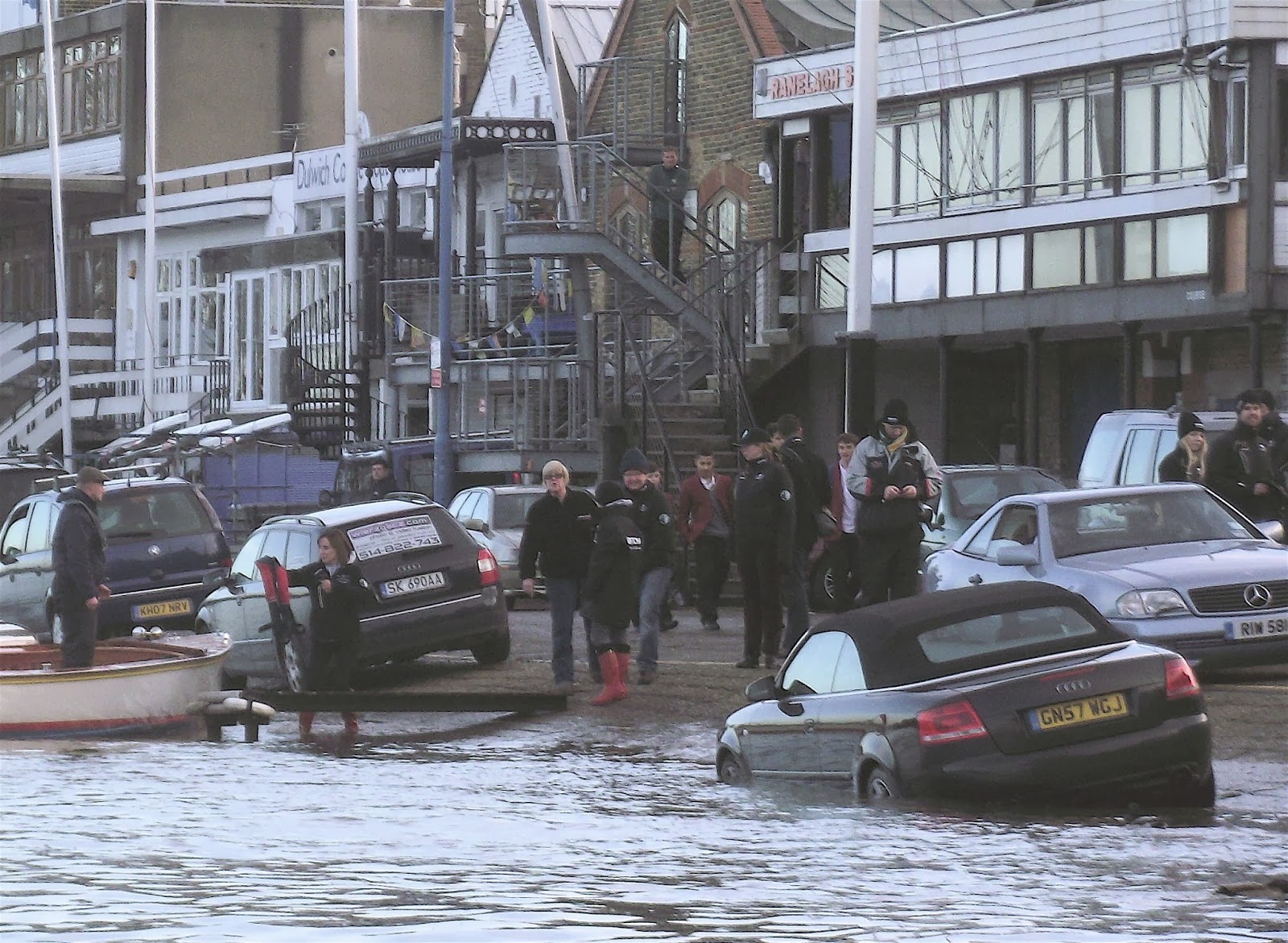
On returning to Putney we found one of the things that they don’t teach you at Cambridge – tides go out and tides come in.

Photographs © Tim Koch