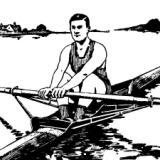
HTBS's Tim Koch did a little research on inrigger rowing in Britain. Here is Tim's report:
Following the recent item on inrigged coxed fours, on 27 November, some people may have the impression that inrigged rowing for pleasure and competition no longer exists. This is far from the case. In Britain, the Skiff Rowing Association, SRA, has existed since 1901 and is still going strong. The Thames Skiff is a round bottomed, fixed seat, clinker built boat with the blades held in place by wooden thole pins at the side of the craft. Singles and doubles are the most common though there is no reason why trebles and fours cannot be made. The SRA sets the rules of racing and runs three events - the Inter-Club competition held at Henley on Thames and the Singles and Doubles Marathons. All other events are organised by affiliated clubs or regattas.
 The affiliated clubs are:
The Skiff Club (1895)
Thames Valley Skiff Club
Wraysbury Skiff and Punting Club (1931)
Dittons Skiff and Punting Club
Wargrave Boating Club
Granta Skiff Club (Cambridge)
The affiliated regattas are:
Sunbury Amateur Regatta This has skiffing, punting, and dongolas (a punt paddled by a team of six people kneeling). It offers club and ‘local’ events and includes pub teams and a tug of war! It all ends with fireworks. Its website says: Away from river, the lawn provides a wide range of activities. From beer tents to Punch and Judy shows, there is something for every member of the family. Many community groups and charities have stalls on the lawn and Sunbury Regatta is a fundraising opportunity for many.
Chertsey Regatta was established in 1851 and so is one of the oldest rowing events still in existence. It offers punting and skiffing.
Hampton Court and Dittons Regatta started in 1881 as an ‘Aquatic Sport and Venetian Fete’. It has punting, skiffing, dongola and junior dingy races. Some early 20th Century film of the event is shown below (click on the black box!).
HAMPTON COURT REGATTA
The Wraysbury and Old Windsor Regatta and The Walton Reach Regatta are so traditional that they do not have websites!
Egham Regatta offers junior sculling, punting and skiffing events and so I think it is the only British regatta run under three codes – British Rowing, The Skiff Rowing association and The Thames Punting Club
Every year the Auriol Kensington Veterans’ Row to Henley passes through this delightful event (in a literal sense as we row over the race course in preference to going up the narrow temporary navigation channel) and I can vouch for the fact that Egham has a marvellous family atmosphere and is well supported by the local community.
A glance at the web-sites of these clubs and regattas quickly shows that they seem to have a good balance of fun and competition, something which is sometimes lost in normal 'outrigged' rowing clubs with their ergo tests and six day a week training.
 (On finishing this article it suddenly struck me that an item on active inrigged rowing in Britain should include the thriving Cornish Pilot Gig racing scene. However, I will be returning to my native Cornwall for Christmas so I will produce something in the new year – hopefully after some first hand research).