Photograph: Werner Schmidt
Showing posts with label Tom Sullivan. Show all posts

Friday, December 28, 2012

Rowing History Footnote: Towns Followed by Mishaps in London

George Towns

In April 1897, the 28-year-old professional sculler George Towns of Newcastle, New South Wales, Australia, who had learned to scull on the Hunter River, arrived to England. At the time, he was regarded as a ‘coming man’ and his financial backers back home in Newcastle had been eager to send him to England to be able to prove himself worthy to row for the World Professional Sculling Championships in a year or two.

Australian oarsmen had dominated the professional sport of sculling since August 1884, when William Beach beat the Canadian Ned Hanlan on the Parramatta River. But in September 1896, the World title went back to Canada when Jake Gaudaur of Ontario, defeated Jim Stanbury of New South Wales on the River Thames in London. In Australia, the hopes were set for Towns to reclaim the World title. In a race on 21 September, 1898, William ‘Bill’ Barry of Putney (Ernest Barry’s older brother) beat Towns on the Championship course between Putney and Mortlake for the Championship of England. Then, on 1 May, 1899, Towns beat Barry for the title, which should, if Towns and his backers played their cards right, open the doors for Towns to challenge Gaudaur for the World title.

 Jake Gauduar

However, Towns’s stay in England was followed by mishaps, the Australian newspaper The Star reported to its readers in an article published on 24 July (but dated 9 June), 1899. The paper’s correspondent wrote that Towns had been run into by an eight when he was training for his first meeting with Barry. Luckily, Towns only received minor injuries, though his boat got badly damaged. Then Towns had to pay foreit to William Haines of Old Winsor as the Australian was ill in influenza and could not race Haines. In another race Towns rowed into a big lump of wood which damaged his boat so he had to abandon the race (and by that losing money in stakes and bets).

In the beginning of June 1899, Towns could do with some extra cash. This was easily picked up by giving private lessons to amateur scullers who could pay his fees. One of these scullers was the young sculler Benjamin Hunting Howell (of New York, USA), who could do with some technical hints on a warm, nice day on the Thames. The article incorrectly mentioned him as a member of Trinity Hall, which he had rowed for between 1894 and 1898, but now rowed for Thames RC. The paper at least gave his championship titles correctly: ‘English amateur champion and holder of the Diamond Sculls.’

 Hunting Howell

Towns and Howell set off from the Leander boathouse in the afternoon, sculling up the river against the tide, rowing side by side, with Towns closes to the Surrey shore. At Barn Elms, a coxed four came down with the tide, and before anyone understood the dire situation, the four ran into Towns. The larger craft’s ironshod bow hit the Australian sculler in the back and missed his spine with a couple of inches, but broke two of his ribs. Towns fell overboard but managed, despite that he was half unconscious, to grab hold of an oar in the four. The oarsmen in the boat managed to pull him into their boat, while Hunting gave them order to row to Thames boathouse. We can only imagining what went through Howell’s mind at this point, as he had a scar on his right lower part of his leg to remind him about his own accident in October 1897. Then another sculler had rowed right into Howell, who had got the other sculler’s bow right through his calf of his right leg just below his knee.

After Towns received first aid at Thames RC, he was taken to the professional sculler Tom Sullivan’s house at Battersea to be examined by a doctor. Beyond the broken ribs, the part of the back where he was hit was bruised and swollen. The Star wrote: ‘The accident caused a tremendous sensation at Putney, where, by reason of his good nature and gentlemanly behaviour, Towns has become a great favourite amongst ‘wet-bobs’ of all classes.’ The author of the article goes on by speculating how this accident might effect Towns's future career. He even goes on saying that ‘it is quite possible that his career as a first-class sculler has closed.’

Luckily, Towns career as first-rate sculler did not come to an end that day in June. A year later, on 10 September, 1900, he defended his English championship title on the Championship course against his countryman J. Wray. The next year, on 7 September, 1901, Towns beat Gaudaur for the World championship title on Lake of the Woods, Canada.

Wednesday, October 5, 2011

The German Champion Herbert Buhtz

Herbert Buhtz and his “Master” Coach, Tom Sullivan.

Herbert Buhtz (1911-2006) was one of Germany’s best scullers in the beginning of the 1930s. He began to row as a teenager at Ruderclub Alt-Werder Magdeburg, the rowing club in his home town of Magdeburg. Buhtz was only 18-year-old when he and his partner in the double scull, Gerhard von Düsterlho, became the club’s first German Champions in 1929. They repeated their success the following year. In 1931, Buhtz began rowing for Berliner Ruder-Klub, which was coached by the New Zealander, Tom Sullivan, who took Buhtz under his wings. Buhtz became German Champion in the single scull that year.

In 1932, Sullivan sent Buhtz and his fellow club member Gerhard Bötzelen to race in the Diamond Challenge Sculls at the Henley Royal Regatta. The Diamonds final became an all-German affair when Buhtz easily beat his clubkameraden. Later that year, at the Olympic double sculls final in Long Beach, California, Buhtz and Bötzelen took a silver after having been in the lead up to 1,800 metres, when they were passed by the Americans Kenneth Myers and Garrett Gilmore. The latter had taken an Olympic silver medal in the single sculls in 1924.

Herbert Buhtz also won the Diamonds at Henley in July 1934, while the single scull European Championships title in August the same year was won by the German champion in the single scull, Gustav Schäfer. However, the following year, Buhtz became the German champion again.

When Coach Tom Sullivan left Berliner Ruder-Klub in October 1936 to move to Austria, Buhtz wrote a long celebratory article in the German rowing magazine, Wassersport:

“Although a German rowing club engages an Englishman [sic!] as trainer, this is in no way a matter of national feeling. The main point is what the teacher is capable of imparting and not what mother tongue he happens to have. […] Tom Sullivan was entirely worthy of the great confidence we had in him. Of the 490 victories won by Berliner Ruderklub Tom was responsible for 224 during the eleven years he supervised the training of the club. He was known as a master of the hard English school, of strict discipline and exact method of rowing. [- - -] His work and mature art convinced everyone. He was an Englishman with an international outlook and an honest admiration for the Germans, a fascinating personality whom young and old under his jurisdiction respected and whom oarsmen from all parts of Germany were attracted. [- - -]”
(From Hylton Cleaver: Sporting Rhapsody (1951), pp 48-49)

In a TV programme from 1989 about the Henley Royal Regatta, which I watched the other night (on a DVD), Herbert Buhtz was interviewed at Henley by the British TV crew. This German gentleman was utterly charming and praised the Henley spectators for their enthusiasm for the 1932 and 1934 Diamonds winner, although he was not an Englishman. (He elegantly steered away from the interviewer’s question about rowing for Nazi-Germany…)

After the Second World War, Buhtz was one of the old members that re-established the Berliner Ruder-Klub, and for a time also acted as coach at the club. He died in Berlin at the age of 95.

Thursday, July 22, 2010

The Mysterious Sculler

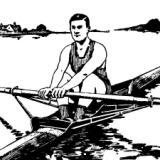
It is inevitable that when we talk about sport personalities, it is the great stars we mostly bring up, or those who maybe did not make it to the top, but there are some good stories to tell about them because they were real characters. In professional rowing we could for example mention the Biglins, Ned Hanlan, Charles Courtney, Ned Trickett, James Renforth, Harry Clasper, William Beach, Jim Stanbury, Richard Arnst, Ernest Berry, Ted Phelps, and Bobby Pearce. I am guessing that the sculler in the picture above probably would not make the list.

Like many of the professional English scullers, he was a Doggett’s Coat and Badge winner (in 1888), but with his 5 ft. 5 ½ in. and 9st. 5lb. he would not be regarded as one of the heavy boys. It is said that he made a name for himself in 1883, when he, at 16 years old, won the Chelsea Coat and Badge, and a year later, the Putney Coat and Badge. He raced against some, for us today almost unknown professional scullers, Tyrrell, Follett, and Norval. In a magazine from the mid-1890s it says, that “he pulls a beautiful even stroke, gets well over his sculls, while his leg-work is greatly admired.”

He trained the New Zealander Tom Sullivan when he had challenged George Bubear for the sculling championships of England, which Sullivan won in September 1893. Thereafter, he, himself, challenged Sullivan for the championship title. They sculled for the title in February 1895, and Sullivan lost the title to his trainer. In July 1896, he challenged the Australian Jim Stanbury for the Sculling World Championships, but Stanbury defended his title and won the wager of 200 pounds.

So, who was this mysterious sculler? Well, he was Charles R. ‘Wag’ Harding. I know very little about ‘Wag’, or why he was given this nickname. Michael Grace does mention him in the chapter on Tom Sullivan in his eminent book The Dolly Varden Legacy. (‘Wag’ Harding can also be seen in the photograph of the Doggett’s winner in my entry on 2 December 2009.)

Thursday, May 27, 2010

Wellington RC: The Dolly Varden Legacy

Today, I received an exciting e-mail from rower and rowing historian Michael Grace of New Zealand. He writes that at his club, Wellington RC’s 125th anniversary celebration on 15-16 May, Michael’s book, The Dolly Varden Legacy, on the club’s history was launched with great success. I had the pleasure to help Michael in September last year with some information and material I had on Tom Sullivan.

Tom Sullivan, who was a great professional sculler and later also a coach, was a member of Wellington RC, and of course there is a lot about Sullivan in Michael’s book.

Michael writes that, in early May, he met 80-year old Friedrich ‘Fritz’ Altenhuber, Hon. President of the First Viennese LIA Rowing Club. “Fritz used to be coached by Tom Sullivan when at LIA in the 40s! Now his granddaughter (!) is here in Wellington rowing! The connections have come full circle,” Michael says in his e-mail. On the left you can see a photograph of Fritz and Michael outside Wellington RC. Michael continues, “It was great talking to Fritz about his time under Tom. He was a very nice gentleman and very passionate about his rowing! Interestingly he said that Tom had had a son (out of wedlock), but he was unsure what happened to the son. Apparently he was living in England, but will be dead by now. It would be interesting to know if he had any living descendants.”

If you are interested in The Dolly Varden Legacy by Michael Grace, copies are available to purchase from the Wellington RC’s web site. The book is NZ$35, plus NZ$20 for international shipping (through PayPal). Click here to order.

Thank you, Michael for your information, and good luck selling the book!

Monday, September 14, 2009

Tom Sullivan Family Connections

After posting an entry on 5 September about the professional sculler and coach, Tom Sullivan, I received a nice e-mail from Mrs. Anne-Marie Wallace of New Zealand. Mrs. Wallace is doing research on her family and her grandmother was a 1st cousin of Tom Sullivan. Mrs. Wallace has taken a special interest in Sullivan, who was born exactly 100 years before her own son, 18 September 1868, respectively 1968.

Sullivan was brought up in Puhoi, New Zealand, but his father, John Sullivan, was brought up in Southwark on the Thames, as was John Sullivan’s sister, who might still have family connections there or elsewhere in England, she writes. Tom Sullivan died in Vienna in 1947.

If anyone has more information about Tom Sullivan, e.g. if he was married and had any children, please contact me, so I can pass on the information to Mrs. Wallace. Thank you!

Saturday, September 5, 2009

Tom Sullivan – The ‘Old Devil’

The other week, I received an e-mail from Michael Grace, who is writing the story of his club, the Wellington Rowing Club in New Zealand. One of the great characters at the club was Tom Sullivan (1869-1947). Michael asked me for some help with a couple of pictures I have of Sullivan, who, of course, is getting his own chapter in the book.

Tom Sullivan was born in Auckland, and won his first rowing race at the age of 13. As an amateur sculler, Sullivan met with huge success, which made him join the professionals’ ranks in late 1890. Already in 1892, Sullivan raced the reigning world champion, Jim Stanbury of Australia, for the title. Sullivan lost, and the following year he challenged George Bubear of Chelsea for the Championship of England on the Championship course on the Thames in London. The New Zealander won, but was later challenged by his own professional coach, Charles ‘Wag’ Hardy, for the title. In a race on the ‘northern river’, the Tyne in Newcastle, in February 1895, Harding beat Sullivan, and again in September that year.

Later, Tom Sullivan turned to coaching, and being very successful, he moved to Berlin where he trained crews at the Berliner Ruder-Klub. Sullivan was interned during the Great War, where he organized the physical training for the Allied prisoners in the concentration camp where he was held. After the war, the ‘Old Devil’, as he called himself, spent some time at De Amstel in the Netherlands before returning to the Berliner RK in 1925. The ‘Old Devil’ – he ruled his oarsmen with severity – coached the German coxed four to an Olympic gold in Los Angeles in 1932, the same year his adepts Herbert Buhtz and Gerhard Boetzelen took an Olympic silver medal in the double sculls. Buhtz also won the Diamonds that year, and also in 1934.

There are some great stories about Tom Sullivan in Hylton Cleaver’s Sporting Rhapsody (1951) and A History of Rowing (1957), and also in Chris Dodd’s eminent The Story of World Rowing (1992).

I am eagerly waiting for Michael Grace’s book about Wellington RC, which is coming out next year to celebrate the club's 125th anniversary.