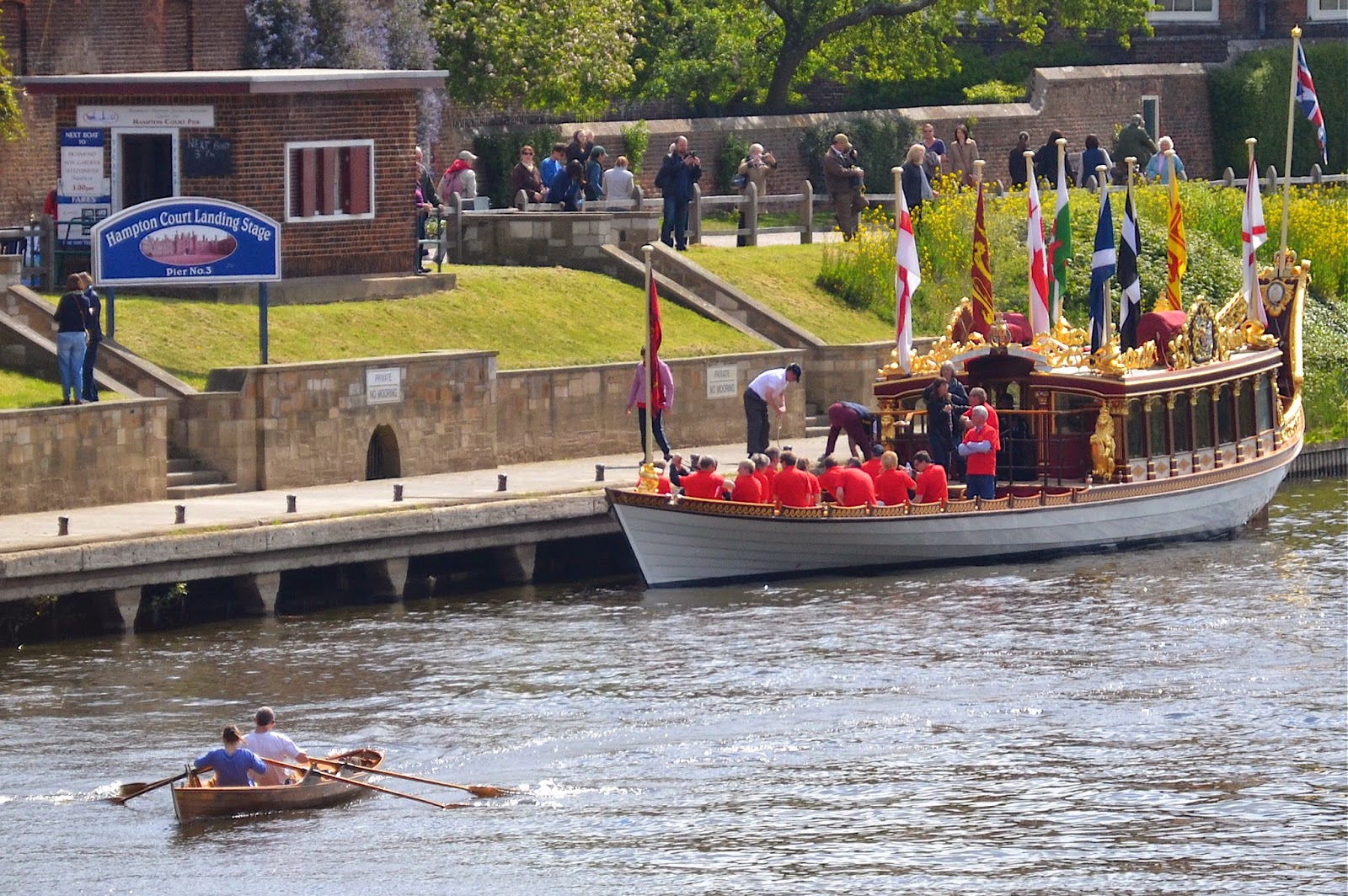
Photograph: Werner Schmidt
Showing posts with label Thomas Doggett Coat and Badge Race. Show all posts

Friday, July 18, 2014

The 300th Coat, the 300th Badge: The 2014 Doggett’s

Welcome to the club. Henry (‘Harry’) McCarthy, the 2014 winner of the Doggett’s Coat and Badge with, from left to right: Nick Beasley (who won Doggett’s in 2001), Ralph Humphrey (1989), Henry, Lenny Grieves (1969), acting Bargemaster, Robert Dwan (2004) and Tom Woods (1999).

Tim Koch reports from London (with some help of Chris Dodd):

Ask anyone involved in rowing and sculling what the sport’s oldest event is and most would suggest either the Oxford – Cambridge Boat Race (1829) or Henley Royal Regatta (1839). Few would know that it is, in fact, a 300-year-old single sculling race, the curiously named ‘Doggett’s Coat and Badge Wager’, a contest that has been run continuously since 1715. The HTBS reports on this unique event and on its fascinating history cover 2010, 2011, 2012 and 2013.

Competitor Ben Folkard boats from Fishmongers’ Hall which is next to London Bridge. The Fishmongers’ Company have had a Hall on this site since 1434.

While 2014 saw the 300th race, it has been decided that the big celebrations will be held in 2015 to mark the 300th year. Nonetheless, this year’s Doggett’s still attracted a Royal visitor in the person of the Queen’s husband, His Royal Highness Prince Philip, Duke of Edinburgh. As this Pathe Newsreel shows, he last saw the race in 1951 (though the film’s commentary is particularly ill-informed).

A tense moment as a 93-year-old member of the Royal family is transferred into the umpire’s launch (though, as a career naval officer from 1939 to 1952, Prince Philip is no stranger to ladders, boats and water).

Colin Middlemiss, Clerk to the Company of Watermen and Lightermen (who organise the event in conjunction with the Fishmongers’ Company) said:

It has been 500 years this year since the earliest Act of Parliament for regulating watermen, wherrymen and bargemen received Royal Assent from King Henry VIII. It’s an extremely special year for us, and we are thrilled the Duke of Edinburgh will be joining one of the oldest and most important celebrations of the river.

The Doggett’s obscurity is in large part due to the fact that it is only open to those under the age of 26 who, in the previous three years, have completed the long apprenticeship to qualify them to carry goods and people on the River Thames. If that were not enough of a barrier to entry, the course itself should dissuade all but the brave or the foolish. It runs from London Bridge to Chelsea, 7,400 metres of unsettled and unsuitable water containing washes, bends, bridges and currents. The prize for this winner of this mad event is suitably eccentric – the scarlet costume of an 18th-century Waterman, a sleeve of which sports a solid silver badge the size of a dinner plate. The less tangible prize is the honour of joining a very exclusive club. The ‘Coat and Badge’ continues to have enormous prestige in the tightly knit community of the Thames Watermen and their families, many of which have worked the river together for generations.
In the shadow of HMS Belfast with Tower Bridge behind them and the Tower of London beside them, the five competitors wait to go onto the start. From left to right: McCarthy, Coughlin, Petipher, Folkard and Maynard.

The competitors drew lots for their colours and stations at Fishmongers’ Hall on 23 June. In traditional style (with my additions in italics), it was announced:

The names of the five young Watermen who are to row on Tuesday, 15th July 2014, in the 300th Race for the Livery and Badge provided yearly under the will of the late MR. THOMAS DOGGETT, a famous Comedian, in commemoration of the happy Accession of His Majesty, George I, to the Throne of Great Britain in 1714, are:

Ben Folkard, Poplar, Blackwall and District Rowing Club. Colour: Green.
Age 23, height 6'3'', weight 76kg. His first attempt at Doggett’s but he comes from a family of Watermen and his grandfather is his Apprentice Master.

Dominic Coughlin, Medway Towns Rowing Club. Colour: Blue.
Age 23, height 6'0'', weight 74kg. First in his family to compete, came 6th in last year’s race.

Louis Pettipher, Medway Towns Rowing Club. Colour: Orange.
Age 23, height 6'0'', weight 79kg. The other first time competitor, though his brother raced three times. He has been sculling for eight months.

Charlie Maynard, Poplar, Blackwall and District Rowing Club. Colour: Red.
Aged 22, height 5'9'', weight 79kg. He came fourth last year and an ancestor, George Maynard, won Doggett’s in 1833.

Henry McCarthy, Poplar, Blackwall and District Rowing Club. Colour: Yellow.
Aged 22, Height 6'1'', weight 77kg. He came second last year. His father, Simon, won in 1984 and an uncle, Jeremy, won in 1992.

Harry McCarthy indulges in some form of meditation perhaps? The ‘Mercia’ behind him was for members of the Watermen's Company to follow the race. Only Doggett's winners are allowed to watch from the privileged position on the roof.

When the 2014 race lined up just below London Bridge at 12.45 it was a warm, calm day and, by Doggett’s standards, the tide was reasonably low and slack. It was McCarthy who got off to the best start and took an immediate lead. Folkard moved close to the north bank from the start while the others stayed to the south or centre.

At the first bridge, the Cannon Street Rail Bridge, the early order was already established: McCarthy (Yellow) then Maynard (Red), Pettipher (Orange), Folkard (Green, not in the picture) and Coughlin (Blue).

By Southwark Bridge the order was McCarthy, Maynard, Pettipher, Folkard and Coughlin. This order was maintained through the Millennium Footbridge and onto Blackfriars Bridge, though the leader’s advantage increased and last two scullers, Folkard and Coughlin, fell increasingly behind the leading pack of three.

At Southwark Bridge, about 500 metres in, the early order was maintained though the field had spread out more.

McCarthy navigates one of the many of the obstacles that it is best not to hit if you want to do well in the Doggett’s.

By Waterloo Bridge (about 1,900 metres) the leading pack had reshuffled slightly resulting in McCarthy leading Pettipher who in turn led Maynard. At the half-way point, the Houses of Parliament, the order was unchanged but the distances between the boats increased. Around this point the umpire ‘dropped’ Coughlin and overtook him.

Approaching Waterloo Bridge. Pictured here, McCarthy leads Pettipher (centre), Maynard (left) and then Folkard (right).

Going under the Golden Jubilee and Hungerford Bridges with the Houses of Parliament and Big Ben in the background, McCarty (right) leads Pettipher (left) and Maynard (centre).

Lambeth Bridge. Folkard in the foreground, in the background, left to right, is Pettipher, McCarthy and Maynard. Around the next bridge (Vauxhall) Folkard was dropped by the umpire.

At the old Battersea Power Station, 6,500 metres into the 7,400-metre race, McCarthy had about fourteen lengths on Pettipher who was about four lengths up on Maynard.

Approaching Battersea Power Station (far left) and the last 1,000 metres, the finish positions look certain.

The umpire’s launch with the man in charge, Bobby Prentice. Prince Philip (just behind the driver) looks on.

Coming up to the last two bridges, Grosvenor Railway and then Chelsea, it’s McCarthy, Pettipher and then Maynard.

At the finish the gap between the second and third placed boats was decreasing but Harry McCarthy sculled home to win convincingly in 24 minutes and 35 seconds. Second place was Louis Pettipher, third Charlie Maynard, fourth Ben Folkard and fifth Dom Coughlin.

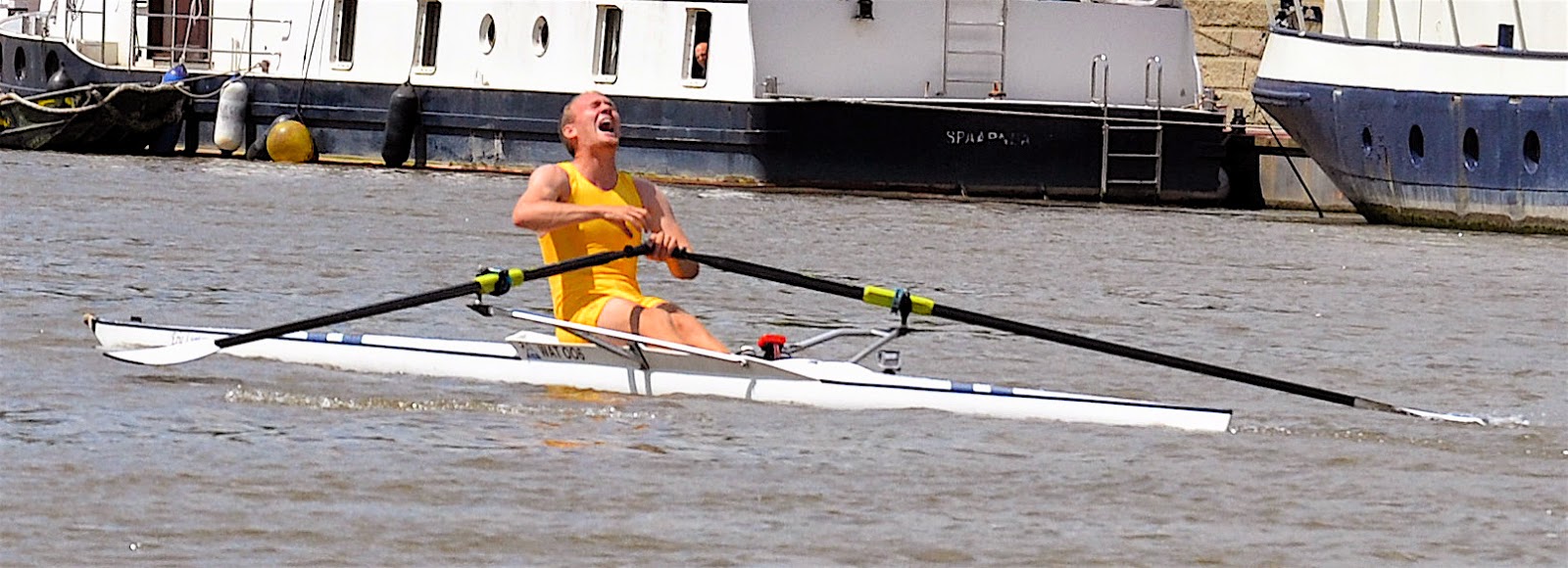
Still pulling hard in the last few strokes, McCarthy approaches his supporter’s boat, the appropriately named ‘Pride of London’.

Passing the finish line, McCarthy quickly goes through a series of emotions. This is ‘Elation’.

‘Joy’

‘Relief’

While congratulations to the winner of the Doggett’s Coat and Badge are always in order, I must single out McCarthy for special praise. In my report on last year’s race I wrote:

Despite McCarthy maintaining form and never giving up, a calm and efficient Brice kept a lead which varied between three and four lengths...... Brice was a worthy winner but I confidently predict that McCarthy, in his first Doggett’s race today, will cross the line first in 2014 or 2015.

What particularly impressed me in the 2013 race was that, even when he clearly could not win, McCarthy continued to hurt himself and give his all. I wish some of the competitors at Henley in particular would give such displays of sportsmanship. Again this year, Harry continued to row hard and feel the pain even when it was obvious that he would win. The pictures of him at the finish tell far better than words what the victory meant to him.

Applause from the Umpire’s Launch and the Royal Party.

Charlie Maynard congratulates his friend and rival.

The press launch drew up alongside McCarthy’s scull a few seconds after the finish and the 300th Doggett’s man told us his feelings about winning, especially as he follows his father who won in 1984 and his uncle who won in 1992:

I wanted to keep it in the family. My Dad has done the Lord Mayor’s Show and things like that and it’s been my dream to walk alongside him...... I came second last year so I had a couple of months off, went on holiday with Charlie (Maynard), one of my best mates, and when we came back we started training (I haven’t had a drink since New Year’s Eve) and you train six days a week, twice a day.... My Dad doesn’t give me grief, he’s like my best mate, he’s helped me through everything this year, I couldn’t have done it without him.....

Later, in the pub, I asked him about his future plans:

I want to row at Henley, I saw this year’s finals and I want to carry on now.... I want to get into a crew boat...... I hate training but I love racing..... I grew up with (my opponents).... and when we train we are still mates but with about three weeks to go..... you don’t really talk to each other..... but you finish the race, give each other a big cuddle and we’re friends again.....

The finish is at Cadogan Pier where there was a brief, informal ceremony where the Duke congratulated the competitors and gave each a bottle of Champagne (apparently with the instruction not to drink it all at once). Here he shakes hands with McCarthy. The main ceremony is in November where the winner is presented with his tailor made costume and, of course, his badge. On race day itself, the Fishmongers’ finish with a splendid luncheon at their Hall – while most Watermen go to the pub. Picture: onthethames.net via @greenwichcouk.

The Duke congratulates Ben Folkard. Prince Philip also gets a prize, the HTBS ‘well dressed gent’ award for his wonderfully shiny shoes. They were probably a fifty-year-old pair of Lobbs, the bespoke footwear also favoured by his son, Prince Charles. 

Dom gives Harry his first alcohol in seven months in an unconventional way.

On the boat back to Fishmongers’ Hall, I asked Robert ‘Bobby’ Prentice, who as Bargemaster of the Fishmongers’ Company is the race umpire, for his take on the this year’s Doggett’s:

The lads did us all proud, it was one of those races where you want everyone to win..... The one that stood out to me was Louis Pettipher, he rowed such a good race. Charlie (Maynard) was always there, in with a great chance, and Harry did the business.... Ben (Folkard) pulled up on the north shore, if he had come over, he would have been a lot closer. And, as always, Dominic (Coughlin) gives value for money. Great competitors all....

Bobby never lets on, but at the end of every race perhaps he is quietly relieved that he still holds the course record. His comments on Pettipher were interesting. If someone who has been sculling only since last November comes second, they must be a very strong contender for winning next year.

Rowing historian and journalist Chris Dodd and I were delighted to be invited to attend the post-race luncheon at Fishmongers’ Hall. As befits a livery company with 700 years of history, the opulent Hall has a wonderful collection of paintings, furniture and silverware. I loved this little silver mustard pot supported by a mermaid and a merman that was tantalisingly placed in front of me. I resisted the temptation to give it a new home.

People in ‘conventional’ rowing and sculling sometimes wonder how good ‘Doggett’s Men’ really are. No doubt, the general standard was probably better in the days when Watermen powered their craft by oars, not engines. Today, the best competitors are of a good ‘club standard’. For example, the 2012 winner, Merlin Dwan, rowed in that year’s Henley Wyfolds for London Rowing Club and the 2011 victor, Chris Anness, sculled in the lightweight single and also the quad for London at that year’s National Championships. The least able competitors will perhaps train just enough to be able to finish the course – though, this in itself is no mean achievement considering the distance and the typical conditions.

Chris Dodd (trying to look like he has not just enjoyed a good lunch) tries out a nice ‘Doggett’s Chair’ that we found in a corner of Fishmongers’ Hall.

Like many things in Britain, the Doggett’s has a bit of a ‘class divide’. For historical reasons, both the Waterman’s Company and the Fishmongers’ Company are involved in its organisation. The former is composed mostly of working men whose trade is ‘the river’, while these days the latter’s members are more likely to be involved with ‘The City’ (London’s financial district) than with fish (with the exception of the occasional smoked salmon canapé). The twain tend not to meet and both have a different appreciation of the event and different ideas on its future. The Fishmongers’ probably see Doggett’s in the same way that non-rowers see Henley, that is as a predominantly social event. There is nothing wrong with this, indeed both Henley and Doggett’s would be the poorer without this aspect to them. The Watermen have a much more emotional tie to a race that they see as part of their heritage, something that any HTBS reader must be able to appreciate. The Fishmongers’ would like to ‘raise the profile’ of the event and market it in a modern way. The Watermen want to leave it pretty much as it always has been. As an historian and a blogger, I can appreciate both points of view.

One of the several paintings of Doggett’s winners in Fishmongers’ Hall. I think this is of Kenny Dwan, who won in 1971. He was one of Britain’s best scullers from the mid-1960s to the mid-1970s. There are five Dwans living, who have won the Coat and Badge.

In his will, the founder of the race, Thomas Doggett, stipulated that the event should continue ‘for ever’. That is a long time but, whatever the problems of maintaining this curious anachronism, I cannot but help feel confident that it is good for at least another 300 years.

My thanks to Chris Dodd for his help in producing the race summery (though any mistakes are mine). 

Photographs © Tim Koch

Tuesday, April 22, 2014

The King is Dead - Long Live the King

A banner announcing the arrival of the Royal Barge carrying George I (looking very well for a man who has been dead for 287 years).

Tim Koch writes:

This year marks the 300th anniversary of the establishment of the House of Hanover, the royal dynasty that ruled Britain and Ireland from 1714 to 1901, that is from the accession of George I to the death of Queen Victoria via the reigns of Georges II, III and IV and William IV. To mark the tercentenary, ‘Historic Royal Palaces’, the charity that looks after the Tower of London, the Banqueting House, Hampton Court Palace, Kensington Palace and Kew Palace, is organising a ‘Glorious Georges Season’. The Season consists of a series of events with the life of George I marked at Hampton Court, the life of George II at Kensington Palace and the life of George III at Kew Palace. Hampton Court was originally built for Henry VIII in 1514 and is sited on the Thames, 20 km from central London. Over the Easter holiday weekend, I was there to see ‘George I’ arrive in the Queen’s Row Barge, Gloriana, the magnificent vessel that HTBS has written about many times before.

Gloriana arrives at Hampton Court.

‘King George’ and his courtiers disembark.

George I (1660 - 1727) was a most unlikely British King. In 1714, at the age of 54, he had never been to Britain and ruled the lands belonging to the Hanover dynasty in Lower Saxony, now part of modern Germany. However, on the death of the British Queen Anne, George inherited her throne as he was her closest living Protestant relative. Although over fifty Roman Catholics had a closer blood relationship to Anne, the 1701 Act of Settlement prohibited Catholics from becoming Kings or Queens of Britain and Ireland.

History has not been kind to George but in recent years he and his reign has been seen in a more positive light. He was not popular with his British subjects who ridiculed him for his supposed stupidity and inability to speak English (though it is rather ironic that the largely monolingual English should criticise someone for not speaking a foreign language). In fact, George spoke good French and Latin and so had no problem communicating with important people. His shyness and the fact that ‘his heart was in Hanover’ may have been somehow interpreted as a lack of intelligence. Today he is seen as a progressive ruler in the Age of Reason, a time when ideas grounded in tradition and faith were challenged. During George’s rule the powers of the King diminished and Britain began the move to the system of government it has today. In the words of one biographer:

.....he ascended a precarious throne, and either by political wisdom and guile, or through accident and indifference, he left it secure in the hands of the Hanoverians and of Parliament.

Gloriana was not the only thing on the water at Hampton Court. These boats were from the nearby Kingston RC. Molesey BC is nearer to the Palace but its boats tend to stay upriver of this point on the other side of Molesey Lock.

The skiff is probably from Dittons Skiff and Punting Club based a little way downriver.

As an aside, most people tend to think of the Royal Family as the epitome of Britishness or Englishness. However, from 1714 to 1901, they were Hanoverians from the House of Brunswick and Lüneburg and, through Queen Victoria’s husband, were members of the House of Saxe-Coburg and Gotha, a branch of the House of Wettin, from 1901 to 1917. In the First World War the obvious German ancestry was a bit embarrassing and the totally made up name of ‘Windsor’ was adopted. On hearing this, it is alleged that the German Emperor said that he would like to see the Shakespeare play, ‘The Merry Wives of Saxe-Coburg-Gotha’. In more recent times, Queen Elizabeth’s husband, Prince Philip, is popularly supposed to be Greek/Danish, but he is a member of the House of Schleswig-Holstein-Sonderburg-Glücksburg. When the then Lady Diana Spencer married Queen Elizabeth’s son, Prince Charles, it was noted that she was far more British or English than he was. It could be argued that the Royals are as British as lederhosen made from bratwurst.

Strangely, when looking at the legacy of George I, most historians seem to concentrate on such things as Parliamentary Democracy and Cabinet Government or the forging of an anti-Spanish alliance and ignore his contribution to rowing, albeit a rather indirect one. In 1714, Thomas Doggett instituted a race with a prize of a coat and a silver badge to be rowed annually by six watermen within a year of completing their apprenticeships ...all which I would have to be continued yearly forever in Commemoration of His Majesty King George’s happy Accession to the British Throne...

George distrusted the conservative Tory Party and so the liberal Whig Party prospered under his rule and also for many years after. As a staunch Whig, Doggett was passionately devoted to the Hanoverians and laid down that the race was to be held each ‘1st day of August forever’ to commemorate the accession of George I on 1st August 1714, and had the 'running' White Horse, the symbol of the House of Hanover, embossed on the silver badge. Three hundred years later, the ‘Doggett’s Coat and Badge’ continues to be raced and the White Horse still adorns ‘The Badge’.

The 1982 Doggett’s winner, Gary Anness, at the 2013 Coat and Badge Race, showing the silver badge with the White Horse of Hanover commemorating the ‘happy accession’ of George I.

Malcolm Knight, the Events Manager for Gloriana, has more space than the average coxswain, but still uses a ‘cox box’ to give instructions to the eighteen rowers. As there is also a steersman in the stern, it could be said that there are two coxes on board – a rower’s nightmare.

Gloriana heads for home.

Photography © Tim Koch

Sunday, September 29, 2013

Cricket Bats and Vampire Dolphins

Watermen’s Hall at 16 St - Mary - at - Hill, London EC3. Picture: Steve Cadman.

Tim Koch writes:

Bernard Hempseed’s recent piece for HTBS on the variations in the deceptions of the arms of the Company of Watermen and Lightermen of the River Thames prompted me to look at the images that I have in my archive. My findings confirmed that, even with a limited search, there are indeed some weird and wonderful versions of the Watermen’s heraldic device.


The present Watermen’s Hall dates from 1780. Its exterior sports a fairly simplified version of the arms. Unlike with some depictions, the oars do look like what they are trying to represent and the boat is a reasonable delineation of a waterman’s wherry. The sculptor has not attempted a ‘heraldic’ depiction of water but has gone for a ‘realistic’ image. Also, while most of us think of dolphins as rather gentle creatures, these marine mammals look ready to attack anyone who comes too close.


John Redmond (right) Master of the Watermen’s Company, 2012 – 2013, and one of his Wardens. They stand below another version of the Company’s Arms, this one displayed above the fireplace in the Court Room of Watermen’s Hall. There is a small picture of the arms and the fire surrounded here. This is a very pleasing example – with the possible exception of the blank space above the boat (which Bernard describes as a ‘bit of a no-no in heraldry’).

John Redmond is wearing the Livery Collar of the Master of the Watermen’s Company. The overall effect is of a splendid gold and enamel badge of office but when looked at in detail it reveals what appears to be a pair of crossed cricket bats, a couple of angry dolphins baring fangs and an arm holding something that could be anything but an oar.

The version of the arms printed on this invitation to the Doggett’s Coat and Badge is used in most of the current publications produced by the Watermen’s Company. Both the single and the crossed oars do not look as though they would be much help in propelling a boat along, the dolphins have clearly come from a castle in Transylvania and the knight’s helmet seems to have morphed into a large angry bird.

Ultimately of course, none of this is important. Heraldic devices emerged long before the precise corporate logo and company trademark. They are a reminder of a time before widespread literacy, when pictures were the best way to convey information and to show the authority under which a body acted. Exact consistency was not important. The reasons for vampire dolphins, however, may remain a mystery.

Wednesday, July 17, 2013

More Doggett’s...

Gary Anness (winner in 1982) who provided the commentary for the 2013 Race.

Tim Koch writes from London,

There are some nice images of the 299th Doggett’s Coat and Badge now online.

YouTube has a lovely video, which captures some of the spirit of the race:


The British Pathe archive has film of the last Royal visitor before this year. The Duke of Edinburgh, the Princess Royal’s Father, saw the race in 1951. The newsreel has a particularly ill informed commentary on the ‘Cap and Badge’ (sic).

There are some nice pictures on Flicker, with a page here and individual posts here, here, and here.

The official site was kind enough to link to my HTBS report.

Like Henley, the Doggett’s is one of those events where it is difficult to point a camera and not get a good picture.

Sunday, July 14, 2013

The Aquatic Silly Season?

The 2013 Dogget’s near the start.

Tim Koch writes from London,

This is obviously the time of year for strange events on the Thames. As my piece below shows, the Doggett’s Coat and Badge Wager was held on 12 July. Unusually, there is an excellent piece on it in the Guardian newspaper by Richard Williams. The Independent Television website has a nice picture of the Princess Royal talking to Nathaniel Brice, the eventual winner, on Cadogan Pier, the finish point of the race. Other good pictures appear on the website LondonSE1 and on Facebook.

On the day before Doggett’s, the Annual Parliamentary Boat Race was held in front of the Houses of Parliament. I previewed this event in 2010 and later reported on the race. The LondonSE1 website says that this year the Commons beat the Lords.

However, even more unlikely than men racing for the right to wear an 18th-century costume or unfit Parliamentarians deciding who are the least worst rowers are the Thames Barge Driving Races held on 13 and 15 July. To quote the events website:

The race consists of about 12 teams of between 4 and 8 members who drive (steer and row) 30 ton barges over a seven mile course for about 90 minutes from Greenwich to Westminster Bridge. Considerable skill is needed to pilot unpowered barges ‘rowed under oars’and ride tidal river currents alone, up river. The event commemorates the skills of Lightermen who moved freight this way along the Thames up until the 1930s and in a wider context it encourages ongoing interest in moving cargo via water and as a way to recruit younger people back into river trades.

July is clearly the time for Madness-on-Thames.

Saturday, July 13, 2013

The gift of Mr. Thomas Doggett: Tim Koch on the 2013 ‘Coat & Badge’

A past winner of the Doggett’s stands guard at Fishmongers’ Hall.

In London on 1st August 1714 it was confidently proclaimed:

THIS BEING THE DAY OF HIS MAJESTY’S HAPPY ACCESSION TO THE THRONE
 THERE WILL BE GIVEN BY MR. DOGGETT AN ORANGE COLOUR LIVERY WITH A BADGE REPRESENTING LIBERTY TO BE ROWED FOR BY SIX WATERMEN THAT ARE OUT OF THEIR TIME WITHIN THE YEAR PAST.
 THEY ARE TO ROW FROM LONDON BRIDGE TO CHELSEA. IT WILL BE CONTINUED ANNUALLY ON THE SAME DAY FOR EVER.

‘For ever’ is a long time but, nearly 300 years later, the Fishmongers’ Company announced in traditional style:

The names of the six young Watermen who are to row on Friday, 12th July 2013, in the 299th Race for the Livery and Badge provided yearly under the will of the late MR. THOMAS DOGGETT, a famous Comedian, in commemoration of the happy Accession of His Majesty, George I, to the Throne of Great Britain in 1714, are:

Samuel Metcalf, London RC. Colour: Royal Blue.
Charlie Maynard, Poplar, Blackwell and District RC. Colour: Orange.
Dominic Coughlin, Medway Towns RC. Colour: Yellow.
Nathaniel Brice, Poplar, Blackwell and District RC. Colour: Light Blue.
Stuart Coleman, Poplar, Blackwell and District RC. Colour: Green.
Henry McCartney, Poplar, Blackwell and District RC. Colour: Red.

In slightly more modern style, the boys' details are on a TwitDoc and for the last three years the event has had a website.

Various ‘Fishmongers’ Halls’ have stood on this site next to various ‘London Bridges’ since 1434. The surrounding buildings are slightly newer. The Fishmongers’ have organised the race since Doggett’s death in 1721.

I have previously written about the history and organisation of this unique event in my reports on the 2010, 2011, and 2012 races. For those who have not heard of it, ‘Doggett’s’ is a single sculling race of 4.6 miles / 7400 metres on the River Thames, only open to those who have finished their apprenticeship to become Watermen in the preceding three years. Historically, qualified Watermen are the only people allowed to carry goods and passengers on the river. While the race is only open to certain members of the Watermen’s Company, for historical reasons it is organised by the Fishmongers’ Company.

In the marshalling area: Dominic Coughlin, Samuel Metcalf and Henry (Harry) McCarthy.

The 2013 race had a unique aspect in that it had a Royal visitor. Her Royal Highness, The Princess Royal (formerly known as HRH, The Princess Anne) viewed the race from the umpire’s launch and afterwards met the competitors and visited Fishmongers’ Hall. The Princess is Queen Elizabeth’s second child and she is tenth in line of succession to the throne.

HRH, The Princess Royal is helped onto the umpire’s launch by Bobbie Prentice. As the Bargemaster of the Fishmongers’ Company, he umpires the race. He won Doggett’s in 1973.

The umpire’s launch with a Royal observer in the stern. The gentleman in the scarlet Coat and Badge is George Saunders who won the race in 1959.

There follows my report on the race, much of which I have shamelessly taken from the commentary provided by Gary Anness who won in 1982 (though any mistakes are mine). A map of the course is here.

At the Millennium Bridge. Left to right: Maynard, McCarthy, Metcalf, Brice and Coleman.

At the start there was some clashing of blades between McCarthy, Coleman and Brice, the people commentator Anness called ‘the race animals’. Between the first bridge, Southwark, and the second, Blackfriars, it was Coleman in the lead rating 32 followed closely by Brice and then McCarthy and Metcalf. As with other Doggett’s races that I have witnessed, steering was a major issue. To the concern of the umpire, Coleman was too close to the north shore and at Blackfriars Bridge three of the scullers unwisely cut the corner for the shortest route while the other three correctly went on the outside of the bend for the fastest water.

At Blackfriars Bridge: Metcalf, McCarthy and Brice.

Five minutes into the race, Coleman had a 2 1/2 length lead over Brice but soon spoilt this by again drifting back over to the north shore. At around seven and a half minutes into the race, Brice passed Coleman and the latter’s rate dropped. At this point McCarthy went after Brice.

Approaching Waterloo Bridge: McCarthy and Brice.

At the Golden Jubilee Bridges (Charing Cross) it was very close with Brice in the lead closely followed by McCarthy, Coleman and then Maynard. The leader started to relax at this point and sculled very well though McCarthy was obviously determined to continue his pursuit. At around eleven minutes and thirty seconds the scullers approached the half way mark just beyond Westminster Bridge and Brice (rating 28-30) and McCarthy had put a good distance between themselves and the others.

On the approach to Westminster Bridge and the Houses of Parliament - McCarthy, Coleman and Brice.

Brice was perhaps three or four lengths up on the second-placed man McCarthy at Lambeth Bridge. Eight lengths behind them came Maynard and Coleman and the umpire over took them at Vauxhall Bridge, around seventeen minutes in. Commentator Anness held that between Vauxhall and Chelsea Bridges was the place to attack and that he had seen the race lead change hands many times along this stretch.

McCarthy feels the pain but keeps the work on as an in control Brice heads to the finish at Cadogan Pier by the Albert Bridge.

Despite McCarthy maintaining form and never giving up, a calm and efficient Brice kept a lead which varied between three and four lengths. This was maintained to the finish and Anness’s unofficial time was twenty-five minutes exactly.

The order of finish was Brice, McCarthy, Coleman, Maynard, Metcalf and Coughlin. Brice was a worthy winner but I confidently predict that McCarthy, in his first Doggett’s race today, will cross the line first in 2014 or 2015.

In a gesture typical of this race, McCarthy congratulates the winner Brice.

Nathaniel Brice, aged 24, of Poplar, Blackwell and District RC perhaps contemplates becoming the 299th winner of the Doggett’s Coat and Badge in this his third and final attempt.

Merlin Dwan (2012) and Chris Anness (2011) look on approvingly at the newest member of their very exclusive club.

After landing at Cadogan Pier and meeting the competitors, the Princes Royal went to Fishmongers’ Hall where, among other things, she witnessed an ergo race between two teams from London Youth Rowing.

The Princess Royal watches boys and girls from London Youth Rowing race each other on ergos.

Her Royal Highness seemed a little concerned with some of the noises emanating from the highly competitive young rowers. The brooch of crossed sculls that she is wearing is part of the prize for the Princess Royal Challenge Cup, the women’s open sculls race at Henley Royal Regatta. She did not win it but she did give permission for the event to be named after her.

Many years ago, an unknown waterman wrote this piece of dogrel:

Let your oars like lightning flog it,

Up the Thames as swiftly jog it,

An you'd win the Prize of Doggett
,
The glory of the River!


Bending, bowing, straining, rowing;

Perhaps the wind in fury blowing;

Or the tide against you flowing
;
The Coat and Badge for ever!

I was the pride of the Thames
,
My name was Natty Jerry
.
The best of smart and flashy dames,

I've carried in my Wherry.


In Coat and Badge so neat and spruce,

I rowed all blithe and merry,

And every Waterman did use

To call me Happy Jerry.

In 2013, Nathaniel Brice became the 299th ‘Happy Jerry’.

Twenty winners of the Doggett’s Coat and Badge 1868-1904.

© Photographs Tim Koch