Showing posts with label Steve Fairbairn. Show all posts
Thursday, March 20, 2014
With a Nice Touch from the '30s
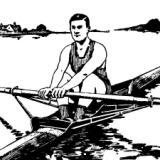
Looking for a rowing book on the internet, on www.abebooks.co.uk to be more precise, I came across Steve Fairbairn’s famous Chats On Rowing, which was published in 1934 by W. Heffer & Sons Ltd., Cambridge. It is not hard to find copies of this book, especially not later editions, but booksellers are still asking a lot for it – as are they for all of Fairbairn’s books, just because …. well, it is Fairbairn. The price for the 1st edition of this Chats On Rowing is £140.00/$239.32. Not only is this copy a 1st edition, it also comes with a dust jacket, which has its wears and tears. I find this dust jacket lovely. The image has such a 1930-ish touch to it with the bowside/starboard oarsman rowing in what looks like a 'tub'. He is maybe not holding the oar right in the image, but I would not have dared to say a thing like that during Fairbairn's lifetime; Steve would for sure have accused me of being a member of the 'Pretty-Pretty Brigade', the camp of the English orthodox style.
My copy of Chats On Rowing was published in 1948 by Nicholas Kaye Ltd., London (a 2nd printing of this edition came out in 1949) and has a less attractive cover, a black&white photograph of two eights racing down the course at Henley (the photograph was taken in 1947 when Jesus College took the Grand Challenge Cup).
Both editions have Fairbairn's poem "The Oarsman's Song", in which the fourth stanza famously reads:
All through the swing he hears the boat sing
As she glides on her flying track,
And he gathers aft to strike the craft
With a ringing bell note crack
My copy of Chats On Rowing was published in 1948 by Nicholas Kaye Ltd., London (a 2nd printing of this edition came out in 1949) and has a less attractive cover, a black&white photograph of two eights racing down the course at Henley (the photograph was taken in 1947 when Jesus College took the Grand Challenge Cup).
Both editions have Fairbairn's poem "The Oarsman's Song", in which the fourth stanza famously reads:
All through the swing he hears the boat sing
As she glides on her flying track,
And he gathers aft to strike the craft
With a ringing bell note crack
Thursday, January 9, 2014
What a Wonderful Cultural Achievement!
A new edition of Steve Fairbairn's On Rowing has recently been made available. The photograph of Fairbairn above is from his first book Rowing Notes from 1926.
Anyone who is only remotely interested in rowing history, probably knows, or at least has heard of, Steve Fairbairn (1862-1938), the Australian who followed his older brothers to study and row at Jesus College, Cambridge, in the 1880s. Although, a good oarsmen, Steve is mostly known as a rowing coach, or one might say the rowing coach. To Steve, rowing was not a set of rules how the oarsman was to move his arms, legs, shoulders and body in the boat, which had been prevalent ever since the schoolboys at Eton had started 'modern' rowing around 1800. This rather stiff style called the English orthodox style, originated from rowing in boats with fixed seats and fixed pins and carried over to the out-rigged boats with sliding seats and swivels, putting a strain on the oarsmen, making it difficult to row effectively unless they had rowed for some years. Also, the style made it very hard for novice rowers to actually learn how to row. Some characteristic elements in the orthodox style were the ‘shoulder catch’, the oar’s ‘back-splash’ and the ‘lively recovery’.
Steve, who coached at Cambridge and later at Thames RC and London RC, wanted his oarsmen to only concentrate on their oars and blade work and not how gracefully they moved in the boat. Teasingly, Steve called the advocates for the English orthodox style the ‘Pretty-Pretty Brigade’ or the ‘orthodox brigade’, also saying that no cups or medals were ever given for stylishness.
Of course, the reaction from the ‘Pretty-Pretty Brigade’ came immediately, accusing Steve of teaching sloppy rowing, and they detracted the Fairbairn ‘style’, or ‘Fairbairnism’, which they said would ruin English rowing. Steve stoically kept a stiff upper lip, saying that he had not invented a new ‘rowing style’ but a method to move the boats faster than before. He was only interested in the rowing itself, not the style, and wanted the oarsmen to have a fresher approach towards rowing and not take everything that was handed down to them as ‘gospel truth’.
A jocular rhymester gave his view in some verses in the Cambridge student magazine The Granta:
Beware the Orthodox, my son,
The slides that check, the arms that snatch;
Beware the drop-in blade, and shun
The Bourneish shoulder-catch.
Mischievously, Steve said that rowing styles were like seasons in Australia, ‘bad, damned bad and bloody awful’.
Throughout his years as a rowing coach, Steve wrote books about his rowing method and how not to row (read: English orthodox style). His books became extremely popular not only in England, but also in Europe, Canada and South America. In 1951, thirteen years after Steve’s death, his son Ian Fairbairn, himself a first-rate oarsman, edited and published The Complete Steve Fairbairn on Rowing. This omnibus of Steve’s writing is maybe not that tricky to find at an antiquarian book-seller, who has his or her books listed on the web, but it does not come cheap. You have to cough up between $250 and $2,000 for a copy.
So, what to do if you are interested in Fairbairn's writings? Fear not, because just before Christmas of last, the company Rowperfect began to publish a new edition On Rowing by Steve Fairbairn, now in digital format (eBook/Kindle edition) for the extremely fair price of $9.99. Editor of this edition is rowing historian Peter Mallory, famous around the rowing world for his 2,500-page, four-volume The Sport of Rowing (2011).
Peter writes in his Introduction, ‘I am very proud to be part of the team that is bringing Fairbairn’s complete works to a new generation of rowers and coaches in a series of affordable eBook volumes. The idea began with Diana Cook of Richard Way Bookseller in Henley-on-Thames, and Rebecca Caroe of Rowperfect.co.uk has made it a reality. Kudos to you both.’
I can only agree: what a cultural achievement this is – Bravo!
Read more about what Peter has to say on this edition on Rowperfect, here. (Peter writes that this is the first time in 60 years that Steve’s collected works are made available, which I humbly would like to correct, as a 2nd printed edition of The Complete Steve Fairbairn on Rowing was published in 1990 by The Kingswood Press.)
However, it must be pointed out that this digital edition does not include all the texts by Steve in The Complete Steve Fairbairn on Rowing, which I wish would be more clear on Amazon (where you can buy this edition). The contents in this first ‘volume’ of Steve’s complete works are as follow: Steve’s famous poem “The Oarsman’s Song”, the pamphlet Rowing Notes from 1904, his first full book Rowing Notes from 1926, Freddy Brittain’s obituary about Steve, published in 1938, and comments by Peter Mallory. More volumes are to follow.
HTBS warmest congratulations to all of you who have been involved in bringing Steve’s writings back to life again.
Anyone who is only remotely interested in rowing history, probably knows, or at least has heard of, Steve Fairbairn (1862-1938), the Australian who followed his older brothers to study and row at Jesus College, Cambridge, in the 1880s. Although, a good oarsmen, Steve is mostly known as a rowing coach, or one might say the rowing coach. To Steve, rowing was not a set of rules how the oarsman was to move his arms, legs, shoulders and body in the boat, which had been prevalent ever since the schoolboys at Eton had started 'modern' rowing around 1800. This rather stiff style called the English orthodox style, originated from rowing in boats with fixed seats and fixed pins and carried over to the out-rigged boats with sliding seats and swivels, putting a strain on the oarsmen, making it difficult to row effectively unless they had rowed for some years. Also, the style made it very hard for novice rowers to actually learn how to row. Some characteristic elements in the orthodox style were the ‘shoulder catch’, the oar’s ‘back-splash’ and the ‘lively recovery’.
Steve, who coached at Cambridge and later at Thames RC and London RC, wanted his oarsmen to only concentrate on their oars and blade work and not how gracefully they moved in the boat. Teasingly, Steve called the advocates for the English orthodox style the ‘Pretty-Pretty Brigade’ or the ‘orthodox brigade’, also saying that no cups or medals were ever given for stylishness.
Of course, the reaction from the ‘Pretty-Pretty Brigade’ came immediately, accusing Steve of teaching sloppy rowing, and they detracted the Fairbairn ‘style’, or ‘Fairbairnism’, which they said would ruin English rowing. Steve stoically kept a stiff upper lip, saying that he had not invented a new ‘rowing style’ but a method to move the boats faster than before. He was only interested in the rowing itself, not the style, and wanted the oarsmen to have a fresher approach towards rowing and not take everything that was handed down to them as ‘gospel truth’.
A jocular rhymester gave his view in some verses in the Cambridge student magazine The Granta:
Beware the Orthodox, my son,
The slides that check, the arms that snatch;
Beware the drop-in blade, and shun
The Bourneish shoulder-catch.
Mischievously, Steve said that rowing styles were like seasons in Australia, ‘bad, damned bad and bloody awful’.
Throughout his years as a rowing coach, Steve wrote books about his rowing method and how not to row (read: English orthodox style). His books became extremely popular not only in England, but also in Europe, Canada and South America. In 1951, thirteen years after Steve’s death, his son Ian Fairbairn, himself a first-rate oarsman, edited and published The Complete Steve Fairbairn on Rowing. This omnibus of Steve’s writing is maybe not that tricky to find at an antiquarian book-seller, who has his or her books listed on the web, but it does not come cheap. You have to cough up between $250 and $2,000 for a copy.
So, what to do if you are interested in Fairbairn's writings? Fear not, because just before Christmas of last, the company Rowperfect began to publish a new edition On Rowing by Steve Fairbairn, now in digital format (eBook/Kindle edition) for the extremely fair price of $9.99. Editor of this edition is rowing historian Peter Mallory, famous around the rowing world for his 2,500-page, four-volume The Sport of Rowing (2011).
Peter writes in his Introduction, ‘I am very proud to be part of the team that is bringing Fairbairn’s complete works to a new generation of rowers and coaches in a series of affordable eBook volumes. The idea began with Diana Cook of Richard Way Bookseller in Henley-on-Thames, and Rebecca Caroe of Rowperfect.co.uk has made it a reality. Kudos to you both.’
I can only agree: what a cultural achievement this is – Bravo!
Read more about what Peter has to say on this edition on Rowperfect, here. (Peter writes that this is the first time in 60 years that Steve’s collected works are made available, which I humbly would like to correct, as a 2nd printed edition of The Complete Steve Fairbairn on Rowing was published in 1990 by The Kingswood Press.)
However, it must be pointed out that this digital edition does not include all the texts by Steve in The Complete Steve Fairbairn on Rowing, which I wish would be more clear on Amazon (where you can buy this edition). The contents in this first ‘volume’ of Steve’s complete works are as follow: Steve’s famous poem “The Oarsman’s Song”, the pamphlet Rowing Notes from 1904, his first full book Rowing Notes from 1926, Freddy Brittain’s obituary about Steve, published in 1938, and comments by Peter Mallory. More volumes are to follow.
HTBS warmest congratulations to all of you who have been involved in bringing Steve’s writings back to life again.
Thursday, June 6, 2013
Steve, Jack and Bossie Found in Cyberspace
Tim Koch writes,
Typing ‘rowing’ into the YouTube search engine and then ploughing through the results is rather like rowing itself – you have to do an awful lot of dull and sometimes painful work in order to get gold. After a lot of ‘internet steady state’ I recently experienced the thrill of a big win. A commercial company called Huntley Film Archives has put up an eleven-minute film made at Thames Rowing Club in 1923 or 1924 (not ‘1930s’ as they state). It is particularly exciting for two reasons. Firstly, it shows three of the greatest Putney personalities of the inter war period and secondly, it shows rowing of a very high standard in slow motion and with very close up shots, both unusual for the time. Unfortunately, the internet version is in low resolution and has a copyright ‘watermark’ but the original film held in the Huntley Archive is undoubtedly a sharp 16mm or even 35mm print.
The start to 48 seconds shows the exterior of Thames Rowing Club at Putney with crews leaving the boathouse and other crews rowing past.
After this there is a ten-second (slightly self-conscious) shot of the great coach, Steve Fairbairn, 1862-1938 (not ‘Fairburn’ as stated).
Steve Fairbairn as depicted on the Mile Post.
Between 58 seconds and 1 minute 17 seconds the film shows the Thames RC ‘First Eight’ for 1923 with the Henley Grand Challenge Cup. The crew was C.G. Chandler, R.G. Bare, J. Beresford Jnr, C.H. Rew, A.F. Long, K.C. Wilson, H.L Holman, S.I. Fairbairn and J. Godwin.
From 1 min 17 sec to 5 min 10 sec there are instructional sequences for sweep rowing showing TRC eights on the water between Putney and Hammersmith. As I have already said, it was unusual for cameramen of the period to get so close to the action. This was not shot on a long lens to achieve the close ups, if it had been the picture would be much more unstable and would have a reduced depth of field. The caption at 3 min 40 ecs says ‘There are not many eights that would bear inspection from the Ultra Rapid ‘. This was British Pathe’s slow motion camera which they were obviously very proud of and which they used in many sporting films. We must assume that these sequences show the classic ‘Fairbairn Method’ of rowing as approved by the master himself.
Between 5 min 10 sec and 6 min 35 sec there are marvellous shots of Jack Beresford Jnr. (1899-1977; on the left), Britain’s greatest sculler of the inter war period. The film is perhaps even better shot than the sweep rowing material. The cameraman must have been standing on the bow of a close-following (perhaps overlapping) launch to get a wonderful high shooting angle of Beresford in his single scull. The caption at 5 min 45 sec says ‘It’s obvious why he is a champion’ and this is very true. The style may not be what we would use today but note the speed with which his legs go down.
From 6 min 35 sec we have ‘the don’ts of sculling’, very gamely illustrated by the great coach, boat builder and father of champions, John Thomas Phelps (1877-1942), better known as ‘(Young) Bossie Phelps’ – not ‘Bossy’ as stated. I have never seen pictures (still or moving) of Bossie in a boat before.
Bossie Phelp
The film ends with a caption stating something that, if it was true in 1923, it is still true now:
If you contemplate rowing
- Remember -
When you know All about it you will be too old to do it.
Tuesday, March 19, 2013
Trois hommes dans un bateau (sans parler du chien)
Hélène Rémond's interesting piece earlier today on the history of rowing in Brittany included a nice picture of a dog in a treble scull. The great coach, Steve Fairbairn talked about 'the endless chain movement' in the rowing stroke. Perhaps this boat practised the endless chien movement? ~ T.K.
Thursday, January 3, 2013
Rowing History Footnote: The Race that Ended with a Fight
Thames RC's William Fernie and ‘Bogie’ Bogle trying to row each other round while they are in the lead in the final of the 1898 Silver Goblets, where they easily beat ‘Old Hutch’ and Steve Fairbairn of Jesus College BC. A race that ended with a fist fight....
The Thames Rowing Club was founded in 1860 as the City of London Rowing Club. At a meeting in February 1862, the name of the club was changed to the Thames Rowing Club. In 1866, the Thames RC had acquired a boathouse at Putney which belonged to the boat builder William Styles of Isleworth. Manager for the boathouse was William East, Sr., William ‘Bill’ East’s father. The professional champion Bill East had strong connections to Cambridge University BC as he acted as their ‘waterman’, taking the Light Blue coxes in a boat for many years to show them how to steer on the sometimes unruly waters of the Thames with its tides and streams between Putney and Mortlake.
With Bill East around Thames RC, many of Cambridge’s rowers went to the club after they left the university and got a job in the city. This was what happened in 1898 when some Trinity Hall oarsmen, William Fernie, William Bieber and Hunting Howell, joined the club. Some ‘Hall’ rowers, including Richard Croft, were already members. Croft took the Colquhoun Sculls in 1893 and the Lowe Double Sculls in 1894 (together with Adam Bell), and he also rowed in the Hall’s first eight winning the Head in 1894 (with Fernie and Bieber) and in 1895 (with Fernie, Bieber and Howell). Also the Hall’s David Campbell-Muir, who got his Blue at the same time as Howell, would become a member of the club.
For the 1898 Silver Goblets at Henley, Fernie raced in the pair with A. ‘Bogie’ Bogle who was ‘a very difficult and aggressive crew member’ Geoffrey Page writes in his history book on the Thames RC, Hear The Boat Sing (1991). For some unknown reason Bogie was not on speaking terms with his partner in the boat on the day of the final, where they were going to race against A. M. Hutchinson ‘Old Hutch’ and Steve Fairbairn of Jesus College BC (yes, the famous coach to be). On the way to the start, Bogie and Fernie tried to pull each other round which they continued to do during the race. Old Hutch and Fairbairn took an early lead at a high rate which was doomed to fail. The Thames pair soon was in the front and won comfortably.
Page writes: ‘They did not stop at the line. Legend has it that they continued to Marsh Lock, where they got out and fought it out on the bank. It is not recorded who won the fight, but the boat was left for the boatman to collect.’
The Thames Rowing Club was founded in 1860 as the City of London Rowing Club. At a meeting in February 1862, the name of the club was changed to the Thames Rowing Club. In 1866, the Thames RC had acquired a boathouse at Putney which belonged to the boat builder William Styles of Isleworth. Manager for the boathouse was William East, Sr., William ‘Bill’ East’s father. The professional champion Bill East had strong connections to Cambridge University BC as he acted as their ‘waterman’, taking the Light Blue coxes in a boat for many years to show them how to steer on the sometimes unruly waters of the Thames with its tides and streams between Putney and Mortlake.
With Bill East around Thames RC, many of Cambridge’s rowers went to the club after they left the university and got a job in the city. This was what happened in 1898 when some Trinity Hall oarsmen, William Fernie, William Bieber and Hunting Howell, joined the club. Some ‘Hall’ rowers, including Richard Croft, were already members. Croft took the Colquhoun Sculls in 1893 and the Lowe Double Sculls in 1894 (together with Adam Bell), and he also rowed in the Hall’s first eight winning the Head in 1894 (with Fernie and Bieber) and in 1895 (with Fernie, Bieber and Howell). Also the Hall’s David Campbell-Muir, who got his Blue at the same time as Howell, would become a member of the club.
For the 1898 Silver Goblets at Henley, Fernie raced in the pair with A. ‘Bogie’ Bogle who was ‘a very difficult and aggressive crew member’ Geoffrey Page writes in his history book on the Thames RC, Hear The Boat Sing (1991). For some unknown reason Bogie was not on speaking terms with his partner in the boat on the day of the final, where they were going to race against A. M. Hutchinson ‘Old Hutch’ and Steve Fairbairn of Jesus College BC (yes, the famous coach to be). On the way to the start, Bogie and Fernie tried to pull each other round which they continued to do during the race. Old Hutch and Fairbairn took an early lead at a high rate which was doomed to fail. The Thames pair soon was in the front and won comfortably.
Page writes: ‘They did not stop at the line. Legend has it that they continued to Marsh Lock, where they got out and fought it out on the bank. It is not recorded who won the fight, but the boat was left for the boatman to collect.’
Friday, March 16, 2012
‘The Song Of The Stroke’
There are many testimonies about Harcourt ‘Tarka’ Gold’s accomplishments as an oarsman, coach, Henley Steward, Chairman of the ARA, and sportsman in general. This little piece will celebrate him as a pamphleteer as it is 92 years ago this month his 20-page pamphlet The Common Sense of Coaching was published.However, Gold was not the sole author of this short publication. He did not write part one, only part two. The first part was actually written by the members of the Oxford University Service Crew which Gold coached for the King’s Cup in the Royal Henley Peace Regatta in 1919. During the crew’s last week of practise before the regatta, Gold writes in the preface, he requested the crew record their attempt “to resuscitate the style and traditions of Oxford rowing after the lapse of five years.”
The only person exempted from taking part in this experiment was the crew’s president, the “pre-war oarsman” Ewart Horsfall, who had rowed for Oxford’s winning boats in 1912 and 1913, and the losing one in 1914. Horsfall also won an Olympic gold medal in the eights at Stockholm (and would take a silver in the eights at the 1920 Amsterdam Games).
The second part, Gold wrote primarily for the coaches of the College Boat Clubs at Oxford as they were believed to have little previous coaching experience. Gold states that it is hard to explain “rhythm” to novice rowers, but writes that “Dr. Warre once gave me the delightful description of rhythm as ‘the song of the stroke’”. Coming from Warre’s Eton and rowing at Oxford meant that Gold’s teaching was based on the orthodox style.
A couple of interesting anecdotal notes are that the Australian crew, which beat Oxford in the King’s Cup final, in an initial stage of their training on the Thames, had their countryman Steve Fairbairn, coach at Thames RC and a renown pamphleteer, to help out. A Cambridge eight, which was also competing for the King’s Cup, had another Australian to assist them, Stanley Bruce of Trinity Hall. (He would later be elected Prime Minister of Australia, and be granted an hereditary peerage, Viscount Bruce of Melbourne.)
After Bruce had coached Cambridge for the Peace Regatta, he dictated some notes which was published first in 1936 as a 24-page pamphlet, Rowing – Notes on Coaching. Both Gold’s and Bruce’s pamphlets are impossible to get hold of today. Time to re-publish them?
Saturday, November 5, 2011
Archie Nisbet: Oarsman, Coach, Rowing Patron
Some weeks ago, I found a copy of the pamphlet London Rowing Club 1856-1956 (n.d., probably 1956) online. While I have Chris Dodd’s eminent book on the history of the London RC, Water Boiling Aft (2006), I did not have this 36-page pamphlet. As it was only a few pounds, including shipping, I quickly ordered the little booklet. The other day it arrived; a slightly faded cover in blue with crossed oars and the London emblem and the title in silver.The pamphlet has a short history of the club, lists of Henley winners from the club, lists of Officers and Members of the club, and some interesting advertisements from the time of the printing of the publication. However, what really caught my
eye was an ex-libris, or bookplate, which was attached to the inside front cover, showing a former owner’s crest with a motto: Vis Fortibus Arma – ‘Vigour is arms to brave men’. Beneath the motto is the owner’s name, Anthony Nisbet. The crest showed the three boar heads of the family of Nisbet. (An ancestor, Alexander Nisbet (1657-1725), was a famous author of Scottish heraldry, also on the Nisbet Clan.)I do not know how Anthony was related to Robert Archibald ‘Archie’ Nisbet (1900-1986), who was a famous oarsman and member and one of the vice-presidents of the London RC. Archie began his rowing career at Pembroke College, Cambridge. Although he never got a ‘Blue’, Archie was a good oar and rowed bow in the 1923 Pembroke eight in the Grand which lost to Thames RC in the final. For a stint thereafter, he was a member of Thames RC, but left to take on the Captainship of London RC in 1924.
In 1927, Archie joined forces with Terence ‘Terry’ O’Brien to win the Silver Goblets at Henley. They were picked to represent their country in the pair at the 1928 Olympic rowing on the Sloten Canal in Amsterdam, even though some weeks earlier they were beaten in an early race in the Silver Goblet by Jack Beresford and Gordon Killick of Thames RC. Both Beresford and Killick were also members of their club’s eight that took the Grand that year. In the Olympic rowing in August, Archie and O’Brien rowed a good race in the final, but they were overpowered by the German duo, Bruno Müller and Kurt Moeschter, who were trained by the English professional, ex-champion, Ernest Barry. The Henley winners in the pair, Beresford and Killick, also took a silver medal at the Olympics, in Thames’ club eight.
During this time at London RC, Archie Nisbet was still in contact with his Alma Mater, and helped to coach their eight. When Pembroke’s bow man suddenly could not row in the first heat of the Grand in 1931, his seat was taken by Coach Nisbet. There is a photograph of November 1934 of Archie with his back towards the camera talking to a crew in the Cambridge trail eights on the Cam. His bicycle indicates that he has followed the eight along the towpath. It states that Archie was an ‘old blue’, which he was not. See photograph here. The following year, in 1935, Archie was one of the ‘official’ Cambridge coaches. This year the light blues had Ran Laurie at stroke and behind him his good friend Jack Wilson. Cambridge won with four and a half boat lengths.
Here is a short film clip of the 1935 Cambridge eight training on the Thames. On race day Laurie was moved from sixth-seat to stroke. You will see a quick glimpse of Coach Nisbet, too.
Archie was still coaching after the Second World War and was elected vice-president of London RC in 1951. According to Dodd, in his Water Boiling Aft, Archie retired from the London RC’s seat on the ARA council in 1975, only to become the Chairman of the Head of the River Race two years later.
Despite Archie’s success as an oarsman and as a coach, there is maybe one accomplishment that rises above the rest, at least in the eyes of rowing historians; Archie was the one who got Steve Fairbairn to begin coaching at London RC after Steve had left Thames RC due to an argument with Jack Beresford’s father, Julius. Steve started to coach London RC crews in April 1926 and the club would thereafter have a long run of success, also many years after Steve had died, in 1938.
Friday, October 7, 2011
Poetry Of Motion
Yesterday, rowing historian Bill Lanouette sent me a photograph (see above). At first, I thought it was the famous Biglin Brothers rowing a pair under the bridge on the Schuylkill . But how could that be, as Bill said it was a photograph taken by Joel Roger showing Bill and his rowing buddy Chuck Levy rowing under Key Bridge on the Potomac? Well, there are for sure some similarities, don’t you think? (see Thomas C. Eakins’s painting of the Biglin brothers below.)
Bill, who is an expert on the Biglins, writes that there is a big difference, however: The Biglins have matching shirts! I also heard that rowing historian Bill Miller noted that the Biglins are rowing a starboard-stroked pair, while Bill and Chuck are in a port-stroked boat. Either way, both pictures show what the great rowing coach Steve Fairbairn called “the poetry of motion.”Talking about poetry, yesterday, the Swedish Academy announced that this year’s Nobel Prize for Literature goes to the Swedish poet Tomas Tranströmer, an excellent choice, I think. I spent most of the evening yesterday re-reading a book of Tranströmer’s collected poems, in Swedish, of course…
Wednesday, June 8, 2011
Nestle's 1938 Rowing Cards, Part 2
As I wrote in yesterday's entry, I won a set of Nestle's Rowing Cards of 1938 on eBay two weeks ago. Above you will see the rest of the cards in the set. While the one's from yesterday showed the difference between the Fairbairn 'style' and the 'old' English orthodox style, these cards show the different boat types: single scull; coxed pair; eight; coxed four; and double scull. It might actually be 'orthodox v. Fairbairn' that is shown in the two cards on top. Steve Fairbairn, who was the coach who more or less came up with 'Fairbairnism', never regarded his method of rowing as a 'style'.It might interest the readers of HTBS, that Nestle also published a set of rowing cards in 1937.
Tuesday, June 7, 2011
Nestle's 1938 Rowing Cards, Part 1
Two weeks ago, I won some premium cards on eBay. It was, I believe, a full set of Nestle's Rowing style sport cards from 1938, the same year the famous rowing coach Steve Fairbairn died. The cards on the left, five out of a total of 12, show the Fairbairn 'style' (on the left) v. the old Orthodox style (on the right).Tomorrow the rest of these beautiful cards will be posted.
Tuesday, April 5, 2011
The 2011 Head Of The River Race
HTBS's Tim Koch reports from the Thames, 2 April:
As reported in HTBS on 20th March, the British rowing season really starts with in late March/early April with various time trials for eights over the Mortlake to Putney Course. Last Saturday, 2nd April, saw the biggest of these, the (Mens) Head of the River Race, HoRR. Three hundred and ninety eight boats rowed the four and a quarter miles (6.8 km) of the Oxford-Cambridge Boat Race Course, each setting off at ten second intervals on an ebb tide. Until the London Marathon was established in 1981, the HoRR was the largest participant event in Britain with over 3,500 competitors and is still the largest single boat type rowing race. The Head of the Charles in Boston, Massachusetts, has 8,000 competitors but the event is held over two days and has 55 different race events for various boat types.
University Post and Chiswick Bridge, which is the start of HoRR, and the finish line for the Boat Race.A crew’s HoRR result tells it were it stands in relation to its peers. Almost every UK rowing club will put in at least one boat and entries from abroad increase every year. In 2011 there were crews from Czech Republic (2), Germany (26), Spain (6), Hungary (1), Switzerland (10), Portugal (1), France (1), Croatia (1), and the Netherlands (1). I cannot recall any entries from North America in past years but I suspect that any crews planning to make the long trip find Henley a more attractive destination.
The first ten finishers were:
Finish-Start-Time
1 2 16 50.75 Leander I
2 1 16 54.21 Molesey I
3 3 16 59.60 Czech Rowing Federation I
4 6 17 3.77 Leander II
5 20 17 7.53 Czech Rowing Federation II
6 4 17 11.93 Astillero (Spain)
7 8 17 15.58 Imperial College I
8 7 17 17.11 London I
9 33 17 22.21 Csepel (Hungary)
10 12 17 23.91 Molesey II
The full results are here.
If most people involved in rowing gave the matter any thought, they would imagine that winter ‘Heads’ have existed as long as the traditional side by side racing done in the summer months. In fact the concept was developed only in the mid-1920s by the hugely influential coach, Stephen Fairbairn (1862-1938), universally known as ‘Steve’. He was inspired by older ‘bump racing’ held at Oxford and Cambridge but this was a different event, originally with a different purpose - to mark the end of winter training and to encourage crews to train over long distances. Steve strongly believed in the benefits of distance training, ‘milage makes champions’ was one of his many adages. (See more here.)
He denied that the Head was really a race, he held that “...it is merely a means of getting crews to do long rows”. In his A History of Rowing (1957), Hylton Cleaver says “Steve Fairbairn did not plan his idea as anything more than a target at which those who rowed through the winter could aim, so that at the end of a period of comparative drudgery they could find out who profited most”.
A few years after the first Head in 1926, the idea had spread to many other rowing courses both in Britain and abroad and there were time trials for every boat type. There is a nice newsreel film of the 1934 Tideway Eights Head here (70 seconds in) though these days there is a ‘rolling’ not ‘standing’ start. Some recognition should go to the organisers in the pre-computer age who worked out the results for four hundred crews with only analogue stopwatches, pencil and paper and mental arithmetic (none of which our younger readers would be familiar with). I remember that timekeeping for the Head of the River Fours in the 1980s was a dangerous business as they supplied you with pencils sharpened to a very fine point at both ends and there were several self stabbing incidents. No doubt one day soon all boats will be fitted with a Global Positioning System and the results will be instantaneous.
The trophy for the first placed ‘Head’ crew is a bust of Fairbairn sculptured by George Drinkwater (an Oxford Blue and writer on rowing) and it is usually kept in the Committee Room of the London Rowing Club [see above]. I was going to photograph it but found that it was on loan to the River and Rowing Museum at Henley for the exhibition commemorating the 150th anniversary of Thames Rowing Club. It amused me that, 85 years after ‘The Row’, Steve is back with Thames.Steve would be surprised to know that now there are people who now train specifically for Heads and treat them, not as a means to an end, but as an end in themselves. He has many memorials but he would be surprised that Head Racing is, arguably, his most enduring legacy.
The Veterans’ (Masters) Head of the River was held on the day after the HoRR on Sunday 3rd April. Two hundred crews raced and the results are here.
Saturday, March 26, 2011
The Mile Post
Today is Boat Race Day. Tim Koch, HTBS's special correspondent in London, writes:Bernard Hempseed’s interesting item on Famous Scullers Monuments (HTBS 22nd March) prompts me to send some pictures of a rowing monument that 120 million people will hear about today, Saturday 26th March, but which few will see. It is the ‘Mile Post’, a stone obelisk which is sited exactly one mile from the Oxford-Cambridge Boat Race start at Putney and which is the first official timing point in the race. The record time to here was set by Oxford in 1978 and repeated by Cambridge in 1993, 3 minutes and 31 seconds. The ‘Mile Post’ is more correctly called the Steve Fairbairn Memorial. A plaque below an oval profile of Fairbairn reads:
THIS MEMORIAL
COMMEMORATES THE CENTENARY OF
STEVE FAIRBAIRN
FAMOUS OARSMAN AND COACH
FOUNDER OF THE HEAD OF THE RIVER RACE
ERECTED BY THE MEMBERS OF
JESUS COLLEGE CAMBRIDGE LEANDER CLUB
LONDON AND THAMES ROWING CLUBS
IT IS EXACTLY ONE MILE
FROM THE START OF THE
UNIVERSITY BOAT RACE COURSE
COMMEMORATES THE CENTENARY OF
STEVE FAIRBAIRN
FAMOUS OARSMAN AND COACH
FOUNDER OF THE HEAD OF THE RIVER RACE
ERECTED BY THE MEMBERS OF
JESUS COLLEGE CAMBRIDGE LEANDER CLUB
LONDON AND THAMES ROWING CLUBS
IT IS EXACTLY ONE MILE
FROM THE START OF THE
UNIVERSITY BOAT RACE COURSE
Steve Fairbairn (1862-1938) was an Australian who was responsible for popularising the ‘leg drive’ in British rowing. Sliding seats had been around since the 1870s but traditional British conservatism meant that they were not used to their full advantage and for fifty years after their invention crews in the UK used the stiff ‘orthodox style’ developed for fixed seat rowing where the back does most of the work. ‘Steve’ was also a great believer in the benefits of rowing long distances and to encourage this he developed the idea of winter time trials, that is ‘head racing’. At the time his ideas produced fierce debate (some even holding the idea that ‘It is better to look good than to go fast’) and they were never fully accepted until after the 1939-1945 War.The other official Boat Race timing points are Hammersmith Bridge (record 6:20, CUBC 1998), Chiswick Steps (record 9:56, CUBC 1998), Barnes Bridge (record 13:32, CUBC 1998) and the University Stone at the finish (record 16:19, CUBC 1998). I think that these records will be safe this year.
Saturday, June 5, 2010
The Bournes: 4 - 'Beja', The Old Master Coach
Here continues the story of Dr. Gilbert Charles Bourne, famous coach at Oxford.
In A Text-Book of Oarsmanship Bourne agrees that the orthodox style has changed since Warre’s days, and that the style has been taught differently by different coaches, all being campaigners for the English orthodox style. The general factor that all the 'orthodox' coaches of the day could agree upon was that the Cambridge coach Steve Fairbairn’s new 'style' was wrong and therefore should be rebuked, which Bourne also does in his book. One error among many that Bourne found with Fairbairn’s Jesus College crews, who fully rowed according to Fairbairn’s method, was that they “always had an air of dreaminess about it.”
Beware the Orthodox, my son,
A few oarsmen and coaches thought that a mix of the two styles were to be preferred, “each style has its own particular merits, and when the best points of each are blended then, in my opinion, perfection is very nearly achieved,” Vivian Nickalls wrote in 1932. But to “blend” the two different styles would be a rare thing to suggest during Bourne’s and Fairbairn’s lifetime. It would however be a more openly discussed subject during the 1950s and 1960s. Vivian Nickalls’s thoughts to “blend” the styles would be expressed some thirty years later by H. R. A. ‘Jumbo’ Edwards in his The Way of a Man with a Blade (1963) where he writes: “… by ‘orthodox’ I mean teaching the best method of moving the body to achieve maximum muscular efficiency in propelling the boat. The Fairbairn method was to teach the oarsman to perfect his bladework and to apply the maximum power to it throughout the stroke. Of course, the ideal is achieved by a combination of these two methods. Putting it another way, orthodoxy was the teaching of the pure art of rowing, while Fairbairnism was the application of the art to winning races. […] It is the greatest pity that Steve and Beja [Dr. Gilbert C. Bourne] never worked together. They would have produced wonderful crews.”
In A Text-Book of Oarsmanship Bourne agrees that the orthodox style has changed since Warre’s days, and that the style has been taught differently by different coaches, all being campaigners for the English orthodox style. The general factor that all the 'orthodox' coaches of the day could agree upon was that the Cambridge coach Steve Fairbairn’s new 'style' was wrong and therefore should be rebuked, which Bourne also does in his book. One error among many that Bourne found with Fairbairn’s Jesus College crews, who fully rowed according to Fairbairn’s method, was that they “always had an air of dreaminess about it.”
The year after, in 1926, Steve retorted Bourne in the book Rowing Notes. Regarding his dreamy Jesus crews, he writes, “Dr. Bourne […] says my crews look dreamy. They could not have given higher praise, especially as the criticisms were intended to be against the style in which I coach my crews. [- - -] Does not looking dreamy only mean being very smooth? In my opinion the dreamier a crew looks, the nearer it approaches to the poetry of motion.”

A jocular rhymester gave his view of the orthodox style in the Cambridge student magazine The Granta:

A jocular rhymester gave his view of the orthodox style in the Cambridge student magazine The Granta:
Beware the Orthodox, my son,
The slides that check, the arms that snatch;
Beware the drop-in blade, and shun
The Bourneish shoulder-catch.
A few oarsmen and coaches thought that a mix of the two styles were to be preferred, “each style has its own particular merits, and when the best points of each are blended then, in my opinion, perfection is very nearly achieved,” Vivian Nickalls wrote in 1932. But to “blend” the two different styles would be a rare thing to suggest during Bourne’s and Fairbairn’s lifetime. It would however be a more openly discussed subject during the 1950s and 1960s. Vivian Nickalls’s thoughts to “blend” the styles would be expressed some thirty years later by H. R. A. ‘Jumbo’ Edwards in his The Way of a Man with a Blade (1963) where he writes: “… by ‘orthodox’ I mean teaching the best method of moving the body to achieve maximum muscular efficiency in propelling the boat. The Fairbairn method was to teach the oarsman to perfect his bladework and to apply the maximum power to it throughout the stroke. Of course, the ideal is achieved by a combination of these two methods. Putting it another way, orthodoxy was the teaching of the pure art of rowing, while Fairbairnism was the application of the art to winning races. […] It is the greatest pity that Steve and Beja [Dr. Gilbert C. Bourne] never worked together. They would have produced wonderful crews.”
‘Jumbo’ Edwards should know as he had rowed for them both, at Oxford and later for The London RC. It is significant that Edwards dedicated his luminous book “to the memory of the greatest of Old Masters Steve and Beja”.
Dr. Bourne only published one book on rowing during his life time. However, the year after his death, in 1933, his manuscript about his younger days was published, Memories of an Eton Wet-Bob of the Seventies, which is a very exciting read for anyone interested in Eton and Oxford of those days. It is not, however, an easy book to find in an antiquarian bookshop nowadays.
In tomorrow's entry the story about the Bournes continues, then about Bobbie Bourne.
Wednesday, March 17, 2010
Great Rowing Books
After I had posted my entry about Fremantle’s pamphlet, where I also mentioned Brittain’s and Playford’s books about the Jesus College BC, I happened to see that bookseller Boudicca’s Books in London had some books for sale about the college and its boat club, The Jesus College Cambridge Boat Club 1827-1994 (1995), Records of the Jesus College Boat Club, Vol. II 1862-1885 (1886), and Jesus College University of Cambridge, College Histories (1902). They also have a couple of books by Steve Fairbairn, Rowing Notes (1930 edition) and The Complete Steve Fairbairn on Rowing (1990 edition). These are not cheap books, but do have a look at Boudicca’s Books as the bookseller has taken the time to give long, detailed information about these books.
Otherwise, if you are looking for new or old books on rowing, the first bookshop you should contact is, of course, Richard Way on Friday Street in Henley-on-Thames. You can easily contact Ms. Diana Cook on waybooks@btconnect.com – they have great service!Sunday, March 7, 2010
Letters From Steve Fairbairn 1926
The always very alert Tim Koch of Auriol Kensington RC writes:
“You recently wrote that: ‘In the mid-1920s, Beresford (Senior) had the infamous quarrel with the club's legendary coach Steve Fairbairn, which made Fairbairn leave the club to instead coach the London RC. Decades later, this would still be remembered at Thames RC as ‘The Row’ [see 28 February].’”
Tim goes on, “A couple of interesting letters in the Auriol Kensington archive nicely marks the point at which 'Steve' left Thames. The attached copy of the letter to the Kensington RC Captain suggesting the establishment of a 'Head of the River Race' for eights is dated 27th August 1926 and is on Thames note-paper. The other letter, dated 21st September 1926 and notifying the Kensington Secretary of a meeting of interested parties, is on London note-paper.”


Honestly, is it not these ‘small foot notes’ in the history of rowing that makes all the difference, and why we still keep on researching and snooping around for more, good rowing stories?
“You recently wrote that: ‘In the mid-1920s, Beresford (Senior) had the infamous quarrel with the club's legendary coach Steve Fairbairn, which made Fairbairn leave the club to instead coach the London RC. Decades later, this would still be remembered at Thames RC as ‘The Row’ [see 28 February].’”
Tim goes on, “A couple of interesting letters in the Auriol Kensington archive nicely marks the point at which 'Steve' left Thames. The attached copy of the letter to the Kensington RC Captain suggesting the establishment of a 'Head of the River Race' for eights is dated 27th August 1926 and is on Thames note-paper. The other letter, dated 21st September 1926 and notifying the Kensington Secretary of a meeting of interested parties, is on London note-paper.”


Honestly, is it not these ‘small foot notes’ in the history of rowing that makes all the difference, and why we still keep on researching and snooping around for more, good rowing stories?
Tuesday, September 22, 2009
The 'Perfect Style'
On Sunday, at the Coastweeks Regatta, I bumped into a friend of mine, Bill, who had been out racing in the masters single event. I asked him how it went, and although Bill did not win his race, he was happy. This was his second year racing in the Coastweeks. As a matter of fact, it is not only his second year racing, it is Bill’s second year rowing. He began last year in April, taking some sculling classes during the summer, racing in the Coastweeks in September, and before the year had ended, he bought himself a shell of his own, lucky fellow.Bill, who is a very nice man, has the right attitude towards his new sport. He enjoys being out on the water trying the get one perfect stroke after another. Adding them up, one outing after another. And though, sometimes he manages to get very few ‘perfect’ strokes on an outing, he enjoys what he is doing. Bill is having pure pleasure being out in his boat. And to me, this makes absolute sense, because whatever you are doing, it has to be fun!
Bill had read one of my entries from 13 September, showing an old ‘funny post card’. Being interested in different rowing styles, Bill asked me about the English Orthodox Style, which predominated during the time the card came out (it was sent in 1917). Some years later, in the beginning of the 1920s, Steve Fairbairn’s method (he refused to call it a ‘style’) became popular – or one could even say it came to be ‘in fashion’! It is hard to try to compare Fairbairn’s new method to the old English Orthodox Style. The only thing, more or less, that Fairbairn wanted his oarsmen, and later oarswomen, to think about was his or her oar in the water. They were not to spend a lot of time learning how their body, arms and legs were supposed to be at a certain time during the stroke, it would come naturally.I have found two drawings in two old Swedish rowing books showing the difference between the Fairbairn method and other rowing ‘styles’ for Bill and you other readers to see and compare. The one on top shows the Fairbairn in black and the old style in grey, while the image on the left shows the ‘old orthodox style’, ‘younger orthodox style’, the ‘continental style’, and, at the bottom, Fairbairn’s style, or method.
Of course, today, rowers are not rowing in any of these ‘styles’, in their purest forms. However, I will leave that discussion to a later date. In the mean time, Bill and all you others, have fun out on the water!
Sunday, September 13, 2009
Go Fishing, Or The Eight That Forgot No. 3
After some serious rowing stuff as the lives of F.S. Kelly and Samuel F. Gordon, it could be nice with some ‘light’ material. I have chosen a funny post card from the mid-1910s. Unfortunately, I cannot read the name of the caricaturist.
While the men on the right seem to be deeply engaged in a momentous discussion of the secrets of rowing, the eight on the left has left in a hurry, forgetting No. 3 on the shore. The heavy coxswain, who probably is the coach of the crew, is making certain that his boat is rowing in the correct way - the English Orthodox Style.
A jocular rhymester gave his view of the English Orthodox Style in some verses in the Cambridge student magazine The Granta in 1927:
Beware the Orthodox, my son,
The slides that check, the arms that snatch;
Beware the drop-in blade, and shun
The Bourneish shoulder-catch.
The ‘Bourneish’ is referring to Dr. Gilbert C. Bourne, an ex-Eton wet-bob who had rowed in two winning boats for Oxford in the Boat Race in 1882 and 1883. His son, Robert C. Bourne, stroked four winning Oxford eights against Cambridge in 1909, 1910, 1911, and 1912 (with his father as the coach). Dr. Bourne was a strong believer in the English Orthodox Style, which is clearly shown in his book A Text-Book of Oarsmanship with an Essay on Muscular Action in Rowing, which was published in 1925. In his book, Bourne trashes the Jesus College coach Steve Fairbairn from Australia, who had other ideas on how to row.
Mischievously, Fairbairn said that rowing styles were like seasons in Australia, ‘bad, damned bad and bloody awful.’
The post card is sent on what seems to be 26 November 1917 with a half-penny stamp to a Mr. D. Masefield, who lives, or at least is staying at, Wyndham Hotel on Old Street in Cardiff. It reads: ‘Thought this card rather fine. Would be pleased to see you on Friday, and maybe we could go fishing for a change. Your friend Ernest’
Is Ernest an old oarsman who is tired of pulling a competitive oar and instead would like to go fishing with his fellow ‘oar’, Mr. D. Masefield? We will never know…
While the men on the right seem to be deeply engaged in a momentous discussion of the secrets of rowing, the eight on the left has left in a hurry, forgetting No. 3 on the shore. The heavy coxswain, who probably is the coach of the crew, is making certain that his boat is rowing in the correct way - the English Orthodox Style.A jocular rhymester gave his view of the English Orthodox Style in some verses in the Cambridge student magazine The Granta in 1927:
Beware the Orthodox, my son,
The slides that check, the arms that snatch;
Beware the drop-in blade, and shun
The Bourneish shoulder-catch.
The ‘Bourneish’ is referring to Dr. Gilbert C. Bourne, an ex-Eton wet-bob who had rowed in two winning boats for Oxford in the Boat Race in 1882 and 1883. His son, Robert C. Bourne, stroked four winning Oxford eights against Cambridge in 1909, 1910, 1911, and 1912 (with his father as the coach). Dr. Bourne was a strong believer in the English Orthodox Style, which is clearly shown in his book A Text-Book of Oarsmanship with an Essay on Muscular Action in Rowing, which was published in 1925. In his book, Bourne trashes the Jesus College coach Steve Fairbairn from Australia, who had other ideas on how to row.
Mischievously, Fairbairn said that rowing styles were like seasons in Australia, ‘bad, damned bad and bloody awful.’
The post card is sent on what seems to be 26 November 1917 with a half-penny stamp to a Mr. D. Masefield, who lives, or at least is staying at, Wyndham Hotel on Old Street in Cardiff. It reads: ‘Thought this card rather fine. Would be pleased to see you on Friday, and maybe we could go fishing for a change. Your friend Ernest’
Is Ernest an old oarsman who is tired of pulling a competitive oar and instead would like to go fishing with his fellow ‘oar’, Mr. D. Masefield? We will never know…
Tuesday, July 21, 2009
Steve Fairbairn - The Master of Sayings
The master of “sayings” when it comes to rowing is without doubt the Australian Steve Fairbairn, who coached Jesus College, Cambridge, Thames RC, and The London RC. Although he died seventy years ago, his books on rowing, which are now all out of print, are very sought after. Be prepared to pay a lot of money for second-hand copies. Fairbairn’s famous maxims were compiled by his friend Freddy Brittain, and given the title Slowly Forward. The following is a piece about Fairbairn and Brittain.In 1929, Steve’s loyal friend Freddy Brittain, then a year away from a lectureship at Jesus College, selected and arranged 366 of Steve’s sayings, a maxim for each day of the year, starting with “Don’t start the next stroke too soon” (1 January), and ending with “Sit back at the finish till the cows come home” (31 December). I have many favorites among the 366 aphorisms, but if I have to pick only one, it is “Enjoy your rowing, win or lose”, which is what I have done ever since I began to row. It was much later, that I realized that this saying actually falls on my birthday.
Freddy gave the book the title Slowly Forward, which surprised Steve. To Steve’s question where the title came from, Freddy answered that it was Steve’s favorite expression when he was coaching his crews. Steve denied this, saying that he always said “Slow Forward.” Freddy explained that an adverb was essential in that position. “Adverb!” Steve blurted out, amused. “Adverbs! You are like the bloody dons – specialized idiots.”
Steve never seemed to forget this, Freddy tells in [his autobiography] It’s a Don’s Life, “whenever he introduced me to anyone – in the Stewards’ Enclosure at Henley, or anywhere else – he used to add solemnly, ‘He knows a lot about adverbs, he does’; and when he wrote to me he often ended his letter with
‘Yoursly everly,
Stevely’ “
The following year, in 1930, Freddy was going to publish his Oar, Scull, and Rudder, and offered it first to Cambridge University Press, who required financial assistance from the author. Freddy did not have any money to spare, so he sent his manuscript to Oxford University Press, who decided to publish it. Steve immediately offered to write the introduction to the book.
Freddy mentions in his autobiography that he was worried about Steve’s offer as “his style of writing, influenced as it inevitably was by years spent in the backwoods of Australia out of touch with books or educated men, was hardly in keeping with a staid University Press, but I could not refuse his offer.” A couple of days later Steve handed his piece to Freddy to read. Steve sat down opposite Freddy when he read it. When Steve saw Freddy getting some twitches around his eyes and evidently saw his face drop, he said, “You don’t like my Introduction?” Freddy began to stammer, “These University Presses are a rather a highbrow lot, you know.”
Then Steve got an idea. Both Steve and Freddy knew another Jesus don, the King Edward VII Professor of English Literature, Sir Arthur Quiller-Couch - know as “Q” - who was a famous poet, novelist, literary critic, and anthologist (The Oxford Book of English Verse, 1900; 1939); and for certain a real man of letters. Q had, as an undergraduate, rowed at Trinity College at Oxford and written the introduction to The Jesus College Boat Club, Vol. I. He was also, according to Freddy in his Arthur Quiller-Couch - A Biographical Study of Q (1947; 2nd ed. 1948), “the best-dressed man in Cambridge.”
“All right. I will tell you what to do,” Steve said. “Q knows something about English. Get him to knock it into shape.” Freddy went to Q’s room and said, “Steve says you know something about English.” Q answered that it was very kind of Steve to say so, and what could he help him with. Freddy handed Steve’s introduction to Q and said that Steve wanted him “to knock it into shape.” Q started to read, and Freddy could now see how Q’s face dropped. Q turned to Freddy and, letting out a deep sigh, said it was impossible to make anything out of it. However, Q took a second look at the manuscript. “All right,” he said. “Tell Steve I will knock it into shape.”
“When the book was published,” Freddy writes in It’s a Don’s Life, “the title-page asserted that it had an Introduction by Steve Fairbairn. It is true that Q had used the same twenty-six letters of the alphabet as Steve, but he had re-arranged them in his own inimitable style.” Steve’s opening sentence had been something like “Me and Freddy have had a lot of talks about rowing,” which in the printed Introduction reads “In our discussions ‘frequent and full’ on the principles of Rowing it has occurred to my friend Mr. Brittain, as to me, to wonder why a scientific Bibliography of the great Art has never yet been compiled.”
Extract from a yet unpublished essay, “Freddy and Stevely – and the Quest for Perfect Rowing”, about the Cambridge rowing coach Steve Fairbairn (1862-1938) and his friend Frederick “Freddy” Brittain (1893-1969), a don at Jesus College, Cambridge.
Monday, March 23, 2009
Have you read any good rowing poetry lately?
On getting the question what poetry is, an editor once replied: “It’s that which can’t be edited.” This being true or not, honestly there is some bad poetry out there, which some editing could have improved, or some influential good editor might even have saved us from entirely.
Now, are there any good poems on rowing? Yes, however, it is as Chris Dodd writes in his Boating, “A volume of good rowing poetry would be a slim one, indeed” (in the Small Oxford Books series, 1983).
There is of course the famous rowing coach Steve Fairbairn’s marvellous “The Oarsman’s Song”, which begins
The willowy sway of the hands away
And the water boiling aft,
The elastic spring and the steely fling
That drives the flying craft.
It is in this poem the oarsman
All through the swing he hears the boat sing
which is where this blog got its name. Steve Fairbairn (1862-1938) is purely remembered as a coach and a writer of rowing books that taught his rowing methods, Fairbairnism, and not as a poet. Nevertheless, I have to say that he had a poet’s mind. How else would he come up with a maxim as “The dreamier a crew looks, the nearer it approaches to the poetry of motion”?
Another rower, coach, and writer who formed wonderful rowing poetry was R.C. Lehmann (1856-1929). When he was not on the river rowing or coaching, he was contributing articles and poems for The Granta, the Cambridge undergraduates’ magazine that he founded, or for the satire magazine Punch. Lehmann showed as much skill at the pen as at the oar. Perhaps his most renowned rowing poem is “The Perfect Oar” in which a stanza goes:
His hands are ever light to catch;
Their swiftness is astounding:
No billiard ball could pass or match
The pace of their rebounding.
Then, joyfully released and gay,
And graceful as Apollo’s,
With what a fine columnar sway
His balanced body follows!
Some years back, when I was writing an essay on rowing poetry in Swedish, I was surprised to find that one of Sweden’s most loved poets during the twentieth century, Anders Österling (1884-1981), a long-time member of the Swedish Academy, had written a rowing poem. It was published in his collection of poetry called Livets värde [Value of Life], which was published in 1940.
The poem is called “Kapproddbåten” [The Racing Shell] and the first stanza reads:
Kapproddbåten bäres ut i kvällav smärta ynglingar i blåa ställ,
som lyfta den med årtakt i sitt blodpå raka armar som en festklenod.
An off the cuff translation would go something like this:
The racing shell is brought out this evening
by slender young men, dressed in blue
who lift it with strokes of the oar in their blood
on straight arms as it was a celebrated treasure piece.
But these poems are from yesterday you might say. Is there not something newer? As a matter of fact there is. Last Christmas, Santa was kind enough to give me the American poet Billy Collins’s latest collection of poems, Ballistics (2008) in which you will find a rowing poem, “Brightly Colored Boats Upturned on the Banks of the Charles”. I normally like Collins’s poems, but I have to confess that this one left me discontented and discouraged. The problem, of course, is that the poet knows nothing about the sport of rowing, and therefore gets some major things wrong that, I might add, non-rowers almost always get incorrect.
Let us have a look:
Brightly colored boats upturned
on the banks of the Charles,
the sleek racing sculls of a college crew team.
[- - -]
I pictured a lighter version of myself
calling time through a little megaphone
first to the months of the year,
then to the twelve apostles, all grimacing
as they leaned and pulled on the long wooden oars.
Collins managed to make two (rowing) mistakes on line three: as he – or the person in the poem - is probably looking at some fours and/or eights, and not some sculling boats (sculling: the rower or sculler has two oars or sculls each), the correct term would be shells or boats. The second mistake is “crew team”. On Bill Miller’s great rowing site Friends of Rowing History (http://www.rowinghistory.net/) you will find the following under Proper Rowing Terminology & Helpful Notes: “When you use the term crew you shouldn't use the term team. Traditionally, crew means a team of rowers. To say crew team is redundant. You may say rowing team.” (For more terms on rowing, please click here.)
I like the humour in “I pictured a lighter version of myself”. I mean who would not like to be lighter? However, nowadays there are no twelve-oared shells around, not even for apostles. The last twelve-oared shells that I know of belonged to the London Rowing Club in the 1870s. Another questionable thing occurs on the last line as it is said that the oarsmen “pulled on the long wooden oars”. The only wooden oars these days are the painted so called trophy oars that hang in the club rooms, or, if in Britain, in the bars of the rowing clubs.
It is not easy to write a poem whether it is dealing with rowing or not, I know. A couple of months ago, I actually had a go myself. One of my Swedish rowing friends had a special birthday coming up and I wanted to send him a rowing book and an English sonnet. After having struggled for three days with the fourteen lines, the special rhyme scheme, and counting syllables, etc, I felt like the poet in William Hogarth’s “The Distrest Poet”. And I do not even know if I could call the finished result a “rowing poem,” although I managed to drop in the word “oar”.
To not embarrass my friend or myself – nor would I like to jeopardize our friendship - I am not going to post my sonnet here. Just trust me, I am not a poet…
Now, are there any good poems on rowing? Yes, however, it is as Chris Dodd writes in his Boating, “A volume of good rowing poetry would be a slim one, indeed” (in the Small Oxford Books series, 1983).
There is of course the famous rowing coach Steve Fairbairn’s marvellous “The Oarsman’s Song”, which begins
The willowy sway of the hands away
And the water boiling aft,
The elastic spring and the steely fling
That drives the flying craft.
It is in this poem the oarsman
All through the swing he hears the boat sing
which is where this blog got its name. Steve Fairbairn (1862-1938) is purely remembered as a coach and a writer of rowing books that taught his rowing methods, Fairbairnism, and not as a poet. Nevertheless, I have to say that he had a poet’s mind. How else would he come up with a maxim as “The dreamier a crew looks, the nearer it approaches to the poetry of motion”?
Another rower, coach, and writer who formed wonderful rowing poetry was R.C. Lehmann (1856-1929). When he was not on the river rowing or coaching, he was contributing articles and poems for The Granta, the Cambridge undergraduates’ magazine that he founded, or for the satire magazine Punch. Lehmann showed as much skill at the pen as at the oar. Perhaps his most renowned rowing poem is “The Perfect Oar” in which a stanza goes:
His hands are ever light to catch;
Their swiftness is astounding:
No billiard ball could pass or match
The pace of their rebounding.
Then, joyfully released and gay,
And graceful as Apollo’s,
With what a fine columnar sway
His balanced body follows!
Some years back, when I was writing an essay on rowing poetry in Swedish, I was surprised to find that one of Sweden’s most loved poets during the twentieth century, Anders Österling (1884-1981), a long-time member of the Swedish Academy, had written a rowing poem. It was published in his collection of poetry called Livets värde [Value of Life], which was published in 1940.
The poem is called “Kapproddbåten” [The Racing Shell] and the first stanza reads:
Kapproddbåten bäres ut i kvällav smärta ynglingar i blåa ställ,
som lyfta den med årtakt i sitt blodpå raka armar som en festklenod.
An off the cuff translation would go something like this:
The racing shell is brought out this evening
by slender young men, dressed in blue
who lift it with strokes of the oar in their blood
on straight arms as it was a celebrated treasure piece.
But these poems are from yesterday you might say. Is there not something newer? As a matter of fact there is. Last Christmas, Santa was kind enough to give me the American poet Billy Collins’s latest collection of poems, Ballistics (2008) in which you will find a rowing poem, “Brightly Colored Boats Upturned on the Banks of the Charles”. I normally like Collins’s poems, but I have to confess that this one left me discontented and discouraged. The problem, of course, is that the poet knows nothing about the sport of rowing, and therefore gets some major things wrong that, I might add, non-rowers almost always get incorrect.
Let us have a look:
Brightly colored boats upturned
on the banks of the Charles,
the sleek racing sculls of a college crew team.
[- - -]
I pictured a lighter version of myself
calling time through a little megaphone
first to the months of the year,
then to the twelve apostles, all grimacing
as they leaned and pulled on the long wooden oars.
Collins managed to make two (rowing) mistakes on line three: as he – or the person in the poem - is probably looking at some fours and/or eights, and not some sculling boats (sculling: the rower or sculler has two oars or sculls each), the correct term would be shells or boats. The second mistake is “crew team”. On Bill Miller’s great rowing site Friends of Rowing History (http://www.rowinghistory.net/) you will find the following under Proper Rowing Terminology & Helpful Notes: “When you use the term crew you shouldn't use the term team. Traditionally, crew means a team of rowers. To say crew team is redundant. You may say rowing team.” (For more terms on rowing, please click here.)
I like the humour in “I pictured a lighter version of myself”. I mean who would not like to be lighter? However, nowadays there are no twelve-oared shells around, not even for apostles. The last twelve-oared shells that I know of belonged to the London Rowing Club in the 1870s. Another questionable thing occurs on the last line as it is said that the oarsmen “pulled on the long wooden oars”. The only wooden oars these days are the painted so called trophy oars that hang in the club rooms, or, if in Britain, in the bars of the rowing clubs.
It is not easy to write a poem whether it is dealing with rowing or not, I know. A couple of months ago, I actually had a go myself. One of my Swedish rowing friends had a special birthday coming up and I wanted to send him a rowing book and an English sonnet. After having struggled for three days with the fourteen lines, the special rhyme scheme, and counting syllables, etc, I felt like the poet in William Hogarth’s “The Distrest Poet”. And I do not even know if I could call the finished result a “rowing poem,” although I managed to drop in the word “oar”.To not embarrass my friend or myself – nor would I like to jeopardize our friendship - I am not going to post my sonnet here. Just trust me, I am not a poet…
Subscribe to:
Posts (Atom)