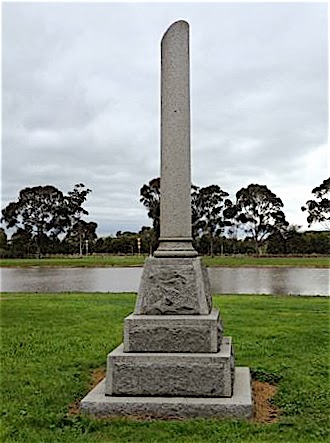
Photograph: Werner Schmidt
Showing posts with label Australia. Show all posts

Monday, November 11, 2013

The Oarsmen’s Cenotaphs*

The Cenotaph in London, the United Kingdom’s primary national war memorial. In years gone by, men raised their hats when passing it. Picture: Arpingstone/Wikipedia.

Tim Koch writes:

The 11th November is a memorial day observed in many countries around the world to remember the members of their armed forces killed in war. While the poignancy of remembering on the 11th hour of the 11th day of the 11th month is very obvious, in some nations the day on which the major ceremonies of remembrance take place has shifted over the years. In the United Kingdom the main observance is now on Remembrance Sunday, the second Sunday of November (though observance of the two minutes silence on the 11th seems to have increased in recent years). Australia has joined New Zealand in putting more importance on ANZAC Day, 25th April. While the United States observes Veterans’ Day on 11th November, it is Memorial Day in May that is now the focus of national observance. Canada keeps the 11th November as Remembrance Day and as a national holiday. ‘Poppy Day’ is especially relevant here as it was a Canadian, John McCrae, who wrote the poem, ‘In Flanders Fields’ which resulted in the poppy becoming the powerful symbol that it is today.

Hugh Riviere’s In The Golden Days which forms part of the War Memorial at Thames Rowing Club.

HTBS has written on the subject of rowing clubs and War Memorials many times before. We have covered the monuments of British clubs Vesta, Marlow, Thames and Auriol and Kensington. Further afield, we have written about the impressive plaque in Vancouver Rowing Club in Canada and the unusual memorial to the oarsmen of the four Nottingham clubs. I thought that we may have exhausted the subject until I discovered the ‘Monument Australia’ website. To quote its home page:

The Monument Australia website is a historical and educational research site which records the public monuments and memorials in all Australian States and Territories under various themes.... Monuments and memorials reflect important values within the community.... and this website aims to help in the preservation of this aspect of the cultural history of Australia.

Naturally, I put ‘rowing’ in to the search facility and, while many results were not relevant, there were five rowing club War Memorials that could be termed ‘Cenotaphs’, all from the state of Victoria.

The Barwon War Memorial. Picture: Nancy Alford/Monument Australia.

A broken column is the memorial for Barwon Rowing Club. It can symbolise a fallen leader or unfinished work and was used on tombs for those whose life was deemed cut short.

The Bairnsdale Memorial. Picture: Graeme Saunders/Monument Australia.

The Bairnsdale Rowing Club War Memorial is an obelisk dedicated to the fifty-seven enlisted and fallen members of the Club who served in the First World War.

The Hawthorn’s Memorial. Picture: Kent Watson/Monument Australia.

A blunt and stereotypical Australian inscription on the Hawthorn Rowing Club memorial states ‘They fought. They fell’.

Alexandra Gardens showing the Yarra River & Melbourne City Skyline. The Judges’ Box mentioned below is on the far end of the left bank. Picture by Donaldytong/Wikipedia.

The city of Melbourne has two monuments to fallen oarsmen and they are both, I think, unique. They are the Victorian Rowing Association Memorial and the Victorian Rowing Association Judging Box. Both are situated in Alexandra Gardens on the south bank of the Yarra River. This is Australia’s equivalent to Philadelphia’s Boathouse Row or London’s Putney Embankment as it is home to seven rowing clubs. They are Melbourne University BC (1859), Melbourne RC (1862), Richmond RC (1863), Banks RC (1865), Yarra Yarra RC (1871), Mercantile RC (1880) and La Trobe University RC (1969). The Henley-on-Yarra Regatta started here in 1904 and, until the Second World War, was a very important rowing and social occasion with attendance peaking at 300,000 in 1925. Film evidence from 1933 is here.

Boathouses along Alexandra Gardens. Picture: Tony Hodder.

The Victoria Rowing Association Memorial lists 320 rowers from 30 Victorian clubs who died in the First World War. There were 2,100 members of the VRA in 1914 and more than half of them enlisted. Of these, nearly a third were killed. The monument has been recently restored and a rededication service was conducted at the Australian Henley Regatta on 23 February, 2013.

The VRA ‘Oarsmen’s Cenotaph’. Picture: Tony Hodder.

Hopefully the 1914-1918 Oarsmen’s Memorial Judges’ Box just down from the boathouses near the finish line of the regatta will soon merit restoration as well.

The 1930 built Judges’ Box. Picture: Graeme Saunders / Monument Australia.

The Box shows its age. Picture: Tony Hodder.

As an aside, there is an interesting (though not absolutely proven) story surrounding the timing of the formal ending of hostilities on 11th November 1918. The Armistice was signed in a railway carriage, 60km north of Paris. Britain’s official delegate, Admiral Sir Rosslyn Wemyss, was ordered by Prime Minister David Lloyd George to have the end of fighting set for 3pm to coincide with a sitting of the British House of Commons. This would allow Lloyd George to theatrically make the announcement to an assembled and expectant Parliament and to bask in the reflected glory of victory. Admiral Wemyss allegedly thought that the delay would cause more unnecessary killing and felt that 11am, ‘the eleventh hour’, had a certain pathos. He was right.


*Cenotaph: A monument erected in honour of a person or group of people whose remains are elsewhere.

Friday, May 24, 2013

More on Murray Bridge and ‘The Cods’

The News, 16 July 1924.

HTBS’s Greg Denieffe writes,

My fellow HTBS-arian and Australian rowing historian Louis Petrin has kindly contacted me regarding the recent post “The Case of Cod v Cods”. Louis writes:

‘Here is a voice recording of an interview in which Christine McRae (mother of James, a Murray Bridge rower who went on to the 2008 and 2012 Olympics) says that the Cods won the race in Ireland.  Sadly, Christine is mistaken, although it would have been nice for these guys to have won something after all their efforts.

I have also found a mention of the race on the front page of local South Australian newspaper, Bunyip for Friday 22 August 1924:

Glad to know that you were on the ball: there’s nothing worse than facts being wrong and repeated. I will endeavour to write to Christine and to the various local websites pointing this out.

My view was that these guys tried as best as they could but everything was against them and it was probably the case that they competed against better rowers anyway.

The facts are, that to travel to Europe, they had a lengthy boat journey, they did not have the best equipment, although it’s hard to know why because here in Oz we did have some good boat builders, and there was no money to pay for basic things like lodgings, food, etc. But in the spirit of good sports, they gave it a go. They were not the first, nor last, to face such challenges. We need more stories on “losers” as the way they behave in losing defines them as winners.’

The Tailteann Games and the progress of the Murray Bridge crew were widely reported in the Australian papers. On the 1 August, 1924, the Sydney newspaper The Arrow questioned the eligibility of the crew to participate in the Aonac Tailteann (Tailteann Festival). The Sydney Morning Herald on the 18 August, 1924, in an article very similar to that printed in The Irish Times, reported on the three international races between the Irish and Australian crews. A local newspaper The Register reported on 6 October, 1924, that the crew were ‘Home Again’ as follows:

There was a large crowd of enthusiasts it the Outer Harbour on Saturday afternoon to welcome the Murray Bridge rowing crew, who were, returning by the R.M.S. Mooltan from London after participating in the Olympic Games. Interviewed on board the vessel, Sir C. A. M. West (manager) said that although the crew were disappointed at not getting pride of place, they were by no means discouraged, and were as keen oars men as ever. Much had been said of their inability to secure the desired success, but he would say, to express the sentiments of the members of the crew, that the best eight won. The trip had been most beneficial in more ways than one. All were enjoying good health. The crew had not practised since the Tailteann Games at Dublin, in August, so were now well rested. At the Olympic contest he was greatly impressed at the fact that the crews favoured the swivel rowlock and that the Americans used a longer slide, which appeared to help the men in their, swing and reach. The crew were in England only a few days, and were not greatly impressed by the English summer, as it rained continuously. The Thames Rowing Club very kindly made the crew honorary members for the time of their stay, and offered them the use of racing boats. In the Irish sports the Australians generally were successful, and secured 29 medals. The crew were defeated by Derry after a grueling contest. After participating in the eights and fours Pfeiffer secured pride of place in the sculling event on the same day.

Thanks to Louis, I was able to find the voice recording made by ABC Adelaide and broadcast last March on their 891 Drive programme. The radio station’s website introduced the show as follows:

Murray Cods at Paris Olympics

In 1924 the Murray Cods, a team of rowers from Murray Bridge, also known as ‘the raggedy eight’, competed in the Paris Olympic Games. [Actually it was the Murray Bridge crew of 1913 that were known as The Raggedy Eight].

But to get there they had to overcome all sorts of problems - class snobbery, interstate rivalry, being past their prime, lack of finances and transportation. They even sold a bullock to raise cash for their journey, then busked on the streets of Paris for expenses.

Local historian Christine McRae, whose son is in training for the London Olympics, talked with Michael Smyth on 891 Drive.

 
Chris talks us through the period from 1913 to 1924 when Murray Bridge were the premier crew in Australia; through WWI in which the club lost eight of its members and through the very successful post-war period up to the 1924 Paris Olympics.

You can listen to the 12-minute programme here.

Photograph courtesy of the State Library of South Australia - PRG 280/1/29/198

As readers of HTBS will know, it was the City of Derry Boating Club and not the USA crew from Yale mentioned in the broadcast that defeated Murray Bridge. Nevertheless, it is well worth a listen. There are a couple of interesting callers to the show and a remarkable disclosure of true friendship shown by the crew to Wally Pfeiffer, who some people wanted banned from representing Australia. 

Chris and her son James after the 2012 Olympic quadruple sculls medal ceremony. Photo ©Stock Journal

The Stock Journal, a website that covers agricultural, political and general news affecting people and businesses in rural, regional and corporate Australia, reported on 7 August, 2012, as follows:

JAMES McRae has become the most decorated athlete in the 103-year history of the Murray Bridge Rowing Club after winning a bronze medal at the London Olympics.McRae and his Australian men’s quad scull team-mates… rowed their fastest race for the season to claim third place at Eton Dorney on Friday. The full article is here and you can watch the full race here.

I was lucky enough to be there to see James win his bronze medal and here’s my ticket for that momentous day.


James has now been selected for the Australian 2013 team as part of a coxed pair with fellow South Australian, Tim Conrad. According to the Rowing Australia website, “This crew may compete in the Coxless Pair, subject to them meeting determined performance criteria prior to 25th July.”  Who knows, he may even return to Eton Dorney in June for the Rowing World Cup.

Friday, May 3, 2013

The Case of CoD v Cods

International Rowing Trophy from the 1924 Tailteann Games.

Greg Denieffe writes from England,

Lovely Derry on the Banks of The Foyle - by J. J. McCready c. 1920
I know a wee spot, it’s a place of great fame
It lies to the North, and I’ll tell you its name
It’s my own native birthplace, and it lies on Irish soil
And they call it lovely Derry on the banks of the Foyle

In August 1924, the Tailteann Games was revived in Ireland. The fact that rowing was one of the sports included, coupled with the fact that the Olympic Games had recently been held in Paris, gave rise to the participation at the Games of the Australian Olympic eight.

Murray Bridge Rowing Club from South Australia had been nominated for the Olympics by a panel of selectors chosen by the State Associations to represent Australia, on condition that they met any challenges on the Port Adelaide course. Having won the 1922 and 1923 King’s Cups (Interstate Championships) Murray Bridge were the form crew, but doubts over their rowing style and the fact that the Olympic regatta was to be raced over 2,000 meters, whilst their King’s Cup victories were over three miles (4.8 km), led to their conditional selection.

The race to finalise selection between Western Australia, Tasmania, Victoria and the South Australians was held on 9 March, 1924, on the course stipulated by the selectors. An epic struggle ended in victory for the Murray Bridge crew by a canvas (deck) and so their Olympic selection was confirmed.

Members of the Murray Bridge Rowing Club, with officials and supporters, following the test race on the 9 March, 1924. Photograph courtesy of the State Library of South Australia - PRG 1258/2/1673.

The crew were nicknamed the ‘Murray Cods’ and whenever they raced; they had a small stuffed Murray cod tied to the bow of their boat. According to the Club’s website, they wrote to the Stewards of Henley Royal Regatta, with a view to racing there, as preparation for the Olympics. “A return letter politely informed the crew they were not welcome to participate, because with the exception of Sladden, all were working class and only gentlemen rowed in Henley on Thames”.

The crew travelled to France with the rest of the Australian Olympic team and on arrival they had to row their boat 37 miles (60 km) to their training camp. It is not surprising that the crew underperformed at the Games: on the day of their heat, in which they finished second to Italy but ahead of Spain, they rowed their boat 26 miles (42 km) from their boat house to the course on the River Seine. In the repêchage they finished third behind Canada and Argentina, but ahead of Belgium. Canada went on to win the silver medal behind the USA crew from Yale. Dr. Benjamin Spock, seven-seat in the victorious USA crew and his 1956 letter to ‘Rusty Wails’ comparing the 1924 crew with that of 1956 was the subject of a six-part article on HTBS in May 2011.

Murray Bridge Rowing Club represented Australia at the 1924 Olympic Games. Harry E. Graetz (Bow), Edward D. Thomas (2), Wally E. H. Jarvis (3), Arthur V. Scott (4), Alf C. Tauber (5), Walter H. Pfeiffer (6), Frank M. Cummings (7), William M. Sladden (Stroke) and Robert A Cummings (Cox).

After the conclusion of the Olympic regatta on the 17 July, the Australian eight travelled to Ireland to take part in the Tailteann Games, held in Dublin between 2 and 18 August. As part of the Games, a four-day regatta was held over the Islandbridge course in the west of the city on the non-tidal River Liffey.

Reproduced from City of Derry Boating Club 125th Anniversary Regatta programme (3 May 1986).

The races were arranged in two sections, National and International. In the former class there were events for senior and junior eights; senior, junior and under-age (under 21) fours; and senior and junior sculls. The International section was for the winners of the National senior eights, fours and sculls who were to race the Australian Olympic crews.

The rowing section of the 1924 Tailteann Games was held on 13-16 August.

In 1924, rowing in Ireland was finally getting back to full strength following the War of Independence and the Civil War. All the usual fixtures were restored and there were two outstanding senior eights: City of Derry Boating Club (CoD) and Bann Rowing Club; that dominated the most important regattas. City of Derry won at their home regatta and at Dublin University, but was narrowly beaten by Bann in the Irish Senior-Eights Championship. They met again in the semi-final at the Tailteann Games and Derry emerged winners by half-a-length. The following day, they won the final rather more easily, beating Citie of the Tribes by 2½ lengths. The senior fours was also won by the Derry club and the senior sculls was won by C. T. Denroche, Lady Elizabeth Boat Club. These crews would now face the Australian visitors on the final day of the regatta in the International races.

British Pathé in a film titled Irelands Sporting Festival 1924 appears to show both crews posing for a group photograph. It then shows the Australian Oarsmen at work on the Liffey and is quickly followed by a shot of the Australian crew posing on the bank with their oars.

IRELAND'S SPORTING FESTIVAL


T. F. Hall in his 1939 book, History of Boat-Racing in Ireland describes the races between ‘CoD and the Cods’:

The International Fours race was first on the programme and fast and powerful as were the Australian visitors, Derry soon had their measure. Australia went for the race at the start and with an early lead looked like scoring. Derry held them, half a length astern, to half-way and then made their first real effort. Well backed by his crew, R. S. Bolton spurted and steadily the Australians came back. At the Wood the boats were level and then came Derry’s second effort, and, as it proved, the decisive one. Slowly Derry went ahead to lead by a quarter-length at the enclosure. Australia, however, were not done with and down the straight spurted strongly only to find their opponents replying in kind. The Australian effort died away and Derry drew out at the finish, good winners by three quarters of a length.

The International Eights race followed a couple of hours later. Gaining courage from their four’s meritorious victory the Derry crew went to the start full of confidence and made full use of the experience of the earlier race. This time they got the start and held a slight lead to the bend rounding which bad steering by Australia nearly resulted in a foul, but Derry sportingly gave way, thereby losing a quarter-of-a-length. This they recovered in the straight to the Wood and at the half-way mark the race was won. The pace was telling on the visitors who became short in the water and Derry were never afterwards in danger, ultimately winning by one-and-a-half lengths in 6 minutes 12 seconds.

The Australian eight showed one change from the crew that raced in Paris; G. Tucker replacing W. Jarvis in the three-seat. W. H. Pfeiffer, who also raced in the Australian four and eight, beat C. T. Denroche in the International Sculling Race bringing home a Tailteann Games medal similar to that shown in a previous HTBS post.

Hall also reported on the celebrations that followed racing:

In the evening the Australian crews were entertained to dinner at the Metropole Restaurant by the Irish Amateur Rowing Union. Mr H. J. Anderson (Galway), Vice-President, occupied the chair and a very pleasant evening wound up a successful four days’ rowing. Replying to the toast of “Our Guests,” Mr C. A. M. West, Manager of the Australian Olympic crew, stated that they had thoroughly enjoyed their visit and their races. On behalf of the crews he heartily congratulated the winners on their rowing and, in memory of the occasion, he presented to the I.A.R.U. the boat in which the Australian eight rowed. The Union subsequently presented the boat to the City of Derry B. C. whose representatives had so worthily upheld the honour of Irish rowing in these memorable races.

City Of Derry Boating Club with the 1924 Tailteann Games Trophy. The victorious Derry eight was: R. A. Coulter (Bow), J. N. Brownslaw (2), K. P. Donegan (3), D. R. Keown (4), E. G. Biggar (5), V. S. Ward (6), T. D. Ward (7), R. S. Bolton (Stroke) and W. Smith (Cox).

In an article printed on Monday 18 August, 1924, The Sydney Morning Herald reported on the Irish Games, covering Athletics, Cycling, Rowing and Lawn Tennis. The Australian’s defeats in Paris and Dublin were put down to the crew being too old (the average age was 32) and reported that their manager had announced that the crew would probably disband on its return home. Perhaps the greatest source of material on the Murray Bridge trip to Paris is that held by State Library of South Australia. The family of the Australian coxswain, Bob Cummings, donated his diary, photograph albums and memorabilia to the library and has given permission to the library to feature the items on the library’s website. On pages 78 to 81 of his diary, Bob wrote about the trip to Ireland as follows:

August 1st
Off for Ireland. Had a wonderful trip through England & Wales to Holyhead on way to Ireland very pretty. London & Midland & Scot – Express arrived Holyhead 3p. Boarded boat sailed. Blew & rough as -. 937 pasgrs on board. Standing room & 2 thirds were sick, myself nearly not quite. Very rough trip arriving in Kingstown Ireland near Dublin. Irish Games Committee met with car. Staying St Pats College Drumcondra. Beautiful living like lords treating us goodo.
Saturday Aug 2.
Opening Irish Games. Great display by Aussie led the athletics America next. Great show equal to Colombes. Bands plenty. 20,000 people. Irish v scotch “shinty” good game.
Aug 3rd, 4th, 5th, 6th, 7th, 8th, 9th, 10th.
Having glorious time. Training on the liffey at Neptune shed. Good. 4s. 8s race on the 16th. Have been several shows all fair. College great. Strike over. Can see results of great war, ruins in street. Several tours were O.K. have been several. Howth Capt O’Toole at the lake.
Aug 11th 12th 13th 14th 15th 16th
Still having good time in Ireland. We were beaten in racing 4s by ¾ length Derry from North & were beaten again in the 8s by 1½ lengths. Had a great dinner on night after racing was over.
Aug 17th
We packed up for home.
Aug 18th
Left Dublin. Some of our chaps had a nasty motor accident, capsized hurt one or two, in our taxi we ran over a dog, all going to station. The crew left for Belfast. Had a day’s look around there nice big place. Left for Glasgow at 9p

Having left home on the 8 May 1924, the Men from Murray Bridge finally arrived home on the 30 September. The adventure was over. In his diary, ‘Bob’ Cummings finishes his record of competing at the Games (page 71):  Had hard luck did our best.

South Australia  (Traditional)
In South Australia I was born
Heave away, Haul away
In South Australia ‘round Cape Horn
We’re bound for South Australia

Saturday, November 26, 2011

New Biography On Professional Champion Michael Rush


Australia has a rich tradition of professional sculling. Many of the Australian scullers reached the very top and became world champions at a time when rowing and sculling was the premiere sport in English-speaking countries. News arrived to HTBS the other day that a new rowing biography, Michael Rush: Champion Australian Sculler by Stephen Gard, has been published this autumn. The book is about the Irish immigrant Michael Rush (1844-1922), who with his six feet and 13 stones became a powerful oarsman on the Clarence River in northern New South Wales. He soon became Champion Sculler of the district, and later Champion of Australia.

In 1874 and 1875, Rush had beaten the prominent sculler Ned Trickett twice, but declined to scull against Trickett for the Championship title on the so called Championship sculling course on the Parramatta River in Sydney, instead demanding the race to be on his homewater, the Clarence River. Trickett refused and went to England to challenge the world champion, Joe Sadler, on the Thames in June 1876. Trickett won and returned home to Australia in triumph. Almost exactly a year later, Rush raced Trickett for the world title, but was severely beaten. He would never be able to win the world title, but he is “remembered for his unfailing courage, humour, warmth, and true sportsmanship, and he has earned a place in Australia’s history”, a press release mentions from the publisher, Bluedawe Books, Australia.
Book information: Michael Rush: Champion Australian Sculler by Stephen Gard is a hardcover edition with dust-jacket. Decorated endpapers. Illustrated throughout in black and white, plus maps, and six pages of colour plates. Includes Bibliography, Index, Glossary of Sculling Terms, and Chapter Notes, 320 pp., ISBN 978-0-646-55987-2. The book was published in September 2011 in a limited edition of 500 copies. Book weighs 1.60 kg packed. $AUD38.00 (plus postage).

Read more about the book and how to order a copy here.

Monday, October 4, 2010

History Of Australian Rowing

In an e-mail earlier today, Sam Golding in Melbourne kindly reminds me about Andrew Guerin’s and Margot Foster’s History of Australian Rowing. He writes that Guerin and Foster “set out historical Australian results and world and Olympic race results with brief descriptions of races. It is fantastic as a resource.”

I certainly agree. They have done a tremendous work, and I am ashamed to say that their eminent rowing history site had slipped my mind. From now on, the HTBS readers will find a link to History of Australian Rowing on the right under ‘Good Rowing Links’. My thanks to Sam Golding ‘Down Under’ for pointing it out.