Photograph: Werner Schmidt
Showing posts with label Bump races. Show all posts

Monday, June 9, 2014

Bumps to the Head: The 2014 Oxford Summer Eights - Part 1

The view from Folly Bride showing the Oxford college boathouses and the finish of the bump racing course. The pall of smoke hanging over the scene is from numerous barbecues run by the various boat clubs. I had expected that Oxford would provide a lunch of roast swan or perhaps plovers’ eggs send down from Brideshead, but instead I had to content myself with a couple of burnt sausages.

Tim Koch writes:

It is a truth universally acknowledged that the British, if they possibly can, will take a perfectly sensible sport and devise a race:

1) With rules so complex that they are impenetrable to any outsider.

2) Which is so potentially dangerous that, had it been invented today it would be banned.

3) Where there is a clear hierarchy that is very difficult to challenge.

3) That has its own nomenclature and arcane rituals.

4) Where the spectators can drink copious amounts of alcohol in very pleasant surroundings and treat actually watching the racing as an option.

The form of boat racing known as ‘bumps’ at Oxford University’s ‘Summer Eights’ or ‘Eights Week’ ticks all these boxes – but this is not a criticism. In fact, ‘Eights’ is a brilliant and fair way of allowing the maximum number of participants of extremely varying abilities to race on a most unsuitable stretch of river and, moreover, it results in a large proportion of them becoming ‘winners’ in one way or another.

A (distorted) early afternoon panoramic view of many of the college boathouses, which are actually on a little island formed by the River Cherwell forking as it flows into the Isis (as the Thames at Oxford is known). My report on the history of Oxford boathouses was on HTBS in April 2013 and there is a map of the Isis here.

A typical scene early in the racing day, before the big crowds arrive. The Jesus College boathouse is on the left and that of Keble College is on the right.

Alumni show the youngsters some style.

On Saturday, 31 May, I was very pleased to be the guest of Jack Carlson, the coach of the Oriel College Men’s First Eight, at the fourth and final day of the 2014 Summer Eights. It was a very good year to be associated with Oriel as their top men’s crew went ‘Head of the River’. In this post, part one of my report from Oxford, I will explain what this means, attempt to show how Eights Week works and try to convey some of the atmosphere of this great occasion. In part two I will concentrate on Oriel Boat Club, its Head Crew and some of the wonderful traditions that surround one of the most successful of all the Oxford University college boat clubs.

The last ‘college barge’ left on the river. Unfortunately, it is now a private residence. The HTBS report mentioned above gives a short history of Oxford barges which were once used in place of boathouses.

Human sacrifices of coxswains are permitted during Eight’s Week. Here, Trinity offer up their cox to the God of Rowing.

Term is not yet over. Spectators in a punt get some work done between races.

In ‘bump racing’ a number of boats chase each other in single file, each trying to catch (‘bump’) the boat in front without being caught by the boat behind. In Summer Eights physical contact is not actually required (though there often is) and once there is overlap of bow and stern, the ‘bumped’ cox should raise his/her hand and concede. The first such race recorded at Oxford was in 1815 when Brasenose raced Jesus. It originated because the river is too narrow for side by side racing. Both at Oxford and at Cambridge (where the river is also tight) there are two sets of bump racing per year, one in early spring and one in early summer. On the Cam they are called ‘Lent Bumps’ and ‘May Bumps’ and on the Isis they are known as ‘Torpids’ and ‘Summer Eights’. The exact rules of each event vary in detail.

Women’s Division 5. Jesus II bump Worcester III after a few seconds of rowing.

Men’s Division 2. Lincoln concede a bump by New College opposite the island boathouses.

Men’s Division 2. Pembroke II bump Christ Church II very near the finish.

Summer Eights are held over four days and consists of seven men’s and six women’s divisions. Each division has thirteen boats and 35 of the colleges that make up the University of Oxford enter in total between two and (this year) nine crews of varying ability. There is a divisional race every 30 - 40 minutes, alternating between the men and the women.

In high divisions where crews may contain Elite rowers, Blues or even Olympians, the racing can be close and may last for much of the course, but in lower divisions the difference in standard between crews and coxes increases and so does the general chaos. Here bumps can happen very soon after the start. If the speed of two boats is dramatically different then boats can be damaged – to the despair of the boatmen but to the delight of the spectators. The boats in the lowest divisions may consist of crews that a college football team or tennis club has put together for the occasion. The rule of thumb is that if a crew is wearing Lycra in their boat club colours, they are probably serious rowers. If a boat consists of eight fairies coxed by a giant chicken, they are almost certainly not real ‘boaties’. In her blog on the 2008 Eights, Sarah Laurence said of the lower divisions: Curiously, the combination of highly unmanoeuvrable boats, inexperienced coxes, high speeds and confined spaces doesn’t always end well.
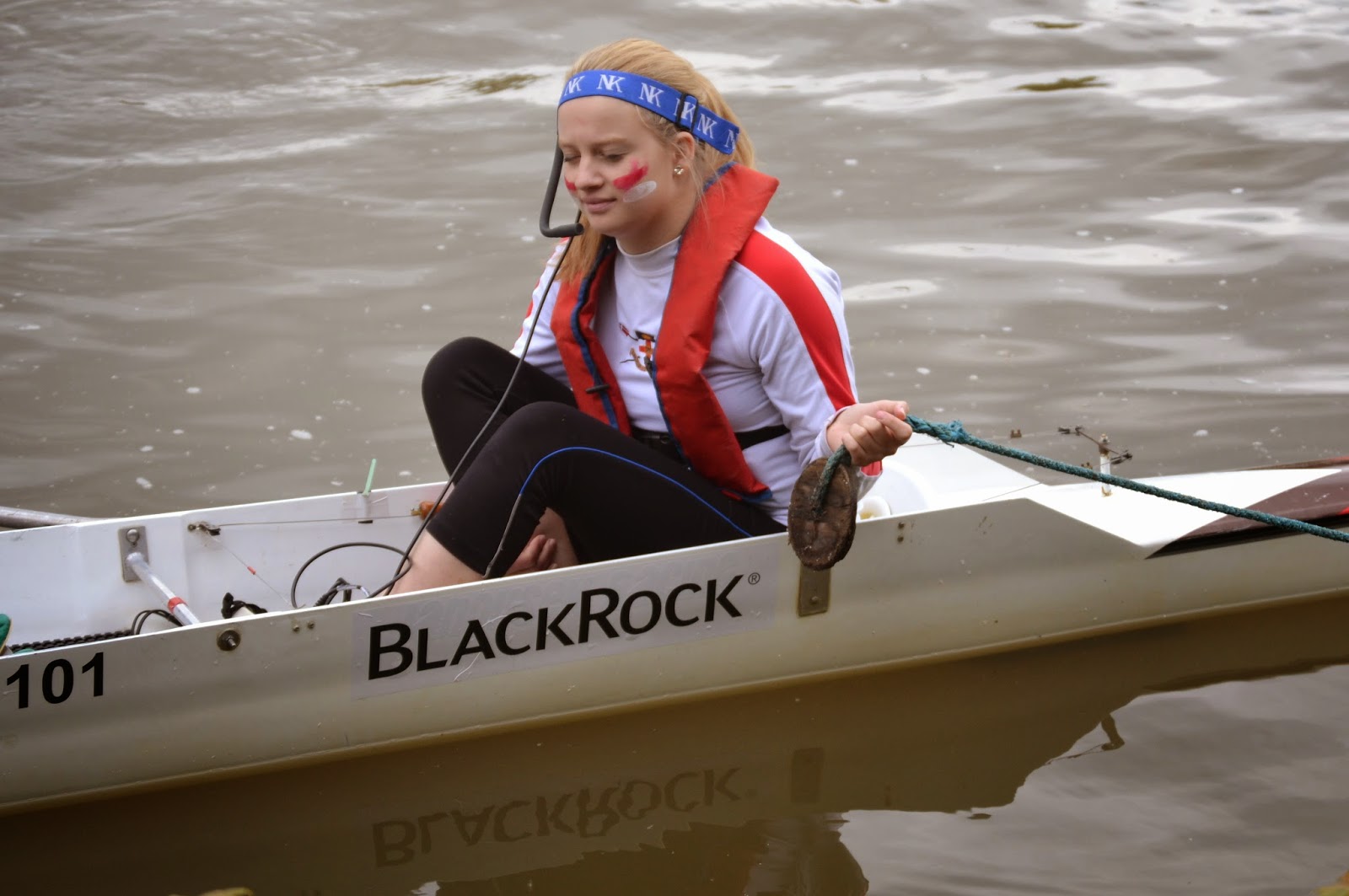
The rules state: Each boat shall be started from a rope 50 feet in length, held by the coxswain, with the other end of the rope fastened to a post on the tow path. The distance between each starting post shall be 130 feet (40 metres). Here the cox for Regents Park Boat Club in Women’s Division 5 holds her starting rope.

Women’s Division 5 on the start. The boatmen use long poles to stop the boats drifting in or out too far. With about 20 seconds to go they gently push the boats out from the bank (the coxes still holding the ropes) and the crews ‘come forward’ ready to race in anticipation of the shot from the starting cannon. In former times the boatmen would drink beer between races and this often resulted in impaired and rather dangerous handling of the unwieldy poles by the end of the day.

Men’s Division 5 take their first stroke.

On the first day of racing, the starting order of each division is the finish order of last year’s race. In Summer Eights, when a bump is made both boats pull over to the side and do not race any more that day. The result is that crews often have to sprint continuously and not ‘settle’ in mid-race as in normal regattas. Crews who successfully bump the boat in front of them (or ‘bump up’) exchange starting positions the following day. Thus, over four days of racing a crew may only rise a maximum of five places and this means, for example, that to go to ‘Head of the River’ in any one year, you have to start in the top five of Division One. For many boat clubs, any chance of getting to the top of their division means that they need several years of ‘bumping’ their way up their table of thirteen crews. A look at part of this year's 'bump chart' may make things clearer.

Men’s and Women’s Division One, 2014 Summer Eights.

Taking the top three men’s crews as an example, the above chart shows that in 2013 Pembroke College (PCBC) were ‘Head’, followed by Christ Church (ChChBC) and then Oriel (OCBC). On the Wednesday of the 2014 Eights, Pembroke did not bump and were not bumped (i.e. they ‘rowed over’) and so they stayed in first place. However, Oriel bumped Christ Church so OCBC went up to second place and ChChBC went down to third place. On the Thursday, the second day, Oriel bumped Pembroke and Christ Church rowed over. Thus Oriel went up to first place, Pembroke went down to second place and Christ Church stayed third. They all remained in these positions for the next two days of racing as none of them bumped or were bumped, that is they all rowed over. There is a further complication – the boat that finishes first in each division may row as the ‘Sandwich Boat’ at the bottom of the division above in the same day’s racing. If you understood this you are ready to look at the full 2014 results, here for the men and here for the women.

Men’s Division 5. Oriel III about to bump Trinity III. They are in ‘The Gut’, a bendy part of the course that many inexperienced (and some experienced) coxes have failed to negotiate.

A view from Donnington Bridge near the start. In Men’s Division 5, Regent’s Park chase Christ Church III. They eventually bumped them.

Tim Foster, Olympic Gold medallist in coxless fours in 2000, now an MBA student at Keble. Here he is umpiring before he rowed in the Keble First VIII in Division One later in the day. A crew mate in the boat was Storm Uru, the New Zealand Lightweight International and bowman of this year’s victorious Blue Boat. In the end, Keble bumped on three of the four days.

I managed to catch a few words with Tim, widely regard as one of the all time great technical rowers, especially effective in the vital but often unrecognised seat behind the stroke.

Tim K: An obvious question, you are rowing in a boat of a slightly lower standard than you have done in the past, what’s the attraction?

Tim F: Well, partly I am a slightly lower standard rower than I was in the past but also it’s been really good fun, it has reminded me of what rowing is about and it’s been a great chance to come back and race after about 14 years of retirement.

Tim K: You have a younger superstar to help you out, Storm Uru, how’s that?

Tim F: Actually it’s great. I think he’s claimed that I’m in the boat to make him feel not so old .... It’s been great to row with him and to see why he’s such a champion....

Tim K: And now you’re helping out before you race, very much in the spirit of the event.

Tim F: Yes, it’s a great event and it relies on everyone doing their bit, so this morning is my turn.

Men’s Division 2. St Peter’s get their reward for bumping every day and so getting ‘blades’.

The view from the top of Christ Church boathouse at the end of the island. This shot was taken towards the end of the day when the crowds had swelled, awaiting the final races in Men’s and in Women’s Division One.

Women’s Head of the River 2014: Wadham. From bow: Madeleine Butler, Anne Binderup, Lia Orlando, Rachel Anderson, Canna Whyte, Stephanie Hall, Alkaterini Mandaltsi, Elizabeth Zotti, Nicola Rodgers (Cox).

In the beginning of this piece, I indicated how clever this form of racing is, accommodating over 1500 rowers of widely differing abilities on a narrow river. I also said that it produced a fair number of ‘winners’. The obvious ones are the men’s crew and the women’s crew that go to the top of Division One, i.e. go ‘Head’. But there are those who get to the top of their respective divisions who also consider themselves victorious. Further, many are very pleased if they make one or more bumps. Those who bump every day are awarded the coveted ‘blades’, that is a illuminated oar emblazoned with the names of the crew and of the boats that they bumped (though ‘awarded’ is perhaps not the correct term, you have to buy your blade if you want one). Others are happy if they simply avoid getting bumped and go neither up nor down.

Even the worst rowers can gain satisfaction as a crew that is bumped every day gets ‘spoons’. The ‘wooden spoon’ is usually a non-literal award to a person or team that comes last in some event. HTBS did a nice post about them here. The award of spoons may in fact be welcomed as traditionally the British take great pride in doing something really badly. We like to dwell on our ‘glorious failures’ such as the Charge of the Light Brigade, the retreat from Dunkirk or Scott’s race to the South Pole rather than promulgate our historic successes (assuming that we have any). It sometimes seems that we are more impressed by those bumped ten strokes off the start than by those who go ‘Head of the River’. Win or lose though, Summer Eights is a great event.

Men’s Head of the River, the final order. Oriel, Pembroke, Christ Church, Magdalen.

Head of the River 2014: Oriel. From bow: Charles Cornish, Rufus Stirling, Kelvin Jackson, Calum Pontin, Malcolm Howard, Christopher Fairweather, John Redos, William Zeng, Olivia Cleary (Cox).

Part 2 will be posted tomorrow!

Monday, April 22, 2013

Oxford: Beer, Boathouses and Barges

A coxed four on the Isis with Christ Church Meadow in the background. Christ Church (one of the forty-four colleges or halls that together comprise the University of Oxford) was founded in 1524 and alumni include Sir Christopher Wren, John Locke, John Wesley, William Penn, W. H. Auden and Lewis Carrol. Of these, only Carrol rowed (though Penn did found one of the great rowing States).

Tim Koch writes from London,

Just over a year ago I visited the Cambridge Lent Bumps where I was particularly struck by two things. One was the madness that is ‘bump’ racing and the other was the sight of the beautiful Victorian boathouses that belong to many of the Cambridge colleges. A report on the latter is a HTBS story that has yet to be written as I did not have time to cover the bumps and to investigate the many attractive buildings that line the River Cam along Midsummer Common. However, on a recent trip to Oxford I decided to investigate the Dark Blue’s equivalent, the college boathouses by Christ Church Meadow along the Isis (as the Thames at Oxford is called).

My investigations started well. On approaching Folly Bridge, the western end of the approximately 2,000 metres of river between the bridge and Iffley Lock used by the boat clubs, I came across the appropriately named ‘Head of the River’ pub.

This panoramic picture shows the Head of the River pub on the left and the boathouses in the distance on the right. Like all pictures on HTBS, it can be enlarged by double clicking on it.

The ‘Head of the River’ sign. Appropriately the pub is owned by Fuller, Smith and Turner whose 350 year old brewery is based near the mid-way point of the Boat Race on the Thames at Chiswick, West London. They are great supporters of rowing on the Thames Tideway and they sponsor the Head of the River Fours and Hammersmith Amateur Regatta.

Most college boathouses are on the north bank of the river and, approaching from Folly Bridge, the first of these that I encountered was the shared home of Wadham, St Anne’s and St Hugh’s. It was built in 1990 and is most generously described as ‘architecturally inoffensive’ though ‘bland’ also comes to mind.

Oxford’s ‘Boathouse Row’ looking east from the Folly Bridge end. Wadham et al have the boathouse nearest the camera.

The next club houses are a semi-detached pair from 1968 belonging to Pembroke and St Edmund Hall. Both are utilitarian buildings, they are simply boxes with a roof terrace.

Pembroke may have a boring boathouse but at least they seem to be making full use of it.

The next two buildings are a pair, more attractive than their neighbours, slightly ‘art deco’ in style, their curving lines reminiscent of a 1930s liner. In fact they were built in 1964, one for Corpus Christi and St John’s and one for Jesus and Keble.

Jesus College and Keble College Boat Clubs.

Three more ‘boring boxes’ from the 1950s or 1960s follow, ironically housing some of Oxford’s oldest boat clubs. The trio are the bases for Brasenose and Exeter, then Lincon, Queen’s and Oriel, then Balliol and New College (typically of things at Oxford, ‘New College’ was founded in 1379).

The last three boathouses on the north bank are the oldest, dating from the late 1930s or 1940s. Their design is uninspiring though their red brick construction gives them some interest. The one on the left belongs to Merton and Worcester. The middle one houses Magdalen (usually pronounced "Maudlin"), Lady Margaret Hall, Trinity, and St Antony’s. The one on the right is occupied by Christ Church and is, appropriately perhaps, reminiscent of the chapel of an austere Protestant sect.

The south bank of the river has only two college boathouses but between them they house twelve boat clubs and include the most controversial building on the Isis. In 2007, University College opened an ultra modern £2.7m / $4.1m structure which subsequently won a Royal Institute of British Architects prize.

University College Boathouse. At least it’s not boring.

University College also shares with Linacre, Somerville, Wolfson, St Benet’s and St Peter’s. This most modern of buildings is on the site of a very traditional one, the former Oxford University Boat Club boathouse. The old building was an ornate, typically Victorian riverside construction which was erected in 1881 by University College who then leased it to OUBC. Sadly, it burnt to the ground in 1999 taking much of the University Boat Club archive with it. OUBC did not take a lease on the replacement building as its crews now train on better water in Wallingford where a state of the art boathouse was opened in 2006.

The other boathouse on the south bank is in a safer, more conservative and traditional style even though it was only built in 1996. Long Bridges Boathouse belongs to Hertford but also houses Mansfield, St Catherine’s, St Hilda’s and Templeton.

By the time I had got to Long Bridges I began to wonder why the Cam is lined with many beautiful Victorian boathouses while the Isis boat clubs have relatively modern and largely unattractive functional buildings? A coach that I fell into conversation with told me that the answer lies in the fact that originally Oxford college boat clubs based themselves not on land but on large ornate barges that were moored along the river in front of where the boathouse now stand. These were employed as locker rooms and to host social functions and for spectators to use as a viewing platform during bump racing and regattas.

College Barges along Christ Church Meadow in Eights Week, 1926.

Like the one above, most pictures featuring college barges seem to have been taken during ‘Eights Week’ such as the splendid photographs here and here. Strangely, the Flickr photostream of the Swedish Heritage Board has a couple of nice images, one of the Pembroke Barge and one of the St John's Barge. As this picture shows, transport to the barges from the opposite bank cared little for health and safety.

The first barges found their way to the Isis in the 1840s and were originally highly ornate craft built to be rowed by eighteen or more men with much ceremony in grand river processions by the ancient City of London trade guilds known as Livery Companies. By the mid-nineteenth century these processions were, after several hundred years, going out of fashion. Luckily this coincided with the rise of amateur rowing at Oxford and so the barges were sold off to become the static headquarters for the emerging boat clubs. They were adapted slightly to their new role but the spirit and grand appeal of the original ceremonial craft was maintained.

This barge belonged to Jesus College between 1911 and 1964. It is now moored at Richmond, West London and functions as a restaurant.

The stern of the Jesus barge.

Some detail on the Jesus barge. It was formerly painted in the college colours of green and white.

For those who wish to know more about these craft, there is a book (which I have not read), called The Oxford College Barges: Their History, Architecture and Use by Clare Sherriff. It is published by Unicorn Press.

At their Victorian peak there were perhaps thirty barges moored along the Isis but their numbers declined throughout the first half of the twentieth century. In 1936, Christ Church was the first college to decide to replace their deteriorating hulk with a boathouse. At the time they were widely criticised though possibly more by the social types than the rowing men. Not only were barges very agreeable meeting places and viewing platforms during Eights Week, they were commonly towed down to Henley to serve the same purpose during the Royal Regatta. The final abandonment of barges between the mid-1950s and the late 1970s were all in favour of land based boathouses. In an article in The Times in June 1956 it was noted:

The boat club barges which bring an Edwardian grandeur to Eights Week in Oxford are one by one yielding their stations along the Isis.... To-day there are thirteen of them.... in little more than a year the number may be six or seven...... Rowing opinion in recent years has hardened against them...... Oxford rowing men are sternly bent on ending the long ascendency of Cambridge; and they feel that an important requirement is properly equipped boathouses.

The Times further quoted RH Carnegie, the then President of OUBC as saying:

I hope the barges will all be gone in ten years. I don’t mean this from the aesthetic point of view, but from the point of view of rowing. Boathouses are more efficient. The disappearance of barges is a sign of the fact that there is no longer a leisured class at Oxford.

Jesus, New, St John’s and Pembroke shared this barge for many years after 1857. The four doors each access the four individual changing rooms – which must have been very small and dark.

Considering their numerous disadvantages it is strange that barges lasted as long as they did. Firstly, anything that is made of wood and that sits in water will need constant and expensive maintenance – something that the Jesus barge at least could not have got as it actually sank in 1955. Secondly, the barges could not store rowing boats and, inconveniently, these had to be racked in boat sheds some distance away. Thirdly, conditions in the cabin changing rooms were cramped and squalid. In a 1936 letter to The Times regarding the then Cambridge domination of the Boat Race, GA Ellison, President of OUBC 1933-1934, said:

Cambridge with its boathouses makes rowing reasonably comfortable for all crews. The College Barge at Oxford makes rowing moderately comfortable for one crew, barbaric for the rest.

Finally, the plumbing in the barges was probably non existent. There were certainly no showers or baths and this extract from the history of St Catherine’s College Boat Club gives an insight into what served as lavatories as late as the 1960s:

The College Barge was still very much in use as a base for outings, and in 1964/5 we actually lived in it for some time to save money while doing long terms of research. We cooked on a gas stove and invented the Bucket and Blade Club for those who shared this probably illegal residence, and its basic bucket sanitation. John Haden, Captain of Boats 1965-1966.

By 1966, ten years after the 1956 Times article, only Hertford, Pembroke, Wadham and St Catherine’s retained their barges. Hertford’s went in that year, Pembroke’s two years later, Wadham’s in 1973 and in 1978 Catz was the last college to give up their relic of Victorian boating.

Tim aboard the barge formerly belonging to Jesus College. Now where’s that bucket...?

Another question arises. Why was the use of floating barges purely an Oxford phenomenon, why did Cambridge clubs base themselves on land from the start? Again, the answer is simple. The Cam is too narrow to comfortably moor barges and to allow reasonable space for rowing boats. Also, it was easy to get the former Livery Company boats along the Thames from London to Oxford. To move a barge from London to Cambridge would require a difficult journey via the sea.

Thus, the Light Blues built along the Cam in a time of Victorian confidence and affluence while their Dark Blue counterparts erected most of their boathouses in the 1950s and 1960s, a time of considerably less wealth and certainty. The difference is clearly reflected in the quality of the respective buildings. However, things are slowly improving along the Isis notably with the new University College and Long Bridges boathouses. It looks as if things will only get better.

As usual, the British Pathe cinema newsreel site provides wonderful moving pictures that serve as a memorial to this splendid (if not very practical) part of the history of rowing at Oxford. Watch it here.

© Photographs Tim Koch

Sunday, May 13, 2012

Isis - Troubled Water

Click to enlarge
It is May which means that it will soon be time for ‘Summer Eights’ or as it is also called, Eights Week, the bump races on Isis which is the biggest intercollegiate rowing event at the University of Oxford. However, some of the colleges have run into trouble as they have not been able to train on the river due to an extremely high water level, The Oxford Student wrote the other day. The newspaper has talked to some rowers who think it is unfair as some colleges’ rowers have been able to train outside of Oxford. Read the article in The Oxford Student here.

Reading this article about this four-day regatta, which has been rowed almost every year since 1815, except 1820, 1821, 1823, 1829, and during the War years, reminded me that I had an old programme, or ‘race chart’, from 29 May, 1929, showing the order of starting for the different crews.

One fun thing with these old ‘charts’ is the advertisements. In mine from 1929 you will find ads from ‘Grimbly, Hughes & Co.’ the food experts and wine & spirit merchants; the ‘New Theatre, Oxford’ is presenting “The Desert Song”; ‘The Oriel Restaurant’ on High Street has a full page ad; and so has ‘Arthur Shepherd & Woodwards’, the tailors, who has a special ‘flannel trouser offer’; E. M. Staniland is pushing for ‘King Weed’, which should be smoked in one of his ‘natural briars’; a couple of car dealers are selling ‘dependable used’ cars; buy flowers and fruit at ‘John Mattock’; or have your photograph taken by ‘James Soame’; or stay at ‘The Castle Hotel’ or ‘Becket House Hotel’, or see the Eights from ‘Salter’s Steamer’ where you of course can obtain tea on board; and ‘Elliston & Cavell Ltd.’ in Magdalen Street, which was established in 1823, offers ‘Everything for Ladies and Children’s wear’.

I am ashamed to say that I have only witnessed Eights Week for half a day in May 1998….

Wednesday, February 9, 2011

Killed By A Bump?

The legend says that oarsmen have actually died competing in the Cambridge bump races by being hit by the bow on a boat coming from behind. Earlier today, Greg, who is a loyal reader of HTBS, sent an e-mail with a clip from the Daily Mail on Monday, 7 February, where a Mail reader has even heard that a crew put a sword in the bow of their boat. True or false? See what the answer was in the Daily Mail by clicking here.

Oh, yes, Greg also wanted to assure me that he is not the reader of the Daily Mail, which is a "right wing tabloid", in his family. He states, "It in no way reflects my views. Glad to get that off my chest!" I agree, Greg, sometimes it feels good to get things of one's chest!