Photograph: Werner Schmidt
Showing posts with label Auction. Show all posts

Wednesday, November 6, 2013

Another F. S. Kelly ‘Henley Prize’ went under the Hammer

F. S. Kelly

Greg Denieffe writes:

A new Sporting Memorabilia sale by Graham Budd Auctions took place in Sotheby’s, 34-35 New Bond Street, London, on 5 and 6 November. The full catalogue is online and as in recent sales, there were a few lots (240-245) of interest to collectors of rowing memorabilia. Undoubtedly, the star ‘rowing’ item was a Ladies’ Plate Medal won by F. S. Kelly in 1899.

Lot 240

A Henley Regatta prize medal for the Ladies Challenge Cup in 1899 won by Frederick Septimus Kelly, the Eton College Stroke, the rim named to F.S. KELLY. F.S. Kelly later rowed for Oxford and Leander and won a gold medal at the 1908 Olympic Games as a member of the coxed eight. By profession he was a musician and composer. Having survived Gallipoli, Kelly was killed in action in the last days of the Battle of the Somme. Estimate: £300 - £500

Sold for £240 (plus commission, 17,5 %)

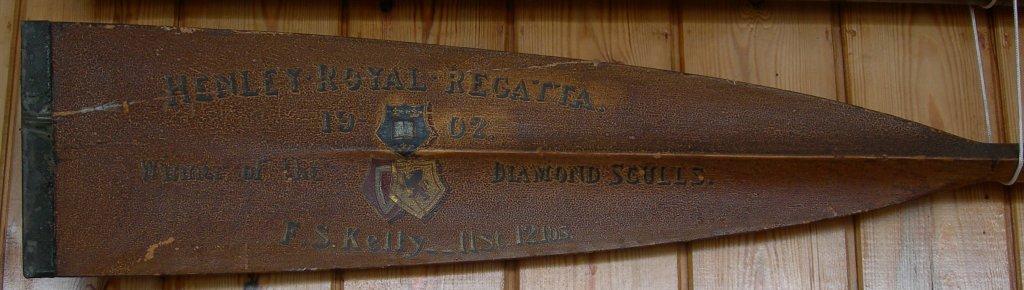
Early in 2012, HTBS reported that Kelly’s Pineapple Cup sold at Bonhams for £3,800. This was his prize for winning the 1905 Diamond Challenge Sculls, his third victory in four years. His first win in the Diamonds was for Balliol College, Oxford, when he won in 1902 beating Raymond Etherington-Smith in the final. Balliol College has the sculls in their historic collections centre in St Cross Church. The following year, sculling for Leander Club, he retained his title beating Julius Beresford, and in 1905 he defeated Harry Blackstaffe. Not to be outdone, the River and Rowing Museumin Henley has a 1905 scull in their collection.

Kelly, a New South Welshman by birth – his father was Irish – also won The Grand Challenge Cup at Henley three times in succession (1903-1906), The Stewards’ Challenge Cup in 1906 and a gold medal for Great Britain at the 1908 Olympics in the eights. He is remembered on the Bisham War Memorial.

Two other lots caught my eye:

Lot 244

Rowing programmes, Durham Regatta 22.6.1938; Maidenhead Amateur Regatta 3.8.1929; Henley Royal Regatta 2.7.38 & 5.7.52; Oxford University Summer Eights 26.5.1936, 22.5.1937 & 24.5.46; Oxford v Cambridge Boat Race 30.3.1946; Oxford University Torpids’ Race Card 21.2.1939; the lot also including a 12-page booklet Henley 1839, red cloth boards; and an Ouse Amateur Sailing Club Regatta at Denver (11). Estimate: £130 - £160

Sold for £110 +

A very diverse collection that would probably do well on eBay split into individual lots. The Henley booklet is rather grand considering it only consists of 12 pages.

Lot 245

A portrait of the British rower Tony Butcher by an unknown hand, oil on canvas, 68.5 by 53cm., 27 by 21in., framed. Estimate: £200 - £300

Sold for £150+

I like the composition of this portrait. The decorated oars are clearly important mementos of a rowing career that saw victory in the 1947 University Boat Race (Cambridge) and The Grand Challenge Cup in 1948 (Thames Rowing Club) and participation in the 1948 Olympic Games (Great Britain 4-).

My first thought on seeing this picture was that Cyril Bird would have enjoyed it. He used the pen name ‘Fougasse’ and in 1948 had a cartoon published in Punch with the caption "Yes, I did row a little at one time – why, how did you discover that?"  Perhaps Oscar Wilde was right, when he opined in his 1889 essay The Decay of Lying that, “Life imitates Art far more than Art imitates Life”.

The other rowing related lots sold for:
241 sold for £160+
242 sold for £240+
243 sold for £100+

All but Lot 245 sold to room bidders.

Friday, May 10, 2013

Auction Watch

HTBS's Greg Denieffe writes,

The next Sporting Memorabilia auction by Graham Budd Auctions will be held on 13 and 14 May 2013. The full catalogue is here.

The ‘Rowing’ section is to be held on 13 May and consists of lots 214-218 and they are described in the auction catalogue as follows:

Lot 214 - Three pewter Wadham College Oxford ‘Fours’ rowing trophies.
Comprising: a pair of ‘First Prize’ double-handled tankards for 1876 and 1877, complete with the names of the crews and coxswain and bearing the college crest, glass bases (one cracked), height 14.5 cm., 5 3/4in., the other a single handled lidded tankard ‘Scratch Fours’ trophy for 1879, also with a glass base, height 16cm., 6 1/4in., all three manufactured by James Dixon & Sons and retailed by Rowell of Oxford. The name of Charles J.Rae (Coxswain) is common to all three trophies and he was almost certainly the recipient. He was born in Alexandria, Egypt in 1858.
Estimate £150-250

“One of the Presidents” by Spy, Vanity Fair 22 March 1890.

Lot 215 - Five Vanity Fair prints including three oarsmen.
Comprising A C Bourne [A C Bourne is a misprint and should read R C Bourne], Lord Ampthill and Mr S D Muttlebury; sold together with the golfers Horace Harold Hilton & H Mallaby-Deeley mostly by Spy; the lot also including a Vanity Fair style print for 'Titch' of the Cambridge University Rugby Football Club, the group a mixture of framed & folio (6)
Estimate £120-150

Lot 216 - A photographic presentation of Cambridge Town Rowing Club 1913.
Two period photos in a double mount with manuscript legend, published by Stearn & Sons, Cambridge, mounted, framed & glazed, overall 78 by 45cm, 3 by 18in.
Estimate £100-150

Lot 217 - A photograph album relating to rowing at Cambridge University in 1926.
Numerous professional black and white photographs of the college, its rowers and competition, some loose photographs within the album as well.
Estimate £150-250

Lot 218 - A small poster for the 1955 European Rowing Championships at Gent.
Published in Belgium, backed onto linen, 28 by 20cm, 11 by 8in.
Estimate £75-100

The Watersportbaan is a five lane rowing race course in the Belgian city of Ghent that was first used in 1954. The Wikipedia page has a fine picture of the 1906 Grand Challenge Cup winners - Royal Club Nautique de Gand. They retained the ‘Grand’ in 1907 but were not allowed to compete at Henley Royal Regatta the following year although they did not wish to anyway! See lot 393 below.

HTBS readers will also be interested in two lots not included in the rowing section. The first, lot 3, is included in the ‘General & Mixed Sports’ section and the second, lot 393 in the ‘Olympic Games & Athletics’ section, being held on the 14 May.

Lot 3 - Desborough of Taplow (The Right Hon. Lord) Fifty Years of Sport at Oxford, Cambridge, Eton, Harrow and Winchester.
Various editors, published in 3 large volumes, 2 in 1913 in deluxe boards and the third in standard boards published in 1922
Estimate £75-100

Lot 393 - A superb and very large period photograph of the London 1908 Olympic Games Regatta at Henley.
The image in fine condition and measuring 70 by 96cm, 27½ by 37¾ in, mounted with original printed title reading THE OLYMPIC REGATTA, HENLEY, JULY 31st 1908, FINAL, LEANDER v BELGIUM, and with a printed legend beneath detailing the crews and result, under glass in original wooden frame, overall 101 by 124cm, 40 by 49in.
Estimate £600-800

There are many similar photographs on the internet: The following one was taken a few seconds before the one in lot 393 but from a slightly different angle. The finish judge has the flag raised, ready to declare Leander as Olympic Champions. The progress board, if that is what it was called in 1908, has the crews as BELGIUM and LEANDER. Great Britain had two crews in the event, Cambridge, winners of a bronze medal, being the second.  There were only four events in 1908 and both loosing semi-finalists were awarded bronze medals. Belgium was represented by Royal Club Nautique de Gand. You will find a list of all the medallists here.


The two-day sale takes place in the saleroom at Sotheby's, 34-35 New Bond Street, London, W1A 2AA.

Sunday, April 14, 2013

Old Swedish Rowing Medal on eBay


The other day HTBS-colleague Greg Denieffe pointed me in the direction of an old Swedish rowing medal on eBay. It was handed out as a winning medal (‘1 Pris’) for coxed fours on 19 July, 1908, at a regatta held in Vaxholm, a small town in the outer parts of the Stockholm archipelago. The organiser was the local rowing club, Vaxholms Roddförening, and on the medal you can see an out-rigged coxed four and the town’s coat of arms (as it looked then) with the Vaxholm fortress, which was first built in 1510. It was some time after the 1650s that the fortification got its round stone tower which is still in the town's coat of arms today. The fortress was not only kept as a military protection (against the Russians), as the sea entrance to Stockholm, it was also a customs-house where duties were paid by outside merchants going in to the Swedish capital.

Rowing had been practiced for centuries in the archipelago – it is also known that there were rowing races in the 1860s and 1870s – before the first organised rowing club saw the light of day in Vaxholm in 1883. Soon, other rowing clubs were founded in the area, but they all only lasted for a couple of years. However, in 1889, Vaxholms Roddförening was founded and rapidly grew to be one of Sweden’s most successful rowing clubs before the Second World War. It was the first Swedish rowing club to compete in Finland, where in 1902, the club raced and won against the local rowing club in Helsinki and some Russian clubs. Its members became Swedish champions, Nordic champions and represented Sweden in the Olympic Games in 1912, 1920 and 1936.

I am sorry to say that I have not been able to locate any information about this 1908 regatta. The most famous regatta organised by Vaxholms Roddförening is Distanskapprodden (‘The Distance Race’) which is a 14,500-metre (9-mile) long race between Stockholm and Vaxholm in inrigger coxed fours. This race was first organised in 1894, but then by another rowing club, Hammarby IF. Between 1905 and 1907, and then from 1919, it has been organized by Vaxholms Roddförening. Take a look at some of the more recent racing photographs here.

There was already a famous rowing race in 1844 between the Vaxholm fortress and the centre of Stockholm. That year, a Russian expedition, which was doing scientific measuring of the Baltic Sea, had received the permission by the Swedish king Karl XIV Johan to visit Stockholm. When the vessel, a paddle steamer, approached Vaxholm fortress it did not only neglect to stop to be inspected, it broke the code of honor by not saluting the Swedish flag which was raised on the fortress. This annoyed Colonel Anders Israel Panchen, the old commander of the fortress, who ordered a canon-shot to be fired in front of the Russian vessel. The Russians still ignored the order to stop whereupon Colonel Panchen ordered a second and then a third salvo towards the paddle steamer. The third shot hit the wheel and made the vessel unmanageable.

A Russian Navy officer and his crew rowed over to the fortress to ask what was the matter? Colonel Panchen informed him that they had insulted the Swedish flag by not saluting it. The Russians rowed back to the paddle wheeler, but suddenly their boat changed its course to row into Stockholm to complain to the king. Panchen ordered a boat of his best oarsmen to make haste and row into the castle to be the first ones to inform the king about the incident. Despite the Russians’ long lead, the Swedish gig managed to catch up and pass the Russians and was first in to the castle to inform the king, who was said to be very pleased with his sailors’ rowing…. well, so the legend goes….

Monday, February 11, 2013

19th-Century ‘Champion of the World’ Joins Steve Redgrave’s Boat at RRM

On 9 January, HTBS's Greg Denieffe wrote about an interesting painting of Edward Hawks that was up for auction at Bonhams in London. At the auction it was not revealed who the buyer was, but in a press release the River & Rowing Museum writes that it was the lucky 'winner'. The HTBS team is delighted the RRM was the museum that managed to buy it as it means that it will be on display for everyone to see. Here follows the press release which offers the story about this iconic painting, which will soon be on permanent display at the award-winning River & Rowing Museum, Henley-on-Thames.

The portrait joins other rowing memorabilia of national importance, including the Coxless Four rowed to victory by Steve Redgrave and Matthew Pinsent at the 2000 Sydney Games, and the boat from the first Oxford-Cambridge Boat Race in 1829, which took place in Henley-on-Thames.


The River & Rowing Museum in Henley-on-Thames acquired an iconic 19th-century portrait of the oarsman Edward Hawks in The Gentleman’s Library sale at Bonhams, Knightsbridge. The lot, which sold for £8,000, gained widespread media attention and a great deal of interest under the hammer because of its subject’s association with Henry ('Harry') Clasper, known for revolutionising the sport of rowing.

Hawks, who is illustrated in the painting in front of Durham Cathedral, was a member of the 1845 Newcastle rowing crew, captained by Henry Clasper, Hawks’s relative, that gained notoriety by winning the ‘Champion of the World’ against prize the top Thames crew at the Thames Regatta. Henry Clasper was responsible for revolutionising the art of rowing when it was one of the most popular sports in Britain through his pioneering boat and oar designs. Among other developments he created the ‘Newcastle Oar’, which had a curved blade to create a winning advantage. From initiating his rowing career as a keel man (rowing coal barges), Clasper’s inventive designs eventually led his crew to dominate the waters of Newcastle as champions.

The painting, bought from museum funding in an exciting auction, will be on public display as part of the Museum’s permanent collection in The Schwarzenbach International Rowing Gallery from the end of February. The piece adds more depth to the museum’s extensive collection of items that relate to the history of professional rowing. The acquisition of the work was funded in equal measure by a legacy from Mr David Lunn-Rockliffe, one of the Museum’s founders and a past Chairman of Trustees, and matched by a grant from the V&A Purchase Fund.

Paul Mainds, Trustee and Chief Executive of the River & Rowing Museum Foundation says:

We are delighted to have been able to acquire such a significant painting which has already generated such interest in both the rowing world and the national press. It will be the centrepiece of display about professional rowing which was so rooted in the North East of England but which had a truly international dimension. It is a great story that deserves to be told! We are hugely grateful to the V&A Purchase Fund for their support. We also feel that this acquisition is a fitting tribute to David Lunn-Rockliffe whose legacy contributed to the purchase. His ambition for the Museum was always that it should be an international focus for rowing history and a significant centre for the visual arts.

Sam Travers, a specialist in the 19th Century Paintings department at Bonham’s commented:

There was an electric atmosphere in the saleroom and a good deal of interest in this painting. The portrait transports the viewer to a time when rowing was the major sport of the North East and figures like Edward Hawks made the Tyne famous for its innovative boat design and strong crews. With the fame and success of the crew that Edward Hawks was part of and the rarity of portraits of this type, it is no surprise that there was so much interest from private collectors and museums. I’m sure this will make a superb addition to the collection at the River & Rowing Museum.

About the portrait
The full-length portrait of Hawks in distinctive rowing strip holding a scull in his right hand is inscribed ‘Edward Hawks aged 46 years’. The picture, attributed to the English School, 19th century, depicts Durham Cathedral in the background. The rarity of this painting is to have a portrait of a professional oarsman – most pictures of pro rowing from this era are regatta scenes.

‘Ned’ Hawks was a member of the Newcastle coxed four otherwise made up of four Clasper brothers who defeated the Thames watermen at the Thames regatta in Putney in 1845 to become champions of the world. Hawks, whose niece Susannah was married to Harry Clasper, was a late replacement in the crew for another Clasper brother who was drowned in an accident.

Clasper began his working life as a pitman in Jarrow, but became a publican who designed and built racing boats. The Lord Ravenscroft used by the Tyne crew in the Thames regatta was a sleek Clasper boat, and Clasper became a dominant name among several Tyneside builders who experimented with hull shapes, outriggers and oars to move boats faster. Harry’s son, John Hawks Clasper, eventually moved the Clasper boat building business to Putney.

Hawks had a distinguished rowing career… but his life ended in tragedy when he hanged himself after running into financial problems.

For more information about the River & Rowing Museum, go here and for Bonhams, go here.


Wednesday, January 9, 2013

Painting of Oarsman Edward Hawks will be Auctioned by Bonhams

This 19th-century portrait of the oarsman Edward Hawks will be auctioned at Bonhams on 29 January. Image from Bonhams.

The good fellow Greg Denieffe has found a real gem in an auction catalogue from Bonhams, he writes, but first he mentions something about Fred Roffe, who HTBS wrote about on 4 January.

Greg writes,

It was sad to read about death of Fred Roffe. Of course I knew of the “The Fred Roffe Collection of Trophies, Medals and Memorabilia of Harry & John H. Clasper” but did not know anything about the man who donated the collection to the museum in Mystic. As is often the case, something that would have been of great interest to Fred Roffe has now come on the market and will be auctioned by Bonhams in London on 29 January.

What is going to be auctioned is a 19th-century portrait of the oarsman Edward Hawks with Durham Cathedral in the background.

Bonham writes in the description of this oil painting: ‘Edward Hawks is depicted here as a proud member of the Newcastle rowing crew who won the Champion of the World prize at the Thames Regatta in 1845. Known as Ned, he was the uncle of Susannah Hawks, wife of the famous rowing champion Henry (Harry) Clasper. The latter captained the winning boat, leading Edward Hawks along with three more Clasper brothers, Richard, Robert and William, to victory. Edward Hawks was a new recruit to the crew for this race due to the untimely death of another Clasper brother, also named Edward, who tragically drowned at the age of twenty five.’

Read more here.

Bonhams gives the following estimate of the painting: £8,000 – 12,000 (€9,900 – 15,000; US$ 13,000 – 19,000)

Saturday, September 8, 2012

Ethel's Gold Medal goes for £17,500!

On 3 September, at Christie’s in London, an Olympic gold medal which was won by Raymond D. Etherington-Smith, the captain of the Leander eight which became Olympic champions in 1908, was sold for an astonishing £17,500 ($27,738). This solid gold medal, 25g, 15 carat gold, auctioned off by his family, was estimated to sell for £5,000 – £7,000 ($7,600 – $11,000).

Raymond Etherington-Smith (1877-1913), called ‘Ethel’ by his friends, studied at Trinity College, Cambridge, where he proved to be an incredible oarsman. He won the Colquohoun Sculls, the Lowe Double Sculls, the University Pairs and Fours, and rowed twice in the Head of the River. In 1898, Ethel rowed in his first Boat Race, and the following year he became President of the C.U.B.C., which was the same year he and his crew managed to break the Dark Blues’ nine-year winning streak. The 1900 Boat Race was also won by the Light Blues with Ethel in fifth-seat. He was Captain of Leander in 1903, 1905, 1906 and 1908, winning the Grand Challenge Cup in 1901, 1903 and 1905, and was the runner-up for the Diamond Challenge Sculls in 1902, racing against the mighty F.S. Kelly.

Ethel was a fine specimen of an oarsman, and Leslie Wars, ‘SPY’, wrote about him: ‘The finest and handsomest young athlete I ever drew as an under-graduate’.

In an article published by the Daily Mail about the auction at Christie’s, Ethel is likened to Sir Steven Redgrave. Read the article here. Incorrectly, the paper writes that Leander’s opponents in the Olympic final race in the eights, the splendid crew from Royal Club Nautique de Gand of Belgium ‘sunk and capsized’ during the race, but that is not true. Following is an account of the race in Henley Races (1919) by Sir Theodore Cook:

‘This proved a magnificent race. The Belgians, who had twice won the Grand Challenge Cup at Henley, and at this Regatta had defeated Cambridge University, were thought likely winners by many people. […] Along Temple Island both were rowing 38 a minute, Leander forging slowly ahead and having half a length to the good at the first signal-box. They gained another quarter length  by the time the second box was reached, in spite of a fine spurt on the part of the Belgians. […] At the Henley mile post Leander were rowing 35 a minute, and were a length and a quarter in front. Both crews rowed in to the finish very hard, Leander at 36 and the Belgians at 38 a minute, the former winning by a good two lengths’ distance in the very fast time of 7min. 52sec.’

The Leander eight had been Great Britain’s ‘second’ boat, and many of the oarsmen had their active rowing career behind them. Due to their age they were called the ‘Old Crocks’. So at age 31, Ethel jokingly told his crew mate Guy Nickalls who was 42 years old: ‘I suppose they have asked me because I am about half-way down the line between yourself and Bucknall in age’ [Henry Bucknall, the stroke, was 23 years old].

Sadly, Ethel, who became a doctor, died five years later, a week after he had turned 36, contracting peritonitis during an operation.

Monday, July 23, 2012

Olympic Rowing Memorabilia Up For Auction!


Here is an interesting report from HTBS’s Greg Denieffe in England. Two auctions on Olympic Games memorabilia is coming up this week, Greg writes:

Two important auctions of Olympic Games memorabilia take place in London this week just days before the 2012 event gets underway. Posters, torches, medals, photographs, tickets and programmes from previous Olympiads will go under the hammer.

On Tuesday, 24 July, Graham Budd Auctions, which specialises in sporting memorabilia, will sell more than 600 lots with items from every Olympic Games since Athens, 1896, the first of the modern era. You can check out their catalogue here.

It is simply a wonderful treasure trove of sporting memorabilia. There are a few rowing related lots but for HTBS readers, lots 288 to 291 will be of special interest:

Lot 288. A 1936 Berlin Olympic Games gold medal winner’s diploma awarded to British rower Jack Beresford for victory in the double sculls with Dick Southwood. Estimate: £2,500 - £2,500.

Lot 289. An International Olympic Committee diploma awarded to the British rower Jack Beresford. Estimate: £1,500 - £2,500.

Lot 290. Jack Beresford’s C.B.E. honour diploma. Estimate: £200 - £300.

Lot 291. Jack Beresford’s blazer badges. Estimate: £400 - £600.

There are full details and photographs of all 4 lots and a search facility to identify the other rowing related lots.

At Bonhams on Wednesday, 15 July, many of the 215 lots date from 1948, the last time the Olympic Games was held in London. Britain was recovering from the Second World War and the so-called ‘Austerity Games’ took place at a time when food rationing was still in place. A record 59 countries sent teams, although Germany and Japan were not invited and the Soviet Union declined its invitation.

Of special interest is lot 36 which was covered in detail in the HTBS post on 28 June 2012, The Auction Of Pearce’s Rowing Memorabilia. With an estimate of £30,000 to £50,000 there won’t be many with deep enough pockets to take on the auctioneer.

Also of interest to collectors will be Lot 86 - A winner’s silver medal and official Olympic Games 1928 blazer badge won by British Olympian, Terrence ‘Terry’ O’Brien in the men’s coxless pairs. The circular medal, the obverse depicting a victorious athlete being carried by a crowd, the reverse depicting the Goddess Nike with “IX Olympiade Amsterdam 1928”, 55mm., two short spindles soldered to top and bottom, the blue cloth blazer badge embroidered with “Olympic Games 1928 Rowing” and a flying Union Jack flag; together with a framed and glazed portrait of Terry O’Brien. Estimate: £1,000 - 1,500.

Thursday, June 28, 2012

The Auction Of Pearce's Rowing Memorabilia


As HTBS reported on 19 April, famous oarsman Bobby Pearce’s Olympic gold medals in the single sculls from Amsterdam in 1928 and Los Angles in 1932, and other rowing memorabilia which belonged to him, will be auctioned by Bonhams in London this summer, on 24 July. It is one lot, only, with a pre-sale estimate of £30,000-50,000 (€37,000-62,000 or US$47,000-78,000). This might seem to be a high price, but now when the lot has been officially opened to view, the winner of the auction will, indeed, get a lot of rowing ‘goodies’.

In the lot is for example, Pearce’s two Olympic gold medals from 1928 and 1932, and other championship medals; Olympic diplomas; prize certificates from the Australian championships 1927-1929 and the Sculling Championship of New South Wales, 1926/27, 1927/28, and 1928/29; framed photographs of Pearce; the 1931 Pineapple Trophy of the Diamond Sculls at the Henley Royal Regatta; a collection of scrap books and photograph albums from 1927-1939, dealing with the Amateur World Sculling Championships and Professional World Sculling Championships, the Olympic Games, Empire Games, and Henley Royal Regatta, and much, much more.

In the lot is also material related to Bobby Pearce's father, Harry Pearce, who was a professional sculling champion, who, in 1911, raced Richard Arnst for the World Sculling Championships (Arnst won).

View the entire lot here. Personally, I hope the lot goes to a museum or another institution which will put these wonderful medals, trophies, diplomas, etc of Bobby Pearce on display for the public to see.

Sunday, April 29, 2012

The Suit Cracknell Wore

2004 Olympic gold medallists: Steve Williams, James Cracknell, Ed Coode, and Matt Pinsent
For those of you who are interested in Olympic rowing memorabilia, a seller on eBay is right now offering Olympic gold medallist James Cracknell’s rowing suit from the 2004 Athens Olympic Games. The seller writes, ‘The suit is signed by all four rowers (James Cracknell, Ed Coode, Sir Matt Pinsent, and Steve Williams) and comes with a letter of authenticity and a signed James Cracknell photograph.’

The starting bid is £500 (plus shipping) and the auction ends on 3 May. Read more here.

I would like to mention that HTBS, of course, has nothing to do with this eBay listing. I am not the seller and do not take any responsibility of what is said about these items, nor if they are authentic or not!

Thursday, April 19, 2012

Bobby Pearce Olympic Gold Medals To Be Auctioned Off At Bonhams

On 4 April, HTBS wrote about an interesting sale at the auction house Bonhams in London. It was Frederick Septimus Kelly’s 1905 Pineapple Trophy Goblet (Diamond Challenge Sculls at Henley Royal Regatta), which was sold for £3,800 (exclusive of premium and VAT).

Bobby Pearce at the 1932 Olympic Games.   
In time for the Olympic Games in London this summer, on 24 July, Bonhams will be holding an Olympic Games sale and among the many sport treasures will be a lot including Henry ‘Bobby’ Pearce’s Olympic gold medals in the single sculls from Amsterdam in 1928 and Los Angles in 1932, and other rowing memorabilia which belonged to him.

Bobby Pearce (1905-1976) began to row early, having rowing in his blood. His grandfather, Harry Pearce, Sr., was Australian sculling champion and so was his father, Harry Pearce Jnr., who also tried, unsuccessfully, to become professional World Sculling Champion, racing Dick Arnst in 1911 and Ernest Barry in 1913. Bobby Pearce turned professional after the 1932 Olympic Games, taking the world title in 1933 by beating Ted Phelps.

In an interview Bobby Pearce’s son, Bobby Jnr., said about the sale: “This is a remarkable archive of Olympic and Australian memorabilia, paying homage to my father’s great sporting achievements. I would hope that a suitable home for this collection could be found in Australia.”

At the Bonhams auction Bobby Pearce medals and his other rowing memorabilia will appear with a pre-sale estimate of £30,000-50,000. It is very likely to bring in much more. Catalogue will be available four weeks before the auction. Go to Bonhams here.

Saturday, March 10, 2012

A Wonderful Tribute To Hart Perry!

Yesterday was a lovely evening at the Rowing Hall of Fame at Mystic Seaport, Mystic, Connecticut. Around 75 people had gathered to celebrate the memory of dear Hart Perry, who passed away on 3 February, 2011. It was not only a tribute to Hart, but also a fund-raising party and silent auction in his name for rowing history, the National Rowing Hall of Fame, and rowing exhibits. Many of the items had belonged to Hart, but there were also some rare posters by artist Thomas Kudzma, who created brilliant art work between the 1960s and the 1980s. While I am writing this I am not sure how much the silent auction brought in, but it seemed most of the rowing objects that were up for auction had bids, and I walked home with a beautiful print under my arm. While all the bids for the objects closed at 8 p.m., the bids for Hart's old dinghy run until 6 p.m. on Saturday.

Here is a photographic cavalcade from the wonderful evening:


Friday, March 9, 2012

Grand Rowing Events In Mystic This Weekend

This is just a little reminder about the big rowing events that is going on in Mystic, Connecticut, today and tomorrow, Saturday. This evening, starting at 5:30 p.m., is the cocktail reception in memory of Hart Perry. This is a fund-raising event and the proceeds from this event will be used for projects related to rowing history and the National Rowing Hall of Fame and rowing exhibits. To raise money there is a silent auction where Hart Perry's old dinghy (see picture above) will be the main object. However, the last couple of weeks have also seen other rowing objects coming in, so there will be rowing books, posters, prints, and other rowing memorabilia to be auctioned off as well. Tickets for this event is $100.

Tomorrow, Saturday, during the day, the Rowing History Forum will take place, and in the evening there is going to be a grand banquet to honour the 2012 Rowing Hall of Famers.

Read more about all these three events here.

Tuesday, February 28, 2012

The Burnell-Perry Thames Dinghy; Or With Cerise Coloured Blades In Connecticut

Hart Perry sculling in his dinghy with the cerise coloured blades...

As has been mentioned before on HTBS, there will be a cocktail reception, raw bar, and silent auction in memory of Hart Perry on Friday 9 March between 5:30 p.m. and 8:00 p.m. (The auction will close on Saturday 10 March at 6 p.m.) The reception and auction will be held at the National Rowing Hall of Fame in the G.W. Blunt White Building at Mystic Seaport, 75 Greenmanville Avenue, Mystic, Connecticut. The cost is $100, and the proceeds from this event will be used for projects related to rowing history and the National Rowing Hall of Fame and rowing exhibits. To register for the reception, go here.

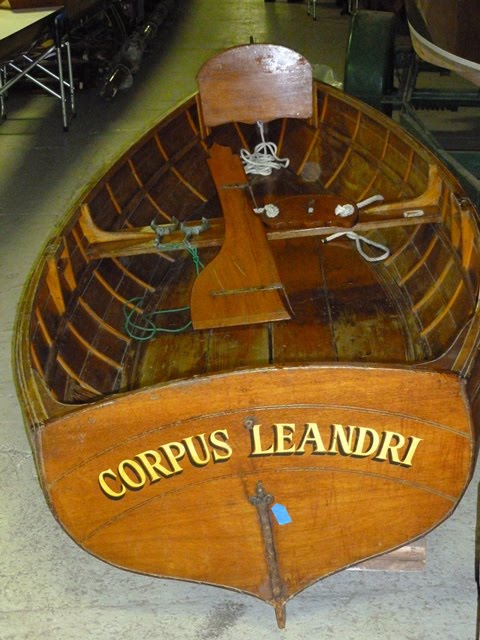
The highlight of the evening will be the auction of Hart Perry’s Thames pulling dinghy, donated by Gill Perry and the Perry family. Here is a description of the dinghy, “Corpus Leandri”: Length: 10ft.; Beam: 4ft. 2in.; Draft: 1ft. 3in.

This clinker-built boat was made in England possibly by Hobbs of Henley-on-Thames or Wyatts of Wargrave, probably in the 1930s, or maybe earlier (there is no boat builder plaque in the boat). There are some uncertainties about what kind of wood has been used, but a qualified guess is cedar on elm, six planks per side. The stern is mahogany whereupon is painted “Corpus Leandri” (the motto of Leander Club is “Corpus Leandri Spes Mea”). One sculling thwart, adjustable stretcher, stern seat and small bow seat, both with backrests in mahogany, and accompanying old velvet cushions. Two floorboards (2x2 floorboards), and a pair of bronze swivel rowlocks (oarlocks) and rudder with lines. Although the dinghy is in good condition, the thwart, floorboards, and inside will need to be re-varnished before the first outing of the season. The dinghy comes with Hart Perry’s sculls, and the blades are painted in Leander cerise.

The starting bid is $5,000. If you are not able to attend the silent auction in person, you are welcome to contact auctioneer Tom Sanford, who will accept your bids from 12 p.m. Friday 9 March to 6 p.m. Saturday 10 March via email or phone: t-sanford@sbcglobal.net or 860-319-6254.

This dinghy comes with a remarkable rowing histo
ry. It was bought by famous oarsman Don Burnell, but it is not known exactly when he obtained it. He most likely purchased it just before, during, or just after World War II.

Charles “Don” Desborough Burnell (1875–196
9) was educated at and rowed for Eton College and Magdalen College, Oxford. He was an Oxford Blue and rowed in the winning Oxford crews in 1895, 1896, 1897, and 1898. Especially the 1897 crew seemed to have been exceptional, being called “the finest crew that ever rowed”. It was also at this time that Burnell was spoken of as “the strongest sweep in England”. As a member of Leander Club, he won several cups at the Henley Royal Regatta, including four consecutive victories in the Grand Challenge Cup from 1898 to 1901, and two in the Stewards’ Challenge Cup in 1898 and 1900 (he also won the 1899 Stewards’ rowing for Magdalen).

The
“Old Crocks” in 1908, Don Burnell, “the strongest sweep in England”, in fifth seat.

For the 1908 Olympic rowing in Henley, Don Bur
nell was asked to race in the Leander crew, which was Great Britain’s “second boat” in the eights, the first one being that year’s winning Boat Race crew from Cambridge. The Leander crew, with Burnell at age 33 and another Magdalen oarsman, Guy Nickalls at age 42, was affectionately called the “Old Crocks”. In the final, the “Old Crocks” overpowered the Belgian eight from Royal Club Nautique de Gand to take the Olympic gold. During Word War I, Burnell served in the London Rifle Brigade, leaving the Army after the War had ended with the rank of Lt. Colonel; he would thereafter often be called “The Colonel”. In 1919, Don Burnell was elected a Henley Steward, in 1921 he coached Oxford, and from 1927 to 1930 he was umpire of the Boat Race. Burnell was President of Leander Club from 1954 to 1957.

In 1903, Don Burnell had married Jessie Backhou
se (1877–1966) and they had two sons and two daughters. The most famous of their children, when it comes to rowing, was Richard “Dickie” Desborough Burnell (1917–1995). Dickie Burnell also rowed for Eton and Magdalen, and won his Blue in the losing Oxford boat in the 1939 Boat Race. After the War, Captain Burnell of the Royal Northumberland Fusiliers, stationed in northern Germany, managed to practice rowing at Hamburg Ruder Club, which fortunately was undamaged from the RAF’s bombings of the town. After coming out of the Army in March 1946, he established himself as one of the best scullers in England. Rowing for Leander, Burnell won the Grand and competed in the Diamonds in 1946, the same year he won the Wingfield Sculls – The British Amateur Sculling Championships and Championship of the Thames. Though working for the British Council, in 1946 he also began on a freelance basis to write rowing articles for The Times.

Six weeks before the 1948 Olympic rowing, again in Henley-on-Thames, Dickie Burnell was teamed up with another successful sculler, Bert Bushnell (Wingfields winner 1947), to represent Great Britain at the Olympics in the double sculls. At first Burnell-Bushnell seemed to be an odd couple. The 31-year-old Burnell, at stroke, was a giant at 6ft. 4in., while Bushnell, 26, in the bow, was only 5ft. 9in. But somehow they made it work. In an article many years later, Bushnell said: “I was on the bridge and ‘Dickie’ was in the engine room.” With some tactical rowing, they took themselves to the final, where they beat the powerful Danish double by two lengths. The day after, Burnell duly reported in The Times that he and Bert Bushnell had become Olympic champions in the double. Thereafter, Burnell continued on a more regular basis to pen rowing articles for the paper.

Having a father and a son being Olympic gold meda
lists in rowing is an exceptional family achievement. Later this year, for the 2012 Olympic Games in London, the BBC is going to air a film, Bert and Dickie, about Bushnell’s and Burnell’s 1948 Olympic triumph. Burnell continued to row after the Olympic Games and in the cerise colours of Leander, he won the 1949 Grand and the 1951 Double Sculls (with Pat Bradley) at Henley. He also captained the British eight at the 1950 British Empire Games (now called the Commonwealth Games) in New Zealand. The British eight, comprised of oarsmen from Leander and Thames RC, took a bronze.

Peter Burnell in his
grandfather, Don Burnell’s dinghy, in 1954 or 1955. In 1962, Peter would win his Blue when he rowed in the losing Oxford crew in the Boat Race.

Dickie Burnell was not only a rowing journalist at The Times (from 1966 at The Sunday Times), he also wrote several books on how to scull and history books about the Boat Race, the Henley Royal Regatta, and Leander Club. His first, Swing Together: Thoughts on Rowing (1952), is a very personal book and a great read, and so is his Sculling with Notes on Training and Rigging (1955), which not only has photographs of his former sculling partner, Bert Bushnell, but also a marvelous photograph of his oldest son, the 14-15-year-old Peter in his grandfather, Don Burnell’s dinghy.

Before World War II, Don and Jessie Burnell lived in Wedmore, which was a fairly large house on Remenham Hill, going out of Henley towards Maidenhead. During the War, when they lived in a little terraced house in St Mark’s Road in Henley, they bought a plot of land in Wargrave, outside of Henley, where they began to build a ho
use. Just after the War, the Burnells moved into the house, called Brentwode, whose garden was next to Hennerton Backwater, which was what the waterway was called from Wargrave to Marsh Lock at Henley. There the dinghy was kept in a hut, if it was not tied up on the “backwater”.

Three young Burnell children at the oars, Peter and Zandra at the stroke oar (port) and John at the bow oar (starboard), c 1955.

In June 1940, Dickie Burnell married Rosalind Garton, daughter of Stanley Garton, who had won an Olympic gold medal in the Leander eight i
n Stockholm in 1912. Dickie and Rosalind Burnell’s five young children, Peter, John, Edward, Alexandra (“Zandra”), and Elizabeth (“Tizzy”), and their cousins, loved to mess about in the dinghy, rowing it up and down the stream of “backwater”. “Towards Wargrave the backwater was rather overhung by willows and we had to duck our heads to get through, but downstream towards Henley it quickly widened out and joined the main River Thames”, Zandra Houston (nee Burnell) still remembers. She continues, “I learned to swim in the backwater at Brentwode, and used to be terrified of putting my feet down in the water as there was loads of weed and large fierce pike swimming about, but I think everyone swam in rivers in those days!” Peter would follow in his grandfather’s and father’s wake, studying at Eton and Magdalen, and rowing for Oxford in the 1962 Boat Race.

The Burnell Family at Brentwode: from left to right, Don Burnell, his wife Jessie, Zandra, Dickie, Dickie
’s sister Janet (who was a professional actress, and quite a character, according to Zandra), and Rosalind. In the front row: Edward and Peter (John is missing in the picture and Rosalind is pregnant with Tizzy). Behind the photographer is the “backwater” where the dinghy was tied up.

When Don Burnell’s wife Jessie died in 1966, he sold Brentwode and moved in to live at Leander Club. It was there that Hart Perry (1933–2011), c
oach for Kent School in Connecticut, laid his eyes on the dinghy for the first time. Perry, who had become head coach at Kent in 1964, frequently took his crews to compete at Henley, and in 1968 he became a member of Leander. It was almost certainly around that time that he bought the dinghy from Dickie Burnell. In 1969, Don Burnell died.

One of Hart Perry’s greatest successes as a coach for Kent came in 1972, when his Kent eight took the Princess Elizabeth Cup at Henley. Two years later, in 1974, Perry was
the first non-Commonwealth citizen elected a Henley Steward. Dickie Burnell, who was President of Leander Club from 1988 to 1993, passed away in 1995 and was laid to rest in the family grave in Remenham, just down stream from Henley, where his parents were buried.

The Burnell Family grave in Remenham.

Perry was the first U.S. citizen to sit on Leander’s governing committee, and was instrumental in raising funds for Leander’s major renovation, in which the club’s bedrooms were named after prominent British and U.S. rowing schools and colleges. Perry brought the dinghy home to Connecticut, where he and his children enjoyed many outings on the Housatonic. When Perry left Kent School to settle in North Stonington, Connecticut, the dinghy naturally came along.

For more than 50 years, Perry lived a life in rowing: he rowed, coached, and served as an official in both national and international events, in two Olympic Games, 18 World Rowing Junior Championships, and 10 World Rowing Championships, and for decades he was working with Juniors within FISA, the international rowing federation. He was the president of the National Association of Amateur Oarsmen, the predecessor organization to USRowing, and after he stepped down from that position, he became the driving force to raise money for U.S. athletes to compete in international regattas. Hart Perry was ind
ucted into four rowing halls of fame, including the National Rowing Hall of Fame in 1990.

Already from the start, in 1956, he was involved with the National Rowing Hall of Fame, and for decades he worked hard to establish a physical place for “the Hall”, especially since he was elected the Executive Director of the National Rowing Foundation (NRF), which is the organization in charge of inducting members into the Rowing Hall of Fame. In spring 2008, Perry finally saw a dream come true when the NRF’s National Rowing Hall of Fame opened in the G.W. Blunt White Building at Mystic Seaport in Mystic, Connecticut. During the years, he received several awards; in 2009, he and his wife, Gillian, his right hand, were awarded the USRowing Medal, and on January 20, 2011, he was awarded FISA’s World Rowing Distinguished Service to Rowing Award at the World Rowing Coaches Conference Gala at the River & Rowing Museum in Henley. Arriving home from England, Perry took ill and died shortly thereafter, on February 3, 2011.

I would especially like to thank Zandra Houston (nee Burnell) and her siblings for their memories about the Burnell dinghy and for providing information about their father and grandfather, and allowing HTBS to post photographs from the Burnell family photo album. Thanks also to Dr. Robert Treharne Jones, press officer at Leander Club, for information. I am also grateful to rowing historian and Leander member Tom Weil for
valuable in-put and a final “editorial clean-up”.