Showing posts with label O.W. Hall-Craggs. Show all posts
Monday, October 21, 2013
Wingfields: Champions of the Thames 2013
An impromptu pre-race gathering of Wingfields Champions from each of the last six decades outside London Rowing Club. From left to right: Bill Barry (1963-66), Alan Campbell (2006, 09, 10, 12, 13), Guy Pooley (1991, 92), Wade Hall-Craggs (1993), Graeme Mulcahy (1976) and Chris Baillieu (1981-84). Mulcahy was this year’s umpire.
Here is Tim Koch’s report from this year’s Wingfield Sculls:
The 173rd Wingfield Sculls and the 7th Women’s Wingfields (previewed by HTBS here) took place on Putney to Mortlake course on 8 October in deference to the founder’s wishes that the prize silver sculls be held ‘by the best’ and that the event should continue ‘for ever’.
In the men’s race, Jamie Kirkwood of Leander drew the Surrey station. The 24-year-old lightweight spent much of 2012 recovering from glandular fever. At the 2013 World Rowing Championships he was 8th in the lightweight single and in the World Cup he was 5th in Sydney, 7th at Dorney and 4th in Lucerne.
Jonny Walton of Leander drew the Middlesex station. During the 2013 World Cup season he was 4th in the single in Sydney and 7th at Dorney. At Lucerne he was 4th in the quad.
Alan Campbell of Tideway Scullers got the centre station. He is Britain’s best heavyweight sculler in many years, a fact proven by his bronze in the single at the London Olympics. A four-times Wingfields Champion, Campbell is a great advocate for the race. His race biography says that ‘he sees the Wingfields as a test of his strength, determination and watermanship which 2000m racing lakes cannot provide’.
Campbell tries a new hat. A boater?
Going off at around 40, Campbell took a very early lead and within the first minute he was able to move into the Surrey station while Kirkwood sculled very wide of the other two, missing the fastest water. Campbell passed Thames Rowing Club two to three lengths up on Kirkwood who was under a length up on Walton. Along Putney Embankment the leader pulled way from the others and gained a three to four length lead. Between the Black Buoy and Harrods, Walton, despite a higher rate and better water, battled to move up on Kirkwood but managed to move into second place in the fifth minute.
At Hammersmith Bridge, Campbell leads followed by Walton and then Kirkwood.
Going through Hammersmith Bridge, Alan Campbell led Jonny Walton by four lengths and Walton in turn led Jamie Kirkwood by the same distance. These positions were maintained until just before Chiswick Steps when Kirkwood fell back and Campbell increased his lead.
At Chiswick. The launches to the left of the umpire’s boat carry the ‘steerers’ for each competitor (though some scullers seem to forget that they are there).
Between Barnes and the finish at Chiswick Bridge the scullers were fairly widely spaced out across the river, Kirkwood often in the slower water.
Going through Barnes Bridge – less than four minutes to the finish.
At the finish at the finish downstream of Chiswick Bridge, the times were Campbell 21.15, Walton 21.32 and Kirkwood 21.44. It was Campbell’s fifth Wingfields win.
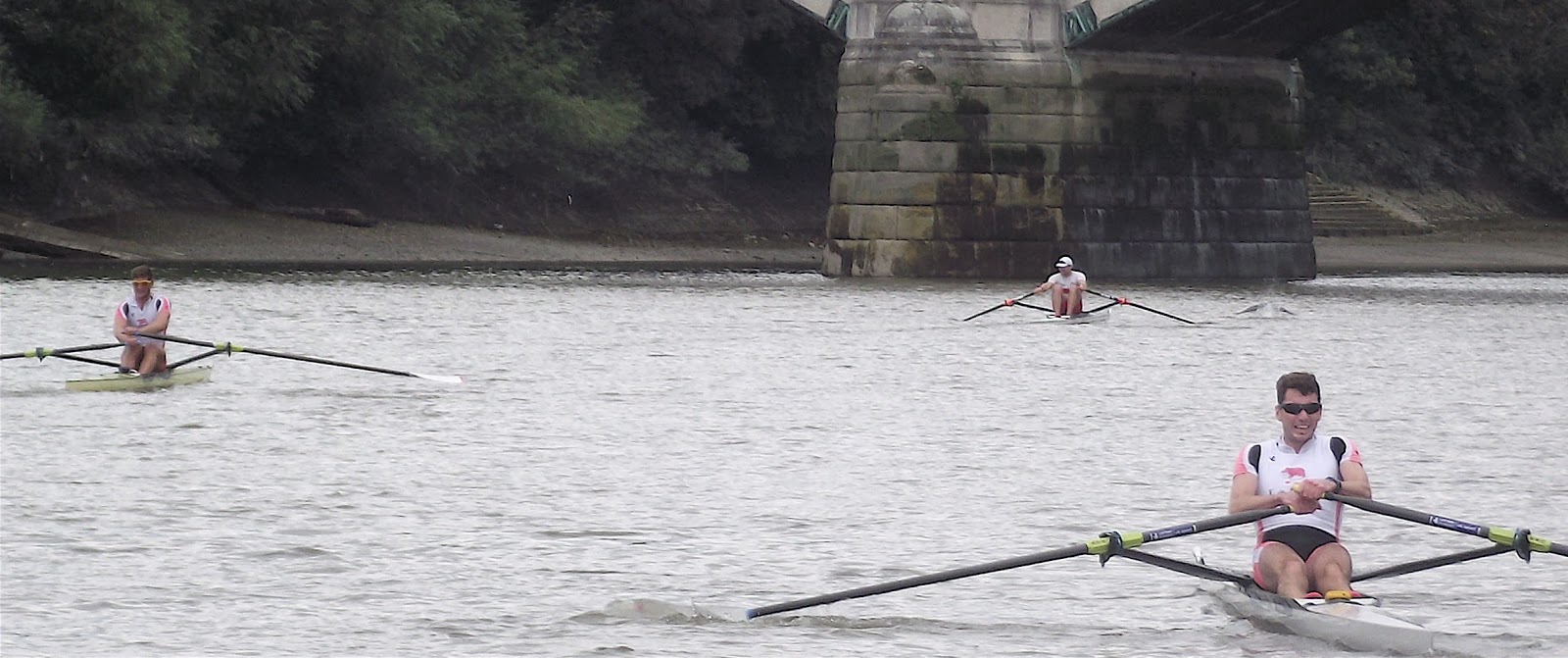
The Finish.
Kirkwood recovers.
There was an impressive six entries in the women’s race. Counting from Surrey, the stations were taken by:
Louisa Reeve (Leander). The only sweep rower and a veteran of the last two Olympic games.
Imogen Walsh (London). ‘Imo’ was 4th in the lightweight double at the 2013 Worlds and won gold in the lightweight quad at the 2011 Worlds.
Beth Rodford (Gloucester). Wingfields Champion last year, Beth won gold in the quad in the 2010 Worlds.
Francis Houghton (Leander). A competitor in the last four Olympics, Francis won silver in the quad in the 2004 and 2008 Games.
Vicky Thornley (Leander). Vicky was 7th in the single at the 2013 Worlds and in this year’s World Cup was 4th at Dorney and 10th in Lucerne.
Vicki Meyer-Laker (Leander). Racing in the double scull in 2013, Vicki was 4th at the Worlds and won Gold at Dorney in the World Cup.
The competitors in the women’s race, left to right: Beth Rodford, Imogen Walsh, Vicky Thornley, Louisa Reeve, Vicki Meyer-Laker and Francis Houghton. A clue as to the winner – she is the one whose feet do not properly reach the floor.
Racing six abreast on a river that was not closed to other users had the potential for problems especially as the scullers were widely spread across the river at the start. While this may have initially made the umpire’s life a little easier, it disadvantaged Houghton, Thornley and Meyer-Laker on Middlesex who were in the slower water (though Houghton and Thornley made the move to Surrey very soon off the start). By the end of Putney Embankment only Reeve and Meyer-Laker were on their original stations and Meyer-Laker led with Thornley second, Walsh third, Houghton fourth, Reeve fifth and Rodford sixth.
Entering Barn Elms reach, left to right: Reeve, Houghton, Thornley, Rodford, Walsh and Meyer-Laker.
In the next two minutes along Barn Elms reach, Houghton and Thornley swapped their second and fourth places. The following two minutes took the scullers to the Harrods buoy by which time Meyer-Laker had lost the lead and dropped to fourth place making the leading pack Houghton followed by Walsh, Thornley and then Meyer-Laker. By Harrod’s Wall, Walsh had overtaken Houghton for first place. In less then two minutes the now second place Houghton was out of the race when her stroke side blade clipped the buoy 300m downstream of Hammersmith Bridge and she overturned.
Houghton has buoy trouble.
The first three positions going through the bridge were to remain unchanged for the rest of the race, that is Walsh in front, several lengths ahead of Thornley who was several lengths ahead of Meyer-Laker.
And then there were five. Going through Hammersmith Bridge, Walsh is followed by Thornley, Meyer-Laker, Reeve and then Rodford.
On the big Hammersmith bend, Reeve and Rodford did not help themselves by staying in the slow water over to Surrey. At Barnes Bridge the leaders remained unchanged with Rodford now fourth and Reeve fifth and all the boats were well strung out with clear water between each.
At the finish.
The final times were Imogen Walsh 21.44, Vicky Thornley 21.53, Victoria Meyer-Laker 21.57, Beth Rodford 22.01, Louisa Reeve 22.09 and a wet Francis Houghton 26.32. It was a splendid win for the lightweight Walsh against considerably taller and heavier opposition (she is 162 cm/5 ft 4 ins tall and weighs 57 k/125 lbs). She wrote on Twitter:
Holy shmoly. I just won Wingfields! Very surprised, very happy, and feeling a little bit sick...
Later she added: Thanks everyone for your messages! Had to get up twice last night to eat something... Defiantly worked hard yesterday!
The 2013 Champion Imogen Walsh at the finish – ‘surprised, happy and a little bit sick...’
Both Walsh and Campbell steered the best course in their respective races. This was not the deciding factor in either win this year but it is an annual frustration to me that so many top competitors do not know how get the best out of the Championship Course. This frustration is compounded by the fact that in the Wingfields it is perfectly legal to have ‘steerers’ signalling to their competitor from a following launch.
This year’s entry (especially in the Women’s Wingfields) illustrates the increasing strength of British sculling, a discipline that the country has not excelled in for many years. However, the true mark of improvement will come when the outcome of both events is not decided by Hammersmith and the race is fought through to the finish at Mortlake.
Champions of the Thames: Walsh and Campbell.
My apologies for taking so long to post this. Sometimes life gets in the way of blogging. T.K.
Wingfields Postscript
The British Rowing Facebook page has some nice pictures of this year’s Wingfield Sculls taken from their headquarters at 6 Lower Mall overlooking Hammersmith Bridge. The best photograph is reproduced below and shows Imogen Walsh going under the bridge.
Imogen Walsh at Hammersmith Bridge. Picture: British Rowing.
Here is Tim Koch’s report from this year’s Wingfield Sculls:
The 173rd Wingfield Sculls and the 7th Women’s Wingfields (previewed by HTBS here) took place on Putney to Mortlake course on 8 October in deference to the founder’s wishes that the prize silver sculls be held ‘by the best’ and that the event should continue ‘for ever’.
In the men’s race, Jamie Kirkwood of Leander drew the Surrey station. The 24-year-old lightweight spent much of 2012 recovering from glandular fever. At the 2013 World Rowing Championships he was 8th in the lightweight single and in the World Cup he was 5th in Sydney, 7th at Dorney and 4th in Lucerne.
Jonny Walton of Leander drew the Middlesex station. During the 2013 World Cup season he was 4th in the single in Sydney and 7th at Dorney. At Lucerne he was 4th in the quad.
Alan Campbell of Tideway Scullers got the centre station. He is Britain’s best heavyweight sculler in many years, a fact proven by his bronze in the single at the London Olympics. A four-times Wingfields Champion, Campbell is a great advocate for the race. His race biography says that ‘he sees the Wingfields as a test of his strength, determination and watermanship which 2000m racing lakes cannot provide’.
Campbell tries a new hat. A boater?
Going off at around 40, Campbell took a very early lead and within the first minute he was able to move into the Surrey station while Kirkwood sculled very wide of the other two, missing the fastest water. Campbell passed Thames Rowing Club two to three lengths up on Kirkwood who was under a length up on Walton. Along Putney Embankment the leader pulled way from the others and gained a three to four length lead. Between the Black Buoy and Harrods, Walton, despite a higher rate and better water, battled to move up on Kirkwood but managed to move into second place in the fifth minute.
At Hammersmith Bridge, Campbell leads followed by Walton and then Kirkwood.
Going through Hammersmith Bridge, Alan Campbell led Jonny Walton by four lengths and Walton in turn led Jamie Kirkwood by the same distance. These positions were maintained until just before Chiswick Steps when Kirkwood fell back and Campbell increased his lead.
At Chiswick. The launches to the left of the umpire’s boat carry the ‘steerers’ for each competitor (though some scullers seem to forget that they are there).
Between Barnes and the finish at Chiswick Bridge the scullers were fairly widely spaced out across the river, Kirkwood often in the slower water.
Going through Barnes Bridge – less than four minutes to the finish.
At the finish at the finish downstream of Chiswick Bridge, the times were Campbell 21.15, Walton 21.32 and Kirkwood 21.44. It was Campbell’s fifth Wingfields win.
The Finish.
Kirkwood recovers.
There was an impressive six entries in the women’s race. Counting from Surrey, the stations were taken by:
Louisa Reeve (Leander). The only sweep rower and a veteran of the last two Olympic games.
Imogen Walsh (London). ‘Imo’ was 4th in the lightweight double at the 2013 Worlds and won gold in the lightweight quad at the 2011 Worlds.
Beth Rodford (Gloucester). Wingfields Champion last year, Beth won gold in the quad in the 2010 Worlds.
Francis Houghton (Leander). A competitor in the last four Olympics, Francis won silver in the quad in the 2004 and 2008 Games.
Vicky Thornley (Leander). Vicky was 7th in the single at the 2013 Worlds and in this year’s World Cup was 4th at Dorney and 10th in Lucerne.
Vicki Meyer-Laker (Leander). Racing in the double scull in 2013, Vicki was 4th at the Worlds and won Gold at Dorney in the World Cup.
The competitors in the women’s race, left to right: Beth Rodford, Imogen Walsh, Vicky Thornley, Louisa Reeve, Vicki Meyer-Laker and Francis Houghton. A clue as to the winner – she is the one whose feet do not properly reach the floor.
Racing six abreast on a river that was not closed to other users had the potential for problems especially as the scullers were widely spread across the river at the start. While this may have initially made the umpire’s life a little easier, it disadvantaged Houghton, Thornley and Meyer-Laker on Middlesex who were in the slower water (though Houghton and Thornley made the move to Surrey very soon off the start). By the end of Putney Embankment only Reeve and Meyer-Laker were on their original stations and Meyer-Laker led with Thornley second, Walsh third, Houghton fourth, Reeve fifth and Rodford sixth.
Entering Barn Elms reach, left to right: Reeve, Houghton, Thornley, Rodford, Walsh and Meyer-Laker.
In the next two minutes along Barn Elms reach, Houghton and Thornley swapped their second and fourth places. The following two minutes took the scullers to the Harrods buoy by which time Meyer-Laker had lost the lead and dropped to fourth place making the leading pack Houghton followed by Walsh, Thornley and then Meyer-Laker. By Harrod’s Wall, Walsh had overtaken Houghton for first place. In less then two minutes the now second place Houghton was out of the race when her stroke side blade clipped the buoy 300m downstream of Hammersmith Bridge and she overturned.
Houghton has buoy trouble.
The first three positions going through the bridge were to remain unchanged for the rest of the race, that is Walsh in front, several lengths ahead of Thornley who was several lengths ahead of Meyer-Laker.
And then there were five. Going through Hammersmith Bridge, Walsh is followed by Thornley, Meyer-Laker, Reeve and then Rodford.
On the big Hammersmith bend, Reeve and Rodford did not help themselves by staying in the slow water over to Surrey. At Barnes Bridge the leaders remained unchanged with Rodford now fourth and Reeve fifth and all the boats were well strung out with clear water between each.
At the finish.
The final times were Imogen Walsh 21.44, Vicky Thornley 21.53, Victoria Meyer-Laker 21.57, Beth Rodford 22.01, Louisa Reeve 22.09 and a wet Francis Houghton 26.32. It was a splendid win for the lightweight Walsh against considerably taller and heavier opposition (she is 162 cm/5 ft 4 ins tall and weighs 57 k/125 lbs). She wrote on Twitter:
Holy shmoly. I just won Wingfields! Very surprised, very happy, and feeling a little bit sick...
Later she added: Thanks everyone for your messages! Had to get up twice last night to eat something... Defiantly worked hard yesterday!
The 2013 Champion Imogen Walsh at the finish – ‘surprised, happy and a little bit sick...’
Both Walsh and Campbell steered the best course in their respective races. This was not the deciding factor in either win this year but it is an annual frustration to me that so many top competitors do not know how get the best out of the Championship Course. This frustration is compounded by the fact that in the Wingfields it is perfectly legal to have ‘steerers’ signalling to their competitor from a following launch.
This year’s entry (especially in the Women’s Wingfields) illustrates the increasing strength of British sculling, a discipline that the country has not excelled in for many years. However, the true mark of improvement will come when the outcome of both events is not decided by Hammersmith and the race is fought through to the finish at Mortlake.
Champions of the Thames: Walsh and Campbell.
My apologies for taking so long to post this. Sometimes life gets in the way of blogging. T.K.
Wingfields Postscript
The British Rowing Facebook page has some nice pictures of this year’s Wingfield Sculls taken from their headquarters at 6 Lower Mall overlooking Hammersmith Bridge. The best photograph is reproduced below and shows Imogen Walsh going under the bridge.
Imogen Walsh at Hammersmith Bridge. Picture: British Rowing.
Monday, October 7, 2013
Tim Koch: Wingfields - The Race of Champions
WD Kinnear’s Wingfields Medal with bars for 1910, 1911 and 1912.
Tim Koch writes:
Tomorrow, Tuesday, 8 October 2013, will see the 173rd race for the Wingfield Sculls and also the 7th Women’s Wingfields. It is strange that an event that carries the grandiose titles of ‘The British Amateur Sculling Championship and Championship of the Thames’ should be so obscure, even within the sport of rowing and sculling.
The Wingfields started in 1830 when Henry Colsell Wingfield presented a pair of miniature silver sculls ‘to be held by the best’ as long as they agreed to race in single sculls on his birthday, 10 August, ‘for ever'. The course is the 4 ½ mile (6.8 km) ‘Thames Championship Course’ (most famously used by the Oxford–Cambridge Boat Race) from Putney to Mortlake complete with tide, bends, shallows, rough water, wind, driftwood and other river users. Patrick Kidd of The Times has written:
(The race is) above all... about athletes being taken out of their comfort zone. Baron Pierre de Coubertin, the founder of the modern Olympics, once said that rowing was the ideal sport because it was so hard for people to watch and thus worth doing purely for its own sake. In the Wingfield Sculls, that vision of glorious amateurism remains alive…
Kidd also quotes Wade Hall-Craggs, winner (‘Champion’) in 1993 and the current Wingfield’s Secretary:
Top class rowers today are used to racing on plastic lakes where so many of the variables have been taken out and it is just a battle of limb and lung size. This is a different challenge.
Certainly the history of the race has numerous examples of winners who probably would not have beaten their opponents had they been on a straight, still water course. Racing on a ‘living river’ requires watermanship, something that cannot be learned on an ergo.
HTBS has previously covered the Wingfield Sculls in 2010, 2011 and 2012. Two years ago, we produced a video record of this splendid contest:
Like other well run rowing contests such as Henley Royal Regatta and the Doggett’s Coat and Badge, the Wingfields is not a democratic organisation, it is organised by a committee of former winners. One of its few sources of income is from shares in the brewers Guinness, which were donated by Lord Iveagh (Rupert Guinness, Wingfields Champion in 1896). In recent years there has also been generous support from the Wingfield Family Society.
The 2012 Women’s Wingfields winner Beth Rodford sculling in the 2010 race. She is watched by the senior surviving Wingfields Champion, Doug Melvin, who won in 1955 and 1958.
In the 2013 race, both the reigning champions, Alan Campbell (Bronze medalist, London 2012) and Beth Rodford, and all their challengers have recently returned from representing Britain at the World Rowing Championships in South Korea. The women are Louisa Reeve (Leander), Imogen Walsh (London), Beth Rodford (Gloucester), Francis Houghton (Leander), Vicky Thornley (Leander) and Victoria Mayer-Laker (Leander). The male competitors are Jonny Walton (Leander), Alan Campbell (Tideway Sculler’s School) and Jamie Kirkwood (Leander).
The Women’s Wingfields starts at 1.30. Wade Hall-Crags writes:
Beth Rodford returns to defend her title against many of her team mates. She is challenged by both members of the double scull, Vicky Meyer-Laker and Frances Houghton. Francis trained out of the University of London for many years so will look to put her Thames Tideway experience to good use. Vicky Thornley was the single sculler at the Worlds and won the B final and wants to test her single sculling on the Tideway. Imogen Walsh’s season went from strength to strength last year after racing Beth in the Wingfields, culminating in fourth in the lightweight double at the Worlds. Lou Reeve is the only sweep rower [...] and enters the Wingfields for the first time.
Alan Campbell, Wingfields Champion 2006, 2009, 2010 and 2012.
The men’s race is an hour later. Of these competitors Hall-Crags says:
This year [....] all the male single scullers from GB’s World Championship team (will) race. Jonny Walton has been doing much of his training with Alan (Campbell) as he was the spare sculler at the Worlds, presumably this has inspired him to challenge. Jamie Kirkwood was the lightweight single at the Worlds and has spent the last few years training on the Tideway at Imperial so feels he has the Tideway experience to challenge Alan. This is the first time Jamie and Jonny have challenged.
The umpire will be Sophie Hosking (Champion 2008 and 2009), who won lightweight double sculls at the London Olympics.
Throughout its long history, the standard of racing in the Wingfields has been very variable. This is probably beacuse in Britain sculling has traditionally been regarded as somehow inferior to sweep rowing. This year’s entry reflects the steady improvement that British sculling is currently undergoing. A list of former winners is here.
As a ’curtain raiser’ to this year’s races, following is a splendid newsreel film that I recently found online. It shows Richard Burnell beating Bertram Bushnell in the 1946 Wingfields. Of course, two years later ‘Bert and Dickie’ won a famous victory in the double sculls at the 1948 London Olympics. The bigger Burnell had previously beaten Bushnell earlier in 1946 in the Diamond Sculls at Henley but it is interesting to see that the highly competitive smaller man never gave up in this second encounter and sculled himself to the point of exhaustion. The final part of the film shows his limp body been lifted into the umpire’s launch at the finish. You could say that there were in fact two ‘Champions’ that day. View the newsreel here.
Tim Koch writes:
Tomorrow, Tuesday, 8 October 2013, will see the 173rd race for the Wingfield Sculls and also the 7th Women’s Wingfields. It is strange that an event that carries the grandiose titles of ‘The British Amateur Sculling Championship and Championship of the Thames’ should be so obscure, even within the sport of rowing and sculling.
The Wingfields started in 1830 when Henry Colsell Wingfield presented a pair of miniature silver sculls ‘to be held by the best’ as long as they agreed to race in single sculls on his birthday, 10 August, ‘for ever'. The course is the 4 ½ mile (6.8 km) ‘Thames Championship Course’ (most famously used by the Oxford–Cambridge Boat Race) from Putney to Mortlake complete with tide, bends, shallows, rough water, wind, driftwood and other river users. Patrick Kidd of The Times has written:
(The race is) above all... about athletes being taken out of their comfort zone. Baron Pierre de Coubertin, the founder of the modern Olympics, once said that rowing was the ideal sport because it was so hard for people to watch and thus worth doing purely for its own sake. In the Wingfield Sculls, that vision of glorious amateurism remains alive…
Kidd also quotes Wade Hall-Craggs, winner (‘Champion’) in 1993 and the current Wingfield’s Secretary:
Top class rowers today are used to racing on plastic lakes where so many of the variables have been taken out and it is just a battle of limb and lung size. This is a different challenge.
Certainly the history of the race has numerous examples of winners who probably would not have beaten their opponents had they been on a straight, still water course. Racing on a ‘living river’ requires watermanship, something that cannot be learned on an ergo.
HTBS has previously covered the Wingfield Sculls in 2010, 2011 and 2012. Two years ago, we produced a video record of this splendid contest:
Like other well run rowing contests such as Henley Royal Regatta and the Doggett’s Coat and Badge, the Wingfields is not a democratic organisation, it is organised by a committee of former winners. One of its few sources of income is from shares in the brewers Guinness, which were donated by Lord Iveagh (Rupert Guinness, Wingfields Champion in 1896). In recent years there has also been generous support from the Wingfield Family Society.
The 2012 Women’s Wingfields winner Beth Rodford sculling in the 2010 race. She is watched by the senior surviving Wingfields Champion, Doug Melvin, who won in 1955 and 1958.
In the 2013 race, both the reigning champions, Alan Campbell (Bronze medalist, London 2012) and Beth Rodford, and all their challengers have recently returned from representing Britain at the World Rowing Championships in South Korea. The women are Louisa Reeve (Leander), Imogen Walsh (London), Beth Rodford (Gloucester), Francis Houghton (Leander), Vicky Thornley (Leander) and Victoria Mayer-Laker (Leander). The male competitors are Jonny Walton (Leander), Alan Campbell (Tideway Sculler’s School) and Jamie Kirkwood (Leander).
The Women’s Wingfields starts at 1.30. Wade Hall-Crags writes:
Beth Rodford returns to defend her title against many of her team mates. She is challenged by both members of the double scull, Vicky Meyer-Laker and Frances Houghton. Francis trained out of the University of London for many years so will look to put her Thames Tideway experience to good use. Vicky Thornley was the single sculler at the Worlds and won the B final and wants to test her single sculling on the Tideway. Imogen Walsh’s season went from strength to strength last year after racing Beth in the Wingfields, culminating in fourth in the lightweight double at the Worlds. Lou Reeve is the only sweep rower [...] and enters the Wingfields for the first time.
Alan Campbell, Wingfields Champion 2006, 2009, 2010 and 2012.
The men’s race is an hour later. Of these competitors Hall-Crags says:
This year [....] all the male single scullers from GB’s World Championship team (will) race. Jonny Walton has been doing much of his training with Alan (Campbell) as he was the spare sculler at the Worlds, presumably this has inspired him to challenge. Jamie Kirkwood was the lightweight single at the Worlds and has spent the last few years training on the Tideway at Imperial so feels he has the Tideway experience to challenge Alan. This is the first time Jamie and Jonny have challenged.
The umpire will be Sophie Hosking (Champion 2008 and 2009), who won lightweight double sculls at the London Olympics.
Throughout its long history, the standard of racing in the Wingfields has been very variable. This is probably beacuse in Britain sculling has traditionally been regarded as somehow inferior to sweep rowing. This year’s entry reflects the steady improvement that British sculling is currently undergoing. A list of former winners is here.
As a ’curtain raiser’ to this year’s races, following is a splendid newsreel film that I recently found online. It shows Richard Burnell beating Bertram Bushnell in the 1946 Wingfields. Of course, two years later ‘Bert and Dickie’ won a famous victory in the double sculls at the 1948 London Olympics. The bigger Burnell had previously beaten Bushnell earlier in 1946 in the Diamond Sculls at Henley but it is interesting to see that the highly competitive smaller man never gave up in this second encounter and sculled himself to the point of exhaustion. The final part of the film shows his limp body been lifted into the umpire’s launch at the finish. You could say that there were in fact two ‘Champions’ that day. View the newsreel here.
Wednesday, November 7, 2012
2012 Wingfield Sculls: A Truly Tough Trial by the Thames
Photograph: Tim Koch
To add to Tim Koch’s short report on the 2012 Wingfield Sculls – British Amateur Sculling Championship and Championship of the Thames on HTBS on Sunday, 4 November, here is a longer, more detailed report about the races by Oliver Wade Hall-Craggs, Hon. Secretary of the Wingfield Sculls. O.W. Hall-Craggs, winner of the Wingfields in 1993, writes.
With the withdrawal of Adam Freeman-Pask, who was ill after the Armada cup, and Mahe Drysdale, who was struck down with gastroenteritis on his return from Sri Lanka where he was promoting rowing, Alan Campbell (Tideway Scullers School) had a row over. The umpire, Sophie Hosking, asked all the competitors if they could switch the races around to give the women the faster water and wider river to accommodate them, land water and spring tides combined for a slow turn of the tide. She also warned them of the very obvious signs of the Olympic legacy with several junior crews out on the water.
Alan Campbell was unopposed in the men’s race, and sculled over to win the trophy. Photograph: Robert Treharne Jones
Alan Campbell set off at a great rate on his own despite some bumpy water on the start line, he was still at 40 at the boats and passed London RC still at 39, by the Black Buoy he smoothed out and reduced his rate to 34. After the Mile post, he dropped his rate and paddled over to claim the title Champion of the Thames for the fourth time, at 24.0. Here are his times at different stations: Mile Post 4.40; Hammersmith Bridge 8,47; (Chriswick Steps no time); Barnes Bridge 19.46; and Finish 24.00.
The morning sunshine gave way to hailstorms and a striking rainbow but that did not improve the water for the women, the spring tide against the wind and land water made for very uncomfortable water along the Putney reach. The new champion today was the most consistent performer in a wide variety of conditions, a champion of all the Thames could throw at her. None of the scullers got off at a very high rate, but Debbie Flood was most determined and got clear. Jess Eddie went for shelter under the Fulham wall and never recovered from that decision, whilst Imogen Walsh and Beth Rodford battled it out level all at 31 except Rodford at 27 along the boats. At the Black Buoy, Flood set off to join Eddie under Fulham and Rodford just got through Walsh.
Beth Rodford won the women’s race after overhauling Debbie Flood, the early leader. Photograph: Robert Treharne Jones
All the scullers were cheered on vigorously at Barn Elms by their juniors, Rodford at 25 was half a length up on Walsh at 29 while Flood led and Eddie began to come back into the stream. It was calm at the Mile post which Flood passed first. Rodford and Walsh were still very close but line astern. Rodford steered better past Harrods and closed on Flood so at Hammersmith Bridge Flood’s lead was much reduced but Walsh was still in touch. Conditions turned considerably worse after St Pauls which had favoured Flood earlier but as all the scullers tucked into the Surrey shore, Rodford drew level with Flood at the Ship, then led along the Eyot where Flood maintained contact. At Chiswick pier the water flattened out again and Rodford began to draw away at 26 to Flood’s 28 and Walsh’s 29. Both Rodford and Flood tried to hit the PLA’s navigation buoys at the crossover and after Barnes Bridge where once again the water picked up nastily. Rodford maintained her steady rate and Flood dropped back, Rodford winning at 23.32. Several of the scullers raced with poppies on their all-in-ones. The 2012 race will not be one they forget in a hurry. All of the scullers deserve credit for finishing a truly tough trial by the Thames.
The Wingfield Family Society continues to support the championships and were represented by Clare Morton, Henry Wingfield’s closest living relative. The silver sculls were presented by two of the committee’s Olympic Champions, Alan received the silver sculls and date bar for his medal from Sophie Hosking (Olympic champion in LW2x) and Beth Rodford received her silver sculls and medal from Mahe Drysdale (Olympic champion in M1x). The secretary thanked all the competitors and hoped those unable to race will return, and thanked Tideway Scullers School and London RC for their hospitality and above all Max for services beyond the call of duty flagging the markers recovering from a severe crash following Alan to return and flag all the female scullers.
Here are the women’s times at five stations: Mile Post, Hammersmith Bridge, Chiswick Steps, Barnes Bridge and the Finish.
Beth Rodford (Gloucester RC): 5.08; 8.51; 14.18; 19.15; 23.32
Debbie Flood (LC): 5.01; 8.49; 14.24; 19.22; 23.43
Imogen Walsh (LRC): 5.10; 8.54; 14.35; 19.33; 24.02
Jess Eddie (ULWBC): 5.16; 9.16; - ; - ; 25.30
Umpire Sophie Hosking (2008 and 2009 Champion)
Aligner Phil Rowley (TSS)
Record times Women
Mile post: 4.44 A Watkins, 2011
Hammersmith: 8.29 A. Watkins, 2011
Chriswick Steps: 13.30 A. Watkins, 2011
Barnes Bridge: 18.11 A. Watkins, 2011
Finish: 21.53 A. Watkins, 2011
Record times Men
Mile post: 4.12 M.W. Wells, 2005
Hammersmith Bridge: 7.32 M.W. Wells, 2005
Chriswick Steps: 12.06 A. Freeman-Pask, 2011
Barnes Bridge: 16.45 A. Freeman-Pask, 2011
Finish: 19.58 A. Freeman-Pask, 2011
HTBS would like to thank O.W. Hall-Craggs for this brilliant report and Robert Treharne Jones for allowing us to post his photographs.
To add to Tim Koch’s short report on the 2012 Wingfield Sculls – British Amateur Sculling Championship and Championship of the Thames on HTBS on Sunday, 4 November, here is a longer, more detailed report about the races by Oliver Wade Hall-Craggs, Hon. Secretary of the Wingfield Sculls. O.W. Hall-Craggs, winner of the Wingfields in 1993, writes.
With the withdrawal of Adam Freeman-Pask, who was ill after the Armada cup, and Mahe Drysdale, who was struck down with gastroenteritis on his return from Sri Lanka where he was promoting rowing, Alan Campbell (Tideway Scullers School) had a row over. The umpire, Sophie Hosking, asked all the competitors if they could switch the races around to give the women the faster water and wider river to accommodate them, land water and spring tides combined for a slow turn of the tide. She also warned them of the very obvious signs of the Olympic legacy with several junior crews out on the water.
The morning sunshine gave way to hailstorms and a striking rainbow but that did not improve the water for the women, the spring tide against the wind and land water made for very uncomfortable water along the Putney reach. The new champion today was the most consistent performer in a wide variety of conditions, a champion of all the Thames could throw at her. None of the scullers got off at a very high rate, but Debbie Flood was most determined and got clear. Jess Eddie went for shelter under the Fulham wall and never recovered from that decision, whilst Imogen Walsh and Beth Rodford battled it out level all at 31 except Rodford at 27 along the boats. At the Black Buoy, Flood set off to join Eddie under Fulham and Rodford just got through Walsh.
Beth Rodford won the women’s race after overhauling Debbie Flood, the early leader. Photograph: Robert Treharne Jones
All the scullers were cheered on vigorously at Barn Elms by their juniors, Rodford at 25 was half a length up on Walsh at 29 while Flood led and Eddie began to come back into the stream. It was calm at the Mile post which Flood passed first. Rodford and Walsh were still very close but line astern. Rodford steered better past Harrods and closed on Flood so at Hammersmith Bridge Flood’s lead was much reduced but Walsh was still in touch. Conditions turned considerably worse after St Pauls which had favoured Flood earlier but as all the scullers tucked into the Surrey shore, Rodford drew level with Flood at the Ship, then led along the Eyot where Flood maintained contact. At Chiswick pier the water flattened out again and Rodford began to draw away at 26 to Flood’s 28 and Walsh’s 29. Both Rodford and Flood tried to hit the PLA’s navigation buoys at the crossover and after Barnes Bridge where once again the water picked up nastily. Rodford maintained her steady rate and Flood dropped back, Rodford winning at 23.32. Several of the scullers raced with poppies on their all-in-ones. The 2012 race will not be one they forget in a hurry. All of the scullers deserve credit for finishing a truly tough trial by the Thames.
The Wingfield Family Society continues to support the championships and were represented by Clare Morton, Henry Wingfield’s closest living relative. The silver sculls were presented by two of the committee’s Olympic Champions, Alan received the silver sculls and date bar for his medal from Sophie Hosking (Olympic champion in LW2x) and Beth Rodford received her silver sculls and medal from Mahe Drysdale (Olympic champion in M1x). The secretary thanked all the competitors and hoped those unable to race will return, and thanked Tideway Scullers School and London RC for their hospitality and above all Max for services beyond the call of duty flagging the markers recovering from a severe crash following Alan to return and flag all the female scullers.
Here are the women’s times at five stations: Mile Post, Hammersmith Bridge, Chiswick Steps, Barnes Bridge and the Finish.
Beth Rodford (Gloucester RC): 5.08; 8.51; 14.18; 19.15; 23.32
Debbie Flood (LC): 5.01; 8.49; 14.24; 19.22; 23.43
Imogen Walsh (LRC): 5.10; 8.54; 14.35; 19.33; 24.02
Jess Eddie (ULWBC): 5.16; 9.16; - ; - ; 25.30
Umpire Sophie Hosking (2008 and 2009 Champion)
Aligner Phil Rowley (TSS)
Record times Women
Mile post: 4.44 A Watkins, 2011
Hammersmith: 8.29 A. Watkins, 2011
Chriswick Steps: 13.30 A. Watkins, 2011
Barnes Bridge: 18.11 A. Watkins, 2011
Finish: 21.53 A. Watkins, 2011
Record times Men
Mile post: 4.12 M.W. Wells, 2005
Hammersmith Bridge: 7.32 M.W. Wells, 2005
Chriswick Steps: 12.06 A. Freeman-Pask, 2011
Barnes Bridge: 16.45 A. Freeman-Pask, 2011
Finish: 19.58 A. Freeman-Pask, 2011
HTBS would like to thank O.W. Hall-Craggs for this brilliant report and Robert Treharne Jones for allowing us to post his photographs.
Subscribe to:
Posts (Atom)