Photograph: Werner Schmidt

Tuesday, June 10, 2014

Bumps to the Head: The 2014 Oxford Summer Eights. Part 2 – An Oriel Picture Diary

Oriel College, part of Oxford University, was founded in 1324 though nothing survives of the original buildings. ‘Front Quad’, pictured above was built between 1620 and 1642. There are few places that are more tranquil than an ancient Oxbridge quad with its honey coloured stone and the unbelievably green grass. It moves a person to philosophy.

Tim Koch writes:

Yesterday, in my report on the 2014 Oxford Summer Eights, I mentioned that I was the guest of Jack Carlson, coach of the Men’s First VIII. This second report from Oxford is a ‘picture diary’ focusing on Oriel and their final day of racing. Calum Pontin, Captain of the Oriel College Boat Club, was kind enough to show me around college. The boat club’s website says:

For the past 35 years Oriel has dominated the Oxford intercollegiate rowing scene, topping the Easter bumps races (Torpids) for 25 consecutive years and the Summer bumps races... more than any other college. The astonishing ascent up the bumps chart of Oriel’s women’s crews, following their admittance to the college in 1986, saw Oriel take the first ever Double Headship in Torpids in 2006.

The progress of Oriel Men’s rowing, 1980 - 2013 can be seen on the red lines on this bump chart. Less importantly, Oriel is 9th out of 30 in the most recent Norrington Table which ranks the undergraduate degree results of Oxford Colleges.

At both Oxford and Cambridge, victorious boat clubs are allowed to mark the walls of college with graffiti marking rowing successes. The door shown leads to the rooms allocated to the Captain of the Men’s Boat Club.

An officially approved chalk which lasts about ten years before it becomes unintelligible should be used (though in this case something more permanent seems to have been applied).

The Tortoise Club is for those who have rowed in the Men’s 1st Summer VIII and 1st Torpid VIII.

The women’s equivalent of the Tortoise Club is The Blessed Virgins Club, whose emblem is a pair of angelic wings. The name is a pun on the official name of the college, ‘The House of Blessed Mary the Virgin in Oxford’. Oriel was a bit of a late developer and only got interested in girls at the age of 660. It was the last all-male Oxford college to admit women and the first female undergraduates (and the Women’s Boat Club) started in 1986.

The Boat Club Captain’s sitting room. Calum Pontin, this year’s Captain and ‘4’ in the First VIII, here studies a worthy text. The room is splendidly decorated with Oriel rowing memorabilia. In the past all the rooms in this ‘staircase’ were allocated to members of the First Eight.

Calum in the other half of the sitting room. Photographs of his predecessors look down upon him and he knows that when he leaves, his picture will join them. A similar room for the Women’s Captain is planned.

This slightly unnerving mascot is called ‘George’ after George Moody, a great benefactor of Oriel and of the boat club. Presumably it belongs to the Tortoise Club, but I think it is a turtle, which would possibly be a better (more aquatic) choice from members of the Chelonian family.

A chalk board by the Porters’ Lodge records Oriel’s progress up to the final day. The final results were as follows. The Women’s 3rd VIII did spectacularly badly, they won ‘spoons’ (i.e. were bumped every day) and on the Friday were ‘overbumped’ (i.e. bumped by a crew that started three boats behind them). The 3rd Men went up two places and the 2nd Women up three. The 2nd Men bumped every day and so won blades, finishing the top 2nd VIII. The 1st Women eventually stayed level, 12th in Division One, and the 1st Men went Head of the River.

The vital bump that secured Oriel’s Headship in 2014 was recorded by this bow camera:


Oriel Men’s First VIII plus coaches: Head of the River.

Oriel Women’s Third VIII: Bottom of the River. They are pictured in front of the portico of the (dining) Hall. The stonework carving ‘REGNANTE CAROLO’ (‘Charles, being King’) commemorates the construction of the building during the reign of Charles I.
Jack Carlson, coach of the victorious Oriel Men’s First VIII, stands by the figure of Victory which once adorned the former Oriel college barge but is now in the club boathouse. The sunglasses are to provide some relief from hay fever but, even if this were not the case, Jack is cool enough to wear shades indoors. Just in the last year, while continuing his PhD he has coxed winning crews at Henley Royal, Canadian Henley and the Head of the Charles, plus he has published a handsome book on rowing blazers (more about his book in a HTBS post coming soon).

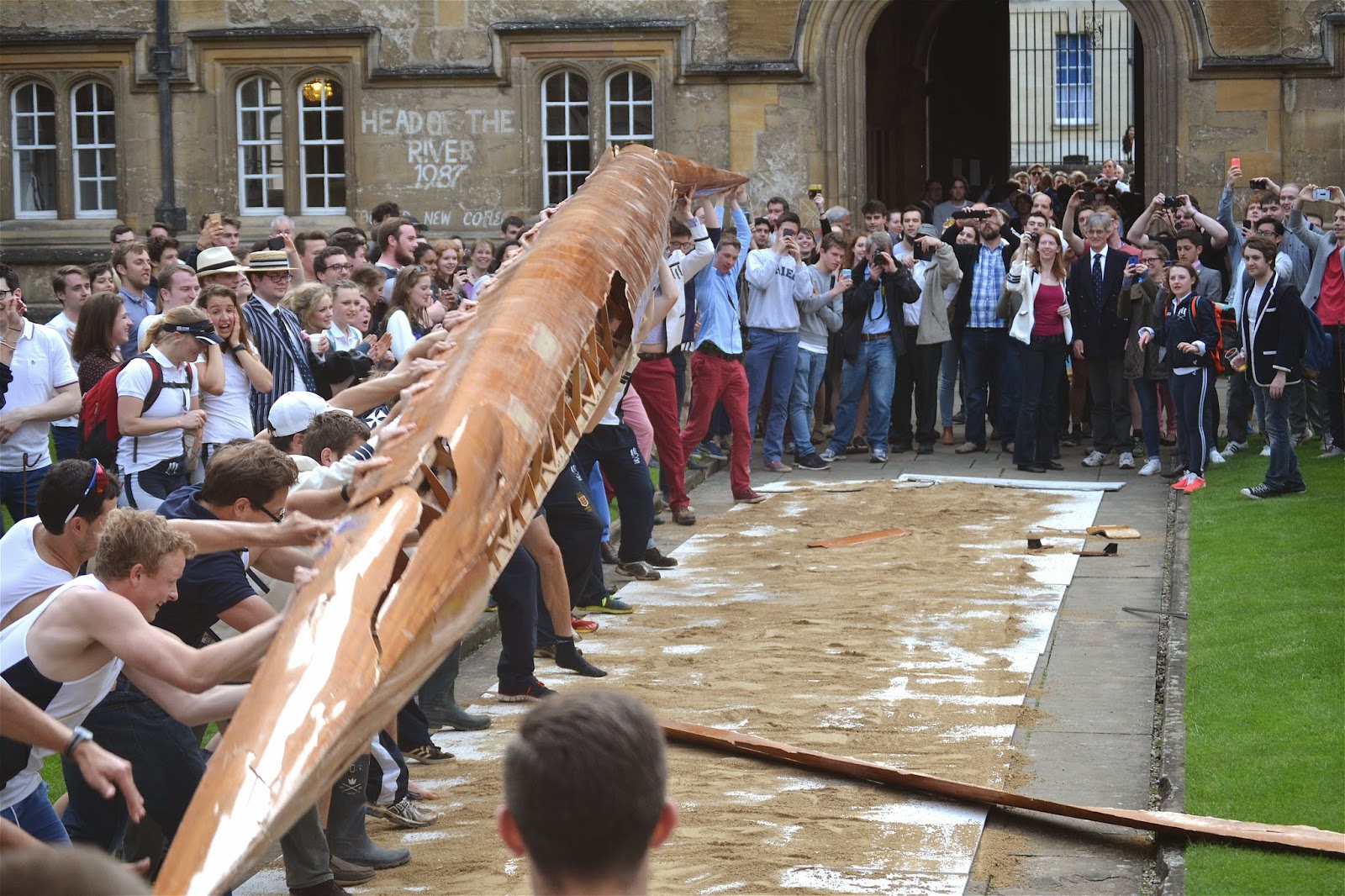
The college boat club that goes Head of the River carries out a remarkable tradition. The winning cox, wrapped in the winning college flag, is carried on an old wooden eight from the boathouse, through the City of Oxford and into college. Members of college follow, noisily chanting and banging on the boat to ensure that everyone knows who is Head of the River. The man nearest the camera is wearing an Oriel College Boat Club blazer. The three ostrich feathers are the badge of The Prince of Wales (though which of the Princes it refers to is disputed). The three rings on his sleeve indicate that he has rowed in a 1st Summer VIII.

Cox Olivia Cleary is carried high alongside Christ Church Meadow. The college flag she is wearing bears the three lions of Edward II. The slightly worried looking gentleman in the blue blazer is the Oriel College Bursar, Mr. Wilf Stephenson, who has the role of ‘responsible adult’ and attempts to see that the college does not get sued as high spirited students wave a 64 foot boat around in public.

A bucolic scene in Christ Church Meadow. As the victorious Oriel party goes past, this cow looks as though she has seen it all before.

The educated rabble make their way into Oxford’s main street, ‘the High’. The Oriel Head Porter holds up the traffic for them.

Once in Oriel’s First Quad, the boat is broken up.

When the supply of wooden boats runs out, this will not be so much fun.

The boat’s final bump.

The Oriel College Hall, ready for the Bumps Supper. Completed around 1642, the room has a splendid hammerbeam roof. The large portrait above the High Table is of Edward II (1284 - 1327) who gave permission for the college to be established. The picture to the left of this is of alumnus, Sir Walter Raleigh (1554 - 1618). The place calls to mind a verse from “He Fell Among Thieves” by Henry Newbolt:

He saw the dark wainscot and timbered roof,
The long tables, and the faces merry and keen;
The College Eight and their trainer dining aloof,
The Dons on the dais serene.


Following the Bumps Supper, the smashed boat is burned in the quad. Traditionally the students jump over the burning hull though, in these more safety conscious days, this is discouraged. I was not able to stay for this part of the proceedings and this picture was taken by Jonathan Craven in 2012, yet another year when Oriel were Head of the River.

Monday, June 9, 2014

Bumps to the Head: The 2014 Oxford Summer Eights - Part 1

The view from Folly Bride showing the Oxford college boathouses and the finish of the bump racing course. The pall of smoke hanging over the scene is from numerous barbecues run by the various boat clubs. I had expected that Oxford would provide a lunch of roast swan or perhaps plovers’ eggs send down from Brideshead, but instead I had to content myself with a couple of burnt sausages.

Tim Koch writes:

It is a truth universally acknowledged that the British, if they possibly can, will take a perfectly sensible sport and devise a race:

1) With rules so complex that they are impenetrable to any outsider.

2) Which is so potentially dangerous that, had it been invented today it would be banned.

3) Where there is a clear hierarchy that is very difficult to challenge.

3) That has its own nomenclature and arcane rituals.

4) Where the spectators can drink copious amounts of alcohol in very pleasant surroundings and treat actually watching the racing as an option.

The form of boat racing known as ‘bumps’ at Oxford University’s ‘Summer Eights’ or ‘Eights Week’ ticks all these boxes – but this is not a criticism. In fact, ‘Eights’ is a brilliant and fair way of allowing the maximum number of participants of extremely varying abilities to race on a most unsuitable stretch of river and, moreover, it results in a large proportion of them becoming ‘winners’ in one way or another.

A (distorted) early afternoon panoramic view of many of the college boathouses, which are actually on a little island formed by the River Cherwell forking as it flows into the Isis (as the Thames at Oxford is known). My report on the history of Oxford boathouses was on HTBS in April 2013 and there is a map of the Isis here.

A typical scene early in the racing day, before the big crowds arrive. The Jesus College boathouse is on the left and that of Keble College is on the right.

Alumni show the youngsters some style.

On Saturday, 31 May, I was very pleased to be the guest of Jack Carlson, the coach of the Oriel College Men’s First Eight, at the fourth and final day of the 2014 Summer Eights. It was a very good year to be associated with Oriel as their top men’s crew went ‘Head of the River’. In this post, part one of my report from Oxford, I will explain what this means, attempt to show how Eights Week works and try to convey some of the atmosphere of this great occasion. In part two I will concentrate on Oriel Boat Club, its Head Crew and some of the wonderful traditions that surround one of the most successful of all the Oxford University college boat clubs.

The last ‘college barge’ left on the river. Unfortunately, it is now a private residence. The HTBS report mentioned above gives a short history of Oxford barges which were once used in place of boathouses.

Human sacrifices of coxswains are permitted during Eight’s Week. Here, Trinity offer up their cox to the God of Rowing.

Term is not yet over. Spectators in a punt get some work done between races.

In ‘bump racing’ a number of boats chase each other in single file, each trying to catch (‘bump’) the boat in front without being caught by the boat behind. In Summer Eights physical contact is not actually required (though there often is) and once there is overlap of bow and stern, the ‘bumped’ cox should raise his/her hand and concede. The first such race recorded at Oxford was in 1815 when Brasenose raced Jesus. It originated because the river is too narrow for side by side racing. Both at Oxford and at Cambridge (where the river is also tight) there are two sets of bump racing per year, one in early spring and one in early summer. On the Cam they are called ‘Lent Bumps’ and ‘May Bumps’ and on the Isis they are known as ‘Torpids’ and ‘Summer Eights’. The exact rules of each event vary in detail.

Women’s Division 5. Jesus II bump Worcester III after a few seconds of rowing.

Men’s Division 2. Lincoln concede a bump by New College opposite the island boathouses.

Men’s Division 2. Pembroke II bump Christ Church II very near the finish.

Summer Eights are held over four days and consists of seven men’s and six women’s divisions. Each division has thirteen boats and 35 of the colleges that make up the University of Oxford enter in total between two and (this year) nine crews of varying ability. There is a divisional race every 30 - 40 minutes, alternating between the men and the women.

In high divisions where crews may contain Elite rowers, Blues or even Olympians, the racing can be close and may last for much of the course, but in lower divisions the difference in standard between crews and coxes increases and so does the general chaos. Here bumps can happen very soon after the start. If the speed of two boats is dramatically different then boats can be damaged – to the despair of the boatmen but to the delight of the spectators. The boats in the lowest divisions may consist of crews that a college football team or tennis club has put together for the occasion. The rule of thumb is that if a crew is wearing Lycra in their boat club colours, they are probably serious rowers. If a boat consists of eight fairies coxed by a giant chicken, they are almost certainly not real ‘boaties’. In her blog on the 2008 Eights, Sarah Laurence said of the lower divisions: Curiously, the combination of highly unmanoeuvrable boats, inexperienced coxes, high speeds and confined spaces doesn’t always end well.

The rules state: Each boat shall be started from a rope 50 feet in length, held by the coxswain, with the other end of the rope fastened to a post on the tow path. The distance between each starting post shall be 130 feet (40 metres). Here the cox for Regents Park Boat Club in Women’s Division 5 holds her starting rope.

Women’s Division 5 on the start. The boatmen use long poles to stop the boats drifting in or out too far. With about 20 seconds to go they gently push the boats out from the bank (the coxes still holding the ropes) and the crews ‘come forward’ ready to race in anticipation of the shot from the starting cannon. In former times the boatmen would drink beer between races and this often resulted in impaired and rather dangerous handling of the unwieldy poles by the end of the day.

Men’s Division 5 take their first stroke.

On the first day of racing, the starting order of each division is the finish order of last year’s race. In Summer Eights, when a bump is made both boats pull over to the side and do not race any more that day. The result is that crews often have to sprint continuously and not ‘settle’ in mid-race as in normal regattas. Crews who successfully bump the boat in front of them (or ‘bump up’) exchange starting positions the following day. Thus, over four days of racing a crew may only rise a maximum of five places and this means, for example, that to go to ‘Head of the River’ in any one year, you have to start in the top five of Division One. For many boat clubs, any chance of getting to the top of their division means that they need several years of ‘bumping’ their way up their table of thirteen crews. A look at part of this year's 'bump chart' may make things clearer.

Men’s and Women’s Division One, 2014 Summer Eights.

Taking the top three men’s crews as an example, the above chart shows that in 2013 Pembroke College (PCBC) were ‘Head’, followed by Christ Church (ChChBC) and then Oriel (OCBC). On the Wednesday of the 2014 Eights, Pembroke did not bump and were not bumped (i.e. they ‘rowed over’) and so they stayed in first place. However, Oriel bumped Christ Church so OCBC went up to second place and ChChBC went down to third place. On the Thursday, the second day, Oriel bumped Pembroke and Christ Church rowed over. Thus Oriel went up to first place, Pembroke went down to second place and Christ Church stayed third. They all remained in these positions for the next two days of racing as none of them bumped or were bumped, that is they all rowed over. There is a further complication – the boat that finishes first in each division may row as the ‘Sandwich Boat’ at the bottom of the division above in the same day’s racing. If you understood this you are ready to look at the full 2014 results, here for the men and here for the women.

Men’s Division 5. Oriel III about to bump Trinity III. They are in ‘The Gut’, a bendy part of the course that many inexperienced (and some experienced) coxes have failed to negotiate.

A view from Donnington Bridge near the start. In Men’s Division 5, Regent’s Park chase Christ Church III. They eventually bumped them.

Tim Foster, Olympic Gold medallist in coxless fours in 2000, now an MBA student at Keble. Here he is umpiring before he rowed in the Keble First VIII in Division One later in the day. A crew mate in the boat was Storm Uru, the New Zealand Lightweight International and bowman of this year’s victorious Blue Boat. In the end, Keble bumped on three of the four days.

I managed to catch a few words with Tim, widely regard as one of the all time great technical rowers, especially effective in the vital but often unrecognised seat behind the stroke.

Tim K: An obvious question, you are rowing in a boat of a slightly lower standard than you have done in the past, what’s the attraction?

Tim F: Well, partly I am a slightly lower standard rower than I was in the past but also it’s been really good fun, it has reminded me of what rowing is about and it’s been a great chance to come back and race after about 14 years of retirement.

Tim K: You have a younger superstar to help you out, Storm Uru, how’s that?

Tim F: Actually it’s great. I think he’s claimed that I’m in the boat to make him feel not so old .... It’s been great to row with him and to see why he’s such a champion....

Tim K: And now you’re helping out before you race, very much in the spirit of the event.

Tim F: Yes, it’s a great event and it relies on everyone doing their bit, so this morning is my turn.

Men’s Division 2. St Peter’s get their reward for bumping every day and so getting ‘blades’.

The view from the top of Christ Church boathouse at the end of the island. This shot was taken towards the end of the day when the crowds had swelled, awaiting the final races in Men’s and in Women’s Division One.

Women’s Head of the River 2014: Wadham. From bow: Madeleine Butler, Anne Binderup, Lia Orlando, Rachel Anderson, Canna Whyte, Stephanie Hall, Alkaterini Mandaltsi, Elizabeth Zotti, Nicola Rodgers (Cox).

In the beginning of this piece, I indicated how clever this form of racing is, accommodating over 1500 rowers of widely differing abilities on a narrow river. I also said that it produced a fair number of ‘winners’. The obvious ones are the men’s crew and the women’s crew that go to the top of Division One, i.e. go ‘Head’. But there are those who get to the top of their respective divisions who also consider themselves victorious. Further, many are very pleased if they make one or more bumps. Those who bump every day are awarded the coveted ‘blades’, that is a illuminated oar emblazoned with the names of the crew and of the boats that they bumped (though ‘awarded’ is perhaps not the correct term, you have to buy your blade if you want one). Others are happy if they simply avoid getting bumped and go neither up nor down.

Even the worst rowers can gain satisfaction as a crew that is bumped every day gets ‘spoons’. The ‘wooden spoon’ is usually a non-literal award to a person or team that comes last in some event. HTBS did a nice post about them here. The award of spoons may in fact be welcomed as traditionally the British take great pride in doing something really badly. We like to dwell on our ‘glorious failures’ such as the Charge of the Light Brigade, the retreat from Dunkirk or Scott’s race to the South Pole rather than promulgate our historic successes (assuming that we have any). It sometimes seems that we are more impressed by those bumped ten strokes off the start than by those who go ‘Head of the River’. Win or lose though, Summer Eights is a great event.

Men’s Head of the River, the final order. Oriel, Pembroke, Christ Church, Magdalen.

Head of the River 2014: Oriel. From bow: Charles Cornish, Rufus Stirling, Kelvin Jackson, Calum Pontin, Malcolm Howard, Christopher Fairweather, John Redos, William Zeng, Olivia Cleary (Cox).

Part 2 will be posted tomorrow!

Saturday, June 7, 2014

The Rock will stay Red!

Harvard's Varsity crew won the 4-mile race in 19:23.3.

After today's 149th Yale-Harvard Regatta on the Thames River in New London, it is clear that the 'Rock' will stay RED, as the Crimson won all three races under a beautiful blue sky. Harvard's new coach, Charley Butt, can now relax after what must have been a nerve wrecking afternoon. Butt's Varsity crew's winning time was 19:23.3, which was 14 seconds ahead of Yale's.

HTBS will come back with a full race report in a couple of days. In the meantime, if you missed to watch the 4-mile race, take a look, here - the stake boats at the start had problems, so it takes several minutes before the race starts in this video. Listen to race commentators Andy Card and Charlie Hamlin small talk....

Friday, June 6, 2014

Will the Rock be Red or Blue Tomorrow?

Tomorrow, for the 149th time, Harvard will meet Yale for their 4-mile race on the Thames River in New London, Connecticut. This time the Crimsons will not have their legendary coach Harry Parker to back them up. Parker died of cancer on 25 June last year, after having been the Crimson heavyweight coach for 51 years. Charley Butt, the Harvard lightweight coach for 29 years, took over the heavyweights, and tomorrow will be his first race as their coach against Yale in the Harvard-Yale Regatta, which was rowed for the first time in 1852.

Harvard has won the race the sixth last times against Yale and the question is now if the Bulldogs will manage to turn the tide. Steve Gladstone, the Bulldogs’ heavyweight coach who came to Yale four years ago, told a reporter of the New Haven Register: ‘I’m pleased with the development. It’s been good. No coach is ever content. There is a clear indication we’re on the right track. We’re progressing.’

At the IRA National Championships, which was held on Lake Mercer last weekend, Harvard came fifth, while Yale was sixth, 6 seconds behind. Washington won, with Brown second, California third and Princeton fourth. It was a disappointing place for Harvard, while Yale took a step up, as it was the first time since 2006 they manage to make the final in the Championships.

Tomorrow afternoon, we will see if the famous ‘Rock’ at the finish line will be painted blue or red.

The races start at 2:45 p.m. on Saturday, 7 June, with the freshmen’s race, which will be followed by the 2nd varsity race, and then the varsity (heavyweights). Today, the sparemen’s race will be rowed on the Thames.

Thursday, June 5, 2014

Some Strong Crimson Coxes

Strong coxes from Harvard.

Earlier today, the National Rowing Foundation (NRF) needed to move some books from the rowing exhibit at Mystic Seaport to Red Top, the Crimson boat house by the Thames River, where the Harvard crews are training right now for their races against Yale on Saturday, 7 June. 'Some book' is really an understatement, as it was 78 boxes with 12 copies in each box, which makes it a total of 936 copies of a very fat and heavy book. What to do? Well, phone calls were going back and forth, and soon there was a van leaving Red Top with assistant coach Patrick Lapage - yes, HTBS has written about Pat before, but also about his grandfather, Michael, who rowed in the British silver eight at the Olympic regatta in Henley in 1948 (read more about the Lapages, here). Of course, in between practice, the oarsmen need to eat and rest, so Pat brought along the Harvard coxes - a tough bunch.

78 boxes with 936 heavy books.

We carried boxes (yes, yours truly did not only act as a 'door opener', he, too, was a pack mule) through some rooms, down the stairs, through some other rooms and out on a small porch, and in the van. I did not count how many times we ran up and down the stairs, but I do not need to do any more work-outs today, or 'for this week', as Pat said. Well, now the books are out of the building thanks to Pat and some very strong coxes ~ Well done!

Wednesday, June 4, 2014

The No-Wiggle Rigs

Dr. John D. Barrow

I am lousy at math. As a child I hated math in school. When my children ask me for help with their math homework, I most of the time point at their mother, Mrs. B., as their reliable home-resource for those kind of things. (I am pretty good at Shakespeare, though…)

So when it comes to math in sports, for example rowing, I am soon lost in the equations. While I do understand that a ‘German rig’ and an ‘Italian rig’ have their advantages to a so called standard rig, I cannot really see that in a lot of numbers. The German rig, as most of you certainly know, was used by crews trained by Karl Adam at Ratzeburg rowing club in Germany in the late 1950s, and the Italian rig has its origin from Giulio Cesare Carcano, a motorcycle engineer at the Moto Guzzi company, who in 1956, watched a coxed four from the Moto Guzzi Club not being able to go straight – the crew later took the 1956 Olympic gold medal in the coxed four.

Anyway, one person who can explain these things by writing ‘numbers’ is Dr. John D. Barrow, math professor, or mathematical physicist, at University of Cambridge in England. Not only does he explain the German rig and the Italian rig, he has also come up with two new what he calls ‘no-wiggle rigs’ for eights, which actually have been tried out on the Thames by Imperial College. The trial was organised by the New Scientist magazine.

Read Dr. Barrow’s interesting article about the different rigs here, and watch the YouTube video below:


Dr. Barrow has also written other interesting articles about math and other sports here.

Tuesday, June 3, 2014

A 1936 German 'Silver Man'


Rowing historians Tom Weil and Bill Miller were at the IRA National Championships this past weekend. They were taking care of the ‘rowing history’ bit of the regatta, making sure that those who were interested in the rich history of our sport got some information about the National Rowing Foundation (NRF) and the Rowing Hall of Fame. And at the same time showing off some big ‘rowing pots’. On Saturday evening, the NRF held a ceremony for the Class of 2014, seventeen rowers who were inducted into ‘the Hall’ – all introduced by Miller.

About the weekend’s events, Bill Miller said: ‘Wow! What a great weekend. The regatta was awesome, perfect weather, the NRF banquet went smoothly. The tent display went very well. I was amazed at how excited everyone got when they viewed the trophies, cups and programs. Photographing the trophies was prolific. I think we proved that promoting NRF/rowing history/Hall of Fame is an awesome way to connect with the rowing community and is important.’

One thing that Bill and Tom had on display in their tent was yet another ‘Silver Man’ statue. Somehow, a Tweet with a picture of the ‘Silver Man’ found its way across the pond and ended up on Greg Denieffe’s smart phone. Greg and I sent some messages back and forth late on Sunday afternoon about the statue (this was before I realised that it belonged to Miller). In the evening, I met Bill briefly when he was on his way back home to Massachusetts. I mentioned the ‘Silver Man’ that Greg had seen in a photograph. Bill smiled and unwrapped a small blanket he had in his car. ‘You mean this one?’ he said. And there it was.

Bill told me that it’s German-made, of nickel-plated bronze and a commemorative piece from the 1936 Olympics Games in Berlin. He bought it from Germany a year ago, but it has no markings on it to reveal who made it. He thought it would be a nice statue to bring along to the IRA, as it had a connection to Daniel James Brown’s great story about ‘The Boys in the Boat’.


About the bronze statue that HTBS has had questions about earlier, Bill said: ‘In general, there were many bronzes made over many decades. Some with oarsmen standing, some seated in a boat.’

Many thanks to Bill Miller for sharing his statue with the HTBS’s readers.

Monday, June 2, 2014

Bravest & Finest Fight it out on the Harlem

Yesterday, when it was the National Learn to Row Day in America, there was a special rowing race on the Harlem River in New York City, ‘Heroes Row the Harlem’. Arranged by the organisation Row New York, a non-profit group dedicated to get children in New York City involved in the sport of rowing, the New York Fire Department (FDNY) and Police Department (NYPD) met for the first time in a rowing race. Both FDNY and NYPD crews had practiced for several weeks to manage to race in eights on the nearly 1,000-metre long course.

It seems the FDNY, the ‘Bravest’, had the best technique and soon left the NYPD, the ‘Finest’, in their wake. ‘Everything is about timing and that’s what we had over them because it’s all eight of us... eight of us working as one’, firefighter Caleb Dauphin said to Time Warner Cable News.

Row New York Executive Director Amanda Kraus also told the news channel: ‘It teaches really good lessons about working together, delaying gratification, learning how to be coachable, how to stick with something even when it’s hard’.

The race was followed by a fun afternoon of rowing lessons both on-land and on-water, and kids’ games, face painting, a picnic and a tour of the Peter Jay Sharp Boathouse, Row New York writes on their website.

Sunday, June 1, 2014

Results from this Weekend's Regattas

European Champions in the women's pair: Helen Glover and Polly Swann of Great Britain. Photo: British Rowing.

This weekend saw some interesting regattas on both sides of the pond, which we mentioned yesterday. In the U.S., it was the NCAA and the IRA. In Europe, it was the European Championships and the Scottish Championships and the Scottish Schools’ Championships. South of Scotland, Tim Koch reminded us about Eights’ Week in Oxford and Bryan Kitch of RowingRelated about the Metropolitan Regatta at Dorney. Tim promised us a report from Eights’ Week later on, while results from the other mentioned regattas will be found below (posting this Sunday evening, some results have not yet been posted, but hopefully they will be up very soon):

NACC
IRA
Scottish Championships
Scottish Schools’ Championships
Met Regatta
European Championships