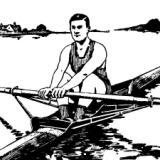
Earlier today Chris Partridge of the eminent blog “Rowing for Pleasure” posted a very interesting entry (and one yesterday) about an upcoming boat auction. It is an online action on 14 April 2010 held by Turk Film Services. Up for sale is up to 200 watercraft, which of many have been in film productions like Hornblower, Harry Potter, Swallows and Amazons, and Three Men in a Boat. There are plenty of punts and rowing skiffs in this unique collection. One skiff you can see up on the left - a Thames Pleasure Skiff built by Salters of Oxford in 1887. But she is not the only beauty…
Monday, March 15, 2010
Boat Auction
Earlier today Chris Partridge of the eminent blog “Rowing for Pleasure” posted a very interesting entry (and one yesterday) about an upcoming boat auction. It is an online action on 14 April 2010 held by Turk Film Services. Up for sale is up to 200 watercraft, which of many have been in film productions like Hornblower, Harry Potter, Swallows and Amazons, and Three Men in a Boat. There are plenty of punts and rowing skiffs in this unique collection. One skiff you can see up on the left - a Thames Pleasure Skiff built by Salters of Oxford in 1887. But she is not the only beauty…

An Oarsman's Dress Code
 Above is a wonderful photograph from 1886 of some distinguished oarsmen of Malmö Roddklubb, my Swedish rowing club. At that time, the colours of the club shirt were yellow and dark blue, with blue pants, and a blue cap. The club was officially founded two years earlier, in 1884, but rowing had been going on in town several years before the club saw the light of day. The picture is from a prize celebration at the restaurant in Kungsparken [the King’s Park], a park that open in 1872. When I rowed in Malmö, you could row on the canals that surrounded the Old Town, which was a 4,5-kilometre (2.8 miles) long stretch. A part of the canals actually runs through the lovely Kungsparken and you can see the restaurant from the water. Nowadays it has been turned into a casino.
 With an old club like this come a lot of good stories and anecdotes. One is from the 1930s and involves the restaurant in Kungsparken. The club’s most prominent oarsman during this time was Sture Olsson, who became Swedish Champion in the single scull three times, in 1929, 1934, and 1935. (Olsson is seen in the photograph on the left, just having received a championship wreath after winning one of those finals.) At one of the summer club banquets, the members were all dressed up in ‘top hat, white tie, and tails’ and gathered outside the restaurant in Kungsparken. They were waiting for Sture Olsson, who seemed to have been delayed. Suddenly, they could hear something approaching the restaurant from the canal side. There was Olsson, sculling in his shell; he had rowed from the boathouse in the dress code of the evening: top hat, white tie, and tails.
And these days, you have a problem getting all the men in the club to wear a tie for a club dinner!
Sunday, March 14, 2010
Rowing To Aberystwyth
 Now, try this word: Aberystwyth, and maybe try it again: Aberystwyth… Aberystwyth (English pronunciation ’æbə’rɪstwɪθ’) is a coastal market town in Ceredigion, Wales. When I was studying at the University of Wales in Lampeter for the 1997/98 term, I visited Aberystwyth several times, to see the water and breathe in the Ocean, get a decent meal, and see the sites. At one occasion, our lecturer actually took us to The National Library of Wales in this lovely little town to study some old medieval manuscripts. So, what has this to do with rowing?
Well, I was surprised to see the name of Aberystwyth on www.row2k today. The Western Telegraph is reporting that Llangwm Rowing Club is yet again going in for a real challenge in May. With other teams from the U.K., the club will row their longboat the 96 miles across the rough Irish Sea between Arklow and Aberystwyth. This is an 18-hour long voyage. However, last year it took the 12-person strong crew from Llangwm RC slightly more than 24 hours to complete the crossing in horrific weather. Read the article by clicking here.
The 18 Rowing Hall Of Fame Inductees
 For those of you who are interested in the biographies of the 2010 Inductees of the National Rowing Foundation's National Rowing Hall of Fame, NRF has now posted both photographs of and rowing achievements by the eighteen Inductees. Please click here to go to that page. As you maybe have read on this blog earlier (9 March), on 20 March NRF is hosting an Inductee Dinner to honour these athletes and the following day, on 21 March, a Rowing History Forum will be held at Mystic Seaport Museum. A report from both these great events will follow on this blog.
Saturday, March 13, 2010
2010 Women's Head Of The River Race
 Today it is The Women’s Eights Head of the River Race on the Thames in London. 2,700 athletes will row the course between Mortlake and Putney (the opposite direction of The Boat Race). Read more about the race by clicking here. On the ‘Heads’ website there is a very interesting 11-minute video how to cox a Tideway Head – it is trickier than you think! Watch it by going to the website, or by clicking here.
The Race

The Race
All that year, he rose,
Each day he grew
The day of the race
He could see the finish line,
Philip Kuepper
A friend of mine, Philip Kuepper, is a poet who lives in Mystic, Connecticut. Among other things, he has written some poems about sculling. Above is one of them, which he kindly has allowed me to publish here. Many thanks, Philip!
All that year, he rose,
Just after dawn broke
Light across the sky.
He took his shell to the river,
Laid it on the water,
And slipped quietly,
Effortlessly, into rowing.
Each day he grew
In strength, in confidence,
Each day his mind
A day closer to realizing
Competitive readiness.
The day of the race
He arrived early, ready.
He laid his shell on the water.
He eased into the race,
As though he was one with the race,
His oars, his arms become one.
He could see the finish line,
In his mind, before he saw it,
Just ahead of him. It was then
He saw, in a flash,
He shadow cross it, a second before him.
Philip Kuepper
(2008)
A friend of mine, Philip Kuepper, is a poet who lives in Mystic, Connecticut. Among other things, he has written some poems about sculling. Above is one of them, which he kindly has allowed me to publish here. Many thanks, Philip!
Friday, March 12, 2010
1 Year Celebration!
 Exactly a year ago today, I started this blog. To be perfectly honest, I did not have high hopes that it would actually take off. I was expecting to sit in my little study, called The Rowing Room by the family, to hammer away some good old stories and thoughts about the noble art of rowing and sculling that would be read by a group of very few enthusiasts. As I am particularly interested in English rowing history, my blog would cover a lot of that stuff; although, as a Swede living on the east coast of the USA, I was not sure how well it would travel over the pond. Of course, my blog would not merely be about rowing in England, there are very good stories to be told from the USA and my old home country, too. And for certain from other countries as well where rowing has set its mark as a sport.
The response from many of you has been overwhelming. Not only have I received nice and kind comments and e-mails, your feed-back has given me an idea of what you are interested in and what you are attracted to when it comes to rowing. This has kept me going. It is what I have mentioned a few times before, this blog is not about me, it is about the rich history of rowing.
Thank you for your support. I hope you will continue to send me e-mails and post comments on my blog.
With very best wishes,
Göran
Thursday, March 11, 2010
About Rowing
 Let us pretend that you know nothing about rowing, but would like to get information about the sport as you are thinking of taking it up for recreational purposes, or even having a go at racing in regattas. Naturally, of course, you would go to your country’s rowing federation’s website to see what kind of information you can obtain.
Just for fun that is what I did; I began with USRowing’s website where you will find the link ‘About the sport’, which has the following sub-links: Viewer's Guide; Rowing Quick Facts; Glossary of Rowing Terms; Eleven Insights to the Sport of Rowing; Sweep Rowing Vs. Sculling; Rowing Classifications; Equipment; The Race; The Stroke; Race Watching Tips; and Rowing Lingo.
Then I went to the British federation’s website, British Rowing, where there also is a link about the sport, called ‘About rowing’. Here you will find the following sub-links: Get into Rowing; Types of Rowing: Fine, Adaptive, Coastal, Indoor, Ocean, Pilot Gigs, Recreational, Surf, Veteran; Rowing Basics; Water Safety; Rowing & Health; Types of Competition; Rowing Stroke; Image Conscious; History; Rowing Diary; News; Frequently Asked Questions; and Charity Events.
 Both websites have valuable information about (sweep) rowing and sculling. Though it might be that you will find the same information under different links, and some 'rowing lingo' might be a little different between American English and British English ('two countries divided by the same language' as it was wisely said...). The main difference is that in Great Britain, and other European countries as well, there are different types of rowing which you will not find in the US. I find it odd that Coastal and Surf rowing have not caught on in the US yet.
I leave it to you readers to click on the sub-links to compare the two sites and their sub-links.
The photographs are taken from the two sites!
Wednesday, March 10, 2010
Good Old Spectator Trains
 In the olden days, rowing races could be a great spectator sport. Large crowds of people would follow the races from river banks and bridges, as is still the case nowadays with The Boat Race on the River Thames in London. The American counterpart of The Boat Race, The Harvard – Yale Boat Race, had early on something that would be impossible to have in London - spectator trains running along the river banks to allow the on-lookers to really follow the races from start to finish. These were specially built coaches or cars with benches for the spectators to sit on.
It was not only at The Harvard – Yale Boat Race spectator trains could be found; other regattas would have them, too. On British Pathé, I found an old newsreel from 1927, showing seven American varsity eights racing at Poughkeepsie in New York State. The camera man is sitting on one of these spectator trains and for a few seconds we can see them as well.
THE AMERICAN VARSITY BOAT RACE
For a couple of years, in the beginning of the 2000s, there were old train cars running up and down the river banks either on the Groton or the New London side of the Thames River to follow the crews from Yale and Harvard on their race day in June. Unfortunately, as old trees and bushes had grown wildly for decades along the river, your view would be blocked now and then. However, it was a nice idea, and with a picnic basket with goodies it was rather tolerable.
Tuesday, March 9, 2010
Rowing Highlights Not To Miss
 We are now in the month of March, which means that we are close to two of the spring rowing highlights on this side of the pond. On Saturday, 20 March there will be Induction ceremonies at The National Rowing Foundation’s Hall of Fame at Mystic Seaport Museum. The celebratory reception and dinner will be held in the River Room at the museum’s restaurant, Latitude (former Seamen’s Inne), beginning at 5:30 p.m.
The eighteen 2010 Inductees are: Jason Read, Wyatt Allen, Chris Ahrens, Joseph Hansen, Matt Deakin, Dan Beery, Beau Hoopman, Bryan Volpenhein, Peter Cipollone, Mike Teti (Teti will be further recognized for his prowess as U.S. Rowing’s head men's coach), Karen Kraft Rigsby, Missy Schwen Ryan, Anne Marden, Amy Fuller, Tom Bohrer, Andy Sudduth, Jim Dietz, and Anita DeFrantz.
The next day, on Sunday, 21 March the Friends of Rowing History, the National Rowing Foundation, and Mystic Seaport Museum will organise the popular Rowing History Forum, also in the River Room at Latitude. Special guest speaker will be Kent Mitchell, U.S. Olympic oarsman 1960 and 1964. Other presentations will be made by renowned rowing historians Thomas E. Weil, Christopher Dodd, and Bill Miller. This event begins at 9:30 a.m. More details and information about the Inductees, the Inductee Dinner, and the Rowing History Forum, you will find by clicking here, and on Rowing News's website.
Monday, March 8, 2010
Celebrating Women For 100 Years
 Today is International Women's Day, which actually started exactly 100 years ago. This was recognized by FISA, who published an article about it on WorldRowing.com. Read the article by clicking here.
The Famous Sculling Kellys
 After several days of English rowing history, it might be time to throw in something about rowing across the pond. In this photograph, taken on 4 June 1935, famous oarsman Jack B. Kelly Sr., is shown giving instructions in the noble art of sculling to his son, Jack Kelly, Jr., or “Kell”. “Kell”, who was born in 1927, was 8 years old when this picture was shot. Daniel Boyne tells the story about this picture and the father’s and son’s outing on the Schuylkill River in his eminent book Kelly: A Father, A Son, An America Quest (2008).
Jack Kelly Sr., Olympic gold medalist in the single in 1920 and in the double in 1920 and 1924 (both years with his cousin Paul Costello) was never allowed to compete in the Diamonds at Henley Royal Regatta, but Jack Kelly Jr., would not only race in the Diamonds, he would actually win the cup twice, in 1947 and 1949; the latter year also becoming the European champion. He competed in four Olympic Games, in the single in 1948 London/Henley; 1952 Helsinki; 1956 Melbourne/Ballarat, and in the double in 1960 Rome. His bronze medal from November 1956, it is said, he gave to his sister Grace in a belated wedding gift as she married Prince Rainier of Monaco in April the same year.
Sunday, March 7, 2010
Tom Everson: A Kensington RC Character
Not only did Tim Koch send me the copies of Steve Fairbairn’s letters, he also sent me some wonderful stories about an old member of Kensington RC, Tom Everson. I leave the scene over to Tim and Tom.
 While looking for Steve’s letter I also found a wonderful piece by an old Kensington member, Tom Everson (1908-2008). He was active from 1928 to 1939 but maintained his membership and interest in the club until his death. His prose is pure Bertie Wooster, though even those not familiar with the works of P.G. Wodehouse [seen in the photograph] will still appreciate it:
[Tom Everson recollected] Piggy Eyre, Thames but also Kensington: “I remember a very bent heavily built old gentleman who would (weather permitting) come up onto the club balcony from time to time to watch the ‘shipping’. Deaf as a post - BUT he had his moments. At a club dinner once the elder John [Julius] Beresford was replying for the guests as from Thames Rowing Club. His speech (often the same one) was a sort of traditional rowing homily and (usually) rather long. Through the haze of tobacco smoke came Piggy’s booming voice ‘Why’s HE replying for the visitors? HE used to belong to this club YEARS AND YEARS AGO’. And again much later ‘IS HE STILL TALKING?’”
Other people remembered by Tom - in the style of Wodehouse with no nod to political correctness:
“Henry Castlemain. Old prep school friend of mine - went to sea - gained 2nd mates ticket - swallowed the anchor - was my best man. Killed in war defusing a Jerry bomb in Liverpool.
Howard Smart. Until you got to know him he gave the unfortunate impression of of a ‘public (private) school lout’. I went to finals day at Henley with him once. We both got very pickled indeed in the company of two very serious minded individuals from New College Oxford who drank nothing but WATER.I don't know how either of us got home - or how much of our sinful life we must have confided in them, but we both received polite little invitations to an Oxford Group Squash - a sort of earnest, hysterical self-examination orgy beloved of the late Dr Buchman. We didn’t go.
Major Lisle. President for a number of years. A keen cyclist, in fact, I believe, in the early years of the century, he was something of a pioneer in organising mobile infantry units. He was five foot nothing in height, had a round bullet head and a walrus moustache. In spite of his advanced years he would come down, collect an unwary crew of shy newcomers and take them afloat. He always stroked, and crammed in as many as he could to the minute, racing up and down his slide like a steam piston with his moustache puffed out in front of him. Tradition has it that he was once stroking a leading a crew in a race when a certain Frenchman in the crew suddenly threw away his oar, waved his arms in despair and shouted ‘I CAN ROW NO MORE. I DIE. I AM OUT OF BREETH’.
There was a time when we went a little international:
Eckhaus. A little blond German with a ready smile. I was never sure where he fitted in the German political spectrum. He might have been Semitic in which case our nickname for him of ‘Adolf’ could have been hurtful but it never seemed to worry him seriously.
Zimmerman. A Czech who frightened the life out of us with his fitness.... I once pointed out the club dartboard to him and his comment was ‘For TRAININK JA?’
Broady Broadbridge. 1914/18 veteran, got the MC, had a fixed idea on the absence of intestinal fortitude in all foreigners. Had two daughters that he referred to as his ‘coxless pair’.
Just before the War (we had several members who) belonged to the ‘Westminster Dragoons’ (a Territorial Army / National Guard Armoured Unit). Rude non military types like me refereed to them as ‘Hyde Park Lancers’. There was a tendency for ‘bum freezer’ mess jackets to appear at Club Dances.
SERIOUSLY though, I love to remember bitterly cold still frosty Sunday morning when we manned the boats. The first mile was HELL with hands stiff and numb with cold. Then the blood would start circulating and the boat would travel smoothly over the dead calm water as we settled down to alternate firm and light paddling up to the Doves at Richmond where we landed for a sandwich and a glass of beer. Then back in the afternoon. We gained a wonderful belief in ourselves, I remember few things in life I have enjoyed so much. My eternal thanks to the Club.”
“Nicely put,” Tim writes, and I agree. They don’t make them like that anymore… Thank you Tim, for yet another brilliant and entertaining entry, and for the copies of the Fairbairn letters!
 While looking for Steve’s letter I also found a wonderful piece by an old Kensington member, Tom Everson (1908-2008). He was active from 1928 to 1939 but maintained his membership and interest in the club until his death. His prose is pure Bertie Wooster, though even those not familiar with the works of P.G. Wodehouse [seen in the photograph] will still appreciate it:
[Tom Everson recollected] Piggy Eyre, Thames but also Kensington: “I remember a very bent heavily built old gentleman who would (weather permitting) come up onto the club balcony from time to time to watch the ‘shipping’. Deaf as a post - BUT he had his moments. At a club dinner once the elder John [Julius] Beresford was replying for the guests as from Thames Rowing Club. His speech (often the same one) was a sort of traditional rowing homily and (usually) rather long. Through the haze of tobacco smoke came Piggy’s booming voice ‘Why’s HE replying for the visitors? HE used to belong to this club YEARS AND YEARS AGO’. And again much later ‘IS HE STILL TALKING?’”
Other people remembered by Tom - in the style of Wodehouse with no nod to political correctness:
“Henry Castlemain. Old prep school friend of mine - went to sea - gained 2nd mates ticket - swallowed the anchor - was my best man. Killed in war defusing a Jerry bomb in Liverpool.
Howard Smart. Until you got to know him he gave the unfortunate impression of of a ‘public (private) school lout’. I went to finals day at Henley with him once. We both got very pickled indeed in the company of two very serious minded individuals from New College Oxford who drank nothing but WATER.I don't know how either of us got home - or how much of our sinful life we must have confided in them, but we both received polite little invitations to an Oxford Group Squash - a sort of earnest, hysterical self-examination orgy beloved of the late Dr Buchman. We didn’t go.
Major Lisle. President for a number of years. A keen cyclist, in fact, I believe, in the early years of the century, he was something of a pioneer in organising mobile infantry units. He was five foot nothing in height, had a round bullet head and a walrus moustache. In spite of his advanced years he would come down, collect an unwary crew of shy newcomers and take them afloat. He always stroked, and crammed in as many as he could to the minute, racing up and down his slide like a steam piston with his moustache puffed out in front of him. Tradition has it that he was once stroking a leading a crew in a race when a certain Frenchman in the crew suddenly threw away his oar, waved his arms in despair and shouted ‘I CAN ROW NO MORE. I DIE. I AM OUT OF BREETH’.
There was a time when we went a little international:
Eckhaus. A little blond German with a ready smile. I was never sure where he fitted in the German political spectrum. He might have been Semitic in which case our nickname for him of ‘Adolf’ could have been hurtful but it never seemed to worry him seriously.
Zimmerman. A Czech who frightened the life out of us with his fitness.... I once pointed out the club dartboard to him and his comment was ‘For TRAININK JA?’
Broady Broadbridge. 1914/18 veteran, got the MC, had a fixed idea on the absence of intestinal fortitude in all foreigners. Had two daughters that he referred to as his ‘coxless pair’.
Just before the War (we had several members who) belonged to the ‘Westminster Dragoons’ (a Territorial Army / National Guard Armoured Unit). Rude non military types like me refereed to them as ‘Hyde Park Lancers’. There was a tendency for ‘bum freezer’ mess jackets to appear at Club Dances.
SERIOUSLY though, I love to remember bitterly cold still frosty Sunday morning when we manned the boats. The first mile was HELL with hands stiff and numb with cold. Then the blood would start circulating and the boat would travel smoothly over the dead calm water as we settled down to alternate firm and light paddling up to the Doves at Richmond where we landed for a sandwich and a glass of beer. Then back in the afternoon. We gained a wonderful belief in ourselves, I remember few things in life I have enjoyed so much. My eternal thanks to the Club.”
“Nicely put,” Tim writes, and I agree. They don’t make them like that anymore… Thank you Tim, for yet another brilliant and entertaining entry, and for the copies of the Fairbairn letters!
Letters From Steve Fairbairn 1926
The always very alert Tim Koch of Auriol Kensington RC writes:
“You recently wrote that: ‘In the mid-1920s, Beresford (Senior) had the infamous quarrel with the club's legendary coach Steve Fairbairn, which made Fairbairn leave the club to instead coach the London RC. Decades later, this would still be remembered at Thames RC as ‘The Row’ [see 28 February].’”
Tim goes on, “A couple of interesting letters in the Auriol Kensington archive nicely marks the point at which 'Steve' left Thames. The attached copy of the letter to the Kensington RC Captain suggesting the establishment of a 'Head of the River Race' for eights is dated 27th August 1926 and is on Thames note-paper. The other letter, dated 21st September 1926 and notifying the Kensington Secretary of a meeting of interested parties, is on London note-paper.”


Honestly, is it not these ‘small foot notes’ in the history of rowing that makes all the difference, and why we still keep on researching and snooping around for more, good rowing stories?
“You recently wrote that: ‘In the mid-1920s, Beresford (Senior) had the infamous quarrel with the club's legendary coach Steve Fairbairn, which made Fairbairn leave the club to instead coach the London RC. Decades later, this would still be remembered at Thames RC as ‘The Row’ [see 28 February].’”
Tim goes on, “A couple of interesting letters in the Auriol Kensington archive nicely marks the point at which 'Steve' left Thames. The attached copy of the letter to the Kensington RC Captain suggesting the establishment of a 'Head of the River Race' for eights is dated 27th August 1926 and is on Thames note-paper. The other letter, dated 21st September 1926 and notifying the Kensington Secretary of a meeting of interested parties, is on London note-paper.”


Honestly, is it not these ‘small foot notes’ in the history of rowing that makes all the difference, and why we still keep on researching and snooping around for more, good rowing stories?
Saturday, March 6, 2010
Where Thames Smooth Water Glide
 Regular readers of this blog know that I am not solely responsible for everything that is posted on these pages. You readers come with interesting ideas and angles to questions raised in different entries. Recent days’ contributions from Tim Koch and Malcolm Cook about Stanley Garton’s letter to ‘Gladder’ show that. I am very grateful for all contributions from the ‘outside’, because, as most of you probably already have figured out by now, this blog is not about me (although, I sometimes take myself as a starting point and then elaborate from there), it is about the rich history of rowing.
Earlier today I received a very short (but powerful, I realised later) e-mail from John Eade of England (see photograph of him on the Thames with Marlow Church in the background). He sent some very interesting links to his website Where Thames Smooth Water Glide. Reading here and there, I was extremely impressed with all the information on these sites and the different links that took you further and deeper into a special niche. The different sites were about: Oxford Rowing, Henley Royal Regatta, The Boat Race, and Doggett’s Coat and Badge Race.
To take a look at these sites, please click on the links below the illustrations. My warmest thanks to John Eade for sending these links and allowing me to post them here.


Subscribe to:
Posts (Atom)