Photograph: Werner Schmidt

Saturday, February 15, 2014

Long To Rain Over Us?

Flood warnings in force in the UK on 14 February. ©The Environment Agency.

Tim Koch writes:

Readers in Britain will not need to be told that large parts of England and Wales are in ‘flood crisis’. Since before Christmas, rising sea, river surface and ground water plus abnormally strong winter storms have caused severe flooding in low lying (and some not so low lying) areas. Correctly or not, there has been strong criticism of the Environment Agency, the body that is responsible for the management of rivers in England, and of the Government. While rural parts of the country, notably parts of the county of Somerset, have been affected for months, there is a view that the authorities have only started to take decisive action since affluent areas near London have been flooded. The crisis is far from over and the worse may still be to come. It is probably a little insensitive to talk about how rowing has been affected when a lot of people have suffered great misery so I will let the following pictures, culled from various rowing club web sites and twitter accounts, tell their own story.

Sign of the times. The rowing course at the National Water Sports Centre in Nottingham on 3 February. It seems to have grown from six to twelve lane. Picture: @nwscnotts.

‘Leander Island’ on 8 January. The river should only be on one side of the pontoon (dock) in front of the Pink Palace. Picture: © Robert Treharne Jones/Leander Club.

Looking down the Henley course. The river should be to the left of the trees in the middle of the watercourse. The land used for the Henley Stewards’ Enclosure, boat tent area and trailer park is all under water. © Robert Treharne Jones/Leander Club.

Looking towards Temple Island and the HRR start. © Robert Treharne Jones/Leander Club.

Pumping out floodwater, Henley Rowing Club, 9 January. Picture: @CoachBethan.

The River and Rowing Museum car park in November. Picture: www.henleywhalers.org.uk

The Henley Standard newspaper has put this aerial video online: http://www.henleystandard.co.uk/news/news.php?id=39393#vid

The boathouse at the Redgrave Pinsent Rowing Lake near Reading, Berkshire, 10 February. Picture: Pete Reed.

Weybridge Rowing Club, Surrey, 9 February. Picture: www.weybridgerowing.co.uk

Worcester Rowing Club, 5 January. WRC often floods in a ‘normal’ year and crews rowing over the neighbouring horse racing course seems to be an almost annual event. Picture: @worcesterrowing.


Monmouth Rowing Club, Wales, 11 February. Perhaps not everyone is unhappy with the flooding. Picture: @RossGazette.

Friday, February 14, 2014

British Rowing Announced Interim Chief Executive Officer

Photo: BBC
In a press release British Rowing announced the other day that the organisation has appointed an interim Chief Executive Officer, following Kate Burt’s decision to leave British Rowing in January. Neil Chugani has stepped into the role on a part-time basis, with immediate effect. British Rowing writes on their website:

‘Neil Chugani has been actively involved in rowing for over 25 years, both as an athlete and a senior volunteer. He was a member of the Organising Committee for the Samsung World Rowing Cup held at Eton Dorney in 2013, and is a serving British Rowing Umpire and Steward of Henley Royal Regatta.

‘In the past Chugani has represented Great Britain as both an Under-23 and senior international, winning a World Championship gold medal in the coxed pair with Matthew Pinsent and James Cracknell in 2001. He has also represented Oxford University Boat Club, Leander Club and Molesey Boat Club, where he is still an active member.

‘Chugani brings considerable business experience to the CEO role, having spent over 20 years in the media and technology industries in senior executive and advisory leadership roles. He currently works with private equity investors and their portfolio companies, most recently having advised CVC Capital Partners on its bid for IMG Worldwide – a leading global business in sports and media.
 
‘Prior to this, he has held senior executive roles including Chief Financial Officer and Executive Director at BBC Worldwide, the commercial arm of the BBC, Deputy Chief Financial Officer at BSkyB Group plc, and was also a banker at Goldman Sachs. He was selected as a member of the Forum of Young Global Leaders at the World Economic Forum in 2009.

‘Annamarie Phelps, Chairman of British Rowing, said: “Neil Chugani brings an invaluable combination of commercial and sporting experience to British Rowing, as well as an intense passion for our sport. I am delighted that he is able to join us at this important time for rowing.”

‘From British Rowing HQ, Neil said: “I am looking forward to an exciting and challenging start to 2014. I have a great love for the sport of rowing, so I am energised by the opportunity to lead forward the “2020 Vision” that is being developed for the future of the sport.”’

Thursday, February 13, 2014

Watch out, Sir! 3

‘The toilers and the spoilers’. Illustrated London News, 18 June 1880.

Another 'Watch out, Sir' contribution from Tim Koch.

Wednesday, February 12, 2014

HTBS Quinquennial Luncheon

HTBS Lunches were subdued affairs before the invention of the Internet.

Tim Koch writes:

In a month’s time it is the fifth anniversary of the first posting on ‘Hear The Boat Sing’ (HTBS). On 12 March 2009, Göran Buckhorn wrote: ‘Against better judgment I have become a blogger.’

I am sure more will be written about this closer to the anniversary proper. In the meantime, I would like to float the idea of an informal anniversary lunch in London. You will appreciate that there is no central meeting point for the blog’s worldwide readership so this is the best I can do. I am suggesting Sunday, 16 March, at the ‘Coat and Badge’ in Putney. On the same day, Cambridge crews are racing Molesey Boat Club crews over the Boat Race course. Goldie goes off at 12.15 and the Blue Boat at 12.45. We could wave them off from the Putney Embankment and then retire to lunch nearby.

If you are willing and able to attend, please contact me at: tim(dot)koch123(at)gmail(dot)com

Tuesday, February 11, 2014

A Rower's Love of Water

Photograph from the River and Rowing Museum.

Between 1 February and 1 June 2014, the River and Rowing Museum in Henley-on-Thames is showing artwork by artist Carolina Godoy of Valdivia, Chile. She took up rowing at age 13 and competed for the Chilean national team from 2000 to 2004, taking a silver medal in the lightweight pairs at the 2002 World Rowing Championships in Seville, Spain.

Godoy said: 'I’m very happy and grateful to the River and Rowing Museum because for me it’s a great opportunity to show my artwork given the worth, tradition and the passion that rowing leads in UK. Through my new exhibition, “Synchronos”, I want to display the many contrasts found in the sport of Rowing: strength versus elegance, shock versus softness, the calm of the steady state paddling vs. the chaos of the race.'

She has previously exhibited her work in Chile, Argentina, Mexico and Switzerland.

However, before you go to the museum, please check their website, as it has been closed due to server flooding.

Monday, February 10, 2014

The Spectre Rower

The Spectre Rower

Winter comes early, here,
this far north.
And the first day the air
is cracked clear, cold,
I hear the creaking
of the spectre rower’s oars
scrape the icy river oe’r and oe’r,
the spectre rower bound
to row oe’r and oe’r.

Winter comes early, here,
in all its cold majesty,
sweeping white the world
with its luxuriant ermine train.
And it is then each morning
not long after dawn
I hear the creaking
of the spectre rower’s oars
scrape the icy river oe’r and oe’r.

Gulls will appear, to haunt the air.
They fly in time to the rowing oe’r and oe’r.
They cry back to the creaking
of the oars they hear
‘twere though the spectre rower a gull
scraping the icy river oe’r and oe’r
in the cold majesty of winter,
the spectre rower bound
to row oe’r and oe’r.

Philip Kuepper
(25 December 2013)

Sunday, February 9, 2014

Buttoned Up

Tim Koch writes:

HTBS has recently been looking at the historical development of oarsmen’s trousers, both long and short. I would like to stay on the subject of clothing but to move above the waist, inspired by the picture below. It shows us a nowadays little known rule of gentlemen’s dress that was rigidly followed until the 1920s.


The year is 1908, the place is almost certainly Henley and the young men are probably from the First Eight of Wadham College, Oxford. If so their blazers would be light blue with white facings (the Second Eight would be white with light blue facings).* It is clearly a hot day and the eye is first caught by the parasols that the men are carrying. However it may then strike the observer that, despite the temperature, they all have their heavy wool blazers buttoned up. Why? It is simply because, throughout the nineteenth century and well into the twentieth, men’s shirts were considered underwear and were to be kept covered, except for collars and cuffs, at all times (I am using ‘shirt’ in its British-English sense, it would be ‘dress shirt’ in American-English). Notice that the blazers button very high so as to cover the body of the shirt. It was acceptable to have a jacket unbuttoned – but only if a waistcoat (American: vest) was worn underneath. Thus braces (American: suspenders) were buttoned to the outside of trousers (American: pants) as they would never be seen. Conveniently, the man in the background, just to the right of the group of rowers, shows us the exception to this rule. He is clearly a labourer of some sort, which is shown by his cloth cap and the fact that he has removed his jacket. Men who performed heavy manual work could appear outdoors without a jacket or coat providing that they wore a sleeveless waistcoat over their shirt – effectively they could show their shirtsleeves.

I have less information about men using parasols. The only evidence of their use, other than by women, that I have found comes from another picture taken at Henley.

Henley, 1908. This is from a nice collection of HRR photographs on the BBC Berkshire website.

I would have thought that, at the time, men using such an article would be considered unacceptably ‘feminine’. Perhaps it was an undergraduate affectation, not something to be considered by mature men (if this sounds over-sensitive, consider the example that wristwatches for men were considered effeminate and too much like a women’s bracelet until their practical use in the trenches of the Great War made them acceptable).

‘In the meadows’, Henley, 1881. Here we see more traditional users of the parasol plus gentlemen showing a little leg (but staying ‘buttoned up’).

* See the Walters of Oxford webste for all the blazers of the College Boat Clubs of Oxford.

Saturday, February 8, 2014

Female Rowers with their Cute Purses

Talking about rowers’ knees and legs, as HTBS did yesterday, well, male ones, it is time to show some female rowers in shorts. However, the most interesting thing with this photograph, depicting some young women carrying their oars down to the River Thames in London in 1939, is the women’s cute little purses. Do you think that these women are vain, bringing their purses with lipstick, face powder, a little mirror perhaps and…? Well, you are wrong. They are only trying to save their lives - in their cute purses are gas masks.

Friday, February 7, 2014

Showing some Legs...

A sculler in shorts: Wally Kinnear in 1913, according to Tim Koch, showing 'legs [..] not obviously those of a champion'.

Just like Tim Koch sometimes gets inspired to write a blog post after having read something on HTBS, so do I. Tim’s entry on Monday 27 January, about the Blues’ baggy trousers, ‘Oxford Bags’, made my think of the opposite one could say, ‘rowing shorts’. (As a matter of fact, I was reading about Stanley ‘Muttle’ Muttlebury and came across a quotation by Rudie Lehmann, who wrote about Muttle’s shorts; more about that later in this post.)

Allow me to first make a couple of general statements: short trousers/pants, knee-pants, Knickerbockers, shorts, and whatever you would like to call them, were, in the late 19th and early 20th centuries, clothing for boys: think school uniforms, boy scouts, and more boyish activities. However, in certain sports grown men were seen wearing this garment, for example oarsmen when they were rowing. Besides this athletic activity and a few others, it was first after the Second World War, where soldiers fighting in the tropics had had shorts to go with their uniforms, that shorts became generally accepted as a sport garment for a gentleman, or when he went on holiday to a beach resort.

Of course, nowadays there are other rules for men in shorts: if you are not sure what these rules are, read what the magazine The Tatler says about them, here, and the website Art of Manliness says, here. (Other websites will also give you homo-erotic explanations of men in shorts, but that is beyond the point of this article.)

Guy Nickalls – 20 July 1889.

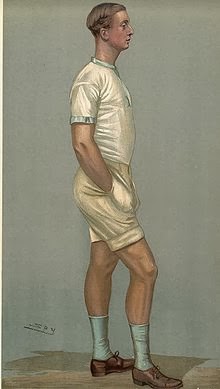
Without really trying to be scientific, I took a look at the cartoons of oarsmen who have been depicted in the magazine Vanity Fair, which was first published in 1868. Nearly 25%, or twelve out of the 50 rowers (or were there 59 oarsmen altogether?), who were depicted between 1889 and 1912 in Vanity Fair are showing ‘legs’ (the first oarsman who was caricatured, Sir Stafford Northcote, appeared in the magazine in October 1870). First out in shorts in Vanity Fair was the Henley Royal Regatta legend, Guy Nickalls, who showed up in his rowing kit on 20 July 1889 in the magazine.

Stanley Duff ‘Muttle’ Muttlebury – 22 March 1890.

Second man out, in shorts in Vanity Fair, was the great Cambridge oarsman, Stanley Duff ‘Muttle’ Muttlebury (in Vanity Fair on 22 March 1890), who, as a matter of fact, is the only oarsman out of the 50 who is depicted holding an oar in a boat. (Robert Henry Foster – 6 July 1910 – is not wearing shorts, nor is he sitting in a boat, but there is at least an eight in the background behind him in his Vanity Fair cartoon). Rudie Lehmann, who showed up in Tim’s blog post wearing ‘Oxford Bags’, wrote about Muttle and his short shorts in verse:

Muttle at six is ‘stylish’, so at least The Field reports;
No man has ever worn, I trow, so short a pair of shorts.
His blade sweeps through the water, as he swings his 13.10,
And pulls it all, and more than all, that brawny king of men.

Lord Ampthill – 21 March 1891.

A year after, almost on the day, Muttle had had his 13 st. 10 lbs. shown in Vanity Fair, Guy Nickalls’s best friend and rowing partner Oliver Arthur Villers Russell, more known as Lord Ampthill, was depicted in Vanity Fair (21 March 1891) showing a stylish fashion, (Oxford) blue jacket and rowing cap, tan shorts and brown knee socks and brown shoes.

Hugh Benjamin ‘Benjie’ Cotton – 15 March 1894.

Then it took some years before another oarsman showed up, exposing some legs in Vanity Fair, Hugh Benjamin ‘Benjie’ Cotton (15 March 1894), who was a fairly short and light oarsman, who also rowed successfully in the colours of the Dark Blues, which was shown by the oar he was holding in his right hand. Cotton, too, was wearing brown knee socks and brown shoes.

Charles Murray Pitman – 28 March 1895.

Charles Murray Pitman (28 March 1895) was said to have been ‘a cheerful, wholesome boy, full of pluck’, but lazy outside the boat, though in the boat, he won four successive Boat Races for Oxford, in 1892-1895.

Walter Eskine Crum – 19 March 1896.

Then there was Walter Eskine 'Crumbo' Crum (19 March 1896), who in Vanity Fair was called ‘quite a fine specimen of young English manhood’ by the artist ‘SPY’, who, however, did not mention anything about the oarsman’s knees or legs, but did write that ‘his chief peculiarities are a beautiful complexion, an almost girlish look, a very frequent blush (which is the outcome of much modesty)’. Crumbo is also, just as Lord Ampthill, wearing a blue blazer with a white pocket square, brown knee socks and white shoes and cap in hand. He looks very dashing.

Harcourt ‘Tarka’ Gold – 23 March 1899.

The legendary oarsman and coach Harcourt Gilbey ‘Tarka’ Gold (23 March 1899) was the first man to be knighted for his services to the sport of rowing, and also the first man who received a comment from ‘SPY’ about his knees in Vanity Fair. SPY wrote: ‘He has wonderful knees; and his legs are always loudly appreciated by the crowd at Putney.’ I leave it to you readers to decide if Tarka’s knees are more ‘wonderful’ than, say ‘Duggie’ Stuart’s or ‘Ethel’ Etherington-Smith’s?

William Dudley-Ward (29 March 1900).

William Dudley-Ward (29 March 1900) met with great opposition within the own ranks when he, as the president of Cambridge University Boat Club, for the 1898 Boat Race, brought in the famous Oxford oarsman and coach William Fletcher to coach the Light Blues. The Dark Blues had been victorious for eight consecutive years so it was a question of finding an answer to the problem with some kind of a 'desperate-times-call-for-desperate-measures' solution. However, the crew was struck with misfortune. Getting close to Boat Race Day, the stroke Charles Steele went down with influenza and could not row and President Dudley-Ward was ordered by his doctor not to row. Second seated, Adam Bell, the 'old man' in the crew, moved reluctantly to the stroke seat. Oxford won the race. The following year, Cambridge won, stopping the Dark Blues to get their tenth straight victory. Then, two days after Dudley-Ward - now president of Cambridge University BC again - was depicted in Vanity Fair, on 31 March 1900, Cambridge won, now with twenty boat lengths. In the Vanity Fair print Dudley-Ward is seen with his turned-upped/cuffed shorts and Cambridge-blue socks.

Wilfrid Hubert Chapman (2 April 1903).

Wilfrid Hubert Chapman (2 April 1903) rowed in the Eton crews that won the Ladies’ Plate at Henley in 1897 and 1898. He was to row bow in the Light Blues’ crew of 1899, but decided not to participate. In February 1900, as Second Lieutenant at the Sixth Yorkshire Regiment, Chapman went to fight in South Africa, but was sent home with fever the next year, in March. He then rowed in the winning Cambridge crews in the 1902 and 1903 Boat Races. It was said that Chapman ‘was probably the most dashing bow who ever rowed in that place’, which referred to his rowing style, as he was ‘not particular about dress’. At the outbreak of the First World War, he left his job at Bombay Company in Karachi to rejoin the Sixth Yorkshire Regiment. Captain Chapman was one of the first ones to get killed at the landing at Suvla Bay in the Dardanelles – the only oarsman depicted in Vanity Fair killed in action during the First World War.

Douglas 'Duggie' Cecil Rees Stuart (13 March 1907).

Douglas 'Duggie' Cecil Rees Stuart (13 March 1907) stroked the Light Blues in four Boat Races between 1906 and 1909. Stuart created a scandal at the first race rowing with a particularly ‘ugly style’, which would be called after him, ‘Stuart’s sculling style’. Ugly or not, Cambridge won the Boat Races in 1906, 1907 and 1908, the latter year being picked as Great Britain’s first boat at the 1908 Olympic rowing regatta on the Henley course. However, the Cambridge crew (slightly altered from the Boat Race crew) was beaten by Royal Club Nautique de Gand, Belgium, in the semifinals.

Banner Carruthers Johnstone (3 July 1907).

The Scotsman Banner Carruthers Johnstone (3 July 1907), by his friends called ‘Bush’ due to his military moustache, was Captain of the Boats at Eton before he showed up at Cambridge, rowing for Trinity College. Johnstone rowed in four Light Blue crews, between 1904 and 1907, losing to Oxford only in the 1905 race. He was also successful at Henley, taking cups in the Silver Goblets, the Visitors’ and the Grand. He rowed in the number three seat in the winning Leander ‘Old Crocks’ crew in the final at the 1908 Olympic eights race against Royal Club Nautique de Gand.

Raymond Broadley 'Ethel' Etherington-Smith (5 August 1908).

About Raymond Broadley 'Ethel' Etherington-Smith, SPY wrote that he was 'the finest and handsomest young athlete I ever drew as an under-graduate', but by summer 1908, the oarsman, in the picture seen in his Leander kit, was 31 years old and a newly Olympic gold medallist in the eights. The Leander crew had been hand-picked by coach Tarka Gold to form the British 'B crew' at the Olympic regatta in Henley-on-Thames. Compared to the British first selected boat, the 1908 Cambridge winning crew in the Boat Race that year, which had been stroked by Duggie Stuart, the Leander crew were older rowers, going by the name of the 'Old Crocks'. Other oarsmen in the 'Old Crocks' crew, who had been depicted in Vanity Fair, were Banner 'Bush' Johnstone and Guy Nickalls. In September 2012, Ethel's 1908 Olympic gold medal was sold for an astonishing £17,500 ($27,738).

That was the twelve oarsmen in Vanity Fair wearing shorts in the magazine. We have to save the oarsmen and oarswomen wearing lycra/spandex till another time.

Much of the information about the Vanity Fair oarsmen was collected from the brilliant "Rowers of Vanity Fair" on Wikipedia.

Thursday, February 6, 2014

Nominations for the 2014 Thomas Keller Medal

The World Rowing Federation, FISA, would like to hear from the general public on who they would like to pick for the prestigious Thomas Keller Medal for 2014, the organisation writes on their website.

The Thomas Keller Medal is the highest distinction in the sport of rowing. It is awarded to recognise an exceptional international rowing career as well as exemplary sportsmanship and legendary aspect.

The award was named after the late President of FISA, Thomas Keller. Born in 1924, Keller was elected President of FISA in 1958 as a 34-year-old and was then the youngest-ever president of an international sports federation.

Following the 1988 Olympic Games, Keller spontaneously awarded the FISA Medal of Honour to single scullers Peter-Michael Kolbe (Germany) and Pertti Karppinen (Finland) to commemorate one of the greatest rivalries in the history of the sport, thereby recognising their exceptional talent and sportsmanship. This shaped the idea of the Thomas Keller Medal, which was initiated by the Keller family following Keller’s passing in 1989. The medal was first awarded to the great Norwegian rower Alf Hansen in 1990.

Each year the winner is carefully selected by the Thomas Keller Medal committee which includes Keller’s son, Dominik, and it follows a broad international nomination process including public nominations. The aim is to ensure that the true values in which Keller so strongly believed are represented.

To be awarded the Thomas Keller Medal the following five factors are taken into consideration:

1. Success at the international level
2. ‘Type’ of career
3. Technical mastery of the sport
4. Sportsmanship
5. ‘Legendary’ aspect

The award will be presented on Saturday, 12 July 2014 at the World Rowing Cup in Lucerne, Switzerland. Please click here to submit your nomination for the 2014 Thomas Keller Medal to FISA by midnight CET on Friday, 21 February 2014.

Wednesday, February 5, 2014

Lewis Clive: The Red Blue

Lewis Clive, 1931.
Tim Koch writes:

I have not yet finished with the picture of the 1931 Oxford Crew that inspired my recent piece on ‘Oxford Bags’. Fourth from the left is the ‘6’ man, Lewis Clive, who seems slightly ‘out of step’ with the others. Perhaps he is standing a little forward of the group; he is upright with his arms folded across his chest while the others slouch a little with their hands in their pockets; the rest of the crew are in ‘blanket bags’ made from some coarse material while his well-tailored trousers are made from a finer cloth; unlike the others, he looks not into the camera but slightly to the side. It could be thought that this Old Etonian from a titled family was a typical member of the privileged group of young men who were at Oxford or Cambridge Universities between the two World Wars – but this was not the case.

Lewis Clive was born on 8 September 1910. His father had been a Conservative Member of Parliament between 1900 and 1906 and also Parliamentary Private Secretary to the Chancellor of the Exchequer, Austen Chamberlain, the latter becoming the boy’s godfather. While at Eton, Clive unusually held two of the most prestigious posts in the school, that of Captain of the Oppidans (selected from the most academically distinguished non-scholarship boys) and Captain of Boats. Going up to Christ Church, Clive rowed at ‘6’ in the losing Oxford boats of 1930 and 1931 (this was the middle of the Cambridge run of thirteen victories in succession, 1924-1936) but had more rowing success on the wider scene.

In 1931 and 1932, he and Hugh ‘Jumbo’ Edwards (who were ‘6’ and ‘5’ respectively in the 1930 OUBC crew) won the Silver Goblets, the pairs event at Henley Royal Regatta. On the strength of their Henley wins, they were selected to represent Britain in the coxless pairs at the 1932 Olympic Regatta in Long Beach where they had a comfortable victory, beating New Zealand by two seconds and Poland by eight. According to sports-reference.com, Clive refused an invitation to join Leander – perhaps an indication of things to come.

The rowers who took part in the 1932 Olympic Regatta (click to enlarge). The countries represented are Australia, Brazil, Canada, France, Germany, Great Britain, Italy, Japan, the Netherlands, New Zealand, Poland, the United States, and Uruguay. I think Lewis Clive is on the front row, eighth from the right, probably between Jack Beresford and David Haig Thomas. Picture: Wikipedia.

So far, perhaps, so conventional. What marked Clive out were his later political views and actions. Some time after leaving Oxford with a second in law in 1932 he became an active member of the centre-left Labour Party.

Strangely, it seems that he was not radicalised while at university (indeed, in his time there, he was a member of the exclusive and reactionary Bullingdon Club). His Times obituary later noted that after graduation he worked as a banker ‘while his political ideas were yet uncertain...’ It continued, ‘His resolute single mindedness.... was accompanied by an eager search for constructive ideas in place of earlier prejudices.....’ It is true that it was not unknown, especially in the inter-war years, for privileged young men and women to embrace left-wing ideas. It is also true that at the time the British Labour Party was a ‘broad church’, which included everyone from liberal reformers to crypto-communists.

It would be easy to dismiss Clive as a ‘Champaign Socialist’. His background was Eton and Oxford, the Bullingdon and banking. Later he became a Labour Party member of the Council in the comfortable London Borough of Kensington and also a member of the Fabian Society. The Fabians advocated gradual rather that revolutionary change and its membership was almost entirely composed of upper middle class intellectuals. Early supporters included Leonard and Virginia Woolf, George Bernard Shaw, H.G. Wells and Emmeline Pankhurst. Clive also expressed a desire to become a Member of Parliament.

Had Lewis Clive attempted to advance his political beliefs purely in debate at Kensington Town Hall or in the drawing rooms of polite society or over the dinner table at country house parties, we could be cynical about his political commitment. However in 1938 he did something that proved the sincerity of his beliefs – he volunteered to fight for the Republican side in the Spanish Civil War.

Volunteers march to Victoria Station in London on their way to Barcelona to fight for the Republican forces. Those were the days when you wore a suit and tie on the way to war.

The civil war in Spain (July 1936 to April 1939) was ostensibly between the Republicans (who were loyal to the established elected government and were supported by the Soviet Union) and the Nationalists (who were ‘fascistic’ if not ‘fascist’ and who led a coup against the Second Spanish Republic, supported by Nazi Germany and Fascist Italy). The armies of both sides were bolstered by foreign volunteers, the International Brigades, from a claimed 53 countries (though the majority, figures vary between 32,000 and 40,000, went to fight for the Republicans). An uneasy mixture of communists, socialists, anarchists and trade unionists from all social classes (though predominantly working class) saw Spain as the opportunity to stop the spread of the ideology of Hitler and Mussolini. There was (and still is) a romantic appeal to the International Brigades. In his book A Moment of War (1991), volunteer Laurie Lee wrote:

I believe we shared something...... unique to us at that time – the chance to make one grand and uncomplicated gesture of personal sacrifice and faith, which might never occur again.... few of us yet knew that we had come to a war of antique muskets and jamming machine-guns, to be led by brave but bewildered amateurs. But for the moment there were no half-truths and hesitations, we had found a new freedom, almost a new morality, and discovered a new Satan – fascism.

A romanticised image from the Spanish Civil War, a conflict in which photojournalism came of age. Picture: http://radicalhistorynetwork.blogspot.co.uk

Two writers on the Spanish Civil War, Richard Baxell and Stuart Christie, confidently state that, at least by the time he got to Spain, Clive was a member of both the Communist Party of Great Britain (CPGB) and of the Labour Party, though Christie says that he was a ‘covert’ CP member. I am unsure about this. Certainly, in the early days of the CPGB, founded in 1920, dual membership was accepted by both sides (in 1922 an open member of the Communist Party was elected as a Labour Member of Parliament). By the late 1930s belonging to both would be more difficult. However, if it were true, it could have been part of Clive’s continuing political journey. Also, at the time many people flirted with communism simply as a response to the growth of fascism – the realities of Soviet Russia were as yet unknown.

Perhaps the most famous volunteer in Spain was George Orwell, the tall figure on the right. With characteristic cussedness, Orwell fought not with the International Brigades but with POUM, Spanish anti-Soviet Communists who were in alliance with the Anarchists. POUM were later persecuted by the pro-Soviet Communists, providing Orwell with inspiration for Animal Farm and 1984. Picture: http://georgeorwell.org/SpanishCivilWar.htm

Lewis joined the British Battalion of the 15th International Brigade, mostly composed of volunteers from English speaking countries. There is a remarkable photographic collection relating to the 15th here. Some volunteers and their leaders were veterans of the 1914-1918 War but most, like Clive, had no military experience.

The first mention that I can find of Clive in Spain is on the website of another writer on the war, Lydia Syson. In March and April 1938, Republican forces in northern Spain were in retreat and were forced back over the Ebro, a deep, broad river with strong currents:

.... during the chaos and terror of the Retreats... John Longstaff had been the very last across the bridge at Mora de Ebro before it was blown up..... (he) never forgot the urgent cries of ‘Venga! Venga!’ as he sprinted to safety. Former Olympic rower Lewis Clive...... had swum across with one non-swimmer, and returned to rescue military equipment. Others were swept away by the current.

The Times obituary records that ‘Earlier in the campaign ....... (Clive) had a remarkable escape when, after an overwhelming advance of Italian tanks, he found himself cut off behind the enemy lines, but succeeded in crawling back to his own lines after 10 days of great privation’. Possibly this refers to an incident on 31 March 1938 when 650 men from the 15th Brigade marched into a column of Italian soldiers. Only 80 Brigaders made it back to their own lines.

Richard Baxell, noted this in a lecture in 2013:

(In the summer of 1938 the British Battalion was) training at Fontanella, a pretty village surrounded by rugged hills and mountains near the Catalonian village of Marsa....(they) were kept busy with ‘training, marching or rifle practice’ and ‘the procedures for crossing rivers’, while at night one of the volunteers who was a particularly strong swimmer (Lewis Clive) swam clandestinely across the Ebro River to reconnoitre the Nationalist positions.

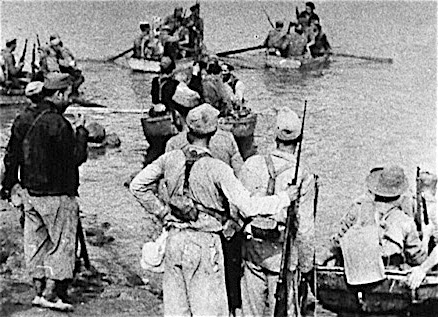
With such feats it did not take Clive long to be made a company commander. On 25 July 1938, the battalion were part of a huge surprise offensive by the Republicans, attacking back across the Ebro River, a final desperate attempt to turn the tide of the war. Richard Baxell quotes veteran John Longstaff:

We got into rowing boats; everyone was silent and thinking about the fighting to come. The Spanish and International Brigaders had muffled even the oars....

I think that anyone who loves rowing will agree that, even with the threat of possible death looming, Clive could probably not have stopped himself thinking, however briefly, of the other times in his life that he had sat in a rowing boat, pulling an oar.

Crossing the Ebro. Picture: http://www.batallaebre.org/english/batallaebre.php

The British volunteers and others crossed the river and had some initial success but were stopped by ferocious aerial and artillery bombardment outside the town of Gandesa. The Nationalist defenders were in a good defensive position on Hill 481 outside of the town and attempts at attacking up the steep rise cost many lives – including that of Lewis Clive.

A website devoted to Irish volunteers in Spain has collected information about Clive’s death. It disproves a ‘barrack room rumour’ that he was killed by drunken ‘friendly fire’ and produces two eye witness accounts of his last few seconds.

An e-mail from José Ignacio García Muniozguren, who translated George Wheeler’s To Make The People Smile Again: A Memoir of the Spanish Civil War (2003) into Spanish, quotes Wheeler who was next to Lewis when he was shot:

Lewis Clive re-appeared and asked about the activity in the fascist lines. It was a hot, sunny day and, as usual, my shirtsleeves were rolled up. At that moment I felt splashes on my left forearm, and glancing down, was astonished to see they were splashes of blood. Turning, I saw Lewis reel and fall. Someone below said ‘What a ghastly sight”. I slid down from my firing position and saw that the top of his head was severed completely…. This big, cheerful, and sincere man had performed his duties as Company Commander with distinction. Well-liked and respected in the battalion, this was a great loss to us all.

Manus O'Riordan responded with what his father, an Irish International Brigade veteran, told him on a return trip to Spain in 1988:

As we journeyed by car through the mountainous battlefields of the Ebro front, on the occasion of his first return visit to Catalunya in fifty years, my father unexpectedly opened up and spoke of his memories. He recalled being right beside Lewis Clive as they were under fire from the fascist lines. When a lull came in the firing, Clive stood up to get a better view. My father said he immediately thought ‘a bad commander’. This was no reflection on Clive's courageous character and bravery, but rather a comment on the recklessness of such bravery in presenting himself in the open as such a soft target for the fascists. The thought had barely formed in my father’s head when Clive was shot...

Older British readers will remember Jack Jones, leader of the Transport and General Workers Union from 1968 to 1979. Here he talks about his experiences on Hill 481 and gives his overview of the Spanish Civil War:


The International Brigades were disbanded and left Spain at the end of 1938 and the Republicans surrendered in April 1939. Spain was to live under the semi-fascist rule of the Nationalist leader, Franco, until his death in 1975.

As far as I know, Clive was the only Blue or Henley winner to die in Spain. The only other Olympian that I know of is Irish boxer, Robert Hillard.

There is a view that the Spanish Civil War, 1936-1939, was in fact a part of the larger fight against tyranny, the Second World War. Nineteen Rowing Blues were killed between 1940 and 1945 including two from the 1931 Boat Race. The Oxford stroke, Holdsworth, died on active service with the Royal Air Force in 1942 and the Cambridge bow, Haig Thomas, fell on D-Day, 6 June 1944 while serving with the Commandos. Clive’s father, Lieutenant-Colonel Percy Clive, had been killed in action in 1918, his older brother, Major Meysey George Dallas Clive, suffered the same fate in 1943.

Because few people nowadays agree with their political philosophies, volunteers such as Lewis Clive are often marginalised or dismissed, thought of as tools of the Soviets or romantic fools. However, these people realised long before the United States and free Europe, that the only way to stop fascism was by force. Richard Baxell quotes volunteer John Bassett:

(The 1930s were) a time of hope, when a man with a rifle had some power to divert the tide of human affairs.

The Times obituary concluded:

Lewis Clive’s many friends, whatever their political views, will not forget his inspiring courage, and will find some consolation in the knowledge that he died gallantly.... in what he was convinced was a critical struggle to save democracy for Spain and ultimately for Europe.

Tuesday, February 4, 2014

Watch out, Sir! 2

Tim Koch writes:

There is a story that as the oarsmen struggled to row through the massed canoes and punts, they (quietly) described them as ‘panoes and …..’.

Monday, February 3, 2014

Watch out, Sir!

"Look Ahead, Sir!" A Reminiscence of Henley Regatta ~ The Graphic 31 July 1880.

I immediately fell in love with this print the first time I saw it several years ago. Last autumn, I found it on eBay, and bought it straight away. In 1880, there were still no booms along the course at Henley (they came first for the 1899 Regatta). This meant that spectators' pleasure boats and punts could drift out in front of crews racing and mess up many good oarsmen's chances to win. The gentleman in the single scull is probably not in a race, but on his way to the start. Will he make it in time?

Sunday, February 2, 2014

Sir Steve is Going Downhill


British Channel 4’s winter sports reality show is called “The Jump”, and believe it or not, one of the contestants is Sir Steven Redgrave who, although he says that he is ‘ten years too old’ to do ski jumping, decided to go for it. Yes, his wife called him Crazy!

But, as the newspaper The Independent wrote in an article: ‘Sir Steve, you see, is a bit of a skiing nut. Actually, scratch that: he’s a lot of a skiing nut.’ Read the article here. Training for another discipline, Sir Steve took a nasty fall, but luckily he did not break anything. 

Thanks to HTBS’s Hélène Rémond who sent this video and newspaper article along.

Saturday, February 1, 2014

Rudern Film: Buster Keaton – Der Student


Greg Denieffe writes:

In 2010, the film College (1927) was featured in a HTBS post called ‘Ready all!’ It was released in Germany as Der Musterschüler / Buster Keaton – Der Student and was promoted with a poster depicting an animated Buster Keaton playing Ronald, a hapless athlete, in his coxing singlet and holding an oar. Behind him is the silhouette of a racing eight.

On The Rabbit’s guide to Rowing Films you will find a plot summary and information on the film’s location. The final minutes show Keaton’s true athletic prowess as he goes to the rescue of his girlfriend, performing all the athletic feats he has tried and failed at throughout the film. However, he did have a limit to his physical ability. For a scene where Ronald pole-vaults through a window, Keaton had to use a stunt double for the first time in his career.

You can watch the whole film on YouTube or skip to 43.40 and follow the action from his ‘selection’ as coxswain by the Dean of Clayton College.

Keaton died on 1 February 1966, aged 70. Today, HTBS would just like to say, thanks for being such a good ‘coaxer’!

Spoils of victory! – A poster for College showing the victorious Clayton crew on the pontoon.