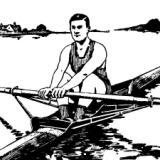
For all of you readers of HTBS who have enjoyed the entries about John Fairfax, today The Daily Telegraph’s travel section has a real treat for you: an interview with Sylvia Cook, the woman who helped Fairfax prepare for his solo-row across the Atlantic in 1969, and then two years later rowed with him from San Francisco to Australia. Four days shy of a year, Fairfax and Cook rowed across the Pacific Ocean and were struck by all kinds of terrible disasters. Why did she accompany him on this trip? For love, she says. Read this wonderful article here.
Sunday, February 26, 2012
Interview With Sylvia Cook!
For all of you readers of HTBS who have enjoyed the entries about John Fairfax, today The Daily Telegraph’s travel section has a real treat for you: an interview with Sylvia Cook, the woman who helped Fairfax prepare for his solo-row across the Atlantic in 1969, and then two years later rowed with him from San Francisco to Australia. Four days shy of a year, Fairfax and Cook rowed across the Pacific Ocean and were struck by all kinds of terrible disasters. Why did she accompany him on this trip? For love, she says. Read this wonderful article here.

Saturday, February 25, 2012
Henry Searle: “How I Won The World Championship”, Part 1
In an e-mail Bernard Hempseed of New Zealand, author of Seven Australian World Champion Scullers, writes that he recently obtained Scott Bennett’s book The Clarence Comet: The Career of Henry Seale 1866-89 (1973). In the book is a discussion of an newspaper article Searle wrote after he had won the World Championship in 1888. It was published in Leeds, Bernard writes, but a reprint was done in Hobart after Searle’s death, in December 1889. “I found the reprint and have managed to make a transcript of it”, Bernard writes. And he would like to share it with HTBS’s readers! The article will be published in three installments on HTBS, today, tomorrow, and Monday. Thank you very much to Bernard! Enjoy HTBS readers.
The Mercury (Hobart, Tas.) 11 Dec 1889
“How I won the World Championship”
by Henry E. Searle
Champion Single Sculler of the World
[Our cable message published to-day tells of the death of Searle, the champion sculler, cut off in the prime of manhood and the hay-day of honourable prosperity. The following record of his career, and his own narrative of how he won his last great race, taken from the Leeds Times, will be read with interest.]
 The British public, through the Press and in other ways, have taken so mach interest in me since I attained the position of Champion Sculler of the World, and have been so hospitable and kind, that I venture to give the following account of myself with a view to satisfy all legitimate curiosity they may have in regard to myself and my doings, A further reason that urges me to this course is that it will, once and for all, relieve me from the necessity of answering needless questions, however pleasurable they may be, to each fresh questioner become somewhat tedious to the replier.
My full name then is Henry Ernest Searle. I was born on the 14th day of July, 1866, in Queen’s-street, at Grafton, on the Clarence River, in N.S.W., and am now 23 years of age. Both my parents are of English birth, and they went out to Australia to settled just as Grafton was being settled, it was very small and very wild when my father first took up his abode there; sugar-cane and maize growing, cattle raising, and mining being the chief industries which attracted colonists. In a few years it became an important centre, and is now a large and flourishing city. It has a noble situation on the Clarence River, which is here about half-a-mile wide; the site of the town being about 45 miles from the Heads, as we call the mouth of that river. The Clarence is a fine broad river, to which the Thames in comparison is but a creek. Its rise and fall does not average more than 6ft., except in heavy rains; it has long reaches of from five to six miles, straight as a racecourse, so that it is admirably suited as a nursery for oarsmen, and it is no wonder that it has turned out many and good ones. But in my young days there was very little shipping on it.
After living seven years at Grafton, and while I was still a mere child, my father shifted to Esk Island, which he had bought, and there he set up farming maize, cane etc. Elk Island is about 40 miles from Grafton, and so much nearer the Heads. There I grew up, at first attending school, and then assisting my father in his farming operations. When at school we had to row three and a half miles either way, for in those days roads were few and far between, and water travelling was the usual mode of progression. In fact, life at Esk Island was not unlike what life must be in Venice. It is not, therefore, surprising that from an early age I took kindly to the sculls. The boat contained my sister and my younger brother. We used often to race other boats bound on the same errand, and I may add that the Searle boat generally showed the way. I always had a great ambition for rowing, and, used often to say that I wished to become to become a sculler. In my boyish attempts I put in all I knew of hard work, and, as I have said, very successfully, so that I soon got known as a smart lad.
When I was 17 my father bought me a racing skiff, and in that I practiced for twelve months. Next year, at the age of 18, there was a local regatta at Chatsworth Island for all comers in watermen’s skiffs for which I entered and scored my first win in my first public race. This was a happy augury for my future success. I need scarcely say that Trickett’s reputation had reached me as a boy when I was at school or working with my father, and his many victories had fired my ambition. Trickett was often the subject of our conversations, and when we had any great match on I used often to say to my father “I wonder who is going to win today’s race”, and I generally managed to pick the winner.
After winning a few races I often told, my parents, in my youthful enthusiasm, that I wanted to be the Champion Sculler of the World.
My next race was at Harewood Island, in waterman’s skiffs, double sculls. My partner was F. Fisher. Three pairs started, and we rowed second, but the first boat being disqualified we got the prize. The same day in a youths’ race, age 19, I scored another win; and a few months later at the same place, against all-comers, in light skiffs over a 3½ mile course, level start, I beat M. Wallace and M. Driscoll who were both reckoned very good men. On the same day I suffered defeat in a mile race, M. Wallace kindly showing me the way home. I have on more than one occasion returned him the compliment since G. Baker was third on this occasion. My next race was again at Chatsworth Island in light skiffs, level start, and again I got the victory, beating A. Baker, M. Wallace, G. Bush, and L. Pringle. After this race I got handicapped. For instance, at the regatta at Yamba I had a 10 lb. handicap against A. Baker and M. Wallace, who were at feather-weight. Owing to rough weather my boat was nearly swamped, but though it was half full of water I managed to come in second, Baker being first. All this time I was doing my regular work at the farm, seeing to things, and generally assisting my father; but I would take half an hour in the morning or in the evening for practice.
My next race, if I remember rightly, was at Palmer’s Island. I had a 16 lb. handicap, A. Baker 16 lb., Wallace 10 lb., and G. Baker feather-weight. I won, Wallace being second. I rowed again at Palmer’s Island with 28 1b. handicap, A. Baker 81b., Wallace 71b., and Reid a feather. After a good race, I leading about a mile, my weight began to tell, and Baker passed me, though I managed to follow him home a good second. Then I rowed a match with M. Wallace, at Chatsworth, over a 2½ mile course, and won easily. A fortnight later I rowed a match with S. Davis, also over a 2½ mile course. It was a clinking race for the first half-mile, but I beat him easily at the finish.
The second installment of Searle’s article will be published tomorrow.
The Mercury (Hobart, Tas.) 11 Dec 1889
“How I won the World Championship”
by Henry E. Searle
Champion Single Sculler of the World
[Our cable message published to-day tells of the death of Searle, the champion sculler, cut off in the prime of manhood and the hay-day of honourable prosperity. The following record of his career, and his own narrative of how he won his last great race, taken from the Leeds Times, will be read with interest.]
 The British public, through the Press and in other ways, have taken so mach interest in me since I attained the position of Champion Sculler of the World, and have been so hospitable and kind, that I venture to give the following account of myself with a view to satisfy all legitimate curiosity they may have in regard to myself and my doings, A further reason that urges me to this course is that it will, once and for all, relieve me from the necessity of answering needless questions, however pleasurable they may be, to each fresh questioner become somewhat tedious to the replier.
My full name then is Henry Ernest Searle. I was born on the 14th day of July, 1866, in Queen’s-street, at Grafton, on the Clarence River, in N.S.W., and am now 23 years of age. Both my parents are of English birth, and they went out to Australia to settled just as Grafton was being settled, it was very small and very wild when my father first took up his abode there; sugar-cane and maize growing, cattle raising, and mining being the chief industries which attracted colonists. In a few years it became an important centre, and is now a large and flourishing city. It has a noble situation on the Clarence River, which is here about half-a-mile wide; the site of the town being about 45 miles from the Heads, as we call the mouth of that river. The Clarence is a fine broad river, to which the Thames in comparison is but a creek. Its rise and fall does not average more than 6ft., except in heavy rains; it has long reaches of from five to six miles, straight as a racecourse, so that it is admirably suited as a nursery for oarsmen, and it is no wonder that it has turned out many and good ones. But in my young days there was very little shipping on it.
After living seven years at Grafton, and while I was still a mere child, my father shifted to Esk Island, which he had bought, and there he set up farming maize, cane etc. Elk Island is about 40 miles from Grafton, and so much nearer the Heads. There I grew up, at first attending school, and then assisting my father in his farming operations. When at school we had to row three and a half miles either way, for in those days roads were few and far between, and water travelling was the usual mode of progression. In fact, life at Esk Island was not unlike what life must be in Venice. It is not, therefore, surprising that from an early age I took kindly to the sculls. The boat contained my sister and my younger brother. We used often to race other boats bound on the same errand, and I may add that the Searle boat generally showed the way. I always had a great ambition for rowing, and, used often to say that I wished to become to become a sculler. In my boyish attempts I put in all I knew of hard work, and, as I have said, very successfully, so that I soon got known as a smart lad.
When I was 17 my father bought me a racing skiff, and in that I practiced for twelve months. Next year, at the age of 18, there was a local regatta at Chatsworth Island for all comers in watermen’s skiffs for which I entered and scored my first win in my first public race. This was a happy augury for my future success. I need scarcely say that Trickett’s reputation had reached me as a boy when I was at school or working with my father, and his many victories had fired my ambition. Trickett was often the subject of our conversations, and when we had any great match on I used often to say to my father “I wonder who is going to win today’s race”, and I generally managed to pick the winner.
After winning a few races I often told, my parents, in my youthful enthusiasm, that I wanted to be the Champion Sculler of the World.
My next race was at Harewood Island, in waterman’s skiffs, double sculls. My partner was F. Fisher. Three pairs started, and we rowed second, but the first boat being disqualified we got the prize. The same day in a youths’ race, age 19, I scored another win; and a few months later at the same place, against all-comers, in light skiffs over a 3½ mile course, level start, I beat M. Wallace and M. Driscoll who were both reckoned very good men. On the same day I suffered defeat in a mile race, M. Wallace kindly showing me the way home. I have on more than one occasion returned him the compliment since G. Baker was third on this occasion. My next race was again at Chatsworth Island in light skiffs, level start, and again I got the victory, beating A. Baker, M. Wallace, G. Bush, and L. Pringle. After this race I got handicapped. For instance, at the regatta at Yamba I had a 10 lb. handicap against A. Baker and M. Wallace, who were at feather-weight. Owing to rough weather my boat was nearly swamped, but though it was half full of water I managed to come in second, Baker being first. All this time I was doing my regular work at the farm, seeing to things, and generally assisting my father; but I would take half an hour in the morning or in the evening for practice.
My next race, if I remember rightly, was at Palmer’s Island. I had a 16 lb. handicap, A. Baker 16 lb., Wallace 10 lb., and G. Baker feather-weight. I won, Wallace being second. I rowed again at Palmer’s Island with 28 1b. handicap, A. Baker 81b., Wallace 71b., and Reid a feather. After a good race, I leading about a mile, my weight began to tell, and Baker passed me, though I managed to follow him home a good second. Then I rowed a match with M. Wallace, at Chatsworth, over a 2½ mile course, and won easily. A fortnight later I rowed a match with S. Davis, also over a 2½ mile course. It was a clinking race for the first half-mile, but I beat him easily at the finish.
The second installment of Searle’s article will be published tomorrow.
Wednesday, February 22, 2012
John Fairfax Never Dies...
 On 18 February, HTBS posted the news that John Fairfax, the first person to solo row across the Atlantic, had died on 3 February, 74 years old. A couple of obituaries had by then been published about this remarkable adventurer, who at 9 settled an argument with a fellow boy scout by firing a pistol at the hut where the boy and the rest of the scouts were sleeping; and at 13 was living in the Amazon jungle like Tarzan; and at 20 tried to commit suicide in the jungle by having a jaguar attacking him (the animal did attack, but then Fairfax had changed his mind and killed it with his gun); and became an apprentice to a pirate, etc, etc.
The story about John Fairfax seems to really have taken off - it went viral, as they say - after Margalit Fox's obituary in The New York Times last Sunday. It is a very well-written article, although I think that I prefer the one in The Daily Telegraph on Saturday.
There is actually an interview on YouTube with Fairfax from 1969, after he had completed his crossing over the pond. He seems very relaxed in this clip:
I managed to find some other film clips from 1969 with Fairfax before he sets out from the Canary Islands and during his voyage. Now, I have to warn you, the link will take you to an hour video with several film clips of news from 1969: media mogul Robert Maxwell loses News of the World to Rupert Murdoch, the war in Vietnam, Sophia Loren shows her new baby, Judy Garland gets married (again), Paul McCartney gets married (not with Garland!), housing problems in Northern Ireland, a plane crash, Harold Wilson goes to Nigeria, Richard Nixon goes to the U.K., etc, etc, etc.... I am afraid, you will not be able to fast-forward the film, but while waiting for the different clips about Fairfax - his girlfriend at the time, Sylvia Cook, is talking to him on the phone 'over...'; Fairfax shows his food; in the middle of the Ocean, he is filming a Russian tanker which he boards to take a shower and get some food; an interview where he explains his thoughts about fighting Nature even if it means that he will not survive (check out the foot stretchers) - you will brush up your knowledge about what happened in 1969!
Here is the link: John Fairfax continues Atlantic crossing Video - Watch ITN Videos
While I am writing this, I am sure there are already some writers in Hollywood working on banging out a script in a month, or two, for a movie about John Fairfax. Whom would you like to see as 'the lone wolf' who crossed an Ocean in a rowing boat?
Tuesday, February 21, 2012
Tim Koch: Dorney Lake - No Bends Here...
 Dorney Lake
HTBS's Tim Koch writes from London:
When I began to visit Henley Regatta in the mid 1980s there was a little ritual carried out by a random collection of boatmen, watermen and master rowers. On the night before the regatta started they took it upon themselves to ‘check that the course was straight’. It seems that this was best done from the bar of the Little White Hart Hotel, situated opposite the boat tent area just above the finish. In between pints of local Brakspear beer they stepped outside, peered earnestly down the course, engaged in secretive conversation and then returned to the pub. At the end of the night they usually agreed among themselves that the course was indeed straight (though it could be argued that their judgement was slightly impaired by this stage).
While the Henley course is no longer checked, an Auriol Kensington Rowing Club training ‘away day gave me the opportunity to ascertain the straightness of another important course - the site of the Olympic Regatta at Dorney Lake near Windsor (21 miles / 34 km west of central London).
In July and August 2012 up to 30,000 spectators a day will be at Dorney to watch the Olympic and Paralympic rowing and the flat water canoe events. The ‘lake’ and its 450 acre grounds are owned and managed by the ancient fee paying school, Eton College. Built between 1996 and 2006 on the site of an old gravel pit, Dorney is 2,200 metres long and has eight lanes, each 13.5 metres wide. In addition there is a parallel five lane warm up and return channel.
The site is managed by a charity, the Dorney Lake Trust which has a three part remit:
a) To provide safe rowing for Eton College pupils.
b) To offer highest-level facilities for major rowing events.
c) To welcome all community sectors for sporting and other activities.
The income from events and functions go towards keeping charges as low as possible, especially for young people.
 Dorney Boathouse
In August 2006, Eton Dorney was the site of that year’s World Rowing Championships. Today many schools, clubs and national squads regularly train there. Three major regattas, formerly held on the River Thames, now take place on the course. They are Wallingford, London Rowing Club’s Metropolitan Regatta and Marlow (regarded as a ‘Henley warm up’ event).
 Seems straight!
The Olympic Regatta runs from Saturday 28 July to Saturday 4 August. It will have 14 events involving 550 athletes (353 men and 197 women). The finals are as follows:
1 August: M 8+, W 2-, W 4x
2 August: M Lwt 4-, M 2x, W 8+
3 August: M 2-, M 1x, M 4x, W 2x, W 1x
4 August: M 4-, M Lwt 2x, W Lwt 2x
I have a ticket for the final day, 4 August. By luck this is the day when the two best hopes for British wins are competing, the men’s four and the men’s lightweight double (though, as the British squad has crews who have qualified in 13 of the 14 events, everyday of the London Olympic Regatta will be thrilling for Brits). Whatever the final results, it is certain that Dorney Lake will be a winner.
Sunday, February 19, 2012
Bert Bushnell: "I was a bloody nuisance"
 Today, The Daily Telegraph is publishing an interesting article about the 1948 Olympic Games by Janie Hampton. The article describes the many problem Great Britain had to organise the Games, but also the happiness amongst the athletes and the spectators to actually be there. The British rower Bert Bushnell, who together with Dickie Burnell won the gold medal in the double sculls on the Henley course, is quoted saying: “There was no fuss and my life wasn’t changed. I went back to work as a marine engineer on Monday. I didn’t get paid to have days off and my employers considered I was a bloody nuisance.” Read the article here.
On 5 March, Janie Hampton’s book Austerity Olympics: When the Games Came to London in 1948 (Aurum Press) will be published.
Saturday, February 18, 2012
John Fairfax Dies
 Yesterday, newspapers reported that John Fairfax, who was the first person to solo row across the Atlantic, had passed away at an age of 74. As a child he had read an article about the two Norwegians, George Harbo and Frank Samuelsen, who in 1896 crossed the ocean in a small rowboat. He had in 1966 tried to raise money for his solo voyage, but then he was unable to get any financial backers. After John Ridgway and Chay Blyth had rowed the Atlantic in 1966, Fairfax “felt a sudden sense of urgency.” He continued: “I realised if I didn’t solo it soon, it was going to be done by somebody else.”
In January, 1969, at the age of almost 32, Fairfax, who in his passport under ‘Occupation’ had put down ‘Adventurer’, left the Canary Islands in his Britannia, which was designed by Uffa Fox. After battling the sea for 180 days, Fairfax reached Florida where he was met by his girlfriend, Sylvia Cook, and the media of the world. He also received congratulations from Apollo 11 astronauts, Neil Armstrong, Buzz Aldrin, and Michael Collins. Armstrong and Aldrin were just getting ready to take their first steps on the Moon.
In 1971, Fairfax and Cook, who could not swim, were the first persons to row across the Pacific, from San Francisco to Hayman Island in Australia, a 361-day voyage. About their passage Fairfax said: “It was a miserable journey. I don’t care if I never touch another oar.” A quite understandable statement. Read The Daily Telegraph’s obituary here. (The British paper writes that John Fairfax died on 8 January, while some other papers write that he passed away on 8 February.) Read more about Fairfax on The Ocean Rowing Society website. On 19 February The New York Times published an obituary where Ms. Cook was interviewed from London.
See also HTBS 22 February, John Fairfax Never Dies...
Tuesday, February 14, 2012
Happy Belated Birthday, Frank!
 On 10 February famous rower and coach Frank Cunningham celebrated his 90th birthday. To pay tribute to Cunningham, the Washington State Senate passed a resolution honouring him for his service to the community and the nation as a teacher and coach. In an article, Cunningham, who was a teacher for 30 years and a coach for 50, said: “It was fun to meet the governor and it is nice to get that kind of attention. But it was kind of a charade.” Read the whole article here.
In November 2010, Cunningham was the recipient of USRowing’s highest honour, the USRowing Medal. He began to row at Noble and Greenough School in Massachusetts in 1937, and during the 1940s he rowed in different crews at Harvard University. Cunningham has coached many of the U.S.’s most prominent scullers.
HTBS would like to send Frank Cunningham a Happy Belated Birthday Greeting!
Saturday, February 11, 2012
National Rowing Hall of Fame Events on 9 & 10 March 2012
 National Rowing Hall of Fame Events on 9 & 10 March 2012 Featuring the Induction of the National Rowing Hall of Fame Class of 2012 on Saturday, 10 March
Event Descriptions and Details:
Friday, 9 March 5:30 p.m. – 8:00 p.m.
Cocktail Reception, Raw Bar and Silent Auction in memory of Hart Perry. Proceeds from this event will be used for projects related to Rowing History and The National Rowing Hall of Fame and Exhibits. Cost $100 per person. Location: The National Rowing Hall of Fame in the G.W. Blunt White Building at Mystic Seaport, 75 Greenmanville Avenue in Mystic, Conn 06355.
The highlight of the evening will be the auction of Hart Perry’s Thames pulling dinghy, donated by Gill Perry and the Perry family. This boat once belonged to famous Oxford Blue and Olympic champion Don Burnell (1875-1969), father of renown oarsman, Oxford Blue, Olympic champion, and rowing journalist Dickie Burnell (1917-1995).
Saturday 10 March 9:30 a.m. – 3:00 p.m.
Rowing History Forum
Guest Speaker will be Peter Raymond, Princeton ’68, Olympic Four 1968, Olympic eight 1972, and member of The National Rowing Hall of Fame Class of 2012. Additional presenters are Tom Weil, Joanne Iverson, Peter Mallory, and Christopher Dodd.
For additional information go to www.RowingHistory.net/forum.htm or send an email to Bill Miller at bmiller@verizon.net. Cost $40 per person, lunch will be served. Location: The River Room in Latitude 41 Restaurant at Mystic Seaport, 75 Greenmanville Avenue in Mystic, Conn 06355.
Saturday 10 March 5:30 p.m. – 11:00 p.m.
National Rowing Hall of Fame – Class of 2012 Induction Ceremony & Reception
Come to honor and celebrate the Class of 2012 at a cocktail reception in the National Rowing Hall of Fame, followed by dinner and the Induction Ceremony. Cost $200 per person. Location: The National Rowing Hall of Fame in the G.W. Blunt White Building and the River Room in Latitude 41 Restaurant at Mystic Seaport, 75 Greenmanville Avenue in Mystic, Conn 06355.
The Class of 2012:
Sebastian Bea ~ Eugene Clapp ~ Elizabeth S. McCagg Hills ~ Franklin Hobbs IV ~ William Hobbs ~ Paul A. Hoffman ~ Anna Seaton Huntington ~ Robert Kaehler ~ Jeff Klepacki ~ J. Cleve Livingston ~ Michael Livingston ~ Mary McCagg ~ Timothy C. Mickelson Lawrence “Monk” Terry ~ Ted Murphy ~ Harry Parker ~ Stephanie Maxwell Pierson ~ Peter Raymond ~ Jennifer Dore Terhaar
Please register online at www.natrowing.org
Friday, February 10, 2012
Rowing Is Back In Springfield!
 A couple of days ago, HTBS received an e-mail from Jonathan Moss, President of the Pioneer Valley Riverfront Club in Springfield, Massachusetts. I am happy to share the exciting news with the HTBS readers. Jonathan Moss writes,
The history of Springfield rowing is nearly as old as the 150+ year old history of American Rowing. Yet, it had a dark period for many decades ... until now. The Pioneer Valley Riverfront Club will bring rowing back to the facility which had public school rowing out of it in the early 1900s. We were recently notified by the City of Springfield of our winning proposal!
Much work needs to be done for development of facility, location, and programs. But this was the first very critical step in the vision of the organization (and, my dream since moving to the area 10 years ago and learning of its past). We will be putting lots of sweat equity and other efforts forward in the coming weeks and years. To get us started, we’re launching a fundraising campaign. The first $18,000 raised will be matched dollar for dollar by some local advocates who share our vision. Please, consider helping to fund this effort by going to our donation page here.
To have a facility will not only allow us to continue our youth and adult programs along with inner-city outreach efforts, but we should also be able to expand and stay on top of equipment maintenance much more easily. We plan to have more than just rowing connecting people to healthy activities in Springfield. North Riverfront Park is conveniently located between the river and a bike path while being conveniently accessible by car.
To get a bird’s eye view of the site, click here.
Thanks so much for your encouragement, interest and support.
Sincerely,
Jonathan Moss
President, Pioneer Valley Riverfront Club
Rowing@pvrowing.org
cell phone: (413) 262-0945
Wednesday, February 8, 2012
Martin Gough: Women’s Boat Race: Worth The Wait
 From London, Martin Gough*, who sometimes writes for HTBS, has an exacting report about the Women's Boat Race. Martin writes:
The only criticism being levelled at organisers of the University Boat Race, after it was announced earlier today, Wednesday, that the women’s race would have parity with the men’s event from 2015, was that it will not come sooner. As part of a new five-year sponsorship deal with asset management company BNY Mellon, women will have the same funding, support and coverage as their male counterparts in three years’ time, racing on the same day, over the same course, in front of the same 250,000-strong crowds and watched by the same TV audience of 7 million.
But while officials batted away detailed questions over the logistics of racing in 2015, it was clear how much work still needs to be done to raise the infrastructure and levels of performance of the women’s squads from their current standard – among the top crews in the country – to those in the men’s race – among the top crews in the world. Sir Matthew Pinsent took part in three Boat Races for Oxford – winning in 1990 and 1991 and losing in 1993, either side of winning his first Olympic title. He also coached the women’s reserve crew for two years while a student and is now on the event umpires’ committee.
“To this day one of the big attributes of someone in the squad is that they have their own car,” he said of the women’s race. Pinsent continued, “The reason Oxford’s women train at Radley [while the men are half an hour away in Wallingford] is that they cycle there. The men’s boat club has vans to take them to training. The boats they had, the coaching they had, the logistical support; a huge amount fell on the boat club officers. Every year they would have to create it again. Finally we’ve found a solution to that.”
Race organisers expect an increase in applications from international rowers and graduates from the US – where undergrad rowing is strong but post-grads are ineligible to compete for their universities – to study at the two institutions and compete in the women’s event, although no sports scholarships are available.
 Pinsent cited two examples of successful female rowers making different choices than men would in the same situation, because of the stature of the women’s race at the time. Anna Watkins (on the right), who, along with Katherine Grainger, has won back-to-back world titles in the double scull and is heavily favoured for Olympic gold this summer, rowed at Newnham College a decade ago, but never went for Cambridge squad selection. Watkins decided she wanted to go to the Olympics but realised the most obvious route into the GB squad was through sculling, which is not on offer at university level.
“We’ve got to make sure there is more of a pathway from the women’s boat club to international rowing. At the moment it happens accidentally. Hopefully in 2020 there will be three or four women in the Olympic team who have come through the Boat Race,” said Pinsent.
Watkins said on Twitter that she was “thrilled” by the news, adding, “Looking forward to seeing a viable pathway from CUWBC and OUWBC to British Rowing re-established.”
Pinsent’s God-daughter is Natalie Redgrave, daughter of his former rowing partner Sir Steve, who was part of Oxford’s winning crew last year, in her second year at the university. However, she is not going for a second victory this year. Pinsent added: “I doubt even as a medic that she’s still going to be studying in 2015. There’s a case in point of someone who obviously loves the sport and loves racing but once you’ve done it once, you think: I’ve done that now. In the men’s boat club you would seldom have a guy who won a Blue in his first year of uni decide not to do it anymore. Of course you’re going to do it again, aim to win two or three. But it’s much harder work [currently] on the women’s side to give a two or three-year commitment.”
The commitment has been made, the fanfare is over. Now the work begins on turning the Women’s Boat Race into the same captivating spectacle that the men’s event often is.
*Martin Gough is a freelance writer on Olympic and Paralympic sport. You can follow him on Twitter and read his regular blogs.
Photo of Anna Watkins by Dr. Robert Treharne Jones, Leander Club.
Greg Denieffe: “Women in Rowing – Rocking the Boat”
 Guin Batten shortly after receiving her silver medal at the 2000 Sydney Olympics. The medal is on display at the River & Rowing Museum in their “Rocking the Boat – The Story of Women’s Rowing” exhibition which runs until June 2012.
HTBS’s Greg Denieffe writes from England:
Guin Batten was back at the River & Rowing Museum on Saturday, 4 February 2012, to talk about the changing experience of women in rowing over the last 30 years. It was essentially a reprise of her presentation “The Glass Ceiling” at the Rowing History Forum at the same venue last October which was reported by Tim Koch on HTBS on 1 November 2011.
The weather for the two events could not have been more different. In October, the ‘Thames Room’ was bathed in sunshine but last Saturday the temperature did not get above zero and that was indoors! The lecture was held in ‘The Launch’ where about forty people were in attendance. For the Rowing History Forum, the great majority of attendees were men, but for this event the women outnumbered the men by as much as 4:1. Perhaps the title of the lecture had a great bearing on who it appealed to?
What was clear from listening to Guin, like many great athletes, she had made up her mind when she was quite young that she was going to be an Olympian. At thirteen years of age, she showed some promise as a cross country runner and represented her school at the English School’s Cross Country Championships. As she stood on the start line she thought the next step would be the Olympics (overlooking the fact that cross country running was not on the Olympic programme). A disappointing result soon put paid to that dream, but the Olympic ambition was still very much alive. After taking up rowing at Southampton University, where her sister Miriam was already a student, Guin began the journey that would lead to 5th place in the women’s single sculls at Atlanta in 1996 and a silver medal in the women’s quad four years later in Sydney. Tim’s report covered her presentation in detail so there is no need to repeat it here.
 Guin’s lecture was followed by a screening of A Hero for Daisy, the inspirational story of U.S. Olympian Chris Ernst who, in response to substandard conditions for women in the 1970s, fired up her rowing squad to storm the Yale athletic director’s office in dramatic fashion. I am embarrassed to say that I had never heard of the film before, but I’m sure that everyone who has seen it will never forget it.
 “Featuring two-time Olympian and Yale rower, Chris Ernst, who galvanized her rowing team to protest the substandard conditions facing female athletes in the 1970s. On a cold rainy day in 1976, Ernst led her teammates to the athletic director’s office, where they stripped, baring bodies emblazoned with the phrase TITLE IX in blue marker. This event rocketed around the globe, leaving an indelible imprint on the nation in terms of what gender equity really meant.” The film was directed by Mary Mazzio.
Title IX of the Education Amendments of 1972 is a United States law but is most commonly known simply as Title IX. It will be known to everyone in the USA but may not be so well known to people on the other side of the pond. The law states that “No person in the United States shall, on the basis of sex, be excluded from participation in, be denied the benefits of, or be subjected to discrimination under any education program or activity receiving Federal financial assistance...”
The full statement read by Chris Ernst to Jodie Barnett, Director of Physical Education in Barnett’s office in Ray Tompkins House, 3 March 1976:
Mrs. Barnett: These are the bodies Yale is exploiting. We have come here today to make clear how unprotected we are, to show graphically what we are being exposed to. These are normal human bodies. On a day like today the rain freezes on our skin. Then we sit on a bus for half an hour as the ice melts into our sweats to meet the sweat that has soaked our clothes underneath. We sit for half an hour chilled ... half a dozen of us are sick now, and in two days we will begin training twice a day, subjecting ourselves to this twice everyday. No effective action has been taken and now matter what we hear, it doesn’t make these bodies warmer, or dryer or less prone to sickness. We can’t accept any excuses, nor can we trust to normal channels of complaint, since the need for lockers for the Women’s Crew has existed since last spring. We are using you and your office because you are the symbol of Women’s Athletics at Yale; we’re using this method to express our urgency. We have taken this action absolutely without our coach’s knowledge. He has done all he can to get us some relief, and none has come. He ordered the trailer when the plans for real facilities fell through, and he informed you four times of the need to get a variance to make it useable, but none was obtained. We fear retribution against him, but we are, as you can see, desperate. We are not just healthy young things in blue and white uniforms who perform feats of strength for Yale in the nice spring weather; we are not just statistics on your win column. We’re human and being treated as less than such. There has been a lack of concern and competence on your part. Your only answer to us is the immediate provision of use of the trailer, however inadequate that may be. - Yale Women’s Crew 3/3/76
A short video clip from the movie:
I did a quick search on the internet and found Oli Rosenbladt’s review of the movie on the row2k website from 5 May 1999, which you will find here.
 Chris Ernst went on to win a gold medal in the lightweight women’s double scull at the 1986 World Rowing Championships held in Nottingham. Having been at those Championships, I searched out the programme, but could not find anything within about the LW2X or Chris. I may be wrong but the photo on the cover just may be her. Confirmation one way or the other would be most welcome.
 I think it is appropriate that the Yale crew is known as the ‘Bulldogs’ and Chris would be proud to be called one. After finishing her international rowing career Chris Ernst* became a plumber and in doing so went from fighting for showers to fixing them!
Thanks to Guin Batten and the River & Rowing Museum for putting on the event.
*For those who would like to have more information about Chris Ernst’s rowing career read Dan Boyne’s The Red Rose Crew (2000).
Tuesday, February 7, 2012
Erging? Of Course, There Is An App For That!


Three weeks ago, HTBS wrote about Patrick Schnöll’s newly released application for rowing, “iRowCoach”. Now Patrick is at it again, in the beginning of February, he released an “iErgCoach”. This app is also compatible with iPhone 3GS, iPhone 4, iPhone 4S, iPod touch (3rd generation), iPod touch (4th generation), and iPad. It requires iOS 5.0 or later. It is available here for $1.99. Get it now and enjoy your "outing" on the erg.
Sunday, February 5, 2012
The Forever Sonata

The Forever Sonata
(To Frederick Kelly)
In a morning of tranquil splendor
He rowed the bay,
The air hung fragrant with peace.
He did not notice in the cut of the water
The agitation of shadows foretelling doom.
In the word “water” is the word “war.”
But who would think that?
Certainly no one
Out for a row in a morning of splendor.
And the Somme? Who would even know
What the Somme was, though the Somme was
Already calling somberly his name
In the somber roll call of the dead.
And the Somme drummed on ahead of him
As he rowed through splendor morning.
Never to know morning would become mourning,
As the Somme drummed somberly his name.
And where peace once hung fragrant in the splendor
Morning, now hung acid
Stink of the war, the acid
Odor of the dead who rowed
No more, no more.
Now across the bay a century later,
Splendor rises in the morning air,
Air through which I can sense
The dead rowing where the fragrance
Of peace laurels his brow,
Laurels with the music of his sonata,
His sonata that will play
Forever in the splendor.
Philip Kuepper
(1/21/2012)
See also "F.S. Kelly's Lost Sonata Found After 80 Years"
Friday, February 3, 2012
Reception In Memory Of Hart Perry
 Exactly a year ago, on 3 February, 2011, Hart Perry passed away. Those of us who worked with Hart almost weekly on many of his ideas and other tasks to raise awareness and support of the sport of rowing still miss him immensely. We miss his guiding hand, but also Hart as a person, his gentle smile and that special twinkle in his eyes that you would see when you realised that you yet again had signed up for a chore that you normally would have turned down if it was not Hart who had asked you. But you also knew that the job, big or small, was for the general good of rowing. And Hart was never, never late telling people that you had done a great job, not he.
On 5 February, 2011, I published some memorial words about Hart which begins,
With the passing of Hart Perry an era has come to an end. Without exaggeration it can be said, that never in any sport have so many athletes had so much to thank one single man for. Thousands and thousands of rowers and others involved in our much-loved sport would not be where they are today if it had not been for Hart Perry, both when it comes to rowing, but also for what kind of persons they would become after their rowing career was over. I am one of them. Read the rest of the entry…
On Friday evening 9 March, 2012, there will be a Cocktail Reception & Raw Bar in memory of Hart Perry in the National Rowing Hall of Fame in the G.W. Blunt White building at Mystic Seaport, Mystic, Connecticut. There will soon be more details and information posted on the National Rowing Foundation’s website about this event. This is one of three rowing events during the weekend of 9-10 March. During the day on Saturday, the 6th Rowing History Forum will be held in the River Room in Latitude 41° Restaurant by Mystic Seaport. More information here.
In the evening on Saturday, the National Rowing Foundation will host the Hall of Fame Induction Banquet, also in the River Room. Induction Banquet information will be also be posted on the NRF website but it will be by invitation, only.
Wednesday, February 1, 2012
OUBC Film 4: Charming Men, Eventually...
 The Boat Race is getting closer (7 April). Oxford Today has just released the forth film of six in its series “A Year in the Life of the Boat Race” about the Dark Blues and the crew’s training. This forth film is taking a look at the technology of the design and construction of the shells used in the Boat Race. Watch it by clicking here (where you also can watch the three first films).
Subscribe to:
Posts (Atom)