Photograph: Werner Schmidt

Monday, March 24, 2014

Good Times in a Rat Infested Shack - Tom Green’s Boathouse

Female rowers with their ‘cute purses’ (‘purses’ are ‘handbags’ or ‘shoulder bags’ in British-English.)

Tim Koch writes:

The recent HTBS posting ‘Female Rowers With Their Cute Purses’ showed a 1939 photograph of a group of women taking their oars to the river’s edge while carrying cardboard boxes containing gas masks strung around their necks. Britain officially declared war on 3 September 1939 but ‘Air Raid Precautions’ to protect the civilian population had been going on for some time before that. There was a real fear that gas bombs would be used in air raids on cities and the distribution of civilian gas masks had started in June 1939. By September, 38 million masks had been issued.

A poster of 1939.

As the war progressed, the risk of gas attack diminished and masks were carried less and less. However, some men found that being able to carry a socially acceptable ‘manbag’ was too convenient a thing to give up and kept their cigarettes, spectacles, wallet, sandwiches etc. in their gas mask case. While gas bombs were never used in air raids, some people allegedly died when they ‘tested’ their masks by wearing them and putting their head in a gas oven. The mask filters (which contained white asbestos) were not designed to deal with the coal-gas used in heating and cooking.

Some of the boxes in the picture have been decorated by their owners and other women even knitted covers for their gas mask container.

A knitting pattern of 1940 for gloves, scarf and gas mask container. It is strange that there were concerns about such things when, by June 1940, the Nazis were in France poised for invasion across the English Channel. Perhaps it says something about the British ‘stiff upper lip’ and the spirit of Mrs. Miniver. 

A range of commercial gas mask bags were produced for sale by enterprising manufacturers, though not all were as sophisticated as these. 

Following the posting of the 1939 picture, rowing historian Colin Cracknell wrote in the comments section:

Any idea where this was taken? It looks as if it could be the foreshore at Tom Green’s Boathouse, Barnes Bridge. Alpha Ladies boated from there, but I’m informed that those are not their blades.

I do not know which club the blades belonged to, but I can confirm that it was taken on the Thames outside Tom Green’s Boathouse next to Barnes Bridge, half a mile from the finish of the Oxford-Cambridge Boat Race course. The recent picture posted below shows the same spot – though it covers a much wider angle.

The double steps in the top right of the 1939 picture are shown above the coaching launch here. They were to gain access to the police launches that were moored opposite Tom Green’s, one of which can be seen in the old photograph. Also in the black and white picture, the windows of the red brick mansion (apartment) block opposite are reflected in the water. The colour picture shows Barnes Bridge on the left and next to it the distinctive ‘Tower House’ which was once the home of Geoffrey Page, rowing historian and rowing correspondent of the Daily Telegraph.

Boat Christening at Tom Green’s showing much the same view across the river as today. Picture: River and Rowing Museum.

Tom Green’s Boathouse, c.1937.

The core of the boathouse that was to become Tom Green’s existed before 1876, but it was in this year that it was taken over by the Thomas George Green and it stayed in the family until its demise ninety-nine years later. By accident or design, it seems to have attracted those whom most of the amateur rowing world marginalised. In the words of a 1947 newspaper ‘Green's boat-house provides for "homeless" tradesmen, artisans and women who like the river’.

Some ‘women who like the river’ at Tom Green's sometime in the 1930s. Picture: River and Rowing Museum.

Tom Green’s, sometime between the Wars. The women wearing the ‘club’ symbol are members of Alpha Rowing Club, based at Green’s. I think that the woman standing second from the right is Amy Gentry, a famous advocate of women’s rowing. She and the other non-Alpha RC women would be members of Weybridge Ladies Amateur Rowing Club. Picture: River and Rowing Museum.

The ever fascinating Pathe Newsreel website has a couple of wonderful films showing women rowing out of Green’s in the 1920s and 1930s. Eve on the River was shot in 1921 and River Girls in 1931. I think we see Tom Senior in the first film and Tom Junior in the second. There is also a 1927 film of Bert Barry training out of Green’s for the World Championship.

Before I attempt a brief history of Tom Green’s Boathouse, I would like to finish off the ‘wartime’ aspect that started this story. In the Cygnet Rowing Club newsletter of 2004, Rene Rawkins gave a wonderfully frank account of rowing out of Green’s during the 1939-1945 War. I reproduce it here with the permission of her son, Paul, who has written a history of Cygnet RC (click here and then on the ‘history’ link on the left).

Rene wrote:

Tom Green’s Boathouse was a rat infested wooden shack situated immediately adjacent to Barnes Bridge on the Chiswick side, close to the site where Thames Tradesmen’s Rowing Club now stands. There were no showers... Ma Green – Tom Green’s wife – cooked on a large (bottled gas) stove, there being no electricity either. Needless to say, no insurance company would touch the place.... For all that, we had some good times there.

A large number of clubs boated out of Tom Green’s during the war, some of them refugees from the Civil Service Boathouse, which had been requisitioned as a morgue in 1939. My own club, the Savings Bank.... moved to Green’s in 1935. Other incumbents were Alpha and St George’s
[both women’s clubs, TK]. Come the war, we were joined by the likes of the Ministry of Pensions and the Ministry of Health.

Tom Green was one of the river’s great characters; a professional boatmen, he was given to binge drinking and frequently disappeared for days at a time, before being brought back much the worse for wear on the ferry that ran between Barnes and Chiswick. Ma Green was forever purloining our sweaters and shoes while we were out on the water. Yet, if you enquired about the whereabouts of a missing item of clothing she’d swear blind that she’d never seen it, even when she was standing before you actually wearing it....


Ma Green: ‘I don't know anything about a missing beret.... or earrings’. Picture: River and Rowing Museum.

Despite the war, rowing at Tom Green’s followed a very familiar pattern with outings during the week and on Saturday afternoons and Sunday mornings. On just one such Sunday morning in mid May 1940, I remember standing on the foreshore and watching a whole flotilla of brightly decorated craft.... heading down river.... Two weeks later less than half their number made their way back up river, all painted in battle grey and very battered – the remnants of Dunkirk.

Women’s rowing flourished during the war, most men having been called up..... There was a very full regatta programme right the way through the war...... mostly held in aid of the services and the Red Cross. We ventured as far afield as Torquay. I still have the trophy to show for our first encounter with coastal rowing and damned hard work it was too!


A pre-war picture of Green’s and Barnes Bridge.


The same view today. Green’s was where the trees now are. The modern boathouse belongs to Thames Tradesmen’s Rowing Club.

The story of this historic boat house starts with Tom Green Senior, that is Thomas George Green. At age 16, in 1864, he was apprenticed as a waterman to his father. He completed his apprenticeship and became a member of the Watermen’s Company in 1871 and won the Doggett’s Coat and Badge in 1872. He had a successful rowing career including winning the Champion Fours (‘The Championship of England’) at the Thames Regatta at least four times in the early 1870s. In September 1876 Tom’s waterman's four went to the United States where they raced on the Schuykill in Philadelphia and beat crews from New York and Halifax for a prize of $2,500. Tom also got $500 for second place in the Open Sculls. In later life he became a King’s Waterman.

Perhaps using his American prize money, in 1876, Tom Green bought a rundown boathouse next to Barnes Bridge and set to rebuilding it while also building a fleet of boats. Green’s eventually had sixty boats to hire to serious and not so serious rowers and it became the headquarters of several rowing clubs and the base for a number of regatta committees. In those days a rowing club did not have to own any boats, many survived by hiring craft as they were needed and this made the sport accessible to ordinary working people. In a short history of Green’s written by John Powell, a copy of which is with the River and Rowing Museum, it is recoded that the clubs using the boathouse at one time included: Cobden, Gaiety, Nelson, Temple, Metropolitan Police, Helen Smith’s, The Times, Daily Mail, News Chronicle and Star, University of London Medical School, The Ladies Boat Club of the UC Hospital, The Ladies Boat Club, Simpson’s on the Strand and Grosvenor. Powell later quotes from a history of Thames Tradesmen’s Rowing Club which adds that ‘Barnes Bridge, Amalgamated Press, Alpha Ladies, London Transport and St George’s Ladies made their home with Tom Green.’

Tom Senior was also an accomplished coach. He trained Bill Beach, the Australian who was undefeated as World Professional Sculling Champion from 1884 to 1887, when he undertook a series of challenges over the Thames Championship Course, Putney to Mortlake, in 1886. In his book A History of Rowing (1957), Hylton Cleaver reports the extraordinary story of Beach’s race against the Canadian, Jacob Gaudaur, when each sculler in turn stopped from exhaustion and slumped in his boat:

At Barnes Bridge.... Beach was exhausted. (Tom Green Snr.) the man who trained him.... shouted to his man to stop and to come to him at the raft – rather like a naughty schoolboy. Beach wearily pulled in as ordered; his trainer splashed him full in the face with water and spoke these words: ‘Now, Bill! Think of your wife and children, and go after him, for he’s as bad as you!’ Such were the effect of the cold shower and these orders that, in an unforgetable finish, Beach did win on the post.

A great story – a pity that it is not true. The Times carried a full report on the race and does not mention this incident. What it does say is that Beach led by half a length passing Green’s boathouse and extended this to three lengths at the finish. Further, Tom was not on the bank but was following the Australian in a pilot boat, acting as his steersman. However, the report does acknowledge that Tom’s motivational calls aided Beach greatly and that the sculler acted ‘in obedience to the earnest entreaties of Green’.

Tom Green Senior in later life. Picture: River and Rowing Museum.

Cleaver also records that Tom Senior trained Charles ‘Wag’ Harding to victory in both his races against the considerably larger Tom Sullivan of New Zealand for the English Sculling Championship in 1895. Many other professionals used Green’s as a base when preparing for Tideway races. The great Ned Hanlan trained from there in his race against Trickett for the World Professional Championship in 1880, and Ernest Barry often used Green’s, first in his race against Towns for the English Championship in 1908. No doubt all received the benefit of Tom’s advice and, in their races, many were steered by him from a pilot boat. Tom steered amateurs as well as professionals, notably in the Wingfield Sculls of 1887 when he guided Steve Fairbairn.

Tom Senior had five sons and six daughters. Three of the boys became Watermen, but it was Thomas George Edward Green (‘Tom Green Junior’ or ‘Young Tom’) who took over the boathouse on the death of his father aged 77, in 1925. Young Tom never weighed more than 8 1/2 stone / 120 lbs / 54 kg but came second in the Doggett’s of 1897. Cleaver says that he had a Clasper boat made that was 31ft / 9.44 m long, 8.5 ins / 22 cms wide and which weighed 21 lbs / 9.5 kg. In this he won the London Coat and Badge.

A rare picture of Young Tom Green (centre) without his cap. The man on the left is B.C. Fisher, described by Hylton Cleaver as 'a devout and long standing disciple of Steve’s [Steve Fairbairn]'. He was involved with Fairbairn in establishing the Head of the River Race. The man on the right is Geoffrey Carr, an Anglian RC cox from 1903 to 1914. He won the Thames Cup with Anglian at Henley Royal in 1910 and a silver medal steering a famous Thames four in the 1912 Stockholm Olympics.

In the fifty years between 1925 and 1975 Green’s seemed to have carried on as if the world was not changing, particularly as regards health and safety and ideas on basic sanitation. The history of Thames Tradesmen’s notes that at some time:

Toilet facilities were very primitive consisting only of a canvas enclosure ‘out in the woods’. Guests were confronted by a board with two apertures and the entertainment provided by the birds, bees, and other denizens of the trees.

Rita Cramp (née Dennis) joined Alpha as a schoolgirl in the early 1950s. She recalls:

I used to take a filled hot water bottle so I could have a warm wash after our outings or evening runs. It was then used for others to wash their feet in. It was all so taken for granted, it’s amazing when one thinks of it now.

A contemporary of Rita’s, Nina Padwick, remembers' the cold water and big sink and the oil heater on which we could stand a kettle (and) the way that the leathers we used on the boats got ‘eaten by rats’ (though John Hart found many tucked away after Mrs. Green died)'.

John Hart was responsible for rescuing the extensive ‘Green archive’ (now held by the River and Rowing Museum) from certain destruction after Ma Green died.

Young Tom and his redoubtable wife, Kate, universally known as ‘Ma and Pa’, continued regardless, the premises decaying around them. Even so, in 1957 rowing journalist Hylton Cleaver wrote that ‘today sixteen men’s clubs and two women’s clubs use the quarters’.

When Tom became infirm in his late seventies, Ma continued the business, personally dragging the boats for hire in and out of the boathouse. Colin Cracknell recalls Ma making him stand outside in the rain when he arrived early one day because ‘Anglian’s time is two o’clock’. Colin continues:

I boated from Tom Green’s in 1961/62, before Anglian and Mortlake merged and moved into their new premises by the crematorium. By that time the accommodation at Green’s was rather Spartan, (perhaps it always was), but Anglian had a reasonably comfortably club room and bar.... there were showers although they were rarely used. People just sluiced down out of old enamel bowls after an outing. The mud on the foreshore was something to behold, (not like the gas mask picture, when it seems to have been well cared for with shingle etc.), and you could easily lose your (boots) there.

Young Tom died in 1958 in the rooms about the boat racks where he was born 84 years earlier.

Young Tom Green, possibly just back from the pub... Picture: River and Rowing Museum.

In 1923 the land upon which Green’s stood had been purchased from the Duke of Devonshire by the local government body, Chiswick Urban District Council, who became Tom’s landlord. Shortly after the Second World War, the council had made an effort to close down Green’s, so they could build a communal boathouse on the site. However, it would take more than the massed resources of local government to shift Ma Green and it was only on her death in 1975 that the authorities got their way. Sadly, they were assisted by the fact that the boathouse burnt down in 1977. It was, until then, as it was twenty years earlier when Hylton Cleaver wrote ‘Tom Green’s Boathouse today is a relic of the days when Putney Bridge was wooden and horse-drawn coaches crossed it...’

The trees mark where Tom Green’s stood. Thames Tradesmen’s Rowing Club boat from the undistinguished boat house in the centre. Across the river are the distinctive white double balconies of the 1899 White Hart pub in Barnes, a fine viewing point for races on the Championship Course and once the temporary base of many professionals training out of Green’s.

I found this decorative ironwork in the undergrowth alongside the railway embankment that ran alongside the boathouse. Is this the last, sad remains of Tom Green’s, a relic of Victorian rowing that lasted until 1975?

If you wish to find out more about Tom Green’s Boathouse, the River and Rowing Museum has put their extensive Green archive online.

Saturday, March 22, 2014

Tom Watson is In!

Photo: theboatrace.org
A couple of days ago, Oxford University BC announced a change in the Dark Blue crew. Tom Watson (on the right), who so successfully has stroked Isis for three years, replaced Chris Fairweather in the two seat. Watson has represented Canada in the lightweight quadruple scull at the Under-23 World Championships.

According to the Boat Race website, the Dark Blue coach Sean Bowden said: “After further testing in the week after the Weigh-in, Tom Watson has been selected for the Oxford Blue Boat replacing Chris Fairweather in the 2 seat. Tom brings with him a good deal of experience having stroked 3 winning Isis crews. Chris Fairweather is now rowing in the Isis crew.”

Earlier today, Oxford raced against Leander in their final pre-race fixture. Oxford, on the Middlesex station, took the lead from the start, and was a length ahead at the Town Buoy, which at the Mile Post had increased to two lengths. At the finish at Chiswick Steps, Oxford was three lengths ahead. Read a race report from the Boat Race website here.

The 2014 BNY Mellon Boat Race will take place on 6 April 2014.

Friday, March 21, 2014

The Way of the Man with the last Wooden Spoon

Cuthbert Lempriere Holthouse, oarsman of Lady Margaret Boat Club and student of St John’s College, Cambridge, with his mock prize, the ‘Wooden Spoon’, which showed everyone that he was the last one on the 1909 honours list at the Mathematics Tripos. On Holthouse's left is a shield with St John’s College Coat of Arms.

The story of the ‘Wooden Spoon’ and the last man who received this award at Cambridge University, Cuthbert Lempriere Holthouse, has been told many times by bloggers all around the web. Most of these bloggers have got the information, it seems, from the Wikipedia entry called “Wooden Spoon”. However, as many HTBS readers would agree, especially after having taken a look at the picture of Holthouse above, this kind of ‘story ‘is just what you would expect to find on HTBS. I am afraid that I have not a lot to add about Cuthbert Lempriere Holthouse and his Spoon, but this is how the story goes:

Ever since man came up with sport competitions, the winner, an individual or a team, has received a grand prize. The ones coming in second and third have sometimes also got prizes, though of less value than the victor. Nowadays, gold, silver and bronze medals are handed out in most sports, but in a few sport events, for example Henley Royal Regatta, only the champion crew receives a winning cup.

Some sports have gone further and not only awarded prizes to the winner and the second- and third-placed persons or teams, but also the dead-last person/team has received a so-called booby prize. In the first fictional boat race report, in Book V in The Aeneid of Virgil, Aeneas presents Sergestus, who has steered his vessel too close to some rocks whereupon the oars wreck and leave Sergestus and his crew last of the competitors:

Aeneas presents Sergestus with the reward he promised,
happy that the ship is saved, and the crew rescued.
He is granted a Cretan born slave-girl, Pholoe, not unskilled
in the arts of Minerva, nursing twin boys at her breast.
(translated by A. S. Kline, 2002)

The first time the mock prize ‘Wooden Spoon’ was recorded was in 1793 (though, Wikipedia says in 1803), but as an academic ‘award’, not as a sport prize. Two years earlier, in 1791, the ‘Senior Wrangler’, the top student on the honours list, or the ‘academic success’, was first mentioned. ‘Spoon’, as in the slang word ‘spoony’(foolish), found its way into the academic world of Cambridge during the 1700s.

This one-metre long spoon is one of two (!) that were handed out by friends to two students of Selwyn College in 1906 (both ended up at the bottom of the degree list). This spoon now hangs on the staircase of the Selwyn College library, Cambridge.

In 1823, the poem “The Wooden Spoon” was published in The Cambridge Tart. One stanza reads:

And while he lives, he wields the boasted prize
Whose value all can feel, the weak, the wise;
Displays in triumph his distinguish’d boon,
The solid honours of the Wooden Spoon.

The year after this mock poem was published, the Cambridge student Hensleigh Wedgewood, who later would become a barrister and an etymologist, was handed a special prize as the Classics student at Cambridge who came dead last on the degree list. As it was a custom for examiners in the Mathematics Tripos to award prizes to top students and give the student who just managed to scrape by a wooden spoon, the examiners in Classics decided to award prizes to all their students, and as Wedgewood was last, they gave him a wooden wedge, a jest on his own name. In the 1860s, Wedgewood’s son, Ernest, kept up the good family tradition by becoming ‘The Spoon’.

The ‘Wooden Spoon’ also spread to other English-speaking countries. In 1847, it appeared at Yale University and, in 1861, at University of Pennsylvania. However, in America the ‘Wooden Spoon’ shifted from being a mock award to a honour award, so at Yale the most popular student was given the spoon.

The Wedge and the Spoon, from The Slang Dictionary (1913; published by Chatto & Windus, London).

At Cambridge, it was, however, the spoon handed out at the Mathematics Tripos that was most famous, or maybe it is more correct to say, ‘infamous’. The attitude towards ‘The Spoon’ also changed through the years, from being an embarrassment to receive to an attracted prize to walk away with. Reports tell that the student who was presented with ‘The Spoon’ in the Senate House, where the honours were handed out, was greeted with the same enthusiasm as the ‘Senior Wrangler’, at least amongst the students. At times, this occasion did turn out to be a disorderly event, as in June 1882, which came to be known as ‘The Battle of the Spoon’.

An unhappy student receives the ‘Wooden Spoon’. Detail from Robert B. Farren’s painting Degree Day (1863). See the full painting here.

While ‘The Spoon’ became quite notorious, it grew larger and larger, from a small wooden spoon to the last wooden spoon, which was 1,5 metre long and was handed out in 1909 to the student Cuthbert Lempriere Holthouse (1887-1967). Maybe it was because Holthouse was an oarsman at Lady Margaret Boat Club of St. John’s College that the spoon took the shape of an oar?

According to the Wikipedia entry “Wooden Spoon”, there is an inscription in Greek on this oar/spoon, which may be translated to something like this:

‘In Honours Mathematical
This is the very last of all
The Wooden Spoon which you see here
O you who see it, shed a tear

Alternatively: This wooden object is the last souvenir of the competitive examinations in mathematics. Look upon it, and weep.’

Looking at the photograph of Cuthbert Lempriere Holthouse, he does not look that displeased. We must remember that it was not that uncommon to receive a third degree. On this matter, HTBS’s Tim Koch has written ‘a Third was [an] entirely appropriate [degree]. It was known as “A Gentleman’s Degree” or “An Oarsman’s Degree”’, so it was very suitable for young Holthouse to be on the receiving end. We also have to remember that a good number of students placed below the ‘Wooden Spoon’ by getting an Ordinary degree. ‘In the 1860s about three-quarters of the roughly 400 candidates did not score enough to be awarded honours, and were known as poll men’, it says in “Wooden Spoon” on Wikipedia.

When Cuthbert Lempriere Holthouse – don’t you think that it’s such a appropriate name for the last holder of the ‘Wooden Spoon’? – left Cambridge, he, of course, brought his award with him. Holthouse became a clergyman and was appointed an army chaplain during the First World War, in France in 1918. Before he went to Canada in the 1930s, he lent the ‘Wooden Spoon’ to St John’s, so the college could put it on display. When Holthouse came back to England, the ‘Wooden Spoon’ was returned to him.

In the essay “The Wooden Spoon. Rank (dis)order in Cambridge 1753-1909” (2012), Christopher Stray writes:

It subsequently returned to the college in a very curious way. In the 1960s Holthouse put his house in Winchester up for sale so that he could move into a retirement home. One of those who came to inspect the house was another St. John’s oarsman, Guthie Easten, who on looking through the window immediately recognized the spoon. The upshot was that Easten drove the spoon to Cambridge in his small car, with one end sticking out of a window covered in a plastic bag.

When the tripos system changed after 1909, students were grouped into classes that made it impossible to tell who was the lowest place, so the practice ceased. Nevertheless, today Cuthbert Lempriere Holthouse and his ‘Wooden Spoon’ live on; in our social media era, there is of course a Twitter account named @lastwoodenspoon.

A Lady's Ticket for the Wooden Spoon Exhibition at Yale in 1869, depicting a six-oared shell. From Yale University Library.

Today, ‘Wooden Spoons’ are held in the colletions of Cambridge colleges St John’s, Selwyn, Emmanuel and Corpus Christi, and at Yale University, University of Pennsylvania and Oberlin College (Ohio). At the latter college, a wooden spoon was handed out to an 'ugly person'. There are also five known wooden spoons in private collections.

To come back to where I started this blog entry: wooden spoons came to be known in certain sports like tennis and rugby. Below is a short video clip from 1931 showing a rugby match between England and France where, figuratively speaking, England receives the wooden spoon.

FRANCE HANDS ENGLAND 'THE WOODEN SPOON"


See also: Tim Koch writing on Rudie Lehmann's "The Necessity of Having a Butt" in Lehmann Online.

Thursday, March 20, 2014

With a Nice Touch from the '30s

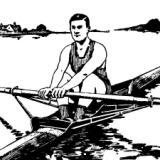
Looking for a rowing book on the internet, on www.abebooks.co.uk to be more precise, I came across Steve Fairbairn’s famous Chats On Rowing, which was published in 1934 by W. Heffer & Sons Ltd., Cambridge. It is not hard to find copies of this book, especially not later editions, but booksellers are still asking a lot for it – as are they for all of Fairbairn’s books, just because …. well, it is Fairbairn. The price for the 1st edition of this Chats On Rowing is £140.00/$239.32. Not only is this copy a 1st edition, it also comes with a dust jacket, which has its wears and tears. I find this dust jacket lovely. The image has such a 1930-ish touch to it with the bowside/starboard oarsman rowing in what looks like a 'tub'. He is maybe not holding the oar right in the image, but I would not have dared to say a thing like that during Fairbairn's lifetime; Steve would for sure have accused me of being a member of the 'Pretty-Pretty Brigade', the camp of the English orthodox style.

My copy of Chats On Rowing was published in 1948 by Nicholas Kaye Ltd., London (a 2nd printing of this edition came out in 1949) and has a less attractive cover, a black&white photograph of two eights racing down the course at Henley (the photograph was taken in 1947 when Jesus College took the Grand Challenge Cup).

Both editions have Fairbairn's poem "The Oarsman's Song", in which the fourth stanza famously reads:

All through the swing he hears the boat sing
As she glides on her flying track,
And he gathers aft to strike the craft
With a ringing bell note crack

Wednesday, March 19, 2014

Desert Row Ocean

Desert Row Ocean

He rowed a different ocean,
an ocean of sand
when he crossed the Sahara;
rowed in his mind
the upcoming competition
as he looked on dunes
mountaining against the rosy hued
sky, evenings.

Wind wrote the desert text.
as it does, often, the ocean’s,
a text he read with his oars,
like a blind man with his fingers;
waves of sand, waves of water,
his body a shell being propelled
through motion coming at him,
motion he met head-on.

Nearing the finish line, on race day,
the water he rowed had become
heavy as sand, ocean become desert,
but a desert he had already
crossed in his mind.

Philip Kuepper
(24 January 2014)

Tuesday, March 18, 2014

A Post From The Pub

The front cover of the menu.

Tim Koch writes:

The ‘Hear The Boat Sing’ 5th Anniversary Lunch was held at the Coat and Badge pub, a short walk from the Putney Embankment, on Sunday, 16 March. A small but select group enjoyed roast beef and Yorkshire pudding and the company of like-minded people. It was a relaxed occasion but there was a brief period of formality when we drank a toast to blogmaster Göran and his wife Ellen, the two people responsible for the existence of HTBS. I then shared the following thoughts with those present.

On 12th March 2009, the very mixed blessing that is the Internet, already a forum for the mad and the bad, overcrowded with videos of wacky cats and friendly ladies (sometimes together, sometimes separately) gained a new eccentricity – a blog dedicated to the history of rowing. Göran Buckhorn’s first post started:

“Against better judgement I have become a blogger. If you would have told me a couple of months ago that I would start a blog, I would have called you insane... But things can change in life. After my contract as boating coordinator.... came to an end, and with that, my responsibility to write and edit the club’s newsletter, I was without a continuing forum to write about rowing and its rich history”.

The post ended:

'”So, when I had not been writing for a week or two, and got rather grumpy, my dear wife, who is a blogger par excellence, gave me the idea that I would maybe like to start a blog on rowing history, and well, here I am blogging away, although, I should know better…”

The menu

Five years, 1,540 posts, 265,000 visits and 809,000 page views later – here we are. ‘Hear The Boat Sing’ has been read from Albania to Zambia (and all countries in-between). It has a loyal following, though, due to the nature of the Internet, I suppose we never know how many ‘regulars’ we actually have. Occasionally one of them will ‘break cover’ to say how much they enjoy HTBS. This is always a pleasing experience as sometimes, writing late into the night, one wonders ‘is there anyone out there actually reading this stuff?’ I must confess though, even if no one was reading it, I think we would go on writing it.

Over the past five years the blog has gained a ‘respectability’ in the rarified world that it operates in. It is unofficially recognised by such bodies as the Boat Race and the River and Rowing Museum. If you look for some aspect of rowing history via a search engine, possibly a majority of the usable results will be from ‘Hear The Boat Sing’.

In its subject, HTBS has two great advantages. Firstly, rowing has a rich and deep history, much of it waiting to be uncovered. Secondly, because it is a ‘minority sport’ (ironically with few minorities) it is very accessible. If we wanted to write about British soccer or American football we would not be able to talk to the stars or mix with the super teams as we can do with the sport of rowing.

On the left, closest to the camera, Liz, then Chris Dodd and on the end is Molly Bushnell. On the right, Colin Cracknell and Sue Bushnell. Absent, Tim Koch and Jonny Ambrose.

As you all probably realise, Göran’s enthusiasm shows no sign of tiring. We contributors write when something inspires us but he must constantly find the two or three posts a week that a credible blog should have. Most bloggers find this easy at first but few can keep going for anything like five years.

As those of you who have met him will know, Göran is a delightful man, a ‘gentleman of the old school’. It is appropriate that I use that antiquated English phrase as he is a committed Anglophile. Very early into our correspondence, I stopped explaining particularly British terms that I thought a Swede living in the United States may have trouble with. I should have realised that someone who is a fan of P.G. Wodehouse would not need my help (in fact his English is better than mine).

We were joined by Bert Bushnell’s daughter, Sue, and granddaughter, Molly. This was Molly’s tribute to her grandfather.

We also have to give credit to Mrs. Buckhorn. As already indicated, Ellen was not only the original inspiration for starting the blog, she is also the ‘Hear The Boat Sing IT Department’. Without her, HTBS would be written on parchment and nailed to a tree.

Over the years the blog has developed a style of its own and has gained a small group of regular contributors plus the occasional guest writer. Sometimes a post will have only a tenuous link with rowing but, as long as it is interesting, this is fine. HTBS is rather like Henley Royal Regatta in that it is a private party which you are welcome to join – providing you embrace its eccentricities.

Here’s to the next five years.

Mine’s a pint.

Monday, March 17, 2014

Stout for Sportsmen


Tim Koch writes:

Today, 17 March, is St. Patrick’s Day and many people, Sons of Erin or not, will mark this solemn religious occasion by drinking industrial quantities of Irish stout, most famously that produced by the ‘Guinness’ company. In the past, HTBS has produced several items noting rowing connections to the ‘black beer’ produced by the Dublin brewing family.

A summery of the rowing career of the company chairman, Rupert Guinness, 2nd Earl of Iveagh (1874-1967) was in this post of August 2010. Guinness won the Diamonds in 1895 and the Diamonds and the Wingfields in 1896.

Possibly due to the influence of Rupert, the company often included rowing in its frequently acclaimed advertising campaigns. In March 2010, Hélène Rémond shared some nice images she had found, and Greg Denieffe posted these in September 2013.

I recently came across another of the brewer’s advertisements with a rowing (or rather sculling) content, but this time in the form of a traditional celebrity endorsement rather than the clever graphics and slogans for which the company is most famous. On 6 July 1929 the ad posted below was run in the Illustrated London News.

Bert Barry’s Guinness endorsement (click to enlarge).

The text starts:

One man beats three. This is a unique feat in the history of rowing. H.A. Barry sculled over four miles: his opponents each raced only a third of the distance. Yet such was the strength and endurance of Barry that he beat each opponent in turn. In his letter on this page, Barry shows how sportsmen of every kind can improve their strength and endurance by drinking Guinness regularly.

In his endorsement Barry explains:

And there is no doubt that ‘Guinness Stout’ has done me a lot of good these last four years. It has built my muscles up wonderfully and has given me the necessary stamina – what I lacked before to stay a long distance at racing pace.

It is signed, H.A. (Bert) Barry, World and British Champion Sculler.

Advertising alcohol as a training aid for sportsmen may seem strange but this was a very different time. The 1912 Olympic sculling champion, Wally Kinnear, recommended Guinness and Champaign (‘Black Velvet’) as a remedy for over training. The old professionals would sometimes have a brandy and port on the start line as it ‘settled the stomach’. Much worse than associating alcohol with athletic success was the common idea of using sportsmen in cigarette advertising. ‘Camel’ cigarettes were especially famous for this – as this ad in Popular Mechanics of June 1935 shows.

Camels – ‘The mild cigarette the athletes smoke’. They include William Garfield ‘Bill’ Miller who came second in the coxless fours at the 1928 Olympics and second to Bobby Pearce in the single sculls in the 1932 Olympics. He was also U.S. Singles Champion, in 1930-1933. If he did actually smoke it is not surprising that a contemporary newspaper described him as ‘The husky Philadelphian’. The museum Mystic Seaport’s website describes another Bill Miller / Camel advertisement held by them though unfortunately there is no illustration. The handsome Miller was a natural choice for advertisers and, more harmlessly, he also endorsed Palmolive Shaving Cream.

Returning to Guinness, the advertisement does not make it absolutely clear but the ‘relay’ was a race from Putney to Mortlake with Barry sculling constantly over the whole distance but with a fresh opponent taking over from the previous challenger for every third of the course. Thus the race started conventionally but at Harrods a new sculler picked up the race with Barry while the original opposition to the Champion dropped out. There would be another change with a third sculler, perhaps around Chiswick Steps. I do not know if this stunt was done with the Guinness endorsement in mind or if it was something that the company picked up on after the event. However, thanks to the remarkable British Pathe website, we can see film of this possibly unique event.

RIVER RELAY RACE


Bert Barry

Herbert Arthur ‘Bert’ Barry (1902-1978) was the son of W.A. ‘Bill’ Barry (who won Doggetts in 1891 and was Professional Sculling Champion of England in 1898). Bert was a nephew of the great Ernest Barry and uncle of William L. ‘Bill’ Barry. Bert won Doggetts in 1925, and in 1927 he challenged the World Professional Sculling Champion, M.L. Goodsell, for his title. Strangely, the race took place in Vancouver, Canada, and not in Goodsell’s native Australia. The defending champion beat Barry convincingly. However, on a return match over the same course three months later, it was the Englishman who was victorious and he remained the unchallenged World Champion for nearly three years. Pathe has an especially good sound film of Bert sculling with his brother Lou around this period.

BERT BARRY


Bert with the statue of the great sculler Ned Hanlan in Toronto in 1934.

In May 1930, Bert lost the World title in his first defence to Ted Phelps, the first time in over fifty years that two Englishmen had contested for the World Sculling Championship. Bert also failed in the return match five months later. Perhaps he was not drinking enough Guinness?

Sunday, March 16, 2014

WHoRR 2014 - some views from Hammersmith

Going to the start.

Tim Koch writes:

A press release issued by the organisers before the 2014 Women’s Head of the River Race started:

On Saturday 15th March at 3:30pm, the 74th Women’s Head will take place from Mortlake to Putney. With the wettest winter the UK has experienced since records began, many rowers have had their training disrupted and head races have been cancelled across the country. In recent weeks, the stream conditions on the Tideway have also been affected by the large volume of water from upriver. Providing the weather is favourable on race day, the stream should make for some very quick times and potentially allow course records to be broken.

Well, the weather was favourable, the stream did make for some very quick times and seven course records were broken including the Head time which was 17.42.21. The full results for the 291 crews are on the event website. Below are some images from around Hammersmith Bridge, the point at which sixty per cent of the race is done. Any half decent crew can get there in a respectable time, but only those who have trained hard can really make a race of it from Hammersmith to the finish.

The first boats through Hammersmith Bridge were crews 1, 2 and 3 (Imperial ‘A’, Vesta ‘A’ and Cus Milano, Italy). Unfortunately for them this was not their finish position.

Thames RC ‘C’ from the downstream side of Hammersmith Bridge.

Viewed from the Surrey bank, the crew that started 53 and finished 5th, a composite of Bath University BC / Gloucester RC / Hartpury RC / Hollingworth Lake RC / Northwich RC / Oxford Brookes University BC / Tees RC / University of West England RC.

Supporters, critics and armchair coaches.

Ruderclub Schaffhausen from Switzerland.

When will it be our turn?

Burway RC lead Leicester RC ‘A’ upstream of Hammersmith Bridge. The building opposite with the ramp and pontoon is the headquarters of British Rowing.

Wallingford RC ‘B’ approach Hammersmith.

From the Middlesex bank on the upstream side.

Avon County seen through the ironwork of Hammersmith Bridge.

The long, painful and seemingly endless stretch from Harrods to the finish at Putney.

The rescheduled Schools’ Head of the River Race is on Wednesday, 26 March at 13.30.

The Head of the River Race is on Saturday, 29 March at 14.15.


The Veterans’ Head of the River Race is on Sunday, 30 March at 10.30.


Photography © Tim Koch

Saturday, March 15, 2014

Sunday CUBC v Molesey BC Race

A photograph from a last year Boat Race fixture at Putney Embankment.

Tomorrow, Sunday 16 March, there will be another Boat Race fixture on the River Thames. Cambridge Blue Boat will race against Molesey Boat Club starting from Putney Embankment at 12:45. There will be live tweeting from @theboatrace during the fixture, and a race report will be posted online at www.theboatrace.org later that the day.

If you are at Putney Embankment half an hour earlier, at 12:15, you can watch Goldie go out against another crew from Molesey BC.

The two crews starting at 12:45 have the following line-up:
CAMBRIDGE
Bow: Michael Thorp
2: Luke Juckett
3: Ivo Dawkins
4: Steve Dudek
5: Helge Gruetjen
6: Matthew Jackson
7: Joshua Hooper
Stroke: Henry Hoffstot
Cox: Ian Middleton

MOLESEY BC
Bow: Sam Scrimegour
2: Pete Robinson
3: Matt Tarrant
4: Fred Gill (Cambridge Blue 2010, Goldie 2009)
5: Mo Sbihi
6: Phil Congdon
7: George Nash (Cambridge Blue 2010, 11 and 13, Goldie 2009)
Stroke: James Foad
Cox: Henry Fieldman (Cambridge Blue 2013)

Friday, March 14, 2014

Rowboat

Rowboat

On the glass-calm water
he left his boat
drift where it would.
He slept in the late
afternoon sunlight.
No bee droned.
The marsh grass stood
still as a painting.

Suddenly!,
he wakened and stabbed!
At the water,
one swift stab shattering
the glass-calm,
where floated reflected
a Great White Cloud.

He had recently been reading
Melville,
of which he had been dreaming.

Philip Kuepper
(1 December 2013)