Tuesday, December 17, 2013
Don't Miss Girl on the River's Santa List!

Monday, December 16, 2013
Lassi Karonen Quits

News media in Sweden announced today that 37-year-old sculling star Lassi Karonen will hang up his sculls and not try to qualify for the Olympic Games in Rio in 2016. In an interview for a Swedish sport radio programme, Karonen said that he has no motivation to get back to rowing on an elite level.
Karonen was only half a second behind Olympic bronze medallist Alan Campbell in the London Games last year. After the 2012 Games, Karonen took a break from elite rowing, but said he would come back to qualify for the Games in Rio.
'I have tried to get back training this autumn to aim for the next Olympic Games, but it has not worked out the way I wanted. It has been too hard and my motivation has disappeared, so I have decided to do something else instead', Lassi Karonen said.
At the 2008 Beijing Games, Karonen took a sixth place in the single sculls and in 2010, he took a silver medal in the single at the European Championships.
Sunday, December 15, 2013
Mike Sweeney will Retire as Chairman of HRR

Mike Sweeney, chairman of Henley Royal Regatta, announced the other day that he will step down as chairman of the regatta after next year’s regatta, which will be the 175th event. He will remain a steward, though. It was also announced that Sir Steve Redgrave was elected vice-chairman of next summer’s regatta. Elected new stewards of the regatta were Olympic champions Mark Hunter and Tom James. Fiona Dennis, who is an international umpire and among other regattas umpired at the 2012 London Paralympic Games, was also elected a steward.
Who is then going to be the new chairman of the regatta when Sweeney retires? In a tweet, Sir Matthew Pinsent, also a steward of Henley Royal Regatta, said that the answer will be found in the key words ‘Sir Steve Redgrave’ and ‘vice-chairman’. So now we all know! Read more in an article published in the local newspaper, the Henley Standard.
Saturday, December 14, 2013
Allen Rosenberg Dies
One of America's most remarkable figures in the sport of rowing has passed away which has been noticed in the U.S. rowing community and the U.S. media. Allen Rosenberg, coxswain, coach and training innovator, was born on 29 November 1931 and died on 7 December 2013. Above is a short interview by Mike Davenport which was posted on YouTube three years ago. In yesterday's New York Times Bruce Weber published a well-written obituary, read it here.
Friday, December 13, 2013
Blue Movies

Tim Koch writes:
The Internet Movie Database (IMDb) is an online database of more than two and a half million feature films, shorts, documentaries, television programmes and video games and is one of the fifty most visited websites. Its content includes films made in the earliest days of the cinema. I recently accessed it when trying to date a film of the Oxford-Cambridge Boat Race on that favourite of HTBS, the wonderful British Pathe website.
BOAT RACE

(Click on the picture above to get to the film.)
It is unhelpfully entitled, Boat Race 1910-1920. While Pathe provides a wonderful resource, they sometimes produce inaccurate descriptions and dates for their films. This is excusable as it would be unreasonable to expect them to consult experts on the thousands of subjects that they cover. Further, the films were originally produced with no thought of going into an archive, they were for immediate consumption, labelling and cataloguing were probably not a high priority. Over the years what labels there were may have fallen off and film splices could have come unstuck. Thus when it was decided to put the collection of 90,000 films online, the starting point was often an unmarked rusty film can containing a jumble of film clips.
When I put ‘Oxford and Cambridge Boat Race’ into the IMDb search facility it listed eleven races that were filmed before the 1914-1918 War. They covered the years 1895, 1897 to 1905 and 1908. Most of these listings contained very little information but what there was is of great interest. For the 1895 film, Michael Brooke wrote:
Although the content of this film is primitive in the extreme – a shot of the traditional Oxford versus Cambridge University Boat Race, filmed on March 30 1895 – this film is of immense historical importance as being the first ever British film.

The producers are listed as Robert W Paul and Birt Acres, both important pioneers in the development of cine cameras and film projectors and, arguably, founders of the British film industry. According to the website earlycinema.com: http://www.earlycinema.com/pioneers/acres_bio.html
(In 1895 Paul and Acres) entered into partnership with a ten year business agreement. This agreement lasted only six weeks before the two split. During their brief partnership, the two shot films of the Oxford and Cambridge Boat Race in April and the Derby in May.
Sadly, the Boat Race film, if it survives at all, is not online. However, the film of the Derby horse race is on YouTube and probably gives some idea of what the Oxford-Cambridge film may have looked like i.e. a brief static shot where the action passes through the frame. This 1899 film taken at Henley also gives an idea of how early productions looked.

Film of the 1898 Boat Race can be viewed in the Rowing Gallery at the River and Rowing Museum in Henley.
Returning to the above Pathe film entitled Boat Race 1910-1920 it was now clear that, as I suspected, it could easily be from the early years of the last century. I doubted that it was one of the very earliest as there is much evidence that it was a sophisticated and expensive attempt at film making which did not rely simply on the novelty of ‘moving pictures’.
What was this evidence? The first thing that struck me was the long running time of the surviving film – nearly ten minutes (the earliest productions could be less than a minute). Possibly more film was shot and has been lost.
The second notable thing is that it was shot over more than one day. I think that the first two and a half minutes cover one or more practice days. We see Oxford coming out of London Rowing Club and Cambridge coming out of Leander’s Putney boathouse and the sightseers are allowed to wander around at will.
When we come to Boat Race Day itself, starting at 2 minutes 30 seconds in, the large crowds are now held well back and the ‘Putney Hard’ is kept clear for the crews to boat. Between 3m and 3m 30sec we get some nice views of the many cameramen taking still and moving pictures, the later with hand cranked cameras.
Between 5m 05sec and 6m 40sec we have the best evidence of all that this film had what would later be called ‘high production values’. It is an unfortunately failed attempt to capture the boats going past in slow motion. For some reason the shot of the two eights was missed and we mostly get images of slow moving water. From 6m 15sec we catch the stern of an eight going out of the frame followed by the umpire’s launch.
We have a five second shot of some point in the first minute of the race at 6m 40 sec as the crews pass the Fulham Wall. Unfortunately, the film is out of sequence. This shot should have been preceded by the shots between 7m and 7m 50sec. These show the crews below Putney Bridge before they turn to go onto the start and then capture the boats getting onto the start.
While the middle of the race was not covered, there is evidence that a remarkable three cameras filmed the finish. At 6m 45sec we have a medium shot (taken from the roof of the Ship pub?) of the crews approaching the finish. At 6m 49sec this cuts to a close up from another camera position which shows the boats crossing the line. After the out of sequence shots mentioned above, from 7m 53sec, we see the last one and a half minutes of the race again, but this time with a very wide shot, perhaps taken from the brewery.

The finish also provides us with the best clue to the actual year. Oxford win by less than a length. The records show that, between 1895 and 1939, the Dark Blues won by one length or less in 1896 (1/2 length), 1901 (2/5 length), 1913 (3/4 length), 1923 (3/4 length), and 1937 (1/4 length). I suspected that 1901 and 1913 were the most likely candidates and set to identifying some of the participants. I managed to produce recognisable shots for the Oxford cox, bow and ‘7’ and for the Cambridge stroke. As the pictures below show, they seem to match the crews for 1901.


The 1901 race turned out to be an unusually exciting and strategically rowed one and was covered in detail by Rudie Lehmann in his book, The Complete Oarsman:
When..... Cambridge had won the toss and had.... chosen Surrey, there were very few who were prepared to back the chance of Oxford under the weather conditions that prevailed. Oxford, however, were confident in their pace and their endurance, and they had mapped out a careful plan of campaign beforehand.

If, as was probable they failed to gain a sufficient lead at Harrod’s to enable them to take the Surrey water ahead of Cambridge, they proposed to drop astern of the leaders, and to content themselves with rowing in this position under the shelter of the Surrey bank, until the water once more made it possible for them to come out and challenge for the lead.

The crews started at a high rate, Cambridge however, rowing a point or two faster than Oxford...... they went through Hammersmith Bridge with a considerable lead. A furious storm was raging as the crews opened out into Comey Reach. Cambridge were rowing well under the shelter of the bank, and Oxford, in obedience to instructions, had come over, and were rowing in a direct line behind, with about half a length of clear water separating them from the leaders. It was apparent here that Oxford had the greater pace; more than once they drew up to Cambridge, but the coxswain gave the word to paddle, and they once more dropped back.
To those who realised what was going on, it was one of the most curious and interesting spectacles ever seen on the Putney to Mortlake course. So the crews proceeded till they came to the broad reach that leads on to Barnes.

The water here became smoother........ (Oxford stroke) Culme-Seymour shook his crew together..... They were now rowing with great vigour, and they steadily gained...... and as they passed under Barnes Bridge the bowmen in the Oxford crew were once more cheered by the sight of their rivals.
From this point Oxford had the better conditions; the bend of the course was in their favour, and they were moving faster, stroke for stroke, than Cambridge.... rowing with extraordinary dash and vigour, they drew level with Cambridge at the Bull’s Head, and finally won the race by two-fifths of a length.

Some of the participants in this great race are worth commenting on further.

Sadly, the brilliant Oxford stroke, Reginald Hobart Culme-Seymour was dead within seven months of his great victory. Stroke of the Eton Second Eight, he got his Blue in his first year at Oxford sitting at ‘2’ in the 1900 Boat Race. He stroked New College to victory in the Torpids Head of the River and also in the Ladies’ Plate at Henley. In his Times obituary it was reported that ‘he had been suffering from the effects of a chill contracted in August which afterwards developed into pleurisy while he was shooting in Scotland’.
The Cambridge stroke, Graham Macdowall Maitland was a victim of the Great War. Commissioned into the Irish Guards, he was mentioned in despatches and was killed at the First Battle of Ypres in November 1914.
The Oxford cox, Gilchrist Stanley Maclagan, steered the Dark Blues for four years from 1899 to 1902. This would be impressive enough on its own but he also took Magdalen College to Head of the River in 1900 and coxed Leander in the Grand Challenge Cup at Henley from 1899 to 1908, winning six times – a record. He was also the cox for the Leander ‘Old Crocks’ that won the Olympic Eights in 1908. He was Secretary of the Amateur Rowing Association at the outbreak of the First World War when he joined the Royal Warwickshire Regiment. He was killed in the first gas attack of the war during the Second Battle of Ypres in April 1915.
On a lighter note, the Cambridge ‘3’ man, Bertram Willes Dayrell Brooke, was remarkable for that fact that his family had their own country and that he carried the title His Highness The Tuan Muda of Sarawak. According to Wikipedia, the White Rajahs of Sarawak
....were a dynastic monarchy of the English Brooke family, who founded and ruled the Kingdom of Sarawak, located on the island of Borneo, from 1841 to 1946. The first ruler was Englishman James Brooke. As a reward for helping the Sultanate of Brunei fight piracy and insurgency among the indigenous peoples, he was granted the landmass of Sarawak in 1841 and received independent kingdom status.
Almost as good as winning a Blue.
Thursday, December 12, 2013
Rowing Daydreaming

Winter, where the rower was,
made rowing impossible.
And so in his imagination,
from Frost’s snowy woods,
he felled a birch,
trimmed it, hollowed it out,
shaped oars from limbs,
and launched it on the River
of Inspiration. He would row
to where his desire drew him,
past where Poe’s raven perched,
past where the Paraclete descended,
past where the Phoenix descended
and rose in flames. These all
sheltered in his Woods of Dream
through which ran the River
of Inspiration. And in his mind
hovered an albatross to remind him
not to repeat the Mariner’s act.
He would row beyond that,
to where he heard Keat’s nightingale
singing from deep within the woods,
veil the woods with evensong,
when all about the rower in reality
was winterswept, the river, the woods,
the wait for spring where he stood
imagining crocus come to soften
the river unutterably frozen.
Philip Kuepper
(11 October 2013)
Wednesday, December 11, 2013
Temptations on the Thames


HTBS’s recent and lively stories about “Fuller’s Head of the River Fours” bring to mind just what riverside breweries can do for rowers – besides sponsoring regattas.
In the 1960s, I rowed in the London School of Economics Boat Club eight from the University of London’s boathouse at Chiswick, a village on the western side of London. From the UL boathouse, when we turned upstream on the Thames to row past the Royal Botanic Gardens at Kew, we inhaled the freshest of country air. But when we turned downstream from Chiswick and rowed to Putney Bridge (a reverse of The Boat Race course) we encountered the tempting aromas of breweries.

The eight was always lively on the downstream piece, and gliding with the current we barely broke a sweat. But the four-plus-miles we pulled back upstream from Putney were always a haul; worsened by two mighty distractions. Off Chiswick Eyot, a slim island just past Hammersmith Bridge, we caught whiffs of hops and malt from Fuller’s Chiswick Brewery, a sprawling complex along the shore. On the upstream pull we were tired and thirsty – and now made especially thirsty for beer. (Why we seldom noticed these aromas rowing downstream I can’t explain. Maybe we weren’t yet breathing hard enough?)
Beyond Chiswick our lungs and thirsts cleared for another mile until, just past Barnes Bridge, we neared Mortlake and a looming brick structure that threw its shadow across the river. This was Watney’s Stag Brewery, in those days a Victorian industrial hulk. And its aromas were much closer and much more pungent than Fuller’s.

From Watney’s to the boathouse we had nothing more in mind than beer. But after showers, I discovered an English convenience never known when rowing in the USA. There, just off the locker room, was a bar, maintained by the boatman, and with a lovely river view. The workout and its temptations were now resolved!
Tuesday, December 10, 2013
10 Years Celebration for Coxmate

The interviewees are: Mike Sweeney, the Henley Royal Regatta Chairman; Alistair Isherwood, a school rowing coach; Brett Woolfitt, an umpire; Bryan Kitch, the rowing journalist, who is running the blog Rowing Related and who very kindly mentions HTBS in his article; Ed Maxwell, a junior coach; Pat Brownrigg, a boathouse manager; “Mr. Coxmate” Peter Hodson, the founder of Coxmate; Rebecca Caroe, the rowing retailer; Stuart Wilson, boatbuilder and general manager at Sykes Racing Boats; and Tonia Williams, a Master rower, who is also a rowing artist.
You are able to get your free copy of this ebook by clicking on the following link: The Future of Rowing.
Coxmate’s Peter Hodson’s innovative nature has led to the company delivering some world “firsts” for the sport: first micro-impeller for coxless boats, first 4-speaker harness, first magnetic electrical contacts for controllers, and first integral GPS speed measurement.
Read more on Coxmate’s website.
Monday, December 9, 2013
Head of the River Charles - in French!
The other day HTBS’s Hélène Rémond of France sent in a video from French tv-programme Canal+. Hélène writes that it presents a French elite rowers training in eights and taking part in Head of the River Charles in Boston. ‘By the way’, she writes, ‘in the video, the journalists refer to the Head of the Charles as the most popular race in the world. I would have said the Boat Race is the most popular.’ I can only agree…
The video is in French, of course, but if you do not understand French just sit back to enjoy the beautiful scenery.
Friday, December 6, 2013
The Talisker Whisky Atlantic Challenge is on!

It has been called the toughest race on earth – the Talisker Whisky Atlantic Challenge, which started on Wednesday, 4 December, from San Sebastian in La Gomer, the Canary Islands, to the Harbor of Antigua, in the West Indies, a distance of roughly 2,600 nautical miles (3,000 miles/4,828 km).
Sixteen boats started with crews from four countries: Great Britain, Sweden, Australia and Spain. There were crews with solo rowers up to crews with five people on board:
Solo – two boats from Australia and Sweden;
Pairs – five crews from Great Britain, three from Sweden and one from Spain;
Trio – one crew from Great Britain;
Fours – three crews from Great Britain;
Five – one crew from Great Britain.
Four women are competing this year, the pair Hannah Lawton and Lauren Morton in team “Inspirational Friends”, and Jane McIntosh and Liz Beauchamp who are rowing in the Royal Air Force four team “Atlantic Forces” with Warren Burns and Howie Raw.
The media coverage for this race, at least in Great Britain, has almost entirely concentrated on the British crew “Row2Recovery” with Cayle Royce, Scott Blaney, Mark Jenkins and James Kayll. Royce was injured in 2012 whilst serving in the British Army in Afghanistan. He stepped on an explosive device and had to have both his legs amputated above the knee, and suffered facial scarring and multiple amputations to the fingers of his left hand. Blaney suffered an above-the-knee amputation and soft tissue injuries from a bomb whilst conducting operations in Afghanistan in 2007. Blaney and Royce will row with Captain James Kayll of the Light Dragoons and Captain Mark Jenkins, who serves with the Royal Army Medical Corps as a Physiotherapy Officer.
Here is a video clip of the brave men in the “Row2Recovery” crew:
HTBS wishes all the teams the best of luck in their endeavour to cross the Atlantic Ocean.
Thursday, December 5, 2013
The Thought Behind the Oar

It was not something
he made a meal of.
Yet depending on
where he was
in his travels,
come July 4th, December 6th, 9/11,
he would take to the water
and row,
to connect with the spirits
of those no longer of earth,
those no longer of the elements
we wrap ourselves in.
Philip Kuepper
(11 September 2013)
Wednesday, December 4, 2013
Malcolm Cook: Shaved Blades were used in the Boat Race in the 1920s and 1930s

HTBS received an interesting e-mail from Malcolm Cook of Quintin Boat Club (below on the right) regarding our blog posts about ‘shaved blades’ (or ‘narrow blades’ as they are also called). Malcolm writes:

[Editor’s note: some newsreels from British Pathe have been thrown in between the races, so a film following the 1922 race is a film with that race, etc.]:
1922 Boat Race: Both stroke and 7 of the Cambridge crew had shaved blades. Stroke’s was 1/2 inch narrower and 7’s was 1/4 inch narrower.
(The Times, 28 March 1922)
VARSITY BOAT RACE

1924 Boat Race: Oxford’s stroke had a blade 3/8 inch narrower than the rest of his crew.
(The Times, 5 April 1924)
THE BOAT RACE 1924 long version

1925 Boat Race: Oxford’s stroke had a blade 3/8 inch narrower than the rest of his crew. Stroke and 7 of the Cambridge crew had blades that were 1/4 inch narrower but their oars were an inch longer than the rest of their crew.
(1926 Rowing Almanack)
1926 Boat Race: Both strokes had blades 1/4 inch narrower than the rest of their crew.
(The Times, 27 March 1926)
1927 Boat Race: Oxford’s stroke had a blade 3/8 inch narrower than the rest of his crew. Cambridge’s stroke had a blade 1/4 inch narrower.
(The Times, 2 April 1927)
1929 Boat Race: Both strokes had blades 1/4 inch narrower than the rest of their crews.
(The Times, 23 March 1929)
1930 Boat Race: Oxford’s stroke and 7 had shaved blades. Stroke’s was 1/2 inch narrower than the rest of the crew and 7’s was 1/4 inch narrower.
(The Times, 12 April 1930)
1931 Boat Race: Oxford’s stroke had a blade 1/2 inch narrower than the rest of his crew.
(The Times, 21 March 1931)
THE BOAT RACE

1933 Boat Race: Both strokes had blades 1/4 inch narrower than the rest of their crews.
(The Times, 1 April 1933)
1936 Boat Race: Oxford’s stroke had a blade 1/4 inch narrower than the rest of his crew.
(The Times, 4 April 1936)
THE BOAT RACE 1936

1939 Boat Race: Both strokes had blades 1/4 inch narrower than the rest of their crew.
(The Times, 1 April 1939)
THE BOAT RACE - OXFORD V CAMBRIDGE 1939

Malcolm also notes that ‘In a few instances a heavy oarsman in the middle of the crew was given a slightly wider blade than the rest of his crew.’
The interesting question is if it helped the crew to win the Boat Race if the stroke had a narrower blade? It is impossible to say, of course, but it should be noticed that all the races mentioned above in Malcolm’s list were won by Cambridge. This was a period, between the wars (1920-1939), when the Light Blues had a good run – Oxford only won the Boat Race in 1923, 1937 and 1938.
You might recall that the question about a stroke rowing with a narrower blade than the rest of his crew came up in the HTBS review of Daniel James Brown’s The Boys in the Boat (on 19 August). I was highly skeptical that Ran Laurie, the stroke in the 1936 British Olympic eight, rowed with a narrow blade in the Olympic final, where the British crew ended up fourth. However, Brown directed me, and other misbelievers, to his source, Stanley Pocock’s book “Way Enough!” – Recollections of a Life in Rowing (2000), where it states that Laurie had told Stanley Pocock’s father, George Pocock, ‘that he [Laurie] had not been able to pull hard enough to row himself out. The lighter water caused by the head wind had rendered his small blade too small’.
[p. 77]
I found it extremely interesting to read Malcolm’s list to find out that the years Laurie stroked the Cambridge winning crews, in 1935 and 1936 (he rowed in the 3 seat in 1934), he is not mentioned in The Times as having a shaved blade. Food for thought...
Many thanks to Malcolm for all the hard work going through The Times’s archives!
Tuesday, December 3, 2013
Some Photographs from 2013 HOR4s

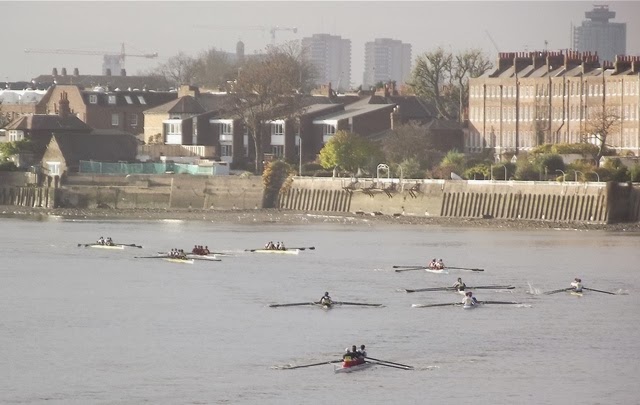
It was an international quad racing in the yellow and red colours of Tideway Scullers who took the 2013 Fuller’s Head of the River Fours on the Thames on Saturday. Starting as the second boat, Alan Campbell and other Olympians Valent Sinkovic, Aleksandar Aleksandrov and Ondrej Synek passed the Leander crew just before Barnes Bridge to comfortably take the Head. Here are some photographs from Tim Koch:


Monday, December 2, 2013
The Italians at the 1937 European Championships


Then the other day I received an interesting e-mail from Johan ten Berg, a Dutch rowing historian, who has come to HTBS's help several times before. In his e-mail Johan wrote that he had published the above photograph of the Italian eight, who became European champions in 1937, in the Dutch rowing magazine Roeien. In a Dutch newspaper (see below), Johan had found that ‘Checchin’ had been called in from Italy to row in the bow seat in the coxed four when the original bow man, Milan Bussani, had had an accident after a training outing on Bosbaan, crushing his middle finger. The Italian crew crossed the finish line as the third boat, claiming the bronze medal – on the top of the page in the newspaper from 16 August, 1937, is a picture from the coxed fours race, showing ‘Checchin’ in the bow seat.

(Click on the image above to enlarge it!)
Many thanks to Johan for sharing the information about the 1937 European Championships in Amsterdam.
Sunday, December 1, 2013
The 2013 HOR4s Results

Subscribe to:
Posts (Atom)