Photograph: Werner Schmidt

Wednesday, August 26, 2009

Mystic Weekend Of Rowing

The month of September is soon upon us, which means that it is time for the Mystic Weekend of Rowing (MWOR) again. As usual it is a two-day event on the Mystic River in Mystic, Connecticut, with The Battle Between the Bridges on Saturday 19 September and the Coastweeks Regatta on Sunday 20 September. Both events have been established to promote the sport of rowing in a community environment, and they are supported by the National Rowing Foundation (NRF), Mystic Seaport Museum, and the Mystic Arts Center.

In August every year there is a fundraising event, a cocktail reception for MWOR. This is always a nice evening at the Mystic Arts Center where you can mingle and rub shoulders with the organizers of the regattas and other rowing dignitaries. This year it was yesterday, and unfortunately, I was not able to attend, which was a real pity.

But now to go back to the rowing events: the Saturday races between the Amtrak railroad bridge upriver to the famous historic bascule drawbridge in downtown Mystic are for invited top-notch scullers. Every year some scullers, who have competed at the World Championships and Olympic Games, find their way to Mystic to sprint on the almost 500-metre long course.

These races can be best viewed from the Mystic River Park, the drawbridge, or the Mystic Art Center’s lawn. As always, Andy Card, Yale University lightweight men’s crew coach, will be the witty commentator and introduce the rowers and call their races. This is a brilliant opportunity to watch the country’s, if not the world’s, best scullers in action – and it is free!!

On Sunday the rowing will move upriver to Mystic Seaport Museum for the Coastweeks Regatta, which is an event for local and regional rowers and scullers. Hundreds of athletes, men and women of all generations, will race on the 2,000-metre course from north of the I-95 overpass to the north end of Mystic Seaport.

To read more about this event (and to find more information how to sign up to compete on the Sunday event), please click here.

Last year, the organizers of Coastweeks Regatta had a real treat to offer the rowers, their family and friends, and the spectators at the regatta. Two of the 2008 Olympic rowing medalists, Anna Cummins (gold, women’s eight; to the left) and Michelle Guerette (silver, women’s single scull; to the right), were present to give a talk on how it felt to compete at the Olympic Games and therefore be a part of the history of rowing. It was indeed a very pleasant and enjoyable event with two very humble ladies.

Monday, August 24, 2009

Michael Palin: A Decent Rowing Chap

Reading the Daily Telegraph this morning, I saw an interesting article about the actor, writer, etc. Michael Palin, one of the Monty Python fellows. He was interviewed by Marc Lee. I have always thought Palin seemed such a nice and decent chap, and, according to the article, he is.

One of the reasons for the article in the Telegraph, it seems, was that two films that Palin has been involved in were released on DVD today, East of Ipswich, which he wrote for the BBC, and Three Men in a Boat from 1975 (only PAL, for now). In Three Men in a Boat - of course based on Jerome K. Jerome’s famous novel - Palin plays one of the main characters, Harris. In the Telegraph article Palin reveals that Harris resembles his own father, Edward Moreton Palin.

What is not said in the article is that Palin Senior was an oarsman once upon a time, and probably could teach Palin Junior a trick or two in the noble art of rowing on the Thames. In Palin’s travelogue Michael Palin Around the World in 80 Days, which first aired on BBC in 1989 (which was followed by a book with the same title), Palin is travelling on the train “Southern Express” in India, and he writes in his book (Day 28: on 22 October [1988]):

“As the engine works harder and the air swirling into the cab becomes fresher and cooler I think of my father taking this train sixty years ago, for he visited the regatta at Poona when he worked in India as an engineer. A silver mug celebrating his part in a coxless fours' victory and inscribed 'Royal Connaught Boat Club, Poona 1929' stood on our mantelpiece throughout my childhood, and, now as daylight fades, I find myself crossing the river where it was won. But Poona is now spelt Pune and it's an awful anti-climax, grey and industrial and no sign of flanelled fools.”

And this is the reason, this entry is posted on my rowing blog! If you would like to read the entire article in the Telegraph, please click here. If you would like to watch Three Men in a Boat have a look at Youtube: search 'Three men in a boat, 1975'.

Wednesday, August 19, 2009

A Rowing Treasure Chest

Earlier today, when I was looking around on the web for information about some professional sculling races, I stumbled over a real gem, or maybe I should call it a treasure chest filled with rowing jewels. On the web site British Pathé – britishpathe.com – which is said to be the “world’s first digital news archive” with 3,500 hours of video and 12 million stills, you will find tons of black & white, but also colour, videos of rowing and sculling from the early 1900s to the 1970s.

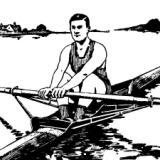
Among other things you will find the Thomas Doggett’s Coat and Badge Race, Henley Royal Regatta, the Boat Race between Oxford and Cambridge (and each crew in training), early films of women rowing and racing, the European Championships, World [Professional] Championships and how some of the World Champions are training and their different rowing styles. (Search for ‘Ernest Barry’ [see picture above], ‘Bert Barry’, ‘Ted Phelps’, E.A. Phelps’, ‘R. Phelps’, and a real favourite ‘Phelps Family’, which shows the 1960 Doggett’s Race in colour, etc.)

What you will see are ‘previews’, which means that you can not download these videos, or link them, but I guess by contacting British Pathé you can get some kind of rights to download or buy the videos.

Now, if you are ready to spend hours in front of your computer screen, watching rowing, click here.

Sunday, August 16, 2009

About Three Distinguished Oarsmen

Ernest Barry, Wally Kinnear, and Harry 'Blackie' Blackstaffe

Slightly more than five months ago, I started the blog “Hear The Boat Sing” (after a phrase in Steve Fairbairn’s poem “The Oarsman’s Song”). In my first entry, on 12 March, I wrote that as there are not a lot of rowing magazines around, it is hard to get anything published, especially if it is related to the history of rowing.

Of course, that never stops me from trying! Some months back, I sent an article to Ms. Wendy Kewley, the editor of ARA’s fine magazine Rowing & Regatta, thinking that I should start by contacting the nicest rowing magazine there is, and then work my way down, so to say… It had worked well earlier once upon a time when I had written a couple of reviews of some rowing books. I then contacted the eminent British/American magazine Maritime Life and Traditions - nowadays sadly deceased - and the editor, Jenny Bennett, took the articles right away.

Well, the result of my latest attempt arrived in the mail yesterday, when the good mail man, in his stylish pith helmet, dropped off the latest issue of Rowing & Regatta, No. 37, August / September, 2009, in my mail box. There it was, my article “Three men in a boat” about Harry Blackstaffe, William D. Kinnear, and Ernest Barry in a triple scull, or as it is also called, a treble scull.

In the article, I wrote that the Olympic champions ‘Blackie’ Blackstaffe and ‘Wally’ Kinnear, and their friend, the professional champion Ernest Barry, were the most distinguished oarsmen of their time, during the 1900s and 1910s, and they were... Well, you can read it yourself in the magazine. If you are not subscribing to Rowing & Regatta, you can read more about the magazine, and maybe even subscribe to it, by clicking here.

With one article published, who knows what this can be the beginning of?

Monday, August 10, 2009

Birthday Boy!


Today’s entry is a very personal one: our son, Anders, is turning 4 years old. As the photograph is showing him rowing (well, sort of) in a dory, I thought it would be appropriate to post it on my blog. I can reveal that he is not getting a single scull as a birthday present. I would like to buy one for me before getting one for him…

HAPPY BIRTHDAY – Dear Boy!

Sunday, August 9, 2009

Rowing Books For Youths 3

Following is a list of youth fiction containing rowing as a major or minor theme. Rowing historian Bill Miller combined the majority of these titles. I have corrected some minor mistakes and added some titles to the list. However, there might still be some errors, especially when it comes to when a book was published. Some stories were published first in a magazine before making it into a published book. Please remember that many of the author names you see are pseudonyms, and that the author used his real name for some books and his pseudonym/s for others.

Please feel free to contact me if you would like to add titles, but please keep in mind that this is a list for youth fiction books!

Austin, S.: Freda’s Rowing Ambition at Riverside (1956)
Barbour, R.H.: Captain of the Crew (1901)
Barbour, R.H.: Flashing Oars (1930)
Barbour, R.H.: Tod Hale with the Crew (1926)
Barbour, R.H.: Coxswain of the Eight (1922)
Barton, G.: The Bell Haven Eight (1914)
Bonehill, R.: The Young Oarsmen of Lakeview (1897)
Bradley, E.: The Adventures of Mr. Verdant Green (1853)
Chadwick, A.: The Eight-Oared Victors (1913)
Chapman, A.: Fred Fenton on the Crew (1913)
Coke, D.: The Bending of a Twig (1900)
Dudley, A.T.: The School Four (1909)
Forbes, G.B.: Frank Allen Head of the Crew or The Boys of Columbia High on the River (1911)
Grahame, K.: The Wind in the Willows (1908)
Grant, R.: Jack Hall or The School Days of an American Boy (1888)
Haywood, C.: Robert Rows the River (1965)
Hughes, T.: Tom Brown at Oxford (1861)
Hughes, T.: Tom Brown’s School Days (1854)
Jerome, J.K.: Three Men in a Boat (1889)
Johnson, O.: Stover at Yale (1912)
Kingman, L.: The Luck of Miss L. (1986)
Knudson, R.R.: Rinehart Shouts (1987)
MacEwen, C.: Thee Women in One Boat (1891)
Morrison, G.W.: The Girls of Central High on Lake Luna (1914)
Neuman, W.: Horace Higby, Cox of the Crew (1971)
Optic, O.: The Boat Club (1854)
Optic, O.: Work and Win (1865/66?)
Paine, R.D.: Sandy Sawyer Sophomore (1911)
Paine, R.D.: The Stroke Oar (1908)
Paine, R.D.: The Twisted Skein (1915)
Paterson, C.&B.: The Foxwood Regatta (1986)
Patten, G.: Ben Oakman, Stroke (1925)
Patten, G.: Cliff Sterling, Stroke of the Crew (1912)
Quirk, L.W.: The Freshman Eight (1913)
Serverance, M.S.: Hammersmith, His Harvard Days (1878)
Silliman, L.: The Scrapper at Camp Blazing Rock (1946)
Standish, B.L. Frank Merriwell’s Faith (1900)
Wood, J.S.: College Days or Harry’s Career at Yale (1894)

Saturday, August 8, 2009

Rowing Books For Youths 2

Looking around on my bookshelves, I only found another “youth book” about rowing girls, The Girls of Central High on Lake Luna, or the Crew that Won (1914) by Gertrude W. Morrison. The frontispiece shows some girls in “correct” rowing dresses for girls and women at the time (image on the right). This is one in a series about the “Girls in Central High” by Morrison.

Another novel with young women is Three Women in One Boat (1891) by Constance MacEwen. The book is a parody of Jerome K. Jerome’s famous novel Three Men in a Boat (To Say Nothing of the Dog) (1889). Some time back, I had an essay posted on The Friends of Rowing History’s great web site rowinghistory.net. If you would like to read my essay, “Rowing Women as Belles des Bateaux, or To Say Nothing of the Cat”, please click here.

Talking about girls rowing, I have seen book lists with titles similar to MacEwen’s, Three Girls in a Boat (n.d., but was probably published in the first half of the 1920s) by Laura A. Baker-Snow and Three Girls in a Boat (1938) by Madge and C. Fox-Smith. I have not seen copies of either book, so I am unaware if they are for girls or women.

Friday, August 7, 2009

Rowing Books For Youths 1

The Amalgamated Press in England published for many years weekly and bi-weekly magazines for boys and girls. Between 1922 and 1963, the company published the popular The Schoolgirls' Own Library (although during Second World War it was temporarily stopped due to paper shortage). In all 1,143 issues of The Schoolgirls’ Own Library were published.

Some of the stories were written by Sheila Austin, which was a pseudonym of Stanley E. Austin (1890-1958). In the “New Series”, published after the war, in August 1956 (No. 240), Austin came out with Freda’s Rowing Ambition at Riverside. This story (64 pp) is about Freda Royston, a new girl at Riverside School and her crew – her “chums” – who manage, after various adventures, to make rowing an official sport at Riverside.

Although, young women began to row at Wellesley College, Massachusetts, in mid-1870s, and Newnham College, Cambridge in England, organized a “boating society” for women in 1893, stories about rowing girls and women were rare during the first half of the 20th century. While you might think that an important milestone as the first official European rowing championships for women, held in 1954, would create an interest in publishing stories about rowing girls, it did not; nor, for that matter, were there a lot of stories published about boys’ rowing.

And while there are tons of youth stories about football (soccer, that is), baseball, basket ball, and other “popular” sports, we are still waiting for stories about rowing girls and boys.

Tuesday, August 4, 2009

Notes From A Rowing Tie Snob

Call me a snob, but I like to wear a neck tie. I guess I got it from my father, and, at least in that sense, I am a chip off the old block. I take every opportunity to wear a tie, and if there is no real reason, I wear one anyway. And to be really honest, living in America does not make it easier. Few places or occasions here demand something around your neck, unless you are going to a wedding or a funeral.

On certain occasions, I have being seen wearing a bow tie or even a neck scarf, a day cravat (what some people wrongly call an Ascot). But being a “tie fellow”, I presume that the nice people in my surroundings are indulgent towards my behaviour and shrug their shoulders and explain the whole thing with a “well, he is from Europe, you know…”, or something to that effect. “But, blimey,” you might say, “what does this have to do with rowing? Has the Swede gone bonkers?”

Well, being interested in neck ties, I find it fascinating that some rowing clubs around the world have club ties. This is especially true in Great Britain where every rowing club with self-respect has their own tie in the colours of the club. I am sad to say this is not the case in Sweden. I tried, unsuccessfully, to introduce a club tie for my club in Malmö - actually using my old British school tie, which is in the same colours as my rowing club’s colours, black and yellow – but my idea was turned down by the club committee. In the 1990s, when I was a member for some years of the Upper Thames RC in Henley-on-Thames, England, I received the organization’s club tie as a gift. The tie is dark blue with Isis and Tamesis in white - Isis and Tamesis are sculptures on each side of the Henley Bridge. (See photo of the tie up on the left; and, if you wonder, yes it is tied with a Half-Windsor knot).

During the first decades in the 20th century, many tobacco companies put a premium card with the pack of cigarettes or box of tobacco. In 1934, Churchman's Cigarette Company in England came out with a card set called “Well Known Ties”. Two famous rowing clubs, and their ties, were featured on two cards, Leander Club and Thames RC. In the illustration (see top of this entry) the Leander tie looks more red than pink, or if I may correct myself, cerise. The old Putney waterman, at one time the King’s Bargemaster, ‘Bossie’ Phelps once corrected an Australian oarsman, who happened to call Leander’s colour pink: “Half a moment, Sir, let’s get this straight; it is not pink; it is cerise.” The story is printed in ‘Jumbo’ Edwards’s The Way of a Man with a Blade (1963), and I will not re-tell the whole story here as it is actually rather mean to our Aussie rowing friends.

A colour combination that I personally really like is Auriol Kensington RC’s green and pink (or is that also cerise?). Anyone who is interested in the skill of tying his tie more than one way should immediately get a copy of Thomas Fink’s and Yong Mao’s The 85 Ways to Tie a Tie (2000), which will show the science and aesthetics of tie knots. A book a true gentleman, rowing chap or not, should not be without.

Monday, August 3, 2009

Rowing Films - Not That Hot!

Have you watched any good rowing films lately?

You haven’t? Well, to be honest, I am not surprised as there are very few around. It seems the sport of rowing is hard to make convincing on the big screen. Most of the rowing films come out funny (when they are not suppose to be). One of the first films with rowing in it – and it is made to be funny – is College (1927) with Buster Keaton. Some years later, in 1934, Hollywood made a daring move with Eight Girls in a Boat (to the right), which was a remake of a German film from 1932.

MGM’s first British production was A Yank at Oxford (1938) starring Robert Taylor as an American student at Oxford. Taylor strokes his college’s eight (to the left) at bump races and at the end of the film, Oxford’s boat in the Boat Race against Cambridge. Other famous stars, or stars to be, in this film were Maureen O’Sullivan (leaving Johnny Weissmuller’s Tarzan alone in the jungle) and Vivien Leigh (before her success with Gone With The Wind).

To watch Robert Taylor win the Boat Race, please go to: www.youtube.com search for A Yank at Oxford (part 9).

In 1984, a terrible remake of A Yank at Oxford was done, Oxford Blues, with Rob Lowe. Please do not waste any time watching it.

It seems that making a documentary about rowing is easier to do than a fictional story. Although some of the worst ones are based on rowing “history” books, for example the film Rowing Through is based on the great book The Amateurs and the film True Blue is based on the book with the same title. (For some unknown reason True Blue was called Miracle at Oxford in America.)

If you are interested in a list of documentaries on and films about rowing, please click here.

Wednesday, July 29, 2009

Good Writing On Rowing 3

Unless you are a rowing historian, rowers and scullers tend to regard rowing in narrow, slender racing shells as the pure “rowing”; then forgetting hundreds and maybe thousands of years of activities in galleys, Viking boats, fishing boats, different types of work boats, and recreational boats, etc. Following here are ten poems and “sayings” that show another side of the rich history of rowing. Enjoy!

21)
And here
father Aeneas hangs a leafy branch
of ilex as a signal for his crews,
the goal at which they are to turn around,
to wheel back on their long way. Then they choose
places by lot; above the sterns, far off,
the captains gleam in purple, gold; the oarsmen
are crowned with poplar leaves, their naked shoulders
are glistening, wet with oil. They man the benches;
their arms are tense upon the oars; they wait,
expectant, for the start as throbbing fear
and eager love of praise drain their high hearts.
At last, with the bright trumpet blast, at once
they all shoot from their starting places; shouts
of sailors beat against the skies, the waters
are turned to foam beneath the stroking arms.
They cleave the furrows with their equal thrusts;
the whole sea gapes, torn by oars, the ships’
three-pointed beaks.
From Book V in The Aeneid of Virgil (translation by Allen Mandelbaum)

22)
Pull babes – pull, sucklings – pull, all. But what the devil are you hurrying about? Softly, softly, and steadily, my men. Only pull, and keep pulling; nothing more. Crack all your backbones, and bite your knives in two – that’s all. Take it easy – why don’t ye take it easy, I say, and burst all your livers and lungs!
From Moby-Dick by Herman Melville

23)
The banked oars fell an hundred strong,
And backed and threshed and ground,
But bitter was the rowers' song
As they brought the war-boat round.

They had no heart for the rally and roar
That makes the whale-bath smoke--
When the great blades cleave and hold and leave
As one on the racing stroke.
From Rudyard Kipling’s “The Rowers”

24)
So they took the oars from where they lay in crotches under the gunwales and began to row. Many of the oars had been broken or lost in the storm, but there were enough left to row twenty a side. The sea grew white under their strokes. The breath of the rowers came from their mouths like a thick mist, and the chop of the oars, the creaking of their straps against the thole-pins, made a noise that seemed pleasant enough after the silence in which they had lain.
From The Men of Ness by Eric Linklater

25)
There's no earthly way of knowing
Which direction we are going
There's no knowing where we're rowing
Or which way the river's flowing
From Roald Dahl’s “The Rowing Song”

26)
Once upon Iceland's solitary strand
A poet wandered with his book and pen,
Seeking some final word, some sweet Amen,
Wherewith to close the volume in his hand.
The billows rolled and plunged upon the sand,
The circling sea-gulls swept beyond his ken,
And from the parting cloud-rack now and then
Flashed the red sunset over sea and land.
Then by the billows at his feet was tossed
A broken oar; and carved thereon he read,
Oft was I weary, when I toiled at thee;
And like a man, who findeth what was lost,
He wrote the words, then lifted up his head,
And flung his useless pen into the sea.
“The Broken Oar” by Henry Wadsworth Longfellow

27)
The pots were safely sunk; and then
The father gave the word for home:
He took the tiller in his hand,
And, in his heart already home,
He brought her nose round towards the land,
To steer her straight for home.

He never spoke,
Nor stirred again:
A sudden stroke,
And he lay dead,
With staring eyes, and lips off lead.

The son rowed on, and nothing feared:
And sometimes, merrily,
He lifted up his voice, and sang,
Both high and low,
And loud and sweet:
For he was ever gay at sea,
And ever glad to row,
And rowed as only blind men row:
And little did the blind lad know
That death was at his feet:
For still he thought his father steered;
Nor knew that he was all alone
With death upon the open sea.
So merrily, he rowed, and sang:
And, strangely on the silence rang
That lonely melody,
As, through the livid, brooding gloam,
By rock and reef, he rowed for home--
The blind man rowed the dead man home.

/- - -/

His hand has never touched an oar,
Since they came home together--
The blind, who rowed his father home--
The dear, who steered his blind son home.
From Wilfred Wilson Gibson’s “The Blind Rower”

28)
I took the oars: the Pilot's boy,
Who now doth crazy go,
Laughed loud and long, and all the while
His eyes went to and fro.
'Ha! ha!' quoth he, 'full plain I see,
The Devil knows how to row.'
From “The Rime of the Ancient Mariner” by Samuel Taylor Coleridge

29)
“You linger to see his back, and the back of his neck and shoulder-side...
The Bending forward and backward of the rowers...”
From Walt Whitman’s "I Sing the Body Electric"

30)
[They talked about other occasions when they have been out on the river, like when George was on his first outing in] “an eight-oared racing outrigger” [when he] “immediately on starting, received a violent blow in the small back from the butt-end of number five’s scull [sic], at the same time that his own seat seemed to disappear from under him by magic, and leave him sitting on the boards. He also noticed, as a curious circumstance, that number two was at the same instant lying on his back at the bottom of the boat, with his legs in the air, apparently in a fit.”
From Three Men in a Boat (To Say Nothing of the Dog) by Jerome K. Jerome

Sunday, July 26, 2009

Good Writing On Rowing 2

Here are some more poems and “sayings” on the sport of rowing.

11)
I was the pride of all the Thames
My name was Natty Jerry
The best of smart and flashy dames
I’ve carried in my wherry.

For then no mortal soul like me
So merrily did jog it,
I lov’d my wife, my friend, d’ye see
And won the prize of Doggett.

I Coat and Badge so neat and spruce
I row’d all blithe and merry
And every Waterman did use
To call me Happy Jerry.
From “Happy Jerry” by Charles Dibdin

12)
Strong daughters of the golden south!
With health and beauty for your dower
Sure pledge of grander womanhood,
We hail with you this joyous hour.

We meet this day to dedicate
A noble craft to noble waters,
Sealed by these brief and simple rites,
To ten of San Diego’s daughters.

Manned by a crew as leal and true,
As e’er pulled oar or sailed a smack,
So let all other craft beware,
Nor try to sail athwart “The Zlac.”
From Philip Morse’s “Lines Written for the Launching of the ZLAC”, a barge that was launched 3 August 1895 at the ZLAC Rowing Club

13)
I don’t care, you know, a bit how they row,
Nor mind about smartness of feather;
If steering is bad, I’m not at all sad,
Nor care if they all swing together!
Oh why do they shout and make such a rout,
When one boat another one chases?
‘Tis really too hot to bawl, is it not?
Or bore oneself over the Races!
I DON’T CARE A RAP FOR THE RACES! –
MID ALL THE REGATTA EMBRACES –
I’M THAT SORT OF CHAP, I DON’T CARE A RAP,
A RAP OR A SNAP FOR THE RACES!
From “A Regatta Rhyme” (On board the ‘Athena’, Henley-on-Thames) by Joseph Ashby-Sterry, published in Punch

14)
If you want a receipt for that popular mystery,
known to the world as a ‘Varsity crew,
take all the redoubtable athletes in history,
tub them and coach them and clothe them in blue.
The giant physique of a Samson or Hercules,
skill of Apollo in steering the sun,
the custom of noted ascetics to shirk all ease –
e.g. St. Anthony, second to none –
the doggedness deep of the stone-rolling Sisyphus,
speed of a Hutchens when started to run;
a force irresistible used without busy fuss,
like sixty Hanlans rolled into one;
From “The ‘Blue’ Fever” by J. Maycock (with special thanks to ‘Hélène’)

15)
Down the river the light fours roll
Like a tramp in the trough of a heavy sea,
Like a rakish elephant on a spree,
Striking despair to the inmost soul
Of the coach on his tow-path bike or gee,
Watching their plunging, staggering motion,
(As though they were not on the Cam, but the ocean).

Behind rides a man who is quite ignored,
“Out one … You’re straight … Out one again!”
But the steerer sneer with superb disdain –
Crash! And a sculler falls overboard,
And the four leaves a ruinous wake in the train,
Tubs, scullers and pairs – fairly makes one shiver –
And now Trail Eights are on the river!
“Light Fours” by R. E. Swartwout

16)
I met a solid rowing friend, and asked about the race,
“How fared it with your wind,” I said, “when stroke increased the pace?
“You swung it forward mightily, you heaved it greatly back;
“Your muscles rose in knotted lumps, I almost heard them crack.
“And while we roared and rattled too, your eyes were fixed like glue,
“What thoughts went flying through your mind, how fared it, Five, with you?”
But Five made answer solemnly, “I heard them fire a gun,
“No other mortal thing I knew until the race was done.”
From “A Trinity Boating Song” by R. C. Lehmann

17)
In future when the windless lake is still,
And sounds of evening bells float from the hill,

When skimming shells in straining practice fly
Up past the western shore, with coxswain’s cry

And rowlock’s rhythmic throb and wash of oar,
“The Old Man’ in his launch will come nor more.

He dwelt among us without blame or fear,
And trained his oarsmen many a zealous year;

He taught them manhood also; how to meet
Their fate, unspoiled by triumph or defeat.

“Row hard! And may the best crew win,” he said;
And victory hovered ever ‘round his head.

Alas, the crew, the lake, the changing shore
Shall see “The Old Man” in his launch no more.
“Charles E. Courtney” by Albert W. Smith

18)
Come, my friends.
'Tis not too late to seek a newer world.
Push off, and sitting well in order smite
the sounding furrows; for my purpose holds
To sail beyond the sunset, and the baths
Of all the western stars, until I die.
It may be that the gulfs will wash us down;
It may be that we shall touch the Happy Isles,
And see the great Achilles, whom we knew.
Though much is taken, much abides; and though
We are not now that strength which in old days
Moved earth and heaven, that which we are, we are---
One equal temper of heroic hearts,
Made weak by time and fate, but strong in will
To strive, to seek, to find, and not to yield.
From "Ulysses" by Lord Tennyson

19)
What after all, is a sportsman? As I understand the breed he is a one who has not merely braced his muscles and developed his endurance be exercise of some great sport, but has, in the pursuit of that exercise learnt to control his anger, to be considerate to his fellowmen, to take no mean advantage, to resent as a dishonour the very suspicion of trickery, to bear aloft a cheerful countenance under disappointment, and never to own himself defeat until the last breath is out of his body.
R. C. Lehmann

20)
[“Stilton’s”] entire formative years, therefore, as you might say, had been spent in dipping an oar into the water, giving it a shove and hauling it out again. Only a pretty dumb brick would fritter away his golden youth doing that sort of thing.
Bertie Wooster about G. D'Arcy “Stilton” Cheesewright in P. G. Wodehouse’s Joy in the Morning

Tuesday, July 21, 2009

Steve Fairbairn - The Master of Sayings

The master of “sayings” when it comes to rowing is without doubt the Australian Steve Fairbairn, who coached Jesus College, Cambridge, Thames RC, and The London RC. Although he died seventy years ago, his books on rowing, which are now all out of print, are very sought after. Be prepared to pay a lot of money for second-hand copies. Fairbairn’s famous maxims were compiled by his friend Freddy Brittain, and given the title Slowly Forward. The following is a piece about Fairbairn and Brittain.

In 1929, Steve’s loyal friend Freddy Brittain, then a year away from a lectureship at Jesus College, selected and arranged 366 of Steve’s sayings, a maxim for each day of the year, starting with “Don’t start the next stroke too soon” (1 January), and ending with “Sit back at the finish till the cows come home” (31 December). I have many favorites among the 366 aphorisms, but if I have to pick only one, it is “Enjoy your rowing, win or lose”, which is what I have done ever since I began to row. It was much later, that I realized that this saying actually falls on my birthday.

Freddy gave the book the title Slowly Forward, which surprised Steve. To Steve’s question where the title came from, Freddy answered that it was Steve’s favorite expression when he was coaching his crews. Steve denied this, saying that he always said “Slow Forward.” Freddy explained that an adverb was essential in that position. “Adverb!” Steve blurted out, amused. “Adverbs! You are like the bloody dons – specialized idiots.”

Steve never seemed to forget this, Freddy tells in [his autobiography] It’s a Don’s Life, “whenever he introduced me to anyone – in the Stewards’ Enclosure at Henley, or anywhere else – he used to add solemnly, ‘He knows a lot about adverbs, he does’; and when he wrote to me he often ended his letter with
‘Yoursly everly,
Stevely’ “

The following year, in 1930, Freddy was going to publish his Oar, Scull, and Rudder, and offered it first to Cambridge University Press, who required financial assistance from the author. Freddy did not have any money to spare, so he sent his manuscript to Oxford University Press, who decided to publish it. Steve immediately offered to write the introduction to the book.

Freddy mentions in his autobiography that he was worried about Steve’s offer as “his style of writing, influenced as it inevitably was by years spent in the backwoods of Australia out of touch with books or educated men, was hardly in keeping with a staid University Press, but I could not refuse his offer.” A couple of days later Steve handed his piece to Freddy to read. Steve sat down opposite Freddy when he read it. When Steve saw Freddy getting some twitches around his eyes and evidently saw his face drop, he said, “You don’t like my Introduction?” Freddy began to stammer, “These University Presses are a rather a highbrow lot, you know.”

Then Steve got an idea. Both Steve and Freddy knew another Jesus don, the King Edward VII Professor of English Literature, Sir Arthur Quiller-Couch - know as “Q” - who was a famous poet, novelist, literary critic, and anthologist (The Oxford Book of English Verse, 1900; 1939); and for certain a real man of letters. Q had, as an undergraduate, rowed at Trinity College at Oxford and written the introduction to The Jesus College Boat Club, Vol. I. He was also, according to Freddy in his Arthur Quiller-Couch - A Biographical Study of Q (1947; 2nd ed. 1948), “the best-dressed man in Cambridge.”

“All right. I will tell you what to do,” Steve said. “Q knows something about English. Get him to knock it into shape.” Freddy went to Q’s room and said, “Steve says you know something about English.” Q answered that it was very kind of Steve to say so, and what could he help him with. Freddy handed Steve’s introduction to Q and said that Steve wanted him “to knock it into shape.” Q started to read, and Freddy could now see how Q’s face dropped. Q turned to Freddy and, letting out a deep sigh, said it was impossible to make anything out of it. However, Q took a second look at the manuscript. “All right,” he said. “Tell Steve I will knock it into shape.”

“When the book was published,” Freddy writes in It’s a Don’s Life, “the title-page asserted that it had an Introduction by Steve Fairbairn. It is true that Q had used the same twenty-six letters of the alphabet as Steve, but he had re-arranged them in his own inimitable style.” Steve’s opening sentence had been something like “Me and Freddy have had a lot of talks about rowing,” which in the printed Introduction reads “In our discussions ‘frequent and full’ on the principles of Rowing it has occurred to my friend Mr. Brittain, as to me, to wonder why a scientific Bibliography of the great Art has never yet been compiled.”


Extract from a yet unpublished essay, “Freddy and Stevely – and the Quest for Perfect Rowing”, about the Cambridge rowing coach Steve Fairbairn (1862-1938) and his friend Frederick “Freddy” Brittain (1893-1969), a don at Jesus College, Cambridge.

Monday, July 20, 2009

Good Writing On Rowing 1

There is a lot of good writing about rowing. And here I mean short, powerful, witty, and intelligent phrases, poems, and deep thoughts that tell a reader about our sport, how it is and how we would like it to be seen and remembered.

Here is a list of 10 “sayings”. I have not listed them in a special order, although I believe No. 1 should be regarded as the top one. I will be back with more of them in a near future.

1)
There is nothing – absolutely nothing – half so much worth doing as simply messing about in boats.
Ratty in Wind in the Willows by Kenneth Grahame

2)
He keeps his sturdy legs applied
Just where he has been taught to,
And always moves his happy slide
Precisely as he ought to.
He owns a wealth of symmetry
Which nothing can diminish,
And strong men shout for joy to see
His wonder working finish.
From “The Perfect Oar” by R. C. Lehmann

3)
Dead-heat to Oxford by five feet.
‘Honest’ John Phelps, the 1877 finishing judge at the Boat Race

4)
It’s a great art, is rowing.
It’s the finest art there is.
It’s a symphony of motion.
And when you’re rowing well
Why it’s nearing perfection –
And when you reach perfection
You’re touching the Divine.
It touches the you of you’s
Which is your soul.
George Pocock

5)
The three ‘R’s of rowing are: Rowing, Rowing, and Rowing.
Stan Pocock

6)
There is no disgrace being beaten when you are trying to win.
Jack Beresford, Jr.,

7)
From stretcher to oar with drive and draw,
He speeds the boat along.
All whalebone and steel and a willowy feel –
That is the oarsman’s song.
From “The Oarsman’s Song” by Steve Fairbairn

8)
If anybody sees me near a boat again, they have my permission to shoot me.
[Later Sir] Steve Redgrave after winning his fourth consecutive Olympic gold medal. However, he would become Olympic Champion again, in Sydney in 2000.

9)
Nothing as beautiful as rowing, the records of how we have used it to test ourselves and each other, and the reasons it should be preserved for future generations, should be so neglected, so forgotten, or so unsung.
Thomas E. Weil in his essay “The dangerously neglected legacy of rowing”

10)
Jolly boating weather,
And a hay harvest breeze,
Blade on the feather,
Shade off the trees,
Swing, swing together
With your bodies between your knees.
"Eton Boating Song" by William Cory

There are many different versions of Cory’s ‘Jolly boating weather’. When Hugh Laurie was asked to sing it on television, he could not help referring to it as a ‘homoerotic anthem’ – look this up on: Youtube.com > "hugh laurie homoerotic anthem"

Sunday, July 5, 2009

Shame On Me!

Today, Sunday the 5 July, it was the final day at the Henley Royal Regatta in Henley-on-Thames. Although, I have been to the town of Henley several times, for rowing business or vacation, I have to confess that I have never been to the Henley Royal Regatta - and for that I am embarrassed. A friend of mine, a rowing fellow in London, expressed in an e-mail, when he heard that I had not attended the regatta, how shocked he was that I had not been to “Henley Royal”. And I agree. I mean, I regard myself to have a fairly good all-round education, but not having been to Henley (the regatta) leaves my education with a big dent. Last time I was in Henley with my family to visit the River and Rowing Museum – and what a lovely tribute to rowing it is - my then 19-months old daughter was sick and our stay ended up to be the worst holiday ever!!!

But, as I wrote, today was the last day of the “Henley Royal”. Although, I was not there, I like to know the results of the different events. This year there were some world-class scullers competing in The Diamond Challenge Sculls, and I was curious which of them would end up in the final heat. Early on, when it was clear that the Diamonds holder from 2008, Ian Lawson of Great Britain, was overpowered by the Kiwi Duncan Grant (lightweight single world champion), the trophy was going to be between Olaf Tufte of Norway, Mahe Drysdale of New Zealand, and the young, very talented British sculler, Alan Campbell. All moved up through the heats, and in the semi-final it was Tufte against Campbell, and the British sculler won. According to the British newspapers, it was a thrilling race, perfectly executed by Campbell. However, in the final race Drysdale was too difficult to beat. If you would like to get all the results from this year’s Henley, please click here.

The excuse that I had not to go to Henley this year is a good one. My friend Per Ekström and his family were visiting us here in Connecticut during the “Henley Days”. Not only is Per a dear friend of mine and a fellow of the Swedish rowing club where I am a member, Malmö Roddklubb, he is also the editor – or, Editor-in-Chief, if you like – of the Swedish rowing magazine Svensk Rodd, which we started in 1990. So I took all the Ekströms to the National Rowing Hall of Fame and to the rowing exhibit “Let Her Run”, and gave them a VIP-tour of the Boat Storage Space of Mystic Seaport Museum where the National Rowing Foundation’s nice collection of Pocock shells are hidden. They all seemed to like it.

Now, I have been thinking how I am to illustrate this entry to give it both a little dash of “Henley Royal” and a dash of Per Ekström and me. Spring in 1997, I think it was, my rowing club in Sweden bought a new eight, a British Aylings. For the première outing, we were nine fellows all “dressed up” to show her off on the water. From the bow: Jan Andersson, Bengt Ryberg, Håkan Christensson, Per Ekström, Ian Nicholls, Timo Ulfskans, Thomas Barge, Peter Kauranen (stroke), and Göran R Buckhorn (coxswain). And yes, the club got some publicity in the local newspapers as buying a new eight is always something special.

It is special to go to the regatta in Henley, too. And one of these years, I am going to go, by golly.