Photograph: Werner Schmidt

Friday, January 13, 2012

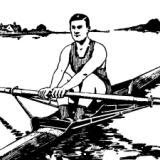
New Oarsome ‘Artwork for Oarsfolks’

The art pieces in this entry are published with permission of Tonia Williams and may not be reproduced or republished without permission from o4rsom.com - ‘Artwork for Oarsfolks’.

Last spring, Tonia Williams, who was born in New Zealand of parents who had moved there from Great Britain, launched her rowing art at the Maadi Cup Regatta. In 1996, after her elite rowing career was over - among other things, she represented Great Britain between 1991 and 1994, stroking the lightweight four to British rowing’s first sweep-oar gold medal for women in 1993 - Tonia became interested in rowing art. During two decades, while she was pursuing an occupation in architectural and urban design, she was desperately looking for “art that captured the colour and vibrancy of our beautiful sport”, she writes in an e-mail to HTBS from New Zealand.

Once Tonia had decided to have a go herself at rowing art, she started o4rsom.com - ‘Artwork for Oarsfolks’ - in March/April 2011 to promote sales of prints and her original art. It is immediately clear to anyone who views her work, that it is created by someone who knows, loves and understands the sport of rowing. Her ‘Artwork for Oarsfolks’ really captures the essence of the noble art of oarsmanship.

To try to create international interest for her art, Tonia took a trip to the U.K. where, she writes, the “interest was fairly high, and I received an invitation to exhibit some of my originals at the Henley Royal Regatta Stewards Art Gallery.” They will be retailing her prints, cards, and postcards. Another outcome from her visit to Henley is that she has been given an exclusive exhibition at the famous River and Rowing Museum from May to August this year as a part of the museum’s Olympic build up, she also writes.

“Naturally I am keen to build on this momentum and am looking for further profile wherever possible”, Tonia mentions. She continues, “I currently have prints (on a variety of medium), cards and postcards available, and am always happy to discuss arrangements of mutual benefit.” So, if there is anyone who is keen on carrying Tonia’s beautiful art, do not hesitate to contact her here.

Now, what I personally think is a great idea is Tonia’s ability to customise ‘original’ art to incorporate club and crew colours to create a virtual original. This has been well received by some clubs and schools, “especially”, writes Tonia, “as end of year gifts for sponsors, coaches, and athletes”.

Although, Tonia retired from elite rowing in 1996, she did win the mixed double (with Richard Newey) at the world Masters Games in Melbourne, Australia, in 2002. Presently, she is Commodore of North Shore Rowing Club.

From now on, you will find a link to Tonia’s o4rsom.com - ‘Artwork for Oarsfolks’ - under Buy Rowing Stuff on the right. HTBS wishes Tonia luck in her new endeavour.

Thursday, January 12, 2012

Tim Koch: Sorry Olaf……

An embarrassed Tim Koch writes from London...

My widely read interview with Olaf Tufe on Monday, 9 January, contained a very big mistake. I wrote that Olaf’s coach is Eskild Ebbesen, which is not correct, it is Carsten Hassing. My apologies to everyone involved and for any embarrassment caused. I must have misunderstood Olaf in a hasty interview in noisy conditions. The part about the difference of opinion over rate is correct but it is between Olaf and Carsten.

Göran R Buckhorn: As the editor of HTBS, I would like to apoligise, too, and take the opportunity to thank Michiel Jonkman, who contacted me from the Netherlands regarding this mistake. Michiel is right now working on a book about legendary scullers, among them Olaf Tufte, of course… Corrections have now been made to the post on Monday, 9 January. Again, we are deeply sorry...

Picture of Carsten Hassing from Rowing Canada.

Perfect!

I am happy to report that on Tuesday, 10 January, HTBS was featured on Rebecca Caroe’s website Rowperfect in its series ‘Quirky Rowing Websites’. At first, I have to confess, I was a little hesitant to read what Rebecca had to say about HTBS. Being a pessimist, I did not think that ‘quirky’ sounded very flattering, but I was relieved to read that her interpretation of the word was more leaning towards the meaning ‘original’ than ‘strange’. Please read her nice piece about HTBS here.

The least we can do to thank Rebecca is to put up a link to her website Rowperfect. From now on you will find it on the right under ‘Good Rowing Links’. Thank you, Rebecca!

Wednesday, January 11, 2012

F.S. Kelly's Lost Sonata Found After 80 Years

Keeping HTBS going with articles almost daily demands a lot of reading, researching, and writing. Of course, this means that one feels close to some of the rowers and scullers; they become favorites, or even ‘rowing heroes’. The other day the good fellow Tim Koch sent an e-mail with a link to an article from last year’s spring about one of these ‘heroes’, Frederick Septimus Kelly (1881-1916), who was born in Sydney. Kelly was an eminent oarsman, but also a pianist and composer.

At the outbreak of the First World War, he signed up in the British 63rd Royal Naval Division and belonged to the Hood Battalion. According to the article in ABC News in Australia in May, 2011, during the Gallipoli campaign, he composed a violin sonata for a young female violinist, Jelly D’Aranyi, whom Kelly had met and played with in London. He was killed at the end of the Battle of the Somme, on 13 November, 1916. D’Aranyi played the sonata at his memorial service.

The sonata was lost for more than 80 years, but writes ABC News, “it has been rediscovered thanks to years of detective work by Chris Latham, a violinist and director of the Canberra International Music Festival”. Read the interesting article and view a short film clip about the ‘rediscovery’ here.

Jelly D’Aranyi (1893-1966) became a famous violinist. Listen to D’Aranyi playing a piece by Brahms here below:

Tuesday, January 10, 2012

OUBC Film 3: The Boat Race Jockey

On 30 October and 7 December, 2011, HTBS had two posts about an article and films which were posted on Oxford Today, “A Year in the Life of the Boat Race”. Now, Oxford Today has made a third film available about the Dark Blues and their training, a film as interesting as the first two ones. This installment concentrates on the cox and coxing a Blue boat on the Thames. Watch it by clicking here.

Monday, January 9, 2012

Olaf Tufte: “You Can Always Hear The Boat Sing A Little More...”

Olaf teaches Thomas everything he knows – in 20 minutes. Harald looks on.

HTBS’s Tim Koch’s Auriol Kensington Rowing Club had some foreign celebrities visiting the club last Saturday, Tim writes...

It is not often that a group of young master rowers from a middle ranking rowing club get to race against one of the great scullers of the day. It is even less often that they beat him. However, this is what happened at Auriol Kensington Rowing Club in Hammersmith, London, on Saturday 7 January. The circumstance, as you may have already guessed, were fairly unusual.

Team Norway: Bjørn, Harald, Thomas, and Olaf.

One of the most popular television shows in Norway is Senkveld med Thomas og Harald (‘Late night with Thomas and Harald’). In-between their studio interviews they show recordings of various ‘challenges’ that the two presenters have undertaken. They decided that one of these should be a Norwegian rowing crew racing a British crew on the Thames. To this end they recruited the finest sculler in Norway and, indeed, the world, Olaf Tufte. Olaf has been the reigning Olympic champion since he won the single sculls in Athens in 2004 and Beijing in 2008. He also won the World Championships in 2001 and 2003. A good start. They then got Bjørn Jostein Singstad, a young rower with the Norwegian National Squad. Not bad. Unfortunately, the next two members of the quadruple scull were Thomas and Harald themselves. Neither of them had ever rowed. They had no time to learn. Harald had just broken his arm. However, this was not a problem for the television people as, of course, the sole object of the exercise was to make amusing TV for a non-rowing audience. Thus Thomas got about 40 minutes of training, half on land and half on water. He sat at ‘3’ behind Olaf, who was at stroke. Bjørn sat at bow. Harald, one arm in a sling, sat at ‘2’, without any oars but with a small Norwegian flag to wave in encouragement. Umpire Martin Gill also had to do a lot of flag waving at the start but the race soon settled down and the result, perhaps not surprisingly, was a win for Ali Boileau, Hugh Mackworth-Praed, Harry Powell, and Nick Hubbard of ‘Team Britain’. I suspect that, in the future, they will tell their grandchildren of the day that they beat Olaf Tufte - but without going into the details. I know that I would.

The finish: Team GB beats Team Norway.

Team Norway, umpire and safety boat return from the finish.

I, of course, had to take advantage of having a great Olympian in the Auriol Kensington clubhouse. Firstly, I photographed the possible 2012 Olympic sculling champion under a picture of the 1912 winner (Kensington Rowing Club’s Wally Kinnear). Secondly, I asked Olaf for an interview - which he kindly gave.

The 1912 Champion and the 2012(?) Champion.

What is your form like at the start of the Olympic year?
I think that I am well prepared. In the winter, I do a lot of ergs and I feel that I am on the right track.

Are you defiantly in the single for the 2012 Olympics?
Nothing is ever definite in rowing but that is what I am aiming for and yes, at the moment, I am.

After winning two Olympic titles, what keep you motivated?
You can always be a little bit better, you can always hear the boat sing a little bit more, a little bit longer..... What keeps me in rowing is that it is a big happy family and the best thing I know is to compete against my good friends...... The one who is going to win in London will be better than the one who won in Beijing and Athens and so on... So as long as you think that you can be better than you were, that is the motivation.

Can you win a third Olympic title?
(Olaf fixes me with a steely gaze. I feel a little nervous...)
If I thought that I couldn’t, I would not be here.

You won the Olympic title for a second time in 2008 despite not winning much in the preceding years. Will it be the same in 2012?
True, I have not won much since Beijing. I think the reason for that is that I have been doing a lot of other stuff outside of rowing.... But in the approach to the Olympics...... I have cleared away anything that takes away my energy.... I am focusing more and more on the rowing and everything that comes with it, I am not known for resting..... I think that I am doing some good things now and I have an OK plan but in the end we will see if it is good enough.

Tell me more about your plan.
I am not doing anything very different to what I have done, I am actually going back to the things that I did in 2008. I have been doing more ergs during the winter like I did in '08 which was not too bad a choice. Then I will probably do more speed work than I have done. I have a new coach (Carsten Hassing*). He is more about higher rating, not low rate and hard push, so we fight a little bit against each other, I want to do the heavy stroke and he wants a high rate. So with that little struggle and fight I hope we will get the best out of both of them and it will bring me even closer to success.

Who do you think are the scullers to beat in 2012?
Myself.

OK...., and then.....?
... It’s Mahé (Drysdale, NZ, third in Beijing)... Ondřej (Synek, Czech, second in Beijing) ... Alan (Campbell, Britain, fifth in Beijing) will of course be a big one on his home course.., you never know about Marcel Hacker... then you have the Swede, Lassi (Karonen) but I don’t think he will take the medals, the others are too strong. You have some stars coming up, you have the Azerbaijan guy (Aleksandr Aleksandrov)..., the Cuban (Angel Fournier)... both trying to fight their way into the finals.

Excuse the slightly parochial question but how strong do you think Britain’s Alan Campbell is?
If he is capable of winning this should be his year. The pressure of competing on his home ground will be a big challenge for him, even if he says it is not a problem, it will always be that way. We will have to see if he can turn that pressure into energy. But he is a great sculler, really fast, really strong, so he is one of the guys you have to watch out for.

Olaf, thank you very much and good luck in the Olympics.

If you want to see a great example of Olaf’s ability to put it all together when it really counts (and at the last minute), look at the penultimate 250 metres of the Athens final:


Olaf also mentions that he and his coach, Carsten Hassing, who successfully has coached parts of the Canadian National Team, have discussed the possibility of combining other rowing philosophies, such as higher stroke ratings, with the proven Norwegian technique.

Remember, he is going for his third Olympic title and, if successful, he would be the first single sculler to do this since the great Finn, Pertti Karppinen won in 1976, 1980, and 1984. Vyacheslav Ivanov of the USSR is the only other sculler to do this (1956, 1960, and 1964).

Let’s hope Olaf’s 2012 final is more successful that this outing:


(Olaf: “It can happen to the best…”)

See also AK News! & "Tufte On The Thames", 25 April, 2012.
* Corrections were made to this post on Thursday, 12 January, 2011.

Sunday, January 8, 2012

Adieu Ramer

HTBS's Hélène Rémond reports from France:

On 24 May 2010, HTBS was happy to announce the new “improved publication, Ramer, of the French Rowing Federation, but issue 676, delivered in November 2011, was to be the last one. The decision was taken by the Federation’s Board of Directors to cease the magazine because the number of subscriptions had been going down, getting lower and lower since the beginning of 2011. In the last editorial, FFSA president Jean-Jacques Mulot explained: “from 3,000 subscribers, they were less than 2,000 of them in a few months [...]. This situation leads us, like other rowing federations before, to choose new means of communication that will rapidly be operational”.

Ramer had turned into a large-format magazine printed on recycled paper. The quarterly went from 44 pages up to 64 pages with more photographs. The interviews and reports did not only tackle French rowing - including Breton rowing, with champion Marie Le Nepvou, for instance - but also international events like the HRR and the Head of the Charles Regatta...


It is always sad to see a rowing magazine go down the pipes...

Saturday, January 7, 2012

The Currach - A Symbol Of Ireland

The Irishman Greg Denieffe sends greetings for the new year:

“Athbhliain faoi Mhaise Duit!”

Greg got a very nice gift for Christmas. He writes:

My very good friend Seamus Keating and his wife Margaret gave me a beautiful Celtic Wood Carving for Christmas. Above you can see a picture of it in its presentation box and I thought the HTBS readers may like to know a little bit more about this boat type, “The Currach”.

According to Currach.org “Currachs are heritage, culture, history, and athletics all in one; and the history of the Currach is as old as Ireland itself. The first written record comes from Julius Caesar in 100 BC and early Gaelic accounts speak of large ocean going sailing Currachs roving the North Atlantic. However, such a light and graceful craft were not only used on the sea and it is recorded that in 1602, O’Sullivan Beare, the Irish chieftain, quickly assembled Currachs to cross the Shannon to escape from the Earl of Thomond and his army.

“The origin of the Currach may be lost in the mists of time, but their traditional construction has changed little over the centuries. Now made from tarred canvas they were originally built by craftsmen using animal skins, stretched over wooden slats or laths and rowed with bladeless oars. Although flimsy-looking it is perfectly adapted to the local seas. Irish legend has it that it was in a Currach that St. Brendan journeyed across the Atlantic 900 years before Columbus and 400 years before the Vikings! He speaks of his visit to a vast land across the Western Ocean (Newfoundland) and a great impassable river (the Mississippi?). If true, the first European to arrive in America (in a Currach, no less) was an Irishman! The Currach is a one of the most romantic Irish symbols, familiar to tourists all over the world.”

A model representing St Brendan’s currach.

It would seem that the gift was a precursor for me to look into the history of the Currach at a very momentous time as it is been reintroduced to the east coast of Ireland today, 7 January 2012.

As reported on thejournal.ie on Wednesday 4 January this year:

Two hand-built currachs to be launched into the Irish Sea this weekend

TWO HAND-BUILT CURRACHS will be launched in to the Irish Sea this weekend after being built by a team of volunteers in Dublin’s East Wall. The boats were built as part of a month-long currach workshop in East Wall, where artist and boat builder Mark Redden led a team on what’s involved in the ancient Irish technique of boat building. Currachs are traditional Irish boats, which used to be covered by animal skins, and are often found on the west coast of the country. “As a physical thing the currach represents something more than a simple water craft. It stands for the quality of ancient design, a legacy left to us by our forebearers, and a resourcefulness applicable to today’s life,” said Redden.

The team behind the new currachs hope that they will be able to compete in regattas off the west coast. The boats were built in the East Wall Water Sports Centre in Dublin’s docklands, right beside the river Tolka. In a piece of good news for the currach team, Met Eireann says that the weekend is going to be relatively mild and less cold and blustery than the last few days have been – which should mean less choppy waters for launching the currach.

There is a page on Facebook "East Wall Currachs" with more information and pictures of the boats being built.

The Aran Boatmen by Islandcraft Studios.

“The Currach, a traditional west of Ireland rowing boat has been used for centuries on the Aran Islands by skillful fishermen. It is covered in tarred canvas and is very light, graceful and sea worthy. This product is made by a process known as Intarsia which is the ancient art of making pictorial mosaics by laying precious and exotic woods onto a solid wood surface. Seven different woods are used to make these Celtic designs.”

Friday, January 6, 2012

Team Gallagher Trans-Tasman Rowing Challenge


Bernard Hempseed writes from New Zealand:

Here is a link about four guys trying to row from Sydney to Auckland, Team Gallagher Trans-Tasman Rowing Challenge. This is one of the worst stretches of water with frequent storms etc. They have had some bad luck with being pushed back and not making progress. I think they thought they might be home by Christmas when they set out, but they are still out there. One of the chaps is James Blake, son of the late Sir Peter Blake of NZ sailing fame (he won us the America’s Cup!) Sir Peter got killed by pirates on the Amazon about ten years ago.

Thank you, Bernard for this report. Read more about these brave fellows here, and do watch the film clip above, nothing wrong with the holiday spirit among them. Keep it up, gentlemen!

Thursday, January 5, 2012

The Zone Of Pure Rowing


The Zone of Pure Rowing

Like toy blocks tossed,
Higgledy-piggledy,
On the floor of a nursery,
The jumble of colorful
Buildings tumbled along the shore
Of the river, rowed
By the rower in a trance
of flight, flight past
All he rowed, the rower
Not even conscious of himself
He had shed when he attained
The zone of pure rowing.

Philip Kuepper
(25 September, 2011)

Wednesday, January 4, 2012

New Book: Ethics And Sport In Europe

Writing an article for her French newspaper Quest-France, HTBS’s Hélène Rémond met Pr. Dominique Bodin, a sociologist who is the director of VIPS laboratory (Violence, Identity, Politics and Sport), she writes in an e-mail. Hélène continues,

He is co-author of a new book published by The Council of Europe Publishing. Entitled Ethics and Sport in Europe, the book could be interesting to HTBS readers, all the more as it has an English edition. Even though it is not dedicated to rowing, it tackles the historical and philosophical context of ethics in sport, as well as the new challenges to ethics in sport. It’s full of sociological, philosophical, and psychological reflections. The authors are two researchers from Rennes where an international conference was held in 2009. The book contains its proceedings. “Defending ethics in sport is vital in order to combat the problems of corruption, violence, drugs, extremism and other forms of discrimination it is currently facing. Sport reflects nothing more and nothing less than the societies in which it takes place. However, if sport is to continue to bring benefits for individuals and societies, it cannot afford to neglect its ethical values or ignore these scourges”, reads the synopsis.

Tuesday, January 3, 2012

Fun With Church Boats

Just before New Year's, I received the last of the 2011 issues of the Swedish rowing magazine Svensk Rodd, edited by my dear friend Per Ekström. Although, the content is mostly about autumn events and articles by the Swedish rowing stars Frida Svensson and Lassi Karonen to mention a few, for the cover, editor Ekström has chosen a funny photograph taken from the Water Festival held in the village of Orsa in the province of Dalecarlia in July 2011. The only thing I know is that the rowers managed to pull the water skier 600 metres.

The province of Dalecarlia, or Dalarna in Swedish, has many clubs rowing in church boats, a descendant of the boats built by the Vikings. Mostly the church boat has ten pairs of oars. Here is a short clip from 2009 showing a start in this boat type.


Here is another clip showing the church boats from 'above'. The crews are all women. It looks like fun, doesn't it?

Monday, January 2, 2012

Talisker Whisky Atlantic Challenge 2011

While HTBS has written mainly about the British crew Row2Recovery, the Talisker Whiskey Atlantic Challenge 2011 actually has 17 teams rowing in 'the world's toughest rowing race' from La Gomera, Tenerife, to Port St Charles, Barbados. All the crews are racing to raise money for a charity or a good course. After a month on the Atlantic, a few boats have retired from the race due to different setbacks. Read more about all the teams here.

Sunday, January 1, 2012

Row2Recovery Crew In Trouble

One brave crew: front row (ltr) Will Dixon, Neil Heritage, and Rory Mackenzie; back row (ltr) Carl Anstey, Ed Janvrin, and Alex Mackenzie. Photo ©
Row2Recovery.

The six British ex-soldiers, Neil Heritage, Rory Mackenzie, Carl Anstey, Will Dixon, Ed Janvrin, and Alex Mackenzie, who form the crew Row2Recovery, which right now is trying to cross the Atlantic, and which HTBS wrote about on 18 November, 2011, has run into problems, writes the Daily Telegraph. The brave crew, four who have lost limbs in combat and their two able-bodied crew members, is running terribly low on fresh water since their desalinator that converts seawater to drinking water broke down. The manual pump also broke down. Their supply of water will run out in slightly more than a week, so it is extremely important that the rescue boat, which has 300 litres of water bottles, will reach them in a week’s time, at the latest.

Read the article in the Daily Telegraph here.

These brave men’s campaign Row2Recovery to support service men and women has so far raised £625,000.00. They hope to raise £1M during their daring voyage across the Atlantic. Please donate here.

Have A Merry New 2012!!!

HTBS WISHES ALL ITS READERS A HAPPY NEW YEAR!