Photograph: Werner Schmidt
Showing posts with label Henley-on-Yarra. Show all posts

Monday, November 11, 2013

The Oarsmen’s Cenotaphs*

The Cenotaph in London, the United Kingdom’s primary national war memorial. In years gone by, men raised their hats when passing it. Picture: Arpingstone/Wikipedia.

Tim Koch writes:

The 11th November is a memorial day observed in many countries around the world to remember the members of their armed forces killed in war. While the poignancy of remembering on the 11th hour of the 11th day of the 11th month is very obvious, in some nations the day on which the major ceremonies of remembrance take place has shifted over the years. In the United Kingdom the main observance is now on Remembrance Sunday, the second Sunday of November (though observance of the two minutes silence on the 11th seems to have increased in recent years). Australia has joined New Zealand in putting more importance on ANZAC Day, 25th April. While the United States observes Veterans’ Day on 11th November, it is Memorial Day in May that is now the focus of national observance. Canada keeps the 11th November as Remembrance Day and as a national holiday. ‘Poppy Day’ is especially relevant here as it was a Canadian, John McCrae, who wrote the poem, ‘In Flanders Fields’ which resulted in the poppy becoming the powerful symbol that it is today.

Hugh Riviere’s In The Golden Days which forms part of the War Memorial at Thames Rowing Club.

HTBS has written on the subject of rowing clubs and War Memorials many times before. We have covered the monuments of British clubs Vesta, Marlow, Thames and Auriol and Kensington. Further afield, we have written about the impressive plaque in Vancouver Rowing Club in Canada and the unusual memorial to the oarsmen of the four Nottingham clubs. I thought that we may have exhausted the subject until I discovered the ‘Monument Australia’ website. To quote its home page:

The Monument Australia website is a historical and educational research site which records the public monuments and memorials in all Australian States and Territories under various themes.... Monuments and memorials reflect important values within the community.... and this website aims to help in the preservation of this aspect of the cultural history of Australia.

Naturally, I put ‘rowing’ in to the search facility and, while many results were not relevant, there were five rowing club War Memorials that could be termed ‘Cenotaphs’, all from the state of Victoria.
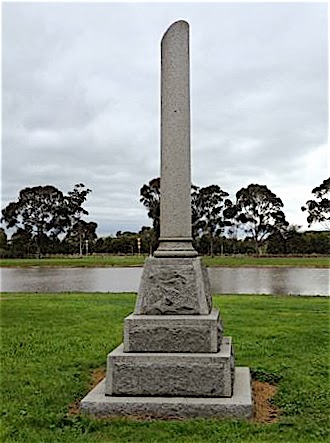
The Barwon War Memorial. Picture: Nancy Alford/Monument Australia.

A broken column is the memorial for Barwon Rowing Club. It can symbolise a fallen leader or unfinished work and was used on tombs for those whose life was deemed cut short.

The Bairnsdale Memorial. Picture: Graeme Saunders/Monument Australia.

The Bairnsdale Rowing Club War Memorial is an obelisk dedicated to the fifty-seven enlisted and fallen members of the Club who served in the First World War.

The Hawthorn’s Memorial. Picture: Kent Watson/Monument Australia.

A blunt and stereotypical Australian inscription on the Hawthorn Rowing Club memorial states ‘They fought. They fell’.

Alexandra Gardens showing the Yarra River & Melbourne City Skyline. The Judges’ Box mentioned below is on the far end of the left bank. Picture by Donaldytong/Wikipedia.

The city of Melbourne has two monuments to fallen oarsmen and they are both, I think, unique. They are the Victorian Rowing Association Memorial and the Victorian Rowing Association Judging Box. Both are situated in Alexandra Gardens on the south bank of the Yarra River. This is Australia’s equivalent to Philadelphia’s Boathouse Row or London’s Putney Embankment as it is home to seven rowing clubs. They are Melbourne University BC (1859), Melbourne RC (1862), Richmond RC (1863), Banks RC (1865), Yarra Yarra RC (1871), Mercantile RC (1880) and La Trobe University RC (1969). The Henley-on-Yarra Regatta started here in 1904 and, until the Second World War, was a very important rowing and social occasion with attendance peaking at 300,000 in 1925. Film evidence from 1933 is here.

Boathouses along Alexandra Gardens. Picture: Tony Hodder.

The Victoria Rowing Association Memorial lists 320 rowers from 30 Victorian clubs who died in the First World War. There were 2,100 members of the VRA in 1914 and more than half of them enlisted. Of these, nearly a third were killed. The monument has been recently restored and a rededication service was conducted at the Australian Henley Regatta on 23 February, 2013.

The VRA ‘Oarsmen’s Cenotaph’. Picture: Tony Hodder.

Hopefully the 1914-1918 Oarsmen’s Memorial Judges’ Box just down from the boathouses near the finish line of the regatta will soon merit restoration as well.

The 1930 built Judges’ Box. Picture: Graeme Saunders / Monument Australia.

The Box shows its age. Picture: Tony Hodder.

As an aside, there is an interesting (though not absolutely proven) story surrounding the timing of the formal ending of hostilities on 11th November 1918. The Armistice was signed in a railway carriage, 60km north of Paris. Britain’s official delegate, Admiral Sir Rosslyn Wemyss, was ordered by Prime Minister David Lloyd George to have the end of fighting set for 3pm to coincide with a sitting of the British House of Commons. This would allow Lloyd George to theatrically make the announcement to an assembled and expectant Parliament and to bask in the reflected glory of victory. Admiral Wemyss allegedly thought that the delay would cause more unnecessary killing and felt that 11am, ‘the eleventh hour’, had a certain pathos. He was right.


*Cenotaph: A monument erected in honour of a person or group of people whose remains are elsewhere.

Tuesday, March 13, 2012

Easy To Pick A Crew

The London RC’s eight competing on the Yarra River, Melbourne, in 1934. The crew, who was racing in the Grand Challenge Cup in the Australian Henley, had Dermot St John Gogarty as coach. Gogarty also raced on the Yarra, but when he was in the lead, his shell sunk. The photograph is from Chris Dodd’s book about the London RC, Water Boiling Aft.

In yesterday’s entry on HTBS, Tim Koch wrote about Dermot St John Gogarty’s homage to Rudyard Kipling and his poem “If”. Tim asks for more information about Gogarty. In a comment the same day, Greg Denieffe gives some information about Gogarty. Greg replied that Gogarty was “born in 1908, […] the second son of Oliver St. John Gogarty, the Irish poet, author & Senator (Wikipedia has a good entry on him). Dermot was a well known architect who went to Pembroke College, Cambridge and was a rowing coach at University College, Dublin. He coached their maiden eight in 1933 to wins at Bann and Derry.” Greg also writes that it would be nice with some more information on his rowing connections at Pembroke and UCD.

I am happy to report that I have found some additional information about Dermot St John Gogarty and his rowing and coaching career.

After leaving Pembroke College, Gogarty joined the London Rowing Club and rowed in two Grand races in 1931 and 1932, winning the Cup in 1931. In Chris Dodd’s eminent Water Boiling Aft: London Rowing Club The First 150 Years, 1856-2006 (2006) it states that “The 1930s was a golden age for London at Henley, and a decade marked by expeditions to Paris, Copenhagen, Denmark, Portugal and Australia.” In 1934, for the centenary regatta of Henley-on-Yarra, Melbourne, London RC received an invitation and decided to go. With Gogarty as coach, seven oarsmen plus the cox boarded the Ormonde which set sail for Australia. The eighth oarsman, Donald Wilson, an Australian, was already in Australia and was ordered to get fit.

Dodd tells an entertaining story about the Londoners’ voyage to Australia in his book. On the web, I actually also found an article about Gogarty, published in the Melbourne’ newspaper The Argus on Saturday, 13 October 1934. Under a head-line that reads: “Easy to Pick a Crew" -

“Take four Loyalists, add four Republicans, and you will have the ideal rowing eight. Mr. Dermot St. John Gogarty, coach of the London Rowing Club, comes from Dublin, and the “recipe” is his. “You put the Loyalists on one side of the boat, the Republicans on the other, and the result is a tough crew,” he explains. It is not so easy to select an English eight. Mr. Gogarth did some hard thinking on the way out to Australia. One day – it was in the Indian Ocean – he had an inspiration. It dawned upon him that he had two Australians in the crew. By seating them on one side of the boat it was easy to fix the rest of the crew.

“Gogarty entered Pembroke College, Cambridge, in 1927, and obtained a diploma in architecture four years later. He did a great deal of rowing, and although selected in trail crews for Cambridge, he never obtained a seat. As a member of the London club, he rowed in the 1931 and 1932 Grand Challenge Cup races at Royal Henley, being successful in the 1931 eight. For the last Royal Henley, he coached Trinity College, Dublin, for the Ladies’ Challenge Plate, and the crew was defeated in the final by only 3ft. in record time for the race.

“Mr. Gogarth is a keen fisherman, particularly for trout. He will be sculling at Henley in the Yarra Challenge Cup race.”

One thing differs from the information in Dodd’s book and the newspaper article: Dodd has it that only Wilson was Australian, while the article says Gogarty had two Australians in his crew.

So, how did the English oarsmen do ‘down under’? In the Grand Challenge Cup, London beat the Hawthorn Rowing Club in their first heat, Richmond Rowing Club in the semifinal, and won by four lengths over Wanganui of New Zealand in the final. And how did Coach Gogarty do in the sculls? Dodd writes, Gogarty “met with disaster in the first heat when his boat suddenly broke in half when he was in the lead”. Dodd continues to write, “A week later, London won the seven-abreast two-and-a-half mile Victoria State Championships by thirteen lengths in 14 minutes 20 seconds. Second-placed Melbourne University were awarded the state title.”

Some questions remains, though, Gogarty’s rowing connections at Pembroke and UCD, and did he write any more rowing poems?