Photograph: Werner Schmidt
Showing posts with label Wooden Spoon. Show all posts

Monday, June 9, 2014

Bumps to the Head: The 2014 Oxford Summer Eights - Part 1

The view from Folly Bride showing the Oxford college boathouses and the finish of the bump racing course. The pall of smoke hanging over the scene is from numerous barbecues run by the various boat clubs. I had expected that Oxford would provide a lunch of roast swan or perhaps plovers’ eggs send down from Brideshead, but instead I had to content myself with a couple of burnt sausages.

Tim Koch writes:

It is a truth universally acknowledged that the British, if they possibly can, will take a perfectly sensible sport and devise a race:

1) With rules so complex that they are impenetrable to any outsider.

2) Which is so potentially dangerous that, had it been invented today it would be banned.

3) Where there is a clear hierarchy that is very difficult to challenge.

3) That has its own nomenclature and arcane rituals.

4) Where the spectators can drink copious amounts of alcohol in very pleasant surroundings and treat actually watching the racing as an option.

The form of boat racing known as ‘bumps’ at Oxford University’s ‘Summer Eights’ or ‘Eights Week’ ticks all these boxes – but this is not a criticism. In fact, ‘Eights’ is a brilliant and fair way of allowing the maximum number of participants of extremely varying abilities to race on a most unsuitable stretch of river and, moreover, it results in a large proportion of them becoming ‘winners’ in one way or another.

A (distorted) early afternoon panoramic view of many of the college boathouses, which are actually on a little island formed by the River Cherwell forking as it flows into the Isis (as the Thames at Oxford is known). My report on the history of Oxford boathouses was on HTBS in April 2013 and there is a map of the Isis here.

A typical scene early in the racing day, before the big crowds arrive. The Jesus College boathouse is on the left and that of Keble College is on the right.

Alumni show the youngsters some style.

On Saturday, 31 May, I was very pleased to be the guest of Jack Carlson, the coach of the Oriel College Men’s First Eight, at the fourth and final day of the 2014 Summer Eights. It was a very good year to be associated with Oriel as their top men’s crew went ‘Head of the River’. In this post, part one of my report from Oxford, I will explain what this means, attempt to show how Eights Week works and try to convey some of the atmosphere of this great occasion. In part two I will concentrate on Oriel Boat Club, its Head Crew and some of the wonderful traditions that surround one of the most successful of all the Oxford University college boat clubs.

The last ‘college barge’ left on the river. Unfortunately, it is now a private residence. The HTBS report mentioned above gives a short history of Oxford barges which were once used in place of boathouses.

Human sacrifices of coxswains are permitted during Eight’s Week. Here, Trinity offer up their cox to the God of Rowing.

Term is not yet over. Spectators in a punt get some work done between races.

In ‘bump racing’ a number of boats chase each other in single file, each trying to catch (‘bump’) the boat in front without being caught by the boat behind. In Summer Eights physical contact is not actually required (though there often is) and once there is overlap of bow and stern, the ‘bumped’ cox should raise his/her hand and concede. The first such race recorded at Oxford was in 1815 when Brasenose raced Jesus. It originated because the river is too narrow for side by side racing. Both at Oxford and at Cambridge (where the river is also tight) there are two sets of bump racing per year, one in early spring and one in early summer. On the Cam they are called ‘Lent Bumps’ and ‘May Bumps’ and on the Isis they are known as ‘Torpids’ and ‘Summer Eights’. The exact rules of each event vary in detail.

Women’s Division 5. Jesus II bump Worcester III after a few seconds of rowing.

Men’s Division 2. Lincoln concede a bump by New College opposite the island boathouses.

Men’s Division 2. Pembroke II bump Christ Church II very near the finish.

Summer Eights are held over four days and consists of seven men’s and six women’s divisions. Each division has thirteen boats and 35 of the colleges that make up the University of Oxford enter in total between two and (this year) nine crews of varying ability. There is a divisional race every 30 - 40 minutes, alternating between the men and the women.

In high divisions where crews may contain Elite rowers, Blues or even Olympians, the racing can be close and may last for much of the course, but in lower divisions the difference in standard between crews and coxes increases and so does the general chaos. Here bumps can happen very soon after the start. If the speed of two boats is dramatically different then boats can be damaged – to the despair of the boatmen but to the delight of the spectators. The boats in the lowest divisions may consist of crews that a college football team or tennis club has put together for the occasion. The rule of thumb is that if a crew is wearing Lycra in their boat club colours, they are probably serious rowers. If a boat consists of eight fairies coxed by a giant chicken, they are almost certainly not real ‘boaties’. In her blog on the 2008 Eights, Sarah Laurence said of the lower divisions: Curiously, the combination of highly unmanoeuvrable boats, inexperienced coxes, high speeds and confined spaces doesn’t always end well.
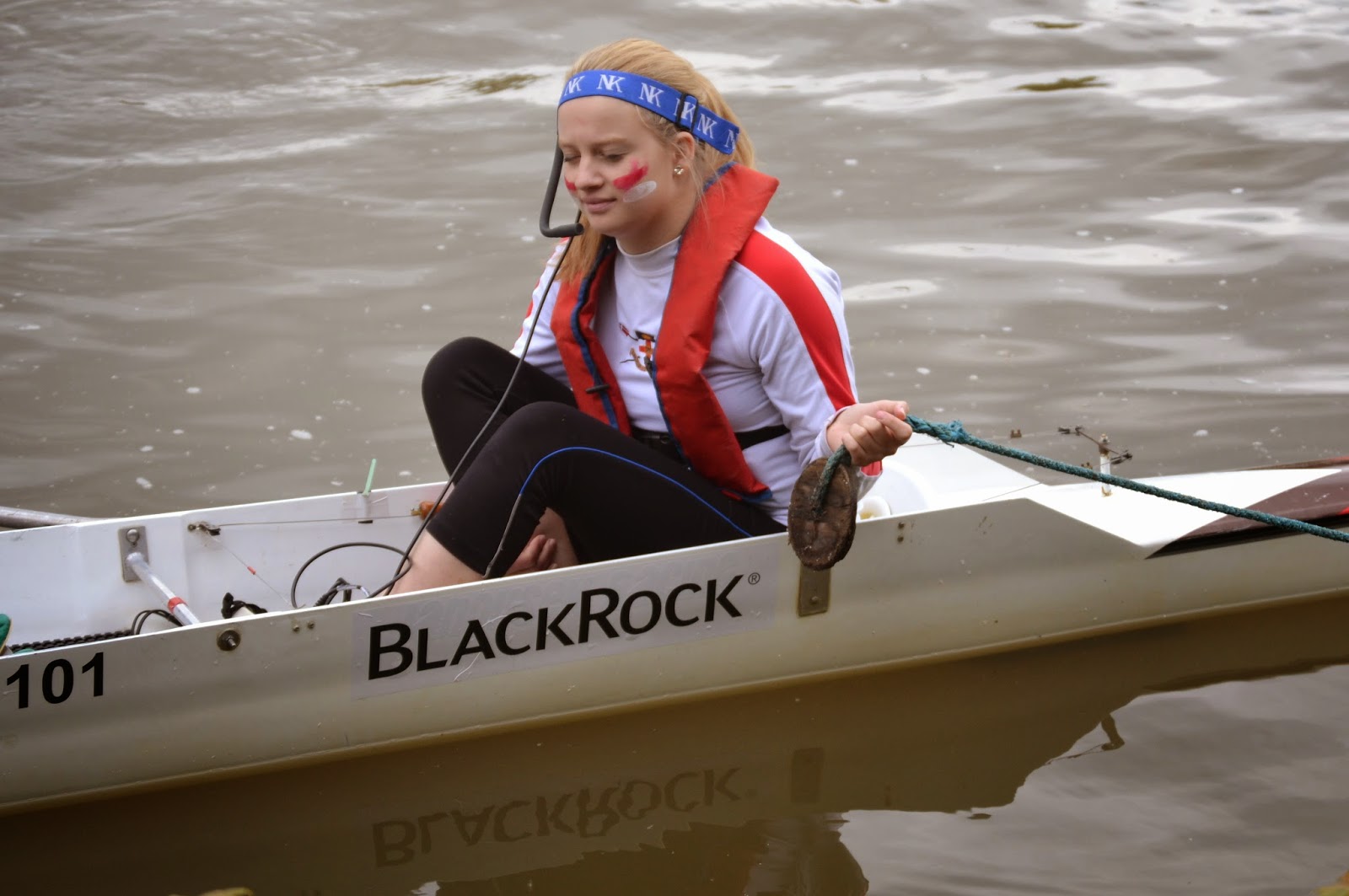
The rules state: Each boat shall be started from a rope 50 feet in length, held by the coxswain, with the other end of the rope fastened to a post on the tow path. The distance between each starting post shall be 130 feet (40 metres). Here the cox for Regents Park Boat Club in Women’s Division 5 holds her starting rope.

Women’s Division 5 on the start. The boatmen use long poles to stop the boats drifting in or out too far. With about 20 seconds to go they gently push the boats out from the bank (the coxes still holding the ropes) and the crews ‘come forward’ ready to race in anticipation of the shot from the starting cannon. In former times the boatmen would drink beer between races and this often resulted in impaired and rather dangerous handling of the unwieldy poles by the end of the day.

Men’s Division 5 take their first stroke.

On the first day of racing, the starting order of each division is the finish order of last year’s race. In Summer Eights, when a bump is made both boats pull over to the side and do not race any more that day. The result is that crews often have to sprint continuously and not ‘settle’ in mid-race as in normal regattas. Crews who successfully bump the boat in front of them (or ‘bump up’) exchange starting positions the following day. Thus, over four days of racing a crew may only rise a maximum of five places and this means, for example, that to go to ‘Head of the River’ in any one year, you have to start in the top five of Division One. For many boat clubs, any chance of getting to the top of their division means that they need several years of ‘bumping’ their way up their table of thirteen crews. A look at part of this year's 'bump chart' may make things clearer.

Men’s and Women’s Division One, 2014 Summer Eights.

Taking the top three men’s crews as an example, the above chart shows that in 2013 Pembroke College (PCBC) were ‘Head’, followed by Christ Church (ChChBC) and then Oriel (OCBC). On the Wednesday of the 2014 Eights, Pembroke did not bump and were not bumped (i.e. they ‘rowed over’) and so they stayed in first place. However, Oriel bumped Christ Church so OCBC went up to second place and ChChBC went down to third place. On the Thursday, the second day, Oriel bumped Pembroke and Christ Church rowed over. Thus Oriel went up to first place, Pembroke went down to second place and Christ Church stayed third. They all remained in these positions for the next two days of racing as none of them bumped or were bumped, that is they all rowed over. There is a further complication – the boat that finishes first in each division may row as the ‘Sandwich Boat’ at the bottom of the division above in the same day’s racing. If you understood this you are ready to look at the full 2014 results, here for the men and here for the women.

Men’s Division 5. Oriel III about to bump Trinity III. They are in ‘The Gut’, a bendy part of the course that many inexperienced (and some experienced) coxes have failed to negotiate.

A view from Donnington Bridge near the start. In Men’s Division 5, Regent’s Park chase Christ Church III. They eventually bumped them.

Tim Foster, Olympic Gold medallist in coxless fours in 2000, now an MBA student at Keble. Here he is umpiring before he rowed in the Keble First VIII in Division One later in the day. A crew mate in the boat was Storm Uru, the New Zealand Lightweight International and bowman of this year’s victorious Blue Boat. In the end, Keble bumped on three of the four days.

I managed to catch a few words with Tim, widely regard as one of the all time great technical rowers, especially effective in the vital but often unrecognised seat behind the stroke.

Tim K: An obvious question, you are rowing in a boat of a slightly lower standard than you have done in the past, what’s the attraction?

Tim F: Well, partly I am a slightly lower standard rower than I was in the past but also it’s been really good fun, it has reminded me of what rowing is about and it’s been a great chance to come back and race after about 14 years of retirement.

Tim K: You have a younger superstar to help you out, Storm Uru, how’s that?

Tim F: Actually it’s great. I think he’s claimed that I’m in the boat to make him feel not so old .... It’s been great to row with him and to see why he’s such a champion....

Tim K: And now you’re helping out before you race, very much in the spirit of the event.

Tim F: Yes, it’s a great event and it relies on everyone doing their bit, so this morning is my turn.

Men’s Division 2. St Peter’s get their reward for bumping every day and so getting ‘blades’.

The view from the top of Christ Church boathouse at the end of the island. This shot was taken towards the end of the day when the crowds had swelled, awaiting the final races in Men’s and in Women’s Division One.

Women’s Head of the River 2014: Wadham. From bow: Madeleine Butler, Anne Binderup, Lia Orlando, Rachel Anderson, Canna Whyte, Stephanie Hall, Alkaterini Mandaltsi, Elizabeth Zotti, Nicola Rodgers (Cox).

In the beginning of this piece, I indicated how clever this form of racing is, accommodating over 1500 rowers of widely differing abilities on a narrow river. I also said that it produced a fair number of ‘winners’. The obvious ones are the men’s crew and the women’s crew that go to the top of Division One, i.e. go ‘Head’. But there are those who get to the top of their respective divisions who also consider themselves victorious. Further, many are very pleased if they make one or more bumps. Those who bump every day are awarded the coveted ‘blades’, that is a illuminated oar emblazoned with the names of the crew and of the boats that they bumped (though ‘awarded’ is perhaps not the correct term, you have to buy your blade if you want one). Others are happy if they simply avoid getting bumped and go neither up nor down.

Even the worst rowers can gain satisfaction as a crew that is bumped every day gets ‘spoons’. The ‘wooden spoon’ is usually a non-literal award to a person or team that comes last in some event. HTBS did a nice post about them here. The award of spoons may in fact be welcomed as traditionally the British take great pride in doing something really badly. We like to dwell on our ‘glorious failures’ such as the Charge of the Light Brigade, the retreat from Dunkirk or Scott’s race to the South Pole rather than promulgate our historic successes (assuming that we have any). It sometimes seems that we are more impressed by those bumped ten strokes off the start than by those who go ‘Head of the River’. Win or lose though, Summer Eights is a great event.

Men’s Head of the River, the final order. Oriel, Pembroke, Christ Church, Magdalen.

Head of the River 2014: Oriel. From bow: Charles Cornish, Rufus Stirling, Kelvin Jackson, Calum Pontin, Malcolm Howard, Christopher Fairweather, John Redos, William Zeng, Olivia Cleary (Cox).

Part 2 will be posted tomorrow!

Friday, March 21, 2014

The Way of the Man with the last Wooden Spoon

Cuthbert Lempriere Holthouse, oarsman of Lady Margaret Boat Club and student of St John’s College, Cambridge, with his mock prize, the ‘Wooden Spoon’, which showed everyone that he was the last one on the 1909 honours list at the Mathematics Tripos. On Holthouse's left is a shield with St John’s College Coat of Arms.

The story of the ‘Wooden Spoon’ and the last man who received this award at Cambridge University, Cuthbert Lempriere Holthouse, has been told many times by bloggers all around the web. Most of these bloggers have got the information, it seems, from the Wikipedia entry called “Wooden Spoon”. However, as many HTBS readers would agree, especially after having taken a look at the picture of Holthouse above, this kind of ‘story ‘is just what you would expect to find on HTBS. I am afraid that I have not a lot to add about Cuthbert Lempriere Holthouse and his Spoon, but this is how the story goes:

Ever since man came up with sport competitions, the winner, an individual or a team, has received a grand prize. The ones coming in second and third have sometimes also got prizes, though of less value than the victor. Nowadays, gold, silver and bronze medals are handed out in most sports, but in a few sport events, for example Henley Royal Regatta, only the champion crew receives a winning cup.

Some sports have gone further and not only awarded prizes to the winner and the second- and third-placed persons or teams, but also the dead-last person/team has received a so-called booby prize. In the first fictional boat race report, in Book V in The Aeneid of Virgil, Aeneas presents Sergestus, who has steered his vessel too close to some rocks whereupon the oars wreck and leave Sergestus and his crew last of the competitors:

Aeneas presents Sergestus with the reward he promised,
happy that the ship is saved, and the crew rescued.
He is granted a Cretan born slave-girl, Pholoe, not unskilled
in the arts of Minerva, nursing twin boys at her breast.
(translated by A. S. Kline, 2002)

The first time the mock prize ‘Wooden Spoon’ was recorded was in 1793 (though, Wikipedia says in 1803), but as an academic ‘award’, not as a sport prize. Two years earlier, in 1791, the ‘Senior Wrangler’, the top student on the honours list, or the ‘academic success’, was first mentioned. ‘Spoon’, as in the slang word ‘spoony’(foolish), found its way into the academic world of Cambridge during the 1700s.

This one-metre long spoon is one of two (!) that were handed out by friends to two students of Selwyn College in 1906 (both ended up at the bottom of the degree list). This spoon now hangs on the staircase of the Selwyn College library, Cambridge.

In 1823, the poem “The Wooden Spoon” was published in The Cambridge Tart. One stanza reads:

And while he lives, he wields the boasted prize
Whose value all can feel, the weak, the wise;
Displays in triumph his distinguish’d boon,
The solid honours of the Wooden Spoon.

The year after this mock poem was published, the Cambridge student Hensleigh Wedgewood, who later would become a barrister and an etymologist, was handed a special prize as the Classics student at Cambridge who came dead last on the degree list. As it was a custom for examiners in the Mathematics Tripos to award prizes to top students and give the student who just managed to scrape by a wooden spoon, the examiners in Classics decided to award prizes to all their students, and as Wedgewood was last, they gave him a wooden wedge, a jest on his own name. In the 1860s, Wedgewood’s son, Ernest, kept up the good family tradition by becoming ‘The Spoon’.

The ‘Wooden Spoon’ also spread to other English-speaking countries. In 1847, it appeared at Yale University and, in 1861, at University of Pennsylvania. However, in America the ‘Wooden Spoon’ shifted from being a mock award to a honour award, so at Yale the most popular student was given the spoon.

The Wedge and the Spoon, from The Slang Dictionary (1913; published by Chatto & Windus, London).

At Cambridge, it was, however, the spoon handed out at the Mathematics Tripos that was most famous, or maybe it is more correct to say, ‘infamous’. The attitude towards ‘The Spoon’ also changed through the years, from being an embarrassment to receive to an attracted prize to walk away with. Reports tell that the student who was presented with ‘The Spoon’ in the Senate House, where the honours were handed out, was greeted with the same enthusiasm as the ‘Senior Wrangler’, at least amongst the students. At times, this occasion did turn out to be a disorderly event, as in June 1882, which came to be known as ‘The Battle of the Spoon’.

An unhappy student receives the ‘Wooden Spoon’. Detail from Robert B. Farren’s painting Degree Day (1863). See the full painting here.

While ‘The Spoon’ became quite notorious, it grew larger and larger, from a small wooden spoon to the last wooden spoon, which was 1,5 metre long and was handed out in 1909 to the student Cuthbert Lempriere Holthouse (1887-1967). Maybe it was because Holthouse was an oarsman at Lady Margaret Boat Club of St. John’s College that the spoon took the shape of an oar?

According to the Wikipedia entry “Wooden Spoon”, there is an inscription in Greek on this oar/spoon, which may be translated to something like this:

‘In Honours Mathematical
This is the very last of all
The Wooden Spoon which you see here
O you who see it, shed a tear

Alternatively: This wooden object is the last souvenir of the competitive examinations in mathematics. Look upon it, and weep.’

Looking at the photograph of Cuthbert Lempriere Holthouse, he does not look that displeased. We must remember that it was not that uncommon to receive a third degree. On this matter, HTBS’s Tim Koch has written ‘a Third was [an] entirely appropriate [degree]. It was known as “A Gentleman’s Degree” or “An Oarsman’s Degree”’, so it was very suitable for young Holthouse to be on the receiving end. We also have to remember that a good number of students placed below the ‘Wooden Spoon’ by getting an Ordinary degree. ‘In the 1860s about three-quarters of the roughly 400 candidates did not score enough to be awarded honours, and were known as poll men’, it says in “Wooden Spoon” on Wikipedia.

When Cuthbert Lempriere Holthouse – don’t you think that it’s such a appropriate name for the last holder of the ‘Wooden Spoon’? – left Cambridge, he, of course, brought his award with him. Holthouse became a clergyman and was appointed an army chaplain during the First World War, in France in 1918. Before he went to Canada in the 1930s, he lent the ‘Wooden Spoon’ to St John’s, so the college could put it on display. When Holthouse came back to England, the ‘Wooden Spoon’ was returned to him.

In the essay “The Wooden Spoon. Rank (dis)order in Cambridge 1753-1909” (2012), Christopher Stray writes:

It subsequently returned to the college in a very curious way. In the 1960s Holthouse put his house in Winchester up for sale so that he could move into a retirement home. One of those who came to inspect the house was another St. John’s oarsman, Guthie Easten, who on looking through the window immediately recognized the spoon. The upshot was that Easten drove the spoon to Cambridge in his small car, with one end sticking out of a window covered in a plastic bag.

When the tripos system changed after 1909, students were grouped into classes that made it impossible to tell who was the lowest place, so the practice ceased. Nevertheless, today Cuthbert Lempriere Holthouse and his ‘Wooden Spoon’ live on; in our social media era, there is of course a Twitter account named @lastwoodenspoon.

A Lady's Ticket for the Wooden Spoon Exhibition at Yale in 1869, depicting a six-oared shell. From Yale University Library.

Today, ‘Wooden Spoons’ are held in the colletions of Cambridge colleges St John’s, Selwyn, Emmanuel and Corpus Christi, and at Yale University, University of Pennsylvania and Oberlin College (Ohio). At the latter college, a wooden spoon was handed out to an 'ugly person'. There are also five known wooden spoons in private collections.

To come back to where I started this blog entry: wooden spoons came to be known in certain sports like tennis and rugby. Below is a short video clip from 1931 showing a rugby match between England and France where, figuratively speaking, England receives the wooden spoon.

FRANCE HANDS ENGLAND 'THE WOODEN SPOON"


See also: Tim Koch writing on Rudie Lehmann's "The Necessity of Having a Butt" in Lehmann Online.