Showing posts with label Olympic Rowing. Show all posts
Showing posts with label Olympic Rowing. Show all posts
Monday, July 21, 2014
Jack Beresford - the Greatest of Them All

Tuesday, June 24, 2014
The Birth of Modern Olympic Rowing

Greg Denieffe writes:
In July 2012, in a post called 1948 Olympics And The Thin Green Line, Part 2, I identified Terence Sanders as first man born in Ireland to win an Olympic rowing medal for Great Britain; he was the stroke of the British coxless four that won the gold medal at the 1924 Paris Games. It was also in Paris that the first Olympic rowing regatta was held in 1900, and it was at those Games that the first Olympic rowing medal was won by an Irishman. His name was William Carr and I will return to him later.
Had things gone to plan, the inaugural Games of the modern era, held in 1896, would have seen the first Olympic rowing champions crowned in Athens, but the weather intervened and the rowing events were cancelled. Peter Mallory touches on the subject in The Sport of Rowing (2011):
The rowers assembled, but rough water in Piraeus Harbor forced the postponement and eventual cancellation of the regatta. Therefore, rowing competition was not actually included until the second modern Games in Paris in 1900, and as a consequence, French became the language of international rowing from that time forward until quite recently.

In the poster/programme (above) the rowing events are listed under the heading Sports nautique and are shown as follows:
Aviron:
Un rameur: 2000 metres sans virage (Skiffs).
Deux rameurs de pointe: 2400 metres san virage (Outriggers).
Quatre rameurs de pointe: 2400 metres san virage (Outriggers).
Huit rameurs de pointe: 2400 metres san virage (Outriggers).
The regatta took place on the River Seine between Courbevoie and Asnières on 25 and 26 August 1900 and all the events were over a shortened course, believed to be 1,750 metres, and not as suggested in the Poster above. Throughout the regatta there was wrangling, protests, crew changes and the farce of two finals in the coxed fours event, both of which count in the official International Olympic Council (IOC) medal table.
Whilst the results of the regatta are readily available, books on rowing history only briefly mention the event and therefore this article is an attempt to put faces to the first Olympic rowing champions and gather the story of those two days in August 1900 into one place.
Un rameur (Skiffs)/Single Sculls
Twelve scullers entered, nine from France and one each from Great Britain, Italy and Spain. The four heat winners; Saint George Ashe (GBR), Hermann Barrelet (FRA), Louis Prével (FRA) and Georges Delaporte (FRA) were joined by the four runners-up in two semi-finals, with the first two in each semi advancing to the final. Barrelet won the first semi by ten seconds with André Gaudin (FRA) taking the second qualification spot. In the second semi, Prével had nearly as much to spare over Robert d’Heilly (FRA).
Ashe who had finished third in the first semi-final was eliminated but protested the result; Barrelet and Gaudin objected and refused to race if Ashe was allowed to take part in the final but they eventually relented and took their places in a five boat final. Read more about Ashe in Göran Buckhorn’s post from November 2012, The First Englishman....
Barrelet won the final beating Gaudin for the third time in two days. Ashe finished third, 40 seconds behind the winner! Prével failed to finish after falling in the water and of course protested but this time the protest was rejected. Perhaps good Anglo-French relations were the reason; the Entente Cordiale would be signed within four years.


Deux rameurs de pointe/Senior Coxed Pairs
Only three countries entered for the coxed pairs event; France had five crews; Belgium and the Netherlands had one each, giving seven crews split into two semi-finals. Even today, not only rowing historians but sports historians and especially Olympic historians discuss the possibility that the youngest ever Olympic medallist took part in this event.
The French crew from Société Nautique de la Marne won the first semi-final beating the Dutch crew from Minerva Amsterdam who also qualified for the final. In the second semi-final Rowing Club Castillion (FRA) had an ‘easily’ verdict, beating Cercle Nautique de Reims (FRA) by 27 seconds!
The Dutch crew had been coxed by Hermanus Brockmann (60 kg) in their semi-final and had nine seconds to make up on their French conquerors in that race. They decided to copy their rivals and use a much lighter coxswain in the final and recruited a young French boy whom some believe to be that youngest ever Olympic medallist. The final was a very close affair but the change of coxswain made the difference with the Dutch crew (now with a French coxswain) reversing the result of the semi-final and winning by 0.2 seconds.

The same scene through the eyes of Vincent van Gogh in 1877.
Anthony Th. Bijkerk has written two interesting articles about the Dutch pair, their substitute coxswain and the wonderful trophy, called ‘La Chanson’ that they received for their victory. The first in the Journal of Olympic History (Spring 1997) and the second in the Journal of Olympic History (Winter 2001).
This quote is from the latter:
Although the identity of the young French coxswain has never been detected, there does exist a photograph of him and it was published in a Memorial Book from the Dutch Student Rowing Club LAGA, in which François Antoine Brandt, in 1926, published his own story on the events in Paris.
The 1997 article contains an English translation by Bijkerk of Brant’s account of what actually happened in the coxed pairs event. The 2001 article has photographs of the Dutch pair with their French coxswain and another of the pair at Henley Royal Regatta in 1899. There are also two photographs of the trophy presented to them and bearing the inscription:
EXPOSITION UNIVERSELLE DU 1900
RÉGATES À L’AVIRON DU 26 AOÛT
2 RAMEURS SENIORS
1er PRIX

Gold medals were not given at the 1900 Games; a silver medal was given for a first place and a bronze medal was given for second. The International Olympic Committee has retroactively assigned gold, silver, and bronze medals to competitors who earned first, second, and third place finishes respectively, bringing early Olympics in line with current awards.
Quatre rameurs de pointe/Senior Coxed Fours
French crews made up half the 10 entries with Germany providing three and both the Netherlands and Spain one each. The regatta jury ‘tore up’ their rule book following protests that crews eliminated in heats two and three had posted better times than the winner of heat one. They announced a further qualifying round but failed to notify all the crews. Despite the course having only four lanes they then announced that there would be a six-boat final. More protests followed and eventually two finals were raced; one for the winners of the three heats and one for the three crews involved in the original protest.
The winners of the three heats were as follows:
Ludwigshafener Ruder Verein (GER), time 6:14.0; Minerva Amsterdam (NED), time 6:02.0 and Germania Ruder Club, Hamburg (GER), time 5:56.2. These three crews should have been joined in the final by the runners-up to ‘Germania’ as this was a four-boat heat.
The runners-up in the first heat, Réal Club Barcelona (SPA) posted a very slow time of 6:38.4 and therefore there had been no reason for ‘Ludwigshafener’ to push themselves to race any quicker. The runner-up in the second heat, Club Nautique de Lyon (FRA), time 6:06.2 and the third crew from the final heat, Favorite Hammonia (GER), time 6:03.0 did not see it that way and so the protests began.
Eventually the jury went with the option of two finals, perhaps the least satisfactory of all the options available to them.
The final for the losers with the three quickest times from the heats, took place on Sunday 26 August and was won by Cercle de l’Aviron Roubaix (FRA), time 7:11.0. They had finished second in the four-boat heat and were automatic qualifiers for the final by right if the original programme had been followed. ‘Lyon’ finished second and ‘Hammonia’ last.

The second final in this event was held over until the following day, Monday 27 August. The form of the crews in the heats was upheld with ‘Germania’ winning in a time of 5:59.0, ‘Minerva’ were four seconds behind and Ludwigshafener a close third in 6:05.0.
Bijkerk in his 1997 article includes a report by Dr. Meurer, the coach of the Dutch crews (participating under the patronage of Minerva Amsterdam). It was published in August 1900 in a Dutch sports magazine and it provides us with much valuable information about the organisation of the ‘Minerva’ crews, about the coxed fours event(s) and a reason why the ‘A’ final was held over until the following day: the original three prizes had been given to the crews in the first final and new prizes had to be supplied before the race could take place. Dr. Mauer did not mince his words when he expressed his opinion on the organisation of the regatta:
It is completely clear for me that the Netherlands should not any longer compete in rowing races in France; the conception of sport and the organization of races are more than 25 years outdated here!
There is a short slide show on the film website onlinefootage.tv that shows the coxed-pairs and coxed-fours as they line up to race on the River Seine. View the 44 second clip here. Included is a picture of a coxswain with his arm raised. He certainly looks younger than the boy recruited by Brandt and Klein.
Huit rameurs de pointe/Senior Eights
Five crews from five countries raced two heats. The first two crews in each heat were to advance to a four boat final. Minerva Amsterdam (NED) won the first heat in 4:59.2; Club Nautique de Gand (BEL) were second, time 5:00.2 and Germania Ruder Club, Hamburg (GER), time 5:04.8, finished third of the three. In the second heat which was effectively a row-over Vesper Boat Club (USA) finished alone in a time of 5:15.4, Société Nautique de la Marne (FRA) failing to finish. ‘Germania’ was thus allowed to take the fourth place in the final. The times quoted (Wikipedia) are fast, even for a course of 1,750m.

The final was won by the American crew in a time of 6:07.8. The Belgians finished second, time 6:13.8 beating the Dutch (6:23.0) and the Germans (6:33.0). Alfred van Landeghem (Cox) and Oscar de Somville were members the Belgian crew and you can read more about their exploits at Henley Royal Regatta (1906-09) and the 1908 Olympics in The Mysterious Affair of 'Les Braves Belges'.
The Dutch crew, Minerva Amsterdam, contained the winning coxed pair of Brandt and Klein. They were coxed by Hermanus Brockmann who lost his seat in the final of the coxed-pairs but was the coxswain of four that finished runner-up to ‘Germania’. As the IOC recognizes him as a winner in the pairs, as a runner-up in the fours and a bronze medallist in the eights, he is, without ever knowing it, the first multi-medallist in Olympic rowing.

The First Irishman …
In the four-seat of the victorious American crew was 24-year-old William John ‘Bill’ Carr. He was born on 17 June 1876 in Gortnagrace, near Castlefin, County Donegal, Ireland. He went to the United States in the 1890s where he worked initially as a carpenter, and later as a building inspector in Philadelphia. His parents were Robert Edmund McIlcar of Gortnagrace, Castlefin and Jane Doran of Alt, also near Castlefin; they were married when they were 20 and 21 years-old respectively at Melmount Catholic Church, Strabane, County Tyrone on 11 February 1873. It wasn’t unusual for immigrants to simplify or change their name on entering the United States.
In November 2000, Vesper Boat Club honoured this crew by hosting a celebration of their achievement a century before. Bill Lyon wrote a preview of the event in the Philadelphia Inquirer on 2 November 2000:
So there they sat, the nine of them in a wooden boat, bobbing about in the choppy waters of the River Seine, in the shadow of the Eiffel Tower, waiting for the start. Eight sturdy Philadelphians and a coxswain, come to Paris to represent America and the Vesper Boat Club, in the 1900 Olympics.
A fierce head wind raged at them, but they dug grimly in and after a dozen strokes opened a lead they would never yield. They covered 1 mile and 153 yards (1,750 meters) in 6 minutes, 7 4/5 seconds, six full seconds ahead of runner-up Belgium.
The crew of eight: John Exley, Henry de Baecke, James Juvenal, John Geiger, William Carr, Ed Hedley, Edward Marsh and Roscoe Lockwood. The cox: Louis Abell. The coach: Pat Dempsey, who took no salary. Rowing, in the minds of its devotees, is its own reward.
A full century later, descendants of the Vesper Olympic champions are gathering tonight, 72 of them, at the newly restored club on gleaming Boathouse Row. Great-grandchildren and great-nephews are coming, bringing with them mementos - a medal, statuary, even one of the original oars.
It is being billed as a history flashback. Not many reunions link 100 years.
Although Olympic rowing did not have the most auspicious start, the fact remains that it has been on the Olympic programme since Baron Pierre de Coubertin founded the modern Olympics, and rowing is the only Olympic team sport to be included in every modern summer Games.
Footnote:
Some historians and websites suggest that there were six events for rowing at the 1900 Olympics. This is not the accepted position by the IOC who recognize four events, albeit with two sets of prizes awarded in the coxed-fours category. The event that causes confusion is a coxless-pairs event won by Belgium. The eminent Olympic historian, Bill Mallon in his work The 1900 Olympic Games (1998) lists four criteria that should be considered in determining whether an event held during the Exposition Universelle of 1900 was an ‘Olympic’ event or one held in conjunction with the Exposition. The four criteria are: Amateur or Professional, International or National, Handicapped or not and Open or Restricted. He concluded that the single sculls, coxed-pairs, coxed-fours and coxed-eights were all Olympic events because the competitors were amateurs, the events were international, the races were not handicapped and these events were open to all. Four other events were raced at the regatta – three events for juniors; coxless-pairs, coxless-fours and coxed-eights and a coxless-fours event for novices. These four events failed the ‘openness’ criterion and therefore are not judged to be Olympic events by the IOC.
The coxless pairs event was won by Belgium; another Belgian crew was second with France in third place. The winners are given as Van Crombuge and De Sonville. Could they actually be Marcel Van Crombrugge and Oscar De Somville who raced in the Belgian eight that took the silver medal? Now there’s something for Poirot to ponder!
Wednesday, June 18, 2014
The Olympic '56 Eight Reunion
A few weeks ago, I had the great pleasure of bumping into William ‘Bill’ Becklean, cox of the Yale crew who took the Olympic gold medal in the eights in 1956. We had a nice chat, and Bill mentioned that he and the others in the Olympic eight crew were soon to have their annual reunion. Yesterday, he sent along a photograph of the group, of which only five remain. Special guest at the reunion was Emory Clark, of the Vesper ‘64 Olympic eight, also an Olympic champion.
I would like to share the photograph of the group with you readers.
 Left to right: [at the head of the table] Bob Morey, stroke; Tom Charlton, bow and captain; [white trousers] Bill Becklean, cox; Ann Esselstyn; Emory Clark, of the 64 Vesper Olympic crew; Dave Wight, #2; and Caldwell ‘Ess’ Esselstyn, #6 and host of the reunion, at his farm near Hudson, N.Y.
Bill writes: ‘Only five of us are left, Emory was added this year, so we didn't have to retell all the old rowing stories!’
Thank you, Bill, may there be many more reunions for your group to come!
I would like to share the photograph of the group with you readers.

Bill writes: ‘Only five of us are left, Emory was added this year, so we didn't have to retell all the old rowing stories!’
Thank you, Bill, may there be many more reunions for your group to come!
Tuesday, June 3, 2014
A 1936 German 'Silver Man'

Rowing historians Tom Weil and Bill Miller were at the IRA National Championships this past weekend. They were taking care of the ‘rowing history’ bit of the regatta, making sure that those who were interested in the rich history of our sport got some information about the National Rowing Foundation (NRF) and the Rowing Hall of Fame. And at the same time showing off some big ‘rowing pots’. On Saturday evening, the NRF held a ceremony for the Class of 2014, seventeen rowers who were inducted into ‘the Hall’ – all introduced by Miller.
About the weekend’s events, Bill Miller said: ‘Wow! What a great weekend. The regatta was awesome, perfect weather, the NRF banquet went smoothly. The tent display went very well. I was amazed at how excited everyone got when they viewed the trophies, cups and programs. Photographing the trophies was prolific. I think we proved that promoting NRF/rowing history/Hall of Fame is an awesome way to connect with the rowing community and is important.’
One thing that Bill and Tom had on display in their tent was yet another ‘Silver Man’ statue. Somehow, a Tweet with a picture of the ‘Silver Man’ found its way across the pond and ended up on Greg Denieffe’s smart phone. Greg and I sent some messages back and forth late on Sunday afternoon about the statue (this was before I realised that it belonged to Miller). In the evening, I met Bill briefly when he was on his way back home to Massachusetts. I mentioned the ‘Silver Man’ that Greg had seen in a photograph. Bill smiled and unwrapped a small blanket he had in his car. ‘You mean this one?’ he said. And there it was.
Bill told me that it’s German-made, of nickel-plated bronze and a commemorative piece from the 1936 Olympics Games in Berlin. He bought it from Germany a year ago, but it has no markings on it to reveal who made it. He thought it would be a nice statue to bring along to the IRA, as it had a connection to Daniel James Brown’s great story about ‘The Boys in the Boat’.

About the bronze statue that HTBS has had questions about earlier, Bill said: ‘In general, there were many bronzes made over many decades. Some with oarsmen standing, some seated in a boat.’
Many thanks to Bill Miller for sharing his statue with the HTBS’s readers.
Thursday, May 15, 2014
Practice for the Non-Olympics...

The Dour Dane
With University of Washington winning the Olympic eights at the 1936 Berlin Games - so beautifully told by Daniel James Brown in The Boys in the Boat - when it was time to prepare for the 1940 Olympic Games, which were going to be held in Tokyo, the Huskies' coach Al Ulbrickson (above) was ready to fight to represent the USA in the eights again. Below is a 1939 film showing him 'inspecting' his oarsmen before they go out for practice, according to the voice on the newsreel, for the coming Olympics.
As we know, the 1940 Games were relocated to Helsinki due to the War, but soon the Finnish capital had to be given up, too, as Finland was attacked by the Soviet Union in 1939. The 1944 Olympic Games in London were thereafter cancelled.
Wednesday, April 16, 2014
New Editions of ‘The Boys’

Regular readers of HTBS will know that Daniel James Brown’s The Boys in the Boat is held in high esteem in both the USA and in Britain. This month (April 2014) sees the release of the latest edition of the book – in French. The cover is similar to that of the UK hardcover (published by Macmillan, 6 June 2012). I like the colour of this new edition, the picture is clearer and the gathering clouds behind the crew hint at the menace of the war – the gathering storm – that was only three years away.
The French title Ils Etaient un Seul Homme translates word-for-word as They were One Man. Admittedly, it loses something in translation, but rowing people will certainly know what the publisher is saying. When Brown was interviewing Joe Rantz about his experiences at the Berlin Olympics and seeking his consent to tell his story, Rantz insisted that the book should be about ‘the boys in the boat’. For sure he was no ordinary Joe.
The sub-title L'historie vraie de l'equipe d'aviron qui humilia Hitler translates as The True Story of the Rowing Crew that Humiliated Hitler. Of course, this is an attempt to convey the sentiment of the English sub-title, An Epic Journey to the Heart of Hitler’s Berlin, which is a little more subtle. Published in paperback on 5 April by La Librairie Vouibert, you can buy a copy here.
This is not the first foreign language edition of Brown’s book. Last year (25 July 2013), a Dutch edition was published in paperback. Translated by Joost Mulder, it is called De Jungens in de Boot – De Legendarische Acht Van 1936. Typically Dutch, it is understated and straight to the point, The Boys/Guys in the Boat – The Legendary Eight 1936.

The cover is very simple in design; the photograph of the crew on the dock is timeless and the addition of the eagle flying overhead is the only hint of Nazism on display. If a new rowing book in Dutch is your ‘kopje thee’, you can buy a copy here.

A British paperback edition of the book was published by Pan on 2 January 2014. This is a slightly revised to include a few corrections as suggested by the HTBS team. It also includes an additional photo of the Huskies in 1929 sawing a giant log as part of their training. This was spotted by Brown when he read last August’s book review by HTBS editor Göran Buckhorn. The first thing you notice with this edition is the wonderful velvety feel of the cover. The picture of the boys on the dock has been darkened; the blood red sky and the inclusion of the Brandenburg Gate draped in Nazi flags should broaden the appeal of the book to those with a general interest in the Second World War.


The American paperback is due to be published on 27 May by Penguin Books. At this stage it looks like it will have the same cover as the American hardcover published by Viking (4 June 2013). The photograph used on these editions is in stark contrast to the European ones. The crew is rowing, in warm-up routine, but there is no connection with Berlin or the Olympics.
If you’re still reading, you must be a real bibliophile! So for you, here are a few other editions to look out for:


Whichever edition you decide to opt for, remember this great book is a success story not only for Daniel James Brown but for OUR sport, whatever you call it! #Aviron #Canottaggio #Rámhaíochta #Remo #Rodd #Roeien #Rowing #Rudern
Friday, April 4, 2014
The Mysterious Affair of 'Les Braves Belges'

HTBS's Agatha Christie, aka Greg Denieffe, writes:
Hercule Poirot is in his office sitting at his desk. In front of him is a strange contraption at which he is staring. It is the latest computer, the RAM-ING Speed 4X. There is a knock on the door.
Poirot: Come in, Come in.
Hastings enters and is surprised with Poirot’s demeanour.
Hastings: What’s the matter Poirot? Are you okay?
Poirot: Nothing is the matter mon ami, quite the contrary. Come and see this … this thing on my new computer. It is a ‘blog’ called ‘Ear Ze Boat Sing. I have been working all night to help these poor fellows identify the first ‘Vainqueurs’ whom I am proud to call ‘mes collègues Belges’.
Hastings: Are you sure you are okay Poirot?
Poirot: Ah, my little English friend – I see you are still upset about the results of Le Grand Challenge Cups of 1906, 1907 and 1909. Now, let me tell you what I have found out about ‘Les Braves Belges’.

According to my good friend Jan Martens, one of Ghent’s rowing clubs was founded in 1883 as Sport Nautique de Gand (SNG). The club started out modestly but four years later was a founding member of the Belgian Rowing Federation (BRF). In 1898, their first flag, in their new colours of blue and white, was presented to the club (the initial club colours were black and white). Two years later a different flag, light blue with white lettering “Sport Nautique de Gand 1883” was adopted at the request of the BRF in order to differentiate the club from the local Cercle des Régates. Around 1890 SNG had become the foremost rowing club in Belgium and international successes would follow.
A royal appellation was granted in 1907 after a resounding victory at Henley. Use of the French language was a sign of the times and the club became ‘Société Royale de Sport Nautique de Gand’.
After the Second World War, the club was active in promoting the Watersportbaan, finished and dedicated in 1955. In 1964, a new name was adopted, Koninklijke Roeivereniging “Sport Nautique” Gent, and put on the new flag presented in 1971; three years later, the current name, Koninklijke Roeivereniging Sport Gent, now completely in Flemish, was introduced.
And yes Hastings... I have found photographs of these fine fellows, take a look. What a beautiful moustache has Monsieur Van der Waerden.

Official result of the final: Club Nautique de Gand, Belgium, beat Trinity Hall, Cambridge, by three lengths – time 7 minutes, 9 seconds.
Équipage: Urbain Molmans, Albert Heye, Alphonse Van Roy, Guillaume Visser, M. Orban, Réme Orban, Oscar de Somville, Rodolphe Poma (stroke), Raphael Van der Waerden (cox)


Official result of the final: Sport Nautique de Gand, Belgium, beat Christ Church, Oxford, by one length – time 7 minutes, 31 seconds.
Équipage: P. de Geyter, Guillaume Visser, Urbain Molmans, Alphonse Van Roy, François Vergucht, Polydore Veirman, Oscar de Somville, Rodolphe Poma (stroke), Rodolphe Colpaert (cox).
Despite the official result, this postcard gives the 1907 winners as Sport Nautique & Royal Club Nautique de Gand. The royal appellation applying to the official winning club from the previous year.


Official result of the final: Royal Club Nautique de Gand, Belgium, beat Jesus College, Cambridge, by one length – time 7 minutes, 8 seconds.
Équipage: Urbain Molmans, Guillaume Visser, St. Kowalski, Réme Orban, François Vergucht, Polydore Veirman, Oscar de Somville, Rodolphe Poma (stroke), Alfred van Landeghem (cox).
Both these postcards identify the 1909 vainqueurs as Royal Club Nautique & Royal Sport Nautique de Gand, the royal appellation now applying to both clubs.
According to Peter Mallory in The Sport of Rowing (2012), writing about the resounding victory of the Belgians (Club Nautique de Gand) in 1906:
The Ghent Eight were led by the dominant international sweep rowers of their day, Guillaume Visser and Urbain Molmans. Before rowing 4 and bow in the winning Grand Challenge Cup Eight at Henley in 1906, Visser and Molmans had rowed to Gold in the coxed-pairs, coxed-fours and eights at the European Championships in 1903, Silver in the coxed-pairs and Gold in the coxed-fours and eights in 1904, along with Gold in the coxed-pairs and coxed-fours and Silver in the eights in 1905.
So, Hastings you can see that there is a mystery to be solved.
Hastings: What mystery is that exactly, Poirot?
Poirot: It was not until 1970 that the venerable Stewards of Henley Royal Regatta changed the rules to allow composites to compete in the Grand Challenge Cup. Did the equally venerable gentlemen of Ghent find a way around this rule? I think so. You see Hastings, Visser and Molmans were docks foremen and members of Sport Nautique de Gand.
Hastings: I say Poirot, that’s just not cricket!
Poirot: Perhaps not Hastings, but I do not think a crime has been committed because in 1906 they must also have been members of Club Nautique de Gand – at least for HRR entry purposes. And, of course, in the following year the entry was made in the name of Sport Nautique de Gand. And yet again, in 1909, the Ghent entry was back in the name of Club Nautique de Gand, which by then was ‘Royal Club Nautique de Gand’. The photographs and postcards do not lie but they do not tell the whole truth.
Hastings: Of course! They rowed under ‘a flag of convenience’. But what happened to them in 1908? I know that the Stewards introduced a rule change excluding overseas entries from the regatta that year owing to the Olympic Regatta being held in Henley in mid-July. Surely, they represented Belgium at the Olympics?
Poirot: Ah! Hastings, is that the time? I must leave straight away for a meeting with Chief Inspector Japp. Perhaps another time, yes? Au revoir.
Hastings (an old Etonian) is determined to find out what happened in Henley-on-Thames at the 1908 Olympic Regatta and decides to use Poirot’s computer. Initially he is foiled by the demand for a password, but eventually he types in felicity4me and sure enough it works! He finds that Great Britain was represented by Cambridge University BC and Leander Club, and it was the latter that beat Belgium, represented by Royal Club Nautique de Gand, to win the gold medal in the eights.

There are reports on all the eights’ races at the 1908 Games here.
The 1908 Belgian crew was Oscar Taelman, Marcel Morimont, Rémy Orban, Georges Mijs, François Vergucht, Polydore Veirman, Oscar De Somville, Rodolphe Poma, Alfred van Landeghem (cox).
An analysis the Belgian crews who raced at Henley between 1906 and 1909 prove that ‘Club de Gand’, ‘Sport de Gand’ and the ‘Belgian Olympic eight’ bore remarkable similarities. Of the 15 rowers used in the four years, seven men raced in three or more years, while Oscar De Somville (7) and Rodolphe Poma (stroke) raced in all four years. It is also noteworthy that De Somville and van Landeghem were Olympic silver medallist in the eights in the Paris Games in 1900.

Crews 1906, 1907, 1908 and 1909:
Urbain Molmans: HRR 1906 (Bow) – HRR 1907 (Three) – Olympics 1908 (NA) – HRR 1909 (Bow)
Albert Heye: HRR 1906 (Two) – HRR 1907 (NA) – Olympics 1908 (NA) – HRR 1909 (NA)
Alphonse Van Roy: HRR 1906 (Three) – HRR 1907 (Four) – Olympics 1908 (NA) – HRR 1909 (NA)
Guillaume Visser: HRR 1906 (Four) – HRR 1907 (Two) – Olympics 1908 (NA) – HRR 1909 (Two)
M. Orban: HRR 1906 (Five) – HRR 1907 (NA) – Olympics 1908 (NA) – HRR 1909 (NA)
Remy Orban: HRR 1906 (Six) – HRR 1907 (NA) – Olympics 1908 (Three) – HRR 1909 (Four)
Oscar De Somville: HRR 1906 (Seven) – HRR 1907 (Seven) – Olympics 1908 (Seven) – HRR 1909 (Seven)
Rondolphe Poma: HRR 1906 (Stoke) – HRR 1907 (Stroke) – Olympics 1908 (Stroke) – HRR 1909 (Stroke)
Raphael Van der Waerden: HRR 1906 (Coxswain) – HRR 1907 (NA) – Olympics 1908 (NA) – HRR 1909 (NA)
P. de Geyter: HRR 1906 (NA) – 1907 (Bow) – Olympics 1908 (NA) – HRR 1909 (NA)
Francois Vergucht: HRR 1906 (NA) – HRR 1907 (Five) – Olympics 1908 (Five) – HRR 1909 (Five)
Polydore Veirman: HRR 1906 (NA) – HRR 1907 (Six) – Olympics 1908 (Six) – HRR 1909 (Six)
Rodolphe Colpaert: HRR 1906 (NA) – HRR 1907 (Coxswain) – Olympics 1908 (NA) – HRR 1909 (NA)
Oscar Taelman: HRR 1906 (NA) – HRR 1907 (NA) – Olympics 1908 (Bow) – HRR 1909 (NA)
Marcel Morimont: HRR 1906 (NA) – HRR 1907 (NA) – Olympics 1908 (Two) – HRR 1909 (NA)
Georges Mijs: HRR 1906 (NA) – HRR 1907 (NA) – Olympics 1908 (Four) – HRR 1909 (NA)
Alfred van Langehem: HRR 1906 (NA) – HRR 1907 (NA) – Olympics 1908 (Coxswain) – HRR 1909 (Coxswain)
St. Kowalski: HRR 1906 (NA) – HRR 1907 (NA) – Olympics 1908 (NA) – HRR 1909 (Three)
(Errors and omissions excepted.)


Poirot never found out that Hastings had cracked his computer!
Wednesday, March 26, 2014
Rowing the Mississippi for a Million

With his row, Pritchard is hoping to raise $1 million.
Read Chris P.'s blog post here.
Go to the website Mississippi Million here (with video).
Go to Right To Play here.
This blog post was updated at 9:25 a.m. on 26 March to reflect what is mentioned in Comment No. 1. G.R.B.
Tuesday, March 25, 2014
Was the First Wanker a Belgian Oarsman?

HTBS is proud to welcome famous rowing historian and collector Thomas E. Weil as a guest writer of today’s blog post. Thomas has a special take on the word “wanker”, which he thinks may have originated in the rowing world.
Thomas writes:
“Wanker” is a disparaging term, used widely throughout the Commonwealth countries, which has been “ranked as the fourth most severe pejorative in English” (Wikipedia, citing Advertising Standards Authority, December 2000, accessed via Wayback Machine. Retrieved January 14, 2012. (pdf)). While a number of sources trace its origins to post-WW1 (the Online Etymology Dictionary, for instance, cites its earliest appearance to “British naval slang for ‘midshipman’ (1929)”, I am inclined to agree with the statement that “The terms wank and wanker originated in British slang during the late 19th and early 20th century” (Wikipedia, citing A Dictionary of Slang and Unconventional English. Eric Partridge, Paul Beale. Routledge, 15 Nov 2002).
Falling squarely within this earlier time frame, my hypothesis for the origin of the term points directly to the results of the Grand Challenge Cup event at Henley Royal Regatta in 1906, 1907 and 1909, when, to the shock and horror of the English rowing world, the premier eights prize of the kingdom was won by non-English crews.
Several American eights had crossed the Atlantic to be vanquished over the almost three-quarters of a century that the Grand had been contested, but European crews had only rarely bothered to venture the short distance across the English Channel to challenge for the trophy before 1906. So, when Belgian crews from two clubs in Ghent won England’s most precious rowing prize three times in four years (and skipped the fourth because it was an Olympic year), English oarsmen were inconsolably traumatized. What was a frustrated Englishman to do?
It probably didn’t help matters much when the Royal Club Nautique de Gand struck a commemorative medal that showed a toga-wearing woman seated on a Roman galley deck victoriously blowing a trumpet while the British lion cowered at her feet.

Nor would the British have been pleased at the sight of postcards touting the victories that popped up in the mail following the Belgian accomplishments. The postcards, which showed the crews posed on a bench or seated in their boat, were often headed “Vainqueurs au Grand Challenge Cup a Henley” (see image on top of a 1907 postcard).
Was the choice of “vainqueurs” (or “victors”), rather than the more typically English and modest term “winners”, particularly provocative? Perhaps it was. Was it so provocative as to have instigated a vicious verbal counter-volley? It could have been ...
“Vainqueur”, for practical purposes, is pronounced “vang-cur”, with the emphasis on the second syllable. Given the not uncommon practice in some circles of pronouncing a “v” like a “w”, could annoyed Englishmen have picked up on the Belgians’ own term, and started sarcastically and disparagingly referring to them as “wang-curs”, or “wankers” (with the accent on the first syllable)? Certainly they could have!
Did they? Who knows, but all of the ingredients for an international slanging war were there, and the timing is right for the supposition that first uses occurred some time in the late 19th and early 20th centuries. And that usage may easily have been exacerbated in later years by the contempt for the Europeans who crumbled so quickly in the face of Germany’s WWI advances, only then to be saved at the cost of so many British lives.
Should our breasts not swell with pride to think that the sport we love may have been the source of “the fourth most severe pejorative in English”? Absolutely. (And might we be grateful that it was the Belgians and not the French who first succeeded at Henley, in which event we might be using the term “grenwee” instead of wanker? Peut-être ...)
Wednesday, February 5, 2014
Lewis Clive: The Red Blue
 |
| Lewis Clive, 1931. |
I have not yet finished with the picture of the 1931 Oxford Crew that inspired my recent piece on ‘Oxford Bags’. Fourth from the left is the ‘6’ man, Lewis Clive, who seems slightly ‘out of step’ with the others. Perhaps he is standing a little forward of the group; he is upright with his arms folded across his chest while the others slouch a little with their hands in their pockets; the rest of the crew are in ‘blanket bags’ made from some coarse material while his well-tailored trousers are made from a finer cloth; unlike the others, he looks not into the camera but slightly to the side. It could be thought that this Old Etonian from a titled family was a typical member of the privileged group of young men who were at Oxford or Cambridge Universities between the two World Wars – but this was not the case.
Lewis Clive was born on 8 September 1910. His father had been a Conservative Member of Parliament between 1900 and 1906 and also Parliamentary Private Secretary to the Chancellor of the Exchequer, Austen Chamberlain, the latter becoming the boy’s godfather. While at Eton, Clive unusually held two of the most prestigious posts in the school, that of Captain of the Oppidans (selected from the most academically distinguished non-scholarship boys) and Captain of Boats. Going up to Christ Church, Clive rowed at ‘6’ in the losing Oxford boats of 1930 and 1931 (this was the middle of the Cambridge run of thirteen victories in succession, 1924-1936) but had more rowing success on the wider scene.
In 1931 and 1932, he and Hugh ‘Jumbo’ Edwards (who were ‘6’ and ‘5’ respectively in the 1930 OUBC crew) won the Silver Goblets, the pairs event at Henley Royal Regatta. On the strength of their Henley wins, they were selected to represent Britain in the coxless pairs at the 1932 Olympic Regatta in Long Beach where they had a comfortable victory, beating New Zealand by two seconds and Poland by eight. According to sports-reference.com, Clive refused an invitation to join Leander – perhaps an indication of things to come.

So far, perhaps, so conventional. What marked Clive out were his later political views and actions. Some time after leaving Oxford with a second in law in 1932 he became an active member of the centre-left Labour Party.
Strangely, it seems that he was not radicalised while at university (indeed, in his time there, he was a member of the exclusive and reactionary Bullingdon Club). His Times obituary later noted that after graduation he worked as a banker ‘while his political ideas were yet uncertain...’ It continued, ‘His resolute single mindedness.... was accompanied by an eager search for constructive ideas in place of earlier prejudices.....’ It is true that it was not unknown, especially in the inter-war years, for privileged young men and women to embrace left-wing ideas. It is also true that at the time the British Labour Party was a ‘broad church’, which included everyone from liberal reformers to crypto-communists.
It would be easy to dismiss Clive as a ‘Champaign Socialist’. His background was Eton and Oxford, the Bullingdon and banking. Later he became a Labour Party member of the Council in the comfortable London Borough of Kensington and also a member of the Fabian Society. The Fabians advocated gradual rather that revolutionary change and its membership was almost entirely composed of upper middle class intellectuals. Early supporters included Leonard and Virginia Woolf, George Bernard Shaw, H.G. Wells and Emmeline Pankhurst. Clive also expressed a desire to become a Member of Parliament.
Had Lewis Clive attempted to advance his political beliefs purely in debate at Kensington Town Hall or in the drawing rooms of polite society or over the dinner table at country house parties, we could be cynical about his political commitment. However in 1938 he did something that proved the sincerity of his beliefs – he volunteered to fight for the Republican side in the Spanish Civil War.

The civil war in Spain (July 1936 to April 1939) was ostensibly between the Republicans (who were loyal to the established elected government and were supported by the Soviet Union) and the Nationalists (who were ‘fascistic’ if not ‘fascist’ and who led a coup against the Second Spanish Republic, supported by Nazi Germany and Fascist Italy). The armies of both sides were bolstered by foreign volunteers, the International Brigades, from a claimed 53 countries (though the majority, figures vary between 32,000 and 40,000, went to fight for the Republicans). An uneasy mixture of communists, socialists, anarchists and trade unionists from all social classes (though predominantly working class) saw Spain as the opportunity to stop the spread of the ideology of Hitler and Mussolini. There was (and still is) a romantic appeal to the International Brigades. In his book A Moment of War (1991), volunteer Laurie Lee wrote:
I believe we shared something...... unique to us at that time – the chance to make one grand and uncomplicated gesture of personal sacrifice and faith, which might never occur again.... few of us yet knew that we had come to a war of antique muskets and jamming machine-guns, to be led by brave but bewildered amateurs. But for the moment there were no half-truths and hesitations, we had found a new freedom, almost a new morality, and discovered a new Satan – fascism.

Two writers on the Spanish Civil War, Richard Baxell and Stuart Christie, confidently state that, at least by the time he got to Spain, Clive was a member of both the Communist Party of Great Britain (CPGB) and of the Labour Party, though Christie says that he was a ‘covert’ CP member. I am unsure about this. Certainly, in the early days of the CPGB, founded in 1920, dual membership was accepted by both sides (in 1922 an open member of the Communist Party was elected as a Labour Member of Parliament). By the late 1930s belonging to both would be more difficult. However, if it were true, it could have been part of Clive’s continuing political journey. Also, at the time many people flirted with communism simply as a response to the growth of fascism – the realities of Soviet Russia were as yet unknown.

Lewis joined the British Battalion of the 15th International Brigade, mostly composed of volunteers from English speaking countries. There is a remarkable photographic collection relating to the 15th here. Some volunteers and their leaders were veterans of the 1914-1918 War but most, like Clive, had no military experience.
The first mention that I can find of Clive in Spain is on the website of another writer on the war, Lydia Syson. In March and April 1938, Republican forces in northern Spain were in retreat and were forced back over the Ebro, a deep, broad river with strong currents:
.... during the chaos and terror of the Retreats... John Longstaff had been the very last across the bridge at Mora de Ebro before it was blown up..... (he) never forgot the urgent cries of ‘Venga! Venga!’ as he sprinted to safety. Former Olympic rower Lewis Clive...... had swum across with one non-swimmer, and returned to rescue military equipment. Others were swept away by the current.
The Times obituary records that ‘Earlier in the campaign ....... (Clive) had a remarkable escape when, after an overwhelming advance of Italian tanks, he found himself cut off behind the enemy lines, but succeeded in crawling back to his own lines after 10 days of great privation’. Possibly this refers to an incident on 31 March 1938 when 650 men from the 15th Brigade marched into a column of Italian soldiers. Only 80 Brigaders made it back to their own lines.
Richard Baxell, noted this in a lecture in 2013:
(In the summer of 1938 the British Battalion was) training at Fontanella, a pretty village surrounded by rugged hills and mountains near the Catalonian village of Marsa....(they) were kept busy with ‘training, marching or rifle practice’ and ‘the procedures for crossing rivers’, while at night one of the volunteers who was a particularly strong swimmer (Lewis Clive) swam clandestinely across the Ebro River to reconnoitre the Nationalist positions.
With such feats it did not take Clive long to be made a company commander. On 25 July 1938, the battalion were part of a huge surprise offensive by the Republicans, attacking back across the Ebro River, a final desperate attempt to turn the tide of the war. Richard Baxell quotes veteran John Longstaff:
We got into rowing boats; everyone was silent and thinking about the fighting to come. The Spanish and International Brigaders had muffled even the oars....
I think that anyone who loves rowing will agree that, even with the threat of possible death looming, Clive could probably not have stopped himself thinking, however briefly, of the other times in his life that he had sat in a rowing boat, pulling an oar.
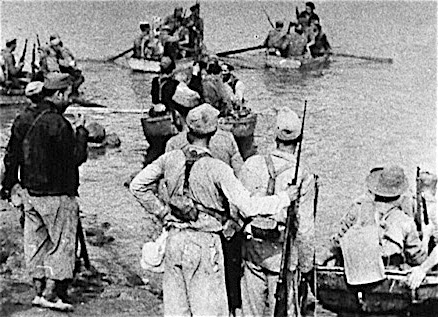
The British volunteers and others crossed the river and had some initial success but were stopped by ferocious aerial and artillery bombardment outside the town of Gandesa. The Nationalist defenders were in a good defensive position on Hill 481 outside of the town and attempts at attacking up the steep rise cost many lives – including that of Lewis Clive.
A website devoted to Irish volunteers in Spain has collected information about Clive’s death. It disproves a ‘barrack room rumour’ that he was killed by drunken ‘friendly fire’ and produces two eye witness accounts of his last few seconds.
An e-mail from José Ignacio García Muniozguren, who translated George Wheeler’s To Make The People Smile Again: A Memoir of the Spanish Civil War (2003) into Spanish, quotes Wheeler who was next to Lewis when he was shot:
Lewis Clive re-appeared and asked about the activity in the fascist lines. It was a hot, sunny day and, as usual, my shirtsleeves were rolled up. At that moment I felt splashes on my left forearm, and glancing down, was astonished to see they were splashes of blood. Turning, I saw Lewis reel and fall. Someone below said ‘What a ghastly sight”. I slid down from my firing position and saw that the top of his head was severed completely…. This big, cheerful, and sincere man had performed his duties as Company Commander with distinction. Well-liked and respected in the battalion, this was a great loss to us all.
Manus O'Riordan responded with what his father, an Irish International Brigade veteran, told him on a return trip to Spain in 1988:
As we journeyed by car through the mountainous battlefields of the Ebro front, on the occasion of his first return visit to Catalunya in fifty years, my father unexpectedly opened up and spoke of his memories. He recalled being right beside Lewis Clive as they were under fire from the fascist lines. When a lull came in the firing, Clive stood up to get a better view. My father said he immediately thought ‘a bad commander’. This was no reflection on Clive's courageous character and bravery, but rather a comment on the recklessness of such bravery in presenting himself in the open as such a soft target for the fascists. The thought had barely formed in my father’s head when Clive was shot...
Older British readers will remember Jack Jones, leader of the Transport and General Workers Union from 1968 to 1979. Here he talks about his experiences on Hill 481 and gives his overview of the Spanish Civil War:
The International Brigades were disbanded and left Spain at the end of 1938 and the Republicans surrendered in April 1939. Spain was to live under the semi-fascist rule of the Nationalist leader, Franco, until his death in 1975.
As far as I know, Clive was the only Blue or Henley winner to die in Spain. The only other Olympian that I know of is Irish boxer, Robert Hillard.
There is a view that the Spanish Civil War, 1936-1939, was in fact a part of the larger fight against tyranny, the Second World War. Nineteen Rowing Blues were killed between 1940 and 1945 including two from the 1931 Boat Race. The Oxford stroke, Holdsworth, died on active service with the Royal Air Force in 1942 and the Cambridge bow, Haig Thomas, fell on D-Day, 6 June 1944 while serving with the Commandos. Clive’s father, Lieutenant-Colonel Percy Clive, had been killed in action in 1918, his older brother, Major Meysey George Dallas Clive, suffered the same fate in 1943.
Because few people nowadays agree with their political philosophies, volunteers such as Lewis Clive are often marginalised or dismissed, thought of as tools of the Soviets or romantic fools. However, these people realised long before the United States and free Europe, that the only way to stop fascism was by force. Richard Baxell quotes volunteer John Bassett:
(The 1930s were) a time of hope, when a man with a rifle had some power to divert the tide of human affairs.
The Times obituary concluded:
Lewis Clive’s many friends, whatever their political views, will not forget his inspiring courage, and will find some consolation in the knowledge that he died gallantly.... in what he was convinced was a critical struggle to save democracy for Spain and ultimately for Europe.
Thursday, January 23, 2014
50th Anniversary of Vesper BC's Triumph

This Saturday, January 25, Vesper Boat Club, Philadelphia, will celebrate the 50th anniversary of the 1964 Olympic Games in Tokyo, where oarsmen from the club took the gold medal in the eights. More than 23 athletes, with their families, who represented Vesper Boat Club and the United States Olympic Team, will be present. Read more about these Vesper oarsmen in a great article on USRowing’s website, here.
Below is a short video from the U.S. Olympic trials at Orchard Beach Lagoon, New York, where the Vesper eight beat Harvard University and the University of California.
Below is 26 seconds of Vesper’s 1964 Olympic glory:
Tuesday, January 14, 2014
The Cods: Paris or the bush?

Greg Denieffe writes:
News has reached HTBS that the story of ‘The Murray Bridge Cods’ is to be made into 60-minute documentary by Australian International Pictures. It will tell the story of Murray Bridge Rowing Club and how they beat the odds to represent Australia at the 1924 Paris Olympics.
When I contacted Wayne Groom, the director of the documentary, he informed me that the target date for completion is 31 December 2014 but that there was still a lot of research to do and interviews to conduct. The project has a Facebook page that has started posting regular updates and a website with further details and an appeal for financial support to fund the project.
Here is a link to a short promotional film to whet the appetite of HTBS readers.
Last May, HTBS posted two articles about the Australian 1924 Olympic eight’s trip to Ireland to compete at the Tailteann Games. Australia was represented by Murray Bridge Rowing Club. Founded in 1909, the club won their first interstate championships in 1913 representing South Australia. Unfortunately, the First World War ended the hopes of this crew ever representing Australia at an Olympic Games.

Following the end of the War, the Stewards of Henley Royal Regatta decided in January 1919 that it would not be desirable to hold Henley Royal Regatta that year but that an interim regatta, later called Royal Henley Peace Regatta, should be held. King George V presented a cup for competition between amateur oarsmen that had served in the Army, Navy or Air Force of any country who had fought for the Allied forces. The competition was called The Allied Forces Eights and was won by the Australian Imperial Forces. The Australian interstate championships resumed in 1920 and in 1922 this cup became the trophy for the championship eights and was renamed The King’s Cup. Murray Bridge won the interstate eights in 1920, 1922 and 1923 and the test race for Olympic selection in 1924.
According to the Australian Army Shop there was some resistance to the use of the cup as a trophy for the interstate championships:
The King’s Cup was presented by King George V to the Australian Imperial Forces (AIF) Number One Crew on July 4th 1919 after the crew’s win at the Henley Peace Regatta. This historic post-war regatta brought together eight teams representing the Allies of the First World War. Australia fielded two crews – AIF Number One and AIF Number Two – for the eight-oared race. They vied against each other and against the USA, France, New Zealand, Canada and Cambridge and Oxford Universities for the prize.
In the end AIF Number One Crew defeated Oxford University for the prize, having also beaten AIF Number Two Crew in the first round and Cambridge University in the semi-final. The King’s Cup was presented to the crew's stroke, Captain M. C. Disher of the Australian Army Medical Corps before being taken by the Australian Imperial Expeditionary Forces Sports Control Board. The board shipped the trophy to the Australian War Museum.
Despite repeated requests to the Australian War Museum that the Cup be used as a perpetual trophy for the annual Interstate Eight-Oar Championship of Australia, the trophy remained locked away. Capt. Disher decided to petition King George V for the trophy’s release. He sent his petition via the Governor General to the King on October 30th 1920. The last line of his petition reads, “And your petitioner therefore humbly prays that your Majesty may be graciously pleased to make known your wishes in regard to the disposal of the said Trophy.”
The King’s response was conveyed by Winston S. Churchill, who wrote: “His Majesty commands me to inform you that it is his wish that the Cup should be used as a permanent trophy and be competed for annually in the Interstate Eight-Oar Race of Australia.”
In the HTBS posts The Case of CoD v Cods and More on Murray Bridge and 'The Cods' you can read about Murray Bridge’s adventures in Paris at the Olympics and on their trip to Ireland for the Tailteann Games where they competed in the international eights, fours and single sculls.

Subscribe to:
Posts (Atom)