Greg Denieffe, who contributed with a nice piece about King George V’s visit to Ireland in 1911 on HTBS on 17 May, is here back with another wonderful piece. This time his story is about the first American rowing team competing in Ireland, in 1901. Greg writes,
In 1901 the University of Pennsylvania became the first “foreign” crew to reach the final of the Grand Challenge Cup at Henley Royal Regatta. On their way to the final they beat Thames Rowing Club and London Rowing Club but in the final they had to yield to Leander Club who won by a length in a time of 7 min. 5 sec. There was a suggestion that the Henley Stewards encouraged them to enter, but this was denied at the time. Also competing at Henley that year was Trinity College, Dublin. They entered the Thames Cup and the Ladies’ Plate but only raced in the Ladies’ were they were beaten by Eton College, who lost the final to University College, Oxford by two lengths, the winning time being 7 min. 28 sec.
Knowing that the Americans were going to Henley, Dublin University BC wrote to them in May 1901 and challenged them to a race in Killarney on Saturday, 13 July. The challenge was accepted and after the conclusion of racing at Henley both crews travelled together by special train from London to Holyhead en route to Ireland.
The postcard on top was posted in 1906 and the description on the left of the card is “Lower Lake - Killarney - Regatta Day”. Killarney has a rowing tradition dating back to the early nineteenth century. The local clubs race each other in fixed seat ‘sixes’ and ‘fours’ and the rivalry goes back generations. The picture is certainly not the traditional Killarney regatta. On closer inspection you will see the crew leaving the slip is actually an eight, and is in fact the Penn crew setting off to the start for their race against their Dublin challengers.
T.H. Hall says of the visitors, “They rowed in a boat built of papier-mâché and fitted with swivel rowlocks and long slides. Universal admiration was expressed for their strong, erect carriage and swift and vigorous strokes”. The relative times of the crews at Henley made the Americans strong favourites. Trinity replaced their stroke and made a number of other positional changes and dropped their bowman, J.A.W. Johnston. This was all to no avail as despite a gallant effort for the first mile, they were well beaten by 20 lengths over the 3-mile course. Penn stopped the clock at 16 min. 20 sec. The Irish crew was not as together as their rivals and were certainly not trained to race that distance.
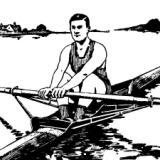
 The picture above was published in a popular magazine believed to be Black and White shortly after the race and shows the Pennsylvanian crew disembarking after their victory.
You can find out more about the University of Pennsylvania’s trip to Henley here.
And there is a nice photograph of the two crews together in Killarney here.
The crews were:
Dublin University BC: J. Baker (bow), J. Cunningham (2), F.J. Usher (3), G. Dougan (4), H.A. Emerson (5), A.A. M’Neight (6), E.L. Julian (captain) (7), J.R. Welland (stroke), H.L. Murphy (cox).
University of Pennsylvania: R. Zane (bow), R. Eisenberry (2), F.L. Davenport (3), S. Crowther (4), A.H. Flickwir (5), G.S. Allyn (6), W. Gardiner (7), J.P. Gardiner (stroke), L.J. Smith (cox).
The New York Times covered the trip to Henley and Killarney and their report headed “PENN WINS IN IRELAND” of July 14, 1901 which includes short biographies of the American crew can be found at this link.
Ernest Lawrence Julian, who rowed at 7, was the Captain of Dublin University BC in 1901. He coached Trinity crews for many years after his graduation and rowed himself for their alumni club, Lady Elizabeth Boat Club under the pseudonym of E.L. Souspierre. In 1909, he became Reid Professor of Law at Trinity College, Dublin. In August 1914 this young professor marched to Lansdowne Road and enlisted in D Company of the 7th battalion, Royal Dublin Fusiliers and went on to become one of the first soldiers of the 10th Irish Division to be killed in action in an advance on Chocolate Hill at Suvla Bay in Gallipoli on 8 August 1915.
This would appear to be the first visit by an American crew to Ireland. However, an Irish crew had raced at the International Regatta in Philadelphia in 1876. Rowing at Trinity College, Dublin can trace its roots back to 1836, initially through the ‘Pembroke Club’ and then as ‘Dublin University Rowing Club’ (DURC). Between 1881 and 1898 there were two clubs representing the university, thanks to the formation of the rival ‘Dublin University Boat Club’. The two clubs finally amalgamated in 1898.
It was the ‘Rowing Club’ that finally accepted an invitation to the important regatta being held to celebrate the centenary of American Independence. They left for America on the 6 August and after arriving in New York travelled on to Philadelphia to compete in the International Four-Oared Race. They were drawn in the first heat against Eureka Boat Club, Newark, N.J. and Argonauta Rowing Association, Bergin Point, N.J. The Dubliners finished second to Eureka by one-and-a-half lengths.
 DURC were also entered for the International Graduates’ Prize and rowed over having successfully objected to the status of the only other crew entered. The Irish party then made its way to Washington at the invitation of Analostan Boat Club and raced at an impromptu regatta. The boat was left behind as a mark of gratitude and donated to Quaker City Boat Club in Philadelphia and may have been used by the first Pennsylvania crew in 1879 which, it was said, was composed of Ellis Ward and his three brothers.
It was probably this connection that persuaded the 1901 crew to travel to Killarney.
Follow this link for a picture of the poster for the heats of the International Four-Oared races held on the first day if the Centennial Regatta on 28 August 1876.
Wonderful stuff, Greg - thank you!