Showing posts with label R.C. Lehmann. Show all posts
Friday, March 7, 2014
A Ramshackle Room
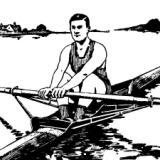
'And some groups of young oarsmen in shorts on the wall'
A Ramshackle Room
When the gusts are at play with the trees on the lawn,
And the lights are put out in the vault of the night;
When within all is snug, for the curtains are drawn,
And the fire is aglow and the lamps are alight,
Sometimes, as I muse, from the place where I am
My thoughts fly away to a room near the Cam.
‘Tis a ramshackle room, where a man might complain
Of a slope in the ceiling, a rise in the floor;
With a view on a court and a glimpse on a lane,
And no end of cool wind through the chinks of the door;
With a deep-seated chair that I love to recall,
And some groups of young oarsmen in shorts on the wall.
There’s a fat jolly jar of tobacco, some pipes –
A meerschaum, a briar, a cherry, a clay –
There’s a three-handled cup fit for Audit or Swipes
When the breakfast is done and the plates cleared away.
There’s a litter of papers, of books a scratch lot,
Such as Plato, and Dickens, and Liddell and Scott
And a crone in a bonnet that’s more like a rag
From a mist of remembrance steps suddenly out;
And her funny old tongue never ceases to wag
As she tidies the room where she bustles about;
For a man may be strong and a man may be young,
But he can’t put a drag on a Bedmaker’s tongue.
And, oh, there’s a youngster who sits at his ease
In the hope, which is vain, that the tongue may run down,
With his feet on the grate and a book on his knees,
And his cheeks they are smooth and his hair it is brown.
Then I sigh myself back to the place where I am
From that ramshackle room near the banks of the Cam.
R. C. Lehmann
(9 February 1910)
A Ramshackle Room
When the gusts are at play with the trees on the lawn,
And the lights are put out in the vault of the night;
When within all is snug, for the curtains are drawn,
And the fire is aglow and the lamps are alight,
Sometimes, as I muse, from the place where I am
My thoughts fly away to a room near the Cam.
‘Tis a ramshackle room, where a man might complain
Of a slope in the ceiling, a rise in the floor;
With a view on a court and a glimpse on a lane,
And no end of cool wind through the chinks of the door;
With a deep-seated chair that I love to recall,
And some groups of young oarsmen in shorts on the wall.
There’s a fat jolly jar of tobacco, some pipes –
A meerschaum, a briar, a cherry, a clay –
There’s a three-handled cup fit for Audit or Swipes
When the breakfast is done and the plates cleared away.
There’s a litter of papers, of books a scratch lot,
Such as Plato, and Dickens, and Liddell and Scott
And a crone in a bonnet that’s more like a rag
From a mist of remembrance steps suddenly out;
And her funny old tongue never ceases to wag
As she tidies the room where she bustles about;
For a man may be strong and a man may be young,
But he can’t put a drag on a Bedmaker’s tongue.
And, oh, there’s a youngster who sits at his ease
In the hope, which is vain, that the tongue may run down,
With his feet on the grate and a book on his knees,
And his cheeks they are smooth and his hair it is brown.
Then I sigh myself back to the place where I am
From that ramshackle room near the banks of the Cam.
R. C. Lehmann
(9 February 1910)
Friday, February 28, 2014
Rudie Lehmann's Harvard Honorary Degree
While the famous coach and writer on rowing matters, Rudie Lehmann is mostly remembered for coaching either Oxford or Cambridge (he studied and rowed for Cambridge, but never in a Blue boat), Lehmann also coached Berliner Ruder Klub and Harvard University.
He received an invitation in 1896 from his American friend Francis Peabody, whom he had rowed with at Cambridge. The rowing at Harvard University was in disorder so Lehmann was offered the opportunity to give Harvard a helping hand, teaching the crimson crews the proper English stroke. Lehmann arrived in Cambridge, Massachusetts, for the first time in mid-November 1896. He returned to Harvard both in 1897 and 1898, and although Harvard greatly improved with Lehmann as their coach, the crimsons never won a race during this time.
As the true gentleman coach, Lehmann never asked for any pay. In June 1897, Harvard awarded Lehmann an honorary degree, which was reported in some American newspapers. With the head line "Mr. Lehmann Speaks at the Harvard Commencement Dinner" the Cornell Daily Sun wrote on 2 July 1897:
It is said that all records for enthusiasm at a Harvard commencement dinner were broken when Mr. R. C. Lehmann was called upon for the third toast. Mr. Lehmann spoke as follows:
“It is my duty to-day to endeavor to the best of my ability to pay the many debts that I have incurred since I came among you in the early spring, but in the first place let me discharge, so far as I can, one debt of gratitude. I mean the debt I owe to this great university, and the high distinction which she has to-day conferred upon me by giving me an honorary degree. [Applause.] Whereas formerly it was my feeling that I might look on as a stranger, a sympathizing stranger only, now I feel that it is my right to cherish the great traditions that have come down to the university through the past generations; that it is my duty to take an active and deep interest in all that concerns her welfare, looking back on all that has passed since the first little seed was planted at Harvard. Looking back to all that has passed, I cannot tell you how deeply I feel the honor that has been done me today in making me one of the great body of Harvard graduates. [Applause.]
“Secondly, I desire to acknowledge the kindliness and consideration, the courtesy and generosity that have been extended to me ever since I set foot on these shores by every man connected with the university, from President Eliot down.
“For your President found time in the midst of all his engrossing duties – he found time, I say – to express his interest in the crew, and to show that whatever went on in Harvard, whether it was a matter of academic or athletic exercise, it was a matter of the deepest concern to him. [Applause]
“For that expression which he gave l thank him. I can assure him that when it was communicated to the crew it touched their hearts deeply.
“I cannot help thinking on this occasion of what might have been. [Applause] I might have represented here a victorious cause, but the dream has passed for this year at any rate.
“Coming among you, as I have to-day, I have found that Harvard men are always ready and willing to extend a greeting, even though they have met with defeat. I have seen to-day men whose friendship it has been my privilege to make, and as I clasped their hands and look into their eyes no words were necessary to assure me how deeply they as Harvard men felt for what happened on Friday last.
“I have seen also men whom I scarcely knew by name, who have come to me and expressed their empathy and their hope that on some future day Harvard might yet win in a boat race.
“I assure you, gentlemen, that this expression of kindliness has overwhelmed me.
“It is the custom to look upon us Englishmen as a sort of coldblooded and phlegmatic race, and in many respects we are; but I think when you once touch us, when you pierce through that outer crust of reserve, you will find we are stirred by emotion as high, by enthusiasm as sincere, and by a generosity not less deep than the qualities you find in the men at Harvard.
“At any rate, it is in the spirit of one who has been adopted as your brother that I appear here before you, and I feel, having been associated with one of her athletic interests, that I have become a son of Harvard and a brother to those whom I see around me, united with them in a spirit and devotion which I hope will last as long life itself.” |Applause.]
Lehmann showing the stroke in a fixed-seat.
So what did Rudie Lehmann get out of his time in America, more than an honorary degree at Harvard? Well, on 14 September 1898, a short piece in The New York Times informed that Harvard’s English coach the previous day had married Miss Alice Marie Davis in Worcester, Massachusetts. Lehmann had met Miss Davis in Mr. and Mrs. Francis Peabody’s home, where she gave the Peabodys’ daughters tutorials.
On the day of the article, the 42-year-old Englishman sailed with his 24-year-old American bride aboard Majestic to Liverpool, England. ‘On arriving home to their house, "Fieldhead", at Bourne End, they were greeted with a triumphal arch, a banquet in the village and an address from the vicar’ the American rowing historian Thomas Mendenhall wrote in a 1979 article about Rudie Lehmann.
He received an invitation in 1896 from his American friend Francis Peabody, whom he had rowed with at Cambridge. The rowing at Harvard University was in disorder so Lehmann was offered the opportunity to give Harvard a helping hand, teaching the crimson crews the proper English stroke. Lehmann arrived in Cambridge, Massachusetts, for the first time in mid-November 1896. He returned to Harvard both in 1897 and 1898, and although Harvard greatly improved with Lehmann as their coach, the crimsons never won a race during this time.
As the true gentleman coach, Lehmann never asked for any pay. In June 1897, Harvard awarded Lehmann an honorary degree, which was reported in some American newspapers. With the head line "Mr. Lehmann Speaks at the Harvard Commencement Dinner" the Cornell Daily Sun wrote on 2 July 1897:
It is said that all records for enthusiasm at a Harvard commencement dinner were broken when Mr. R. C. Lehmann was called upon for the third toast. Mr. Lehmann spoke as follows:
“It is my duty to-day to endeavor to the best of my ability to pay the many debts that I have incurred since I came among you in the early spring, but in the first place let me discharge, so far as I can, one debt of gratitude. I mean the debt I owe to this great university, and the high distinction which she has to-day conferred upon me by giving me an honorary degree. [Applause.] Whereas formerly it was my feeling that I might look on as a stranger, a sympathizing stranger only, now I feel that it is my right to cherish the great traditions that have come down to the university through the past generations; that it is my duty to take an active and deep interest in all that concerns her welfare, looking back on all that has passed since the first little seed was planted at Harvard. Looking back to all that has passed, I cannot tell you how deeply I feel the honor that has been done me today in making me one of the great body of Harvard graduates. [Applause.]
“Secondly, I desire to acknowledge the kindliness and consideration, the courtesy and generosity that have been extended to me ever since I set foot on these shores by every man connected with the university, from President Eliot down.
“For your President found time in the midst of all his engrossing duties – he found time, I say – to express his interest in the crew, and to show that whatever went on in Harvard, whether it was a matter of academic or athletic exercise, it was a matter of the deepest concern to him. [Applause]
“For that expression which he gave l thank him. I can assure him that when it was communicated to the crew it touched their hearts deeply.
“I cannot help thinking on this occasion of what might have been. [Applause] I might have represented here a victorious cause, but the dream has passed for this year at any rate.
“Coming among you, as I have to-day, I have found that Harvard men are always ready and willing to extend a greeting, even though they have met with defeat. I have seen to-day men whose friendship it has been my privilege to make, and as I clasped their hands and look into their eyes no words were necessary to assure me how deeply they as Harvard men felt for what happened on Friday last.
“I have seen also men whom I scarcely knew by name, who have come to me and expressed their empathy and their hope that on some future day Harvard might yet win in a boat race.
“I assure you, gentlemen, that this expression of kindliness has overwhelmed me.
“It is the custom to look upon us Englishmen as a sort of coldblooded and phlegmatic race, and in many respects we are; but I think when you once touch us, when you pierce through that outer crust of reserve, you will find we are stirred by emotion as high, by enthusiasm as sincere, and by a generosity not less deep than the qualities you find in the men at Harvard.
“At any rate, it is in the spirit of one who has been adopted as your brother that I appear here before you, and I feel, having been associated with one of her athletic interests, that I have become a son of Harvard and a brother to those whom I see around me, united with them in a spirit and devotion which I hope will last as long life itself.” |Applause.]
Lehmann showing the stroke in a fixed-seat.
So what did Rudie Lehmann get out of his time in America, more than an honorary degree at Harvard? Well, on 14 September 1898, a short piece in The New York Times informed that Harvard’s English coach the previous day had married Miss Alice Marie Davis in Worcester, Massachusetts. Lehmann had met Miss Davis in Mr. and Mrs. Francis Peabody’s home, where she gave the Peabodys’ daughters tutorials.
On the day of the article, the 42-year-old Englishman sailed with his 24-year-old American bride aboard Majestic to Liverpool, England. ‘On arriving home to their house, "Fieldhead", at Bourne End, they were greeted with a triumphal arch, a banquet in the village and an address from the vicar’ the American rowing historian Thomas Mendenhall wrote in a 1979 article about Rudie Lehmann.
Monday, January 27, 2014
Blues in Bags
Tim Koch writes:
I am often inspired to write a particular post by something that appears on ‘Hear The Boat Sing’. The splendid photograph of the 1931 Oxford Crew that illustrated Malcolm Cook’s article on the use of shaved blades in the 1920s and 1930s is one such thing.
I have attempted to identify everyone but I do stand to be corrected. From left to right: ER Edmett (Cox), WG Holdsworth (Stroke), WDC Erskine Crum (7), L Clive (6), JF Platts-Mills (Bow), CM Johnston (4), RJA Poole (5), GML Smith (2), GM Tinne (3). (On Boat Race Day, Platts-Mills did not row, instead it was WL Garstang in the bow seat.)
The two crew pictures above illustrate the power of photography. The technically better picture of Oxford makes them look far more glamourous than their Light Blue counterparts. The Cambridge picture is from a much copied postcard and contrast has been lost while the Oxford print has more light and shade. The men from the Isis look powerful and poised while those from the Cam look awkward and not especially fit. The irony is, of course, that it was Cambridge who won in 1931.
There is another reason that the two photographs appeal to me. As I have mentioned before, I am interested in the history of men’s clothing and many of these young men are sporting one of the great fashions of the interwar period – ‘Oxford Bags’. ‘Bags’ is simply an old slang word for loose-fitting trousers or, in American-English, pants. These usually measured about 24 inches around the ankle (though there were, briefly, broader examples sported by a flamboyant few) and were wider at the knee. They were popularised by Oxford students, if not invented by them, but by the late 1920s they were worn in many parts of Britain and the U.S., despite ridicule from the older generation. A contemporary joke ran: ‘Why are Oxford Trousers like two French towns?’ ‘Because they are Toulon and Toulouse’. In 1924, the first sighting in Hull in the North of England was thought worthy of a report in the local newspaper. By the 1930s they had become mainstream and were commonly worn by all classes of men, not just privileged undergraduates like these sturdy chaps filmed by British Pathe in 1938:
There is an extreme example in the Oxford Crew picture, sported by Smith, second from the right. They may seem strange to us now but perhaps they are preferable to the modern trend for young men to wear underwear revealing jeans with a low slung crotch, tapering to a tight fit around the ankle. Several places in America have called in the Fashion Police.
The cartoonists were particularly fond of Oxford Bags as seen by the above caricature of WP Mellen and crewmates in 1924 (fans of the British version of the ‘Top Gear’ TV programme may notice Jeremy Clarkson in the top left). Another example is here where the 1925 joke is that ‘Cambridge... have no intention of giving up the trouser race without a struggle. They have visited their local tailor and their coach has him doing 33 stitches to the minute’.
There are several stories about the origins of the fashion. Some claim that bags were invented by the Oxford aesthete and dilettante Harold Acton (often alleged to be the inspiration for the ‘Anthony Blanche’ character in Evelyn Waugh’s Brideshead Revisited). Bob Boothby (later Baron Boothby, a Conservative politician with an exceptionally colourful private life, described by the late Queen Mother as ‘a bounder but not a cad’) claimed that he was the inventor, saying that it was ‘the only creative thing’ that he did while he was at the university. However, Oxford Bags were known to have existed while both of these gentlemen were in short trousers, baggy or not, so their origins must be elsewhere. Writing in the New Sheridan Club newsletter of July 2013, Sean Longden has a theory of much greater interest to HTBS readers:
First mention of wide trousers in the USA came in 1924 when reporters mentioned wide white trousers being worn at the Henley Regatta and “Eights Week”, the annual intercollegiate rowing event at Oxford. This is important because it links us to the true story of why Oxford bags were developed... Speaking in August 1925, Mr Kendrick, the Keeper of Textiles at the Victoria and Albert Museum, gave his explanation for the genesis of the Oxford Bags... ‘(Students) found the wide trousers convenient to pull over (their) shorts to go down to the river.’
A contributor to an online men’s clothing forum found this piece of contemporary supporting evidence in the Dundee Courier newspaper of May 1926.
Longden continues:
Writing in the 1920s, a former travelling salesman referred to selling “Oxford Bags” in the 1880s. And in the 1904 novel A Chicago Princess by Robert Barr, the main character is a former Oxford student who comes across ‘a pair of Oxford bags I had not worn in years...’ Furthermore, the Rowing Museum at Henley holds a pair of 1896 trousers made from an off-white blanket material, which are described as “Oxford Bags”. These were trousers used by rowers to keep warm between races. Effectively the track suit trousers of their day.
There can be not doubt that ‘blanket bags’ originated in the late nineteenth century. There are many pictures of Victorian oarsmen wearing very baggy off white trousers in a coarse woollen material. They are invariably roughly rolled up at the bottom to something approaching the correct length. These are most elegantly illustrated by the ‘Spy’ cartoons in Vanity Fair magazine.
In summary, Oxford Bags were originally a crude garment made in rough inexpensive material invented by rowers as a form of what would later be called ‘sweatpants’. At sometime around the early 1920s students had this style of trousers made in finer cloth, properly tailored and finished with turnups (‘cuffs’ in the U.S.), which were then worn for everyday use. The fashion soon spread and Longden argues that bags influenced the basic shape of men’s trousers up to the 1950s. It seems that rowing provided the first real example of sportswear influencing mainstream fashion.
I am often inspired to write a particular post by something that appears on ‘Hear The Boat Sing’. The splendid photograph of the 1931 Oxford Crew that illustrated Malcolm Cook’s article on the use of shaved blades in the 1920s and 1930s is one such thing.
The Oxford Crew of 1931.
I have attempted to identify everyone but I do stand to be corrected. From left to right: ER Edmett (Cox), WG Holdsworth (Stroke), WDC Erskine Crum (7), L Clive (6), JF Platts-Mills (Bow), CM Johnston (4), RJA Poole (5), GML Smith (2), GM Tinne (3). (On Boat Race Day, Platts-Mills did not row, instead it was WL Garstang in the bow seat.)
The Cambridge Crew of 1931.
Again, I have attempted to identify everyone correctly but contact me
if I have got some names wrong. Clearly the cox, JM Ranking, is
standing at the front. Behind him, left to right, are TA Brocklebank
(Stroke), CJS Sergel (7), PN Carpmael (5), RHH Symonds (3), HRN Rickett
(6), Unknown (perhaps a sub?), G Grey (4), D Haig-Thomas (Bow) and WA Prideaux (2).
I have a particular interest in the 1931 Boat Race as I own a winner’s
medal from that year as well as a sheet of CUBC writing paper with the
crew’s autographs.
The 1931 CUBC Boat Race Medal and crew autographs. Unfortunately, I
do not know who was given this particular medal or who collected the
signatures.
The two crew pictures above illustrate the power of photography. The technically better picture of Oxford makes them look far more glamourous than their Light Blue counterparts. The Cambridge picture is from a much copied postcard and contrast has been lost while the Oxford print has more light and shade. The men from the Isis look powerful and poised while those from the Cam look awkward and not especially fit. The irony is, of course, that it was Cambridge who won in 1931.
There is another reason that the two photographs appeal to me. As I have mentioned before, I am interested in the history of men’s clothing and many of these young men are sporting one of the great fashions of the interwar period – ‘Oxford Bags’. ‘Bags’ is simply an old slang word for loose-fitting trousers or, in American-English, pants. These usually measured about 24 inches around the ankle (though there were, briefly, broader examples sported by a flamboyant few) and were wider at the knee. They were popularised by Oxford students, if not invented by them, but by the late 1920s they were worn in many parts of Britain and the U.S., despite ridicule from the older generation. A contemporary joke ran: ‘Why are Oxford Trousers like two French towns?’ ‘Because they are Toulon and Toulouse’. In 1924, the first sighting in Hull in the North of England was thought worthy of a report in the local newspaper. By the 1930s they had become mainstream and were commonly worn by all classes of men, not just privileged undergraduates like these sturdy chaps filmed by British Pathe in 1938:
MEET THE OXFORD CREW
There is an extreme example in the Oxford Crew picture, sported by Smith, second from the right. They may seem strange to us now but perhaps they are preferable to the modern trend for young men to wear underwear revealing jeans with a low slung crotch, tapering to a tight fit around the ankle. Several places in America have called in the Fashion Police.
Oxford 1924.
The cartoonists were particularly fond of Oxford Bags as seen by the above caricature of WP Mellen and crewmates in 1924 (fans of the British version of the ‘Top Gear’ TV programme may notice Jeremy Clarkson in the top left). Another example is here where the 1925 joke is that ‘Cambridge... have no intention of giving up the trouser race without a struggle. They have visited their local tailor and their coach has him doing 33 stitches to the minute’.
There are several stories about the origins of the fashion. Some claim that bags were invented by the Oxford aesthete and dilettante Harold Acton (often alleged to be the inspiration for the ‘Anthony Blanche’ character in Evelyn Waugh’s Brideshead Revisited). Bob Boothby (later Baron Boothby, a Conservative politician with an exceptionally colourful private life, described by the late Queen Mother as ‘a bounder but not a cad’) claimed that he was the inventor, saying that it was ‘the only creative thing’ that he did while he was at the university. However, Oxford Bags were known to have existed while both of these gentlemen were in short trousers, baggy or not, so their origins must be elsewhere. Writing in the New Sheridan Club newsletter of July 2013, Sean Longden has a theory of much greater interest to HTBS readers:
First mention of wide trousers in the USA came in 1924 when reporters mentioned wide white trousers being worn at the Henley Regatta and “Eights Week”, the annual intercollegiate rowing event at Oxford. This is important because it links us to the true story of why Oxford bags were developed... Speaking in August 1925, Mr Kendrick, the Keeper of Textiles at the Victoria and Albert Museum, gave his explanation for the genesis of the Oxford Bags... ‘(Students) found the wide trousers convenient to pull over (their) shorts to go down to the river.’
A contributor to an online men’s clothing forum found this piece of contemporary supporting evidence in the Dundee Courier newspaper of May 1926.
Longden continues:
Writing in the 1920s, a former travelling salesman referred to selling “Oxford Bags” in the 1880s. And in the 1904 novel A Chicago Princess by Robert Barr, the main character is a former Oxford student who comes across ‘a pair of Oxford bags I had not worn in years...’ Furthermore, the Rowing Museum at Henley holds a pair of 1896 trousers made from an off-white blanket material, which are described as “Oxford Bags”. These were trousers used by rowers to keep warm between races. Effectively the track suit trousers of their day.
There can be not doubt that ‘blanket bags’ originated in the late nineteenth century. There are many pictures of Victorian oarsmen wearing very baggy off white trousers in a coarse woollen material. They are invariably roughly rolled up at the bottom to something approaching the correct length. These are most elegantly illustrated by the ‘Spy’ cartoons in Vanity Fair magazine.
WAL Fletcher, 1893.
CT Fogg-Elliot, 1894.
RC Lehmann, 1895.
In summary, Oxford Bags were originally a crude garment made in rough inexpensive material invented by rowers as a form of what would later be called ‘sweatpants’. At sometime around the early 1920s students had this style of trousers made in finer cloth, properly tailored and finished with turnups (‘cuffs’ in the U.S.), which were then worn for everyday use. The fashion soon spread and Longden argues that bags influenced the basic shape of men’s trousers up to the 1950s. It seems that rowing provided the first real example of sportswear influencing mainstream fashion.
Monday, May 20, 2013
A Stuck-Up Oarsman?
He looks pompous or a little stuck-up, the oarsman in the picture above. He was one of England’s best oarsmen during the late 1880s and he rowed for Cambridge in five Light Blue crews, becoming a true legend, winning The Boat Race in 1886, 1887, 1888 and 1889, and losing in 1890; president of CUBC the last three years. Yes, of course, I am talking about Stanley Duff Muttlebury, who was all but pompous and stuck-up. He was a large and strong man, with good manners and an enormously kind fellow. Affectionately known by Cambridge rowers as ‘Muttle’, he not only swept rowing medals and cups at Cambridge, Muttlebury was equally successful at Henley (though he never won the Grand). Many decades after his active rowing career was over, Muttle was still regarded as the ‘the greatest oar ever produced by Cambridge’.
Muttle’s friend, Rudie Lehmann wrote about him in verse:
Muttle at six is ‘stylish’, so at least the Field reports;
No man has ever worn, I trow, so short a pair of shorts.
His blade sweeps through the water, as he swings his 13.10,
And pulls it all, and more than all, that brawny king of men.
Muttle coaching the Light Blue crew in 1892.
Muttle was, however, less successful as a coach for the Light Blues during the 1890s, but to be fair, the Dark Blues had some extremely good crews between 1890 and 1898. He was one of SPY’s rowing characters in Vanity Fair, actually the only one portrayed in a boat. He died 80 years ago, on 3 May, 1933, 67 years old.
Monday, April 8, 2013
Of those that go down to the River
The famous coach, writer and poet of light verse, Rudie Lehmann’s name stands out when it comes to rowing matters. In 1889, he and some fellow Cambridge students founded the magazine, The Granta, and Rudie took on the position as its first editor. Later, he joined the staff of Punch. However, he was not the only one writing light verse on rowing at Cambridge. In 1895, Owen Seaman (on the right) who had been admitted to Clare College, Cambridge, in 1880, published Horace at Cambridge, a small book with witty poetry, some dealing with rowing. All of the poems had earlier, in one form or the other, appeared in The Granta. In 1897, Seaman joined the staff of Punch, and between 1906 and 1932, he was the editor of the magazine. In “Of those that go down to the River”, Seaman gave the rowing freshmen a taste what they could expect if they were drawn to the river:
WHERE Boating Captains on their beat
Go shepherding the tortuous fleet
Of tubs along the river's reedy hollows,
I marked the Genius who addressed
A Freshman with a beefy chest;
The views of Camus were expressed
Somewhat as follows.
“It first behoves you to undo
Of all your buttons just the two
Topmost, and chance the weather being breezy;
Then, swinging stiffly from the hip,
Cause your prehensile heels to grip
The stretcher; at the signal, nip
Great Heavens! Easy!
Where were we? Yes. There is a rule
Whereby the oarsman, though a fool,
May guarantee the boat against inversion;
Observe your blade; the thing is bent
Obliquely to the element;
Square it at once, and so prevent
Needless immersion.
Again; deposit, if you please,
Your stomach well between your knees,
Aim broadly at the bottom of the vessel;
Swing early, often, long and late;
This is the doctrine up to date,
With which the most immaculate
Fresher must wrestle.
Reck nothing though the process pain
Your blistered hide and make you fain
To be a scaly merman with a sea-tail;
A time may yet arrive when you
Will be as hardened as a Blue,
And have a soul superior to
Matters of detail.
That future waits you far and dim,
And in the awful interim
You have to pass a pretty hot probation;
‘Much is to learn, much to forget,’
And now and then you'll feel regret,
And never, never, fail to sweat
With perspiration.
Full often, rowing like an ox,
On you the curses of your cox,
Falling like blasts of some Tyrrhenian trumpet,
Will rend the horror-stricken air
With language fit to curl the hair
That clusters nicely round the fair
Crest of your crumpet.
Then will you at your rigid thwart
Restrain the apposite retort
And like the parrot merely think profanely,
The while your heavy head you wag
Panting as pants the hunted stag,
And wear your ‘Pontius’ to a rag,
Sliding inanely.
Perchance you will mislay your oar,
When quickening to forty-four,
And learn a little jargon from your skipper;
Or get an unexpected spank
Straight in the centre of your flank
From some inordinately rank
Holiday-tripper.
Those coaches you shall come to know,
That trot with caution to and fro
And wish their knowledge of the chase were larger;
Your valour shall divert the way
Of Nestor-Jones’s* blinkered grey,
And draw a compliment from J.
B. ** on his charger.
Eventually you will land
Triumphant after trials, and
Talk frankly like a father from the saddle
You have the makings of a tar,
And should, with fortune, travel far;
Meanwhile you might get forward. Are
You ready? Paddle!”
‘Nestor-Jones’ (*) was of course Henry Trevor-Jones, described by Seaman in a footnote as the ‘popular and perpetual coach of Trinity Hall’. In a second footnote Seaman wrote that ‘J.B.’ (**) was ‘J. B. Close, President of the C.U.B.C., 1894-5’ which demands an explanation. James B. Close rowed in three winning Cambridge crews in 1872, 1873 and 1874. The latter year, he was president of Cambridge University BC. For the 1895 Light Blue crew, Close was elected president again because he lived in Cambridge, but he did not row that year. With a non-rowing president, the cox Francis Begg undertook the captaincy of the crew. James B. Close’s one-year-older brother, John B. Close, also rowed for Cambridge, earning his Blue in 1871 and 1872. A third brother, William B. Close, earned his Blue in 1875, 1876 and 1877. In a second edition of Horace at Cambridge, which was published in 1902, the stanza in which Trevor-Jones and Close was mentioned was removed.
WHERE Boating Captains on their beat
Go shepherding the tortuous fleet
Of tubs along the river's reedy hollows,
I marked the Genius who addressed
A Freshman with a beefy chest;
The views of Camus were expressed
Somewhat as follows.
“It first behoves you to undo
Of all your buttons just the two
Topmost, and chance the weather being breezy;
Then, swinging stiffly from the hip,
Cause your prehensile heels to grip
The stretcher; at the signal, nip
Great Heavens! Easy!
Where were we? Yes. There is a rule
Whereby the oarsman, though a fool,
May guarantee the boat against inversion;
Observe your blade; the thing is bent
Obliquely to the element;
Square it at once, and so prevent
Needless immersion.
Again; deposit, if you please,
Your stomach well between your knees,
Aim broadly at the bottom of the vessel;
Swing early, often, long and late;
This is the doctrine up to date,
With which the most immaculate
Fresher must wrestle.
Reck nothing though the process pain
Your blistered hide and make you fain
To be a scaly merman with a sea-tail;
A time may yet arrive when you
Will be as hardened as a Blue,
And have a soul superior to
Matters of detail.
That future waits you far and dim,
And in the awful interim
You have to pass a pretty hot probation;
‘Much is to learn, much to forget,’
And now and then you'll feel regret,
And never, never, fail to sweat
With perspiration.
Full often, rowing like an ox,
On you the curses of your cox,
Falling like blasts of some Tyrrhenian trumpet,
Will rend the horror-stricken air
With language fit to curl the hair
That clusters nicely round the fair
Crest of your crumpet.
Then will you at your rigid thwart
Restrain the apposite retort
And like the parrot merely think profanely,
The while your heavy head you wag
Panting as pants the hunted stag,
And wear your ‘Pontius’ to a rag,
Sliding inanely.
Perchance you will mislay your oar,
When quickening to forty-four,
And learn a little jargon from your skipper;
Or get an unexpected spank
Straight in the centre of your flank
From some inordinately rank
Holiday-tripper.
Those coaches you shall come to know,
That trot with caution to and fro
And wish their knowledge of the chase were larger;
Your valour shall divert the way
Of Nestor-Jones’s* blinkered grey,
And draw a compliment from J.
B. ** on his charger.
Eventually you will land
Triumphant after trials, and
Talk frankly like a father from the saddle
You have the makings of a tar,
And should, with fortune, travel far;
Meanwhile you might get forward. Are
You ready? Paddle!”
‘Nestor-Jones’ (*) was of course Henry Trevor-Jones, described by Seaman in a footnote as the ‘popular and perpetual coach of Trinity Hall’. In a second footnote Seaman wrote that ‘J.B.’ (**) was ‘J. B. Close, President of the C.U.B.C., 1894-5’ which demands an explanation. James B. Close rowed in three winning Cambridge crews in 1872, 1873 and 1874. The latter year, he was president of Cambridge University BC. For the 1895 Light Blue crew, Close was elected president again because he lived in Cambridge, but he did not row that year. With a non-rowing president, the cox Francis Begg undertook the captaincy of the crew. James B. Close’s one-year-older brother, John B. Close, also rowed for Cambridge, earning his Blue in 1871 and 1872. A third brother, William B. Close, earned his Blue in 1875, 1876 and 1877. In a second edition of Horace at Cambridge, which was published in 1902, the stanza in which Trevor-Jones and Close was mentioned was removed.
Tuesday, November 13, 2012
Oxford 1897: 'The Finest Crew that ever Rowed'
'The finest crew that ever rowed' - standing, back row, left to right: J.J.J. de Knoop (New College), R. Carr (Magdalen), H.G. Gold (stroke; Magdalen), G.O.C. Edwards (New College), D.H. LacLean (coach), sitting, left to right: C.D. Burnell (Magdalen), C.K. Philips (New College), W.E. Crum (New College), E.R. Balfour (University College), in the very front, H.R.K. Pechell (cox; Brasenose).
After I had posted yesterday's poem by Rudie Lehmann, "A Little Bit Of Blue", I came to realise that the reader of HTBS might get the idea that Lehmann had written this poem to honor the Dark Blues in the photograph that I posted with the poem. That was not the case. Although, this Oxford crew of 1897 was a particularly good one.
Right now, I am in the middle of doing some research on the American oarsman Benjamin Hunting Howell, who rowed for Trinity Hall, Cambridge, between 1895 and 1898, and then for Thames RC until 1900. Howell was picked for the Light Blues boat for the 1897 race against the Dark Blues. Oxford had had a fairly long winning streak which began in 1890 (and would go on until 1898), but for the race in 1897 Cambridge had good hopes to end Oxford's row of victories. Gordon Ross writes in his The Boat Race: The Story of the First Hundred Races Between Oxford and Cambridge (1954):
'...Cambridge made a determined bid to strive for victory in 1897, but they were really up against it. The Oxford crew is described unconditionally as he finest crew that ever rowed. It consisted of de Knoop at Bow (his second race), Edwards at Two (the only new boy), Philips at Three (his third race), Burnell at Four (his third race), Balfour at Five (his second race), Carr at Six (his second race), Erskine-Crum at Seven (his fourth race), Gold at stroke (his second race) and Pechell the cox (his second race); a boat-load of experience.'
Edwards, Philip, Burnell, Carr, Gold and Pechell would win the 1898 race as well. Two of these fine oarsmen would stand out in the history of rowing: Charles 'Don' Burnell, who was called 'the strongest sweep in England' and who won an Olympic gold medal in the eights in 1908 (and who was the father of Dickie Burnell); and Harcourt 'Tarka' Gold, who after his active rowing career would become a very successful coach (Olympic gold medal in the eights in 1908 and 1912), Chairman of Management Committee of the Henley Royal Regatta and the first person to be knighted for his services to rowing (Steve Redgrave being the second one).
No, it did not come as a big surprise that the Light Blues lost the 1897 race. According to Gordon Ross, the bookmakers had the odds of 5 to 1 on Oxford.
After I had posted yesterday's poem by Rudie Lehmann, "A Little Bit Of Blue", I came to realise that the reader of HTBS might get the idea that Lehmann had written this poem to honor the Dark Blues in the photograph that I posted with the poem. That was not the case. Although, this Oxford crew of 1897 was a particularly good one.
Right now, I am in the middle of doing some research on the American oarsman Benjamin Hunting Howell, who rowed for Trinity Hall, Cambridge, between 1895 and 1898, and then for Thames RC until 1900. Howell was picked for the Light Blues boat for the 1897 race against the Dark Blues. Oxford had had a fairly long winning streak which began in 1890 (and would go on until 1898), but for the race in 1897 Cambridge had good hopes to end Oxford's row of victories. Gordon Ross writes in his The Boat Race: The Story of the First Hundred Races Between Oxford and Cambridge (1954):
'...Cambridge made a determined bid to strive for victory in 1897, but they were really up against it. The Oxford crew is described unconditionally as he finest crew that ever rowed. It consisted of de Knoop at Bow (his second race), Edwards at Two (the only new boy), Philips at Three (his third race), Burnell at Four (his third race), Balfour at Five (his second race), Carr at Six (his second race), Erskine-Crum at Seven (his fourth race), Gold at stroke (his second race) and Pechell the cox (his second race); a boat-load of experience.'
Edwards, Philip, Burnell, Carr, Gold and Pechell would win the 1898 race as well. Two of these fine oarsmen would stand out in the history of rowing: Charles 'Don' Burnell, who was called 'the strongest sweep in England' and who won an Olympic gold medal in the eights in 1908 (and who was the father of Dickie Burnell); and Harcourt 'Tarka' Gold, who after his active rowing career would become a very successful coach (Olympic gold medal in the eights in 1908 and 1912), Chairman of Management Committee of the Henley Royal Regatta and the first person to be knighted for his services to rowing (Steve Redgrave being the second one).
No, it did not come as a big surprise that the Light Blues lost the 1897 race. According to Gordon Ross, the bookmakers had the odds of 5 to 1 on Oxford.
Monday, November 12, 2012
A Little Bit Of Blue
When the waves rise high and higher as they toss about together,
And the March-winds, loosed and angry, cut your chilly heart in two,
Here are eighteen gallant gentlemen who come to face the weather
All for valour and for honour and a little bit of blue!
Chorus.
Oh get hold of it and shove it!
It is labour, but you love it;
Let your stroke be long and mighty; keep your body on the swing;
While your pulses dance a measure
Full of pride and full of pleasure.
And the boat flies free and joyous like a swallow on the wing.
Isis blessed her noble youngsters as they left her; Father Camus
Sped his youths to fame and Putney from his grey and ancient Courts:--
"Keep," they said, "the old traditions, and we know you will not shame us
When you try the stormy tideway in your zephyrs and your shorts.
"For it's toil and tribulation till your roughnesses are polished,
And it's bitterness and sorrow till the work of oars is done;
But it's high delight and triumph when your faults are all abolished,
With yourself and seven brothers firmly welded into one."
So they stood the weary trial and the people poured to greet them,
Filled a cup with praise and welcome--it was theirs to take and quaff;
And they ranged their ships alongside, and the umpire came to meet them,
And they stripped themselves and waited till his pistol sent them off.
With a dash and spurt and rally; with a swing and drive and rattle,
Both the boats went flashing faster as they cleft the swelling stream;
And the old familiar places, scenes of many a sacred battle,
Just were seen for half a moment and went by them in a dream.
But at last the flag has fallen and the splendid fight is finished,
And the victory is blazoned on the record-roll of Fame.
They are spent and worn and broken, but their soul is undiminished;
There are winners now and losers, but their glory is the same!
Chorus.
Oh get hold of it and shove it! It is labour, but you love it;
Let your stroke be long and mighty; keep your body on the swing;
While your pulses dance a measure
Full of pride and full of pleasure,
And the boat flies free and joyous like a swallow on the wing.
R. C. Lehmann
Thursday, November 8, 2012
Teddy Roosevelt and ‘A Great And Permanent Amusement’
Tim Koch writes from London,
By the time you read this (but not at the time of writing) the man who will be President of the United States for the next four years should have been chosen – assuming there is no repeat of the ‘hanging chad’ election of 2000. In a long campaign, the candidates were very concerned with talking about the economy and foreign policy but, inexplicably, expressed no opinions on rowing. Possibly the last* U.S. President who had anything to say on the subject was the Theodore ‘Teddy’ Roosevelt (1858-1919) who was held office between 1901 and 1909. He was a sickly child who became a strong and athletic adult by wholeheartedly embracing ‘manly pursuits’. As well as the 26th President he was a soldier, boxer, hunter, naturalist, explorer and sportsman. He was also a ‘Progressive Republican’ (when such a thing was not, some would say, an oxymoron) and a Nobel Peace Prize winner. In more recent years some have looked beyond the caricature of the man and have held that he was one of the great U.S. Presidents.
As this picture here shows, by the time Teddy was a young Harvard sculler he had left his childhood weaknesses behind him. In his autobiography he had this to say about rowing:
'.... at Oyster Bay (his holiday home) our great and permanent amusements were rowing and sailing: I do not care for the latter and I am fond of the former. I suppose it sounds archaic, but I cannot help thinking that people with motor boats miss a great deal. If they would only keep to rowboats or canoes, and use oar or paddle themselves, they would get infinitely more benefit... But I rarely took exercise merely as exercise. Primarily I took it because I liked it...'
Roosevelt’s views on exercise and its benefit to the nation were summarised in a speech he gave in 1899 entitled ‘The Strenuous Life’.
Hail to the Chief!
*G.R.B. comment: While Tim is probably right about Teddy Roosevelt being a President to have an opinion about rowing (and who could still actively row while he was in the White House), I believe, though, that it was Teddy's fifth cousin, Franklin D. Roosevelt, 'FDR' (1882-1945), who was the last President of the United States (1933-1945) who could have an opinion on rowing. As a student, at Groton School in Massachusetts, FDR rowed. In a famous 1897 letter, the 15-year-old wrote home to his parents about a prominent visitor to the school: 'Mr. Lehmann, the English coach, gave us an informal talk on rowing... as you probably know, he is about the greatest authority on rowing in the world.' FDR continued to Harvard, but he did not row there. Instead, he became an avid sailor. His 25-foot sloop Vireo is now on display at Mystic Seaport. By the boat is a photograph showing FDR with family and friends sailing in Vireo. The day after this photograph was taken in 1921, FDR was stricken by polio and would never be able to sail again. However, he continued to be interested in rowing, and both his sons James and Franklin Jr., rowed at Groton School and at Harvard.
By the time you read this (but not at the time of writing) the man who will be President of the United States for the next four years should have been chosen – assuming there is no repeat of the ‘hanging chad’ election of 2000. In a long campaign, the candidates were very concerned with talking about the economy and foreign policy but, inexplicably, expressed no opinions on rowing. Possibly the last* U.S. President who had anything to say on the subject was the Theodore ‘Teddy’ Roosevelt (1858-1919) who was held office between 1901 and 1909. He was a sickly child who became a strong and athletic adult by wholeheartedly embracing ‘manly pursuits’. As well as the 26th President he was a soldier, boxer, hunter, naturalist, explorer and sportsman. He was also a ‘Progressive Republican’ (when such a thing was not, some would say, an oxymoron) and a Nobel Peace Prize winner. In more recent years some have looked beyond the caricature of the man and have held that he was one of the great U.S. Presidents.
As this picture here shows, by the time Teddy was a young Harvard sculler he had left his childhood weaknesses behind him. In his autobiography he had this to say about rowing:
'.... at Oyster Bay (his holiday home) our great and permanent amusements were rowing and sailing: I do not care for the latter and I am fond of the former. I suppose it sounds archaic, but I cannot help thinking that people with motor boats miss a great deal. If they would only keep to rowboats or canoes, and use oar or paddle themselves, they would get infinitely more benefit... But I rarely took exercise merely as exercise. Primarily I took it because I liked it...'
Roosevelt’s views on exercise and its benefit to the nation were summarised in a speech he gave in 1899 entitled ‘The Strenuous Life’.
Hail to the Chief!
*G.R.B. comment: While Tim is probably right about Teddy Roosevelt being a President to have an opinion about rowing (and who could still actively row while he was in the White House), I believe, though, that it was Teddy's fifth cousin, Franklin D. Roosevelt, 'FDR' (1882-1945), who was the last President of the United States (1933-1945) who could have an opinion on rowing. As a student, at Groton School in Massachusetts, FDR rowed. In a famous 1897 letter, the 15-year-old wrote home to his parents about a prominent visitor to the school: 'Mr. Lehmann, the English coach, gave us an informal talk on rowing... as you probably know, he is about the greatest authority on rowing in the world.' FDR continued to Harvard, but he did not row there. Instead, he became an avid sailor. His 25-foot sloop Vireo is now on display at Mystic Seaport. By the boat is a photograph showing FDR with family and friends sailing in Vireo. The day after this photograph was taken in 1921, FDR was stricken by polio and would never be able to sail again. However, he continued to be interested in rowing, and both his sons James and Franklin Jr., rowed at Groton School and at Harvard.
Wednesday, August 22, 2012
Olympic Rowing? No, thank you!
In a very recently published press release, the International Rowing Federation, FISA, declared the London 2012 Olympic Games Rowing Regatta “a resounding success following the eight days of racing at the Eton Dorney regatta course.” The message continued: “Packed grandstands and enthusiastic cheering became the norm for each day of the regatta with crowds spread along most of the 2,000m course. The official Olympic customer satisfaction survey of all Olympic sites consistently rated Eton Dorney as the top venue peaking at a 97 per cent approval rating.”
Denis Oswald, president of FISA, hailed the regatta as a very successful Olympic Regatta and said: “Rowing is very popular in Great Britain and we knew that the interest would be strong, and it was. The regatta went smoothly for athletes, organisers and supporters.”
Everywhere you read about the regatta at Eton Dorney the story is the same: “The best regatta ever”. If you are British you are probably still in a euphoric state because of all the medals your rowing countrymen and -women brought home. It makes me happy to read that everyone seems to agree that it was a smashing hit.
Of course, it makes it a little harder to understand that one hundred years ago, despite the British oarsmens’ triumphs at the 1908 and 1912 Olympic Regattas, the British rowing’s governing body at that time, ARA, decided that Olympic rowing was not anything that the British rowers should occupy themselves with. Even before the Stockholm Games had started, in the spring of 1912, ARA sent a letter to the German Olympic organisers (the 1916 Olympic Games were supposed to have been held in Berlin had not the War intervened) that ARA “could not at this early date bind themselves to send crews to compete at the next or any future Olympiad”. But why, you might ask yourself? The answer came to the British Olympic Association (BOA) after the War when it was time again to send crews to the Olympic Games, now in Antwerp. BOA then took the opportunity to also send an invitation to ARA’s rival organization NARA to send crews. Now ARA took the chance to speak more plainly:
“[…] that organized international athletic competitions to take place at regular specific periods, and the expenditure of time and money which such competitions must necessarily entail, are entirely contrary to the true spirit of amateur sport”.
There it is in black and white! No true amateur sportsman would like to compete against other athletes who are getting paid to compete. The British view on this was very strict. If someone paid your trip to go to the Olympics, then you were paid and were therefore not an amateur. For the 1916 Berlin Games, BOA had suggested that a public fund was to be set up to try to raise £100,000. The idea got some support, among the supporters was Sir Arthur Conan Doyle and the editor of The Field, Theodore A. Cook, who was the only oarsman to support the suggestion, probably because he was a member of the International Olympic Committee. Among the doubtful oarsmen were Guy Nickalls and Rudie Lehmann (on the left). It might seem odd that both these famous oarsmen were against the Games, after all, Nickalls took an Olympic gold in the eights in 1908, and Lehmann was known to have very liberal ideas. Although, ARA sent crews to the next Olympic rowing regattas, the organization did not really believe in the Games. In 1925, ARA told the Canadian Association of American Oarsmen that “it had never been in sympathy with the Olympic Games or Olympic Regattas.In the research library of Mystic Seaport in Mystic, Connecticut, is a letter written by Halladay (down on the left) in December 1990 to the American rowing historian Tom Mendenhall (up on the right). The American had probably written the Englishman a letter about Rudie Lehmann because Halladay writes
“You may be interested to know that I thought at one time of writing a life of Lehmann. It seemed to me that he needed to be remembered as more than a large footnote in the history of rowing. I got to know his son, John Lehmann, quite well. He was a minor literary figure and publisher, on the fringes of the Bloomsbury group and at one time thought to be the ‘fifth’ man forming the Cambridge spy-ring – Burgess, McLean etc. But there were no papers of any importance and so I had to drop the matter.”
Personally, I think it is really a shame that Halladay did not pursue this mission. Just think what a grand book it could have been. But, instead, we can read Halladay’s book about the amateur question among the oarsmen at a time when they did not want to have anything to do with the Olympics.
Thursday, May 10, 2012
At Putney
At Putney
When eight strong fellows are out to row,
With a slip of a lad to guide them,
I warrant they’ll make the light ship go,
Though the coach on the launch may chide them,
With his “Six, get on to it! Five, you’re late!
Don’t hurry the slides, and use your weight!
You're bucketing, Bow; and, as to Four,
The sight of his shoulders makes me sore!”
But Stroke has steadied his fiery men,
And the lift on the boat gets stronger;
And the Coxswain suddenly shouts for “Ten!
Reach out to it, longer, longer!”
While the wind and the tide raced hand in hand
The swing of the crew and the pace were grand;
But now that the two meet face to face
It’s buffet and slam and a tortoise-pace.
For Hammersmith Bridge has rattled past,
And, oh, but the storm is humming.
The turbulent white steeds gallop fast;
They’re tossing their crests and coming.
It’s a downright rackety, gusty day,
And the backs of the crew are drenched in spray;
But it’s “Swing, boys, swing till you’re deaf and blind,
And you’ll beat and baffle the raging wind.”
They have slipped through Barnes; they are round the bend;
And the chests of the eight are tightening.
“Now spend your strength, if you’ve strength to spend,
And away with your hands like lightning!
Well rowed!” - and the coach is forced to cheer -
“Now stick to it, all, for the post is near! ”
And, lo, they stop at the coxswain’s call,
With its message of comfort, “Easy all!”
So here’s to the sturdy undismayed
Eight men who are bound together
By the faith of the slide and the flashing blade
And the swing and the level feather;
To the deeds they do and the toil they bear;
To the dauntless mind and the will to dare;
And the joyous spirit that makes them one
Till the last fierce stroke of the race is done.
R. C. Lehmann
When eight strong fellows are out to row,
With a slip of a lad to guide them,
I warrant they’ll make the light ship go,
Though the coach on the launch may chide them,
With his “Six, get on to it! Five, you’re late!
Don’t hurry the slides, and use your weight!
You're bucketing, Bow; and, as to Four,
The sight of his shoulders makes me sore!”
But Stroke has steadied his fiery men,
And the lift on the boat gets stronger;
And the Coxswain suddenly shouts for “Ten!
Reach out to it, longer, longer!”
While the wind and the tide raced hand in hand
The swing of the crew and the pace were grand;
But now that the two meet face to face
It’s buffet and slam and a tortoise-pace.
For Hammersmith Bridge has rattled past,
And, oh, but the storm is humming.
The turbulent white steeds gallop fast;
They’re tossing their crests and coming.
It’s a downright rackety, gusty day,
And the backs of the crew are drenched in spray;
But it’s “Swing, boys, swing till you’re deaf and blind,
And you’ll beat and baffle the raging wind.”
They have slipped through Barnes; they are round the bend;
And the chests of the eight are tightening.
“Now spend your strength, if you’ve strength to spend,
And away with your hands like lightning!
Well rowed!” - and the coach is forced to cheer -
“Now stick to it, all, for the post is near! ”
And, lo, they stop at the coxswain’s call,
With its message of comfort, “Easy all!”
So here’s to the sturdy undismayed
Eight men who are bound together
By the faith of the slide and the flashing blade
And the swing and the level feather;
To the deeds they do and the toil they bear;
To the dauntless mind and the will to dare;
And the joyous spirit that makes them one
Till the last fierce stroke of the race is done.
R. C. Lehmann
Thursday, June 23, 2011
"Eat Sawdust Without Butter"
In yesterday's entry, I wrote about Rudie Lehmann's daughter Rosamond, and Selina Hasting's biography about her. Today, it's time to go back to Rudie Lehmann as I have a rare picture to share with you all. The illustration on top is from the July, 1896 of Baily's Magazine of Sports and Pastimes (No. 437, Vol. LXVI). In this issue is an article about "Mr. R. C. Lehmann", of whom it's said: "Few names are better known, few faces are more familiar in the aquatic world and the resorts of the rowing men, than that of the gentlemen whose linements will be seen on the [...] page."The article also mentions Lehmann as a barrister, who once wrote a book with the "ponderous title", A Digest of Overrules Cases. The article continues to say: "The bar, however, did not hold him for long; possibly he realised the directness of Lord Thurlow's question [...] to a father who asked him if he would recommend his son to go to the bar, "Sir, can your son ear sawdust without butter?'" Lehmann's book, the article states, "is the sawdust; for the relish Mr. Lehmann turned to the lighter paths of literature."
The article also mentions Lehmann's many dogs: "At one time he might almost have started a small dog show of his own, for his kennel consisted of seventeen [dogs]."
Wednesday, June 22, 2011
On Rudie Lehmann's Daughter Rosamond
The other day, a lady thank me in an e-mail for giving her some information about the connection between Rudie Lehmann and his daughter Rosamond Lehmann. The lady had read HTBS on 4 June about the Lehmann family, and although she is interested in rowing and know who Rudie was and likes Rosamond Lehmann's novels, the connection was not clear until she read it on HTBS.
Now, this is what we would like to hear, because not only is it HTBS mission to entertain, if we can throw in a little education in the mix, we are all for that! To educate myself, I actually ordered Selina Hasting's biography Rosamond Lehmann (2002) three weeks ago. I have not managed to start reading it, but I have flipped through the book and read some pages here and there and discovered that there is some stuff about Rosamond's father, Rudie (and her mother, Alice, too). And to everyone who would like to balance what John Lehmann writes in his autobiography, The Whispering Gallery (see link above) about his father, can now see what one of his sister's thought about their upbringing; well, interpreted by Selina Hastings, that is.
And be aware, in Rosamond Lehmann, Hastings sometimes is very gossipy...
Now, this is what we would like to hear, because not only is it HTBS mission to entertain, if we can throw in a little education in the mix, we are all for that! To educate myself, I actually ordered Selina Hasting's biography Rosamond Lehmann (2002) three weeks ago. I have not managed to start reading it, but I have flipped through the book and read some pages here and there and discovered that there is some stuff about Rosamond's father, Rudie (and her mother, Alice, too). And to everyone who would like to balance what John Lehmann writes in his autobiography, The Whispering Gallery (see link above) about his father, can now see what one of his sister's thought about their upbringing; well, interpreted by Selina Hastings, that is.And be aware, in Rosamond Lehmann, Hastings sometimes is very gossipy...
Sunday, June 12, 2011
Two Rowing University Men


So, who were those handsome fellows in the entry from yesterday? They both had had an article each published in the spring of 1890 in the English Illustrated Magazine. The piece by the fellow on the left was called "Rowing at Oxford", and the fellow on the right had one called "Rowing at Cambridge".
While I do not think that we have ever mentioned the chap on the left at HTBS, which, by the way, is really bad of us, the chap on the right is one of 'HTBS's heroes'. However, he looks a little different in this picture as he is not wearing a moustache nor does he look like a light-weight; it is said that he weighted 148 lb, or 67 kg, when he rowed. The answer, of course, is R.C. 'Rudie' Lehmann, famous rowing writer and coach, who actually did not have an astounding recored as a Cambridge Blue, or as an oarsman at the Henley Royal Regatta. But enough about Lehmann whom we have written a lot about on HTBS.
So, who is then the moustached fellow on the left? William Grenfell, who was educated at Harrow School and Balliol College, Oxford. Grenfell rowed for Oxford in the famous dead-heat boat race of 1877, and belonged to the dark blue crew that won the following year. He was President of OUBC in 1879. He also enjoyed mountaineering, tennis, fencing, swimming and fishing, and swam the Niagara rapids twice. Grenfell climbed the Matterhorn three times, rowed across the English Channel and was Amateur Punting Champion of the Upper Thames.
Greenfell was an MP, first for the Liberal Party and then for the Conservatives. He received a peerage in 1905 as 1st Baron of Desborough. He was a driving force to get the Olympic Games to London in 1908. His sons, Julian (the poet) and Gerald were both killed in action in 1915. Desborough's third son, Ivo, died in a car accident in 1926. The Barony was extinct with the death of Baron of Desborough in 1945.
Saturday, June 4, 2011
The Lehmann Family, And To Keep A Dream Alive
Right now I am writing something about R.C. Lehmann - 'Rudie' Lehmann, that is - and I am hoping to finish it soon. For you who follow HTBS regularly know that Rudie is one of my rowing 'heroes' and several of the posts here on HTBS have to do with his writing, whether it is his rowing books, rowing stories, or rowing poems. My current writing about Rudie - I am not sure what to call it, but it's probably more of an essay than anything else - is partly based on his son's autobiography, The Whispering Gallery, which was published in 1955. Rudie and his American wife, Alice, had four children, Rosamond, the novelist, Beatrix, the actress, Helen, and John (on the right), who was a man of letters: poet, journalist, editor, and publisher.While Rudie Lehmann wrote a lot, there is not that much written about him. A very good article about Rudie is Thomas C. Mendenhall's 'The British are Coming' in the series "Coaches and Coaching", article 5, in the American rowing magazine, The Oarsman, January/February, 1979. Mendenhall has used John Lehmann's The Whispering Gallery for his article, but he was also in contact with Rudie's son when he was writing it. These letters are now held at Mystic Seaport Collection and Research Center, where Thomas C. Mendenhall's manuscripts can be found.
Another good source for information about the whole entire Lehmann family must be the Princeton University Library, which has a large collection of the Lehmann Family Papers. I have not yet taken a trip to Princeton to go through this collection, but I plan to do that in the future, when I have retired, many years from now. As it happened, in 2008 I was interviewed by Allison Frederick of USRowing for their website, 'the masters section'. And as it where, my tongue slipped and I said: "I have this silly dream of writing a small play about the British rowing coach and writer, R.C. Lehmann".
Oppss, I did it again. I guess, it's one way to keep the dream alive, to say it in the open. And one day, I have to begin working on that play about Rudie.
Tuesday, May 10, 2011
The Complete Oarsman
Talking about R.C. ‘Rudie’ Lehman’s The Complete Oarsman, the good man Bernard Hempseed sent me an e-mail the other say with a link to a ‘readable’ copy of the book. Bernard writes,
Here is a site that has the text of Lehman’s book The Complete Oarsman. It is in a number of sections but each is easy to get. They can be copied into a word document but would take a bit of formatting to turn it into something printable. I downloaded just some of it - history and great races - but the technical stuff may be of interest to some. The other website I sent you earlier also had the book but the text file was hopeless as it was very poorly done. Here is The Complete Oarsman.
Thank you, Bernard!
Here is a site that has the text of Lehman’s book The Complete Oarsman. It is in a number of sections but each is easy to get. They can be copied into a word document but would take a bit of formatting to turn it into something printable. I downloaded just some of it - history and great races - but the technical stuff may be of interest to some. The other website I sent you earlier also had the book but the text file was hopeless as it was very poorly done. Here is The Complete Oarsman.
Thank you, Bernard!
Monday, May 9, 2011
Cambridge v. Harvard 1906, Part 2
Here follows the second and final part of “Cambridge v. Harvard 1906”.
At Bourne End on 6 August, 1906, both Cambridge and Harvard began their practice for the big race on the Thames on 8 September. On 23 August both crews moved to Putney. The first time Harvard rowed the full course, on 1 September, they finished almost on record time, 18 minutes, 50 seconds, which was only 5 seconds longer than Oxford’s record time in 1893. Harvard’s old coach and great rowing advocate, Robert ‘Bob’ F. Herrick, arrived to England some weeks after the crew had reached England. In his book Red Top – Reminiscences of Harvard Rowing (1948), Herrick’s writes: “The English opinion was on the whole rather favorable to the Harvard crew, but on the other hand Americans who had seen them for some little time were not at all confident”.
Although, one would think that Herrick, as an old rowing coach, would have had some judgment of which boat would win, but instead he writes, “I saw them [Harvard] go out and also saw the Cambridge crew go out each day until the race. It was difficult for me to form any opinion of the two crews. There were, of course, the general marked differences between an English crew and an American crew, but this made it all the harder to form any opinion.”
On 8 September, at 4:30 p.m., the race started. Rudy Lehmann, who was the race umpire, states in his The Complete Oarsman, “It was a brilliant unclouded day. There was a slight breeze from the west, but scarcely sufficient to ruffle the surface of the water, except in Corney Reach and near the finish. The flood tide was not a very strong one, and as the wind was almost always on the quarter it was not possible to anticipate that record time would be accomplished.” Bob Herrick followed the race from the referee’s boat, “All along the course were tens of thousands of spectators who sat on the banks and the housetops,” he wrote.
Cambridge started at a rate of 40 strokes to the minute, and Harvard at a much lesser rate. At the mile, the Americans were two and a half lengths behind, and Herrick claims that Harvard was beaten there and then. At Hammersmith Bridge, the light blues were four lengths ahead, and although Harvard put in a spurt now and then, which reduced Cambridge lead, the Englishmen’s victory was never in jeopardy. Cambridge paddled passed the finish line at 19 minutes 58 seconds.
A view from Barnes Bridge, Cambridge in a comfortable lead over Harvard.
“This day will always be considered by Cambridge oarsmen as one of the really great dates in their calendar,” Lehmann writes in The Complete Oarsman. He continues, “The race rowed on that occasion between our crew and a crew representative of Harvard University was, no doubt, a brilliant triumph for our English rowing men, and for the sound and ancient traditions on which their teaching had been based; but it was something more than that; it was a splendid culminating point of a genuine sporting event in which from first to last there had been neither hitch nor jar. Friendship there was and courtesy and chivalry, but of the animosity which has sometimes embittered and disfigured such contests there was never even the faintest trace.”
If Lehmann’s approach to the race and its result can be viewed very British, so might Bob Herrick’s view seem very American. In Red Top, he writes, “After the race there was a dinner at Prince’s restaurant in London, which I remember as about the dullest occasion I ever was present at. I have no doubt the depression caused by our defeat explains my feelings somewhat, but I still believe the dinner was a much duller affair than it would have been possible to have in [America]. The crew were all delighted with their treatment by the English and all enjoyed the trip very much, thought they found it very difficult to be reconciled to defeat.”
Harvard would get their revenge. In 1914 at Henley, Harvard took the Grand Challenge Cup. But that is another story…
At Bourne End on 6 August, 1906, both Cambridge and Harvard began their practice for the big race on the Thames on 8 September. On 23 August both crews moved to Putney. The first time Harvard rowed the full course, on 1 September, they finished almost on record time, 18 minutes, 50 seconds, which was only 5 seconds longer than Oxford’s record time in 1893. Harvard’s old coach and great rowing advocate, Robert ‘Bob’ F. Herrick, arrived to England some weeks after the crew had reached England. In his book Red Top – Reminiscences of Harvard Rowing (1948), Herrick’s writes: “The English opinion was on the whole rather favorable to the Harvard crew, but on the other hand Americans who had seen them for some little time were not at all confident”.
Although, one would think that Herrick, as an old rowing coach, would have had some judgment of which boat would win, but instead he writes, “I saw them [Harvard] go out and also saw the Cambridge crew go out each day until the race. It was difficult for me to form any opinion of the two crews. There were, of course, the general marked differences between an English crew and an American crew, but this made it all the harder to form any opinion.”
On 8 September, at 4:30 p.m., the race started. Rudy Lehmann, who was the race umpire, states in his The Complete Oarsman, “It was a brilliant unclouded day. There was a slight breeze from the west, but scarcely sufficient to ruffle the surface of the water, except in Corney Reach and near the finish. The flood tide was not a very strong one, and as the wind was almost always on the quarter it was not possible to anticipate that record time would be accomplished.” Bob Herrick followed the race from the referee’s boat, “All along the course were tens of thousands of spectators who sat on the banks and the housetops,” he wrote.
Cambridge started at a rate of 40 strokes to the minute, and Harvard at a much lesser rate. At the mile, the Americans were two and a half lengths behind, and Herrick claims that Harvard was beaten there and then. At Hammersmith Bridge, the light blues were four lengths ahead, and although Harvard put in a spurt now and then, which reduced Cambridge lead, the Englishmen’s victory was never in jeopardy. Cambridge paddled passed the finish line at 19 minutes 58 seconds.
A view from Barnes Bridge, Cambridge in a comfortable lead over Harvard.“This day will always be considered by Cambridge oarsmen as one of the really great dates in their calendar,” Lehmann writes in The Complete Oarsman. He continues, “The race rowed on that occasion between our crew and a crew representative of Harvard University was, no doubt, a brilliant triumph for our English rowing men, and for the sound and ancient traditions on which their teaching had been based; but it was something more than that; it was a splendid culminating point of a genuine sporting event in which from first to last there had been neither hitch nor jar. Friendship there was and courtesy and chivalry, but of the animosity which has sometimes embittered and disfigured such contests there was never even the faintest trace.”
If Lehmann’s approach to the race and its result can be viewed very British, so might Bob Herrick’s view seem very American. In Red Top, he writes, “After the race there was a dinner at Prince’s restaurant in London, which I remember as about the dullest occasion I ever was present at. I have no doubt the depression caused by our defeat explains my feelings somewhat, but I still believe the dinner was a much duller affair than it would have been possible to have in [America]. The crew were all delighted with their treatment by the English and all enjoyed the trip very much, thought they found it very difficult to be reconciled to defeat.”
Harvard would get their revenge. In 1914 at Henley, Harvard took the Grand Challenge Cup. But that is another story…
Sunday, May 8, 2011
Cambridge v. Harvard 1906, Part 1
The Cambridge crew which met Harvard in a race on the River Thames on 8 September, 1906. Standing, from the left: A.B. Close-Brooks, H.G. Baynes, and H. Shimwell (substitute); seated: M. Donaldson, B.C. Johnstone, F.J. Escombe (coach), H.M. Goldsmith, D.C.R. Stuart, and G.H.F. Benham; seated in front: B.G.A. Scott and R.V. Powell.The first international rowing competition between an English and American university was in 1869, when Harvard travelled to meet Oxford in a coxed four race on the championship course on the River Thames in London. The Atlantic cable had just opened so the American newspapers quickly received the reports about the crews training and, on the 27th of August, the race report. Rowing historian Bill Miller has written an article about the race, "The Great International Boat Race".
It would take another 37 years before another international race between an American and an English university would take place.
On 2 May, HTBS’s Tim Koch reported on the mishap he had found on Wikipedia about the English oarsman Eric Powell, who was a Cambridge Blue in 1906, 1907, and 1908. The first year Eric rowed for Cambridge, his two-year older brother, Ronald Powell (seen on the right), was also in the boat. Ronald had rowed in two previous light blue crews, in the winning 1904 crew and the losing 1905 crew. In 1906, the Cambridge boat was victorious again.On 28 June that year Harvard won against Yale in a downstream race on Thames River in New London. Harvard was eager to match oarpower with the winner of the Oxford-Cambridge race, so without further delay, a ‘cable’ was sent to Francis Lee Higginson, an Harvard man, who had taken up an English summer house close to Bourne End, the residence of the famous English coach Rudy Lehmann. Higginson and Lehmann knew each other well, as Higginson had rowed for Harvard in 1898 when Lehmann was over in America, coaching the Harvard crew. On 15 July, 1906, Higginson looked up Lehmann to show him the message in which Harvard was challenging Cambridge for a match on the Thames in London. The Harvard crew stood ready to leave America as soon as the challenge had been accepted by Cambridge.
In his book The Complete Oarsman (1908), Rudy Lehmann writes that he hesitated as he was not sure that a representative Cambridge crew could be brought together as the crew has scattered all over after Henley. After consulting with Raymond Etherington-Smith and Claude Goldie, Lehmann decided to approach old Cambridge men to raise funds for several weeks of training. The subscription list eventually showed a total of £356 15s. Lehmann and Henry Goldsmith, the Cambridge Boat Club president, also sent letters and telegrams to get the Cambridge crew together. At a meeting in London, a date was set for the race, 8 September, and as soon as a representative crew was pulled together H.M. Goldsmith, selected the coaches. His choices fell on Francis Escombe and Stanley Muttlebury.
While Ronald Powell was able to train and row in the Cambridge boat, his brother Eric was, as C.M. Pitman writes in his The Record of the University Boat race 1829-1909 (1909) “unable to return from the Continent”. In total, the Englishmen took in two substitutes in their boat, so when it was time for their first practice outing on 6 August at Bourne End, the Cambridge crew looked like this:
A.B. Close-Brooks, bow
J.H.F. Benham, 2-seat
H.M. Goldsmith, 3-seat
M. Donalson, 4-seat
H.G. Baynes, 5-seat
R.V. Powell, 6-seat
B.C. Johnston, 7-seat
D.C.R. Stuart, stroke
B.G.A. Scott, cox
The Americans arrived in England on 4 August, and two days later, they were also practicing at Bourne End. The Harvard crew looked like this:
R.M. Tappen, bow
S.W. Fish, 2-seat
R.W. Flint, 3-seat
C. Morgan, 4-seat
J. Richardson, 5-seat
R.L. Bacon, 6-seat
D.A. Newhall, 7-seat
O.D. Filley, stroke
M.B. Blagden, cox
Pitman reports that due to illness, the Harvard crew had to make several changes during their training. Regarding their boat and style, he writes, “They row in a centre-seated boat, and used swivel rowlocks and very long slides. Their general style was very much like that of other American crews which have visited this country, a style which appears to the English critic to result in an almost complete sacrifice of swing to leg work.”
“Cambridge v. Harvard 1906” continues tomorrow!
Friday, April 22, 2011
Sporting Illustrations By Booth
Frontispiece by artist J.L.C. Booth in R.C. Lehmann's Sportsmen and Others.Bryan Kitch of the eminent blog Rowing Related made a comment regarding the image I used for Wednesday's entry about R.C. Lehmann's Sportsmen and Others (1912). Bryan is asking if there are others like it in Lehmann's book. Yes, there is, but I believe I picked the nicest one to illustrate the entry. The illustrator of Lehmann's book was J.L.C. Booth, who, in 1898, came out with his own book Sporting Rhymes & Pictures.
Lehmann and Booth probably knew each other from the magazine Punch, where Booth now and then had illustrations published. Although, it is not easy to find information about Booth, he seems to have been a well-respected illustrator. In a review of Sportsmen and Others, the Evening Post of New Zealand writes on 11 May 1912 about the book: "Mr. Booth's fourteen or fifteen sporting and character sketches suggest (and correctly) a lively book of shrewd observations and wholesome humour."
In the story "A Putney Waterman" a lady "had a difference with her 'old man'", so she flung herself over the railing. "She'd mistook the tide, for the ebb was three-parts run out, and there warn't more than a foot or two of water where she jumped. [... She said:] 'Don't save me, sailor,' she sez when she see me comin', 'I've sworn to die.' 'So you shall, ma'am,' I sez, 'some other day."
"[...] it may be said of coxswains that they are not so much individual men as members of a tribe or secret society formed entirely of male human beings weighing on an average 8 stone. They have meeting-places where they come together to devise the torments which later on they inflict on their fellow-mortals. The have signs and passwords." In "Coxswains".
Wednesday, April 20, 2011
A Charming Book By Lehmann
There has been a lot about R.C Lehmann on HTBS lately, but I find the man fascinating, so I can not stop writing about him. We know him best as an authority on rowing and as a poet of light verse, while his contemporaries probably recognised him as an important contributor to Punch. It was in this magazine he wrote his parodies of Sherlock Holmes which later were collected in Adventures of Picklock Holes (1901).Another book, which is not that easy to find nowadays, is called Sportsmen and Others. I have a copy without printing year, but one edition published by Kegan Paul, Trench, Trubner & Co came out in 1912. My edition is in the series called Bell's Indian and Colonial Library and was issued 'for circulation in India and the Colonies only' as it states in the book. Of the 24 short stories, five are about rowing: 'Two Boatmen', 'Mr Ed Plummer', 'A Putney Waterman', 'Coxswains', and 'A Bumping Correspondence'. The illustration on top is from the story 'Coxswains'.
Though, it is very light entertainment, it is a charming book.
Thursday, April 14, 2011
R.C. Lehmann Online
HTBS's Tim Koch writes from London:
The recent HTBS item quoting a poem by Rudy Lehmann (on 9 April, 2011) reminded me that two of his books on rowing are available to view online.
Some of you may already be familiar with Project Gutenberg. Over 33,000 free e-books can be downloaded to read on a PC, Mac, iPad, Kindle, Sony Reader, iPhone, Android or other portable device. They are all digitized from ‘real’ US copyright free books by thousands of volunteers. No fee or registration is required but you can make a donation if you wish.
The only book on rowing that the Project has is Rowing by RC Lehmann, published in 1898. This is probably not as well known as Lehmann’s other book on the subject, The Complete Oarsman (1908) which is also available online at the University of California Digital Library. (I like the fact that the last page shows that the paper version was taken out of the library three times, in 1953, 1993 and 2003). I have not had the chance to read the Complete yet, so more about it another time.
Rudolph Chambers Lehmann (1856-1929) was a coach to Oxford, Cambridge, Leander, Harvard, Trinity College Dublin and Berlin Rowing Club. Born into a literary and academic family, he was a writer, notably for the humorous British magazine Punch, and produced music and poetry. In another part of his life, he was a Member of Parliament for four years.
Rowing has over 300 pages and many illustrations. Some of the advice given still holds good today, though much, as would be expected, is outdated (but still interesting). It is sometimes funny (as Lehmann intended) and sometimes unintentionally funny, particularly when the attitudes and idioms of the late Victorian ruling class are exposed.
The chapters and sub headings include ‘First lessons on fixed seats’ and ‘First lessons on sliding seats’, ‘Of ailments….’, ‘Of the necessity of having a butt’, ‘Swivel Rollocks’, ‘Sculling by Guy Nickalls’, ‘Are athletes healthy?’ and chapters on rowing at Oxford, Cambridge, and Eton and in Australia and the United States.
The following are some of my favorite extracts but if you read the book you will undoubtedly find ones of your own.
Introduction by the author
My object in the following pages will be not merely to give such hints to the novice as may enable him, so far as book-learning can effect the purpose, to master the rudiments of oarsmanship, but also to commend to him the sport of rowing from the point of view of those enthusiasts who regard it as a noble open-air exercise, fruitful in lessons of strength, courage, discipline, and endurance, and as an art which requires on the part of its votaries a sense of rhythm, a perfect balance and symmetry of bodily effort, and the graceful control and repose which lend an appearance of ease to the application of the highest muscular energy...
Well put. T.K.
On fixed seats
Every oarsman must begin on fixed seats. This statement is to an English public school or University oar a mere platitude; but in America, and even in some of our English clubs outside the Universities, its force and necessity have been lost sight of…… For it is on fixed seats alone that a man can learn that free and solid swing which is essential to good oarsmanship on slides.
I am not sure we can return to fixed seat boats for beginners but I think it is true that novice rowers do not spend enough time ‘backstop rowing’ (no legs, arms and body only). T.K.
Training and Diet
For a Boat Race crew in training at Putney:
A.M.
7:00 - Out of bed, and without bathing or washing dress immediately in flannels. A cup of milk and a biscuit.
7:15 - Out of the house. A brisk walk with one sharp run of 150 yards.
7:50 - Back to the house. Bath, etc.
8:30 - Breakfast: Fish, plainly cooked, without sauce. Soles, whiting, and smelts are best. Salmon is not allowed. Cutlets or beefsteaks, or grilled chicken. Eggs, boiled, or poached, or fried, sometimes scrambled. Mustard and cress, or water-cress. Toast. Limited amount of butter. Marmalade is allowed only during the last fortnight of training. Not more than a cup and a half of tea.
11:00 - At Putney, when the state of the tide permits it, exercise in the boat. It should be noted that the tide sometimes makes it necessary for the crew to do its rowing in the morning, sometimes in the afternoon. Occasionally work can be done both in the morning and afternoon.
P.M.
1:00 - Lunch: Cold meat. Tomatoes plainly made into a salad with oil and vinegar. Toast. Small quantity of butter. Oatmeal biscuits. One glass of draught beer, or claret and water.
3or4 - Work in the boat.
6:30 - Dinner: Fish, as at breakfast. An entrée of pigeons, or sweetbread, or spinach and poached eggs. Roast joint (not pork or veal), or else chicken, with potatoes, mashed or boiled, and boiled vegetables. Stewed fruit with rice puddings. Sometimes jelly. Two glasses of draught beer, or claret and water. For dessert, figs, prunes, oranges, dry biscuits, and one glass of port wine.
9:50 - A glass of lemon and water, or a cup of water-gruel.
10:00 - Bed.
Note—Once or twice during training there is a "champagne night," when champagne is substituted for beer or claret and water; but this only occurs when the crew have been doing very hard work, or when they show evident signs of being over-fatigued, and require a fillip.
The inclusion of alcohol at all is very strange by modern standards. The impression given is that this is the minimum amount of strong drink that a man needs in a day and that such deprivation is a real sacrifice. The idea of Champagne for over-fatigued crews is a lovely one. The suggested diet is fine but what was the logic behind some of the exclusions? No pork, veal or salmon? Marmalade only during the last fortnight of training? These strange diet ideas were not confined to the 1890s. In the 1980s I had a coach who was convinced that if you ate cucumber before a race you would surely lose, but cream cakes guaranteed success. We never did find out why. T.K.
The Necessity of Having a Butt
Rowing Types No.3. First, let me insist on the necessity of having a butt in a crew….. I have seen eight healthy, happy, even-tempered young men go into training together for three weeks…... At the end of (that time) every man in that crew was the proud possessor of seven detested foes……. Why was this so? The simple answer is this, that the crew in question did not number among its members a butt. I doubt if the importance of a butt in modern boat-racing has been properly recognized…. the position of butt is a far more important and responsible one than that of stroke or No. 7. If you can find a good, stout, willing butt—a butt who lends himself to nicknames, and has a temper as even as a billiard-table and as long as a tailor's bill—secure him at once and make him the nucleus of your crew.. The butt must therefore be neither silent, nor slack, nor a drawler. Nature will probably have saved him from being a thinker or an orator. He must be simply good-natured without affectation, and ready to allow tempers made stormy by rowing and training to break upon his broad back without flinching.
This is absolutely true. We did not use the expression but we had ‘a butt’ in the two Henley Crews that I coxed and it was silently acknowledged that he was a very important part of the crew. T.K.
The recent HTBS item quoting a poem by Rudy Lehmann (on 9 April, 2011) reminded me that two of his books on rowing are available to view online.
Some of you may already be familiar with Project Gutenberg. Over 33,000 free e-books can be downloaded to read on a PC, Mac, iPad, Kindle, Sony Reader, iPhone, Android or other portable device. They are all digitized from ‘real’ US copyright free books by thousands of volunteers. No fee or registration is required but you can make a donation if you wish.
The only book on rowing that the Project has is Rowing by RC Lehmann, published in 1898. This is probably not as well known as Lehmann’s other book on the subject, The Complete Oarsman (1908) which is also available online at the University of California Digital Library. (I like the fact that the last page shows that the paper version was taken out of the library three times, in 1953, 1993 and 2003). I have not had the chance to read the Complete yet, so more about it another time.Rudolph Chambers Lehmann (1856-1929) was a coach to Oxford, Cambridge, Leander, Harvard, Trinity College Dublin and Berlin Rowing Club. Born into a literary and academic family, he was a writer, notably for the humorous British magazine Punch, and produced music and poetry. In another part of his life, he was a Member of Parliament for four years.
Rowing has over 300 pages and many illustrations. Some of the advice given still holds good today, though much, as would be expected, is outdated (but still interesting). It is sometimes funny (as Lehmann intended) and sometimes unintentionally funny, particularly when the attitudes and idioms of the late Victorian ruling class are exposed.
The chapters and sub headings include ‘First lessons on fixed seats’ and ‘First lessons on sliding seats’, ‘Of ailments….’, ‘Of the necessity of having a butt’, ‘Swivel Rollocks’, ‘Sculling by Guy Nickalls’, ‘Are athletes healthy?’ and chapters on rowing at Oxford, Cambridge, and Eton and in Australia and the United States.
The following are some of my favorite extracts but if you read the book you will undoubtedly find ones of your own.
Introduction by the author
My object in the following pages will be not merely to give such hints to the novice as may enable him, so far as book-learning can effect the purpose, to master the rudiments of oarsmanship, but also to commend to him the sport of rowing from the point of view of those enthusiasts who regard it as a noble open-air exercise, fruitful in lessons of strength, courage, discipline, and endurance, and as an art which requires on the part of its votaries a sense of rhythm, a perfect balance and symmetry of bodily effort, and the graceful control and repose which lend an appearance of ease to the application of the highest muscular energy...Well put. T.K.
On fixed seats
Every oarsman must begin on fixed seats. This statement is to an English public school or University oar a mere platitude; but in America, and even in some of our English clubs outside the Universities, its force and necessity have been lost sight of…… For it is on fixed seats alone that a man can learn that free and solid swing which is essential to good oarsmanship on slides.
I am not sure we can return to fixed seat boats for beginners but I think it is true that novice rowers do not spend enough time ‘backstop rowing’ (no legs, arms and body only). T.K.
Training and Diet
For a Boat Race crew in training at Putney:
A.M.
7:00 - Out of bed, and without bathing or washing dress immediately in flannels. A cup of milk and a biscuit.
7:15 - Out of the house. A brisk walk with one sharp run of 150 yards.
7:50 - Back to the house. Bath, etc.
8:30 - Breakfast: Fish, plainly cooked, without sauce. Soles, whiting, and smelts are best. Salmon is not allowed. Cutlets or beefsteaks, or grilled chicken. Eggs, boiled, or poached, or fried, sometimes scrambled. Mustard and cress, or water-cress. Toast. Limited amount of butter. Marmalade is allowed only during the last fortnight of training. Not more than a cup and a half of tea.
11:00 - At Putney, when the state of the tide permits it, exercise in the boat. It should be noted that the tide sometimes makes it necessary for the crew to do its rowing in the morning, sometimes in the afternoon. Occasionally work can be done both in the morning and afternoon.
P.M.
1:00 - Lunch: Cold meat. Tomatoes plainly made into a salad with oil and vinegar. Toast. Small quantity of butter. Oatmeal biscuits. One glass of draught beer, or claret and water.
3or4 - Work in the boat.
6:30 - Dinner: Fish, as at breakfast. An entrée of pigeons, or sweetbread, or spinach and poached eggs. Roast joint (not pork or veal), or else chicken, with potatoes, mashed or boiled, and boiled vegetables. Stewed fruit with rice puddings. Sometimes jelly. Two glasses of draught beer, or claret and water. For dessert, figs, prunes, oranges, dry biscuits, and one glass of port wine.
9:50 - A glass of lemon and water, or a cup of water-gruel.
10:00 - Bed.
Note—Once or twice during training there is a "champagne night," when champagne is substituted for beer or claret and water; but this only occurs when the crew have been doing very hard work, or when they show evident signs of being over-fatigued, and require a fillip.
The inclusion of alcohol at all is very strange by modern standards. The impression given is that this is the minimum amount of strong drink that a man needs in a day and that such deprivation is a real sacrifice. The idea of Champagne for over-fatigued crews is a lovely one. The suggested diet is fine but what was the logic behind some of the exclusions? No pork, veal or salmon? Marmalade only during the last fortnight of training? These strange diet ideas were not confined to the 1890s. In the 1980s I had a coach who was convinced that if you ate cucumber before a race you would surely lose, but cream cakes guaranteed success. We never did find out why. T.K.
The Necessity of Having a Butt
Rowing Types No.3. First, let me insist on the necessity of having a butt in a crew….. I have seen eight healthy, happy, even-tempered young men go into training together for three weeks…... At the end of (that time) every man in that crew was the proud possessor of seven detested foes……. Why was this so? The simple answer is this, that the crew in question did not number among its members a butt. I doubt if the importance of a butt in modern boat-racing has been properly recognized…. the position of butt is a far more important and responsible one than that of stroke or No. 7. If you can find a good, stout, willing butt—a butt who lends himself to nicknames, and has a temper as even as a billiard-table and as long as a tailor's bill—secure him at once and make him the nucleus of your crew.. The butt must therefore be neither silent, nor slack, nor a drawler. Nature will probably have saved him from being a thinker or an orator. He must be simply good-natured without affectation, and ready to allow tempers made stormy by rowing and training to break upon his broad back without flinching.This is absolutely true. We did not use the expression but we had ‘a butt’ in the two Henley Crews that I coxed and it was silently acknowledged that he was a very important part of the crew. T.K.
Subscribe to:
Posts (Atom)