Showing posts with label Youth Rowing. Show all posts
Showing posts with label Youth Rowing. Show all posts
Thursday, November 7, 2013
A Visit to Henley RC
BBC Countryfile visited Henley Rowing Club earlier in May this year - no comments necessary...

Wednesday, February 6, 2013
... but I Like These Best!
"IT'S THE SCHOOL-KIDDIES' HENLEY!"

Here is a funny little clip from a 1932 'School-Kiddies' Henley', some improvised rowing races for boys and girls under the age of 14 from British Pathe. Despite the fun rowing, school children on field trips really only have one thing on their mind - food. Listen to the last comment from the interviewed boy.
Friday, January 25, 2013
Rowing is Passion
Here is a nice promotional video for youth rowing and sculling. Very nicely done...
Sunday, November 18, 2012
2012 SilverSkiff Regatta in Turin

The SilverSkiff Regatta in Turin, Italy, was back again after last year’s cancellation due to severe flooding. At this year’s regatta almost 500 single scullers had found their way to the waters of the River Po to race on the 11 km long course. The day before the SilverSkiff Regatta, a KinderSkiff Regatta for juniors was raced on a 4,000-metre distance by 200 youth scullers.
The men’s race was won by Jost Schoemann-Finck of Germany who had the fastest overall time at 41:39. Schoemann-Finck’s country woman Lena Müller won the women’s category at 47:11. The master I-category was won by 76-year-old Carlo Zezza of the U.S., this despite that he at one point flipped in his single scull. However, Zezza climbed back in his shell to win in his master class at 53:38. There was also an adaptive rowing category.
The scullers came from twenty-two different countries, FISA World Rowing website writes. To read more about the SilverSkiff Regatta, please click here. To get the results, please click here.
Saturday, November 17, 2012
Great Story!
I just read about Gib North, who is young man and a member of the Chattanooga Junior Rowing Club’s adaptive rowing program. He is rowing with Katie Rouse in a double scull on the Tennessee River. It's a great and inspiring story. Read it here.
Sunday, July 1, 2012
2012 HRR: Ladies Last

HTBS’s Tim Koch continues to report from Henley Royal Regatta:
Traditionally, Henley Royal Regatta was a man’s event. However, times change and, while the sometimes cussed Regatta does not like to admit to it, Henley changes with it. It is a paradox that, to appear to be unchanging, an event or institution must constantly evolve. In this spirit, this year’s Henley saw the introduction of the Junior Women’s Quadruple Sculls, an event for ‘crews from any one club or school, home or overseas, where no sculler will have attained her eighteenth birthday before the first day of September preceding the event’. With the exception of masters and lightweights, junior women was the last rowing group to be unrepresented at ‘The Royal’.
On Thursday, I had the pleasure of talking to the girls from Walford Anglican School for Girls, Adelaide, Australia. They were the only foreign entry amongst the seven others in the event. They usually row in eights, but Meg Barnett, Georgia Day, Hannah Jury and Georja Osborne won a place in the quad through a qualifying time trial. A trip to the U.K. was always going to be exciting but the excitement increased as they discovered what a special event Henley is. They made history as they were in the first race in the new event but, sadly, they lost. In mitigation, they were 16 year-old sweep rowers in an event for 18 year-old scullers. Mike Sweeney, Chairman of the Regatta, said ‘We are confident that (the event) will establish itself very quickly. We’re delighted by the fifteen boat entry and think that the quality of racing so far has been good’.
There are many variations on the joke concerning someone thinking that the ‘Ladies’ Plate’ was a race for ladies but women and Henley have always had an interesting relationship. The social side of the Regatta has always, of course, welcomed ‘the fair sex’ and membership of the Stewards’ Enclosure has been open to women for many years. On the water it has been more difficult.

In 1974 Mimi Sherman (‘the pig tailed Californian’), the cox of the Santa Clara University Heavyweight men’s crew was told by the Regatta that she could not compete as ‘it would be against the tradition of Henley’. She arrived in England anyway, hoping to change the Stewards’ minds. They did – but it took five months before they lifted the ban on women coxswains. Henley Chairman John Garton was quoted as saying ‘I would emphasize that this is in no way the thin end of the wedge. It is not a triumph for women’s lib – or any nonsense of that sort’. This gives the impression that the Chairman and the Committee of Management were ‘old fools’ but Garton went onto say ‘We may have to consider the introduction of women’s events before long’ and that ‘...the acceptance of a new situation brought about by a changing world..... cannot probably do the regatta any harm’.
Kingston Rowing Club tried to hurry things along when, in 1978, they sent in an entry for the Double Sculls in the name of A. Hohl and P. Bird. Regatta Chairman Peter Coni discovered that these were the maiden names of the two best female scullers of the day, Astrid Ayling and Pauline Hart. He was not amused.
Between 1981 and 1983 Henley tinkered with some women’s invitation events over a shortened course. The programme explained that the events ‘...will enable the Stewards to assess the feasibility of including races over the shorter course during the normal regatta programme, and the desirability of the considerable extension to the hours of racing which any full events for women would necessarily involve’. However, the experiment was carried out with little enthusiasm or thought and it ended without comment.
It was in 1993 that things got serious. An event for Open Women’s Single Sculls was introduced and was initially counted as a round of the World Cup. In 1996, the event was renamed the Princess Royal Challenge Cup. A women’s eights race was held as an invitation event in 1998 and 1999, but by 2000 it was formally incorporated into the regatta as an Open Women’s event. First called the Henley Prize, it is now the Remenham Challenge Cup. An Open Women’s Quadruple Sculls race was introduced in 2001 and in 2003 was renamed the Princess Grace Challenge Cup. No doubt, in time, the Junior Women’s Quadruple Sculls event will eventually get a more attractive name.
What of the future? The Regatta programme is already fairly crowded but I would think that a ‘club event’ for women would be the next step, probably a women’s ‘Thames Cup’. There is also the effect on Henley Women’s Regatta to consider. Mimi Sherman certainly started something.
Friday, February 10, 2012
Rowing Is Back In Springfield!
 A couple of days ago, HTBS received an e-mail from Jonathan Moss, President of the Pioneer Valley Riverfront Club in Springfield, Massachusetts. I am happy to share the exciting news with the HTBS readers. Jonathan Moss writes,
The history of Springfield rowing is nearly as old as the 150+ year old history of American Rowing. Yet, it had a dark period for many decades ... until now. The Pioneer Valley Riverfront Club will bring rowing back to the facility which had public school rowing out of it in the early 1900s. We were recently notified by the City of Springfield of our winning proposal!
Much work needs to be done for development of facility, location, and programs. But this was the first very critical step in the vision of the organization (and, my dream since moving to the area 10 years ago and learning of its past). We will be putting lots of sweat equity and other efforts forward in the coming weeks and years. To get us started, we’re launching a fundraising campaign. The first $18,000 raised will be matched dollar for dollar by some local advocates who share our vision. Please, consider helping to fund this effort by going to our donation page here.
To have a facility will not only allow us to continue our youth and adult programs along with inner-city outreach efforts, but we should also be able to expand and stay on top of equipment maintenance much more easily. We plan to have more than just rowing connecting people to healthy activities in Springfield. North Riverfront Park is conveniently located between the river and a bike path while being conveniently accessible by car.
To get a bird’s eye view of the site, click here.
Thanks so much for your encouragement, interest and support.
Sincerely,
Jonathan Moss
President, Pioneer Valley Riverfront Club
Rowing@pvrowing.org
cell phone: (413) 262-0945
Saturday, November 12, 2011
Chivalry On The Water
 Is being a gentleman on the water something of the past? You know like Bobby Pearce stopping at a 1928 Olympic rowing race to let some ducks pass his lane, or Jack Beresford (seen above), who was in the lead of the 1921 Diamond Sculls final, but stopped rowing to wait for F.E. Eyken of the Netherlands, who had hit the booms. At the end, the Dutchman was the stronger sculler and won with a length and a half.
I am happy to report that chivalry on the water is not dead. To the great names of Pearce and Beresford we can now add James Konopka and Nick Mead of Episcopal Academy in Philadelphia. These young men recently received the Thomas Eakins Medal of the Schuylkill Regatta for showing “great presence, maturity and selflessness and the true spirit of the sport of rowing”. In an under-17 race in the double scull on the Schuylkill, Konopka and Mead stopped rowing to assist another pair of competitors, whose boat had capsized. They stayed with the other boat until a referee’s launch arrived to the spot. Konopka and Mead then continued to row, coming dead last in this 2.5-mile race.
So acted true gentlemen of the sport of rowing! Kudos, gentlemen. (Read more here.)
Monday, September 5, 2011
Rowing's True Soul
Yesterday, the World Rowing Championships ended in Bled. Whether a favorite boat or crew took a gold, silver, or bronze medal, or maybe totally missed to get to the A-final, or even failed to qualify for next year’s Olympic rowing in Great Britain, at times the whole entire event could turn a little hyper. Following some of the top athletes from a distance, their success or failure, I have to confess that I felt that the roots of rowing felt far away.
Earlier this year FISA, the International Rowing Federation, launched a new brand identity: “The Soul of Rowing”, and doing so also redesigned the organisation’s website and adding a short video to promote its new “brand”. Rowing is now “about the human spirit”, it is said, and the sport of rowing is like a Far East art. For the visitors to the FISA website, there is even a text explaining what we are watching, probably because otherwise we would not understand what on earth is the meaning of this nonsense. I am sorry FISA, but you have been had by the agency you hired to “renew” yourselves. To view the gobbledygook, see above.
So back to the roots of rowing. Enter Mr. Bob Egle! I had no idea whom Mr. Egle was until I happened to stumble over his film “Rowing – A Digital Short” on YouTube where I was looking for a rowing clip. Now, here is a fellow, who does not know anything about your sport, but sees the local school, Upper Arlington High School Rowing Team (in OH) on the river, and, in an attempt to understand the sport, makes a film about the school’s rowing team. He puts some young rowers, boys and girls, in front of the camera and allows them to talk about our sport. Listen to what they are saying, words like: team work, camaraderie, power, trust in team mates, nervous, cruelest sport, tension, hardest sport, awesome feeling, food, FUN……
Listen, yes, but also watch how these young people’s faces shine when they talk about rowing. I think this little film is lovely as it explains what our sport is truly about. This film made me want to go out on the river right away to feel how the shell is running underneath me, and I can imagining what the film can do to get other young girls and boys to take up rowing.
Well done, Bob Egle & and the rowers at Upper Arlington High School. FISA – watch and learn!
Bob Egle's film is here below:
Tuesday, May 24, 2011
Youth Rowing On The Harlem
It's a pity, really, but nowadays, you will rarely find any articles in the New York Times about the sport of rowing, not even during and just after the Rowing World Championships and the Olympic Games. However, last Sunday, I was surprised to find an article, "Through Rowing, New Confidence", about students learning to row on the Harlem River. Nice article, read it by clicking here.
Tuesday, April 26, 2011
Old 'Furney' - A Victorian Eccentric
 Dr Frederick James Furnivall in a scull on his 85th birthday, in 1910.
In my April column 'In this month' in the Rowing & Regatta magazine, published by British Rowing, I am mentioning Dr Frederick James Furnivall who founded the Hammersmith Sculling Club for girls in April 1896. Furnivall, who was born in 1825, was a real character, an eccentric Victorian philologist who for certain is worth a much longer article than the 400 words that forms my monthly little column. As a matter of fact, in 2003, Simon Winchester published his The Meaning of Everything: the Story of the Oxford English Dictionary, which gives an entertaining picture of old 'Furney', who co-founded this famous dictionary and who during his whole entire life founded literary societies and rowing clubs.

Some years after the 71-year-old Furnivall had founded the Hammersmith Sculling Cub for girls, in 1901, the club also allowed young men to join as members. The club would later change its name to Furnivall Sculling Club.
 Furnivall and some club members.
 The good Tim Koch was actually in contact with the club when he heard that I was working on a small piece for my column. Furnivall Sculling Club very generously put some of their old photographs of Furnivall to my disposal, and I am sorry that my magazine column is running without any illustrations. But, luckily, here at HTBS there is always room for entries with illustrations, so please enjoy these nice old pictures of Frederick James Furnivall and 'his' pretty club members. Furnivall died in 1910.
All the photographs in this entry belongs to Furnivall Sculling Club and are posted with the courtesy of the club. My warm thanks goes to the club and to Tim for their help!
Tuesday, October 19, 2010
Book About Kent's Henley Champions
 Tucked away in the northwest corner of Connecticut is Kent School. The school, which is beautifully located by the Housatonic River, was founded in 1906 by the thirty-two-year-old Episcopal monk Frederick Herbert Sill. Early on, Father Sill wrote that the school would “provide at a minimum cost for boys of ability and character, who must presumably upon graduation be self-supporting, a combined academic and commercial course of instruction, and also preparation for college and university courses. Simplicity of life, self-reliance, and directness of purpose are to be especially encouraged in the boys.”
In the beginning the school had problems making ends meet, but Sill solved these financial difficulties with fundraising and with what would become a famous Kent School ‘self-help philosophy’; the boys had to do almost all the school’s chores themselves, cleaning, washing, waiting the tables, managing the athletic teams, etc. And everyone had to help, boys from wealthy families and boys from families of more modest means were all threated alike. In 1922, when the school had a firm economic base to stand on, Father Sill bought a wooden eight for $800 to add on to the old boats that were already in a boathouse on campus.
Rowing was not a ‘new’ sport for Sill. In 1895, when the newly founded Intercollegiate Rowing Association invited schools to a four-mile championship race for eights at Poughkeepsie, New York, the winning Columbia University boat was steered by Sill.
 The Kent crews immediately met with success and already during the winter of 1926/27, Father Sill received an invitation from the Henley Royal Regatta to have a Kent eight compete in the Thames Challenge Cup (as the regatta lacked a true Cup for school boys) in the summer of 1927. The invitation was picked up by The New York Times who wrote about the glamour and glory with an America preparatory school eight going to the famous regatta in Henley. “Sill was not happy with the publicity,” Rick Rinehart writes in his eminent book Men of Kent, which was published by Lyons Press a couple of months ago. Rinehart quotes Sill saying that “I believe there are some features of English sportsmanship that it would be well for us in the United States to assimilate.” Rinehart writes “Father Sill’s ascetic view of sportmanship gave rise to a Kent School Boat Club, KSBC, ethos that was still very much in practice when I joined the club.” Rinehart continues “Humility was the watchword. Neither defeat nor victory was to be worn on one’s sleeve.”
In their first, and only, heat of the 1927 Thames Challenge Cup, Kent met Thames RC who won by a quarter of a length, and ultimately won the trophy that year. Kent then returned to Henley in 1930 and 1933, the latter year taking the Thames Cup. Kent crews would carry on winning cups at Henley also after Father Sill had stepped down as a coach. He was superseded by ‘Tote’ Walker, who “might have been mistaken for one of the Marx Brothers.” Rinehart states. But despite Walker’s rough appearance, he was a true gentleman, who believed that ‘winning was enough’ and therefore told his crews to not win with more than two boat lengths. (Though, a couple of exceptions are known: at one time, when Walker was verbally insulted by another crew’s coach, he allowed the Kent boat to totally whip the other boat in the race.)
In the beginning of the 1960s, Walker took an assistant coach under his wings, William Hartwell Perry Jr., who had coached in Honolulu while stationed there with the Coast Guard. Hart Perry had begun to row at Noble and Greenough School in Dedham, Massachusetts, when his baseball coach gave him the hint to “consider another sport”. Perry successfully took up rowing, and continued to pull an oar at Dartmouth, but was soon banned from sports until he had improved his grades. However, he rowed his sophomore year, but at his junior year he had been, as Perry himself would say, “growing the wrong way,” that is, Rinehart writes, “too heavy for lightweight rowing and too short for heavyweights.” In 1964, Hart Perry was appointed head coach at Kent School.
So, having been a student at Kent since 1968 and having tried most of the sports available at the school, and having “excelled at nothing”, Rick Rinehart joined the KSBC in 1971. For the 1972 rowing season Rinehart was sure to make the second or junior boat. When one of the oarsmen in the first boat, Mike ‘Pa’ Brown, had injured his wrist, Coach Perry moved Rinehart over to join Charlie Kershaw, Fred Elliott, John Rooney, Geoff O’Keefe, Clint Whistler, Charlie Poole and Murray Beach, and coxswain Roger Stewart. The crew developed rapidly and their progress was rewarded with a new boat, Frederick Herbert Sill, designed and built by Helmut Schoenbrod.
In their first race in April 1972, with cruel rowing conditions on the Housatonic River, the boys from Kent handsomely beat the crews from Yale and the Coast Guard, but were disqualified as their boat in the choppy water had gone over in another boat’s lane. The Kent crew would never let that happen again. They would win the following races and to this day, some of the crew members are still amazed by the swing the boat had in those pre-Henley races, Rinehart writes. Finding their “rowing mojo,” as Rinehart says, after easily winning the New England Interscholastic Rowing Association’s Regatta, the nine boys and their coach were ready to take on the world, which in rowing terms means the Henley Royal Regatta, where they were going for the Princess Elizabeth’s Challenge Cup. As a spare oarsman they brought the stroke from Kent’s second boat, Garth Griffin, and little did they know at the time what a lucky choice that would turn out to be.
A few days before their first heat, Geoff O’Keefe came down with a severe virus that left him in a hospital room. The boys’ practice on the Thames in Henley had gone swimmingly well, and continued to do so, now with Garth Griffin, the spare man, in the boat. Their first opponent, the British crowd’s favourite and cup holder, Pangbourne, proved not to rock the Kent boat, nor did Brentwood in the final.
The Kent crew of 1972 is still the school’s latest Henley champions, although a fine crew from Kent almost upset Eton in the Princess Elizabeth’s Challenge Cup earlier this summer.
 Rick Rinehart’s Men of Kent: Ten Boys, a fast Boat, and the Coach who made them Champions is a well-written and elegant tale of some schoolboys who, together with their coach, show us that real teamwork, and to borrow father Sill’s word “a directness of purpose”, will lead to result as long as we never give in. What Dan Boyne’s fine The Red Rose Crew might have triggered women to keep thriving to reach higher and higher Men of Kent will goad and inspire all high school and college rowers to go for the top level. But it is not only the excellently told parts about rowing that gave me pleasure reading this book. I very much enjoyed Rinehart’s frank way to tell us his story, about his school, parents, a young man’s friendship among other young men and his hope to find future happiness with his girlfriend. It is true that there are several rowing history mishaps in the book – the author is especially stumbling and tripping over which year certain rowing events happened – but this will not cloud my opinion that this is a great rowing book with, what Hart Perry said to me the other day, “a hell of a story”.
Friday, September 10, 2010
Rowing Kicks Off In New Bedford
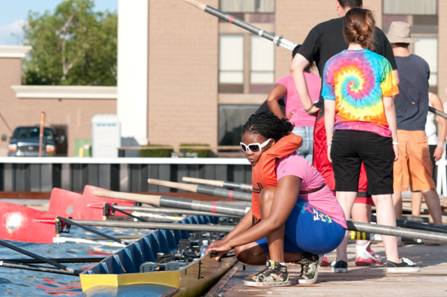 “Rowing is very much alive and playing its unique role in developing the character of those who take up the oar,” was something rowing historian Tom Weil said yesterday when he was the ‘keynote speaker’ at the opening of the New Bedford Community Rowing Programme at Buzzards Bay Center in New Bedford, MA. Weil continued to say, according to an article in South Coast Today, “You couldn't ask for a better partner in business or life than a rower.
I received an invitation to this event, but unfortunately, this was the same evening as my children had a ‘Kick Off’ at their school.
There was a lot of town and rowing celebrities gathered at the Buzzards Bay Center for the opening and it seems to have been a really nice event. Click here to read the article in South Coast Today.
Tuesday, June 8, 2010
Rowing To Fishers Island
 The Crimson Knights rowing to Fishers Island. From bow to stern: William Solberg ’11; Tim Smith ’10 (Northeastern); Bert Harney ’10 (Cornell); Grant Barnekow ’10 (U Cal Berkeley); Patrick Grogan ’10 (Trinity Dublin); Josh Weinstein ’11; Kyle Good ’10 (Cornell); stroke Emery Schoenly ’10 (Yale); cox Bryan Wong ’10 (NYU). Photograph: Tony Tremaine, Salisbury captain ’66.
Last Friday in Mystic, I had the great pleasure to meet coaches and a varsity crew from Salisbury School (Connecticut). The team was training in the nearby little town of Stonington, and with some strings pulled here and there, I ended up giving these nice chaps a guided tour in the National Rowing Hall of Fame, the rowing exhibit ‘Let Her Run’, and the Boat Storage at Mystic Seaport Museum. They very patiently and politely allowed me to show them around and to tell some anecdotes about some professional scullers, Thomas Doggett, and Dick and George Pocock, Yale’s 1956 Olympic eight, etc.
The crews’ coaches Tote Smith and Tony Tremaine told me that the boys had been up early in the morning to row their eight from the Connecticut shoreline across Fishers Island Sound to Fishers Island (which actually is in New York State!), a good 2-3 mile stretch of open water (see photograph on top), and then back. Indeed a good way to live up to their school’s motto Esse Quam Videri!
The crew - William Solberg, Tim Smith, Bert Harney, Grant Barnekow, Patrick Grogan, Josh Weinstein, Kyle Good, Emery Schoenly, and cox Bryan Wong – has a busy schedule for the next three weeks. They are going to race at the USRowing Youth National Championships in Cincinnati, and thereafter leave for England to row at the Marlow Regatta, the Reading Town Regatta, and the ever so famous Henley Royal Regatta.
Best of luck, boys, or as you probably would say:
GO CRIMSON KNIGHTS, GO!
Wednesday, May 12, 2010
Oliver Optic's Work And Win
 Yesterday, a rowing book arrived in the mail. It is not a new book on rowing, and to be honest, it is maybe not that much of a rowing book either. The book is Work and Win by Oliver Optic (William Taylor Adams 1822-1897). What caught my eye was the cover of the book, a boy in a single scull. This book was first published in 1865 or 1866; my copy is of a much later date, probably mid-1900. I have added it to my entry of 9 August, 2009, where I posted a list of juvenile books with rowing as a minor or major theme.
Tuesday, May 11, 2010
Etonians And Their 'Boaters'
 This time, Tim Koch, was very quick sending me some comments about my entry from yesterday about Eton and ‘boaters’. I hand over to Tim - and this time let's call him 'Guest writer' - who writes:
Your recent comments about 'boaters' (flat topped straw hats) at Eton School in England prompts me to send a picture of such an item from my collection of rowing memorabilia [see above]. It was worn sometime in the 1880s by one of the crew of the boat 'Victory' in the 'Procession of Boats' which takes place every year on the school's ‘parents' day" known as the 'Fourth of June'.
Eton School (more correctly called 'Eton College', though the boys are aged 13 to 18) is the most famous fee paying school in the world. Founded in 1440 by Henry VI, it has produced eighteen British Prime Ministers (however, by the time you read this, David Cameron could have made the number nineteen). Our interest is in the fact that it can lay claim to have invented rowing as an amateur sport - though Westminster School, founded 1179, may disagree. The earliest record of rowing for pleasure at the school dates from 1793. Until perhaps the First World War, it produced the majority of University Boat Race and Henley winners.
 The 'Fourth of June' is a celebration of the birthday of King George III (1738-1820), Eton's greatest patron. This year it is on 2nd June. Various events take place on this day but the most famous is ‘The Procession of Boats’, in which the best crews from the top four years row past in clinker built, fixed pin eights. They wear uniforms of eighteenth century midshipmen, with the cox dressed as an admiral. The rowers have boaters sporting the name of their boat on their hat-bands and the school arms in metal, all decorated with fresh flowers. At a certain point, the entire crew and cox stand up in the boat with their oars erect. They face Windsor Castle, remove their hats and cheer the memory of George III. The ever reliable British Pathe web-site provides filmed evidence of these seemingly unlikely events.
This film from 1904 also shows Edward VII's Royal Barge which would have been rowed by professional Watermen:
(KING EDWARD VII AT ETON)
Here is some nice colour film from 1960. Interestingly, the boys seem less confident than those in 1907:
(ETON - THAMES / POWER BOATS)
Some nice sound film from 1938. At forty seconds in, there is a brief shot of the 'Monarch', a ten-oar.
FOURTH OF JUNE AT ETON
The 'Monarch' was retired in 1990 after at least 100 years service and is now in the National Maritime Museum in Falmouth here in England.
My collection also contains a programme from 'The Procession of Boats' of 1885. It shows many famous rowing names, notably Guy Nickalls, S.D. Muttlebury, C.M. Pitman and Lord Ampthill.

Many thanks to Tim for this lovely contribution!
Tuesday, March 30, 2010
Rowing School Girls In The 1950s
 Already in another entry (Rowing Books For Youths 1, on 7 August 2009), I have talked about the Amalgamated Press, which for several years published magazines for girls and boys. This publishing company, which also published books under the names Fleetway Publications and Fleetway House (as it was located in Fleetway House in London), also came out with juvenile ‘annuals’. The School Friend Annual
  started in 1927 to entertain girls with cartoons, strips, poems, articles, stories, and fashion, etc. In 1953 and 1959, the covers of The School Friend Annual show girls in a rowing setting. While both pictures are ‘nice’, artistic improvements could have been made to the details of the boats. Now, the riggers go right into the hull (1953) and the sculling girl in the single is using terribly ‘thin’ sculls (1959).
Wednesday, February 24, 2010
Film review: La Régate
I am incredibly happy to introduce my blog’s first guest writer, mademoiselle Hélène Rémond of France. Among many things, Hélène is a journalist, and interested in all kind of aspects of rowing. You might have seen her name in my entries earlier as she, now and then, has sent me material or come up with ideas that I have tried to elaborate and present in my blog. Here is a film review of Bernard Bellefroid’s new film La Régate, which has just been released in a couple of countries in Europe, that Hélène has specially written for this blog. My warmest gratitude goes to her for doing so!
)
La Régate (‘The Boat Race’) by filmmaker Bernard Bellefroid
With Joffrey Verbruggen, Sergi Lopez, Thierry Hancisse (from the Comédie Française) and Pénélope Lévèque.
Belgian director Bellefroid’s first feature film La Régate has been shown since last Wednesday in France. The Belgian public could see it today. As to Luxembourg, the film will be on the big screen on 26th this month. Where else will the story of 15 year-old Alexandre be projected? Time will tell. This is a moving, touching, sensitive film in an original environment usually not given much coverage: rowing. The actors’ performance is very convincing. Inspired by Bellefroid’s own experience, it is a social drama, the poignant story of Alex beaten by his father with whom he is living. He finds the way of getting out of this violence by being involved in rowing to win the Belgian championship.
)
)
The setting of the Meuse river where he rows is radiant. The rock soundtrack illustrates well Alex’s rage used in a positive way, to surpass himself in the boat. It contrasts with the dark side of the apartment where much tension is felt. It is the story of a harsh relationship between a father and his son, the inability to show love when suffering is overwhelming. At the Rowing Club, with the help of the coach, Sergi, and Murielle, the girl he’s in love with, Alex will learn how to regain human values, to exchange with others, to love... He is initiated to the values of rowing: willpower, surpassing of oneself, solidarity, team spirit. It is a sport requiring strength and endurance and Alex needs these qualities to be able to escape his suffocating past. The film ends on this quote: “To the men who'll never be sons. To the sons looking for their dads. To the dads who don't know their sons no more To my future children I can finally dream of.”
)
La Régate has won prizes at Namur Film Festival 2009, at the International Rome Film Festival and at Angers Film Festival 2010.
Hélène Rémond
La Régate (‘The Boat Race’) by filmmaker Bernard Bellefroid
With Joffrey Verbruggen, Sergi Lopez, Thierry Hancisse (from the Comédie Française) and Pénélope Lévèque.
Belgian director Bellefroid’s first feature film La Régate has been shown since last Wednesday in France. The Belgian public could see it today. As to Luxembourg, the film will be on the big screen on 26th this month. Where else will the story of 15 year-old Alexandre be projected? Time will tell. This is a moving, touching, sensitive film in an original environment usually not given much coverage: rowing. The actors’ performance is very convincing. Inspired by Bellefroid’s own experience, it is a social drama, the poignant story of Alex beaten by his father with whom he is living. He finds the way of getting out of this violence by being involved in rowing to win the Belgian championship.
The setting of the Meuse river where he rows is radiant. The rock soundtrack illustrates well Alex’s rage used in a positive way, to surpass himself in the boat. It contrasts with the dark side of the apartment where much tension is felt. It is the story of a harsh relationship between a father and his son, the inability to show love when suffering is overwhelming. At the Rowing Club, with the help of the coach, Sergi, and Murielle, the girl he’s in love with, Alex will learn how to regain human values, to exchange with others, to love... He is initiated to the values of rowing: willpower, surpassing of oneself, solidarity, team spirit. It is a sport requiring strength and endurance and Alex needs these qualities to be able to escape his suffocating past. The film ends on this quote: “To the men who'll never be sons. To the sons looking for their dads. To the dads who don't know their sons no more To my future children I can finally dream of.”
La Régate has won prizes at Namur Film Festival 2009, at the International Rome Film Festival and at Angers Film Festival 2010.
Hélène Rémond
Thursday, February 18, 2010
FISA Interviews Bernard Bellefroid
 Yesterday, The International Rowing Federation, FISA's, web site posted an interview with the Belgian filmmaker Bernard Bellefroid about his rowing movie, La Regate, which Hélène Rémond flagged already in November last year (see my 11 November entry). The film has just been released in France at a few theatres. You can read the full interview by clicking here.
Monday, February 8, 2010
More Great Rowing Pictures
For some weeks now, I have been busy with research and writing pieces for the British magazine ROWING & REGATTA and the Swedish rowing magazine SVENSK RODD. Parallel to this I have begun a writing project that, actually, has nothing to do with rowing. It is too early to say how big of a task this is, and if I can pull it through, but thanks to Tim Koch in London, I still have something to post here on my blog.
True to his habit, Tim has found another wonderful photo archive, corbisimages.com which, he writes “is a commercial one, so I’m not sure about the legal issues of reproducing the pictures (though they all have spoilers).”
If you go to corbisimages.com and type in ‘rowing’ you get thousands of results, most not relevant to the sport, Tim writes. Some of these you might have seen for sale on eBay, but most of them are not. To be able to watch the pictures below you have to click on the underlined number.
Here are some of Tim’s favourites (with his captioning). Enjoy!
Nice crew picture 1890: No. 1
In place of a firm handshake 1920: No. 2
Wellesley Women 1922: No. 3
1950s sexist caption: No. 4
American coaches, big horns, great clothes: No. 5 No. 6 No. 7
Third class, smoking? (This is one of my favourites, too): No. 8
Wartime spirit: No. 9
Minnesota Boat Club: No. 10 No. 11
The history of African American rowing in the USA: No. 12
Interesting early women rowing: No. 13
Nothing is new: No. 14
Nice rowing kit: No 15
A good student: No. 16
Twelve years later: No. 17
Again, many, many thanks to Tim!
True to his habit, Tim has found another wonderful photo archive, corbisimages.com which, he writes “is a commercial one, so I’m not sure about the legal issues of reproducing the pictures (though they all have spoilers).”
If you go to corbisimages.com and type in ‘rowing’ you get thousands of results, most not relevant to the sport, Tim writes. Some of these you might have seen for sale on eBay, but most of them are not. To be able to watch the pictures below you have to click on the underlined number.
Here are some of Tim’s favourites (with his captioning). Enjoy!
Nice crew picture 1890: No. 1
In place of a firm handshake 1920: No. 2
Wellesley Women 1922: No. 3
1950s sexist caption: No. 4
American coaches, big horns, great clothes: No. 5 No. 6 No. 7
Third class, smoking? (This is one of my favourites, too): No. 8
Wartime spirit: No. 9
Minnesota Boat Club: No. 10 No. 11
The history of African American rowing in the USA: No. 12
Interesting early women rowing: No. 13
Nothing is new: No. 14
Nice rowing kit: No 15
A good student: No. 16
Twelve years later: No. 17
Again, many, many thanks to Tim!
Subscribe to:
Posts (Atom)