Photograph: Werner Schmidt
Showing posts with label Trial Eights. Show all posts

Tuesday, March 4, 2014

The 1933 Cambridge Trial Eights Heat

WELL TOGETHER ALREADY!


While this is the period of pre-Boat Race fixtures on the Thames when Oxford crews and Cambridge crews race other university crews or club crews, I thought I should throw in an old race that happened 81 years ago, a Light Blue Trial eights heat from 1933, probably rowed in the month of December that year, at Ely. The film is from British Pathe with the title: “Ely. Well Together Already! Light Blues show winning form in trial eights to select crew for 1934’s race.” It was not surprising that the editor of this newsreel would proclaim Cambridge a winner of the 1934 Boat Race. The Light Blues had won every race against the Dark Blues since 1920, but one, in 1923. Although, it is hard to see who is actually in the winning trial eight, I believe I see three of the most important Cambridge crew members during the mid-1930s, the three 'rookies': Ran Laurie, Jack Wilson and cox Noel Duckworth - all three men have been mentioned multiple times on HTBS.

With this trio, the Light Blues won three more Boat Races, in 1934, 1935 and 1936, before the Dark Blues managed to win both in 1937 and 1938.

Tuesday, January 21, 2014

Giving It Some Welly*: The 2014 Oxford Trial Eights


A Study In Blue: Oxford’s ‘Wellies’.


Chris Dodd has written about rowing and rowing history for forty years including twenty-five years as the rowing correspondent of the Guardian. Many of Chris’s articles for that esteemed newspaper can be read here. He now reaches the pinnacle of his writing career (possibly) with this exclusive report for Hear The Boat Sing on the 2014 Oxford Boat Race Trials which took place on Sunday, 19 January. Pictures, captions and sub-editing by Tim Koch.


The crews, courtesy of The Boat Race Company. (Click on the picture to enlarge.)


Chris writes:


Unprecedented events took place at the Oxford trials at Putney – delayed for a month because of pre-Christmas illness amongst the squad. On a sumptuous winter watercolour afternoon, with a handful of cotton wool clouds hanging low on the horizon of a Cambridge blue heaven, the tide had great difficulty in turning.


Since the beginning of January the Thames Valley has been a lake district. Millions of gallons have nowhere to go but plunge ever eastward towards the estuary, and at Putney the moored boats struggled to turn for nearly an hour as the ebb was supposed to be giving way to the flow.

Facing the camera, Race Umpire Richard Phelps (CUBC, 1993-1995) talks tides to Boat Race legend, Professor Boris Rankov (OUBC, 1978-1983). In the background are two other sporting icons. The white arch on the left marks the home of British soccer, Wembley Stadium, approximately 7 miles / 11 kilometres away. On the right, the white building is the ground of Fulham Football Club, better known as ‘Craven Cottage. Fulham are a much loved (if not always successful) London team.


The umpires panel debated the problem and decided that if the going got tough up at Barnes, the crews could hug the Middlesex bank and take the inside arch of the bridge, with official Tony Reynolds posted on the railway bridge to warn crews progressing downstream on what they supposed was the ebb that there may be boats racing upstream steering where they didn’t ought to be.


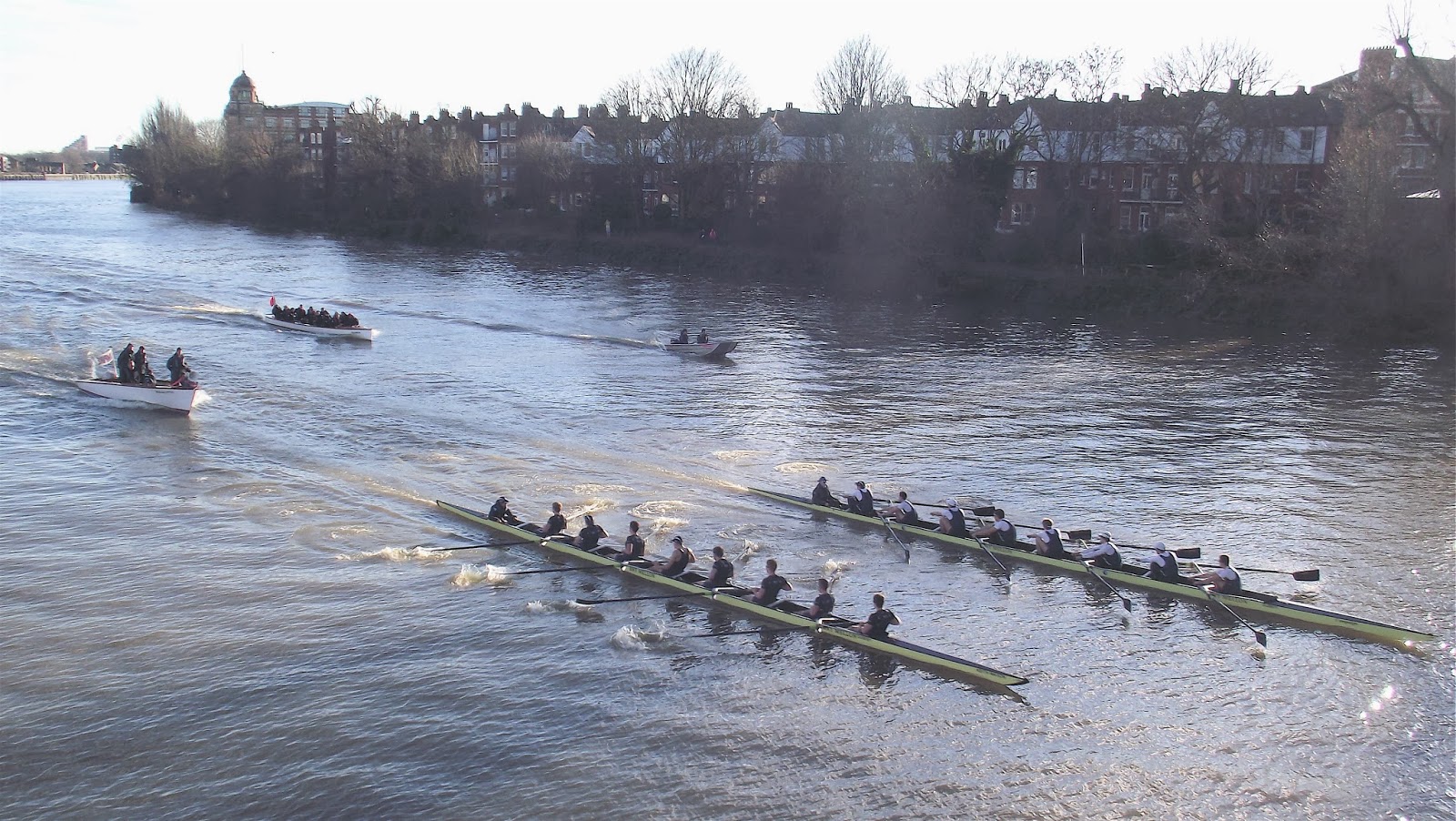
In the event, Oxford coach Sean Bowden delayed the start, waiting for the tide in vain, and then moved the course downstream to run from Wandsworth Pier to Chiswick Steps. And a damn fine race it was. Persistent, with president Malcolm Howard at 5, stroked by Chris Fairweather and coxed by Lawrence Harvey, was on Surrey, while Stubborn, with Olympian Constantine Louloudis stroking and Sophie Shawdon coxing, was on Middlesex.


It was a good start on flat water, nothing in it at Putney Railway Bridge, both crews neat and strong, with Persistent showing by scarcely two seats at Putney Bridge. Umpire Richard Phelps warned both crews early on, and the boats were close together as they duelled past the boathouses.


By Newens Marine, Stubborn had their bow ball in front and eked their lead to half a length at Barn Elms. The flotilla carved its way through a fleet of dinghies to the Mile, where Stubborn, led by Constantine’s fluent stroking, were a length in front.


Passing Harrods. Stubborn on the left, Persistent on the right.


Harvey was having none of this, though. Persistent clawed back the gap between Harrods and Hammersmith, both crews being warned as the blades were a cigarette paper from knitting.


Oxford supporter Sophie Behan finds a good viewing point on Hammersmith Bridge, next to the famous ‘second lamppost from the Surrey buttress’, which is said to mark the fastest water.


At Hammersmith Bridge, Persistent leads Stubborn by a canvas.


Persistent passed the bridge perhaps a canvas ahead, Stubborn classically under the second lamppost, and Persistent pushed out to half a length advantage by St Paul’s School, where another fleet of sails diced over the available water. Miraculously nobody hit anyone, and as Chiswick Eyot approached, Stubborn closed the gap once more, reducing the lead to little more than a length at the Steps.


Viewed through the metalwork of the upstream side of Hammersmith Bridge, the crews pass, on Middlesex, Sons of the Thames Rowing Club and, out of shot on Surrey, St Paul’s School.


Stubborn showed a hint of a wilt before the race stopped, but this was a mere blip. Bowden has sixteen good men and true, racers to a man. The unofficial time – Wandsworth Pier to Chiswick Steps – was 16 minutes 10 seconds to 16.14. A record!


Many thanks to Chris for his report. More pictures can be viewed on Twitter. Martin Cross, 'The Blogging Oarsman' shot a short little video of the boats approaching Hammersmith Bridge. HTBS reported on the trials held in December for both universities’ women and the Cambridge men here  and here.


*A common British idiom which means to apply great physical effort to something. Its origins are not old but they are obscure. A ‘welly’ is a long rubber boot, more formally known as a ‘Wellington Boot’ in the UK but as a ‘gumboot’ or simply ‘rain boot’ in other countries. It is named after the 1st Duke of Wellington who popularised them (he also popularised defeating the French). The most iconic British Wellington Boots are made by Hunter Boot Ltd, founded in Edinburgh in 1856. They are one of the sponsors of the Boat Race, but have cleverly got themselves some wonderful publicity in the last four years by supplying the crews with special Cambridge Blue or Oxford Blue boots, 
with the respective boat club’s crest. They are not available to the public but a pair of size 15/50 Oxford boots recently sold for £95/$130 on eBay. This may seem to be a lot of money but an ‘ordinary’ pair costs £85 new.

Friday, December 20, 2013

The 2013 Oxford - Cambridge Women’s Trial Eights: Races To The Finish

Maintaining form. Anastasia Chitty and OUWBC President Maxie Scheske, Stroke and 7 of Boudicca.

Here is Tim Koch’s report from Oxford and Cambridge Women’s Trial Eights which were rowed yesterday. Tim writes:

A small piece of history was made on Thursday, 19 December, when the Oxford and Cambridge Women’s Trial Eights were held over the full Tideway course for the first time. I was lucky enough to get a place in the press launch on a windless, mild and bright winter’s day with beguine river conditions. My only concern was that I would get bored after the first few minutes of each trial, fearing a five-minute race and a fifteen-minute procession. Be assured that this apprehension was not a result of any archaic ideas about women’s rowing, rather it was based on the fact that long running injustices can take a long time to put right.

In my report on the 2012 Henley Boat Races I referenced a piece written in the event programme by the rowing journalist and historian, Chris Dodd. To quote myself:

The men in (Chris’s) view, ‘struggled for 180 years to make a really good, nail biting contest of it for 4 miles and 374 yards’. He says that, until they received proper funding and professional coaching in the 1980s, the men were not fit enough to race the full distance. The result was a mad scramble to reach Hammersmith Bridge, by which point the winner usually emerged and the loser followed in their puddles in the long row to the finish. Chris says that this has now changed and that the Boat Race ‘has come of age as a superb event’.


‘Proper funding and professional coaching’ came to the Oxford and Cambridge Women last year, giving them two years preparation before they race on the Tideway in 2015. The question is, will this be enough time to produce crews that can make a race of it over the full distance? I am pleased to say that, judging by the four crews at Thursday’s Trials, the answer could well be ‘yes’. The Oxford race was particularly impressive, fought through to the last stroke. I do not envy the coach who has to choose a crew out of these two boats. Former BBC sports reporter Martin Gough @martingough22 said on Twitter:

Key question over Women’s Boat Race answered decisively. Can WBR be a contest over the full course? Both Trials lasted past Chiswick Steps – more than most men’s races until 15 or so years ago.

None of the four coxes who raced today, or the two who raced with the CUBC men the day before, were faultless. The Boat Race, more than any other, is a coxswain’s race and perfection is what is really required.

As I cannot better the excellent race reports published on the official Boat Race website, I am reproducing them verbatim below, interspersed with my photographs.

The Oxford Trial VIIIs

Cleopatra, with the experienced Harriet Keane rowing at 5, won the toss and chose the Surrey station, leaving Middlesex to Boudicca, with Oxford president Maxie Scheske in the 7 seat.

With three-times Boat Race winner Sarah Winckless taking charge in the umpire’s launch, the crews set off in perfect racing conditions, with Cleopatra rating 39 strokes a minute and Boudicca at 38.

Oxford off the start at Putney Pier. Cleopatra left and Boudicca right.

Past the boathouses Boudicca was already looking the more together crew, settling at 36 strokes a minute and leading Cleopatra by half a length. The women in Boudicca used the inside of the Middlesex bend to good advantage, increasing their lead to ¾ length before cox Erin Wysocki-Jones cut off the corner at Craven Cottage, and Cleopatra were able to get back in to the race.

Barn Elms
 

Harrods
 
Cleopatra, on Surrey, began to claw back the deficit, despite underrating the leaders, until they reached Hammersmith Bridge where the crews were level.

Hammersmith Bridge
 

St Pauls School
 
Despite steering wide, Boudicca held their ground, and the crews were still level as the race entered the rougher water off the top of Chiswick Eyot. With the race still level at Chiswick Steps, Cleopatra pushed on hard approaching the Crossing where they led by half a length, but Boudicca found a new rhythm and lengthened out their stroke, still at 30, to regain the lead approaching the bandstand.

Chiswick crossing

The Bull at Mortlake

There was a full boat length in Boudicca’s favour at Barnes Bridge where the leaders were able to sit up confidently and increase their lead, eventually crossing the line 3 lengths clear, to win a well-fought race.

 Barnes Bridge

 
 Approaching Mortlake Brewery

The finish
 
The Cambridge Trial VIIIs

The first Cambridge women’s crews to trial over the full Boat Race course were Nudge Nudge, coxed by their president, Esther Momcilovic, and Wink Wink, with double Blue Caroline Reid in the 5 seat.

Cambridge off the start. Wink Wink on the left, Nudge Nudge on the right.

Passing Thames RC

Nudge Nudge won the toss and chose the Middlesex station, setting off at 40 strokes a minute against Wink Wink at 41, but it was the Surrey crew who drew ahead past the boathouses, maintaining a high rate at 37 while Nudge Nudge had already settled at 35.

At Barn Elms

Approaching the Mile Post
 
Rowing in a solid style, Wink Wink increased their lead to 2/3 length at Barn Elms, rating 34 to Nudge Nudge at 32 but the Cambridge President steered a better line than the Oxford crew on Middlesex had done an hour earlier. Now it was Nudge Nudge who looked the more rhythmic crew, and past Harrods the crews were level once again.

Passing Harrods
 
With both crews rating 33 beneath Hammersmith Bridge Nudge Nudge now pushed on hard and gained half a length around the outside of the bend.

Hammersmith
 
They maintained the same margin to the top of Chiswick Eyot and then made the move that would determine the outcome of the race. Upping the rate a couple of pips they took a further half a length off the opposition in about ten strokes and past the Crossing they led by a full length.

Approaching Chiswick Crossing

Mortlake

Through Barnes Bridge
 
With both crews at 31 strokes a minute Nudge Nudge gradually extended their lead, but a spirited finish by Wink Wink closed the gap a little as the finish line approached.

Last few strokes
 
Nudge Nudge were declared the eventual winners by three lengths, rounding off a day of excellent racing which bodes well for The Newton Women’s Boat Race itself in just over three months’ time.

On returning to Putney we found one of the things that they don’t teach you at Cambridge – tides go out and tides come in.

Photographs © Tim Koch

Thursday, December 19, 2013

Four Eights Are Sixteen: The December Boat Race Trials 2013

Members of Cambridge University Women’s Boat Club wait for the men's race by the famous steering point that is the second lamppost out from the Surrey buttress of Hammersmith Bridge.

Tim Koch reports from Cambridge Trials:

Wednesday, 18 December was the date set for the 2013 Oxford - Cambridge Heavyweight Men’s Boat Race Trials held over the full 4 1/4 mile Putney to Mortlake course. These are not contests of Light Blue against Dark, they are intra-university races, Oxford v Oxford and Cambridge v Cambridge, where the last sixteen rowers and last two coxswains from each university battle it out in theoretically matched boats, all eighteen hoping to impress the coach who has to make the final selection. The Tideway Trials are an important learning experience for athletes and coxes, as well as an intense selection test. Unfortunately, this year illness and injury has struck the Oxford camp and they have delayed their Trial VIIIs until the New Year.

Sean Bowden, the Chief Coach of Oxford University Boat Club said in a press release:

In the last week the squad has been hit by a wave of illness that has affected a significant number of rowers.. The problem has been compounded by the fact that the large majority of those unable to row are all on the same side of the boat... (The) coaching staff did not want to take the risk of racing with athletes not in good health. Furthermore, there seemed to be little value in holding the race with a number of substitutes from outside the squad in the boats in what would have been largely scratch and untested crews. Trial VIIIs is an important part of the team’s preparation for The 2014 BNY Mellon Boat Race so this is not a decision made lightly.

Trial VIIIs 2013 - CUBC. Courtesy of The Boat Race Company.

The Cambridge Trials continued as planned however. The squad has only two Old Blues, Mike Thorpe and President Steve Dudek. Both crews were stroked by Americans - Luke Juckett and Henry Hoffstot. They included the first Austrians ever to represent Cambridge, Florian Herbst and the international U23 sculler, Alexander Leichter. The coxswains were first-time triallists, Ian Middleton and 2013 Blondie cox, Arav Gupta.

As I was stationed on Hammersmith Bridge, I did not see the whole race and thus I must quote at length from the report on the official Boat Race website. I have shortened the boats christened Sea Shells and She Sells to 'Sea' and 'She' as it is mentally confusing to use the full names (or is it just me?) Full credit to umpire Richard Phelps for coping with this student joke.

'Sea'... won the toss and chose the Surrey station. That left the early advantage on Middlesex to 'She'... ‘Sea’ went off at 43, a pip higher than the opposition, but it was ‘She’ who eked out a slight advantage past the boathouses and maintained the lead all the way to Barn Elms. As both crews were warned in turn for their steering American stroke Luke Juckett took ‘Sea’ up a notch to take a canvas lead past Harrods.

Hoffstot’s She Sells (left) on Middlesex and Juckett’s Sea Shells (right) on Surrey pass the Harrods Buoy.

Approaching Hammersmith Bridge.

As the Surrey bend now began to work in the their favour ‘Sea’... increased their lead to two thirds of a length but the crews now began to feel the full force of the stiff south-westerly breeze. ‘She’ on Middlesex seemed to cope better with the rougher conditions while Dudek’s crew lost a little of their rhythm. But they recovered past Chiswick Steps, and were drawing level once again, when Ian Middleton, the ‘Sea’ cox, unfortunately failed to spot the obstacle in his path until it was too late, and the marker buoy hit the stroke side riggers of his crew, who immediately lost half a length.

Approaching Barnes Bridge ‘She’ were able to cross into their opponents water and take the rate down to 29 while the losing crew maintained their rate at 31. Both crews upped the rate approaching the finish but ‘She’ now had a comfortable lead, crossing the line to win by just over 3 1/2 lengths.

“Both crews have different strengths and weaknesses and we focused a lot on developing the strengths”, said Cambridge chief coach Steve Trapmore afterwards.

“I was pleased with the way the race went”, said umpire Richard Phelps, who will take charge of his first Boat Race next year. “Both crews responded quickly to my warnings, but we were off the race line at one or two points so there’s still some work to be done there.”

The victorious She Sells comes ashore ahead of the losing Sea Shells.

In support of Phelps’s comments on the racing line, from my viewpoint on Hammersmith Bridge, I thought that both coxes went wide passing Harrods - though She Sells cox, Arav Gupta, corrected his mistake first. In semi-defence of Sea Shells cox Ian Middleton who hit what I presume to be the Surrey crossing buoy at Chiswick, this has moved out of position since the storms at the end of October. However, I imagine that Middleton has passed by it many times since then and a Boat Race cox cannot afford to make a mistake even a fraction of this severity.

The winning time was 18 minutes 38 seconds. Even if Oxford had raced, comparing the times of different races held on a tidal river is fairly meaningless. However, in the Head of the River Fours held over the same course nearly three weeks earlier, the top Cambridge boat consisting of trialists Helge Gruetjen, Steve Dudek, Mike Thorpe, Henry Hoffstot and cox Ian Middleton came second to the top Oxford Four of Malcolm Howard, Constantine Louloudis, Karl Hudspith, Michael di Santo and cox Laurence Harvey. The only consolation for the ‘Tabs was that they beat an impressive Leander Four into third place.

'Hear The Boat Sing' always looks for the historical aspect of any contemporary rowing event. While I gave a brief historical perspective in my report on the 2012 Trials I can now add an interesting footnote. I was recently researching the 1923 Boat Race for a forthcoming piece when I came across an article in the Sphere magazine of 17 March 1923, subtitled ‘The Fathers of the Boat Race’. It chronicled what were then the two oldest surviving veterans of the race. The Rev. Cannon Richard Martin, then 89, and the Rev. John Arkell, then 87, rowed at ‘3’ and ‘4’ respectively in the Oxford Crew of 1857.

Richard Martin, Oxford ‘4’ in 1857.

John Arkwell, Oxford ‘3’ in 1857, ‘2’ in 1858 and ‘Stroke’ in 1859.

Arkell, who died not long after the Sphere report, had the more distinguished rowing career of the two. After winning in 1857, he rowed again in 1858 and lost, but won at Stroke in 1859. Also in 1859, Arkell won the Silver Goblets at Henley with the famous oarsman and coach, Edmund Warre, beating AA Casamajor and James Paine. The Sphere records our particular interest in John Arkell thus:

Mr. Arkell has... a great claim to special honour by the rowing fraternity of the two Universities. It was he who became one of the originators and founders of what are today known as ‘The Trial Eights’ which are races made up of two of the best eights the ‘Varsity can produce about Christmas each year... It was in the vetera’s own room at Pembroke, Oxford, whilst he was President of the ‘Varsity Boat Club, that the rules and regulations for these eights were drawn up by four or five celebrated oarsmen.

Returning to the present day, although the Heavyweight Women will not race on the Tideway until 2015, their Trial Eights will run over the Putney to Mortlake course on Thursday, 19 December. Unlike the men, the Oxford women will be racing - they are obviously made of stronger stuff. HTBS will also be there.

The end of a long day.

What we are supposed to call the ‘BNY Mellon Boat Race’ is on Sunday, 6 April 2014 at 6.00pm. The equally inelegantly named ‘Newton Women’s Boat Race’ is at Henley on Sunday, 30 March 2014 at 3.00pm.

Wednesday, December 19, 2012

'Easy' beats 'Quick' with 0.6 sec.!

Photo: Newton Women Boat Race website
While Cambridge’s women in Tonic did not have a problem easily winning over their opponents in Gin, which HTBS reported on Monday, the Oxford University Women’s trial eights race was truly a battle to the finish line on the Henley course on Sunday. After the crews had crossed the line, they eagerly waited for the result from Umpire Matthew Pinsent. His verdict: Easy defeated Quick by 0.6 seconds – an amazing race.

Read more about the race here.

To get more information about these two crews, please click here.

Monday, December 17, 2012

'Tonic' Ahead of 'Gin'

Photo: Newton Women Boat Race website
For the Newton Women’s Boat Race, which is going to be raced on 24 March, 2013, at Henley-on-Thames, Cambridge University Women Boat Club (CUWBC) held their trial eights race at Eton Dorney on Saturday, 15 December. The two eights Gin and Tonic (and spare four) raced over the 2,000-metre Olympic course into a stiff cross head wind on an otherwise glorious day.

Despite an early lead from Gin, rowing in a new Hudson shell, Tonic, in a Empacher, proved their spirit was in the crew and, with the more experienced stern pair, hauled Gin back before the 1000-metre mark. Fay Sandford, the stroke in Tonic, was able to settle to a nice long stride and set a good rhythm, moving slowly away and taking clear water by 1500-metre and winning by a margin of 5 seconds.

To get some more information about these crews, please click here.

Oxford University Women Boat Club (OUWBC) held their trial eights race on Sunday, 16 December, more information about that race will follow.

Friday, December 14, 2012

The 2012 Pre Christmas Trial VIIIs

Oxford approaching Hammersmith Bridge. Spirfire on the left and Hurricane on the right.

HTBS's Tim Koch reports from London,
In my piece for HTBS on 28 November I gave an historical perspective to the Boat Race Trials. I suggested that, with modern scientific selection methods, they are not as important as they perhaps were in choosing the final crew. However, I omitted to say that, as far as selecting the cox goes, these inter-club races can still be vital deciders. There is simply no test that is a substitute for steering the simple yet difficult ‘S shaped course other than doing it in a side by side race – as the coxes found in the pre Christmas trials held in good conditions over the full Boat Race Course on 13 December.

Two Boat Race legends, Umpire Boris Rankov (a six times Boat Race winner) and Dan Topolski (who coached Oxford to twelve victories). Sir Matthew Pinsent will umpire the main race for the first time on 31 March.

The Trials are not Oxford v Cambridge races. CUBC and OUBC each race their final 16 oarsmen and two coxes against each other, not against the other place’. This year the Dark Blues raced first in boats named Spitfire and Hurricane for the occasion. Just over an hour later, the Light Blues put out Bangers and Mash. Former BBC sports reporter Martin Gough got one of the much sought after seats in the press launch and later gave me his impressions of the races.

The Oxford Race
Hurricane (Surrey Station)
Bow: James Stephenson (GB)
2: Oliver Bristowe (GB)
3: Joseph Dawson (GB)
4: Benjamin French (USA)
5: Karl Hudspith
(GB)
6: Constantine Louloudis (GB)
7: Dr. Alex Woods (GB)
Stroke: William Zeng
(USA)
Cox: Katie Apfelbaum (USA)

Spitfire (Middlesex Station)

Bow: James Mountain
(GB)
2: Maurus Wuethrich 
(Switzerland)
3: Nicholas Hazell
(GB)
4: Iain Mandale
(GB)
5: Tom Watson
(Canada)
6: Samuel O’Connor
(NZ)
7: Alexander Davidson
(GB)
Stroke: Malcolm Howard
(Canada)
Cox: Laurence Harvey (GB)

Oxford's Spitfire goes afloat.

Martin Gough: (In the Oxford Race) it was fairly marginal off the start, both went off quite high... If anything, Spitfire took advantage of the Fulham Bend and were half a length up by Barn Elms. Their cox, Laurence Harvey, was warned quite severely by umpire Boris Rankov early on. Spitfire were 3/4 of a length up at the Mile but as the bend came back in Hurricane’s favour they put their move in. They looked longer and looked as if they had a better rhythm throughout, Hudspith
and Louloudis in the middle playing a really important part. As they came around the Hammersmith Bend, Hurricane were perhaps half a length up. Just before Chiswick Eyot, very close to where the race was stopped last year, there was a clash of blades. Alex Wood in the seven seat lost his blade and lost it again as he tried to regain it. In the time it took Hurricane to get going again, Spitfire were a length up. Even then, even with Spitfire about to have the bend in their favour, I wondered whether Hurricane might come back. They looked looser, they looked like they were getting more length per stroke. (Tim Koch: Some have suggested that, if the Trial were the real thing, cox Harvey’s crew would have been disqualified, even though he otherwise took a better course than Apfelbaum). Both crews put pushes in and Hurricane got back to perhaps 1/4 of a length down. They both put in a great sprint finish, Hurricane taking it up to over 38 strokes per minute and Spitfire to 40, an absolute nail biter, a really good race.

Time: 17 minutes 45 seconds, Spitfire won by 1/4 length.

Cambridge going to the start. Mash is nearest Putney Bridge and Bangers is in the foreground.

The Cambridge Race
Bangers (Surrey Station)
Bow: Chris Snowden
 (GB)
2: Mike Thorp (GB)
3: Josh Hooper 
(Australia)
4: Alexander Leichter 
(Austria)
5: Ty Otto (USA)
6: Stephen Dudek 
(USA)
7: Milan Bruncvik
 (Czech)
Stroke: Niles Garratt
 (USA)
Cox: Henry Fieldman 

(GB)

Mash 
(Middlesex Station)
Bow: Rowan Lawson (GB)
2: Alex Ross (NZ)
3: Jack Lindeman (USA)
4: Helge Gruetjen (Germany)
5: George Nash (GB)
6: Grant Wilson (USA)
7: Alexander Scharp (Australia)
Stroke: Alexander Fleming (Australia)
Cox: Sam Ojserkis 
(USA)


Cambridge going away from Hammersmith Bridge. Bangers lead Mash. Both have Four and Five on bowside (starboard) with tandem rigs.

Martin said this of the less exciting Cambridge Race: Mash took an early lead and were half a length up at the Mile Post. Bangers... took a while to hit their stride but started to claw back... and were level by Harrods. It was a decent move. To spite some minor clashing and some errant steering they came through to gain the lead by Hammersmith, a length by St Paul’s, they just moved on from there. There was some interesting steering after this, Henry Fieldman, the Bangers cox, went really tight at the Bandstand. The cox who is missing that the moment is Ed Bossom (who steered Cambridge last year and who is still around)... It could end up that he gets the Cambridge seat after all this... Fieldman was the better of the two coxes on display but it may prove that there are better ones available...

Time: 17 minutes 46 seconds, Mash won by four lengths.

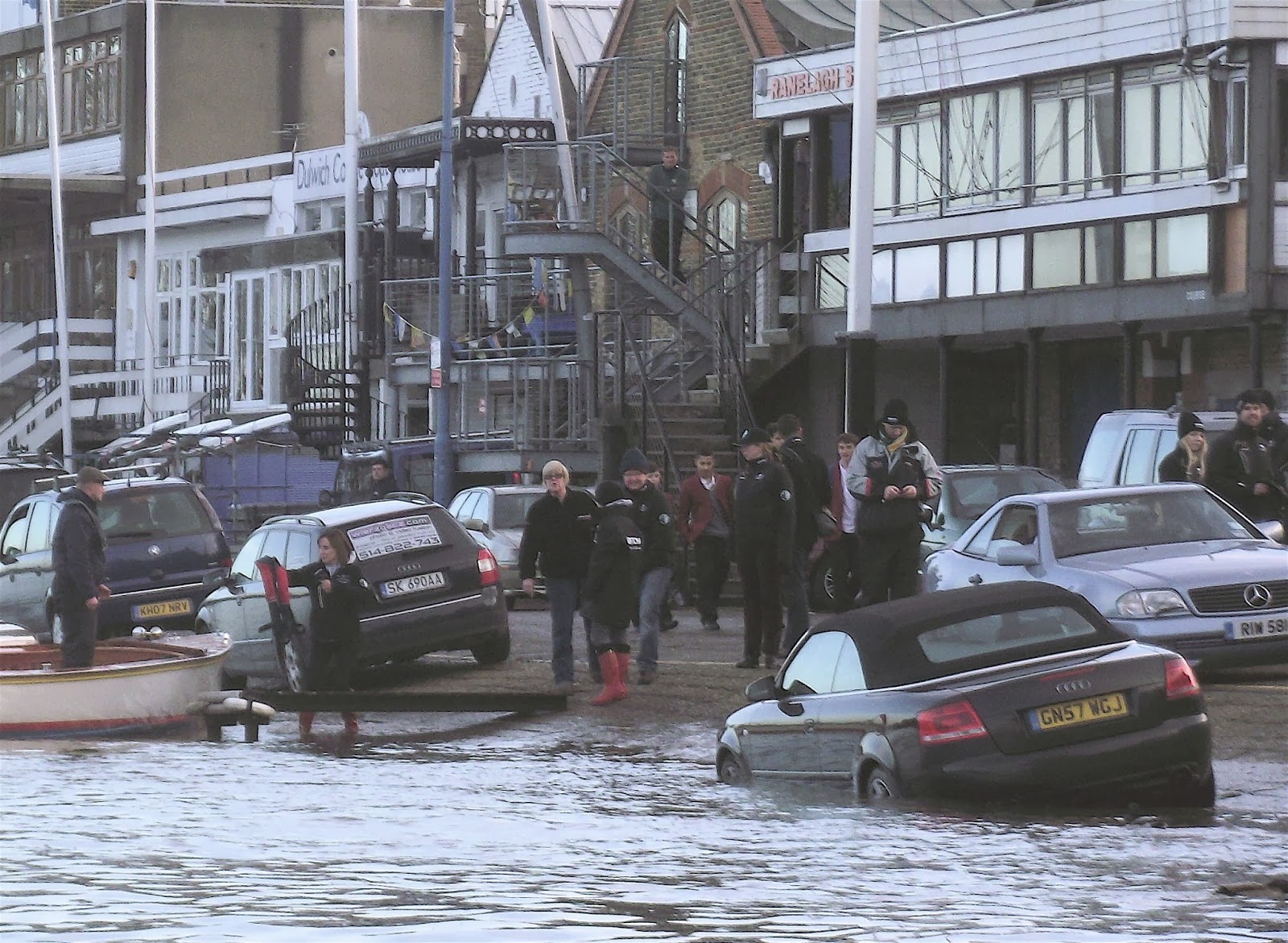
On their return, Cambridge found the Putney Embankment flooded by a spring tide.

Read what The Daily Telegraph writes about the Trial Eights here.

Thursday, December 13, 2012

While We Wait for the Trial Eights...


While HTBS is getting ready to cover the races of Oxford's and Cambridge's trial eights today, we give you a Swedish tradition that falls on 13 December every year, the 'Sankta Lucia' celebration. Every school and every town and city elects their own Lucia, who also has maidens and 'star boys', the latter in funny hats (yes, I was forced to do that at school, and I hated every second of it). 

Monday, November 26, 2012

The 2012 Trial Eights

Sean Bowden, OUBC Coach, and Steve Trapmore, CUBC Coach, with the trophy in 2011.

Tim Koch reports from London:

The recent and delightful HTBS item about the 1896 Cambridge Trial Eights reminds me that the 2012 Trials for both Universities will take place on the Thames Tideway on Thursday, 13 December (HTBS will be there). Two OUBC crews will race each other at 11.10 and then two CUBC crews will race each other at 12.25. In the past the Trial Eights were raced separately, usually with Cambridge at Ely and Oxford at Henley – as this 1934 cinema newsreel shows:

VARSITY TRIAL EIGHTS


The old idea behind Trials is explained in this 1933 newsreel:

OXFORD TO BREAK THAT 10 YEARS LOSING SPELL?


The modern version of the Trial Eights (with both Boat Clubs on the Tideway on the same day) is still useful for crew selection but is now perhaps more of a public relations exercise for the sponsors. While I am not privy to the Boat Race coaches’ selection methods, today’s top crews are usually selected using a more scientific approach involving very sophisticated trials known as ‘seat racing’.

Here two boats race each other repeatedly over the same course but, in each race, one member of each crew is swapped into the other boat. It is difficult to do this fairly and remove all other variables and it certainly cannot be done on the Tideway with its constantly changing conditions. Also, the results are difficult to interpret – but it is still generally regarded as one of the best ways of picking a top level crew from a large number of people. A full explanation of seat racing is on the splendid South African Association of Rowing Coaches website.

Other selection factors that they did not have to consider in 1896 were individual ergo scores and the results of a lot of small boat racing.

The 2012 - 2013 ‘Boat Race Season’ officially began on 22 November when, according to tradition, the President of the previous losing club challenged the President of the previous victorious club to the next race. As both the Cambridge Men’s and Women’s Blue Boats won in 2012, it was up to Alex Davidson and Bridget Fryer of Oxford to issue the Challenges on behalf of their clubs.

The 2013 ‘BNY Mellon Boat Race’ for the men’s heavyweight first and second eights will take place on Sunday, 31 March, 2013, on the Putney to Mortlake course. The heavyweight women will compete in the ‘Newton Women’s Boat Race’ at the Henley Boat Races a week before on Sunday, 24 March, 2013. The women will achieve parity with the men when their race moves to ‘Boat Race Day’ proper on the Tideway in 2015.

Friday, November 23, 2012

Cambridge Trial Eights 1896: Comparing Jackets and Socks

Sixteen oarsmen and two coxes proudly wearing their 'Trial Caps' for the Cambridge Trial Eights Race on 5 December, 1896. Back row, left to right: (unidentified), C. R. Pattison-Muir (Caius), S. V. Pearson (Emmanuel), Sultan (the horse), D. E. Campbell-Muir (Trinity Hall), Henry Trevor-Jones (coach; on the horse), (unidentified), J. E. Payne (Peterhouse), H. E. Oakeley (Jesus) and G. A. Crane (First Trinity). Front row, left to right: G. T. Bullard (Trinity Hall), B. H. Howell (Trinity Hall), C. M. Steele (Trinity Hall), (unidentified: 'old oar'?), A. S Bell (old oar, Trinity Hall), W J. Fernie (old oar, Trinity Hall), C. D. J. Goldie (Third Trinity), (unidentified), R. B. Etherington-Smith (First Trinity) and H. G. Brown (First Trinity). Sitting in the very front, left to right: W. H. G. Woodroffe (Emmanuel), P. Cave-Moyles (Caius) and F. E. Foster (Trinity Hall). (Photography courtesy NRF)
 
On 13 November, I wrote about the 1897 Oxford crew - 'The Finest Crew that ever Rowed'. I then mentioned that I am doing research for a booklet about Benjamin Hunting Howell, the American who rowed at Trinity Hall and in the 1897 Light Blue crew. I thought it might interest you HTBS readers to see a unique photograph from December 1896 showing Cambridge's two 'Trial Eights'. The oarsmen and two coxes are wearing their 'Trial Caps', the cap that indicates that they were selected for a seat in one of the two crews who are going to race on the Boat Race course between Putney and Mortlake. To help them with their practice are some 'old oars' who have rowed in the Boat Race before.

The first time I saw this photograph, I only recognised a few of the persons in the picture: Hunting Howell, Henry Trevor-Jones (and his horse, Sultan, which was said to be as old as his owner; Trevor-Jones was 42 years old when this photo was taken), Arthur Bell, William Fernie and Raymond Etherington-Smith. How was I to find out the names of the other oarsmen and coxes? Well, I was lucky to find an old issue of The Cambridge Review from 26 November on the web. The unsigned article gives us the names of the two eights. The first boat had the following crew: bow H. E. Oakeley (Jesus), 2 J. E. Payne (Peterhouse), 3 P. Cave-Moyles (Caius), 4 H. G. Brown (First Trinity), 5 S. J. Selwyn (Third Trinity), 6 G. A. Crane (First Trinity), 7 S. V. Pearson (Emmanuel), stroke C. M. Steele (Trinity Hall) and cox W. H. G. Woodroffe (Emmanuel). In the second boat rowed: Bow D. E. Campbell-Muir (Trinity Hall), 2 J. Sutherland (Jesus), 3 R. B. Etherington-Smith (First Trinity), 4 P. L. May (L.M.B.C.), 5 B. H. Howell (Trinity Hall), 6 C. R. Pattison-Muir (Caius), 7 G. T. Bullard (Trinity Hall), stroke C. D. J. Goldie (Third Trinity) and cox F. E. Foster (Trinity Hall). The second boat won the Trials.

Having all the names does not necessarily mean that I know who is who. So, I looked in books about the Boat Race for photographs of crews around the year 1897. I looked in some of the colleges' boat clubs' books. I compared club jackets, scarves, socks, caps (in the picture above A. S. Bell is wearing his Trinity Hall cap; he got his 'Trial Cap' in 1895, then also going on to row in 1896, 1897 and 1898 - losing all four races). It took me a week to connect the faces with the names, and I am still missing three names of the 'Trial Caps' and one old oar (sitting between Steele and Bell). And I have to confess that I might have messed up a couple of them - you see, I do not know how scientific it is to nail down names for people who are wearing a special kind of striped socks...

It is also interesting to see who is not in the photograph. One oarsman, who had not rowed for Cambridge before, did not have to row in the 'Trials' to get a seat in the 1897 Light Blue boat: William Dudley-Ward. His reputation as a 'good oar' at Eton had preceded him when he came to Cambridge in 1896. At this time, Cambridge was eager to get 'wet bobs' from Eton. In Sport and the British: A Modern History (1989; 1992), Richard Holt writes: 'The long domination of the dark over the light blues in the Boat Race of the 1890s was put down to the fact that more Etonians went to Oxford than to Cambridge.' This is true, but looking back in the record books, Cambridge had had one or two Etonians in every crew since their last victory, in 1889. Besides Dudley-Ward, Bell had also rowed at Eton.

Below is a photograph of whom eventually made up the 1897 Light Blue crew. Only two of the oarsmen who went through the Trials got their Blue: Howell and Campbell-Muir.

Here is a photograph of the Light Blue crew who would eventually row against the Dark Blues on 3 April, 1897. Back row, left to right: B. H. Howell (4 Trinity Hall), E. J. D. Taylor (3 Caius; dark jacket), W. J. Fernie (stroke Trinity Hall; sitting) and D. E. Campbell-Muir (bow Trinity Hall). Front row, left to right: W. A. Bieber (5 Trinity Hall), A. S. Bell (2 Trinity Hall),  E. C. Hawkins (cox; Caius), W. Dudley Ward (7 Third Trinity) and D. Pennington (6 Caius).

Anyone who has more information about who is who in the photo on top, or corrections are very welcome to contact me!