Photograph: Werner Schmidt
Showing posts with label Auriol Kensington RC. Show all posts

Friday, May 9, 2014

Graham Hill: English Gentleman, Oarsman and King of Monaco

Graham Hill at the 1971 Dutch Grand Prix. Picture: Wikipedia.

Tim Koch writes:

Veteran British readers and anyone interested in motor sport will know of the English racing driver, Graham Hill (1929-1975). He was one of those sportsmen who were held in great affection long after their career ended, not only by fans of the sport in question but also by ‘the general public’. In the days (not so long ago) when Britain was a more deferential country, this widespread affection was gained not so much by simple sporting success – it was most assured if the athlete in question was thought of as ‘a gentleman’ who seemed to win ‘effortlessly’. It was popularly supposed that Hill was such a man. When his perceived wit, charm, charisma and his reputation as a ladies’ man par excellence was added to the mix, the legend was assured. It was a legend that rowing can take some credit for.

I have no real knowledge of motor racing and consequently am reliant on the writings of those who do claim to know something of it. There seems to be some sort of consensus among such people that Hill was not the most naturally talented of drivers but he achieved a genuinely unique success by force of will, hard work and an attention to detail. There were certainly no ‘effortless’ wins, whatever the public may have thought, but the fact is that Graham Hill is the only man to have achieved the ‘Triple Crown’ of Motorsport. The original definition is that the Crown’ is made up of the Indianapolis 500 (won by Hill in 1966), the 24 Hours of Le Mans (won in 1972) and the Monaco Grand Prix (won in 1963, 1964, 1965, 1968 and 1969, hence the ‘King of Monaco’ epithet). A newer definition replaces Monaco with the Formula One World Championship but, as Hill won this in 1962 and 1968, he is still the only man to achieve the Triple, however defined.

Graham the ladies’ man ‘practising for Monaco’, 1968. Picture: autoinjected.com.

The internet has many affectionate (though rarely totally uncritical) takes on the man, his sport and his life.

Formula1.com:

Graham Hill’s iron-willed determination, fierce pride and great courage enabled him to overcome the odds against more naturally gifted drivers. None of them was more popular with the public than the moustachioed extrovert with the quick wit, who loved the limelight, was a natural entertainer and became one of the first Formula One media stars. His fans remained loyal, even when he damaged his reputation by racing too long past his prime.

The Slog:

When Graham Hill became something of a hero for me around 1964, he already looked out of date. Despite the long hair and sideburns that later transformed him into a racing rock star as the Sixties progressed, his laconically courageous speaking style, refusal to take much beyond mechanics seriously, and appalling pencil moustache made him more of an archetypal Spitfire pilot than a racing driver.

The Gentleman's Digest:

Racing, in the 1950s and 1960s, was a different sport than the modern Formula 1. Drivers used to be more involved in...... the more messy tasks of the behind-the-scenes mechanics than the professional pilots of the modern circus. Often, drivers would drive their own cars to the track, towing their race cars on a trailer. Hill, like other stars of his time, was therefore much more than a pilot in the modern sense; he was also a mechanic, a technician, and a developer. As an ambassador of style, Hill was famous for his iconic sideburns with the pencil thin moustache and the sleek, combed back hairstyle. Even after a full race of 60 laps under a helmet, Hill's haircut would be perfectly put together. He would combine his signature style with the fine sense of fashion inherent to an English gentleman.

8x.forix.com:

Graham Hill was the face of motor racing in Britain in the 1960s – extrovert, fun-loving, dashing, rakish, moustachioed and handsome he was the public's idea of what a racing driver should look like........ he might have been a throwback to the 30s when chaps went racing for fun and could afford to spend large amounts of money on their hobby. Yet he had worked his way up from nothing..... he did not have enthusiastic parents who could dispense large amounts of money....... He was a late starter too: his first sporting love was rowing....... And rowing was to be an ever-present part of his motor racing career too – the familiar dark blue and white helmet which he always wore was based on the colours of the London Rowing Club – in his autobiography he remarked that he seemed only to excel at sports which allowed him to sit down while competing and that he could even do one of them facing the wrong way.

Hill in his iconic racing helmet sporting the colours of London Rowing Club. Picture: hooniverse.com

Hill’s entry into the world of competitive sport was through rowing. Some sources state that he started at London RC where he was an active member from 1952 to 1954. Some say that he first took up rowing at Southsea Rowing Club on the south coast of England while doing his National Service with the Royal Navy in Portsmouth from 1950 to 1952. The truth is that he was introduce to the sport at Auriol Rowing Club in Hammersmith, West London, by a cousin, John Ward. The club minute books record that his membership was approved at the committee meeting of 25 August 1949. The twenty year old must have been a quick learner as his first sporting success came nine months later when he rowed at ‘4’ in the crew that won Junior Eights at Hammersmith Amateur Regatta on 6 May 1950. His first taste of international competition came two weeks later when the crew raced ‘Junior International Eights’ at the 60th Terdonck Regatta, near Ghent in Belgium. It was a seven boat race which included crews from Belgium, Holland and France. Auriol led all the way but were beaten on the line by Antwerp Sculling Club who won by 1/5 of a second. Rowing also proved beneficial to an old leg injury that Hill had sustained in a motorbike accident some years before.

The winning crew in Junior Eights at the 1950 Hammersmith Amateur Regatta. Hill is top right. (Excuse the camera flash.)

Hill’s first trophy (albeit shared) The Hammersmith Cup for Junior Eights.

A close up of the Hammersmith Cup. It is engraved ‘N Hill’ as Hill’s first name was actually ‘Norman’.

There are few people left from Hill’s time at Auriol but Colin Cheney (who joined in 1945) remembers that at that time bad arguments were settled by impromptu boxing bouts in the clubroom and that Hill took part in at least one of these fights. Cheney also recalls that the Auriol clubroom was frequently strewn with motorcycle parts as members found it a convenient place to rebuild and maintain the only affordable form of motorised transport at the time, something that Hill would clearly have enjoyed. Speaking at the Auriol Club Dinner after winning his first major title in 1962, Hill said:

People ask me, ‘What’s the best thing about becoming World Champion?’ I say it’s that when I visit Auriol, I am now known as ‘Graham Hil’ and not as ‘Johnny Ward’s cousin’.

The ARC crew for Ghent pictured in Rowing Magazine No. 7, Spring 1950. It was Tony Kay, the stroke, that Hill boxed in the Auriol clubroom. History does not record what the dispute was about though I could imagine that Hill coveted the stroke seat.

Probably Auriol’s biggest contribution to Hill’s life was through the fact that it was where he met his wife, Bette, inevitably described as ‘long suffering’ due to her husband’s flirtatious character. Interviewed by Cars for the Connoisseur magazine in 2002, she recalled how she and Graham met:

In 1950 at a Boxing Day rowing regatta at Auriol Rowing Club at Hammersmith while Graham was still in the Navy doing his National Service.... I worked with a girl who was engaged to one of his crew members and they had a Boxing Day engagement party which she took me along and things sort of clicked.

Bette rowed for Stuart Ladies' Rowing Club (now part of Lea RC) on the River Lea in East London and Graham coached her and her crewmates. They won the Women’s Head of the River for three consecutive years and Bette rowed for Britain in the Amsterdam International Regatta in 1952.

The 21-year-old Hill in his Auriol colours.

In 1952, even before the completion of his National Service, Hill applied to join one of the biggest and best clubs of the day, London RC. With his determination to win, he clearly did not wish to return to the small and relatively uncompetitive Auriol Rowing Club where high level success was unlikely. According to Chris Dodd’s history of LRC, Water Boiling Aft:

John Pinches, the captain, thought quizzically about 'gentlemen' but like the cut of his jib, and when Hill said that he was willing to ride his motorcycle from Chatham barracks each day for training, Pinches took him on....... From joining London until 1954 he rowed in twenty finals, usually as stroke, eight of which resulted in wins. He also stroked the Grand eight at Henley in 1953.....

Graham Hill in London RC cap and tie at Henley.

One of the major advantages of rowing at London was that it provided the impecunious young instrument maker with a bedroom in the clubhouse. In the 1954 Head of the River, Hill at 11 stone, 6 lbs / 160 lbs / 72.5 kg stroked the London boat that won the Vernon Trophy for the fastest Tideway crew. This was to be Hill’s last significant rowing achievement as, in the previous year, he had paid £1 to drive four laps of the Brands Hatch in a F3 car and was ‘immediately bitten by the racing bug’. Soon, one sport’s loss was to be another sport’s gain.

Chris Dodd:

Throughout his racing career he continued to support rowing and London (and Auriol - TK), turning out to make accomplished speeches, beginning the demolition to make way for the extension to the boathouse by driving an old Morris car into the wall and opening the new Fairbairn room when the work was done. He famously adopted London's blue-and-white colours on his racing helmet, attributing his driving success to what he learned from rowing.

As a member of Hill’s first rowing club, now called Auriol Kensington, I may be biased, but I cannot but think that his motor racing colours should have been the dark green and light blue of Auriol.

Hill demolishing part of the London RC clubhouse in 1968. I think modern attitudes to driving a car into a brick wall for a stunt may be different.

In his autobiography, Life at the Limit (1969), Graham Hill wrote:

I really enjoyed my rowing. It really taught me a lot about myself, and I also think it is a great character-building sport....... You have to have a lot of self-discipline and a great deal of determination. You not only get to know about yourself, but you get to know about other people - who you would like to have in a boat with you over the last quarter-mile of a race when you are all feeling absolutely finished. With seven other fellows relying on you, you can't just give in. The self-discipline required for rowing and the 'never say die' attitude it bred obviously helped me through the difficult years that lay ahead.....

Millions were shocked when Hill was killed, not in a racing car, but when the light aircraft that he was piloting crashed in fog on 29 November 1975. The helmet in the colours of London Rowing Club were, however, seen again on racing circuits when Graham and Bette’s son, Damon, entered Formula 1 in 1992 and became World Champion in 1996, the only son of a former Champion to do so. In 2013, Damon’s son, Josh, also competed wearing the blue and white while racing in Formula 3. The legend lives on.

Monday, November 11, 2013

The Oarsmen’s Cenotaphs*

The Cenotaph in London, the United Kingdom’s primary national war memorial. In years gone by, men raised their hats when passing it. Picture: Arpingstone/Wikipedia.

Tim Koch writes:

The 11th November is a memorial day observed in many countries around the world to remember the members of their armed forces killed in war. While the poignancy of remembering on the 11th hour of the 11th day of the 11th month is very obvious, in some nations the day on which the major ceremonies of remembrance take place has shifted over the years. In the United Kingdom the main observance is now on Remembrance Sunday, the second Sunday of November (though observance of the two minutes silence on the 11th seems to have increased in recent years). Australia has joined New Zealand in putting more importance on ANZAC Day, 25th April. While the United States observes Veterans’ Day on 11th November, it is Memorial Day in May that is now the focus of national observance. Canada keeps the 11th November as Remembrance Day and as a national holiday. ‘Poppy Day’ is especially relevant here as it was a Canadian, John McCrae, who wrote the poem, ‘In Flanders Fields’ which resulted in the poppy becoming the powerful symbol that it is today.

Hugh Riviere’s In The Golden Days which forms part of the War Memorial at Thames Rowing Club.

HTBS has written on the subject of rowing clubs and War Memorials many times before. We have covered the monuments of British clubs Vesta, Marlow, Thames and Auriol and Kensington. Further afield, we have written about the impressive plaque in Vancouver Rowing Club in Canada and the unusual memorial to the oarsmen of the four Nottingham clubs. I thought that we may have exhausted the subject until I discovered the ‘Monument Australia’ website. To quote its home page:

The Monument Australia website is a historical and educational research site which records the public monuments and memorials in all Australian States and Territories under various themes.... Monuments and memorials reflect important values within the community.... and this website aims to help in the preservation of this aspect of the cultural history of Australia.

Naturally, I put ‘rowing’ in to the search facility and, while many results were not relevant, there were five rowing club War Memorials that could be termed ‘Cenotaphs’, all from the state of Victoria.

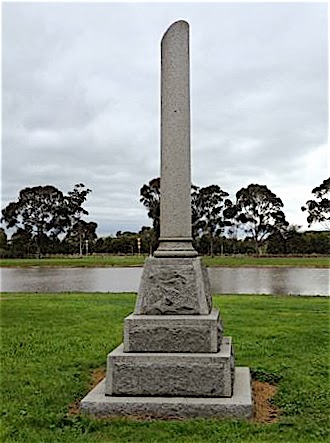
The Barwon War Memorial. Picture: Nancy Alford/Monument Australia.

A broken column is the memorial for Barwon Rowing Club. It can symbolise a fallen leader or unfinished work and was used on tombs for those whose life was deemed cut short.

The Bairnsdale Memorial. Picture: Graeme Saunders/Monument Australia.

The Bairnsdale Rowing Club War Memorial is an obelisk dedicated to the fifty-seven enlisted and fallen members of the Club who served in the First World War.

The Hawthorn’s Memorial. Picture: Kent Watson/Monument Australia.

A blunt and stereotypical Australian inscription on the Hawthorn Rowing Club memorial states ‘They fought. They fell’.

Alexandra Gardens showing the Yarra River & Melbourne City Skyline. The Judges’ Box mentioned below is on the far end of the left bank. Picture by Donaldytong/Wikipedia.

The city of Melbourne has two monuments to fallen oarsmen and they are both, I think, unique. They are the Victorian Rowing Association Memorial and the Victorian Rowing Association Judging Box. Both are situated in Alexandra Gardens on the south bank of the Yarra River. This is Australia’s equivalent to Philadelphia’s Boathouse Row or London’s Putney Embankment as it is home to seven rowing clubs. They are Melbourne University BC (1859), Melbourne RC (1862), Richmond RC (1863), Banks RC (1865), Yarra Yarra RC (1871), Mercantile RC (1880) and La Trobe University RC (1969). The Henley-on-Yarra Regatta started here in 1904 and, until the Second World War, was a very important rowing and social occasion with attendance peaking at 300,000 in 1925. Film evidence from 1933 is here.

Boathouses along Alexandra Gardens. Picture: Tony Hodder.

The Victoria Rowing Association Memorial lists 320 rowers from 30 Victorian clubs who died in the First World War. There were 2,100 members of the VRA in 1914 and more than half of them enlisted. Of these, nearly a third were killed. The monument has been recently restored and a rededication service was conducted at the Australian Henley Regatta on 23 February, 2013.

The VRA ‘Oarsmen’s Cenotaph’. Picture: Tony Hodder.

Hopefully the 1914-1918 Oarsmen’s Memorial Judges’ Box just down from the boathouses near the finish line of the regatta will soon merit restoration as well.

The 1930 built Judges’ Box. Picture: Graeme Saunders / Monument Australia.

The Box shows its age. Picture: Tony Hodder.

As an aside, there is an interesting (though not absolutely proven) story surrounding the timing of the formal ending of hostilities on 11th November 1918. The Armistice was signed in a railway carriage, 60km north of Paris. Britain’s official delegate, Admiral Sir Rosslyn Wemyss, was ordered by Prime Minister David Lloyd George to have the end of fighting set for 3pm to coincide with a sitting of the British House of Commons. This would allow Lloyd George to theatrically make the announcement to an assembled and expectant Parliament and to bask in the reflected glory of victory. Admiral Wemyss allegedly thought that the delay would cause more unnecessary killing and felt that 11am, ‘the eleventh hour’, had a certain pathos. He was right.


*Cenotaph: A monument erected in honour of a person or group of people whose remains are elsewhere.

Friday, October 4, 2013

Tales of the Riverbank: Hammersmith

‘Hammersmith: Boating Men Going Out’. This print shows the first Hammersmith Bridge, 1824 - 1884.

Tim Koch writes:

As someone who has boated from Hammersmith in West London for nearly thirty years, I was very interested in the recent HTBS posting, ‘Famous Photographer’s Rowing Pictures’ which showed photographs taken in 1957 of scullers on the Thames by Hammersmith Bridge and also rowers in Hammersmith’s ‘West End Boathouse’. I cannot, as yet, identify the ‘NPW Rowing Club’ to which the latter belonged – but I hope to soon. I agree that they cannot be from the amalgamated National Provincial Bank RC and the Westminster Bank RC as these two merged in 1968, were called the National Westminster Bank RC (NWBRC) and were never based at the West End Boathouse. A summery of the history of these two fine clubs is here.

The wartime pumping station by Hammersmith Bridge.

Picture number 3 of 7 in the above post (which shows a single about to scull under Hammersmith Bridge) is most interesting for a non-rowing reason. On the other side of the bridge, behind the sculler's head, appears to be some sort of strange craft. In fact it is a pumping station sitting on piles driven into the river bed. It was left over from the 1939 - 1945 War when it pumped river water to back up local fire hydrants used to fight fires resulting from the ‘Blitz’ bombing raids. Starting 7 September, 1940, London was bombed for fifty-seven consecutive nights. It was, in effect, a ‘9/11’ every night for two months. Although no longer connected by the time the photograph was taken, the remains of the water pipe that ran from the pumping station along the walkway of the bridge can still be seen (just below the lamp post on the left). Another legacy of the War was the fact that the bridge would have been painted grey at the time the picture was taken (and for many years after). It was a futile attempt to camouflage the bridge from enemy aircraft and it was only in the 1980s that the original green and gold paintwork was restored. Furnivall Sculling Club claim that their colours (‘myrtle and old gold’) come from the bridge’s first colour scheme.

More significant to the history of rowing are the two pictures of a crew relaxing by an open bay above a sign saying ‘BOATHOUSE’. This was the West End Boathouse, a place that in its long existence gave thousands of ordinary working men the opportunity to experience the joys of rowing. The building had two incarnations over perhaps 120 years – and a legacy still exists today.

Lower Mall in Hammersmith perhaps pictured in the 1860s.

The building was originally erected around the 1850s as ‘Biffin's Metropolitan Boathouse’. Biffens were an already established firm of local boat builders that had been operating since the early 19th century. The picture above shows from right to left:

The Blue Anchor pub, which still exists.

Two cottages which in 1869 were replaced by ‘Biffin’s Anchor Boathouse’ and which today is the Auriol Kensington Rowing Club.

The Rutland Pub, which also still exists. The top floor was damaged by bombing in 1941 and was removed in the 1950s.

Biffin’s Metropolitan Boathouse is to the left of the Rutland. Before the 1914 - 1918 War, it was extended to double its size, taking over the land on the left until then occupied by the house with the round window in its gable end. The result is shown in the picture below and in these Pathe Newsreels from 1919:

NEW ZEALAND FORCES HOLD REGATTA


and from sometime in the 1920s:

HAMMERSMITH REGATTA


The National Amateur Rowing Association Regatta, c.1924.

The history of the Biffin dynasty and their connection with boat building and both amateur and professional rowing is a long and involved story and is for another time. However, the advertisement from the British Rowing Almanac reproduced below shows the services that Biffin’s at its peak offered the rowing community.

Biffin’s advertise their wares (click to enlarge).

Whatever else they did, Biffin's most important contribution to rowing was to rent changing rooms and to provide boat hire to clubs that could never own property or afford to buy many (or any) of their own craft. A rowing club could thus come into existence by a few dozen people paying a small subscription. As an example of this, Cygnet RC had been founded at Putney in 1890 for Post Office workers. By 1904 it needed more space and moved to Biffin’s where it had the use of a dressing room and six boats for £40 a year. The annual subscription was £1.40 so only a minimum of thirty members were needed to make the club viable. The advertisement below gives some idea of the clubs that operated out of the Biffin Boathouses.


Most of the clubs mentioned in the above advertisement (including the cheekily named ‘Leander Boat Club’) were tradesmen’s clubs or were (after 1890) affiliated to the National Amateur Rowing Association. This is because they did not pass the Amateur Rowing Association’s ‘manual labour clause’ i.e. that anyone who worked with their hands could not be considered an amateur. This list of some defunct London clubs shows even more groups that rowed out of Biffin’s and other boathouses.

It is generally accepted that it takes two or three generations to build up a family business and two or three generations to run it down. This was the case with Biffin’s. In 1897, the fourth generation put most of the Metropolitan Boathouse at 16 Lower Mall up for sale. The family retained some rooms at the rear of the building and also the Anchor Boathouse at 14 Lower Mall. The new owners were the West End Amateur Rowing Association (WEARA).


The WEARA had been formed in 1880 as an association of seven rowing clubs belonging to businesses based in the fashionable West End of London, many of which were department stores. In the days of ‘jobs for life’ and of some companies housing their unmarried workers in strictly run dormitories, it was common for employees (supported by the employers) to organise social and sporting activities with their workmates. The Association organised regattas amongst the constituent clubs and the latter grew in number – especially with the purchase of the Metropolitan Boathouse.

Hammersmith 1883: The West End Amateur Rowing Association Regatta.


Looking toward the Rutland pub and Hammersmith Bridge from the WEARA boathouse. The man looking out of the window above the sign ‘ROWING’ is in fact in a boat bay. The whole bay opens to the floor and eights were manhandled out to ground level. Initially it required most members of the crew to be on the higher level but, as more of the boat came out, so pairs of people had to run down the stairs to the outside to take the weight of the increasingly protruding boat. This would be a difficult manoeuvre with a ‘light’ carvel built boat but this would also have to be done with heavy clinker built craft. It is in one of these open bays that the crew of 1957 is pictured

In the early part of the 20th century it was necessary to double the size of the building and by 1909 there were fifteen affiliated clubs with over a 1000 members and 30 eights between them. The most famous alumnus of the WEARA was WD (Wally) Kinnear who won the single sculls at the 1912 Olympics. Workmates introduced him to rowing through Cavendish RC, the WEARA affiliated club for employees of Debenhams Department Store. Kinnear rowed and sculled for Cavendish from 1902 until 1905 when he left to join Kensington RC. It was only at an ARA affiliated club could he attempt his dream of winning the Diamond Sculls at Henley.

WD Kinnear in Cavendish colours.

In the inter war period the WEARA thrived and in the 1920s a rowing tank was built as a memorial to the 125 members who died in the 1914 - 1918 War. Things were not so good following the 1939 - 1945 War and the building slowly fell into disrepair. In 1964 it was put up for sale but no buyer came forward and the structure deteriorated further. In 1970, Hammersmith Council declared it a ‘dangerous structure’ and it had to be evacuated. Some of the clubs in the WEARA found other homes but many disappeared forever. The one positive thing to come out of this sad situation was that when the building was demolished and replaced with flats in the early 1980s, the developers had to build a new boathouse as a condition of planning consent. The ‘New West End Boathouse’ is sited behind Furnivall Sculling Club and, although it is much smaller than the building it replaced, it today holds the eights and fours belonging to Auriol Kensington RC and to Furnivall SC.

Lower Mall, Hammersmith in 2004. From right to left: the Blue Anchor pub, Auriol Kensington RC, the Rutland pub, the flats that replaced the WEARA Boathouse, Furnivall Sculling Club (with the ‘V’ shaped roof). Unseen behind Furnivall is the New West End Boathouse, an undistinguished structure which, for those that know its origins, is a rather sad legacy of a rather remarkable past.

Thursday, August 1, 2013

Lions not Donkeys

An early First World War recruitment poster. There was no official ‘Oarsman's Battalion’ but some crews joined their local regiment en masse. The idea that war was ‘the greater game’ could not have lasted very long.

Tim Koch writes from London,

This week marks the 99th Anniversary of the outbreak of the First World War. The actual day is open to choice. Austria-Hungary declared war on Serbia on 28 July, 1914. Germany declared war on Russia on 1 August and on France on 2 August. Britain declared war on Germany on 4 August.

During the period 1914 to 1918, five million British men served in the armed forces. Initially they were all volunteers and conscription was not introduced until seventeen months into the conflict. The poplar view of the early months of the war is of young men desperate to join up in case hostilities ended before they could take part in a great adventure. Adventure may not have been everyone’s reason for joining the ‘citizens’ army’ as there was also enormous peer pressure from workplaces, friends, families, sports clubs, schools, colleges and social groups. Whatever their reasons, oarsmen would have been among the first to join up. They were young and fit and had a bond with their crew mates that only one of the ultimate team sports can produce. Sadly, for many the 1914 rowing season was to be their last.

My own club, now called Auriol Kensington, has pictures of two 1914 crews on its walls. The Kensington Junior Eight that won at Molesey lost four members by 1918 and the Auriol eight that raced at Henley lost three. In all, both clubs lost a total of twenty-four men who were members at the outbreak of the War. This would not be untypical.

The memorials subsequently erected to by clubs to remember their crew mates killed is a subject that HTBS has covered several times. We have noted those in Thames RC, Auriol Kensington RC, Vesta RC, and Marlow RC. While it is common for British rowing clubs have war memorials, on my recent visit to Vancouver Rowing Club (VRC) in Canada, I was reminded of the sacrifices made by men from what was then the British Empire. VRC has a bronze plaque listing the names of the 164 men who volunteered for active service including the 38 who were wounded and the 38 who were killed, a death rate of twenty-three per cent.

The list of those members of Vancouver RC who served in the 1914-1918 War. Those marked with a star were killed, those marked with a bar were wounded. A similar memorial exists for the 1939-1945 War. (Click on the image to enlarge.)

Back home, I have recently become aware of an oarsmen’s memorial that has two differences to any others that I know of in the UK. First, it commemorates those rowers killed not from a club but from a city, and second, it is sited outside, not in a clubhouse.

The Nottingham Oarsmen’s War Memorial.

Detail from the Nottingham Memorial.

Trent Bridge crosses the River Trent in the city of Nottingham in the English East Midlands. On the north side of the bridge is a First World War memorial to fifty-five men of the four rowing clubs that existed in the city at that time. They were Nottingham Union RC, Nottingham RC (1862), Nottingham Boat Club (1894) and Nottingham Britannia RC (1869). The first two amalgamated in 1946 to form Nottingham and Union Rowing Club while the second two amalgamated in 2006 to form Nottingham Rowing Club (along with Nottingham Schools Rowing Association and the Nottinghamshire County Rowing Association).

The Memorial and a wider view of its place over the River Trent.

Examining the military ranks listed on the memorial is interesting and perhaps gives some indication of the social makeup of the Nottingham clubs. The fifty-five are made up of fourteen private soldiers, five non-commissioned officers (sergeants and corporals), twenty-eight 2nd Lieutenants and Lieutenants, five captains and three majors. Thus half were the most junior commissioned officers, that is 2nd lieutenants and lieutenants, men who led a platoon of fifty soldiers.

In his 2010 book, Six Weeks –  The Short & Gallant Life of the British Officer in the First World War (Weidenfeld & Nicolson), John Lewis-Stempel attempts to disassociate the junior officers from the seemingly idiotic high ranking officers who appeared to have no ideas beyond sending wave after wave of men headlong into machine gun fire (‘lions led by donkeys’). Lewis-Stempel says that the two most junior officer ranks often suffered a casualty rate twice that of private soldiers and that their average life expectancy on the front line was six weeks. Until 1917 they mostly came from public (which in the UK means private) schools. The top fee paying schools had casualty rates of twenty per cent. In four years, 1,157 Old Etonians were killed (though as the War went on and the ‘officer class’ was rapidly decimated, ‘temporary gentlemen’ from middle and working class backgrounds had to fill the void).

One of forty-two Rowing Blues killed in the First World War: Captain W.H. Chapman rowed for  Cambridge in 1899, 1902 and 1903. He was killed at the Dardanelles in 1915.

That the upper classes suffered disproportionally can also be seen in the casualty rates of those oarsmen who were obviously from socially privileged backgrounds. This forum lists the forty-two Oxford and Cambridge Rowing Blues who were killed, all of them officers. The book Henley Races by Sir Theodore Cook (Oxford University Press 1919) is available online and lists the two hundred and seventy Henley competitors who are known to have died. In both lists, half were 2nd Lieutenants and Lieutenants with thirty per cent holding the rank of captain. The Oxford-Cambridge split is exactly half. A deadly noblesse oblige.

My thanks to Ian Scothern for taking the Nottingham pictures for me. Also, some may have noticed the second name on the memorial, that of Albert Ball VC, a First World War ‘Ace’. I am investigating further but I suspect that Ball’s connection with NRC may have been somewhat tenuous.

Wednesday, July 3, 2013

Henley Makes Its Final Preparations

The view from Henley Bridge. The finish is in the background and the boat tent area is in the middle ground. The floating pile driver in the foreground will soon be removed.

Tim Koch writes from Henley, Tuesday, 2 July,

As regular HTBS readers may remember, one of my annual rituals is to take part my club’s veterans’ (masters’) annual row from Hammersmith in West London to Henley-on-Thames in Oxfordshire. 

Two eights take three days to cover the fifty-six miles, arriving on the Monday before the start of Henley Royal Regatta (which runs from Wednesday to Sunday). Staying overnight in Henley, one of my great pleasures is to wonder around the regatta site on the Tuesday, the day before the start of ‘The Royal’. Here you encounter few people beyond the rowers, coaches, officials and journalists and the atmosphere is one of excitement and expectation – mingled with a little fear. It is particularly delightful to see the awe of those making their first visit to the world’s most famous regatta. However much you may read about or see pictures of Henley, nothing prepares you for seeing the real life setting. The only downside to mixing with athletes at the peak of their training is that it reminds me (were any reminder needed) of how old and unfit I am. I then resolve to start training again...... tomorrow.

Here are some pictures of Henley’s final preparations:

 In front of the floating grandstand – checking out the opposition.
 
Practice, practice....

The Leander Club raft.

Trees in the Stewards’ Enclosure are forbidden to drop leaves during the Regatta.

Twenty-four hours later this mode of dress would not be acceptable in the Stewards’ Enclosure.


Inside one of the boat tents.

A team talk from the coach.

The view from the bow.

Coaches bicycles in the boat tent area.

Thoughts from the skiff - 'Are they as good as we were....'. 

© Photographs Tim Koch