Photograph: Werner Schmidt
Showing posts with label Well-Dressed Gents. Show all posts

Thursday, July 24, 2014

Life in Britain in 1914

From the Telegraph's series Life on the Eve of War, episode "Fashion in 1914" by Drusilla Beyfus.

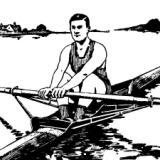
The Daily Telegraph is right now running a series called "Life on the Eve of War" with episodes called, for example, "Women's Rights in 1914", "Art & Culture in 1914", "Food in 1914", "Cars & Planes in 1914" and "Fashion in 1914". More is to follow, and we hope that eventually there will be one piece called "Sports in 1914" (I guess, hoping for a "Rowing in 1914" would be to ask for too much...). While we are waiting for this episode, you can enjoy Drusilla Beyfus's "Fashion in 1914" in which you will find the image above, an advertisement for Burberry suits showing a gentleman at a rowing regatta, probably Henley.

Wednesday, July 9, 2014

Looking Smart in a Rowing Blazer!

Yes, yes, HTBS has already written a lot about Jack Carlson's beautiful book Rowing Blazers, which just came out in England (it will be out in September in the U.S.). Tim Koch, for example, wrote a glorious review of the Rowing Blazers before this summer's Henley Royal Regatta. However, we cannot help to push for the book a little bit more by posting a short promotion video for the publication, especially as HTBS's own T.K. is briefly shown for two seconds in the film (at 1:52-1:54). Enjoy it here below:


Wednesday, July 2, 2014

Trying ‘Rowing Blazers’ For Size: A Review by Tim Koch

The title leaf of Rowing Blazers by Jack Carlson (Thames and Hudson, 2014). It shows Ellie Piggott and Brianna Stubbs of Wallingford Rowing Club. They won Gold in the lightweight doubles at the World Under-23 Championships in 2010. © Carlson Media Inc.

Tim Koch writes:

Today, 2 July, is the first day of Henley Royal Regatta and it is also most people’s first chance to see the exciting new book that HTBS has been talking about for some time, Rowing Blazers.

The term ‘coffee table book’ is often used pejoratively – and for good reason. Large format, lavishly illustrated publications, frequently with minimal text, can sometimes be ‘hack jobs’ produced by those who don’t know and don’t care in order to make a quick profit from those who happily accept superficiality over substance*. It is presumably for this reason that some publishers prefer to use the rather less satisfying term ‘adult illustrated non-fiction’ for such productions. Labels notwithstanding, Jack Carlson’s Rowing Blazers, is one of the superior works in the illustrated book category. It is clearly a ‘labour of love’ by someone who knows and cares about the subject and who has spent an inordinate amount of time and trouble producing not only the pictures but also the text. The publisher tells us that the book:

….. looks at the authentic striped, piped, trimmed, and badged blazers that are still worn by oarsmen and women around the world today, and at the elaborate rituals, elite athletes, prestigious clubs, and legendary races associated with them… The stunning original photographs, many by “prep” guru F.E. Castleberry, are taken in situ at the historic boathouses, campuses, and team rooms of clubs in the United States, Great Britain, the Netherlands, South Africa, New Zealand, Australia, and beyond. These enchanting portraits are… accompanied by histories, anecdotes, and captivating descriptions of the esoteric traditions behind each blazer.

Geoff Roth, who rowed for Cambridge University Boat Club in 2010, wearing his ‘Blue’ blazer in the Captain’s Room of CUBC’s Goldie Boathouse, The jacket’s stains are unexplained but by tradition a CUBC blazer is never cleaned. © Carlson Media Inc.

Jack is well qualified to produce such a book. His rowing career began as a cox at Buckingham Browne and Nichols School in Massachusetts, a role that gave him his first trip to Henley and with it his introduction to rowing blazers. In his journey from school to the rowing crews of Georgetown and of Oxford Universities, via the U.S. National Team and recently a Henley medal, he found himself ‘ideally placed to investigate the bizarre vestments in depth’.  I would suggest that ‘investigate’ is too mild a word as, after recruiting a number of ‘celebrated photographers’, he began an intermittent three-year worldwide journey, a guest of the international rowing fraternity:

The rowing world is a small one..... members of the rowing community are always willing to help one another and assist in any effort that promotes the sport. So – thanks to the fraternal spirit and enthusiasm of hundreds of rowers and coxswains – I was able to arrange photo shoots at clubs around the world and with some of the most prominent oarsmen and women at these clubs… We jumped over burning boats in Oxford, slept on strangers’ couches in Wisconsin, and witnessed beer-soaked blazer rituals in the Netherlands…

Like many from the American New England states, Jack has a foot in the Old World as well as in the New. He gives an outsider’s affectionate view on this quintessentially British garment which, like many other things (particularly in sport) Britain gave to the world and the world took it, adapted it to local culture, customs and conditions and sent it back to the Old Country. Writing about the early nineteenth century ‘boating jackets’ Jack says:

The chosen colours and details comprised a code that revealed the college, club and particular crew with which a rower was affiliated. The British, after all, have always had a hyper-awareness of subtle social distinctions and a flair for uniforms and pageantry.  

The understated Oxford University Boat Club blazer, here worn by Colin Smith (OUBC 2004, 06, 09). While a dark blue jacket with dark blue trim and no badge may not be the boldest of garments, it is can still be very effective. Jack quotes the Livingstone brothers (who rowed against each other in the 2003 Boat Race) in their book, Blood Over Water (2009): ‘It is astonishing what the sight of a Blues blazer can do to many a sensible, well-adjusted girl’. Where can I buy one?  © Carlson Media Inc.

I have to make two declarations before reviewing this book. Firstly, I liked it before I even saw it and this not a very professional approach for a reviewer. Rowing Blazers is very much a ‘Hear The Boat Sing’ sort of thing as it shows how a forward looking, innovative and modern sport such as rowing can still produce and parade these very clear acknowledgements of its origins, history and heritage. Secondly, perhaps as proof that rowing ability or good looks are not a requirement to be included, I am pictured in my Auriol Kensington regatta blazer, trying to look as though I have the right to be alongside Murray and Bond, Steve Redgrave, the Winklevoss brothers et al.

Chris Bartley, now a member of the British lightweight four, a winner at the 2010 World Championships and a silver medallist at London 2012 in his King’s School Chester Boat Club blazer. The ‘HR’ cypher on the badge stands for Henry VIII who founded the school in 1541. © Carlson Media Inc.

It is unusual to take much note of the words in any book that is predominantly about the pictures but Rowing Blazers’s is an exception.  If the photographs were removed, the text alone would still be an absorbing read. Jack’s writing is both pithy and informed and more space is allocated to the printed word than is often the case with such publications. His researches reveal many delightful and/or obscure facts and stories and also challenges several myths (though he does perpetuate the defamation of John Phelps and his role the 1877 ‘Dead Heat’ Boat Race)!

In the case of the entry on Lady Margaret, the boat club of St John’s College, Cambridge, several ‘tall stories’ are examined. The tale begins when a St John’s crew allegedly mounted a sword on their bow during a race and accidentally killed the cox of the crew in front. When St John’s Boat Club was banned ‘forever’ as a result of this, the story goes that they reappeared as ‘Lady Margaret Boat Club’ and wore bloody red jackets to mark the incident. All this is ‘pure fantasy’ but the very real red jackets worn by LMBC are significant. Jack holds that as rowing developed as a sport at Oxford and Cambridge in the early nineteenth century, colourful flannel ‘rowing jackets’ or ‘boating coats’ appeared as practical garments to be worn on the water, both to identify the crews and to keep them warm. Soon, however, they were adopted as part of a young gentleman’s informal dress après-rowing. The first recorded use of the term ‘blazer’ (in inverted commas) to refer to one of these garments was in the Cambridge University General Almanac and Register for 1852 – but solely to describe the ‘blazing red’ boating coats of Lady Margaret Boat Club. It was only eighteen years later, in the 1870 edition of the Almanac, that all boat clubs’ jackets were called ‘blazers’ and the term soon spread. Jack holds that it is a myth that it was the coats worn by the crew of the Royal Navy ship, HMS Blazer in the mid-nineteenth century that gave rise to the name, calling it ‘a classic case of false etymology’.

One of the book’s more informal pictures shows Andy Triggs-Hodge MBE in the unofficial but popular version of the Molesey Boat Club blazer. Andy won Gold in the British Coxless Four in Beijing and in London. He also stroked the winning Oxford crew in the 2005 Boat Race and so presumably has an OUBC blazer and a couple of British Olympic Team ones as well. © Carlson Media Inc.

So much for the prose, what of the pictures? Some photographs are pure ‘prep’ and would not be out of place in a Ralph Lauren catalogue. Others have more of a journalistic, Sunday newspaper ‘colour supplement’ feel and a few owe something to reportage photography – but all are a delight. The fact that the blazers are all modelled by ‘real’ rowers could have produced problems. At the risk of perpetuating outdated stereotypes, I think that when amateur models pose to be photographed in a professional context, many men worry about appearing effeminate (and so tend to adopt a ‘manly scowl’) and many women fear that they will either be portrayed in some sort of sensual way or that some imagined physical defect will be highlighted (and so appear slightly uncomfortable). Remarkably the photographers for Rowing Blazers seem to have (almost entirely) overcome these problems with the 250 plus ‘real people’ that they pictured. However, perhaps the models are secondary and the real stars of the book are both the blazers and the settings in which they are pictured.

Sir Steve Redgrave CBE, the ‘local boy made good’ in the colours of his home club, Marlow. Famously he won Gold at five consecutive Olympics. Though only 52, he could be described as ‘the grand old man of British rowing’ especially as it seems likely that he will become the Chairman of Henley Royal Regatta later this year. © Carlson Media Inc.

My favourite photographs are of the near rags worn by some Dutch student clubs (which, at Henley, are also a nice counterpoint to the pristine jackets especially purchased for the occasion by many American crews). The British sometimes like to think that they have to monopoly on eccentric customs and traditions but many universities in the Netherlands score higher on the ‘madness meter’. Exact customs vary from boat club to boat club but the basic idea is that the same blazers are passed down from one generation of students to the next. They suffer particularly as they are worn in the post regatta ‘fights’ in which oarsmen attempt to wrestle each other to the ground by their lapels – but repairing and cleaning is only allowed in very exceptional circumstances, if at all. A familiar and distinctive sight at Henley, the inherited blazers of clubs such as DSRV ‘Laga’, ASR ‘Nereus’, and KSRV ‘Njord’ seem to come in two sizes – ‘too big’ and ‘too small’ – and in two conditions – ‘dirty’ and ‘disgusting’. Whatever their crimes against tailoring, they are worn with enormous and justifiable pride.

On the Rowing Blazers website, Jack writes:

I hope that this book serves as an introduction for the uninitiated into an otherwise arcane world and brings the rowing community in touch with our sport’s colorful heritage. And I hope readers have as much fun perusing the book as we did making it.

I am sure that all three of these hopes will be realized. After a short time spent in the pages of this book, you will feel as if you were Jack’s companion on his aquatic and sartorial road trip, sharing with him the ‘fraternal spirit and enthusiasm’ of the rowing community on his journey into the ridiculous but delightful world of rowing blazers.

A picture not from the book but from the HTBS archive, showing Jack Carlson (far right) celebrating his Henley Medal for coxing Taurus to victory in the Britannia Challenge Cup, Henley 2013.

Rowing Blazers is published by Thames & Hudson in Europe and was officially released on 26 June. The book is available from Rock the BoatNew WaveLeander Club and the Henley Royal Regatta Shop. Of course, you are also able to buy a copy in Henley at Richard Way Bookseller, 54 Friday Street, or give them a call at  INT+44+(0)1491-576663.The book will be published by Vendome in North America, and will be released there in September. U.S. residents can pre-order signed copies here.

*The best example of a rowing book like this is Regatta: A Celebration of Rowing by Benjamin Ivry (Simon and Schuster, 1988). Thankfully, now out of print.

Saturday, June 14, 2014

Go To Blazers


Tim Koch writes:

For over six months, HTBS has been dropping hints about a lavish book on rowing blazers that was in production. Even before some examples showing the quality of the photography and text crept out, the project already had great credibility as the person behind it, Jack Carlson, is a man steeped in rowing. This was not going to be something thrown together by a publisher out for a quick profit using stock pictures and hack text culled from the internet. I wrote about Jack very recently in my pieces on the Oxford Summer Eights (where he coached the crew that went Head of the River) and HTBS’s Greg Denieffe interviewed him last year and wrote this:

Jack Carlson has certainly had an annus mirabilis in 2013. A winner at this year’s Henley Royal Regatta and Canadian Henley Regatta, he was instrumental in bringing together a ‘Super 8’ made up of some of the world’s fastest women scullers to compete at last week’s Head of the Charles Regatta racing as Cambridge Boat Club in the Women’s Championship Eights, they started behind the USA national crew and rowed a remarkably well passed race to snatch victory by 1.2 seconds.

Previously he coxed at Buckingham Browne and Nichols School, was Captain of Rowing at Georgetown and was the co-creator of the iErg. In his spare time he is writing a PhD thesis at Oriel College, Oxford.


Clearly, Jack is someone who gets things done and done well. It was with great excitement therefore that I received the above invitation, my chance to see the book before its official publication date. I can tell you now that I was not disappointed. A full review will follow, it would be wrong to rush something when so much time (four years) and care had obviously been put into producing Rowing Blazers. The official website tells the story of how the book came about, shows some of the wonderful images and allows pre-ordering of copies. For now, here are some pictures of the London launch party. There are other launch events planned for Henley in July and New York and Boston in September-October.

Not the first dummy to wear a rowing blazer.


Jack and a fan.


Selfie 1

Selfie 2

This could be one of those books where an unsigned copy is worth more than a signed one.

The Ralph Lauren event was covered by many others, most not usually present at rowing events, including the ‘society magazine’, Tatler, The Times, and other blogs including boymeetsfashion, andrewcusack and preposity. Air kisses to you all, darlings.

Tuesday, April 29, 2014

Rowing Blazers by Jack Carlson Coming Soon!

From Downunder Louis Petrin writes:

Good news. The book on Rowing Blazers by Jack Carlson will be will be released in July 2014 in Europe and in September 2014 in the U.S., just in time for the 175th Henley Royal Regatta and the 50th Head of the Charles Regatta.

You can pre-order copies at www.rowingblazers.com

To order outside of the USA: the Henley Regatta Shop.

HTBS first mentioned the book on 19 October 2013.

The book has 256 pages making for some serious reading on the history of rowing blazers with 200 colour photos accompanied by histories, anecdotes, and captivating descriptions of the esoteric traditions behind each blazer.

I wonder if they have included photos of the HTBS Tie designed by Tim Koch?

Thursday, March 6, 2014

When Rowing Ideas are Running Dry....

NEW FASHION FOR LONDON ROWING CLUB


As you readers know, here at HTBS we are interested in both rowing and 'style', so we cannot help posting this film about a London RC crew who, in 1967, goes from an outing to the gentleman shop Moss Bros. for morning suits as one member of the crew is getting married.

Not everyone knows the rules for when to wear a morning suit, but at least a few of us are aware that it can (should?) be worn by a groom at his daytime wedding. Some ill-advised fellows are trying to get away by wearing a 'tux' for their daytime wedding. Read what GQ magazine's 'Style Guy' says about that here. If you wonder, yes, I wore morning dress for my wedding, however I did not wear my school tie, but I did have a boutonnière.

Regarding formal dress, read also this.

Sunday, February 16, 2014

Showing some Legs... 2


‘L’Enfant Terrible at Henley: “Oh! nurse, look at his little trousers”’. The Sketch, 12 July 1893.

A contribution from Tim Koch.

Sunday, February 9, 2014

Buttoned Up

Tim Koch writes:

HTBS has recently been looking at the historical development of oarsmen’s trousers, both long and short. I would like to stay on the subject of clothing but to move above the waist, inspired by the picture below. It shows us a nowadays little known rule of gentlemen’s dress that was rigidly followed until the 1920s.


The year is 1908, the place is almost certainly Henley and the young men are probably from the First Eight of Wadham College, Oxford. If so their blazers would be light blue with white facings (the Second Eight would be white with light blue facings).* It is clearly a hot day and the eye is first caught by the parasols that the men are carrying. However it may then strike the observer that, despite the temperature, they all have their heavy wool blazers buttoned up. Why? It is simply because, throughout the nineteenth century and well into the twentieth, men’s shirts were considered underwear and were to be kept covered, except for collars and cuffs, at all times (I am using ‘shirt’ in its British-English sense, it would be ‘dress shirt’ in American-English). Notice that the blazers button very high so as to cover the body of the shirt. It was acceptable to have a jacket unbuttoned – but only if a waistcoat (American: vest) was worn underneath. Thus braces (American: suspenders) were buttoned to the outside of trousers (American: pants) as they would never be seen. Conveniently, the man in the background, just to the right of the group of rowers, shows us the exception to this rule. He is clearly a labourer of some sort, which is shown by his cloth cap and the fact that he has removed his jacket. Men who performed heavy manual work could appear outdoors without a jacket or coat providing that they wore a sleeveless waistcoat over their shirt – effectively they could show their shirtsleeves.

I have less information about men using parasols. The only evidence of their use, other than by women, that I have found comes from another picture taken at Henley.

Henley, 1908. This is from a nice collection of HRR photographs on the BBC Berkshire website.

I would have thought that, at the time, men using such an article would be considered unacceptably ‘feminine’. Perhaps it was an undergraduate affectation, not something to be considered by mature men (if this sounds over-sensitive, consider the example that wristwatches for men were considered effeminate and too much like a women’s bracelet until their practical use in the trenches of the Great War made them acceptable).

‘In the meadows’, Henley, 1881. Here we see more traditional users of the parasol plus gentlemen showing a little leg (but staying ‘buttoned up’).

* See the Walters of Oxford webste for all the blazers of the College Boat Clubs of Oxford.

Friday, February 7, 2014

Showing some Legs...

A sculler in shorts: Wally Kinnear in 1913, according to Tim Koch, showing 'legs [..] not obviously those of a champion'.

Just like Tim Koch sometimes gets inspired to write a blog post after having read something on HTBS, so do I. Tim’s entry on Monday 27 January, about the Blues’ baggy trousers, ‘Oxford Bags’, made my think of the opposite one could say, ‘rowing shorts’. (As a matter of fact, I was reading about Stanley ‘Muttle’ Muttlebury and came across a quotation by Rudie Lehmann, who wrote about Muttle’s shorts; more about that later in this post.)

Allow me to first make a couple of general statements: short trousers/pants, knee-pants, Knickerbockers, shorts, and whatever you would like to call them, were, in the late 19th and early 20th centuries, clothing for boys: think school uniforms, boy scouts, and more boyish activities. However, in certain sports grown men were seen wearing this garment, for example oarsmen when they were rowing. Besides this athletic activity and a few others, it was first after the Second World War, where soldiers fighting in the tropics had had shorts to go with their uniforms, that shorts became generally accepted as a sport garment for a gentleman, or when he went on holiday to a beach resort.

Of course, nowadays there are other rules for men in shorts: if you are not sure what these rules are, read what the magazine The Tatler says about them, here, and the website Art of Manliness says, here. (Other websites will also give you homo-erotic explanations of men in shorts, but that is beyond the point of this article.)

Guy Nickalls – 20 July 1889.

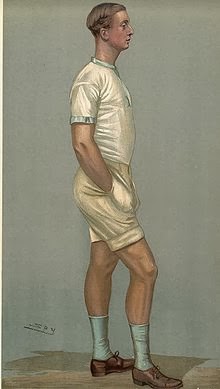
Without really trying to be scientific, I took a look at the cartoons of oarsmen who have been depicted in the magazine Vanity Fair, which was first published in 1868. Nearly 25%, or twelve out of the 50 rowers (or were there 59 oarsmen altogether?), who were depicted between 1889 and 1912 in Vanity Fair are showing ‘legs’ (the first oarsman who was caricatured, Sir Stafford Northcote, appeared in the magazine in October 1870). First out in shorts in Vanity Fair was the Henley Royal Regatta legend, Guy Nickalls, who showed up in his rowing kit on 20 July 1889 in the magazine.

Stanley Duff ‘Muttle’ Muttlebury – 22 March 1890.

Second man out, in shorts in Vanity Fair, was the great Cambridge oarsman, Stanley Duff ‘Muttle’ Muttlebury (in Vanity Fair on 22 March 1890), who, as a matter of fact, is the only oarsman out of the 50 who is depicted holding an oar in a boat. (Robert Henry Foster – 6 July 1910 – is not wearing shorts, nor is he sitting in a boat, but there is at least an eight in the background behind him in his Vanity Fair cartoon). Rudie Lehmann, who showed up in Tim’s blog post wearing ‘Oxford Bags’, wrote about Muttle and his short shorts in verse:

Muttle at six is ‘stylish’, so at least The Field reports;
No man has ever worn, I trow, so short a pair of shorts.
His blade sweeps through the water, as he swings his 13.10,
And pulls it all, and more than all, that brawny king of men.

Lord Ampthill – 21 March 1891.

A year after, almost on the day, Muttle had had his 13 st. 10 lbs. shown in Vanity Fair, Guy Nickalls’s best friend and rowing partner Oliver Arthur Villers Russell, more known as Lord Ampthill, was depicted in Vanity Fair (21 March 1891) showing a stylish fashion, (Oxford) blue jacket and rowing cap, tan shorts and brown knee socks and brown shoes.

Hugh Benjamin ‘Benjie’ Cotton – 15 March 1894.

Then it took some years before another oarsman showed up, exposing some legs in Vanity Fair, Hugh Benjamin ‘Benjie’ Cotton (15 March 1894), who was a fairly short and light oarsman, who also rowed successfully in the colours of the Dark Blues, which was shown by the oar he was holding in his right hand. Cotton, too, was wearing brown knee socks and brown shoes.

Charles Murray Pitman – 28 March 1895.

Charles Murray Pitman (28 March 1895) was said to have been ‘a cheerful, wholesome boy, full of pluck’, but lazy outside the boat, though in the boat, he won four successive Boat Races for Oxford, in 1892-1895.

Walter Eskine Crum – 19 March 1896.

Then there was Walter Eskine 'Crumbo' Crum (19 March 1896), who in Vanity Fair was called ‘quite a fine specimen of young English manhood’ by the artist ‘SPY’, who, however, did not mention anything about the oarsman’s knees or legs, but did write that ‘his chief peculiarities are a beautiful complexion, an almost girlish look, a very frequent blush (which is the outcome of much modesty)’. Crumbo is also, just as Lord Ampthill, wearing a blue blazer with a white pocket square, brown knee socks and white shoes and cap in hand. He looks very dashing.

Harcourt ‘Tarka’ Gold – 23 March 1899.

The legendary oarsman and coach Harcourt Gilbey ‘Tarka’ Gold (23 March 1899) was the first man to be knighted for his services to the sport of rowing, and also the first man who received a comment from ‘SPY’ about his knees in Vanity Fair. SPY wrote: ‘He has wonderful knees; and his legs are always loudly appreciated by the crowd at Putney.’ I leave it to you readers to decide if Tarka’s knees are more ‘wonderful’ than, say ‘Duggie’ Stuart’s or ‘Ethel’ Etherington-Smith’s?

William Dudley-Ward (29 March 1900).

William Dudley-Ward (29 March 1900) met with great opposition within the own ranks when he, as the president of Cambridge University Boat Club, for the 1898 Boat Race, brought in the famous Oxford oarsman and coach William Fletcher to coach the Light Blues. The Dark Blues had been victorious for eight consecutive years so it was a question of finding an answer to the problem with some kind of a 'desperate-times-call-for-desperate-measures' solution. However, the crew was struck with misfortune. Getting close to Boat Race Day, the stroke Charles Steele went down with influenza and could not row and President Dudley-Ward was ordered by his doctor not to row. Second seated, Adam Bell, the 'old man' in the crew, moved reluctantly to the stroke seat. Oxford won the race. The following year, Cambridge won, stopping the Dark Blues to get their tenth straight victory. Then, two days after Dudley-Ward - now president of Cambridge University BC again - was depicted in Vanity Fair, on 31 March 1900, Cambridge won, now with twenty boat lengths. In the Vanity Fair print Dudley-Ward is seen with his turned-upped/cuffed shorts and Cambridge-blue socks.

Wilfrid Hubert Chapman (2 April 1903).

Wilfrid Hubert Chapman (2 April 1903) rowed in the Eton crews that won the Ladies’ Plate at Henley in 1897 and 1898. He was to row bow in the Light Blues’ crew of 1899, but decided not to participate. In February 1900, as Second Lieutenant at the Sixth Yorkshire Regiment, Chapman went to fight in South Africa, but was sent home with fever the next year, in March. He then rowed in the winning Cambridge crews in the 1902 and 1903 Boat Races. It was said that Chapman ‘was probably the most dashing bow who ever rowed in that place’, which referred to his rowing style, as he was ‘not particular about dress’. At the outbreak of the First World War, he left his job at Bombay Company in Karachi to rejoin the Sixth Yorkshire Regiment. Captain Chapman was one of the first ones to get killed at the landing at Suvla Bay in the Dardanelles – the only oarsman depicted in Vanity Fair killed in action during the First World War.

Douglas 'Duggie' Cecil Rees Stuart (13 March 1907).

Douglas 'Duggie' Cecil Rees Stuart (13 March 1907) stroked the Light Blues in four Boat Races between 1906 and 1909. Stuart created a scandal at the first race rowing with a particularly ‘ugly style’, which would be called after him, ‘Stuart’s sculling style’. Ugly or not, Cambridge won the Boat Races in 1906, 1907 and 1908, the latter year being picked as Great Britain’s first boat at the 1908 Olympic rowing regatta on the Henley course. However, the Cambridge crew (slightly altered from the Boat Race crew) was beaten by Royal Club Nautique de Gand, Belgium, in the semifinals.

Banner Carruthers Johnstone (3 July 1907).

The Scotsman Banner Carruthers Johnstone (3 July 1907), by his friends called ‘Bush’ due to his military moustache, was Captain of the Boats at Eton before he showed up at Cambridge, rowing for Trinity College. Johnstone rowed in four Light Blue crews, between 1904 and 1907, losing to Oxford only in the 1905 race. He was also successful at Henley, taking cups in the Silver Goblets, the Visitors’ and the Grand. He rowed in the number three seat in the winning Leander ‘Old Crocks’ crew in the final at the 1908 Olympic eights race against Royal Club Nautique de Gand.

Raymond Broadley 'Ethel' Etherington-Smith (5 August 1908).

About Raymond Broadley 'Ethel' Etherington-Smith, SPY wrote that he was 'the finest and handsomest young athlete I ever drew as an under-graduate', but by summer 1908, the oarsman, in the picture seen in his Leander kit, was 31 years old and a newly Olympic gold medallist in the eights. The Leander crew had been hand-picked by coach Tarka Gold to form the British 'B crew' at the Olympic regatta in Henley-on-Thames. Compared to the British first selected boat, the 1908 Cambridge winning crew in the Boat Race that year, which had been stroked by Duggie Stuart, the Leander crew were older rowers, going by the name of the 'Old Crocks'. Other oarsmen in the 'Old Crocks' crew, who had been depicted in Vanity Fair, were Banner 'Bush' Johnstone and Guy Nickalls. In September 2012, Ethel's 1908 Olympic gold medal was sold for an astonishing £17,500 ($27,738).

That was the twelve oarsmen in Vanity Fair wearing shorts in the magazine. We have to save the oarsmen and oarswomen wearing lycra/spandex till another time.

Much of the information about the Vanity Fair oarsmen was collected from the brilliant "Rowers of Vanity Fair" on Wikipedia.

Monday, January 27, 2014

Blues in Bags

Tim Koch writes:

I am often inspired to write a particular post by something that appears on ‘Hear The Boat Sing’. The splendid photograph of the 1931 Oxford Crew that illustrated Malcolm Cook’s article on the use of shaved blades in the 1920s and 1930s is one such thing.

The Oxford Crew of 1931.

I have attempted to identify everyone but I do stand to be corrected. From left to right: ER Edmett (Cox), WG Holdsworth (Stroke), WDC Erskine Crum (7), L Clive (6), JF Platts-Mills (Bow), CM Johnston (4), RJA Poole (5), GML Smith (2), GM Tinne (3). (On Boat Race Day, Platts-Mills did not row, instead it was WL Garstang in the bow seat.)

The Cambridge Crew of 1931.

Again, I have attempted to identify everyone correctly but contact me if I have got some names wrong. Clearly the cox, JM Ranking, is standing at the front. Behind him, left to right, are TA Brocklebank (Stroke), CJS Sergel (7), PN Carpmael (5), RHH Symonds (3), HRN Rickett (6), Unknown (perhaps a sub?), G Grey (4), D Haig-Thomas (Bow) and WA Prideaux (2).
I have a particular interest in the 1931 Boat Race as I own a winner’s medal from that year as well as a sheet of CUBC writing paper with the crew’s autographs.

The 1931 CUBC Boat Race Medal and crew autographs. Unfortunately, I do not know who was given this particular medal or who collected the signatures.

The two crew pictures above illustrate the power of photography. The technically better picture of Oxford makes them look far more glamourous than their Light Blue counterparts. The Cambridge picture is from a much copied postcard and contrast has been lost while the Oxford print has more light and shade. The men from the Isis look powerful and poised while those from the Cam look awkward and not especially fit. The irony is, of course, that it was Cambridge who won in 1931.

There is another reason that the two photographs appeal to me. As I have mentioned before, I am interested in the history of men’s clothing and many of these young men are sporting one of the great fashions of the interwar period – ‘Oxford Bags’. ‘Bags’ is simply an old slang word for loose-fitting trousers or, in American-English, pants. These usually measured about 24 inches around the ankle (though there were, briefly, broader examples sported by a flamboyant few) and were wider at the knee. They were popularised by Oxford students, if not invented by them, but by the late 1920s they were worn in many parts of Britain and the U.S., despite ridicule from the older generation. A contemporary joke ran: ‘Why are Oxford Trousers like two French towns?’ ‘Because they are Toulon and Toulouse’. In 1924, the first sighting in Hull in the North of England was thought worthy of a report in the local newspaper. By the 1930s they had become mainstream and were commonly worn by all classes of men, not just privileged undergraduates like these sturdy chaps filmed by British Pathe in 1938:

MEET THE OXFORD CREW


There is an extreme example in the Oxford Crew picture, sported by Smith, second from the right. They may seem strange to us now but perhaps they are preferable to the modern trend for young men to wear underwear revealing jeans with a low slung crotch, tapering to a tight fit around the ankle. Several places in America have called in the Fashion Police.

Oxford 1924.

The cartoonists were particularly fond of Oxford Bags as seen by the above caricature of WP Mellen and crewmates in 1924 (fans of the British version of the ‘Top Gear’ TV programme may notice Jeremy Clarkson in the top left). Another example is here where the 1925 joke is that ‘Cambridge... have no intention of giving up the trouser race without a struggle. They have visited their local tailor and their coach has him doing 33 stitches to the minute’.

There are several stories about the origins of the fashion. Some claim that bags were invented by the Oxford aesthete and dilettante Harold Acton (often alleged to be the inspiration for the ‘Anthony Blanche’ character in Evelyn Waugh’s Brideshead Revisited). Bob Boothby (later Baron Boothby, a Conservative politician with an exceptionally colourful private life, described by the late Queen Mother as ‘a bounder but not a cad’) claimed that he was the inventor, saying that it was ‘the only creative thing’ that he did while he was at the university. However, Oxford Bags were known to have existed while both of these gentlemen were in short trousers, baggy or not, so their origins must be elsewhere. Writing in the New Sheridan Club newsletter of July 2013, Sean Longden has a theory of much greater interest to HTBS readers:

First mention of wide trousers in the USA came in 1924 when reporters mentioned wide white trousers being worn at the Henley Regatta and “Eights Week”, the annual intercollegiate rowing event at Oxford. This is important because it links us to the true story of why Oxford bags were developed...  Speaking in August 1925, Mr Kendrick, the Keeper of Textiles at the Victoria and Albert Museum, gave his explanation for the genesis of the Oxford Bags... ‘(Students) found the wide trousers convenient to pull over (their) shorts to go down to the river.’

A contributor to an online men’s clothing forum found this piece of contemporary supporting evidence in the Dundee Courier newspaper of May 1926.

Longden continues:

Writing in the 1920s, a former travelling salesman referred to selling “Oxford Bags” in the 1880s. And in the 1904 novel A Chicago Princess by Robert Barr, the main character is a former Oxford student who comes across ‘a pair of Oxford bags I had not worn in years...’  Furthermore, the Rowing Museum at Henley holds a pair of 1896 trousers made from an off-white blanket material, which are described as “Oxford Bags”. These were trousers used by rowers to keep warm between races. Effectively the track suit trousers of their day.

There can be not doubt that ‘blanket bags’ originated in the late nineteenth century. There are many pictures of Victorian oarsmen wearing very baggy off white trousers in a coarse woollen material. They are invariably roughly rolled up at the bottom to something approaching the correct length. These are most elegantly illustrated by the ‘Spy’ cartoons in Vanity Fair magazine.

WAL Fletcher, 1893.

CT Fogg-Elliot, 1894.

RC Lehmann, 1895.

In summary, Oxford Bags were originally a crude garment made in rough inexpensive material invented by rowers as a form of what would later be called ‘sweatpants’. At sometime around the early 1920s students had this style of trousers made in finer cloth, properly tailored and finished with turnups (‘cuffs’ in the U.S.), which were then worn for everyday use. The fashion soon spread and Longden argues that bags influenced the basic shape of men’s trousers up to the 1950s. It seems that rowing provided the first real example of sportswear influencing mainstream fashion.