Photograph: Werner Schmidt
Showing posts with label Raymond Etherington-Smith. Show all posts

Wednesday, November 6, 2013

Another F. S. Kelly ‘Henley Prize’ went under the Hammer

F. S. Kelly

Greg Denieffe writes:

A new Sporting Memorabilia sale by Graham Budd Auctions took place in Sotheby’s, 34-35 New Bond Street, London, on 5 and 6 November. The full catalogue is online and as in recent sales, there were a few lots (240-245) of interest to collectors of rowing memorabilia. Undoubtedly, the star ‘rowing’ item was a Ladies’ Plate Medal won by F. S. Kelly in 1899.

Lot 240

A Henley Regatta prize medal for the Ladies Challenge Cup in 1899 won by Frederick Septimus Kelly, the Eton College Stroke, the rim named to F.S. KELLY. F.S. Kelly later rowed for Oxford and Leander and won a gold medal at the 1908 Olympic Games as a member of the coxed eight. By profession he was a musician and composer. Having survived Gallipoli, Kelly was killed in action in the last days of the Battle of the Somme. Estimate: £300 - £500

Sold for £240 (plus commission, 17,5 %)

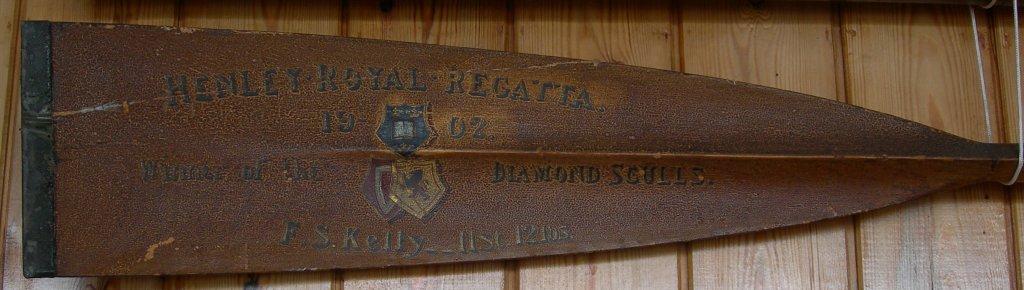
Early in 2012, HTBS reported that Kelly’s Pineapple Cup sold at Bonhams for £3,800. This was his prize for winning the 1905 Diamond Challenge Sculls, his third victory in four years. His first win in the Diamonds was for Balliol College, Oxford, when he won in 1902 beating Raymond Etherington-Smith in the final. Balliol College has the sculls in their historic collections centre in St Cross Church. The following year, sculling for Leander Club, he retained his title beating Julius Beresford, and in 1905 he defeated Harry Blackstaffe. Not to be outdone, the River and Rowing Museumin Henley has a 1905 scull in their collection.

Kelly, a New South Welshman by birth – his father was Irish – also won The Grand Challenge Cup at Henley three times in succession (1903-1906), The Stewards’ Challenge Cup in 1906 and a gold medal for Great Britain at the 1908 Olympics in the eights. He is remembered on the Bisham War Memorial.

Two other lots caught my eye:

Lot 244

Rowing programmes, Durham Regatta 22.6.1938; Maidenhead Amateur Regatta 3.8.1929; Henley Royal Regatta 2.7.38 & 5.7.52; Oxford University Summer Eights 26.5.1936, 22.5.1937 & 24.5.46; Oxford v Cambridge Boat Race 30.3.1946; Oxford University Torpids’ Race Card 21.2.1939; the lot also including a 12-page booklet Henley 1839, red cloth boards; and an Ouse Amateur Sailing Club Regatta at Denver (11). Estimate: £130 - £160

Sold for £110 +

A very diverse collection that would probably do well on eBay split into individual lots. The Henley booklet is rather grand considering it only consists of 12 pages.

Lot 245

A portrait of the British rower Tony Butcher by an unknown hand, oil on canvas, 68.5 by 53cm., 27 by 21in., framed. Estimate: £200 - £300

Sold for £150+

I like the composition of this portrait. The decorated oars are clearly important mementos of a rowing career that saw victory in the 1947 University Boat Race (Cambridge) and The Grand Challenge Cup in 1948 (Thames Rowing Club) and participation in the 1948 Olympic Games (Great Britain 4-).

My first thought on seeing this picture was that Cyril Bird would have enjoyed it. He used the pen name ‘Fougasse’ and in 1948 had a cartoon published in Punch with the caption "Yes, I did row a little at one time – why, how did you discover that?"  Perhaps Oscar Wilde was right, when he opined in his 1889 essay The Decay of Lying that, “Life imitates Art far more than Art imitates Life”.

The other rowing related lots sold for:
241 sold for £160+
242 sold for £240+
243 sold for £100+

All but Lot 245 sold to room bidders.

Friday, November 23, 2012

Cambridge Trial Eights 1896: Comparing Jackets and Socks

Sixteen oarsmen and two coxes proudly wearing their 'Trial Caps' for the Cambridge Trial Eights Race on 5 December, 1896. Back row, left to right: (unidentified), C. R. Pattison-Muir (Caius), S. V. Pearson (Emmanuel), Sultan (the horse), D. E. Campbell-Muir (Trinity Hall), Henry Trevor-Jones (coach; on the horse), (unidentified), J. E. Payne (Peterhouse), H. E. Oakeley (Jesus) and G. A. Crane (First Trinity). Front row, left to right: G. T. Bullard (Trinity Hall), B. H. Howell (Trinity Hall), C. M. Steele (Trinity Hall), (unidentified: 'old oar'?), A. S Bell (old oar, Trinity Hall), W J. Fernie (old oar, Trinity Hall), C. D. J. Goldie (Third Trinity), (unidentified), R. B. Etherington-Smith (First Trinity) and H. G. Brown (First Trinity). Sitting in the very front, left to right: W. H. G. Woodroffe (Emmanuel), P. Cave-Moyles (Caius) and F. E. Foster (Trinity Hall). (Photography courtesy NRF)
 
On 13 November, I wrote about the 1897 Oxford crew - 'The Finest Crew that ever Rowed'. I then mentioned that I am doing research for a booklet about Benjamin Hunting Howell, the American who rowed at Trinity Hall and in the 1897 Light Blue crew. I thought it might interest you HTBS readers to see a unique photograph from December 1896 showing Cambridge's two 'Trial Eights'. The oarsmen and two coxes are wearing their 'Trial Caps', the cap that indicates that they were selected for a seat in one of the two crews who are going to race on the Boat Race course between Putney and Mortlake. To help them with their practice are some 'old oars' who have rowed in the Boat Race before.

The first time I saw this photograph, I only recognised a few of the persons in the picture: Hunting Howell, Henry Trevor-Jones (and his horse, Sultan, which was said to be as old as his owner; Trevor-Jones was 42 years old when this photo was taken), Arthur Bell, William Fernie and Raymond Etherington-Smith. How was I to find out the names of the other oarsmen and coxes? Well, I was lucky to find an old issue of The Cambridge Review from 26 November on the web. The unsigned article gives us the names of the two eights. The first boat had the following crew: bow H. E. Oakeley (Jesus), 2 J. E. Payne (Peterhouse), 3 P. Cave-Moyles (Caius), 4 H. G. Brown (First Trinity), 5 S. J. Selwyn (Third Trinity), 6 G. A. Crane (First Trinity), 7 S. V. Pearson (Emmanuel), stroke C. M. Steele (Trinity Hall) and cox W. H. G. Woodroffe (Emmanuel). In the second boat rowed: Bow D. E. Campbell-Muir (Trinity Hall), 2 J. Sutherland (Jesus), 3 R. B. Etherington-Smith (First Trinity), 4 P. L. May (L.M.B.C.), 5 B. H. Howell (Trinity Hall), 6 C. R. Pattison-Muir (Caius), 7 G. T. Bullard (Trinity Hall), stroke C. D. J. Goldie (Third Trinity) and cox F. E. Foster (Trinity Hall). The second boat won the Trials.

Having all the names does not necessarily mean that I know who is who. So, I looked in books about the Boat Race for photographs of crews around the year 1897. I looked in some of the colleges' boat clubs' books. I compared club jackets, scarves, socks, caps (in the picture above A. S. Bell is wearing his Trinity Hall cap; he got his 'Trial Cap' in 1895, then also going on to row in 1896, 1897 and 1898 - losing all four races). It took me a week to connect the faces with the names, and I am still missing three names of the 'Trial Caps' and one old oar (sitting between Steele and Bell). And I have to confess that I might have messed up a couple of them - you see, I do not know how scientific it is to nail down names for people who are wearing a special kind of striped socks...

It is also interesting to see who is not in the photograph. One oarsman, who had not rowed for Cambridge before, did not have to row in the 'Trials' to get a seat in the 1897 Light Blue boat: William Dudley-Ward. His reputation as a 'good oar' at Eton had preceded him when he came to Cambridge in 1896. At this time, Cambridge was eager to get 'wet bobs' from Eton. In Sport and the British: A Modern History (1989; 1992), Richard Holt writes: 'The long domination of the dark over the light blues in the Boat Race of the 1890s was put down to the fact that more Etonians went to Oxford than to Cambridge.' This is true, but looking back in the record books, Cambridge had had one or two Etonians in every crew since their last victory, in 1889. Besides Dudley-Ward, Bell had also rowed at Eton.

Below is a photograph of whom eventually made up the 1897 Light Blue crew. Only two of the oarsmen who went through the Trials got their Blue: Howell and Campbell-Muir.

Here is a photograph of the Light Blue crew who would eventually row against the Dark Blues on 3 April, 1897. Back row, left to right: B. H. Howell (4 Trinity Hall), E. J. D. Taylor (3 Caius; dark jacket), W. J. Fernie (stroke Trinity Hall; sitting) and D. E. Campbell-Muir (bow Trinity Hall). Front row, left to right: W. A. Bieber (5 Trinity Hall), A. S. Bell (2 Trinity Hall),  E. C. Hawkins (cox; Caius), W. Dudley Ward (7 Third Trinity) and D. Pennington (6 Caius).

Anyone who has more information about who is who in the photo on top, or corrections are very welcome to contact me!

Saturday, September 8, 2012

Ethel's Gold Medal goes for £17,500!

On 3 September, at Christie’s in London, an Olympic gold medal which was won by Raymond D. Etherington-Smith, the captain of the Leander eight which became Olympic champions in 1908, was sold for an astonishing £17,500 ($27,738). This solid gold medal, 25g, 15 carat gold, auctioned off by his family, was estimated to sell for £5,000 – £7,000 ($7,600 – $11,000).

Raymond Etherington-Smith (1877-1913), called ‘Ethel’ by his friends, studied at Trinity College, Cambridge, where he proved to be an incredible oarsman. He won the Colquohoun Sculls, the Lowe Double Sculls, the University Pairs and Fours, and rowed twice in the Head of the River. In 1898, Ethel rowed in his first Boat Race, and the following year he became President of the C.U.B.C., which was the same year he and his crew managed to break the Dark Blues’ nine-year winning streak. The 1900 Boat Race was also won by the Light Blues with Ethel in fifth-seat. He was Captain of Leander in 1903, 1905, 1906 and 1908, winning the Grand Challenge Cup in 1901, 1903 and 1905, and was the runner-up for the Diamond Challenge Sculls in 1902, racing against the mighty F.S. Kelly.

Ethel was a fine specimen of an oarsman, and Leslie Wars, ‘SPY’, wrote about him: ‘The finest and handsomest young athlete I ever drew as an under-graduate’.

In an article published by the Daily Mail about the auction at Christie’s, Ethel is likened to Sir Steven Redgrave. Read the article here. Incorrectly, the paper writes that Leander’s opponents in the Olympic final race in the eights, the splendid crew from Royal Club Nautique de Gand of Belgium ‘sunk and capsized’ during the race, but that is not true. Following is an account of the race in Henley Races (1919) by Sir Theodore Cook:

‘This proved a magnificent race. The Belgians, who had twice won the Grand Challenge Cup at Henley, and at this Regatta had defeated Cambridge University, were thought likely winners by many people. […] Along Temple Island both were rowing 38 a minute, Leander forging slowly ahead and having half a length to the good at the first signal-box. They gained another quarter length  by the time the second box was reached, in spite of a fine spurt on the part of the Belgians. […] At the Henley mile post Leander were rowing 35 a minute, and were a length and a quarter in front. Both crews rowed in to the finish very hard, Leander at 36 and the Belgians at 38 a minute, the former winning by a good two lengths’ distance in the very fast time of 7min. 52sec.’

The Leander eight had been Great Britain’s ‘second’ boat, and many of the oarsmen had their active rowing career behind them. Due to their age they were called the ‘Old Crocks’. So at age 31, Ethel jokingly told his crew mate Guy Nickalls who was 42 years old: ‘I suppose they have asked me because I am about half-way down the line between yourself and Bucknall in age’ [Henry Bucknall, the stroke, was 23 years old].

Sadly, Ethel, who became a doctor, died five years later, a week after he had turned 36, contracting peritonitis during an operation.