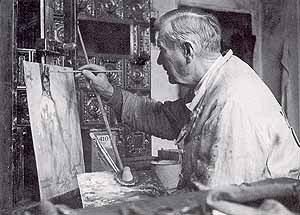
 Today, may I recommend that you HTBS fans read Chris P.'s entry about the Swedish illustrator Brynolf Wennerberg on the eminent blog Rowing for Pleasure. Very interesting, Chris!
Showing posts with label Chris Partridge. Show all posts
Showing posts with label Chris Partridge. Show all posts
Thursday, November 10, 2011
Ladies In Boats
Today, may I recommend that you HTBS fans read Chris P.'s entry about the Swedish illustrator Brynolf Wennerberg on the eminent blog Rowing for Pleasure. Very interesting, Chris!

Tuesday, December 7, 2010
Cranberries, A Black Tooth, Or A Sword?
 Regarding the e-mail from Chris Partidge of Rowing for Pleasure, which was posted on HTBS yesterday, it ends “Your reference to Lund reminds me of the time I visited it for the launch of the Bluetooth radio short-range radio system for mobile phones and computers. At the launch, we were told all about Harald Bluetooth, who unified Scandinavia (hence the appropriate use of his name for a common standard for radio communication). According to the PR spiel, he got his nickname from his love of cranberries, which stained his teeth. Later, we were taken to a historical recreation at Malmö Castle [seen above]. I got talking to a real historian, who said “Cranberries? It’s all ballocks. Bluetooth is a corruption of an old Norse name meaning ‘Grey Warrior’ or something similar.”
 Many sources claim that the Danish king’s name Blutooth, old Norse ‘Blátönn’, actually means ‘black tooth’, which is also Frans G Bengtsson’s explanation of King Harald’s name in an essay he wrote about how The Long Ships came to be written. In The Long Ships Bengtsson has put in an episode with Harald having a terribly tooth ache. However, modern research declares that ‘Bluetooth’ was probably the name of Harald’s well-made sword with a bluish blade. The word ‘tönn’, ‘tooth’, is to be found in many given names of Viking swords. In The Long Ships, the Vikings’ swords ‘bite’ a lot…
Monday, December 6, 2010
Ugly Covers Of The Long Ships
 Chris Partridge of the blog Rowing for Pleasure writes in an e-mail:
 I made a mental note when I read your posts about Frans Bengtsson to look out for a copy of The Long Ships. Sounds a good read, I thought. Just now, I went up to the top floor of Partridge Towers to look out a Hornblower book knew my son had up there, and lo and behold I found a copy of The Long Ships there. None of my family has a clue how it got here. I am looking forward to reading it, even though the cover has an even worse historical atrocity than the helmet wings on the new edition. Not only does the Viking warrior in the picture look as though he is asleep, he is wearing a helmet with cow horns. [See picture on the left.]
Cow horns have been comprehensively rubbished lately, even in the popular TV panel game QI. According to a transcript produced by a QI obsessive, Stephen Fry said: “Viking helmets didn’t have horns. It’s thought that they were actually little more than leather skullcaps, or nothing. The idea of horned helmets comes from various pre-Christian Celtic artefacts and depictions: wrong people and wrong era. The modern association with Vikings dates from a Swedish book illustrator named Gustav Malmström in the 1820s and from productions of Wagner’s Ring in the 1870s (not that the Ring is about Vikings), into which it was introduced by Carl Emil Doepler, the designer of that show. Furthermore, the horned helmets were a development of an earlier 19th century romantic notion: the winged helmet. Horns muscled wings out until they were revived by the Thor and Asterix comics.”

Mind you, that didn’t stop a crew from my club, Langstone Cutters, rowing the Great River Race in plastic cow horn helmets.
 And so Chris ends his thoughts about awful book covers of the Bengtsson novel. I can only agree. There are some terribly ugly ones with historical blunders like horns and wings on the Vikings’ helmets. Why can’t the illustrators do a little research before they start putting their pen to paper? I believe some of their helmets were made of iron to protect them from sword blows, etc.
Besides the cover of Chris’s edition seen above, the first paperback edition from 1957, published by the New American Library, also has a dreadful cover, seen at the very top of this entry. But, of course, the important thing is what Frans G Bengtsson’s The Long Ships has to offer as a historical novel, not the different covers. I am delighted to hear that Chris found a copy of The Long Ships, and I am certain that he will enjoy the book; I am yet to find a reader of the book who did not like it!
Subscribe to:
Posts (Atom)