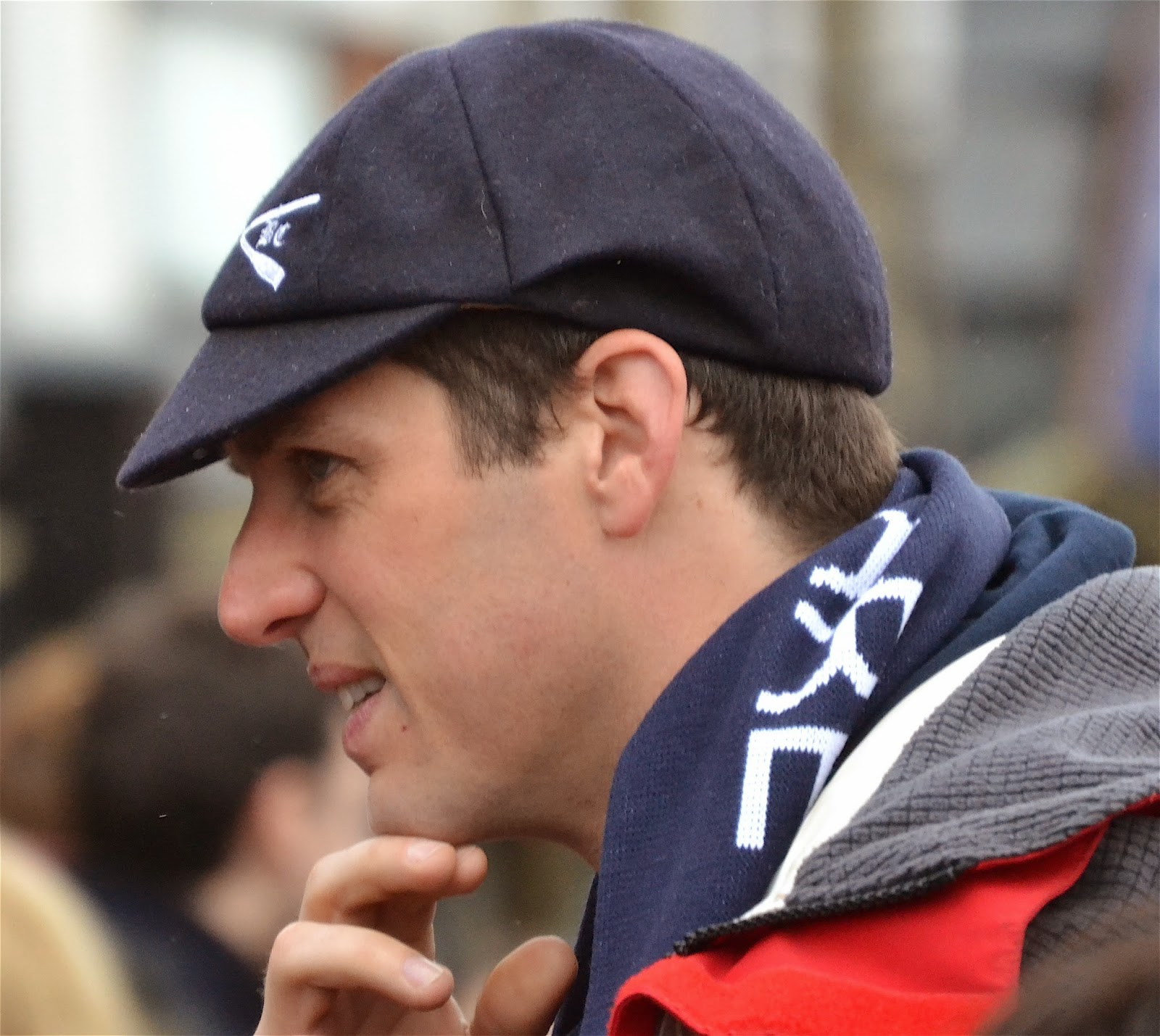
Members of Cambridge University Women’s Boat Club wait for the men's race by the famous steering point that is the second lamppost out from the Surrey buttress of Hammersmith Bridge.
Tim Koch reports from Cambridge Trials:
Wednesday, 18 December was the date set for the 2013 Oxford - Cambridge Heavyweight Men’s Boat Race Trials held over the full 4 1/4 mile Putney to Mortlake course. These are not contests of Light Blue against Dark, they are intra-university races, Oxford v Oxford and Cambridge v Cambridge, where the last sixteen rowers and last two coxswains from each university battle it out in theoretically matched boats, all eighteen hoping to impress the coach who has to make the final selection. The Tideway Trials are an important learning experience for athletes and coxes, as well as an intense selection test. Unfortunately, this year illness and injury has struck the Oxford camp and they have delayed their Trial VIIIs until the New Year.
Sean Bowden, the Chief Coach of Oxford University Boat Club said in a press release:
In the last week the squad has been hit by a wave of illness that has affected a significant number of rowers.. The problem has been compounded by the fact that the large majority of those unable to row are all on the same side of the boat... (The) coaching staff did not want to take the risk of racing with athletes not in good health. Furthermore, there seemed to be little value in holding the race with a number of substitutes from outside the squad in the boats in what would have been largely scratch and untested crews. Trial VIIIs is an important part of the team’s preparation for The 2014 BNY Mellon Boat Race so this is not a decision made lightly.
Trial VIIIs 2013 - CUBC. Courtesy of The Boat Race Company.
The Cambridge Trials continued as planned however. The squad has only two Old Blues, Mike Thorpe and President Steve Dudek. Both crews were stroked by Americans - Luke Juckett and Henry Hoffstot. They included the first Austrians ever to represent Cambridge, Florian Herbst and the international U23 sculler, Alexander Leichter. The coxswains were first-time triallists, Ian Middleton and 2013 Blondie cox, Arav Gupta.
As I was stationed on Hammersmith Bridge, I did not see the whole race and thus I must quote at length from the report on the official Boat Race
website. I have shortened the boats christened
Sea Shells and
She Sells to 'Sea' and 'She' as it is mentally confusing to use the full names (or is it just me?) Full credit to umpire Richard Phelps for coping with this student joke.
'Sea'... won the toss and chose the Surrey station. That left the early advantage on Middlesex to 'She'... ‘Sea’ went off at 43, a pip higher than the opposition, but it was ‘She’ who eked out a slight advantage past the boathouses and maintained the lead all the way to Barn Elms. As both crews were warned in turn for their steering American stroke Luke Juckett took ‘Sea’ up a notch to take a canvas lead past Harrods.
Hoffstot’s She Sells (left) on Middlesex and Juckett’s Sea Shells (right) on Surrey pass the Harrods Buoy.
Approaching Hammersmith Bridge.
As the Surrey bend now began to work in the their favour ‘Sea’... increased their lead to two thirds of a length but the crews now began to feel the full force of the stiff south-westerly breeze. ‘She’ on Middlesex seemed to cope better with the rougher conditions while Dudek’s crew lost a little of their rhythm. But they recovered past Chiswick Steps, and were drawing level once again, when Ian Middleton, the ‘Sea’ cox, unfortunately failed to spot the obstacle in his path until it was too late, and the marker buoy hit the stroke side riggers of his crew, who immediately lost half a length.
Approaching Barnes Bridge ‘She’ were able to cross into their opponents water and take the rate down to 29 while the losing crew maintained their rate at 31. Both crews upped the rate approaching the finish but ‘She’ now had a comfortable lead, crossing the line to win by just over 3 1/2 lengths.
“Both crews have different strengths and weaknesses and we focused a lot on developing the strengths”, said Cambridge chief coach Steve Trapmore afterwards.
“I was pleased with the way the race went”, said umpire Richard Phelps, who will take charge of his first Boat Race next year. “Both crews responded quickly to my warnings, but we were off the race line at one or two points so there’s still some work to be done there.”
The victorious She Sells comes ashore ahead of the losing Sea Shells.
In support of Phelps’s comments on the racing line, from my viewpoint on Hammersmith Bridge, I thought that both coxes went wide passing Harrods - though
She Sells cox, Arav Gupta, corrected his mistake first. In semi-defence of
Sea Shells cox Ian Middleton who hit what I presume to be the Surrey crossing buoy at Chiswick, this has moved out of position since the storms at the end of October. However, I imagine that Middleton has passed by it many times since then and a Boat Race cox cannot afford to make a mistake even a fraction of this severity.
The winning time was 18 minutes 38 seconds. Even if Oxford had raced, comparing the times of different races held on a tidal river is fairly meaningless. However, in the Head of the River Fours held over the same course nearly three weeks earlier, the top Cambridge boat consisting of trialists Helge Gruetjen, Steve Dudek, Mike Thorpe, Henry Hoffstot and cox Ian Middleton came second to the top Oxford Four of Malcolm Howard, Constantine Louloudis, Karl Hudspith, Michael di Santo and cox Laurence Harvey. The only consolation for the ‘Tabs was that they beat an impressive Leander Four into third place.
'Hear The Boat Sing' always looks for the historical aspect of any contemporary rowing event. While I gave a brief historical perspective in my report on
the 2012 Trials I can now add an interesting footnote. I was recently researching the 1923 Boat Race for a forthcoming piece when I came across an article in the Sphere magazine of 17 March 1923, subtitled ‘The Fathers of the Boat Race’. It chronicled what were then the two oldest surviving veterans of the race. The Rev. Cannon Richard Martin, then 89, and the Rev. John Arkell, then 87, rowed at ‘3’ and ‘4’ respectively in the Oxford Crew of 1857.
Richard Martin, Oxford ‘4’ in 1857.
John Arkwell, Oxford ‘3’ in 1857, ‘2’ in 1858 and ‘Stroke’ in 1859.
Arkell, who died not long after the
Sphere report, had the more distinguished rowing career of the two. After winning in 1857, he rowed again in 1858 and lost, but won at Stroke in 1859. Also in 1859, Arkell won the Silver Goblets at Henley with the famous oarsman and coach,
Edmund Warre, beating AA Casamajor and James Paine. The
Sphere records our particular interest in John Arkell thus:
Mr. Arkell has... a great claim to special honour by the rowing fraternity of the two Universities. It was he who became one of the originators and founders of what are today known as ‘The Trial Eights’ which are races made up of two of the best eights the ‘Varsity can produce about Christmas each year... It was in the vetera’s own room at Pembroke, Oxford, whilst he was President of the ‘Varsity Boat Club, that the rules and regulations for these eights were drawn up by four or five celebrated oarsmen.
Returning to the present day, although the Heavyweight Women will not race on the Tideway until 2015, their Trial Eights will run over the Putney to Mortlake course on Thursday, 19 December. Unlike the men, the Oxford women will be racing - they are obviously made of stronger stuff. HTBS will also be there.
The end of a long day.
What we are supposed to call the ‘BNY Mellon Boat Race’ is on Sunday, 6 April 2014 at 6.00pm. The equally inelegantly named ‘Newton Women’s Boat Race’ is at Henley on Sunday, 30 March 2014 at 3.00pm.