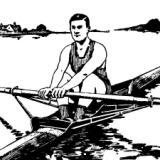
One of Great Britain's finest scullers was W.D. Kinnear, who most of his rowing career rowed for Kensington Rowing Club. HTBS's Tim Koch of Auriol Kensington RC tells the story:
The recent HTBS posting, “A Daring German Rowing Book”, quoted a 1907 training manual as advising abstinence from sex in the run up to important regattas. This was not just one person’s eccentric idea. A few years ago I interviewed John Rogers who was Captain of Kensington Rowing Club from 1954 to 1964. He recalled someone that he had known well, Kensington’s most famous son, W.D. Kinnear, winner of the single sculls in the 1912 Stockholm Olympics. It seemed that, in his coaching days following the 1914-1918 War:
“[Kinnear’s wife, Lillian] used to go around and tell all the wives that their husbands were in training - no sex! They were going to Henley Regatta, no sex. She would really lay the law down. It was one of the wives who told me this, she said that she put the fear of God into you.”
 The picture above shows Wally, Lillian and one of their children in 1910. ‘WDK’ was then in strict training as he was nearing the peak of his sculling career so, presumably, the child was conceived in the winter.
Another one of Kinnear’s training methods relates to a recent HTBS posting on rowing and alcohol. A 1978 letter in the Auriol Kensington archive from John Rogers states:
“In 1912 [Kinnear] was unexpectedly beaten in the Diamond Sculls at Henley. He was over trained (preparing for the Stockholm Olympics in a few weeks time) and told me that part of the remedy for this was to drink ‘Black Velvet’, a mixture of Guinness and Champaign…”
William Duthie Kinnear (1880-1974) was born in Laurencekirk, Scotland. His family called him ‘Bill’ or ‘Billy’ but the rowing world was to call him ‘Wally’ or (inevitably) ‘Jock’. As a young man he went to London to make his career. In 1902 he obtained a post as a salesman for the Debenhams department store. As was common in those days of ‘jobs for life’ and paternalistic employers, the store had its own rowing club (‘Cavendish’) based at the ‘West End Amateur Rowing Association’ boathouse in Hammersmith, West London. This was home to many such clubs including one for the employees of Harrods store. Kinnear’s talent was soon obvious and he won the West End ARA Sculling Championship in 1903, 1904 and 1905. In 1905 he joined Kensington Rowing Club and was to remain a loyal member until his death 69 years later. He had many successes in regattas over the next few years but it was between 1910 and 1912 that he reached his peak. Some credit for this must go to his great friend and informal coach, Harry Blackstaffe, the 1908 Olympic Sculling Champion.
The ‘triple crown’ of sculling in those days was the ‘Diamond Sculls’ at Henley Royal Regatta, the ‘Wingfield Sculls’ (The English Amateur Championship), and the ‘London Cup’ at the Metropolitan Regatta. Wally won the Diamonds in 1910 (beating Rudolph Lucas of Mainzer Club, Germany, easily) and again in 1911 when he had a harder fight against Eric W. Powell. The Times newspaper called it ‘a splendid race and a fine exhibition of sculling’. In the Wingfield’s, Kinnear beat Robert C. Bourne in 1910, was unchallenged and sculled over in 1911 and beat E.D.P. Pinks in 1912. He won the London Cup in 1910 (beating R.C. Bourne) and again the following year.
By 1912 it was clear that Wally Kinnear was ‘world class’. Henley was the closest thing to a regular international competition that existed at the time but the (perhaps) lesser regarded Olympic Games was approaching. There had been four Games previously. In 1896 the rowing was cancelled due to bad weather. In Paris in 1900 there was a reasonable spread of wins among the entries in the Olympic Regatta but in St Louis in 1904 all the competitors were American (save for one Canadian eight) and in London in 1908 the British won most of the rowing medals. The 1912 Games was held in Stockholm, Sweden, and many regard it as the first truly modern Games. The IOC President from 1952 to 1972, Avery Brundage, is quoted in The Olympics: A History of the Modern Games (by Allen Guttermann, 1992) as saying:
“The efficiency and almost mathematical precision with which the events were handled and the formal correctness of the arrangements made a great impression on me.”
In those days each country could enter two crews or scullers in each event. The Amateur Rowing Association chose Kinnear and A.G. McCulloch of Leander Club who had won the Diamonds in 1908 and came second in the Olympic Sculls in the same year. In the event, illness meant that McCulloch did not go to Stockholm.
What is particularly striking by modern standards is how informal the whole thing was. A letter from the ARA Secretary to the Kensington Secretary on 11th May 1912 (just over two months before the Olympic Regatta was due to be held on 18th and 19th July) says:
“I have already sent in an entry of two scullers, one of which will be W. Kinnear. The Swedish Committee are not asking for any names until July 1st. I will send W. Kinnear his entry forms early in June.
P.S.
As it will take some time for a racing boat to reach Stockholm, W. Kinnear may wish to have one sent out before he leaves England. He might perhaps like me to make arrangements with the Captain of Leander Club to have his boat sent out with the Leander eight. If so I will let you know dates etc early in June.”
In the event, Wally’s path to Olympic Gold was a fairly easy one. He beat Stahnke of Germany and then Veirman of Belgium. In the words of The Times, ‘there was no sculler who was able to make W.D. Kinnear extend himself’. This is not to take anything away from the Scotsman – great champions win before the final starts. Only four Britons have won world amateur single sculling titles: Blackstaffe of Vesta (1908 Olympics), Kinnear of Kensington (1912 Olympics), Beresford of Thames (1924 Olympics) and Haining of Auriol Kensington (1993, 1994, 1995 World Championships).
In his 1978 letter, John Rogers recalls that Wally had:
“[...] a very warm and endearing personality. He was always ready with a word of encouragement no matter how new or novice a member and was greatly loved and respected by all [… his rowing career) must have entailed a certain amount of hardship as he was not a rich man.”
 Two stories illustrate the fact that WDK was a humble salesman mixing in a world of so called ‘gentlemen’. His great friend was a fanatical Kensington oarsman, George Newby, who was a much wealthier man. Wally was honoured when asked to be ‘best man’ at his wedding and so gave him the most valuable thing he owned – his 1910 Diamond Sculls ‘Pineapple Cup’ (ninety years later the Newby family donated the prized object to Auriol Kensington Rowing Club). As a prequel to that story, shortly after winning the Diamonds for the first time, Wally was asked by Debenhams if they could display the Cup in one of the store windows. In those days you did not refuse a ‘request’ from your employers and so he agreed. Many of the rowing establishment thought this was very vulgar and the story goes that Guy Nickalls snubbed him until he won the Olympic Sculls when he condescended to say ‘Well done, Kinnear’.
George Newby’s son, the travel writer Eric Newby, has slightly different memories of Wally:
“My father […] was an all round sportsman [... who] used to go down to Whitechapel to be ‘pummelled’ by pugilists in order to toughen himself up, and after vigorous outings on the Thames [...] used to bathe, winter and summer, in the [...] river [...] before setting off to work [...] His ambition was that I should win the Diamond Sculls at Henley, and in this ambition he was aided and abetted by my godfather, a crusty old Scot if there ever was one, who had himself won the Diamonds and the Stockholm Olympics (in A Traveller’s Life, Eric Newby, 1982).
 Looking at the picture above, taken when Wally was in his eighties, a twinkle in his eye and a bottle of whisky in his hand, I don’t think that I would use the epithet ‘crusty old Scot’. He looks like fun to me.
This was, indeed, many great stories about one fine sculler – thank you, Tim!