Photograph: Werner Schmidt
Showing posts with label The Huskies. Show all posts

Thursday, May 15, 2014

Practice for the Non-Olympics...

The Dour Dane

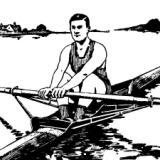
With University of Washington winning the Olympic eights at the 1936 Berlin Games - so beautifully told by Daniel James Brown in The Boys in the Boat - when it was time to prepare for the 1940 Olympic Games, which were going to be held in Tokyo, the Huskies' coach Al Ulbrickson (above) was ready to fight to represent the USA in the eights again. Below is a 1939 film showing him 'inspecting' his oarsmen before they go out for practice, according to the voice on the newsreel, for the coming Olympics.


As we know, the 1940 Games were relocated to Helsinki due to the War, but soon the Finnish capital had to be given up, too, as Finland was attacked by the Soviet Union in 1939. The 1944 Olympic Games in London were thereafter cancelled.

Wednesday, April 16, 2014

New Editions of ‘The Boys’

Greg Denieffe writes:

Regular readers of HTBS will know that Daniel James Brown’s The Boys in the Boat is held in high esteem in both the USA and in Britain. This month (April 2014) sees the release of the latest edition of the book – in French. The cover is similar to that of the UK hardcover (published by Macmillan, 6 June 2012). I like the colour of this new edition, the picture is clearer and the gathering clouds behind the crew hint at the menace of the war – the gathering storm – that was only three years away.

The French title Ils Etaient un Seul Homme translates word-for-word as They were One Man. Admittedly, it loses something in translation, but rowing people will certainly know what the publisher is saying. When Brown was interviewing Joe Rantz about his experiences at the Berlin Olympics and seeking his consent to tell his story, Rantz insisted that the book should be about ‘the boys in the boat’. For sure he was no ordinary Joe.

The sub-title L'historie vraie de l'equipe d'aviron qui humilia Hitler translates as The True Story of the Rowing Crew that Humiliated Hitler. Of course, this is an attempt to convey the sentiment of the English sub-title, An Epic Journey to the Heart of Hitler’s Berlin, which is a little more subtle. Published in paperback on 5 April by La Librairie Vouibert, you can buy a copy here.

This is not the first foreign language edition of Brown’s book. Last year (25 July 2013), a Dutch edition was published in paperback. Translated by Joost Mulder, it is called De Jungens in de Boot – De Legendarische Acht Van 1936. Typically Dutch, it is understated and straight to the point, The Boys/Guys in the Boat – The Legendary Eight 1936.


The cover is very simple in design; the photograph of the crew on the dock is timeless and the addition of the eagle flying overhead is the only hint of Nazism on display. If a new rowing book in Dutch is your ‘kopje thee’, you can buy a copy here.


A British paperback edition of the book was published by Pan on 2 January 2014. This is a slightly revised to include a few corrections as suggested by the HTBS team. It also includes an additional photo of the Huskies in 1929 sawing a giant log as part of their training. This was spotted by Brown when he read last August’s book review by HTBS editor Göran Buckhorn. The first thing you notice with this edition is the wonderful velvety feel of the cover. The picture of the boys on the dock has been darkened; the blood red sky and the inclusion of the Brandenburg Gate draped in Nazi flags should broaden the appeal of the book to those with a general interest in the Second World War.

Photograph courtesy of Thomas E. Weil.


The American paperback is due to be published on 27 May by Penguin Books. At this stage it looks like it will have the same cover as the American hardcover published by Viking (4 June 2013). The photograph used on these editions is in stark contrast to the European ones. The crew is rowing, in warm-up routine, but there is no connection with Berlin or the Olympics.

If you’re still reading, you must be a real bibliophile! So for you, here are a few other editions to look out for:

UK Hardcover - Macmillan (6 June 2013).

UK Large print - W. F. Howes Ltd (1 July 2013).

Audiobook - Penguin (4 June 2013).
                                              
Whichever edition you decide to opt for, remember this great book is a success story not only for Daniel James Brown but for OUR sport, whatever you call it!  #Aviron #Canottaggio #Rámhaíochta #Remo #Rodd #Roeien #Rowing #Rudern

Thursday, October 24, 2013

Daniel James Brown: "Rowing is Beautiful..."


By now HTBS has had several blog posts about Daniel James Brown's book The Boys in the Boat, which - if you have missed it - is a great read. Above is a very interesting video clip from a book shop event in Washington DC where Brown is telling the story how he came to write the book. He is also reading from his book which is followed by questions from the audience. If you have not yet read The Boys in the Boat you will after having watched this video...

Wednesday, September 11, 2013

1936 Olympic Games: Parvis e Glandibus Quercus*

Bobby Moch, USA coxswain, receives a Hitler Oak in the Olympic Stadium on 15 August 1936.

Greg Denieffe writes,

The 1936 Olympic Games, held in Berlin, Germany, were certainly controversial and memorable and they have long fascinated me. Many books have been written about how the world gathered at the heart of the German Reich and how the Games were hijacked by Adolf Hitler, albeit reluctantly at first.

The ’36 Games consisted of a total of 129 events in 19 sports. There was a dead-heat in weightlifting, resulting in 130 Gold Medals being awarded and each gold medallist was also presented with an oak sapling. They have come to be known as Hitler Oaks despite the fact that they were awarded by the German Olympic Committee and ‘were a gift of the German people’. The oak saplings of about 50cm high were each in a terracotta pot adorned with the Olympic Bell and on which was written the motto ‘Grow in the honour of victory! Summon to further achievement!’

Germany topped the overall medal table with 33 Gold, followed by USA with 24 and Hungary with ten. Great Britain finished 10th with four Gold. The rowing table was even more decisive with Germany winning five of the seven events with Great Britain and USA winning one each.

The recently published The Boys in the Boat by Daniel James Brown (here seen with the British cover) has at its heart the 1936 rowing eights final and tells the story of the working class heroes from the University of Washington, Seattle, and their successful quest for Olympic Gold. 

The central character in Brown’s book is Joe Rantz. As he was the only member of the victorious USA crew returning directly home, he ended up bringing the oak sapling back to Seattle where it was planted on campus at the University of Washington. The tree survived for many years despite being moved to several different locations but eventually it died. In 2008, Joe’s daughter, Judith Willman, organised the planting of a replacement oak tree outside the Conibear Shellhouse, home of the Huskies crew. The 2013 UW varsity crew have certainly lived up to the original motto on the terracotta pot.

The photograph of Bobby Moch (on top) appears on page 352 of The Boys in the Boat and I am grateful to the author for the scan. This is how he describes the presentation:

As they lined up next to the German and Italian crews, Olympic officials went down the American line, hanging gold medals around the boys’ necks and placing small laurel wreaths on their heads. Then Bobby Moch, the shortest among them, stepped up onto the highest platform on the podium. One of the boys behind him wisecracked, “You just wanted to win this thing so you could be taller than us for once, didn’t you?” Someone handed Moch a sapling oak tree in a pot. Their names suddenly appeared on the enormous, forty-three-foot-wide announcement board at the eastern end of the stadium. “The Star-Spangled Banner” began to play, and the American flag slowly ascended a flagstaff behind the announcement board.

HTBS has written briefly about the Hitler Oaks before here (Jack Beresford, GBR rowing) and here (Jack Lovelock, NZ athletics).

Jack Beresford’s victory in the double sculls with Dick Southwood was his fifth Olympic medal and in his own words was his greatest and sweetest. I recently discovered an article in the Bedford School magazine, The Ouzel (March 1996), which adds greatly to my previous post and which is transcribed below.

THE HITLER OAK
A story concerning Jack Beresford and the Hitler Oak came to light when the Secretary was contacted by a Mr H. Huntington, who was an apprentice with the firm of Beresford and Hicks, Furniture Makers of Shoreditch. They produced furnitureof quality, and apparently not only are there examples of their craftsmanship in Buckingham Palace, but they also produced furniture for the Coronation of George VI. Mr Huntington well recalls Jack Beresford returning to the factory following his 1936 Gold Medal at the Berlin Olympics and showing the employees the famous oak sapling which had been presented to him by Hitler (sic). Mr Huntington enquired as to the current whereabouts of the tree. It was originally planted on the West side of the School Field near to where the cricket nets now are, but on the outbreak of war it was felt prudent to move it a less conspicuous position, and it was planted on the mound behind the Gymnasium. It remained there until the late 1970s when the construction of the new Swimming Pool necessitated the removal of the mound, and the oak was felled. A certain amount of the wood is still held in storage, and is used primarily for rowing plaques and honours.

As an unusual postscript to the story, Mr Huntington was in the army during the Second World War and found himself fighting northwards through Germany. During a particularly heavy bombardment he took hasty refuge in a ruined building, only to find that it had obviously been a printers. There, on top of the rubble was the picture of Beresford and Southwood winning the Gold Medal. Coincidence indeed… The picture, which has been given to the School by Mr Huntington and to whom we record our grateful thanks is reproduced opposite.

The photograph in question is well known: it shows Beresford and Southwood turning the boat after receiving their victory wreath following a thrilling race in which Germany lead to 1,900m but were rowed down by the wily British double.

Another photograph accompanied the above article: it is rather less well known but just perfect for this blog post. It shows Jack Beresford handing over the oak sapling to Mr Humfrey Grose-Hodge, Headmaster of Bedford School. Whilst most of the oak saplings have died or have been felled, one has to wonder what became of the terracotta pots that they were originally presented in.

Germany won the other five rowing events; single sculls, coxed and coxless pairs, coxed fours and coxless fours but I could not find any photographs of any of these crews with their oak saplings.
However, I have collected photographs of various other athletes with their ‘querce’.

Two photographs of Jesse Owens:

In the first, he salutes during the presentation of his gold medal for the long jump, after defeating Germany's Lutz Long (silver medallist on the right) and Japan’s Naoto Tajima (bronze medallist on the left).

In the second, there are four ‘Hitler Oaks’; Jesse holds two and is surrounded by some of his USA teammates – but are the oaks all his (100m, 200m, 4x100m relay and long jump)?

Watch him receive his oak sapling for the long jump here.

Another American, decathlon champion Glenn Morris, chose to donate his oak tree to his alma mater, Colorado State College of Agriculture and the Mechanic Arts (now Colorado State University). The above photograph shows Morris (pictured right) at the 1936 “Presentation of Oak” ceremony with College President Charles A. Lory (centre) and William Wagner, a fellow athlete.

Jack Lovelock the darling of New Zealand athletics and subject of Bernard Hempseed’s follow up piece on HTBS. Here he is photographed on the medal podium holding his oak sapling for the men’s 1500m which is now fully grown and still alive in the grounds of his old school, Timaru Boys’  High School. Luigi Beccali of Italy finished second and Glenn Cunningham of the USA finished third.

Indian hockey players at the medal ceremony at 'Olympiastadion', Berlin.

Sohn Kee-Chung became the first Korean athlete to win an Olympic medal when he won the gold medal in the Marathon. In 1910, Korea had been annexed by the Japanese Empire, and remained under the control of Japan until Japan’s defeat in Second World War. The Japanese governor in Korea did not permit Sohn and his fellow Korean athletes to compete as Koreans; they participated in the Games as a member of the Japanese delegation, with Japanese names. Sohn was registered under the name Son Kitai.

Despite Germany winning 33 Gold medals, photographs of their athletes with their oak saplings are difficult to find.

Tilly Fleischer, gold medallist for Germany in the women’s javelin, one of only 15 events for women in 1936.


One place you can see the oak saplings being presented is in Leni Riefenstahl’s Olympia (1938). In a 2011 post called "Leni's Infamous Photograph", HTBS editor Göran R Buckhorn wrote, “It is tricky to balance what is showing a historical event and what might cause too much pain doing so“. Nevertheless, Olympia is well worth watching. Various versions are available on YouTube and there are five presentations of oak saplings for the keen-eyed viewer to spot. In Part 1, (Festival of Nations) you will find the presentations to Trebisonda Valla (Italy) women’s 80m hurdles, Jack Lovelock (photographed above), Forrest Towns (USA) men’s 110m hurdles and Sohn Kee-Chung (again photographed above). In Part 2 (Festival of Beauty) you will find the presentation to Robert Charpentier (France) men’s cycling – individual road race.

*Parvis e Glandibus Quercus = Great oaks from little acorns grow.

Wednesday, August 28, 2013

1936 Olympic Trial Video - Washington Winning by a Boat Length

Daniel James Brown's great book The Boys in the Boat is still on many rowers mind, and non-rowers, too, if I understand it right, this week being on the 17th place on the New York Times non-fiction best-seller list. HTBS wrote a book review about the it on 19 August. That post has got some interesting comments, and yesterday 'bob' sent along a link to a newsreel showing how Washington beat Penn by a boat length at the Olympic Trials at Princeton. Watch it here. Rumours have it that it was a photo finish race, but alas, it was not.... Now we know for certain, thanks to 'bob'!

Monday, August 19, 2013

Book Review: The Boys in the Boat

The heroes in the boat: (from left) Stroke Donald ‘Don’ Hume (1915-2001), 7 Joseph ‘Joe’ Rantz (1914-2007), 6 George ‘Shorty’ Hunt (1916-1999), 5 Jim ‘Stub’ McMillin (1914-2005), 4 John ‘Johnny’ White (1916-1997), 3 Gordon ‘Gordy’ Adam (1915-1992), 2 Charles ‘Chuck’ Day (1914-1962), Bow Roger Morris (1915-2009) and, kneeling, Cox Robert ‘Bobby’ Moch (1914-2005).

Although rowing – or as it is called in America, crew – is a minor sport compared to other team games, each and every year sees a new book published about this aquatic activity. Nevertheless, it is rare to be able to add a new title to the niche genre of rowing history. Amongst the authors and the books which are still in print in this group, and worth mentioning here, you will find: David Halberstam’s The Amateurs (hardcover 1986; paperback 1996), Daniel Boyne’s two books The Red Rose Crew (2000; 2005) and Kelly: A Father, A Son, An American Quest (2008, 2012), and Christopher Dodd’s Pieces of Eight (published in Great Britain, 2012).

To this small, but splendid collection of authors and their books can now be included Daniel James Brown and his The Boys in the Boat – Nine Americans and Their Epic Quest for Gold at the 1936 Berlin Olympics (Viking, 2013, 404 pp.). As the subtitle tells, Brown’s book is about the U.S. eight with coxswain who went to fight for honour and glory at the 1936 Olympic rowing regatta on lake Langer See at Grünau, outside Berlin, where these young American oarsmen became Olympic champions by a slim margin.

All Americans love a tale about underdogs, especially if the underdogs are Americans, and at the center of this compelling story is Joe Rantz, one of the boys in the crew, whom Brown met at his neighbour Judy Willman’s house; Judy was Joe’s daughter, and when Joe was diagnosed with cancer, he lived with her his remaining days. Listening to the old oarsman’s account, Brown realized that the story of these Olympians is not as commonly known as, for example, Jesse Owens’s, whose four golds at the Berlin Games gave the Nazis’ ideology of the Aryan race superiority a severe dent.

The sons of farmers, fishermen and lumberjacks forming the Husky crews are getting a little different ‘workout’ sawing through a big log of Douglas spruce. Photograph from 1929. Courtesy of Thomas E Weil.

While rowing back in the 1930s was regarded as a sport for the privileged few, Joe and his oarsmen comrades at the University of Washington were the sons of farmers, fishermen, and lumberjacks. Although Brown’s narrative is about all the boys in the boat – their way from freshmen on Lake Washington to Olympians on Langer See, a three- to four-year voyage not always on an easy, straight course  – it is the human story of young Joe’s struggling life of Dickensian dimensions during the Depression that grabs hold of the reader.

Assisting the Husky crews was a remarkable group of rowing men: University of Washington’s head coach Al Ulbrickson, known as “the Dour Dane,” freshman coach Tom Bolles, who later became a successful coach for Harvard crews (both on the right); and boat builder George Pocock, the Englishman whose father had built boats for the “wet-bobs” at Eton College. George Pocock also helped to coach the Husky boys, using the same techniques he used to build the best racing shells in America: a philosophical approach and a sharp eye. It is as Brown writes, “Great crews are carefully balanced blends of both physical abilities and personality types.”

However, when Ulbrickson had found the perfect combination of nine men, they still had to beat the arch-rival crew from California-Berkeley, coached by Ky Ebright, whose previous crews had represented the U.S. in both the 1928 and 1932 Olympic Games. Then Joe and his mates had to overpower the “snobs” from the East Coast at the 1936 IRA Regatta at Poughkeepsie – this was a time when an incredible number of 90,000 spectators gathered on the shores of the Hudson to watch the races. In the Pocock-built Husky Clipper, the Huskies prevailed (told by the author in a beautiful race report). *Later winning the Olympic Trials in Princeton, it seemed the Washington crew had their trip to Berlin in the bag, but not before good people in Seattle and in the boys’ hometowns managed to raise $5,000 in a few days for their tickets.

In their first heat at Grünau, the Americans managed to keep the British eight at bay, forcing them to a repechage heat, an extra race which they won, taking them to the final, where strong crews from Germany and Italy were all game for the Olympic medals. It was the British boat, stroked by the eminent “Ran” Laurie and coxed by Noel Duckworth – two of my rowing heroes – that the Huskies feared most. In the final race, in front of Der Führer and other Nazi dignitaries, the Husky Clipper sneaked up from the far back of the field to snatch the gold medal, leaving the silver medal to the Italians and the bronze medal to the Germans, and the Brits with nothing, coming in fourth.

Daniel James Brown

Daniel James Brown is a clever author and it is a grand story he is telling. He is not a rower himself, which is probably good, because he has made sure that a non-rower can easily follow the Husky boys when they catch a crab or feel the pain like they do after a hard race on Lake Washington. On the other hand there are also some oddities in his narrative. About Ran Laurie, Brown writes:

In the British boat, Ran Laurie dug furiously at the water. He was still relatively fresh. He wanted to do more. But like many British strokes in those days, he was wielding an oar with a smaller, narrower blade than the rest of his crew – the idea being that the stroke’s job was to set the pace, not to power the boat. With the small blade, he avoided the risk of burning himself out and losing his form.

No, I do not think that Laurie, one of the great Cambridge strokes before the Second World War, had a more narrow blade than the rest of his crew – honestly, it would not be cricket! Oarsmen might have individually adjusted riggers, of course, but to suggest that an English top-notch stroke during this time should not ‘power the boat’ is plain wrong. Another thing where Brown goes astray – and he comes back to it over and over again – is the crews’ starting process: that Bobby Moch, the Huskies’ cox, would raise his hand to show that his crew was ready to race, while I think that the start then was as it is to this day, the cox has his/her hand up to indicate to the umpire at the start that the crew is not ready to start. Take a good look at Oxford’s and Cambridge’s coxes at the start of the Boat Race on the Thames next time. The weather conditions and the stream are making it hard for the person in the stake boat to hold the boat. The cox is having his, or her, hand up while the bow pair is straightening up the boat to the coxswain’s liking. Rowing historian Tim Koch, a frequent HTBS contributor, writes in an e-mail about hands up or down at the start: ‘If you have not got both hands on the rudder strings, you are not ready. This is especially true in the old days of big rudders when rudder strings were very loose and had to be held “tight”.’ There are some other peculiarities of Brown’s in the book, but my points are made. However in the grand scheme of things Brown has done a good job, and we rowers are always grateful when our sport gets exposure in whatever media it might be.

It was evident, even before the book came out in June, that the book would be a success: the film rights have been bought by the Weinstein Company (see here), and when I met Brown at an event this summer, he told me that a screenwriter is working on the script, although he could not give me any details at that time.

Whenever the movie is coming out, I will line up outside the movie theatre, ready to be enchanted.

*This article was updated on 20 August, reflected the information given in Comment No. 1 by Richard A. Kendall.

Wednesday, June 19, 2013

Dawgs – The Bounty Hunters: Huskies Go For The Grand

Coach Callahan and the crew he successfully raced against Cambridge on the Thames Tideway last February. 

HTBS's Tim Koch writes from London,

The oarsmen of the University of Washington, both past and present, have received a lot of attention from Hear The Boat Sing recently. We have written about the UW crew that won the eights in the 1936 Olympics, a story now told in book form and which may yet become a Hollywood movie. Last year we reported on the clash between the Huskies (the generic name for all sports teams from UW) and Cambridge on the Oxford-Cambridge Boat Race course, an event in which ‘The Dawgs’ were clearly superior. Back on their side of the Atlantic, the Men’s Varsity Heavyweight Eight has also proved dominant at the Intercollegiate Rowing Association Championship Regatta, winning five years in the seven that Mike Callahan has been head coach. In both 2012 and 2013 UW won all five events at the IRA Championships.

Perhaps looking for a new challenge, Coach Callahan has now made a bold move. He has entered two varsity crews for Henley Royal Regatta – but not in the events that most people would expect. Traditional wisdom would be that the Varsity crew would enter the Ladies’ Plate which is the second highest men’s eights event (UW won it in 2003) and that the Second Varsity would enter the Temple Challenge Cup which is the top eights race for male students but which is below the level of the Ladies’ (UW Freshmen won it in 2010 and 2012). However, Callahan has put his second boat in the Ladies’ and his first crew in the Grand.

The Grand Challenge Cup is Henley’s top event and is mostly raced for by national squad crews. To preserve the fiction that Henley is for club boats only, such crews enter under some other name. As an example, when an American squad eight won last year they were called ‘California Rowing Club’. It is rare but not unknown for a college crew to win the Grand. Washington actually did it in 1977 (a nice contemporary account is here) and Harvard were victorious in 1985 as were the University of London in 1992 and Imperial College London in 1996.

Mike Callahan likes winning and wearing sunglasses at dusk.

The website gohuskies.com asks a good question and provides a pleasing answer from the man in charge:

Why are the Huskies putting themselves up against such tough competition this year? Coach Callahan believes he has two special crews and wants to see them push themselves, even if it means winning is less assured. “We want to know how fast we can go,” says Callahan. “I think racing as the underdog after a high pressure season of being ranked #1 gives us a fresh opportunity and perspective.”

The Grand Challenge Cup – currently held by the HTBS Mixed Pair of Tim Koch and Hélène Rémond.

It must be admitted that the Grand is not always of the standard that the Stewards would wish for as the timing of Henley does not fit well into the international rowing calendar. However, a post-Olympic year is likely to produce tougher opposition and Callahan must be congratulated for not taking the ‘easiest’ option. Henley entries closed on 17 June and the draw is on the 29. We will then find out what this remarkable squad has actually taken on. There is a nice video of the Huskies in action on YouTube. (I would have liked more shots of the IRA race and less of sweaty men stripped to the waist – but that is just my preference. Perhaps there is a shortage of shirts in Washington?)


To give financial support to the Huskies' trip to Henley, click here.

Thursday, February 21, 2013

Good Row... Terrible Music...

‘Bob’ has written a comment to Tim Koch’s entry about the Cambridge-University of Washington race in London last Saturday. Bob writes, ‘I'm old enough to remember when a boat from Washington had a lot of guys from..... Washington in it! No longer. A nice video is available. Someday a grownup will pick the music.’

Of course, HTBS would like to show the video because it's just great. But I have to write that I agree with Bob about the terrible music, someday… and I hope very soon, a grownup will add some descent music to this film piece, here.

Saturday, February 16, 2013

Who Let The Dawgs Out?

At Harrods

HTBS's Tim Koch reports from the Press Boat about the race between Cambridge and Washington on the Thames earlier today. Tim writes,

In the eagerly anticipated race between the University of Cambridge and the University of Washington held in two stages over the Putney to Mortlake course on today, 16 February, I was initially sure that honour would be satisfied on both sides for at least two reasons.

First Race - Passing London Rowing Club.

Firstly, the question of national pride was somewhat muddled. This was not a simple race between nine plucky Brits and equal number of sturdy Yanks. For a start, the Cambridge crew had more Americans rowing in it than did the Washington crew. As far as those pulling an oar goes, the Tabs had a Czech, two Australians, four Americans and a Brit (what was he doing there)? Two of their Americans, Ty Otto and Niles Garratt, rowed at UW. The Huskies had a New Zealander, a Brit, a Canadian, a Serb, an Australian and three Americans. This says a lot about the international nature of top level universities nowadays (though there is a very long tradition of non Brits rowing in Boat Race crews).

At the end of Putney Embankment.

Secondly, I was sure that it would be a close fought and evenly matched race with either crew having the chance of a close victory. Here I was wrong. Washington were proven to be a far superior crew, even on the strange and unfamiliar waters of the Championship Course. Old Father Thames was very kind to the visitors and the benign conditions (no wind and a slack tide) took much of Cambridge's 'home advantage' away. The Huskie's cox, Lisa Cladwell, steered remarkably well on the strange river and did not seem intimidated by the occasion. She received more than her share of warnings from umpire Matthew Pinsent but I suspect she was simply an experienced steers seeing how far she could push the rules. Officially, U.W. won the first race (from the Boat Race start to Chiswick Steps) by two lengths but there was some confusion over the finish point so it should have been a greater margin of victory. The official verdict for the second race (from the half way point to the finish) was three lengths but it looked further than that to me. Washington were rarely under pressure in either race and almost certainly had more in reserve were it required. Their push from Barnes Bridge to the finish was very impressive. The Boat Race website gives a full race report.

Hammersmith Bridge

I hope my photographs tell the same story though there is almost always a parallax error in these pictures.

It is interesting that Cambridge chose to race such an obviously powerful opponent and it is difficult to see what positives they can take from the experience. Former BBC sports reporter Marin Gough put a quote from the Light Blue's coach, Steve Trapmore, on Twitter:

Good to race under that pressure, good change after 1st piece, work to do but early days, selection not set in stone.

Passing St Pauls School.

Of course, the Boat Race is to decide who is best out of Oxford and Cambridge and probably there is more that one university crew in the world that could beat either. However, I suspect that this fact is of little solace to Cambridge today.

Near the end of the first race at Corney Reach.

The second race starts.

Approaching Mortlake it looks as if Cambridge could do it.

By Barnes Bridge Washington had taken clear water.

A big push by UW after Barnes produced an unbeatable lead.

When the Chairman of Henley Royal Regatta comes to pull you in, it is a clear sign that you have done well.

The Press Boat in 1883....

The Press Boat in 2013. Baseball caps and beanies replace top hats and bowlers. Journalism is clearly no longer a gentleman’s profession.

Photographs © Tim Koch

Tuesday, March 15, 2011

The Boys In The Boat

Tim Koch, HTBS's special correspondent in London, has some great news that he would like to share with you readers. The story about the Huskie crew, who took the Olympic gold medal in the eights at the Berlin Games in 1936, maybe will become both a book and a movie. Tim writes:

The show-business newspaper Variety reports that the Weinstein Company (who recently produced the intelligent and award winning film, The King's Speech) have purchased the film rights to an upcoming book by Daniel James Brown, The Boys in the Boat, about the University of Washington eight that won gold at the 1936 Berlin Olympics. Impressively, Harvey Weinstein has got the acclaimed British actor, Kenneth Branagh to direct the movie. Branagh's previous directorial projects have included many Shakespeare adaptations and the movie blogs seem genuinely excited by the prospect of a film that may transcend the usual sporting movie stereotypes (though, unfortunately, it is been hyped as 'a cross between Seabiscuit and Chariots of Fire').

Branagh is quoted as saying "The Boys in the Boat is an epic. I was completely captivated by the characters, the era, and the dreams of a generation unfolding beautifully and dramatically". Eric Eisenberg of cinemablend.com says: "...what I'm really hoping for from this project is that it is simply a two hour version of the Henley Regatta sequence from The Social Network. If they do that, I see 15 Oscars in their future".

The amazing thing about the 1936 'Huskies' and the story of their performance in Berlin is that, if it were not true, it would be dismissed as a ridiculous collection of film clichés which would insult all but the most undemanding viewer.

Cliché 1: The young coach, the old master and the former colleague turned rival.

In 1927 Al Ulbrickson had taken over as Washington University crew coach at the age of only 24. In the early years he constantly lost to the California crews of Ky Ebright, a former Husky cox and assistant coach. While Cal was to remain UW's greatest rival, the Washington crews slowly got better and better. Ulbrickson was assisted by his friend and former classmate, Tom Bolles (both on the right), and the 'quiet master', George Pocock, the famous boat-builder and coach.

Cliché 2: Selection for the Big Race and beating the old enemy - just.

By 1935 the training had reached a new intensity and the UW crews adopted the motto 'LGB', meaning 'Let's Go to Berlin' or, perhaps, 'Let's Get Better'. At the Olympic Trails in Princeton in July 1936, the Huskies were competing for the US Olympic place against a good Pennsylvania Club Crew, a New York Club Crew, and Ky Ebright's California Crew. Ulbrickson's strategy was one that had proved successful but was also one that needed calmness and confidence to carry out: start with a low rate and produce a fast finish. Going off at 34 stokes per minute, UW were last and a length down on the leading crew until the rate went up to forty. They took the lead in the final 400 metres and won by a length. '...I think this crew will give a good account of itself in Berlin' said Ulbrickson.

Cliché 3: The Big Race is organised by people with another agenda.

Berlin 1936 remains the most controversial Games in Olympic history. The Nazis, who had been in power for three years, were not yet universally recognised for what they really were. They exploited the Games as a propaganda exercise to 'sell' the new state to the world and to propagate their ideas about race. The crews that won their heat to get to the eights final were the USA (who beat the much favoured British crew and set a new world record in the process), (Nazi) Germany and (Fascist) Italy.

Cliché 4: The Big Race: The star player is ill, 'cheating' by the organisers, winning in the last few strokes.

Even before the heat, the '3' man, Gordon Adam and the brilliant stroke, Don Hume, were ill. By the day of the race, Hume was worse but Ulbrickson decided that he would race. There was a strong crosswind and the Germans decided to give the most protected lanes to the slowest qualifiers, which happened to be Germany and Italy. In spite of their protests, the US crew were given the worst lane. Different sources give different accounts of the race; it is clearly one of those stories that get better with telling. Some say that the Americans did not hear the French instruction to start and were dropped on the first stroke. It was certainly true that at 1,100 metres, the Huskies were in last place. The cox, Moch, claims that stroke, Hume, was too ill to respond to his calls for a higher rate. Hume says that he was 'ill but not out of it'. At 1,200 metres Moch was ready to tell the ‘7’ man, Joe Rantz, to stroke the boat when Hume seemed to rally. At 1,500 metres the US boat was third, half a length down from Italy and a few feet behind Germany. In practice their highest stroke was 40 but by 1,800 they were up to 44 and in the next 100 metres they took the lead, beating Italy by eight feet and putting the Germans in third place. The times were: USA 6.25.4, Italy 6.26.0, Germany 6.26.4. Back at the dock, Hitler presented the exhausted crew with a large laurel wreath. 'He wasn't too happy' remembers ‘5’ man, Jim McMillin.

Film of the finish of the 1936 Eights Final is here:


The first minute shows the Germans winning the coxless fours final. I think the shot where they cross the finish line has been speeded up as I make the rate to be in the fifties! It is from the official film of the Games by the brilliant and controversial director, Leni Riefenstahl. The close ups and the 'in boat' shots of the eights were not taken during the race but were shot in practice and edited in later as the camera technology of the time would not have allowed anything else. The Americans do not feature in the film very much. They are the crew furthest from the camera at the start. The closeness of the finish can be seen at 3 minutes and 14 seconds in and there is a nice shot of the crew at 3 minutes and 50 seconds in.

A great picture and short biography of Al Ulbrickson is here.

There is a nice contemporary account of the UW coach in a 1937 edition of Time magazine.

The Husky Crew website has a splendid history section, click here, and even has an audio recording of bowman Roger Morris.

It is sad that the film could not have been made ten years earlier when the majority of these remarkable men were still alive. They were:

Bow: Roger Morris (1915-2009)
2: Charles Day (1914-1962)
3: Gordon Adam (1915-1992)
4: John White (1916-1997)
5: Jim McMillin (1914-2005)
6: George Hunt (1916-1999)
7: Joseph Rantz (1914-2007)
Str: Donald Hume (1915-2001)
Cox: Robert Moch (1914-2005)

The blog, obsessedwithfilm.com cautions that ''...the book is only in proposal form and has not yet been written, no screenwriter will be sought for a while, so don't expect this one to film this year.... perhaps it could be an Oscar 2013 contender''. I look forward to it.