Showing posts with label Bert Bushnell. Show all posts
Friday, July 4, 2014
Henley 2014: A Glorious Opening Day
Magdalen College Oxford (left) race Oxford Brooks University ‘C’ (right) in a heat of the Temple Challenge Cup (Men’s Student Eights).
Tim Koch writes:
There are three things that you do not necessarily expect on a Henley first day: some exciting racing, large crowds and above average temperatures. However, the Wednesday’s opening day provided all three. I will leave others to write more about this as I prefer to spend my time by the riverbank rather than at my computer. Also, Rachel Quarrell, writing in Wednesday’s Telegraph, does it much better than I ever could. If you are interested in weather related pictures of Henley, inter-cut with pictures of girls in bikinis, the nominally puritanical Daily Mail is for you. The full details are on the Henley Royal Regatta website (click on the event name for the stats and remember that some of the top events do not start until later in the week).
Members of the Amsterdam Student Rowing Club Nereus model blazers of varying ages and conditions.
Members of Oxford Brooks University ‘B’ find that losing is not as good as winning. They were beaten by University of Michigan, USA, in a heat of the Temple Challenge Cup (Men’s Student Eights).
My day was spent in the delightful company of some very special guests, all linked by a common theme. I had invited John Beresford (son of Jack Beresford, Britain’s most successful oarsman in the pre-Redgrave era) and Sue and Molly Bushnell (daughter and grand-daughter of the indomitable Bert Bushnell) as my guests. When we met up later in the day with Tizzy Burnell, daughter of the former ‘Grand Old Man’ of British rowing, Richard ‘Dickie’ Burnell, we had a gathering of the ‘Children of 1948’. ‘Bert and Dickie’, coached by Jack, were, of course, the unlikely pairing who won the double sculls at the 1948 London Olympics, an event recently dramatised in a BBC television programme. As regular readers will remember, this production was extensively covered by ‘Hear The Boat Sing’. This meeting was made even more special through the generosity of the Chairman of Henley Royal Regatta, Mike Sweeney, who arranged for us to follow two races in the umpires’ launches and allowed us access to the hallowed Committee Lawn, an area for the Stewards and their guests. It was a gesture very much in the traditions of Henley and was much appreciated by all concerned. Here are some pictures of a memorable day.
Members of Rowing Royal Families pictured, appropriately, in front of the Royal Rowbarge, Gloriana. The press picked up on the story and they were interviewed and photographed by the Henley Standard newspaper (read article here). From left to right, John Beresford, Tizzy Burnell, Sue Bushnell and Molly Bushnell.
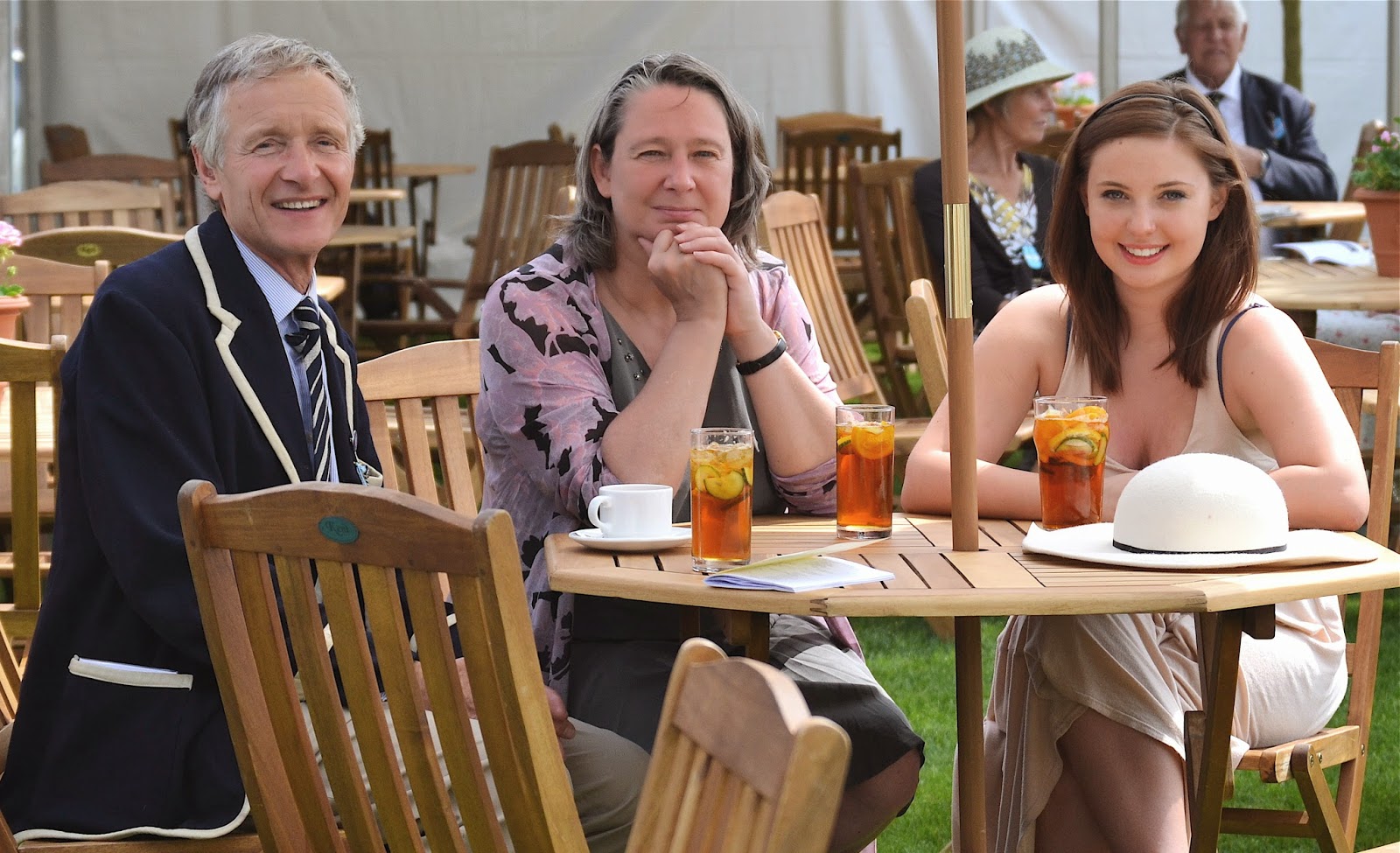
Pimm’s on the Committee Lawn. It does not get more civilised than this, John, Sue and Molly.
Tizzy Burnell introduced us to the ‘Bengal Tiger’, a non-alcoholic cocktail invented by her Grandfather, Charles ‘Don’ Burnell, who won in the eight at the 1908 Olympics (Don and Dickie are the only father and son in Olympic history to have won gold medals in rowing). When Don was umpiring at Henley he felt that he could not drink wines or spirits at lunchtime (something that, in the past, some of his colleagues were not so strict about) and so produced this drink which feels as if it has alcohol in it. It is a mixture of ginger beer, lime juice and Angostura Bitters. If you are not umpiring, you can add vodka.
Sue and Molly followed the race between Cambois and Nottingham in a heat of the Wyfold Challenge Cup (Club Coxless Fours).
John and I followed the race between the University of the West of England (UWE) and Goldie Boat Club in a heat of the Prince Albert Challenge Cup (Men’s Student Coxed Fours). It was a convincing and no doubt enormously satisfying win by the unfashionable UWE over the crew from the more prestigious Cambridge University Boat Club.
The UWE – Goldie race from umpire John Hedger’s point of view.
Tim Koch writes:
There are three things that you do not necessarily expect on a Henley first day: some exciting racing, large crowds and above average temperatures. However, the Wednesday’s opening day provided all three. I will leave others to write more about this as I prefer to spend my time by the riverbank rather than at my computer. Also, Rachel Quarrell, writing in Wednesday’s Telegraph, does it much better than I ever could. If you are interested in weather related pictures of Henley, inter-cut with pictures of girls in bikinis, the nominally puritanical Daily Mail is for you. The full details are on the Henley Royal Regatta website (click on the event name for the stats and remember that some of the top events do not start until later in the week).
Members of the Amsterdam Student Rowing Club Nereus model blazers of varying ages and conditions.
Members of Oxford Brooks University ‘B’ find that losing is not as good as winning. They were beaten by University of Michigan, USA, in a heat of the Temple Challenge Cup (Men’s Student Eights).
My day was spent in the delightful company of some very special guests, all linked by a common theme. I had invited John Beresford (son of Jack Beresford, Britain’s most successful oarsman in the pre-Redgrave era) and Sue and Molly Bushnell (daughter and grand-daughter of the indomitable Bert Bushnell) as my guests. When we met up later in the day with Tizzy Burnell, daughter of the former ‘Grand Old Man’ of British rowing, Richard ‘Dickie’ Burnell, we had a gathering of the ‘Children of 1948’. ‘Bert and Dickie’, coached by Jack, were, of course, the unlikely pairing who won the double sculls at the 1948 London Olympics, an event recently dramatised in a BBC television programme. As regular readers will remember, this production was extensively covered by ‘Hear The Boat Sing’. This meeting was made even more special through the generosity of the Chairman of Henley Royal Regatta, Mike Sweeney, who arranged for us to follow two races in the umpires’ launches and allowed us access to the hallowed Committee Lawn, an area for the Stewards and their guests. It was a gesture very much in the traditions of Henley and was much appreciated by all concerned. Here are some pictures of a memorable day.
Members of Rowing Royal Families pictured, appropriately, in front of the Royal Rowbarge, Gloriana. The press picked up on the story and they were interviewed and photographed by the Henley Standard newspaper (read article here). From left to right, John Beresford, Tizzy Burnell, Sue Bushnell and Molly Bushnell.
Pimm’s on the Committee Lawn. It does not get more civilised than this, John, Sue and Molly.
Tizzy Burnell introduced us to the ‘Bengal Tiger’, a non-alcoholic cocktail invented by her Grandfather, Charles ‘Don’ Burnell, who won in the eight at the 1908 Olympics (Don and Dickie are the only father and son in Olympic history to have won gold medals in rowing). When Don was umpiring at Henley he felt that he could not drink wines or spirits at lunchtime (something that, in the past, some of his colleagues were not so strict about) and so produced this drink which feels as if it has alcohol in it. It is a mixture of ginger beer, lime juice and Angostura Bitters. If you are not umpiring, you can add vodka.
Sue and Molly followed the race between Cambois and Nottingham in a heat of the Wyfold Challenge Cup (Club Coxless Fours).
John and I followed the race between the University of the West of England (UWE) and Goldie Boat Club in a heat of the Prince Albert Challenge Cup (Men’s Student Coxed Fours). It was a convincing and no doubt enormously satisfying win by the unfashionable UWE over the crew from the more prestigious Cambridge University Boat Club.
The UWE – Goldie race from umpire John Hedger’s point of view.
Thursday, May 1, 2014
Repechage for Bert and Dickie
1948: The real Richard Burnell (stroke) and Bert Bushnell (bow).
Tim Koch writes:
British readers with access to the Drama Channel (Freeview 20, Sky 166, Virgin Media 190) will be able to see a repeat broadcast of Bert and Dickie at 9pm on Saturday, 3 May. Called Going for Gold in the U.S., this is a dramatised account of the unlikely pairing of Bertram ‘Bert’ Bushnell and Richard ‘Dickie’ Burnell who won the double sculls at the 1948 London Olympics. The HTBS review is here and newsreel film of the real thing is on the British Pathe site.
Matt Smith plays Bert Bushnell and Sam Hoare plays Dickie Burnell.
Tim Koch writes:
British readers with access to the Drama Channel (Freeview 20, Sky 166, Virgin Media 190) will be able to see a repeat broadcast of Bert and Dickie at 9pm on Saturday, 3 May. Called Going for Gold in the U.S., this is a dramatised account of the unlikely pairing of Bertram ‘Bert’ Bushnell and Richard ‘Dickie’ Burnell who won the double sculls at the 1948 London Olympics. The HTBS review is here and newsreel film of the real thing is on the British Pathe site.
Matt Smith plays Bert Bushnell and Sam Hoare plays Dickie Burnell.
Monday, November 25, 2013
The Big Man’s Boat
The coxed pairs final at the 1948 London Olympics. Denmark beat Italy and Hungary on Henley Reach.
Tim Koch writes:
Regular HTBS readers will know that we are big fans of Jack Wilson, Ran Laurie, Bert Bushnell and Richard Burnell.
All four of these men had distinguished rowing careers but arguably the highlight for all of them was winning Gold at the 1948 London Olympics. Wilson and Laurie won the coxless pairs and Bushnell and Burnell won the double sculls. The winners in the five other events at the Olympic Regatta at Henley were Merv Wood of Australia in the single sculls, Denmark in the coxed pairs, Italy in the coxless fours, and the United States in the coxed fours and the eight. While I was aware that Britain also came second in the eights, I had no knowledge of any other entries from the host country – until recently. A young women who is learning to row at my club casually mentioned that she thought her grandfather had ‘won something rowing in the 1948 Olympics’. I quickly established that he was not Bert or Dickie, or Ran or Jack. It turned out that he was in the third of the two man boats that Britain had entered: the coxed pair. Sadly, it did not win and in fact came eighth out of nine boats.
The British entry for the coxed pairs at the London Games in 1948, Walker, Scott and James.
‘Granddad’ turned out to be bowman Howard (Bakie) James, aged 24. Stroke was Mark Bodley Scott, aged 25, and the cox was 16-year-old David Walker. All were from Thames Rowing Club. In round one, they were the second of three but in the repechage they lost to the eventual winners, Denmark. There is an nice interview filmed in 2012 with stroke Scott on YouTube. In it he says that they were given ‘a little bit of coaching by a fairly elderly gentleman’ and the impression is that they were very much an afterthought following Laurie and Wilson, two of the finest rowers of the pre war period, and Bushnell and Burnell, both of whom showed promise (Dickie had won the Wingfield Sculls in 1946 and Bushnell in 1947) and who had the great Jack Beresford as their coach.
The coxed pair is the heaviest of all racing boat classes with only two rowers to carry the weight of the cox. It needs two big and strong people to make it move fast but, like the coxless pair, it is vital that they row in the same way. Two otherwise good rowers who have different styles are unlikely to make it work. This need for total teamwork means that the cox is often redundant as a steersman. There is a story that when Steve Redgrave and Andy Holmes were training for the coxed pair in the 1988 Seoul Olympics, cox Pat Sweeney was sometimes not available so they replaced him in training with a heavy tool box.
The new cox was the quiet type.
In modern times the coxed pair was never a popular boat at club level in Britain – in fact, I cannot remember ever seeing one. At the top level, it was dropped as an Olympic event after the 1992 Barcelona Games – but at least it had a magnificent finale.
The Italian brothers Carmine and Giuseppe Abbagnle were the firm favourites to win the Olympic Coxed Pairs final on Lake Banyoles on 2 August 1992. They were seven times world champions and one of the great crews in rowing history. At 1000 metres they led by four and a half seconds, the Romanians were second and the British Searle brothers, Greg and Jonny with cox Garry Herbert, were third. With two hundred metres to the finish the Searles had moved up to second place but were still more than a length down on the Abbagnles. The BBC commentator said: ‘Surely it’s too far even for the Searles with their finishing power...’ In the next 25 strokes the British pair went from a boat length down to win by half a length. If you could not watch it on YouTube, you would not believe it.
Tim Koch writes:
Regular HTBS readers will know that we are big fans of Jack Wilson, Ran Laurie, Bert Bushnell and Richard Burnell.
All four of these men had distinguished rowing careers but arguably the highlight for all of them was winning Gold at the 1948 London Olympics. Wilson and Laurie won the coxless pairs and Bushnell and Burnell won the double sculls. The winners in the five other events at the Olympic Regatta at Henley were Merv Wood of Australia in the single sculls, Denmark in the coxed pairs, Italy in the coxless fours, and the United States in the coxed fours and the eight. While I was aware that Britain also came second in the eights, I had no knowledge of any other entries from the host country – until recently. A young women who is learning to row at my club casually mentioned that she thought her grandfather had ‘won something rowing in the 1948 Olympics’. I quickly established that he was not Bert or Dickie, or Ran or Jack. It turned out that he was in the third of the two man boats that Britain had entered: the coxed pair. Sadly, it did not win and in fact came eighth out of nine boats.
The British entry for the coxed pairs at the London Games in 1948, Walker, Scott and James.
‘Granddad’ turned out to be bowman Howard (Bakie) James, aged 24. Stroke was Mark Bodley Scott, aged 25, and the cox was 16-year-old David Walker. All were from Thames Rowing Club. In round one, they were the second of three but in the repechage they lost to the eventual winners, Denmark. There is an nice interview filmed in 2012 with stroke Scott on YouTube. In it he says that they were given ‘a little bit of coaching by a fairly elderly gentleman’ and the impression is that they were very much an afterthought following Laurie and Wilson, two of the finest rowers of the pre war period, and Bushnell and Burnell, both of whom showed promise (Dickie had won the Wingfield Sculls in 1946 and Bushnell in 1947) and who had the great Jack Beresford as their coach.
The coxed pair is the heaviest of all racing boat classes with only two rowers to carry the weight of the cox. It needs two big and strong people to make it move fast but, like the coxless pair, it is vital that they row in the same way. Two otherwise good rowers who have different styles are unlikely to make it work. This need for total teamwork means that the cox is often redundant as a steersman. There is a story that when Steve Redgrave and Andy Holmes were training for the coxed pair in the 1988 Seoul Olympics, cox Pat Sweeney was sometimes not available so they replaced him in training with a heavy tool box.
The new cox was the quiet type.
In modern times the coxed pair was never a popular boat at club level in Britain – in fact, I cannot remember ever seeing one. At the top level, it was dropped as an Olympic event after the 1992 Barcelona Games – but at least it had a magnificent finale.
The Italian brothers Carmine and Giuseppe Abbagnle were the firm favourites to win the Olympic Coxed Pairs final on Lake Banyoles on 2 August 1992. They were seven times world champions and one of the great crews in rowing history. At 1000 metres they led by four and a half seconds, the Romanians were second and the British Searle brothers, Greg and Jonny with cox Garry Herbert, were third. With two hundred metres to the finish the Searles had moved up to second place but were still more than a length down on the Abbagnles. The BBC commentator said: ‘Surely it’s too far even for the Searles with their finishing power...’ In the next 25 strokes the British pair went from a boat length down to win by half a length. If you could not watch it on YouTube, you would not believe it.
Thursday, November 21, 2013
Time for 'Jack & Ran'?
Jack Wilson and Ran Laurie
Here on HTBS we have written a lot about British Olympic rowing champions. Lately, our favourites have been Bert Bushnell and Dickie Burnell, who took the gold in the double sculls at the 1948 Olympic Games, and, in the same Olympic regatta at Henley, Ran Laurie and Jack Wilson, who took the gold in the pair. In 2012, there was a brilliant film made about Bert and Dicke, and now it is time to push for a film about 'Jack & Ran'. Not only did this pair have a tremendous exciting rowing career, first at Cambridge, Ran at the 1936 Olympic Games, then both at Henley in 1938, and again at Henley in 1948 (during these ten years they hardly looked at an oar), and finally at the 1948 Olympics, they also had thrilling adventures in Sudan - everything to make it more than just a rowing movie. Is there anyone out there who needs help with the film script?
There is now a short film clip on Youtube how Laurie and Wilson won the Olympic gold medal, watch it here.
Having been in Sudan for ten years, when they came back in 1948, they were called the 'Desert Rats' - not to be confused with the soldiers in Monty's Eight Army in North Africa...
Monday, October 7, 2013
Tim Koch: Wingfields - The Race of Champions
WD Kinnear’s Wingfields Medal with bars for 1910, 1911 and 1912.
Tim Koch writes:
Tomorrow, Tuesday, 8 October 2013, will see the 173rd race for the Wingfield Sculls and also the 7th Women’s Wingfields. It is strange that an event that carries the grandiose titles of ‘The British Amateur Sculling Championship and Championship of the Thames’ should be so obscure, even within the sport of rowing and sculling.
The Wingfields started in 1830 when Henry Colsell Wingfield presented a pair of miniature silver sculls ‘to be held by the best’ as long as they agreed to race in single sculls on his birthday, 10 August, ‘for ever'. The course is the 4 ½ mile (6.8 km) ‘Thames Championship Course’ (most famously used by the Oxford–Cambridge Boat Race) from Putney to Mortlake complete with tide, bends, shallows, rough water, wind, driftwood and other river users. Patrick Kidd of The Times has written:
(The race is) above all... about athletes being taken out of their comfort zone. Baron Pierre de Coubertin, the founder of the modern Olympics, once said that rowing was the ideal sport because it was so hard for people to watch and thus worth doing purely for its own sake. In the Wingfield Sculls, that vision of glorious amateurism remains alive…
Kidd also quotes Wade Hall-Craggs, winner (‘Champion’) in 1993 and the current Wingfield’s Secretary:
Top class rowers today are used to racing on plastic lakes where so many of the variables have been taken out and it is just a battle of limb and lung size. This is a different challenge.
Certainly the history of the race has numerous examples of winners who probably would not have beaten their opponents had they been on a straight, still water course. Racing on a ‘living river’ requires watermanship, something that cannot be learned on an ergo.
HTBS has previously covered the Wingfield Sculls in 2010, 2011 and 2012. Two years ago, we produced a video record of this splendid contest:
Like other well run rowing contests such as Henley Royal Regatta and the Doggett’s Coat and Badge, the Wingfields is not a democratic organisation, it is organised by a committee of former winners. One of its few sources of income is from shares in the brewers Guinness, which were donated by Lord Iveagh (Rupert Guinness, Wingfields Champion in 1896). In recent years there has also been generous support from the Wingfield Family Society.
The 2012 Women’s Wingfields winner Beth Rodford sculling in the 2010 race. She is watched by the senior surviving Wingfields Champion, Doug Melvin, who won in 1955 and 1958.
In the 2013 race, both the reigning champions, Alan Campbell (Bronze medalist, London 2012) and Beth Rodford, and all their challengers have recently returned from representing Britain at the World Rowing Championships in South Korea. The women are Louisa Reeve (Leander), Imogen Walsh (London), Beth Rodford (Gloucester), Francis Houghton (Leander), Vicky Thornley (Leander) and Victoria Mayer-Laker (Leander). The male competitors are Jonny Walton (Leander), Alan Campbell (Tideway Sculler’s School) and Jamie Kirkwood (Leander).
The Women’s Wingfields starts at 1.30. Wade Hall-Crags writes:
Beth Rodford returns to defend her title against many of her team mates. She is challenged by both members of the double scull, Vicky Meyer-Laker and Frances Houghton. Francis trained out of the University of London for many years so will look to put her Thames Tideway experience to good use. Vicky Thornley was the single sculler at the Worlds and won the B final and wants to test her single sculling on the Tideway. Imogen Walsh’s season went from strength to strength last year after racing Beth in the Wingfields, culminating in fourth in the lightweight double at the Worlds. Lou Reeve is the only sweep rower [...] and enters the Wingfields for the first time.
Alan Campbell, Wingfields Champion 2006, 2009, 2010 and 2012.
The men’s race is an hour later. Of these competitors Hall-Crags says:
This year [....] all the male single scullers from GB’s World Championship team (will) race. Jonny Walton has been doing much of his training with Alan (Campbell) as he was the spare sculler at the Worlds, presumably this has inspired him to challenge. Jamie Kirkwood was the lightweight single at the Worlds and has spent the last few years training on the Tideway at Imperial so feels he has the Tideway experience to challenge Alan. This is the first time Jamie and Jonny have challenged.
The umpire will be Sophie Hosking (Champion 2008 and 2009), who won lightweight double sculls at the London Olympics.
Throughout its long history, the standard of racing in the Wingfields has been very variable. This is probably beacuse in Britain sculling has traditionally been regarded as somehow inferior to sweep rowing. This year’s entry reflects the steady improvement that British sculling is currently undergoing. A list of former winners is here.
As a ’curtain raiser’ to this year’s races, following is a splendid newsreel film that I recently found online. It shows Richard Burnell beating Bertram Bushnell in the 1946 Wingfields. Of course, two years later ‘Bert and Dickie’ won a famous victory in the double sculls at the 1948 London Olympics. The bigger Burnell had previously beaten Bushnell earlier in 1946 in the Diamond Sculls at Henley but it is interesting to see that the highly competitive smaller man never gave up in this second encounter and sculled himself to the point of exhaustion. The final part of the film shows his limp body been lifted into the umpire’s launch at the finish. You could say that there were in fact two ‘Champions’ that day. View the newsreel here.
Tim Koch writes:
Tomorrow, Tuesday, 8 October 2013, will see the 173rd race for the Wingfield Sculls and also the 7th Women’s Wingfields. It is strange that an event that carries the grandiose titles of ‘The British Amateur Sculling Championship and Championship of the Thames’ should be so obscure, even within the sport of rowing and sculling.
The Wingfields started in 1830 when Henry Colsell Wingfield presented a pair of miniature silver sculls ‘to be held by the best’ as long as they agreed to race in single sculls on his birthday, 10 August, ‘for ever'. The course is the 4 ½ mile (6.8 km) ‘Thames Championship Course’ (most famously used by the Oxford–Cambridge Boat Race) from Putney to Mortlake complete with tide, bends, shallows, rough water, wind, driftwood and other river users. Patrick Kidd of The Times has written:
(The race is) above all... about athletes being taken out of their comfort zone. Baron Pierre de Coubertin, the founder of the modern Olympics, once said that rowing was the ideal sport because it was so hard for people to watch and thus worth doing purely for its own sake. In the Wingfield Sculls, that vision of glorious amateurism remains alive…
Kidd also quotes Wade Hall-Craggs, winner (‘Champion’) in 1993 and the current Wingfield’s Secretary:
Top class rowers today are used to racing on plastic lakes where so many of the variables have been taken out and it is just a battle of limb and lung size. This is a different challenge.
Certainly the history of the race has numerous examples of winners who probably would not have beaten their opponents had they been on a straight, still water course. Racing on a ‘living river’ requires watermanship, something that cannot be learned on an ergo.
HTBS has previously covered the Wingfield Sculls in 2010, 2011 and 2012. Two years ago, we produced a video record of this splendid contest:
Like other well run rowing contests such as Henley Royal Regatta and the Doggett’s Coat and Badge, the Wingfields is not a democratic organisation, it is organised by a committee of former winners. One of its few sources of income is from shares in the brewers Guinness, which were donated by Lord Iveagh (Rupert Guinness, Wingfields Champion in 1896). In recent years there has also been generous support from the Wingfield Family Society.
The 2012 Women’s Wingfields winner Beth Rodford sculling in the 2010 race. She is watched by the senior surviving Wingfields Champion, Doug Melvin, who won in 1955 and 1958.
In the 2013 race, both the reigning champions, Alan Campbell (Bronze medalist, London 2012) and Beth Rodford, and all their challengers have recently returned from representing Britain at the World Rowing Championships in South Korea. The women are Louisa Reeve (Leander), Imogen Walsh (London), Beth Rodford (Gloucester), Francis Houghton (Leander), Vicky Thornley (Leander) and Victoria Mayer-Laker (Leander). The male competitors are Jonny Walton (Leander), Alan Campbell (Tideway Sculler’s School) and Jamie Kirkwood (Leander).
The Women’s Wingfields starts at 1.30. Wade Hall-Crags writes:
Beth Rodford returns to defend her title against many of her team mates. She is challenged by both members of the double scull, Vicky Meyer-Laker and Frances Houghton. Francis trained out of the University of London for many years so will look to put her Thames Tideway experience to good use. Vicky Thornley was the single sculler at the Worlds and won the B final and wants to test her single sculling on the Tideway. Imogen Walsh’s season went from strength to strength last year after racing Beth in the Wingfields, culminating in fourth in the lightweight double at the Worlds. Lou Reeve is the only sweep rower [...] and enters the Wingfields for the first time.
Alan Campbell, Wingfields Champion 2006, 2009, 2010 and 2012.
The men’s race is an hour later. Of these competitors Hall-Crags says:
This year [....] all the male single scullers from GB’s World Championship team (will) race. Jonny Walton has been doing much of his training with Alan (Campbell) as he was the spare sculler at the Worlds, presumably this has inspired him to challenge. Jamie Kirkwood was the lightweight single at the Worlds and has spent the last few years training on the Tideway at Imperial so feels he has the Tideway experience to challenge Alan. This is the first time Jamie and Jonny have challenged.
The umpire will be Sophie Hosking (Champion 2008 and 2009), who won lightweight double sculls at the London Olympics.
Throughout its long history, the standard of racing in the Wingfields has been very variable. This is probably beacuse in Britain sculling has traditionally been regarded as somehow inferior to sweep rowing. This year’s entry reflects the steady improvement that British sculling is currently undergoing. A list of former winners is here.
As a ’curtain raiser’ to this year’s races, following is a splendid newsreel film that I recently found online. It shows Richard Burnell beating Bertram Bushnell in the 1946 Wingfields. Of course, two years later ‘Bert and Dickie’ won a famous victory in the double sculls at the 1948 London Olympics. The bigger Burnell had previously beaten Bushnell earlier in 1946 in the Diamond Sculls at Henley but it is interesting to see that the highly competitive smaller man never gave up in this second encounter and sculled himself to the point of exhaustion. The final part of the film shows his limp body been lifted into the umpire’s launch at the finish. You could say that there were in fact two ‘Champions’ that day. View the newsreel here.
Monday, August 20, 2012
A Note on the American Bushnells
Did Olympic gold medallist Bert Bushnell have relatives in America?
After HTBS has posted several blog posts on Bert Bushnell and Dickie Burnell and the BBC film Bert and Dickie, some days ago, HTBS received an e-mail from ‘an American Bushnell’, Steven E. Bushnell in California. Let it be said from the start, no one seems to really know the true connection between Bert’s family and Steven’s family on this side of the pond. But more about that later.
Steven writes, “Early American Bushnells were a largely Connecticut, Puritan family, first in Guilford and then longer and more prominently in Old Saybrook, and after reading about Göran’s outings with his children, here’s information about places not far from Mystic that everyone might enjoy. I’m guessing you’ve at least heard of them, and it may be you’ve visited those on the water, which have to do with some of the ‘American Bushnells’. Those are:
David Bushnell (1740 - ca. 1826) of Saybrook built the first practical submarine, which was the first used to attack a ship, and the engineering aspects of The Turtle (on the right) are simple and neat enough that particularly families with children might enjoy the full-size replicas at the Submarine Force Museum at Groton and the Connecticut River Museum at Essex, at which there are of course many other things for you all. Take a closer look at the Submarine Force Library and Museum and Connecticut River Museum and The Turtle.
“Still in the water, Cornelius S. Bushnell (1829 - 1896) born in Madison, Connecticut, is today best known as a result of his meeting with a Swede, the naval engineer John Ericsson, and of their roles in the construction of the U.S.S. Monitor. There’s a nice description of this history near the middle on the page here and a well-written biography of Bushnell, who had quite an eventful life beyond the Monitor here.
“It seems the Allis-Bushnell House at Madison is undergoing some changes, but at the Annex, there are things Göran’s children Ingrid and Anders, and other visiting children might enjoy seeing, just look here.”
Steven belongs to a branch of the family in California who is descended from those of Saybrook. He continues to write,
“In the end of the 1970s, my late father, David Pearsall B. (if you click on the link you will come to the Wikipedia entry for Steven’s father, and yes, the little baby in the photo is Steven), hired a boat from Bert Bushnell as part of his last, happy honeymoon. My Dad told me how he enjoyed their conversation and about their speculation over whether or not they were related. The evidence now compiled indicates that surname is attached to one family that originated in Berkshire at a place about six miles WSW of the Thames called in earlier times some variant of “the Bushenell,” today Bushnells Green. As I’ve seen comments by Bert’s daughters on HTBS, you might know that Bert’s grand-nephew David, who won the Doggett’s Coat and Badge Race in 1998, runs Bushnell Marine Services at Wargrave, his father, Paul, having been appointed one of the Royal Watermen. More on that family here.
“Göran, if you haven’t been to those places in Connecticut, I’m sure you’ll enjoy taking your children there. Thank you for everything that is written about Bert on HTBS!”
Update 20 Aug., 2 p.m.: Steven Bushnell sent a little extra note on Cornelius’ son: “Samuel Clarke Bushnell (1852 - 1930) was the President of the Yale University Boat Club in 1874, which participated in the races of the National Rowing Association of American Colleges on July 17 and 19 on Saratoga Lake; Ansley Wilcox of Yale winning the single sculls competition.”
Steven also adds: “Cornelius’ feelings about his Swedish colleague in the construction of the Monitor were such that he named a son born in 1861 Ericsson Bushnell.”
Dear Steven ~ thank you for all this interesting information about the Bushnells in Connecticut. I am sure the British Bushnells are now also wondering how they are connected to your family!
After HTBS has posted several blog posts on Bert Bushnell and Dickie Burnell and the BBC film Bert and Dickie, some days ago, HTBS received an e-mail from ‘an American Bushnell’, Steven E. Bushnell in California. Let it be said from the start, no one seems to really know the true connection between Bert’s family and Steven’s family on this side of the pond. But more about that later.
Steven writes, “Early American Bushnells were a largely Connecticut, Puritan family, first in Guilford and then longer and more prominently in Old Saybrook, and after reading about Göran’s outings with his children, here’s information about places not far from Mystic that everyone might enjoy. I’m guessing you’ve at least heard of them, and it may be you’ve visited those on the water, which have to do with some of the ‘American Bushnells’. Those are:
![]() |
| Photo: Connecticut River Museum |
“Still in the water, Cornelius S. Bushnell (1829 - 1896) born in Madison, Connecticut, is today best known as a result of his meeting with a Swede, the naval engineer John Ericsson, and of their roles in the construction of the U.S.S. Monitor. There’s a nice description of this history near the middle on the page here and a well-written biography of Bushnell, who had quite an eventful life beyond the Monitor here.
“It seems the Allis-Bushnell House at Madison is undergoing some changes, but at the Annex, there are things Göran’s children Ingrid and Anders, and other visiting children might enjoy seeing, just look here.”
Steven belongs to a branch of the family in California who is descended from those of Saybrook. He continues to write,
“In the end of the 1970s, my late father, David Pearsall B. (if you click on the link you will come to the Wikipedia entry for Steven’s father, and yes, the little baby in the photo is Steven), hired a boat from Bert Bushnell as part of his last, happy honeymoon. My Dad told me how he enjoyed their conversation and about their speculation over whether or not they were related. The evidence now compiled indicates that surname is attached to one family that originated in Berkshire at a place about six miles WSW of the Thames called in earlier times some variant of “the Bushenell,” today Bushnells Green. As I’ve seen comments by Bert’s daughters on HTBS, you might know that Bert’s grand-nephew David, who won the Doggett’s Coat and Badge Race in 1998, runs Bushnell Marine Services at Wargrave, his father, Paul, having been appointed one of the Royal Watermen. More on that family here.
“Göran, if you haven’t been to those places in Connecticut, I’m sure you’ll enjoy taking your children there. Thank you for everything that is written about Bert on HTBS!”
Update 20 Aug., 2 p.m.: Steven Bushnell sent a little extra note on Cornelius’ son: “Samuel Clarke Bushnell (1852 - 1930) was the President of the Yale University Boat Club in 1874, which participated in the races of the National Rowing Association of American Colleges on July 17 and 19 on Saratoga Lake; Ansley Wilcox of Yale winning the single sculls competition.”
Steven also adds: “Cornelius’ feelings about his Swedish colleague in the construction of the Monitor were such that he named a son born in 1861 Ericsson Bushnell.”
Dear Steven ~ thank you for all this interesting information about the Bushnells in Connecticut. I am sure the British Bushnells are now also wondering how they are connected to your family!
Friday, August 10, 2012
‘Bert And Dickie’: Drama Or Farce?
Let's continue with the 1948 Olympic rowing from a little different angle. Here HTBS's Tim Koch writes about the BBC film Bert and Dickie (called Going for Gold in America):
It is normally advisable to take a ‘Dr Johnson’ approach to any drama centred on rowing. The 18th-century man of letters famously said:
‘Sir, a woman’s preaching is like a dog’s dancing on his hind legs. It is not done well; but you are surprised to find it done at all.’
Films about rowing are rare and are rarely done well. Film makers prefer to make dramas about popular land based sports as the action sequences are considerably easier to shoot and edit to produce a reasonably convincing scene where an actor is portraying a top class athlete. As far as I know the only rowing sequence in a movie that convinces those who know about the sport is the Henley scene in The Social Network. When ‘rowing dramas’ are made they tend to closely follow the clichés set out in the guide ‘How to Make a Rowing Movie’ on the now sadly inactive ‘Tideway Slug’.
Geoffrey Palmer is playing Dickie's father, the 1908 Olympic rowing champion 'Don' Burnell.
Bert and Dickie, however, threatened to be different. Firstly, it was made by the BBC who, famously, are rather good at this sort of period drama. Secondly, it had what film and TV people call ‘high production values’ that is, they spent time and money attempting to get it right. Thirdly, it employed some very talented actors in both lead and supporting roles. This included the wonderful Geoffrey Palmer who, as far as I know, had never appeared in anything bad – despite always playing much the same character. Finally, a large part of Britain and the world are in an ‘Olympic Mood’. At the present time many of us are susceptible to a ‘feel good story’ of plucky chaps winning against the odds. I wanted to like this programme.
The basic ingredients of a dramatic story are all there. An ‘odd couple’ are thrown together by circumstances not of their making. They do not like each other. There is social snobbery and economic deprivation. Eventually they learn to ‘pull together’ because they realise that they have a common goal and because they discover that they have a common problem. In this case, the problem is slightly mad fathers, Dickie’s dad representing the old order where it’s the taking part that counts, Bert’s dad representing the future, believing that winning is all. The tension on the Henley Reach is punctuated by gentle humour on land. There are several delightful cut aways to conversations between the Prime Minister and Chairman of the British Olympic Committee as they wrestle both with the great concepts and the mundane detail of the Games. There are funny and touching scenes where post war ‘austerity’ Britain attempts to make the best of things, especially in the presence of the over cossetted Americans. Unfortunately, the cutaway scenes where Bert’s banished girlfriend (a slightly superfluous role) watches the races from a TV shop in Scotland with a local policeman relaying the commentary to the crowds outside (and to the viewer of course) is an unsatisfactory device. Possibly it is some sort of homage to the British ‘Ealing’ comedies of the 1950s.
Of course, the eternal problem of a story ‘based on real events’ is that we all know how it ends. Thus we have to enjoy the journey that takes us to the predictable and inevitable conclusion – in this case Olympic glory and approval from respective fathers.
A review of this journey on Hear The Boat Sing must be slightly different to one in most other places. ‘Dramatic criticism’ is one part but for rowing historians there is also the question of the accuracy of people, events and objects.
How does Bert and Dickie work as a piece of entertainment? It is commonly observed that ‘drama’ is real life with the boring bits taken out. In this necessary process the characters can become slightly one-dimensional, emotions can, unnaturally, change in an instant and all difficulties are unrealistically permanently overcome. ‘B and D’ is not immune from these faults – but very few dramatic productions are. For me, these criticisms did not spoil my enjoyment of ‘the journey’ from start to finish. The combination of an intelligent script, good acting, high production values and wonderful cinematography (with light use of CGI) makes a very simple story work. It is, simply, a bit of fun. For Brits, still basking in post-Olympic Regatta success with their cynicism blunted, the pleasure is highlighted.
Was it ‘accurate’? In a couple of words – pretty much. Yes, the sculling was bad, we knew it was going to be, let’s accept it and move on. The boats and equipment seemed correct. The costumes were fine bar the inaccuracy, pointed out by Jack Beresford’s daughter, that her ‘father’ was portrayed wearing a brown suit at the Olympic Regatta! The stand in for the Leander clubhouse was a little over grand and the unimpressive Leander pontoon was replaced by the more substantial Eton Rafts but there is nothing ‘wrong’ with such things. The only inaccuracy that made me wince was when Don Burnell said that he won an Olympic gold medal in 1908 in ‘the men’s eights’. I am sure that Burnell senior would have never made such a 21st century gender distinction, it was like having the character say something like ‘you is well good’. On the other hand, I did actually learn something. The film portrayed Jack Beresford Jnr. as, in Chris Dodd’s words, ‘mentor rather than coach’. I would have dismissed this as one of the things film makers do to keep the story flowing had Chris not agreed that this was in fact the case.
I must further commend writer William Ivory (on the right) and director David Blair because, not only was their production reasonably accurate, but it was also brave in that it did not avoid introducing slightly difficult ideas for a non-rowing audience. In the best traditions of the BBC, there was little ‘dumbing down’. There were references to rowing’s contracted amateur – professional debate, detail on rigging and rowing technique, and a discussion on using the repêchage system to gain an advantage. These ideas could have easily been passed over to keep the interest of the least attentive viewer, something all too common in modern film and television.
The ‘clincher’ for me (and anyone associated with this blog) came with a scene towards the end, just before ‘the big race’. Bert is handed a note that says: ’Make the boat sing’. It almost made up for the over sentimental father-son reconciliations on the finish pontoon. However, Bert and Dickie, for all its predictably, is a dog that dances well.
There is a tribute to Bert and Dickie by ‘JBT’ on YouTube, here.
It is normally advisable to take a ‘Dr Johnson’ approach to any drama centred on rowing. The 18th-century man of letters famously said:
‘Sir, a woman’s preaching is like a dog’s dancing on his hind legs. It is not done well; but you are surprised to find it done at all.’
Films about rowing are rare and are rarely done well. Film makers prefer to make dramas about popular land based sports as the action sequences are considerably easier to shoot and edit to produce a reasonably convincing scene where an actor is portraying a top class athlete. As far as I know the only rowing sequence in a movie that convinces those who know about the sport is the Henley scene in The Social Network. When ‘rowing dramas’ are made they tend to closely follow the clichés set out in the guide ‘How to Make a Rowing Movie’ on the now sadly inactive ‘Tideway Slug’.
Geoffrey Palmer is playing Dickie's father, the 1908 Olympic rowing champion 'Don' Burnell.
Bert and Dickie, however, threatened to be different. Firstly, it was made by the BBC who, famously, are rather good at this sort of period drama. Secondly, it had what film and TV people call ‘high production values’ that is, they spent time and money attempting to get it right. Thirdly, it employed some very talented actors in both lead and supporting roles. This included the wonderful Geoffrey Palmer who, as far as I know, had never appeared in anything bad – despite always playing much the same character. Finally, a large part of Britain and the world are in an ‘Olympic Mood’. At the present time many of us are susceptible to a ‘feel good story’ of plucky chaps winning against the odds. I wanted to like this programme.
The basic ingredients of a dramatic story are all there. An ‘odd couple’ are thrown together by circumstances not of their making. They do not like each other. There is social snobbery and economic deprivation. Eventually they learn to ‘pull together’ because they realise that they have a common goal and because they discover that they have a common problem. In this case, the problem is slightly mad fathers, Dickie’s dad representing the old order where it’s the taking part that counts, Bert’s dad representing the future, believing that winning is all. The tension on the Henley Reach is punctuated by gentle humour on land. There are several delightful cut aways to conversations between the Prime Minister and Chairman of the British Olympic Committee as they wrestle both with the great concepts and the mundane detail of the Games. There are funny and touching scenes where post war ‘austerity’ Britain attempts to make the best of things, especially in the presence of the over cossetted Americans. Unfortunately, the cutaway scenes where Bert’s banished girlfriend (a slightly superfluous role) watches the races from a TV shop in Scotland with a local policeman relaying the commentary to the crowds outside (and to the viewer of course) is an unsatisfactory device. Possibly it is some sort of homage to the British ‘Ealing’ comedies of the 1950s.
Of course, the eternal problem of a story ‘based on real events’ is that we all know how it ends. Thus we have to enjoy the journey that takes us to the predictable and inevitable conclusion – in this case Olympic glory and approval from respective fathers.
A review of this journey on Hear The Boat Sing must be slightly different to one in most other places. ‘Dramatic criticism’ is one part but for rowing historians there is also the question of the accuracy of people, events and objects.
How does Bert and Dickie work as a piece of entertainment? It is commonly observed that ‘drama’ is real life with the boring bits taken out. In this necessary process the characters can become slightly one-dimensional, emotions can, unnaturally, change in an instant and all difficulties are unrealistically permanently overcome. ‘B and D’ is not immune from these faults – but very few dramatic productions are. For me, these criticisms did not spoil my enjoyment of ‘the journey’ from start to finish. The combination of an intelligent script, good acting, high production values and wonderful cinematography (with light use of CGI) makes a very simple story work. It is, simply, a bit of fun. For Brits, still basking in post-Olympic Regatta success with their cynicism blunted, the pleasure is highlighted.
Was it ‘accurate’? In a couple of words – pretty much. Yes, the sculling was bad, we knew it was going to be, let’s accept it and move on. The boats and equipment seemed correct. The costumes were fine bar the inaccuracy, pointed out by Jack Beresford’s daughter, that her ‘father’ was portrayed wearing a brown suit at the Olympic Regatta! The stand in for the Leander clubhouse was a little over grand and the unimpressive Leander pontoon was replaced by the more substantial Eton Rafts but there is nothing ‘wrong’ with such things. The only inaccuracy that made me wince was when Don Burnell said that he won an Olympic gold medal in 1908 in ‘the men’s eights’. I am sure that Burnell senior would have never made such a 21st century gender distinction, it was like having the character say something like ‘you is well good’. On the other hand, I did actually learn something. The film portrayed Jack Beresford Jnr. as, in Chris Dodd’s words, ‘mentor rather than coach’. I would have dismissed this as one of the things film makers do to keep the story flowing had Chris not agreed that this was in fact the case.
I must further commend writer William Ivory (on the right) and director David Blair because, not only was their production reasonably accurate, but it was also brave in that it did not avoid introducing slightly difficult ideas for a non-rowing audience. In the best traditions of the BBC, there was little ‘dumbing down’. There were references to rowing’s contracted amateur – professional debate, detail on rigging and rowing technique, and a discussion on using the repêchage system to gain an advantage. These ideas could have easily been passed over to keep the interest of the least attentive viewer, something all too common in modern film and television.
The ‘clincher’ for me (and anyone associated with this blog) came with a scene towards the end, just before ‘the big race’. Bert is handed a note that says: ’Make the boat sing’. It almost made up for the over sentimental father-son reconciliations on the finish pontoon. However, Bert and Dickie, for all its predictably, is a dog that dances well.
There is a tribute to Bert and Dickie by ‘JBT’ on YouTube, here.
Thursday, August 9, 2012
9 August 1948: The Final Day At The Olympic Rowing Regatta In Henley
Olympic champions Jack Wilson (stroke) and Ran Laurie (bow) in the foreground after they have won the Coxless Pairs at the 1948 Olympic Regatta in Henley. In this photograph is also silver medallists Hans Kalt (stroke) and Josef Kalt (bow) of Switzerland. Italy took the bronze.
Although, the Olympic Rowing Regatta at Eton Dorney is over, HTBS is not done with Olympic rowing. Let’s take a look at the 1948 Olympic Rowing Regatta in Henley-on-Thames through some old photographs. Today, 9 August, it is exactly 64 years ago the finals were rowed on the Henley course. One photograph is easily recognized (above), showing Jack Wilson and Ran Laurie after they have just crossed the finish line in the final that gave them the Olympic gold in the Coxless Pairs – or the 'Pairs Without Cox' or 'Coxswainless Pairs' as it was called at that time. The other photographs from this regatta I have never seen published before. Enjoy!
All the equipment from the 1948 Henley Royal Regatta was left untouched to make things easier for the Olympic Regatta in Henley. However, an additional stand to take 4,000 spectators was erected, as was a special Press Box (on the right) which could take 150 members of the media.
*Update: This has been proven to be wrong, it's the Royal Canadian Henley, please see more here.
In this photograph from a repechage heat, the British double, with Bert Bushnell and Dickie Burnell, is way ahead of Holland and third-placed Argentina. Burnell writes in his Swing Together (1952): ‘Personally I do not like the repechage system, because I find it demoralizing to know that the first heat has not got to be won’. However, this being said, Bushnell/Burnell deliberately lost their first heat, so they would not meet the Danish double of Ebbe Parsner and Aage Larsen in the semi-final as the Danes were the favourites to win the gold. But take a look at the photograph again: despite the difference in the oarsmen’s heights – Burnell was 6ft. 4in. (193cm) and Bushnell was 5ft. 9in. (175cm) – they are beautifully well together in the water. Burnell wrote about their stroke: ‘Bushnell was inclined to over-reach; I was on the short side in my forward swing. The result was … we reached naturally to about the same place.’ (in Swing Together)
Olympic champion in the Single Sculls Mervyn Wood of Australia is congratulated by silver medallist Eduardo Risso of Uruguay. Romolo Catasta of Italy came third. Wood had won the 1948 Diamond Challenge Sculls by beating Bert Bushnell in the final.
In the final of the Coxed Pairs Finn Pedersen, Tage Henriksen, and Carl-Ebbe Andersen (cox) of Denmark easily won over Italy with Hungary coming in third.
Although, the Olympic Rowing Regatta at Eton Dorney is over, HTBS is not done with Olympic rowing. Let’s take a look at the 1948 Olympic Rowing Regatta in Henley-on-Thames through some old photographs. Today, 9 August, it is exactly 64 years ago the finals were rowed on the Henley course. One photograph is easily recognized (above), showing Jack Wilson and Ran Laurie after they have just crossed the finish line in the final that gave them the Olympic gold in the Coxless Pairs – or the 'Pairs Without Cox' or 'Coxswainless Pairs' as it was called at that time. The other photographs from this regatta I have never seen published before. Enjoy!
All the equipment from the 1948 Henley Royal Regatta was left untouched to make things easier for the Olympic Regatta in Henley. However, an additional stand to take 4,000 spectators was erected, as was a special Press Box (on the right) which could take 150 members of the media.
*Update: This has been proven to be wrong, it's the Royal Canadian Henley, please see more here.
In this photograph from a repechage heat, the British double, with Bert Bushnell and Dickie Burnell, is way ahead of Holland and third-placed Argentina. Burnell writes in his Swing Together (1952): ‘Personally I do not like the repechage system, because I find it demoralizing to know that the first heat has not got to be won’. However, this being said, Bushnell/Burnell deliberately lost their first heat, so they would not meet the Danish double of Ebbe Parsner and Aage Larsen in the semi-final as the Danes were the favourites to win the gold. But take a look at the photograph again: despite the difference in the oarsmen’s heights – Burnell was 6ft. 4in. (193cm) and Bushnell was 5ft. 9in. (175cm) – they are beautifully well together in the water. Burnell wrote about their stroke: ‘Bushnell was inclined to over-reach; I was on the short side in my forward swing. The result was … we reached naturally to about the same place.’ (in Swing Together)
Olympic champion in the Single Sculls Mervyn Wood of Australia is congratulated by silver medallist Eduardo Risso of Uruguay. Romolo Catasta of Italy came third. Wood had won the 1948 Diamond Challenge Sculls by beating Bert Bushnell in the final.
In the final of the Coxed Pairs Finn Pedersen, Tage Henriksen, and Carl-Ebbe Andersen (cox) of Denmark easily won over Italy with Hungary coming in third.
Tuesday, July 24, 2012
Bert And Dickie And Jack
James Frain as Jack Beresford, Matt Smith as Bert Bushnell and Sam Hoare as Dickie Burnell.
By now, no one who is interested in the history of rowing can have missed when the BBC film Bert and Dickie (Going for Gold – The ’48 Games is the title in America on BBC America) is on. But to be on the safe side: it’s tomorrow, Wednesday, 25 July at 8:30 p.m. on BBC One in Britain, and the very same day on BBC America at 8/7 C.
HTBS’s correspondent Hélène Rémond in France sent a very interesting link, ‘BBC News – Entertainment and Art’, which has great information about the film, and also a film clip from the movie and an interview with the actor Sam Hoare, who plays Dickie Burnell. Despite that it’s said that the Burnells were ‘Rowing Royalties’, Dickie was a very humble man.
HTBS has followed this film from the start and we have written a lot about Matt Smith, who plays Bert Bushnell and Sam Hoare, who portrays Dickie Burnell. One character that we have not really mentioned in this film is Jack Beresford, who is played by James Frain. Beresford, who had taken five Olympic medals in five consecutive Games, was not an unimportant figure in the story about Bert and Dickie’s 1948 Olympic gold medal. Beresford became a mentor and a coach for the young Bert and Dickie.
For those of us who know something about the real Jack Beresford, actor James Frain seems to be an odd choice to play the blond Beresford. In an e-mail to HTBS’s Tim Koch, Jack’s son, John, says about Frain: ‘He’s totally unlike Dad in appearance’. John Beresford goes on by saying that at a screening his sister was horrified to see the actor playing her father wearing a brown suit. She said that Jack would never wear such a thing.
All this promises to be an interesting time in front of the TV on Wednesday!
By now, no one who is interested in the history of rowing can have missed when the BBC film Bert and Dickie (Going for Gold – The ’48 Games is the title in America on BBC America) is on. But to be on the safe side: it’s tomorrow, Wednesday, 25 July at 8:30 p.m. on BBC One in Britain, and the very same day on BBC America at 8/7 C.
HTBS’s correspondent Hélène Rémond in France sent a very interesting link, ‘BBC News – Entertainment and Art’, which has great information about the film, and also a film clip from the movie and an interview with the actor Sam Hoare, who plays Dickie Burnell. Despite that it’s said that the Burnells were ‘Rowing Royalties’, Dickie was a very humble man.
HTBS has followed this film from the start and we have written a lot about Matt Smith, who plays Bert Bushnell and Sam Hoare, who portrays Dickie Burnell. One character that we have not really mentioned in this film is Jack Beresford, who is played by James Frain. Beresford, who had taken five Olympic medals in five consecutive Games, was not an unimportant figure in the story about Bert and Dickie’s 1948 Olympic gold medal. Beresford became a mentor and a coach for the young Bert and Dickie.
For those of us who know something about the real Jack Beresford, actor James Frain seems to be an odd choice to play the blond Beresford. In an e-mail to HTBS’s Tim Koch, Jack’s son, John, says about Frain: ‘He’s totally unlike Dad in appearance’. John Beresford goes on by saying that at a screening his sister was horrified to see the actor playing her father wearing a brown suit. She said that Jack would never wear such a thing.
All this promises to be an interesting time in front of the TV on Wednesday!
Thursday, June 7, 2012
'Bert' Proud Torch Runner
![]() |
| Matt Smith as Bert Bushnell |
BBC One – click on the characters in the film, descriptions that I found entertaining, i.e. Bert, Dickie, Jack Beresford, Don Burnell (Dickie’s father), Rosalind Burnell (Dickie’s wife), Margaret Campbell (Bert’s fiancé, late wife), and Jack Kelly (Jnr., or ‘Kell’, son of Jack Kelly, Snr).
BBC America
If you would like to see Smith with the torch, click here.
Sunday, May 20, 2012
Bert And Dickie - Going For Gold
More about Bert and Dickie, and by Chris Dodd!
While there is no information which date the BBC drama is going to be aired in the U.K., there is a date flying around on the internet when BBC America is going to show this film, which by the way is called Going for Gold – The ’48 Games on their website. The date given is 25 July, but this date is not even stated in the BBC America’s information about the film – please, do not take this date for certain, yet!
On the Rowing Voice blog, Chris Dodd has posted the first review on the film, “Bert & Dickie – a double whammy”. He is very positive, and he writes among other things:
“Bert & Dickie plunges you straight into this world of high hopes and low snobbery. It’s a watery-eyed drama about how Bert Bushnell and Dickie Burnell came to win the double sculls in 1948. By that I don’t mean that it’s soppy; it’s a story of ambition and class that I reckon will touch your tear ducts when the BBC releases it on the box before the Olympics, as it did mine.”
Read Chris Dodd's whole review here.
While there is no information which date the BBC drama is going to be aired in the U.K., there is a date flying around on the internet when BBC America is going to show this film, which by the way is called Going for Gold – The ’48 Games on their website. The date given is 25 July, but this date is not even stated in the BBC America’s information about the film – please, do not take this date for certain, yet!
On the Rowing Voice blog, Chris Dodd has posted the first review on the film, “Bert & Dickie – a double whammy”. He is very positive, and he writes among other things:
“Bert & Dickie plunges you straight into this world of high hopes and low snobbery. It’s a watery-eyed drama about how Bert Bushnell and Dickie Burnell came to win the double sculls in 1948. By that I don’t mean that it’s soppy; it’s a story of ambition and class that I reckon will touch your tear ducts when the BBC releases it on the box before the Olympics, as it did mine.”
Read Chris Dodd's whole review here.
Saturday, May 19, 2012
Chris Dodd On Bert And Dickie, 1948
![]() |
| Bow: Matt Smith as Bert & Stroke: Sam Hoare as Dickie |
Greg writes, ‘Spot the error at the beginning when talking about Redgrave in 1984!’ [Redgrave took his first Olympic gold medal in 1984 in the coxed four – not the coxless four!]
To go to the broadcast, please click here.
Friday, May 11, 2012
Swing Together
![]() |
| Dickie & Bert |
I am not sure, but I am guessing that the filmmakers have very carefully read Burnell’s brilliant book Swing Together: Thoughts on Rowing, which was published in 1952. In this book is a chapter called “Olympic Log Book, 1947-8” where he scribbled down some notes about his training in the boat. It is indeed an interesting read. Burnell’s first partner in the double scull was Dick Winstone, and Burnell’s first entry reads:
‘27.ix.47 Tried out the Leander double sculler with Winstone at Henley. Paddled to Hambleden lock and back. Quite promising.’
The second entry reads:
‘4.x.47. Bow (Winstone) 12 st. 9 ½ lb. Stroke (Burnell) 14 st. 6 ½ lb. Henley. Paddled to lock and up to Fawley in one piece. back to [Temple] Island, and paddled hard over regatta course. Quite comfortable, but ragged when tired.’
Later that month they get the good news that they will receive a new boat:
‘21.x.47. Heard to-day from Gully [Nickalls] that we can have a new boat built by Sims. This is excellent news as the Leander boat, a converted pair, is much too heavy.’
Burnell is frequently coming back to their weights in his log:
‘27.i.48. Bow, 13 st. 5 ½ lb. Stoke, 14 st. 5 lb. Kingston. Paddled new boat to Hampton Court and back. beginning to get the feel of it, but we were very unsteady in a strong and difficult wind.’
’13.iv.48. Bow, 13 st. 6 lb. Stroke, 14 st. 12 lb. Jack Beresford came out with us Paddled up to Ditton and back. Nice water and going quite well. Jack said he thought us promising, but a bit short forward.’
And so it goes on. There are several entries where one word indicates that their practise probably should have gone better: ‘not bad to-day, but…..’ In the beginning of June, Burnell’s log tells that they went out sculling on their own, or had no outing at all. For the Marlow Regatta, which was going to be the double’s first test, the entry on 19 June, ’48, reveals it all: ‘This was a disaster.’ Nothing seemed to have worked. Winstone and Burnell were just not to be, they sculled too differently. They were beaten at Henley by a Belgian double in the semi-final. After Henley, Burnell was put in the double with Bert Bushnell:
‘6.vii.48. Bow (Bushnell), 11 st. 5 lb., Stroke (Burnell), 14 st. 3 ½ lb. […].’
This combination seems to work much better. The last entry with the oarsmen’s weights given is on 26 July ’48: ‘Bow, 11 st. 6 lb. Stroke, 14 st. 3 lb.’ The very last entry is on 31 July ’48, three days before the beginning of the Olympic regatta.
They were a good match, Burnell wrote: ‘Bushnell […] liked a fairly lively rate of striking, but alone lacked the power to maintain it. I also liked it, and had the necessary power, but needed encouragement to keep it up. Bushnell’s liveliness, by taking much of the weight off me, particular at the start, enabled me to get going fast and settle into a comfortable gait, whilst my weight helped us to keep it going. But a great deal of credit must go to Bushnell. It was a remarkable performance for one whose whole time had been spent as a single sculler, to fit in so quickly with the vagaries of a stroke behind whom he had never sculled before.’
Dickie Burnell’s Swing Together: Thoughts on Rowing is a remarkable book!
Wednesday, May 2, 2012
Heavy Boys?
![]() |
| Laurie |
I started to flip through pages in my rowing books, while Tim Koch began looking in The Times archive’s Henley Royal Regatta (HRR) reports. Weights are easy to find in the HRR programmes Tim writes, ‘but heights are more difficult. One way to find out these oarsmen’s heights is to try to find their military records which record such things’.
Here is what Tim found when it comes to the rowers’ weights (in stones and pounds / pounds / kilograms):
D.J. ‘Jack’ Wilson (Henley Royal Regatta 1934): 12.11 / 179 / 81.2
W.G.M. ‘Ran’ Laurie (HRR 1934): 13.4 / 186 / 84.4
B.H.T. ‘Bert’ Bushnell: 10.8 / 148 lbs / 67 Height: 5'10" / 178
H.R.A. ‘Jumbo’ Edwards (HRR 1932): 13.7 / 189 / 85.7
Jack Beresford Jnr (HRR 1939): 11.9 / 163 / 74
L.F. ‘Dick’ Southwood (HRR 1934) 12.10 / 178 / 80.7
Tim and I have to confess we are not sure who ‘Dickie’ Barney was, so if David, or someone else could inform us, we would be grateful. Thank you!
Friday, April 13, 2012
A "Bert And Dickie" Update
![]() |
| In the bow Matt Smith as Bert Bushnell and Sam Hoare as Dickie Burnell in the upcoming BBC film Bert and Dickie. |
On Wednesday evening, there was a private screening of the movie for the involved families, the Bushnells, Burnells, and Beresfords, Sue Bushnell, daughter of Bert, writes to HTBS. Sue continues,
“The rowing scenes are beautifully shot, Matt Smith [playing Bert Bushnell] gives a mesmerising performance and I was particularly moved by the scene where Jack Kelly Jnr., shares his plentiful rations of steaks and cheesecake with his British hosts and fellow Olympians. […] I think the film will be a great success and be of interest to rowing fans and laymen alike.”
Matt Smith is portraying Bert Bushnell and Sam Hoare is Dickie Burnell. Other cast members are James Frain impersonating five-time Olympian Jack Beresford Jnr., who was an Olympic official at the 1948 Olympic regatta, Douglas Hodge is playing Bert’s father, John Bushnell, and Geoffrey Palmer stars as Dickie’s father, Charles Burnell, who took an Olympic gold medal in the eights in 1908.
As of now, there is no official date when Bert and Dickie is going to air on BBC One, but it’s likely to happen in May or June. Of course, HTBS will keep you updated. While we wait, here is a BBC trailer with upcoming films on BBC, with a few seconds of Bert and Dickie (and a few seconds with Sir Steve, too).
Monday, March 26, 2012
New Exhibits At The River & Rowing Museum
Ran Laurie and Jack Wilson: 1948 Olympic champions in the pair.To get you – if you are a rower in England that is – in the right mood for the upcoming Olympic rowing this summer, the River and Rowing Museum in Henley-on-Thames will open a new exhibit on 31 March, “The Perfect Rower – 100 Years of Racing for Glory”, The Guardian reported the other day. The exhibit, which will run until 30 September, 2012, will concentrate on the two previous Olympic rowing regattas held in Henley, in 1908 and 1948.
There will be information and stories about former British rowing heroes, who raced at these two Games. At the 1908 Olympic regatta, all the gold medals went to Great Britain, so for sure there will be artefacts on display about for example Don Burnell and F.S. Kelly who rowed in the Leander crew called the ‘Old Crocks’.At the 1948 Games, Great Britain took two golds, in the double sculls and the coxless pair. These two masterly Olympic championship crews, who HTBS has written about on several occasions, were Ran Laurie and Jack Wilson (the pair) and Dickie Burnell and Bert Bushnell (the double; picture on the left). Rowing historian Chris Dodd, who has worked on the exhibition, is interviewed in the article in The Guardian. Read it here.
Then, between 26 May and 12 August this year, the River and Rowing Museum will also have an exhibit up and running about rowing artwork, “Oarsome – The Art of Rowing” by Tonia Williams, who HTBS wrote about in January, 2012.
Tuesday, February 28, 2012
The Burnell-Perry Thames Dinghy; Or With Cerise Coloured Blades In Connecticut
As has been mentioned before on HTBS, there will be a cocktail reception, raw bar, and silent auction in memory of Hart Perry on Friday 9 March between 5:30 p.m. and 8:00 p.m. (The auction will close on Saturday 10 March at 6 p.m.) The reception and auction will be held at the National Rowing Hall of Fame in the G.W. Blunt White Building at Mystic Seaport, 75 Greenmanville Avenue, Mystic, Connecticut. The cost is $100, and the proceeds from this event will be used for projects related to rowing history and the National Rowing Hall of Fame and rowing exhibits. To register for the reception, go here.
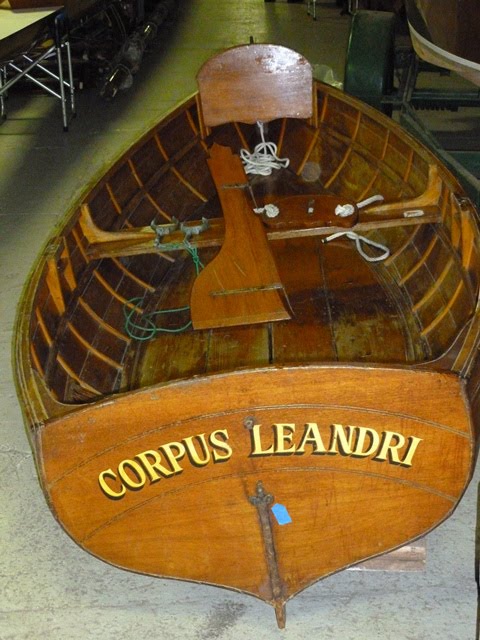
The highlight of the evening will be the auction of Hart Perry’s Thames pulling dinghy, donated by Gill Perry and the Perry family. Here is a description of the dinghy, “Corpus Leandri”: Length: 10ft.; Beam: 4ft. 2in.; Draft: 1ft. 3in.
This clinker-built boat was made in England possibly by Hobbs of Henley-on-Thames or Wyatts of Wargrave, probably in the 1930s, or maybe earlier (there is no boat builder plaque in the boat). There are some uncertainties about what kind of wood has been used, but a qualified guess is cedar on elm, six planks per side. The stern is mahogany whereupon is painted “Corpus Leandri” (the motto of Leander Club is “Corpus Leandri Spes Mea”). One sculling thwart, adjustable stretcher, stern seat and small bow seat, both with backrests in mahogany, and accompanying old velvet cushions. Two floorboards (2x2 floorboards), and a pair of bronze swivel rowlocks (oarlocks) and rudder with lines. Although the dinghy is in good condition, the thwart, floorboards, and inside will need to be re-varnished before the first outing of the season. The dinghy comes with Hart Perry’s sculls, and the blades are painted in Leander cerise.
The starting bid is $5,000. If you are not able to attend the silent auction in person, you are welcome to contact auctioneer Tom Sanford, who will accept your bids from 12 p.m. Friday 9 March to 6 p.m. Saturday 10 March via email or phone: This dinghy comes with a remarkable rowing histo
Charles “Don” Desborough Burnell (1875–196
The For the 1908 Olympic rowing in Henley, Don Bur
In 1903, Don Burnell had married Jessie Backhou

Having a father and a son being Olympic gold meda
Peter Burnell in his Before World War II, Don and Jessie Burnell lived in Wedmore, which was a fairly large house on Remenham Hill, going out of Henley towards Maidenhead. During the War, when they lived in a little terraced house in St Mark’s Road in Henley, they bought a plot of land in Wargrave, outside of Henley, where they began to build a ho

In June 1940, Dickie Burnell married Rosalind Garton, daughter of Stanley Garton, who had won an Olympic gold medal in the Leander eight i
The Burnell Family at Brentwode: from left to right, Don Burnell, his wife Jessie, Zandra, Dickie, DickieWhen Don Burnell’s wife Jessie died in 1966, he sold Brentwode and moved in to live at Leander Club. It was there that Hart Perry (1933–2011), c
One of Hart Perry’s greatest successes as a coach for Kent came in 1972, when his Kent eight took the Princess Elizabeth Cup at Henley. Two years later, in 1974, Perry was
Perry was the first U.S. citizen to sit on Leander’s governing committee, and was instrumental in raising funds for Leander’s major renovation, in which the club’s bedrooms were named after prominent British and U.S. rowing schools and colleges. Perry brought the dinghy home to Connecticut, where he and his children enjoyed many outings on the Housatonic. When Perry left Kent School to settle in North Stonington, Connecticut, the dinghy naturally came along.
For more than 50 years, Perry lived a life in rowing: he rowed, coached, and served as an official in both national and international events, in two Olympic Games, 18 World Rowing Junior Championships, and 10 World Rowing Championships, and for decades he was working with Juniors within FISA, the international rowing federation. He was the president of the National Association of Amateur Oarsmen, the predecessor organization to USRowing, and after he stepped down from that position, he became the driving force to raise money for U.S. athletes to compete in international regattas. Hart Perry was ind

I would especially like to thank Zandra Houston (nee Burnell) and her siblings for their memories about the Burnell dinghy and for providing information about their father and grandfather, and allowing HTBS to post photographs from the Burnell family photo album. Thanks also to Dr. Robert Treharne Jones, press officer at Leander Club, for information. I am also grateful to rowing historian and Leander member Tom Weil for
Subscribe to:
Posts (Atom)