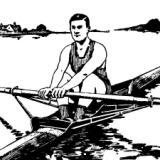
1910: The third of six consecutive Harvard victories over Yale.
Here is Part 2 of Tim Koch’s article on William Averell Harriman. Part 1 was posted yesterday.
In 1911, seventy-four years, two World Wars and thirteen Presidents before his death, Harriman had received the first of his life’s many important appointments when he was made coach of the Yale Freshman Crew for 1912. The Graduate Rowing Committee was desperate to find a solution to the Blue’s poor performance on the water and had decided to abandon professional coaching and to use a ‘gentleman graduate coach’ in the British manner. The new Freshman coach wanted to change the short, choppy stroke with a slow catch and a quick recovery that Yale and most American crews were using. He believed the key to success would be to adopt the ‘English Style’ of rowing, a long, swinging stroke which gave more power and speed with fewer strokes per minute. Following the success of the Leander Eight in the 1908 Olympics, this ‘orthodox style’ of rowing was dominant at Oxford and so, in February 1912, Harriman got a six week leave of absence from the University, obtained some letters of introduction to Oxford coach, G. C. Bourne, and to the OUBC President, R. C. Bourne (G. C.’s son) and booked his passage to England. His reception was a cold one in both senses of the word. In 1955,
Sports Illustrated magazine painted this scene:
Arriving at Oxford ...Averell found his way to the boathouse where he waited outside an open door in the rain while a boatman went up to the dressing room to fetch the Oxford (President). In his own good time that gentleman came down dressed in a great white duffle coat, stood in the rain with Harriman, read and then quizzically reread the letter of introduction. Governor Harriman recalls its key sentence: “Harriman has come from Yale, which is 3,000 miles away, to see you row.” The (President) crumpled the letter into a ball, stuffed it in his pocket and said, “We’ll be going down the river shortly. If you walk along the towpath, you will be able to see us.” He left Harriman standing in the rain.
Possibly this chilly reception was due to the suspicion that an American was unlikely to be an amateur as defined in the strict and peculiar rules of Britain’s Amateur Rowing Association, especially as regards its opposition to professional coaching. Also, the Brits may have sensed that he was ‘new money’ and may have been unsure if he really was ‘a gentleman’. Whatever the reason, Harriman was left alone on the Isis towpath to observe Oxford’s preparations for the 1912 Boat Race.
Oxford, 1912.
The American visitor was still largely ignored when he followed the crew to Henley-on-Thames where they had further coaching under W. F. C. Holland. Daily he followed the crew, observing from horseback, but when they all dined at Leander in the evening, he sat alone. Eventually the Dark Blues must have realised just how serious Harriman was and, perhaps a little flattered by his attention, President Bourne invited him to eat with them.
Sports Illustrated again:
Thus, finally, and formally introduced, Averell got on famously with the Oxonians and joined them at meals and in their weekly glass of champagne. That introduction to British manners and character was not forgotten on later trips to England as World War II Lend-Lease boss...
After training at Henley, the crew moved to Putney for a final period of instruction before the Boat Race on 30 March, now with
Harcourt Gilbey Gold as finishing coach. Harriman’s leave of absence from Yale was running out but he was tempted to stay on in England to see the race against Cambridge. Thus he booked his passage back to the United States on two ships, one leaving before and one after the event. Eventually, he decided that he would have to miss the race and he took the earlier sailing. He cancelled the later booking, one that was to have been on the maiden voyage of a new liner – RMS
Titanic.
Yale Freshmen Eight, 1913. Picture: Library of Congress.
On his return Harriman had less than three months to teach his Freshmen the new style in time for their race against Harvard at New London on 21 June. On the day, Yale lost this and every other race in the 1912 regatta. However, the Freshmen’s losing margin at two and a half seconds was the University’s smallest and they regularly beat their own Varsity crew in training. As a result of this, Harriman was eventually made head coach for 1913.
The new man built soon formed his coaching team and appointed the Freshmen’s ‘7’ man to train them further in the English Style. The new Freshmen coach was one
Dean Acheson, a future Secretary of State (Foreign Secretary) and a man who in later years would, along with Harriman, become one of ‘The Wise Men’ and who perhaps had more influence on post-1945 American foreign policy than anyone else. Years later, following a disagreement with Acheson over Vietnam, Harriman is alleged to have said to an aide: “To you he’s the great Secretary of State. But to me, he’s the freshman I taught to row at Yale.”
In January 1913, Harriman went back to Oxford to learn more of the English Style, this time taking with him Jim Rodgers (his predecessor as head coach who now had become his advisory coach) and Bud Snowden (the Yale Captain).
Yale Varsity Four, 1913. Harriman should have got them bigger shorts. Picture: Library of Congress.
By 14 April the
Washington Herald headlined “Yale Oarsmen Hard At Work – Harriman Employs Methods Which He Learned While Watching Oxford – Awaits English Coaches”. The British finishing coaches were
Alister Kirby (who rowed for Oxford in the Boat Races of 1906 to 1909 and was in the winning eight at the 1912 Stockholm Olympics) and Harcourt Gilbey Gold (who stroked three successive wins for both Eton at Henley and Oxford in the Boat Race). Gold also brought his brother-in-law,
Gilchrist Maclagan, (who coxed four University Boat Races, six Henley Grand wins and the winning eight at the Stockholm Olympics). He was to instruct the cox in use of the new English built and ‘English rigged’ boat. The
Herald article indicated of how far the Varsity coach would defer: Until the two English coaches arrive it is doubtful if Harriman will attempt to select even a tentative first eight.
Unfortunately, things were left very late. The race against Harvard was to be on 20 June, Kirby arrived on 10 May and Gold, Maclagan and the new boat were only available from 3 June. Kirby’s first view of the American crews was at the Yale Spring Regatta on 12 May and the results of this were a selector’s nightmare. The Second Varsity defeated the Varsity by two lengths, the Sophomores (2nd Years) defeated the Juniors (3rd Years) and the Second Freshmen were defeated by a high school crew.
Not surprisingly perhaps, Harvard won every race at New London in 1913. The Yale Varsity crew were in the lead at two miles but lost by 38 seconds at the finish. Crossing the line they were rating 29, compared to Harvard’s 38.
Spectators at the Harvard - Yale Regatta.
This crushing defeat was not the end for the English Style at Yale. Gold and Kirby were engaged to return as finishing coaches for the next year and almost immediately Harriman and Acheson left for England, partly to yet further study rowing technique, partly to attend Henley Royal Regatta on 2 to 5 July. They had a very good time socially but still, as Acheson later recalled, ‘returned as full as Ulysses of esoteric learning about rowing – shell construction, rigging, stroke and training – and with more confidence in our learning that I think I have since felt about anything’. Full of this self-belief, they arranged a race against Princeton. The Harvard newspaper,
The Crimson, of 11 November 1913 takes up the story concerning their old rivals with, no doubt, a certain amount of
schadenfreude:
When the present English system of rowing was first adopted at Yale, it was felt that the success or failure of the undertaking could not be determined in a year’s time, but most of the followers of the scheme had agreed that the race with Princeton on October 25 would go far towards showing whether or not the system warranted a continuation. The Yale crew came across the finish line a length behind Princeton after a two-mile race, which was characterized for Yale as splashing, unfinished and arrhythmical, the eight men being utterly exhausted. This seems to have decided the matter in the eyes of the graduate and undergraduate bodies, the general consensus of opinion being that unless Yale wishes to have her crew suffer continual defeat, a professional coach of the first rank must be obtained and a new system of rowing installed.
Yale Freshmen Eight, 1913.
A month later,
The Day newspaper of 15 December 1913 reported ‘Yale Discards the English Style...’ and that Harriman was to be replaced. While the new Varsity coach (Richard Armstrong, Yale ‘95) was still a ‘gentleman graduate’ (albeit paid), he was to receive strong professional assistance:
Guy Nickalls, the famous Leander Rowing Club coach of London and Eugene J. Giannini, coach for years of the New York Athletic Club crews, have been asked to assist.... The whole question of a change in crew policy came about after the defeat by Princeton.... After this race W. Averell Harriman practically eliminated himself from the situation and left the way for a new coach and a new policy..... Nickalls is quoted as saying that there is no such thing as the English stroke or a Chinese stroke, speaking broadly, and that the stroke used by the English college crews is not in all points suitable for use by American college crews.
An adjoining article had an interview with the great Cornell coach,
Charles E. Courtney:
..... Coach Courtney came out in strong praise of the English system. He said that Yale might have had some success of it if she had someone who knew how to teach it. Without mentioning any names Courtney left the impression that young Averell Harriman was not the best man in the world to teach Yale the English stroke.
Harriman and others in the Yale coaching launch, 1913. Picture: Library of Congress.
Perhaps it was the arrogance of youth and of wealth and privilege, the hubris of the ruling class, that made the young Harriman think that he could teach high performance rowing of any style when his ‘crew’ experience was limited to school and to his Freshman year and when his coaching experience was almost non-existent. Further, to attempt to learn a new and different style of rowing and then impart it to others simply added to the likelihood of failure. Perhaps his time at school had set him up for this. In their book,
The Wise Men: Six Friends and the World They Made, Isaacson and Thomas said about Harriman at Groton:
...with his air of stoic detachment, Harriman seemed aloof even to students of his own age. He had been taught to row by a private tutor on his family’s own private lake, and the other boys came to regard him as more of a coach than a schoolmate as he helped to organise the underclass crews.
Isaacson and Thomas also said of the young Harriman:
He was tough physically and mentally, and relished putting his abilities on the line. Recreations were challenges to be mastered, and Harriman inevitably did: polo, rowing, skiing, bowling, croquet...... ‘He went into any game lock, stock, and barrel’, Robert Lovett later recalled. ‘He would get whatever he needed – the best horses, coaches, equipment....... and worked like the Devil to win'.
Most importantly perhaps, there was the influence on Harriman of his father, who was loving in a strict, stern way, but was fiercely determined that each of his children should ‘be something and somebody’. Maury Klein, a biographer of Harriman Senior, holds that: ‘(E. H.) Harriman prodded [his] children into reaching beyond what they thought themselves capable of doing’.
Here, I would suggest, is ‘the nub’. Harriman worked as hard as he possibly could have done to understand and communicate ‘the English Style’ in the very short time that he had available. But money and effort and will cannot speed the acquisition of the one thing that practically every coach needs – experience.* Even if he had decided not to change Yale’s rowing style, it is doubtful that such a novice coach would have achieved much better results. When he did bring in men of experience to coach, they did not have enough time to be effective. The new regime under Nickalls had both time and experience and Yale Varsity won by inches in 1914 and by 21 seconds in 1915. While it would be churlish not to give Harriman some of the credit for these successes, how much is for history to speculate.
Alert and active to the end, William Averell Harriman died in New York on 26 July 1986, aged 94. In a tribute, former Secretary of State Dean Rusk said: ‘One cannot grieve after a life so long and so nobly led’.
* Before someone with a knowledge of Yale Rowing corrects me, I will have to acknowledge ‘the exception that proves the rule’. In 1870, Yale Semaphore Bob Cook studied ‘orthodox’ rowing in England and is credited with bringing it to the United States and adapting it to American rigs to become ‘The Bob Cook Stroke’ which was widely used by U.S. college crews.