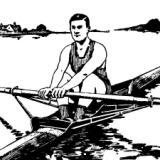
The other day, the local tv-channel in the town of Kalmar, located on the east coast of Sweden just across to the island of Öland, showed a short clip from the rowing club in town, Kalmar Roddklubb, founded in 1925. The recreational rowing has always been strong at the club, which nowadays has forty-something members. Most of the members, it is said in one of the interviews, are 65-year-olds and older. A couple of times a week, the members go out in the club’s inriggers ‘to enjoy being out in the nature’.
Below is the clip:
Showing posts with label Inrigger. Show all posts
Showing posts with label Inrigger. Show all posts
Saturday, July 23, 2011

Thursday, February 3, 2011
Three Inrigger Fours On An Outing
 The post card above is from the inner habour in the town of Helsingborg, on the Swedish South-West coast. Already in 1868, a large rowing and sailing regatta was held in town between Danish and Swedish crews, and more than 15,000 people showed up to watch the races. It then took almost fifteen years before a rowing club was founded in town, Helsingborgs Roddklubb, in 1883.
I do not know when the picture was taken, or when the post card was sent (the stamp has been removed), but it was sent from Helsingborg to the Smart Family in Ballogie, Aberdeenshire, Scotland. As we can see, there are three coxed inrigger fours out in the habour. It is known that the club bought a new four in 1895, and ten years later a couple of new inriggers – by 1911, the club had three inrigger fours, two inrigger pairs, two single sculls, and a four-oared gig. It is very likely that the picture is from around that time. The vessel docked on the left is probably a ferry going over to the Danish town of Helsingör.
I would like to thank “Greg”, who on 2 January, 2011, pointed me in the direction of this nice post card on eBay. As you can all see, I won the card!
Sunday, January 9, 2011
The Revival Of Cornish Pilot Gig Racing 2
 Here Tim Koch continues his story from yesterday about his visit to Falmouth Gig Club in Cornwall.
On a very cold day shortly before Christmas I appeared unannounced at Falmouth Gig Club. Founded in 1985, it is one of the top clubs, and the women have won the World Championships ten times. I found the men’s ‘A’ crew about to go out. Their captain, Fergus Muller, invited me to join them and pointed me towards the ‘pilot’s seat’ in the bow of the gig Energy. The cox was his wife, Amelia, herself a champion rower.

 All my previous rowing experience had been with fine outrigged boats with sliding seats so I was very interested to find out the differences. Like all rowing when it is done well, the crew made it look easy. Energy moved fast and true, untroubled by the choppy water of Falmouth Harbour (which, including Carrick Roads, is the third largest natural harbour in the world and a fine training ground).
Fergus shows the catch.

Fergus shows the finish.
 The real test came when they tolerated me taking over the bow seat for a few minutes. I was slightly overdressed in a tweed jacket and duffle coat but I slipped my brogues under the foot straps and received some quick instructions. The outside hand is held in an underhand grip and the inside hand is close to it. I was told that there was a way of using the legs at the catch despite the fixed seat but that proved too advanced for me. Against all my fine boat training, I was effectively told to ‘lean away from the work’ at the finish. Sadly, this part came easily to me. The wooden Macon oars had no button to stop them sliding through the pins and I found it difficult to keep the blade square at the catch. The result was several crabs as I (quickly) tired but at least there were no ‘boat stoppers’ or broken tholes. I soon handed back my oar and resumed my role as deadweight.
 On the return leg the crew showed me a burst of speed. I had read that a very fast gig can do eight knots and I now believe it. These clinker boats may look heavy compared to a sleek plastic four or eight but they do not feel it when rowed properly. A coxswain’s eye view of a Rock Gig Club crew rowing is here. A view from the pilot’s seat of a Bristol crew rowing is here. It also shows an ‘oar toss’, used to make a quick turn.
 In Britain, fine boat rowing still has an image problem because of its Oxbridge / Henley / private school connotations. Not so with gig rowing. To quote The Times, in thirty years Cornish Gig Racing has gone from ‘… a moribund sport…… to a thriving competitive pastime, claimed now to be the fastest-growing community sport in the West Country……’ Those of us who are evangelical about rowing must applaud all those who made and continue to make this happen. As they say in Cornwall when something merits approval, “Proper Job”!
Many warm thanks to Tim for a very interesting report!
Saturday, January 8, 2011
The Revival Of Cornish Pilot Gig Racing 1
 The always reliable and alert HTBS correspondent Tim Koch in London did not only relax during his Christmas holidays in Cornwall, he had a promise to keep, so here is the first part of his story about Cornish pilot gig racing. Tim writes,
 My entry of 30th November on inrigged rowing in Britain today ended with the afterthought that I should have included something on the thriving sport of Cornish Pilot Gig racing and the promise that I would write something after spending Christmas in my native county, Cornwall. Now, thanks to the generous hospitality of Falmouth Gig Club, I am able to bring a first hand report.
The county of Cornwall forms the tip of the south western peninsula of England. It is bordered to the west and north by the Atlantic Ocean, to the south by the English Channel and to the east by the River Tamar. Naturally, it has a strong maritime tradition. In Cornwall the prevailing winds come from the south west so it is easier to row a boat to windward than to sail it and this led to the development of the Cornish Pilot Gig, a coxed, fixed seat, six oared, clinker built rowing boat. It is built of narrow leaf elm and modern boats are all 32 feet (9.8m) long with a beam of 4 feet 10 inches (1.47m). The gunwales are too thin to support rowlocks so tholes or ‘pins’ are used. One
 of each pair of pins is ‘hard’ (to act as a fulcrum for the oar) and one is ‘soft’ (designed to break in the event of ‘catching a crab’). Gigs are light, buoyant and manageable in heavy seas. As the name suggests, their principal use was to carry ‘pilots’ out to incoming vessels so that they could use their local knowledge to guide ships through dangerous or congested waters. The fastest gig got their man on board first and so won the pilotage fee. Thus, gig racing was born.
When engines replaced sails and oars, interest in racing these boats declined but the sport clung on in Newquay (on the north Cornish coast) and in the Isles of Scilly (28 miles / 45 km west of Cornwall). However, by the 1980s, gig races and the few remaining boats were in danger of dying out. This was changed largely through the efforts of a remarkable local man, Ralph Bird. He triggered a revival by three courses of action. Firstly, Bird organised races. Secondly, he formed the Cornish Pilot Gig Association (CPGA) to see that future gigs were built to an agreed standard and to set the rules of racing. Thirdly, he (eventually) built 29 new gigs with his own hands. The ‘standard’ boat was to be based on the Treffry, built in 1838 and still owned by Newquay Rowing Club. A new boat costs nearly £20,000 ($31,200) and now the two principal boat builders are Hunkins and Nobbs.
 Today there are over 50 clubs (owning over 130 boats between them) affiliated to the CPGA. They are mostly from Cornwall but some are from other parts of the UK. There are also clubs in France, the Netherlands, Australia, the Faroe Islands and the USA. Over 7,000 people take part in gig racing at more than 300 regattas around the South West each summer and the ‘World Championships’ are held every May in the Isles of Scilly. The numbers are growing all the time.
To be continued tomorrow...
Tuesday, November 30, 2010
Inrigger Rowing Is Still Alive In Britain
 HTBS's Tim Koch did a little research on inrigger rowing in Britain. Here is Tim's report:
Following the recent item on inrigged coxed fours, on 27 November, some people may have the impression that inrigged rowing for pleasure and competition no longer exists. This is far from the case. In Britain, the Skiff Rowing Association, SRA, has existed since 1901 and is still going strong. The Thames Skiff is a round bottomed, fixed seat, clinker built boat with the blades held in place by wooden thole pins at the side of the craft. Singles and doubles are the most common though there is no reason why trebles and fours cannot be made. The SRA sets the rules of racing and runs three events - the Inter-Club competition held at Henley on Thames and the Singles and Doubles Marathons. All other events are organised by affiliated clubs or regattas.
 The affiliated clubs are:
The Skiff Club (1895)
Thames Valley Skiff Club
Wraysbury Skiff and Punting Club (1931)
Dittons Skiff and Punting Club
Wargrave Boating Club
Granta Skiff Club (Cambridge)
The affiliated regattas are:
Sunbury Amateur Regatta This has skiffing, punting, and dongolas (a punt paddled by a team of six people kneeling). It offers club and ‘local’ events and includes pub teams and a tug of war! It all ends with fireworks. Its website says: Away from river, the lawn provides a wide range of activities. From beer tents to Punch and Judy shows, there is something for every member of the family. Many community groups and charities have stalls on the lawn and Sunbury Regatta is a fundraising opportunity for many.
Chertsey Regatta was established in 1851 and so is one of the oldest rowing events still in existence. It offers punting and skiffing.
Hampton Court and Dittons Regatta started in 1881 as an ‘Aquatic Sport and Venetian Fete’. It has punting, skiffing, dongola and junior dingy races. Some early 20th Century film of the event is shown below (click on the black box!).
HAMPTON COURT REGATTA
The Wraysbury and Old Windsor Regatta and The Walton Reach Regatta are so traditional that they do not have websites!
Egham Regatta offers junior sculling, punting and skiffing events and so I think it is the only British regatta run under three codes – British Rowing, The Skiff Rowing association and The Thames Punting Club
Every year the Auriol Kensington Veterans’ Row to Henley passes through this delightful event (in a literal sense as we row over the race course in preference to going up the narrow temporary navigation channel) and I can vouch for the fact that Egham has a marvellous family atmosphere and is well supported by the local community.
A glance at the web-sites of these clubs and regattas quickly shows that they seem to have a good balance of fun and competition, something which is sometimes lost in normal 'outrigged' rowing clubs with their ergo tests and six day a week training.
 (On finishing this article it suddenly struck me that an item on active inrigged rowing in Britain should include the thriving Cornish Pilot Gig racing scene. However, I will be returning to my native Cornwall for Christmas so I will produce something in the new year – hopefully after some first hand research).
Saturday, November 27, 2010
Inrigger: A Rare Boat Type
 The coxed inrigger four is indeed a very rare boat type nowadays even in the Scandinavian countries. It was actually introduced as an Olympic boat class at the fifth Olympiad, the Stockholm Olympic Games in 1912. In the Rowing Programme, Rules and General Regulations,* published in 1912 by the Swedish Olympic Committee, there is a definition of a ‘Four-oared Inrigger’ stating that
“An inrigger gig shall be clinker built and comply with the following measurements and weights: –
Length: maximum 10.60 metres
Width: at the widest place, minimum 1.05 metres
Depth: 0.36 metre
Width at water line: 0.78 metre
Weight: 85 kilos
Number of boards on either side: 7.
The width of the boards must not in any part of the cross-sections of the boat vary more than 2 centimetres. For the purpose of measuring the width at the water line, an apparatus of the following construction will be used:
A bar, about 1 metre in length, placed on its edge and supplied with two vertical, movable arms, 12 1/2 centimetres high, one at each end.
In the middle of the bar a notch large enough to fit over the keel of the boat.
 When a boat is to be measured, it shall be laid bottom upwards, with the apparatus placed over the middle rib. The vertical arm is then pushed so far along the bar as to touch the sides of the boat, at the water line. The distance is measured on the bar between the vertical arms, and if, for example, this distance for a four-oared boat is at least 0.78 metre, the boat holds the measurement; if the distance is less, it is not up to the standard.
The length shall be measured in a straight line between the extreme ends of the stem and the stern. The depth shall be measured inwards, from the deepest point of the keel to the deepest part of the boat and perpendicularly up to a line through the upper edges of the uppermost boards. The width shall be measured between the outer edges of the uppermost boards on the widest part of the boat. The width at the water line shall be measured outwards on the middle rib and a height of 12 1/2 centimetres above the lowest board.
The boat shall have an outward keel which in every cross-section shall reach at least 1 centrimetre below the lowest edge of the lowest board. The weight of the boat is reckoned exclusive of the oars but inclusive of all other equipment of the boat. The position of the rowlocks or the axle of the movable rowlock may not be more than 3 centimetres outside the outer edge of the upper board, and the measurement shall be made straight out from the place where the rowlock is fixed.”
 At the Olympic rowing event in Stockholm the following inrigger crews competed: Nykjøbings paa Falster Roklub, Denmark; Société Nautique de Bayonne, France; Christiania Roklub, Norway; Ormsund Roklub, Norway; Göteborgs Roddförening, Sweden; Roddklubben af 1912, Sweden. The Danish boat won followed by the Swedish, Roddklubben af 1912 (seen below). See also HTBS 21 April, 2009. The inrigger would never again appear at an Olympic rowing event, and has to be regarded as an Olympic curiosity.
 What is not known, or maybe more correctly, remembered nowadays is that they also had inriggers in New Zealand during the 1880s and 1890s. Michael Grace, author of the eminent The Dolly Varden Legacy, wrote in an e-mail that he had a draft about inriggers in New Zealand for his book, but it never made it into the final version. This is what he wrote about the inriggers:
“Competition in inrigged fours was still very much prevalent into the 1880s and 1890s. However, the practice of acknowledging the representative boats, rather than the crew themselves, seems to have subsided about the time the NZARA was established (1887). While there is no record of the names themselves, the Club recorded a number of victories in Senior, Junior and Maiden Inrigged Fours during late 1880s and early 1890s. At a NZARA meeting in December 1896, a rule was passed that Maiden four-oared races were only to be rowed in out-rigged boats at all regattas. This effectively spelt the death knell of inrigged racing in New Zealand and this form of boat subsequently faded into obscurity.”**
This boat type has also started to fade away in the Nordic countries, which is really a pity!
* A photo copy of the Rowing Programme, Rules and General Regulations was sent to me by Tim Koch. His club, Auriol Kensington RC in London, has a copy of this rare publication in their archives. It once belonged to the club's prominent sculler, Wally Kinnear, who took an Olympic gold in the single scull in Stockholm.
** My thanks to Michael Grace for allowing me to publish this piece.
For more about the Olympic rowing in Stockholm, see my article Samuel F. Gordon and the 1912 Olympic Rowing.
Subscribe to:
Posts (Atom)