Photograph: Werner Schmidt

Friday, December 2, 2011

Dry Tank Rowing

(Photograph from Rowing Innovations)

I found yesterday's entry about 'land rowing' by Tim Koch fascinating. It reminded me of an article and ad I had seen in the current (December 2011, Vol. 18, Issue 10) issue of Rowing News about a fairly new innovation called Swingulator Dry-Tank Rowing Simulator. This product is the brain child of Rick Kelliher, rowing coach at the University of Vermont. The idea is that for those rowing teams which can not afford to buy or have the space for a rowing tank, the Swingulator is a simpler and cheaper solution, Rowing News writes. The machine costs around $20,000 for an 'eight', but is bought by the 'pairs'. For more information, go to Rowing Innovations.

Here is a little film clip showing a crew rowing the machine:


Of course, anyone aware of the rich history of the sport of rowing knows that any 'new innovation' has very likely been patented many decades ago, rowing historian Bill Miller writes in an article, "Rowing Equipment Patents (U.S.)".

Thursday, December 1, 2011

Tim Koch On Land Rowing

Above an illustration from an 1887 Swedish sport book showing a ‘newer’ rowing machine.

In a comment from an earlier HTBS entry on 27 November, Tim Koch writes,

The recent HTBS story showing a 1912 picture of the rowing machine on the Titanic illustrates that the ‘indoor rower’ is not a new idea. It has its own Wikipedia entry which says:

“Early rowing machines are known to have existed from the mid 1800’s, a US patent being issued to WB Curtis in 1872 for a particular hydraulic based damper design. Machines using linear pneumatic resistance existed around 1900, but they did not simulate actual rowing very accurately, or measure power output.

“In the 1950s and 1960s, coaches in many countries began using specially made rowing machines for training and improved power measurement. One such design was a large, heavy, solid iron flywheel with a mechanical friction break using leather straps […] These machines were capable of setting friction according to a rower’s weight to give an accurate appraisal of boat-moving ability […]

“In the 1970s the Gjessing-Nilson ergometer from Norway, used a friction brake mechanism with industrial strapping applied over the broad rim of the flywheel […] This machine was for many years the internationally accepted standard for measurement.

The first air resistance ergometers were introduced around 1980 […] The Concept 2 ergometer was introduced in 1981 by the Dreissigacker brothers. This machine’s capability of accurate measurement combined with easy transportability spawned the sport of competitive indoor rowing, and revolutionised training for watercraft rowing.”

An early advertisement was for ‘Vigor’s Home Rower’. It appeared in an 1896 edition of Black and White magazine. From the picture it is not clear how it works and I do not know if it really was a cure for ‘asthma, weak lungs, nervousness and constitutional weakness’. It was, however, endorsed by The Emperor of Germany and, more interestingly for us, Lord Ampthill (on the right), a multiple University Boat Race and Henley winner.

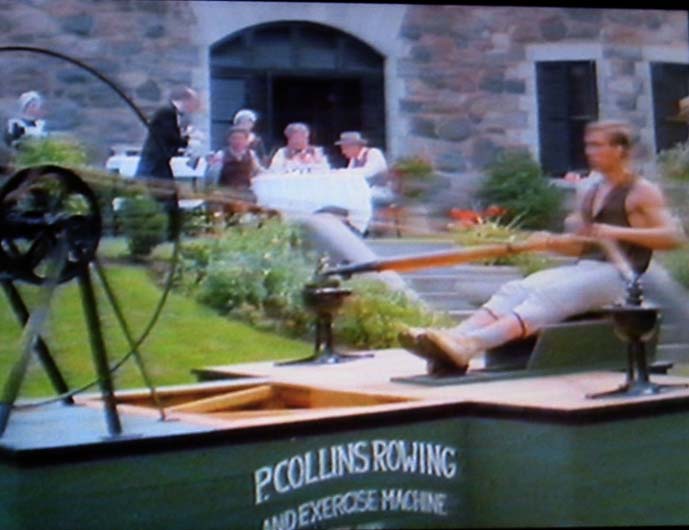
A great example of an early (and quite effective looking) rowing machine appeared in the 1986 film, The Boy in Blue (staring a very young and very ‘buff’ Nicolas Cage) loosely based on the life of Canadian world champion sculler, Ned Hanlan . The ‘Tideway Slug’ has the story of the film here and also a picture of the wonderful ‘P. Collins Rowing and Exercise Machine’. A Nicolas Cage fan site has this nice clip of it in action. Was this machine based on a real indoor/outdoor rower or was it (as I suspect) an invention of the film makers? If anyone knows, please tell me.

One of the most popular late nineteenth/early twentieth century rowing machines was produced by Spalding of the United States. Above is a lovely example which is for sale here.

The resistance is provided by a chain around cogs. I presume that the resistance of the cogs could be increased to vary the work in the drive phase and that there would be some sort of ratchet system to allow a smooth recovery.

The above 1910 picture of Columbia University oarsmen seems to use the same cog and chain system but, as it is a rowing action and not a sculling one, it is placed to the left or right of the rower. A British Path newsreel shows that these were still in use in 1924. Perhaps they were all made by Spalding?

OXFORD TAKE NOTE FOR THE NEXT YEAR


As Wikipedia says of early rowing machines, ‘they did not simulate actual rowing very accurately’. The two main problems were that the resistance was often not constant through the drive phase and that there was no simulation of the ‘run’ of the boat on the recovery.

It is strange that the relatively simple system of ‘air resistance’ that we use today (notably on the Concept machine) was not commonplace from the start. The Concept 2 website shows the evolution of their machine, though the basic design remained the same until the introduction of the ‘Dynamic’ a year ago. Constant air resistance provides the closest feeling to pulling (or, more correctly, pushing) an oar through water, and is superior to any spring, hydraulic, liquid, weight or friction based resistance method. Also, the constantly spinning heavy flywheel simulates the run of the boat and the feeling of ‘picking up’ a moving shell at the catch. Modern electronics now makes the whole thing infinitely measurable.

Before the dominance of the Concept 2 ergo, the closest to the feel of ‘real’ rowing that was obtainable on land was in the ‘tank’. Americans seemed to have led the way in innovative tank design as evidenced by this 1933 newsreel.

AN INDOOR RIVER!


A simple internet search reinforces my impression that tanks are still more popular in the United States than in Britain where they are increasingly converted to gyms and ergo rooms. A form of ‘floating tank’ used at Oxford can be seen here.


The film gives the idea that the ‘Octolog’ was an innovative British idea but they existed in the US in the 1930s and, I think, continue in use today.

Few would hesitate to say that the modern ‘ergo’ has produced the greatest change in training and testing methods that the sport has seen since the work of Steve Fairbairn in the inter War years.

It must be remembered however, that, as the Wikipedia entry on ‘indoor rowers’ states: “Results of (ergometer) tests are an objective measure of an athlete's fitness; however, weight, technique and team coordination also impact performance in a boat, thus assembling a crew based purely on erg scores is not an optimal strategy.”

Said another way (and a particularly popular view from those of us who never got below 7.30 on their 2k tests), ‘Put an ergo on the water and it sinks’.

Wednesday, November 30, 2011

John Betjeman's Henley Regatta Poem

A nice way to round off yesterday's entry about Leander's 1912 Olympic boat is to quote Sir John Betjeman's poem 'Henley Regatta 1902' where a member of the famous club can be seen in his 'pink Leander tie'. Sir John Betjeman (1906-1984) was appointed Poet Laureate in 1972.

Henley Regatta 1902

Underneath a light straw boater
In his pink Leander tie
Ev'ry ripple in the water caught the Captain in the eye.
O'er the plenitude of houseboats
Plop of punt-poles, creak of rowlocks,
Many a man of some distinction scanned the reach to Temple Island

As a south wind fluttered by,
Till it shifted, westward drifting, strings of pennants house-boat high,
Where unevenly the outline of the brick-warm town of Henley
Dominated bu her church tower and the sheds of Brakspear's Brewery

Lay beneath a summer sky.
Plash of sculls! And pink of ices!
And the inn-yards full of ostlers, and the barrels running dry,
And the baskets of geraniums
Swinging over river-gardens
Led us to the flowering heart of England's willow-cooled July.

Tuesday, November 29, 2011

The Story About Leander's Olympic Boat

After yesterday’s entry about the 1912 Oxford crew who raced twice against Cambridge that year, let me continue with another 1912 eight who took the Olympic gold medal at Stockholm: the Leander crew seen above, who beat New College (with Bob Bourne as stroke) in the final. In the photograph are from the stern: coxswain Henry Wells, stroke Philip Fleming, 7 seat Alister Graham Kirby, 6 seat Arthur Stanley Garton, 5 seat James Angus Gillan, 4 seat Ewart Douglas Horsfall, 3 seat Leslie Graham Wormald, 2 seat Sidney Ernest Swann, bow Edgar R. Burgess.

In Tim Koch’s report of this year’s Rowing History Forum at the Henley River and Rowing Museum, Paul Mainds, RRM Chief Executive, is quoted saying that he hopes to have both the 1912 and 2000 Olympic eights on display at the muesum for next year’s Olympic Games in London. Leander’s 1912 eight is currently at the Sports Museum in Stockholm after being donated by one of the local rowing clubs in Stockholm, Stockholms Roddförening.

Stockholms Roddförenings club house acted as the Olympic Rowing Committee’s Headquarters during the Olympic regatta. On the right in the photograph is Leander’s George Duncan Rowe.

Actually, in 2003, I sent a note to Stockholms Roddförening asking how on earth Leander’s eight ended up in their boat house. I received a nice reply from Mr. Lennart Borgh, who had copied the club’s minutes from a committee meeting on 8 August 1912, which read: "The Vice President reported that Chamberlain Fredr. Löwenadler has donated Leander’s eight and oars to the club.” [My translation] Mr. Borgh informed me that old club members had stated that when the shell arrived at the club, the sliding tracks were slightly displaced laterally to increase the leverage. Sometime during the 1930s, the tracks were changed to be straight. Stockholms Roddförening donated the boat to the Sport Museum in the beginning of the 1990s.

So, how come Fredrik Löwenadler donated Leander’s boat to the Stockholm club? I really do not know. However, there is a link between this Swedish nobleman and Leander, I realised when I did a Google search. Lars Johan Fredrik Löwenadler, who was born in Stockholm in 1854, was a match merchant who also worked for the Swedish Chamber of Commerce for the United Kingdom in London at that time. In 1884, he married Miss Florence ’Flo’ Rogers, who was born 1863 in Weston-Super-Mase. They settled in Henley-on-Thames, where Fredrik died in 1915. His wife, Florence, died there in 1946. Living in Henley, Fredrik must have had some contacts with Leander Club!

Monday, November 28, 2011

Oxford 1912

Here is an interesting photograph of the 1912 Oxford crew: bow W.F.A.H. Pitman, 2 seat C.E. Tinne, 3 seat L.G. Wormwald, 4 seat E.D. Horsfall, 5 seat A.H.M. Wedderburn, 6 seat A.F.R. Wiggins, 7 seat C.W.B. Littlejohn, stroke R.C. Bourne, and cox H.B. Wells. At the first race on 30 March, in terrible weather, both crews got waterlogged, the Light Blues by Harrods and the Dark Blues at Chiswick Reach. Oxford managed however to get into shore to empty out the water from their boat. After the crew had taken a couple of strokes to continue on their way to Mortlake, the launch with umpire Fred Pitman showed up. Pitman told them that he had called off the race due to the weather conditions, which upset the Oxford crew as they were still afloat. When Bob Bourne, who was rowing his fourth race against Cambridge, picked up his oar again, Pitman barked at Oxford that he had postponed the race, whereupon Bourne said: “We are going to Mortlake ……. because there’s where we have our clothes”. On 1 April, at the re-row, where the photograph probably was taken, Bourne stroked his crew to a comfortable victory, at 22 min. 5 sec., six lengths ahead of Cambridge.

Sunday, November 27, 2011

Father Browne’s Titanic Album

HTBS’s Greg Denieffe writes from England that Father Browne’s Titanic Album, the centenary edition, was launched in Cobh Heritage Centre on 23 November. There is an article about the launch in The Cobh Edition here. Greg continues:

Cobh is pronounced ‘cove’ and was known as Queenstown at the time. Cobh was the final departure point of the Titanic on 11 April 1912. The ship was built in Belfast and as the locals say “it was fine when it left here”.

The following about the Titanic is from Wikipedia:

“The vessel began her maiden voyage from Southampton, bound for New York City on 10 April 1912, with Captain Edward J. Smith in command. As Titanic left her berth, her wake caused the liner SS New York, which was docked nearby, to break away from her moorings, whereupon she was drawn dangerously close (about four feet) to Titanic before a tugboat towed New York away. The incident delayed departure for about half an hour. After crossing the English Channel, Titanic stopped at Cherbourg, France, to board additional passengers and stopped again the next day at Queenstown (known today as Cobh), Ireland. As harbour facilities at Queenstown were inadequate for a ship of her size, Titanic had to anchor off-shore, with small boats, known as tenders, ferrying the embarking and disembarking passengers to and from the ship. When she finally set out for New York, there were 2,240 people aboard.

“John Coffey, a 23-year-old stoker, jumped ship at Queenstown by stowing away on a tender and hiding amongst mailbags destined for shore. A native of the town, he had probably joined the ship with this intention, but afterwards he said that the reason he had smuggled himself off the liner was that he held a foreboding about the voyage. He later signed on to join the crew of Mauretania”.

And now for the interesting bit, RTE, Ireland’s radio and television network, have 12 photographs on view at this link. All the photographs are stunning but HTBS readers may find number six of interest. It is captioned “First class passengers, such as TW McCawley, could enjoy the use of the ship’s gym”. Photograph above shows Father Frank Browne who took the photographs and who was ordered by his superior to disembark at Cobh. RTE’s Six One programme on 23 November 2011 had a report about Father Browne and his extraordinary photographs. The report is at 38:10 and is available for a couple of more days, here.

Saturday, November 26, 2011

New Biography On Professional Champion Michael Rush


Australia has a rich tradition of professional sculling. Many of the Australian scullers reached the very top and became world champions at a time when rowing and sculling was the premiere sport in English-speaking countries. News arrived to HTBS the other day that a new rowing biography, Michael Rush: Champion Australian Sculler by Stephen Gard, has been published this autumn. The book is about the Irish immigrant Michael Rush (1844-1922), who with his six feet and 13 stones became a powerful oarsman on the Clarence River in northern New South Wales. He soon became Champion Sculler of the district, and later Champion of Australia.

In 1874 and 1875, Rush had beaten the prominent sculler Ned Trickett twice, but declined to scull against Trickett for the Championship title on the so called Championship sculling course on the Parramatta River in Sydney, instead demanding the race to be on his homewater, the Clarence River. Trickett refused and went to England to challenge the world champion, Joe Sadler, on the Thames in June 1876. Trickett won and returned home to Australia in triumph. Almost exactly a year later, Rush raced Trickett for the world title, but was severely beaten. He would never be able to win the world title, but he is “remembered for his unfailing courage, humour, warmth, and true sportsmanship, and he has earned a place in Australia’s history”, a press release mentions from the publisher, Bluedawe Books, Australia.

Book information: Michael Rush: Champion Australian Sculler by Stephen Gard is a hardcover edition with dust-jacket. Decorated endpapers. Illustrated throughout in black and white, plus maps, and six pages of colour plates. Includes Bibliography, Index, Glossary of Sculling Terms, and Chapter Notes, 320 pp., ISBN 978-0-646-55987-2. The book was published in September 2011 in a limited edition of 500 copies. Book weighs 1.60 kg packed. $AUD38.00 (plus postage).

Read more about the book and how to order a copy here.

Friday, November 25, 2011

Julian Grenfell: Oarsman, Poet, Soldier

During Remembrance Week in the U.K., which has just passed, among the poems that are read you will find the famous ‘Dulce et Decorum Est’ by Wilfred Owen and ‘In Flanders Fields’ by John McCrae, but rarely Julian Grenfell’s ‘Into Battle’, which nowadays is totally ignored, although it can still be found in anthologies of war poetry. The two first stanzas of ‘Into Battle’ read:

The naked earth is warm with spring,
And with green grass and bursting trees
Leans to the sun’s gaze glorying,
And quivers in the sunny breeze;
And life is colour and warmth and light,
And a striving evermore for these;
And he is dead who will not fight;
And who dies fighting has increase.


The fighting man shall from the sun
Take warmth, and life from the glowing earth;
Speed with the light-foot winds to run,
And with the trees to newer birth;
And find, when fighting shall be done,
Great rest and fullness after dearth.

The problem that scholars and ordinary readers of poetry have these days with Grenfell is also what he wrote in a letter in October 1914 about the Great War: “I adore war. It is like a big picnic but without the objectivelessness of a picnic. I have never been more well or more happy.” Seven months later, on 13 May 1915, Grenfell was wounded by a shell-splinter. He died on 26 May with his parents and his sister Monica at his bedside. The following day, his poem ‘Into Battle’ was published in The Times together with the announcement of his death. Two months later, on 30 July, Julian’s younger brother Billy was killed in action one mile away from where Julian had been wounded.

Julian Grenfell, who was born on 30 March 1888, was the eldest son of William Henry Grenfell (on the left) later Lord Desborough, a famous oarsman and sportsman. Julian was educated at Eton and then went up to Balliol College, Oxford, where he proved to be a happy-go-lucky chap, who excelled at writing poetry and essays, and at different sports, including rowing. It is said that he was a ‘golden boy’ who socialised with friends and dons alike, but also that he could be a bully. However, at the end of his studies Julian had a breakdown, which led to a poor degree. After Oxford, he joined the 1st Royal Dragoons, stationed in India and later South Africa.

The information about his rowing career at Balliol College is sparse, and if you find any it is confusing: “[Julian was] rowing in the college eight, which won the Wyfold cup at Henley in 1909”. At the time when Julian was rowing, the Wyfold Challenge Cup at Henley was rowed in coxless fours. Looking into if he was in fact rowing at Henley in 1909, Sir Theodore Cook shed some light in his Henley Races (1919). Julian’s Balliol four rowed in the second heat of the Visitors’ Challenge Cup against First Trinity, Cambridge. The Balliol crew, which was stroked and steered by M.B. Higgins, had problems with their course and went into the piles within their first rowed minute. First Trinity was already far ahead, when the Balliol boat got clear. However, the Oxford crew continued to steer badly and came over to the Berks station. The Cambridge crew won easily in 8 min. 4 sec.

Harry Blackstaffe of Vesta RC

The Balliol crew was also rowing in the Wyfold Challenge Cup, where the crew – in addition to Julian in the bow-seat and Higgins on stroke were V.A Barrington-Kennett in second-seat and J.W. Heinemann in third-seat – did not have any difficulties defeating Vestra RC; on the second-seat in the metropolitan crew was the 40-year-old veteran Harry Blackstaffe, who the previous year had become the Olympic champion in the single sculls. In their next heat, the Balliol crew, although again steering poorly, managed to get a lead at the Island against Molesey BC. At Fawley, the Oxford boat had a lead of a length and a half and won easily in 8 min. 3 sec. In the final heat, Balliol met another Oxford college crew, Christ Church. Both boats got a good start and were level at the quarter-mile post. At one point, Balliol was close to the booms, but was quickly back on the right course. At Fawley, both crews were in midstream, almost clashing oars. “The race was a good one to watch, the crews being dead level at the three-quarter-mile signal”, Sir Theodore writes. When Balliol put on a spurt, Christ Church tried to follow, but made some steering errors which led to falling behind and getting Balliol’s wash. Having another race later in the day, Christ Church gave up, and Balliol won easily in 7 min. 44 sec.

After joining the Army, Julian continued to write poems. In the summer of 1914, he was toying with the idea of leaving the Army, but when the war broke out in August the same year, he decided to stay and two months later he was in France. Julian was promoted to the rank of Captain, was mentioned in dispatches, and won the DSO. He declined a job as aide-de-camp as his regiment was short of front-line officers. From his hands came a light poem, ‘Prayer for Those on the Staff’ which reveals his humour:

Fighting in mud, we turn to Thee
In these dread times of battle, Lord,
To keep us safe, if so may be,
From shrapnel snipers, shell and sword.

Yet not on us - (for we are men
Of meaner clay, who fight in clay) -
But on the Staff, the Upper Ten,
Depends the issue of the day.

The Staff is working with its brains
While we are sitting in the trench;
The Staff the universe ordains
(Subject to Thee and General French).

God, help the Staff - especially
The young ones, many of them sprung
From our high aristocracy;
Their task is hard, and they are young.

O lord, who mad’st all things to be
And madest some things very good
Please keep the extra ADC
From horrid scenes, and sights of blood...

He was buried in the military cemetery on the hills above Boulogne in France. Go to Julian Grenfell’s War Diary here. See also HTBS's War Memorials.

This post was updated on 22 May 2014 to reflect the information in Comment 1.

Wednesday, November 23, 2011

The Existential Rower


The Existential Rower

Oars would get him
To his destination,
Oars and his prowess,
The prowess of the athlete.
Discipline grew in him
Like a second being,
The regimen he did not fail
To follow like a religion,
The regimen that burned
His body lean,
Hard, until
His muscles and the singlet he wore
Seemed one, the suit
He wore to his office:
And his shell,
Sleek, slick in the water,
The grace of its shape
To which his body conformed,
The grace of them together on the water,
Each stroking of his oars
Another word in the prayer,
The Prayer of doing
That got him where he was going.

Philip Kuepper
(September 2011)

Tuesday, November 22, 2011

50 Years Of Rowing At Trinity College

The oarsmen that could - fifty years after they started a tradition. Photo: Nick Lacy. Courtesy of Trinity College.

Trinity College in Hartford, Connecticut, is a small liberal arts school like many other educational institutions in the USA. Although there were some activities on the water in the early days, between 1856 and 1873, with some boys messing about in boats, ‘Doctor Rowing’ - Andy Anderson - writes in an article in the current Rowing News (December 2011, Vol. 18, issue 10), the sport of rowing vanished after one of the rowers drowned in an accident. In 1961, Baird Morgan and his friends at Trinity borrowed a shell to race against other schools, and so began a tradition. The boys kept the shell in an old Tobacco Barn.

Last month, the oarsmen, now maybe a little rounder and with some grey hair on their templates, reunited in the fairly new-built boat house by the Connecticut River to celebrate 50 years of oarsmanship at Trinity College. Rowing* has grown and is now one of the biggest sports at the college to the delight of both the old and younger rowers of today.

There is a nice piece on the Trinity College website about the rowing alums who visited the college for the October reunion, read the article here.

Below is a beautiful slideshow from the celebrations in October.


*Trinity College states on its athletic website that the school, both for women and men, has a rowing programme. (Not ‘crew’, we note.)

Monday, November 21, 2011

Film On 2011 Wingfield Sculls

2011 Wingfield Sculls with Adam Freeman-Pask in the lead, Tom Solesbury on the left, and Henry Pelly closes to the camera.

The 171st Wingfield Sculls - The British Amateur Sculling Championship and Championship of the Thames - took place on Thursday, 27 October 2011, as reported earlier on HTBS by Tim Koch. With great weather conditions it looked as it would be an open affair in the men’s race, especially as last year’s champion, Alan Campbell (winner also in 2006 and 2009), had withdrawn due to injury. It was left to Adam Freeman-Pask of Imperial College, Henry Pelly of London RC, and Tom Solesbury of Leander to fight it out on the Thames. In the end it was Freeman-Park who crossed the finish line first in a new record time, at 19 min. 21 sec.

As Rosamund Bradbury withdrew in the women’s race, it became a match between Anna Watkins of Leander, who won last year, and Beth Rodford of Gloucester. Watkins took an early lead, and did not have a problem finishing the race in a new record time at 20 min. 55 sec., beating the old record by almost a minute.

While Tim was one of the first to write a report about the 2011 Wingfields, HTBS is also proud to present Tim’s film from this year’s two races. Enjoy!!!


(Special thanks to Dr Robert Treharne Jones, press officer at Leander Club, for allowing HTBS to publish his photographs.)

Sunday, November 20, 2011

2011 Ernestine Bayer Award

USRowing has announced the recipient of the 2011 Ernestine Bayer Award, Mayrene Earle, founder of MastersCoaching in 2002. The award, formerly known as the Women of the Year Award, is given in recognition of outstanding contributions to women’s rowing and/or to an outstanding woman in rowing and is selected by the female members of USRowing Board of Directors. Earle will be honored at the USRowing Annual Convention in Hartford, Connecticut, on 1-4 December.


“It’s quite an honor,” said Earle according to USRowing’s press release. “I’d like to think that I’ve contributed a lot to women’s rowing in the 30 to 40 years I’ve been doing it, particularly since I started this master’s coaching group.” She continued “Coaching for masters women isn’t a high priority on most coach’s lists in club programs, so they come to me for a little extra coaching. I’d like to think that I’m making a huge difference in their lives on the water as well as off the water.”

The Ernestine Bayer Award is named after Ernestine Bayer, who pushed her husband, Ernie Bayer, 1928 Olympic silver medallist in the coxless four, to allow her to row on the Schuylkill River in Philadelphia. There she founded one of the first women rowing clubs, the Philadelphia Girl’s Rowing Club. Bayer was the first woman inducted to the National Rowing Foundation’s Rowing Hall of Fame, and the first woman to receive the USRowing Medal. She died in 2006, at the age of 97.

Read more about Mayrene Earle and the The Ernestine Bayer Award here.

Saturday, November 19, 2011

HTBS Celebrity News

Who says that the Daily Telegraph is not like any other tabloid paper in the U.K.? The paper’s section ‘Celebrity News’ is spreading the rumour that Pippa Middleton, ‘Her Royal Hotness’, is back dating her old chum, George Percy, the eldest son to the Duke of Northumberland. Well, who actually cares? I for sure do not, but I had to come up with some text to go with the photograph on the left. It is really only the odd looking fixed pins for the oars that I find interesting….

Friday, November 18, 2011

Row2Recovery


In December, a very special crew will try to cross the Atlantic, they are British former soldiers who have been injured in Iraq and Afghanistan. Please click here if you would like to watch a video and read an article in the Daily Telegraph about their voyage. Last September they rowed in the Great River Race on the Thames in London to get some practice, although, the Thames is maybe not as wild as the Atlantic. Read more about these brave men’s campaign Row2Recovery to support service men and women, here.