Photograph: Werner Schmidt

Saturday, April 12, 2014

Images of the 160th Boat Race Part 2: The Race

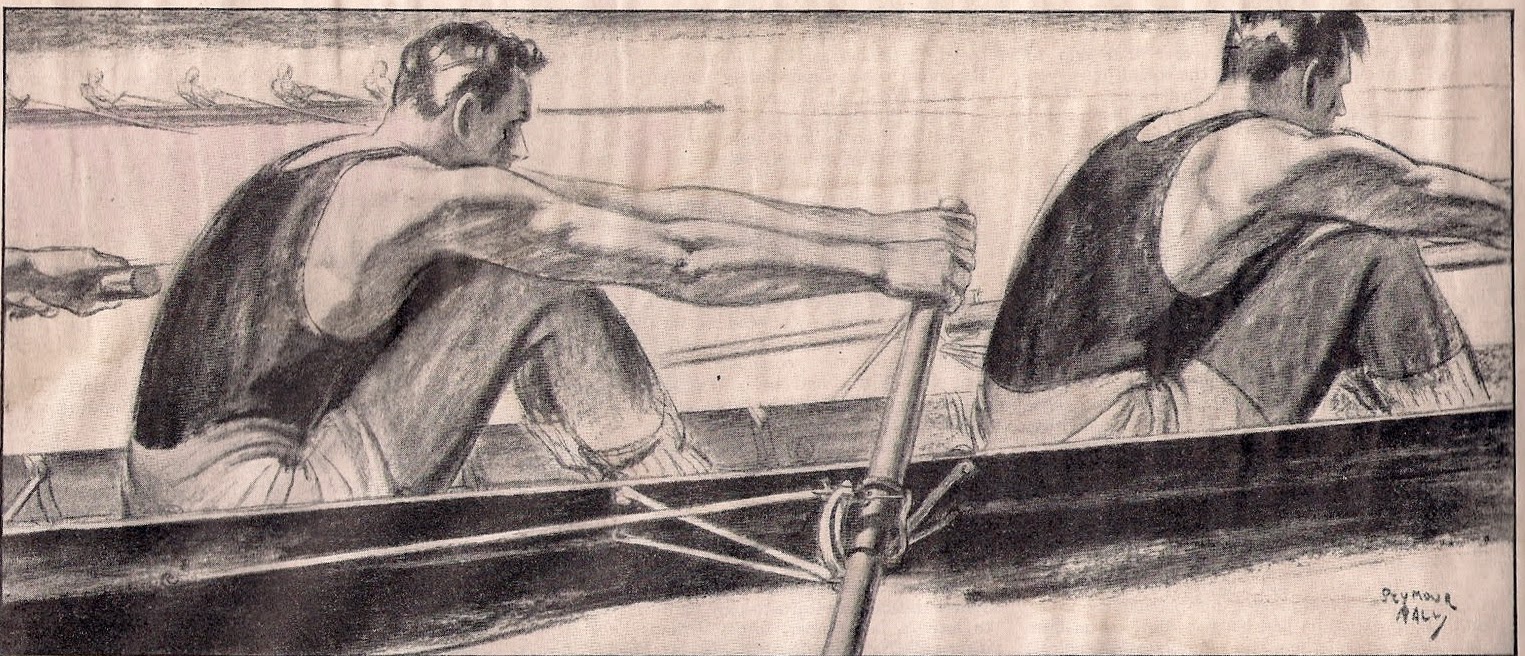
‘The Event From Different Views’, The Illustrated Sporting and Dramatic News, 9 April 1881.

Tim Koch writes:

I discovered long ago that, when following a rowing race in a launch, you can either take notes and produce a written report or you can take photographs, but not both. I took the photo option and have used the results to illustrate selections from Peter McConnell’s excellent Official Race Report (here in italics) published on the Boat Race website.

On an overcast day prone to squalls and with a strong south west wind blowing this was always going to be a test of technique as well as stamina.

On the start, the coxs’ hands raised to show that they are not ready. This picture shows the problem of parallax in photographing a side-by-side race – be assured that the boats were started level!

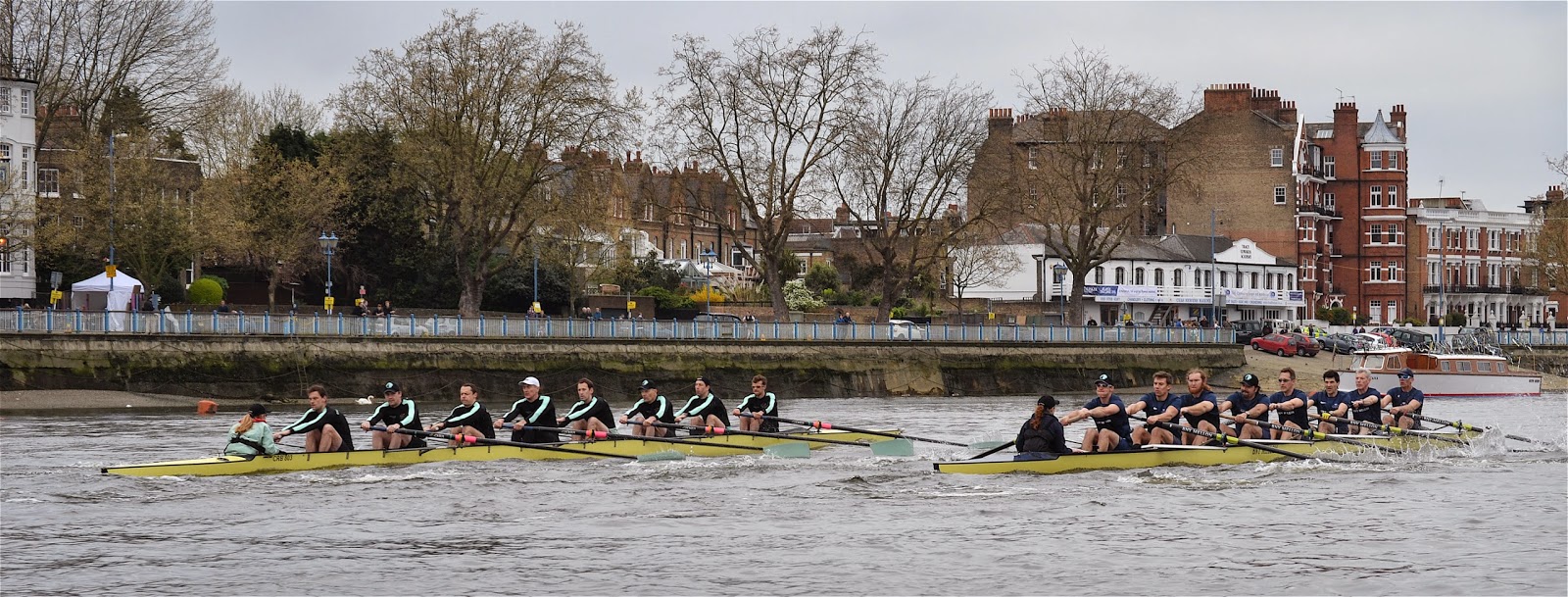
Oxford won the toss and chose the Surrey station which would give them the advantage of the big Surrey bend a third of the way into the Race. Therefore it was Cambridge who would have the early advantage around the Middlesex bend after the end of the Fulham Wall. Off the start both crews sprinted off in the mid 40’s, Oxford taking an early lead.

Seventy five seconds into the race, Oxford lead. The long lens probably exaggerates the closeness of the Oxford ‘7’ blade and that of the Cambridge ‘2’, but the illusion turned real just under four minutes later.

As expected the crews were very close to each other with Cambridge warned by first time Boat Race Umpire Richard Phelps. The Light Blues used the bend to their advantage reeling in Oxford’s lead, hence as they passed the Town Buoy the crews were level.

At Craven Cottage (aka Fulham Football ground) just before Cambridge’s bend advantage ran out.

With both crews at 35 Oxford began to exert their power, pulling out to a 1/3 length lead along the Crabtree Reach.

Approaching the Mile Post.

The crews pictured seconds before ‘the race decider’.

... shortly after the Mile Post, 5 minutes in to the Race, came the moment that effectively settled the result. Phelps had warned Oxford who now had a 3/4 length lead, they responded but Cambridge moved with them and as the Umpire issued a warning to Cambridge the blades of Light Blue 2 man Luke Juckett came into contact with that of Sam O’Connor the Kiwi in the Oxford 7 seat. Juckett was knocked out of his stride, crabbed and was nearly thrown from the boat. Oxford seizing the moment powered away as Cambridge floundered, missing five effective strokes. Worse, Juckett’s rigger was bent meaning his pitch was completely wrong so he could only make a negligible contribution to the speed of his crew.

Juckett’s head goes under.

Juckett emerges from the deep.

Juckett recovers his seat. Bowman Thorpe recovers Juckett’s blade.

Juckett resumes rowing with a gate off pitch and no backstay.

There is ‘only’ fourteen seconds between this picture and the first of this group but this was more than enough time to decide that the race was effectively over.

At Hammersmith Bridge Oxford had an 8 second lead meaning they could choose their own water. They continued to pile on the pressure at a steady 33 strokes a minute and continued to move away from a demoralised Light Blue crew. Even with a strong headwind and rough conditions after Chiswick Eyot, Oxford’s progress was relentless.

At Hammersmith Bridge.

At Chiswick Eyot, approaching Chiswick Steps.

At Chiswick Steps the Oxford lead was 16 seconds over 5 lengths, at Barnes Bridge 28 seconds and at the finish a massive 32 seconds.

Going through Barnes Railway Bridge.

Approaching Mortlake Brewery.

The finish at Chiswick Bridge.

Cambridge cox Ian Middleton raised his hand in protest after the finish but to no avail. Richard Phelps later explained, “I was concerned where Oxford were, so I warned Oxford and they moved immediately. A second later I was happy where the crews were but I then saw the Cambridge bow just twitch-in towards Oxford, so I warned Cambridge. The next thing there was a slight contact but the impact was great.” Talking about the Cambridge appeal he said that “Cambridge’s view was that when the foul occurred Oxford were not on their station. From my perspective Oxford were on their proper station; quite clearly. Contact could only have been in neutral water or at the worst Cambridge were off their station. I advised Cambridge I was overruling their appeal.”

Cox Middleton appeals to Umpire Phelps at the finish.

The luckless Juckett. His broken backstay is clearly evident.

The damage in close up. The pin appears to be upright but it is impossible to tell how much the pitch was out, especially when pressure was applied.

The winning president Malcolm Howard thanked his crew and coach Sean Bowden for an amazing year. He felt the clash but “I don’t think it affected the outcome, we were moving really well, we’d withstood their big push early on and had started to take seats. We were moving on them and would have kept moving.”

Oxford ‘3’ man, Karl Hudspith (right) commiserates with Cambridge bowman, Michael Thorpe (left).

A jubilant Hudspith lifts the Boat Race Trophy. The score now stands at Oxford 78, Cambridge 81 with one dead heat.

On the way back to Putney, a reminder adorning Tideway Scullers’ Boathouse that next year change will come to the 161st Boat Race. In my opinion, this radical move should go further as proper equality will only occur when the men’s reserve race (Isis - Goldie) is moved from the Tideway to the Oxford - Cambridge Henley Boat Races (where the lightweights and remaining women compete) leaving Boat Race Day to the fastest men and the fastest women, full stop. Should anyone complain about ‘a break with tradition’ I would suggest that they fail to understand the paradox that ‘tradition’ can only survive by evolving, not by standing still.  

The race is now on YouTube as is the last Women’s Boat Race to be held at Henley.

Photography © Tim Koch

See also "Images of the 160th Boat Race Part 1: The Prelude".

Friday, April 11, 2014

After the Thaw

After the Thaw

All the way down
from the country
he rode hopeful
past the cold
clear rills, past
creeks afroth with run-off,

toward the bay--
would it be asweep with light,
as he imagined it--
where he would meet the crew
with whom he would become
one of.

With them he would be
the rower he always was,
only more so, once he was
pulling oar in rhythm with them.
If asked, it was this
he would define as love.

Philip Kuepper
(18 March 2014)

Thursday, April 10, 2014

Images of the 160th Boat Race Part 1: The Prelude

‘Humours of the Boat Race’, 1879. Clearly, humour does not age well.

Tim Koch writes:

Other reports on the 2014 Boat Race were rather conventional in that they all came out within hours of the event. Here at HTBS, we like to be different and so have waited several days before putting our take on the day online (nothing to do with me starting a new job). Part 2 will show the race, pictured from my very privileged position in the photographers’ launch.

Putney Embankment, 14.00 (2 p.m.), four hours before the 18.00 (6 p.m.) start. The Putney ‘Hard’ is fenced off to the public.

‘National Treasure’, BBC presenter Claire Balding, manages to get slight smiles out of the normally recalcitrant coaches, Steve Trapmore of Cambridge...

...and Sean Bowden of Oxford.

Oxford’s balcony scene at 15.45 (3:45 p.m.), two and a quarter hours to go.

A young Old Blue (Dark).

Two Old Blues (Light).

Six future Old Blues? Girls from London Youth Rowing sell home made cakes to raise money for new equipment.

The coin toss for stations. Umpire Richard Phelps holds the gold sovereign minted in 1829 (the year of the first race), which was presented to the Boat Race by the late John Snagge.

OUBC President Malcolm Howard flips the coin, CUBC President Steve Dudek calls.

17.05 (5:05 p.m.), Oxford takes to the water.

The Oxford bow man Storm Uru in a reflective mood. The first New Zealand Maori to row in a Boat Race, it is also unusual to find a sculler and a lightweight in the event.

Oxford ‘2’ man Tom Watson, one of many Boat Race oarsman that have originated out of the University of Victoria, British Columbia.

17.14 (5:14 p.m.): The final words of wisdom from coach Bowden are absorbed by cox Harvey and stroke Louloudis. I presume that the reflective band around the cox’s wrist is so that, if he raises his hand on the start to indicate that he is not ready, the umpire will not miss it. While this may not actually be necessary, it is a great attention to detail.

17.15 (5:15 p.m.): Oxford leave for their warm up.

17.15 (5:15 p.m.): Cambridge leave for their warm up.

The view from the photographers’ launch. Leaving the crowds on the Embankment. Old hands said that it was better before the television helicopter hovered noisily overhead when the only noise was the excited murmur of the crowd.

Going through Putney Bridge, away from the start, to await the crews going onto the stake boats.

Ten minutes before the race. Having completed their warm ups, the crews wait downriver, alone with their thoughts.

Six minutes to go. Bowden’s boys pass him on the way to the start.

Cambridge on the stake boat. Only President Dudek (4) finds humour in the situation.

17.57 (5:57 p.m.): On the start. The culmination of 1,200 hours of training. One chance. No second place. 

Photography © Tim Koch

Coming up next – ‘Images of the 160th Boat Race Part 2: The Race’.

Wednesday, April 9, 2014

Katherine Grainger Godmother to Avalon Poetry II

Avalon Waterways recently announced that World Champion and Olympic gold medallist, Dr. Katherine Grainger CBE, has become godmother to Avalon Poetry II, one of three new state-of- the-art river cruise suite ships, which was launched on 22 March.

Katherine Grainger, who won gold in the double sculls together with Anna Watkins at the 2012 Olympic Games and continues to promote the legacy of London 2012, acted as official godmother at the ship christening ceremony in Dordrecht, Holland, on 22 March. Part of a ‘twin christening’ ceremony with sister ship, Avalon Impression, the event took place as the two vessels were moored up alongside each other. The christening formed part of a special four-day inaugural river cruise for both ships sailing from Cologne to Amsterdam.

With VIP guests from the worldwide travel industry and members of the media present, the ceremony was followed by a celebratory champagne reception, dinner and live entertainment with a finale of a fireworks display.

Katherine Grainger, Olympic gold medallist in the double sculls at the London Games, acted as godmother to the Avalon Poetry II when the ship was launched in March.

Before the ceremony, Grainger commented: “I am both honoured and delighted to become godmother to the Avalon Poetry II. It is clear that Avalon Waterways share my passion in creating a winning formula on the water and I am very much looking forward to the christening”.

Alan MacLean, Avalon Waterways’ UK managing director commented: “We are delighted that Katherine is godmother to our latest suite ship Avalon Poetry II and joined us in our celebrations with travel industry partners. Being a world class athlete and having achieved so much in her sport of rowing, Katherine continues to be an athlete ambassador to show others what can be achieved by drawing inspiration from London 2012”.

“We hope that Katherine will enjoy being part of the Avalon experience and experiencing firsthand the high standards we set ourselves in achieving our own excellence on water. We strive to provide our guests with the best river cruise experience possible on board our modern fleet of ships”, MacLean said.

In a press release Avalon Waterways writes that the company will continuing to revolutionise river cruising, and that the new ships will bring the total of suite ships in the fleet to eight, all offering the same state-of-the-art sleek design, spacious suites and high level of service. Each ship features two full decks of ‘Panorama suites’ sized from 200-300 square feet with wall-to-wall panoramic windows that open to create unique ‘open air balconies’, the most spacious river cruising on European rivers – 30% larger than the industry standard. Passengers can look forward to contemporary décor with hand crafted finishes, innovative technologies and well-appointed hotel-style accommodation with the highest level of personal service.

Tuesday, April 8, 2014

Masters of the Boat Race

The start. As in all rowing race pictures taken from the side and astern, the parallax error produces a false picture of the relative positions.

Tim Koch writes:

Recently, rowing in Britain has seen an attempt to change the title ‘veteran’ to ‘master’. This has given rise to some rude and wry comments, but if any group of older rowers deserve to be called ‘masters’, it is the participants in the 19th Oxford - Cambridge Veterans’ Race held on a course from Putney to (just beyond) Hammersmith Bridge on Saturday, 5 April. The minimum age for these Old Blues is 35 with an average crew age of not less than 42. This year, the Cambridge crew contained five Olympians while Oxford boated three including medallists Kieran West, Marc Weber and Barney Williams.

Cambridge Vets. Collective noun: ‘A Tab’. 

Oxford Vets. Collective noun: ‘An Oxonian’.

This is the most relaxed and informal of all the Oxford - Cambridge boat races, either on the Tideway or at Henley, and this is especially evident in the gentlemanly rule that ‘any verdict within six feet shall be declared a dead heat’.

A plot is hatched?

If you don’t know by now.....

Oxford went off the free start high and hard, perhaps a couple of pips higher than the opposition, and quickly got a lead of a couple of seats. Settling well, the Dark Blues increased this to perhaps half a length by the time they passed the OUBC base at Westminster School boathouse. Though Oxford got the first warning off the start, Cambridge got most of umpire Simon Harris’s attention after that. Some put this down to aggressive steering from cox Sarah Smart though she blamed (or maybe thanked) the cross wind.

Approaching Thames RC.

By the end of Putney Embankment there was only slight overlap. Smart later said that when a crew is in this situation, a cox can call for a big push or say ‘just stick in your rhythm, you will come through them, they will break...’ Bravely, she chose the latter. Opposite the football ground there were several clashes, which, in at least one according to umpire Harris, ‘Cambridge lost out’. It looked like the race was effectively over, but things were about to change. Oxford’s ‘high and hard’ start is a dangerous one for a crew not in training and they started to lose pace.

At the Mile Post.

Cambridge kept their rhythm and past the Mile Post they were only a few feet down. Around this point, in the words of cox Smart, ‘we got the sniff and hit our rhythm really strongly...’ The crews drew level just before Harrods and the Light Blues rapidly went a quarter of a length up. Approaching Hammersmith Bridge, Smart said that ‘... just before we were about to break clear, we had stern four clashing and our bow four just put in a massive push and got us clear and once we were clear it was just clean rowing... all the way’.

Nearing the new Harrods development, things started to change.

Cambridge were up by the original Harrods Depository.

Approaching Hammersmith Bridge.

The finish.

Cambridge won by 1 1/4 lengths and the score now stands at thirteen wins to them and six to Oxford. A final thought – with the women racing on the Tideway from 2015, how long before there is a veteran women’s race?

Times:

The Mile Post: Oxford 3m 55s, Cambridge 3m 56s
Hammersmith Bridge: Cambridge 6m 59s, Oxford 7m 03s
Finish: Cambridge 7m 30s, Oxford 7m 35s

Cambridge:
Bow: Tom Middleton
2: Lukas Hirst
3: Paul Wright
4: Kieran West
5: Guy Pooley
6: Dave Gillard
7: Sebastian Schulte
Stroke: Marc Weber
Cox: Sarah Smart

Oxford:
Bow: Nick Holland
2: Donald Macdonald
3: Kingsley Poole
4: Andrew Landon-Green
5: Roberto Blanda
6: Toby Ayer
7: Gerritjan Eggenkamp
Stroke: Barney Williams
Cox: Katie Apfelbaum

Photography © Tim Koch

Monday, April 7, 2014

The 2014 Oxford - Cambridge Boat Race: 'Oo Won?

I love this cartoon from a 1920s edition of Punch as it illustrates the strange fact that a particular university is often supported by people who have no particular love for rowing and have no connection to Oxford or Cambridge. - Dingy Douglas (to partner, just returned from the Boat-Race), " 'Oo Won?" Partner, "Your Lot."

Tim Koch writes:

Most HTBS readers will be aware that Oxford won the 160th Boat Race. I never give my analysis of this event as there are many better qualified people who will be far more illuminating about it than I ever could (notably Rachel Quarrell in the Telegraph, Christopher Dodd on Rowing Voice and Peter McConnell on the Boat Race website). My custom is to give the ‘HTBS angle’ on the day and this year I saw it from a very special angle indeed. I had the great honour and privilege getting a place in one of the press launches and saw the whole event from the Surrey station in a position slightly astern of the umpire. Four hours later, I still feel like a small child who has had too much sugar. This excitement is tinged with some sadness that it was not a clean race and that there was a clash, a crab and a damaged rigger. This probably did not change the final result but no one wants a Boat Race to effectively end like this. This year's 6 o'clock start means that it is ten o'clock as I write this. Normally I would ‘blog’ (if that is a verb) into the night to produce a post but, in eleven hours time, I start a new job. I suppose that I should stay wake for the first day at least so I that I will attempt a few posts spread over the next few days. Apologies for this but here are a couple of things to be going on with. There is a nice BBC video online entitled ‘Boat Races that did not run smoothly’ (for UK viewers only) and here is the moment that I captured Luke Juckett, the Cambridge ‘2’, with his head and shoulders tipped underwater following a clash of blades.

Juckett’s nightmare – and probably not his (or anyone’s) fault. Photo © Tim Koch.

Oxford:
Mile Post 3.47
Hammersmith Bridge 6.48
Chiswick Steps 10.59
Barnes Bridge 15.18
Finish 18.36

Cambridge:
Mile Post 3.44
Hammersmith Bridge 6.56
Chiswick Steps 11.15
Barnes Bridge 15.46
Finish 19.08

Official verdict 11 lengths.

Sunday, April 6, 2014

Fun Stuff!

2013 Winners, the Dark Blues - who will win this year?

So, while you are waiting for the Oxford and Cambridge Boat Race, or as it's also called, The Mellon Boat Race, which starts at 5.55 p.m., here is some fun stuff - 'Which Blue Are You?'