Saturday, April 5, 2014
Images from Tideway Week
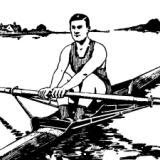
How they train for the Great Boat Race – 1910.
In the week preceding the Oxford - Cambridge Boat Race, the crews, coaches and support staff move to residences near Putney to train daily over the course. By this stage of their training, the hard work is done and the work is light and technical. It is an opportunity for the coxswains especially to hone their knowledge of the course. It is also during this week that the rowing and non-rowing press start to write about the race and all concerned get very used to having their photograph taken at every opportunity. In these days of sponsorship and PR, the coaches reluctantly but dutifully attempt to answer questions (though without actually saying anything beyond that they are well prepared and confident). A report on the Friday Press Conference is on the Boat Race website.
The more things change, the more they stay the same.
Putney Embankment 2014.
Putney Embankment 1882, the Hanlan – Trickett race.
Mr. Trapmore coaching Cambridge, 2014.
Mr. Muttlebury coaching Cambridge, 1892.
Ladies and Gentlemen of the press, 2014.
Gentlemen of the press, 1880.
Practice at Putney, 2014.
Practice at Putney, 1877.
Images of Oxford.
Oxford are based at the Westminster School Boathouse (with ‘JH Clasper’ on the gable end). They are flying their dark blue flag while next door, Crabtree (Cambridge alumni) flies the light blue of Cambridge and the gold of Goldie.
Coach Sean Bowden gives good advice passing Barn Elms.
Passing Harrods.
Approaching Hammersmith Pier.
Nearly home. Approaching Putney Bridge.
Capturing Cambridge.
Hammersmith Bridge
Nearing Harrods.
Near Barn Elms.
Helge Gruetjen (5) and Matthew Jackson (6).
A last burst before going in.
The view from the Media Centre (aka Thames Rowing Club).
Caught from the balcony of Thames RC - the ‘Spare Men’s Race’. In my recent report on the Henley Boat Races, I said that there were nine Oxford - Cambridge Boat Races (vets and men's and women's Blue boats, reserves, lightweights and Head of the River crews). I forgot this event - which makes it ten. The veteran women will be the next addition I suppose.
The Cambridge Press Conference.
The 2014 Umpire, Richard Phelps, in front of a picture of his grandfather, Dick Phelps, who won Doggett’s in 1923.
Friday, April 4, 2014
The Mysterious Affair of 'Les Braves Belges'
Postcard correctly identifying the 1907 winners of The Grand Challenge Cup.
HTBS's Agatha Christie, aka Greg Denieffe, writes:
Hercule Poirot is in his office sitting at his desk. In front of him is a strange contraption at which he is staring. It is the latest computer, the RAM-ING Speed 4X. There is a knock on the door.
Poirot: Come in, Come in.
Hastings enters and is surprised with Poirot’s demeanour.
Hastings: What’s the matter Poirot? Are you okay?
Poirot: Nothing is the matter mon ami, quite the contrary. Come and see this … this thing on my new computer. It is a ‘blog’ called ‘Ear Ze Boat Sing. I have been working all night to help these poor fellows identify the first ‘Vainqueurs’ whom I am proud to call ‘mes collègues Belges’.
Hastings: Are you sure you are okay Poirot?
Poirot: Ah, my little English friend – I see you are still upset about the results of Le Grand Challenge Cups of 1906, 1907 and 1909. Now, let me tell you what I have found out about ‘Les Braves Belges’.
Sport Nautique de Gand boathouse from 1906 to c.1960.
According to my good friend Jan Martens, one of Ghent’s rowing clubs was founded in 1883 as Sport Nautique de Gand (SNG). The club started out modestly but four years later was a founding member of the Belgian Rowing Federation (BRF). In 1898, their first flag, in their new colours of blue and white, was presented to the club (the initial club colours were black and white). Two years later a different flag, light blue with white lettering “Sport Nautique de Gand 1883” was adopted at the request of the BRF in order to differentiate the club from the local Cercle des Régates. Around 1890 SNG had become the foremost rowing club in Belgium and international successes would follow.
A royal appellation was granted in 1907 after a resounding victory at Henley. Use of the French language was a sign of the times and the club became ‘Société Royale de Sport Nautique de Gand’.
After the Second World War, the club was active in promoting the Watersportbaan, finished and dedicated in 1955. In 1964, a new name was adopted, Koninklijke Roeivereniging “Sport Nautique” Gent, and put on the new flag presented in 1971; three years later, the current name, Koninklijke Roeivereniging Sport Gent, now completely in Flemish, was introduced.
And yes Hastings... I have found photographs of these fine fellows, take a look. What a beautiful moustache has Monsieur Van der Waerden.
Winners of the Grand Challenge Cup 1906.
Official result of the final: Club Nautique de Gand, Belgium, beat Trinity Hall, Cambridge, by three lengths – time 7 minutes, 9 seconds.
Équipage: Urbain Molmans, Albert Heye, Alphonse Van Roy, Guillaume Visser, M. Orban, Réme Orban, Oscar de Somville, Rodolphe Poma (stroke), Raphael Van der Waerden (cox)
Above is another photograph of the 1906 ‘Grand’ winning crew. Was this really a composite crew of ‘Club Nautique’ and ‘Sport Nautique’ as the postcards suggests?
Winners of the Grand Challenge Cup 1907.
Official result of the final: Sport Nautique de Gand, Belgium, beat Christ Church, Oxford, by one length – time 7 minutes, 31 seconds.
Équipage: P. de Geyter, Guillaume Visser, Urbain Molmans, Alphonse Van Roy, François Vergucht, Polydore Veirman, Oscar de Somville, Rodolphe Poma (stroke), Rodolphe Colpaert (cox).
Despite the official result, this postcard gives the 1907 winners as Sport Nautique & Royal Club Nautique de Gand. The royal appellation applying to the official winning club from the previous year.
Two postcards with the winners of the Grand Challenge Cup 1909.
Official result of the final: Royal Club Nautique de Gand, Belgium, beat Jesus College, Cambridge, by one length – time 7 minutes, 8 seconds.
Équipage: Urbain Molmans, Guillaume Visser, St. Kowalski, Réme Orban, François Vergucht, Polydore Veirman, Oscar de Somville, Rodolphe Poma (stroke), Alfred van Landeghem (cox).
Both these postcards identify the 1909 vainqueurs as Royal Club Nautique & Royal Sport Nautique de Gand, the royal appellation now applying to both clubs.
According to Peter Mallory in The Sport of Rowing (2012), writing about the resounding victory of the Belgians (Club Nautique de Gand) in 1906:
The Ghent Eight were led by the dominant international sweep rowers of their day, Guillaume Visser and Urbain Molmans. Before rowing 4 and bow in the winning Grand Challenge Cup Eight at Henley in 1906, Visser and Molmans had rowed to Gold in the coxed-pairs, coxed-fours and eights at the European Championships in 1903, Silver in the coxed-pairs and Gold in the coxed-fours and eights in 1904, along with Gold in the coxed-pairs and coxed-fours and Silver in the eights in 1905.
So, Hastings you can see that there is a mystery to be solved.
Hastings: What mystery is that exactly, Poirot?
Poirot: It was not until 1970 that the venerable Stewards of Henley Royal Regatta changed the rules to allow composites to compete in the Grand Challenge Cup. Did the equally venerable gentlemen of Ghent find a way around this rule? I think so. You see Hastings, Visser and Molmans were docks foremen and members of Sport Nautique de Gand.
Hastings: I say Poirot, that’s just not cricket!
Poirot: Perhaps not Hastings, but I do not think a crime has been committed because in 1906 they must also have been members of Club Nautique de Gand – at least for HRR entry purposes. And, of course, in the following year the entry was made in the name of Sport Nautique de Gand. And yet again, in 1909, the Ghent entry was back in the name of Club Nautique de Gand, which by then was ‘Royal Club Nautique de Gand’. The photographs and postcards do not lie but they do not tell the whole truth.
Hastings: Of course! They rowed under ‘a flag of convenience’. But what happened to them in 1908? I know that the Stewards introduced a rule change excluding overseas entries from the regatta that year owing to the Olympic Regatta being held in Henley in mid-July. Surely, they represented Belgium at the Olympics?
Poirot: Ah! Hastings, is that the time? I must leave straight away for a meeting with Chief Inspector Japp. Perhaps another time, yes? Au revoir.
Hastings (an old Etonian) is determined to find out what happened in Henley-on-Thames at the 1908 Olympic Regatta and decides to use Poirot’s computer. Initially he is foiled by the demand for a password, but eventually he types in felicity4me and sure enough it works! He finds that Great Britain was represented by Cambridge University BC and Leander Club, and it was the latter that beat Belgium, represented by Royal Club Nautique de Gand, to win the gold medal in the eights.
Great Britain leads Belgium over the finish line to win gold at the 1908 Olympic Games in Henley-on-Thames.
There are reports on all the eights’ races at the 1908 Games here.
The 1908 Belgian crew was Oscar Taelman, Marcel Morimont, Rémy Orban, Georges Mijs, François Vergucht, Polydore Veirman, Oscar De Somville, Rodolphe Poma, Alfred van Landeghem (cox).
An analysis the Belgian crews who raced at Henley between 1906 and 1909 prove that ‘Club de Gand’, ‘Sport de Gand’ and the ‘Belgian Olympic eight’ bore remarkable similarities. Of the 15 rowers used in the four years, seven men raced in three or more years, while Oscar De Somville (7) and Rodolphe Poma (stroke) raced in all four years. It is also noteworthy that De Somville and van Landeghem were Olympic silver medallist in the eights in the Paris Games in 1900.
Crews 1906, 1907, 1908 and 1909:
Urbain Molmans: HRR 1906 (Bow) – HRR 1907 (Three) – Olympics 1908 (NA) – HRR 1909 (Bow)
Albert Heye: HRR 1906 (Two) – HRR 1907 (NA) – Olympics 1908 (NA) – HRR 1909 (NA)
Alphonse Van Roy: HRR 1906 (Three) – HRR 1907 (Four) – Olympics 1908 (NA) – HRR 1909 (NA)
Guillaume Visser: HRR 1906 (Four) – HRR 1907 (Two) – Olympics 1908 (NA) – HRR 1909 (Two)
M. Orban: HRR 1906 (Five) – HRR 1907 (NA) – Olympics 1908 (NA) – HRR 1909 (NA)
Remy Orban: HRR 1906 (Six) – HRR 1907 (NA) – Olympics 1908 (Three) – HRR 1909 (Four)
Oscar De Somville: HRR 1906 (Seven) – HRR 1907 (Seven) – Olympics 1908 (Seven) – HRR 1909 (Seven)
Rondolphe Poma: HRR 1906 (Stoke) – HRR 1907 (Stroke) – Olympics 1908 (Stroke) – HRR 1909 (Stroke)
Raphael Van der Waerden: HRR 1906 (Coxswain) – HRR 1907 (NA) – Olympics 1908 (NA) – HRR 1909 (NA)
P. de Geyter: HRR 1906 (NA) – 1907 (Bow) – Olympics 1908 (NA) – HRR 1909 (NA)
Francois Vergucht: HRR 1906 (NA) – HRR 1907 (Five) – Olympics 1908 (Five) – HRR 1909 (Five)
Polydore Veirman: HRR 1906 (NA) – HRR 1907 (Six) – Olympics 1908 (Six) – HRR 1909 (Six)
Rodolphe Colpaert: HRR 1906 (NA) – HRR 1907 (Coxswain) – Olympics 1908 (NA) – HRR 1909 (NA)
Oscar Taelman: HRR 1906 (NA) – HRR 1907 (NA) – Olympics 1908 (Bow) – HRR 1909 (NA)
Marcel Morimont: HRR 1906 (NA) – HRR 1907 (NA) – Olympics 1908 (Two) – HRR 1909 (NA)
Georges Mijs: HRR 1906 (NA) – HRR 1907 (NA) – Olympics 1908 (Four) – HRR 1909 (NA)
Alfred van Langehem: HRR 1906 (NA) – HRR 1907 (NA) – Olympics 1908 (Coxswain) – HRR 1909 (Coxswain)
St. Kowalski: HRR 1906 (NA) – HRR 1907 (NA) – Olympics 1908 (NA) – HRR 1909 (Three)
(Errors and omissions excepted.)
The defeat of the Belgians in the final of the Olympics, which earned several of their members a silver medal, did not merit a mention on the menu of the Banquet held by Royal Club Nautique de Gand to celebrate the club’s achievements during the 1908 season. Six men were elected as ‘membres emerites’ and from this we can identify that Messrs Kowalski, Morimond, Poma, Taelman, Veirman and Vergucht were ‘Club’ men.
Polydore Veirman, the six-man of the 1907, 1908 and 1909 crews featured on the cover of the 1911 menu after claiming the sculling championship of Belgium. He also took a silver medal in the single sculls at the 1912 Olympic rowing in Stockholm.
Poirot never found out that Hastings had cracked his computer!
Thursday, April 3, 2014
The Secret Supporters of the Boat Race
Hannah Gates's book The Secret Supporters of the Boat Race.
A new book has just been published about the Oxford and Cambridge University Boat Race. HTBS’s Hélène Rémond took a closer look at the book and asked the author, Hannah Gates, a couple of questions. Hélène writes:
Who are the secret supporters of the Boat Race?
You will get the answer if you read the first children’s book about the Boat Race, The Secret Supporters of the Boat Race, which is written, illustrated and produced by Hannah Gates, who graduated from London College of Fashion in 2008 with a degree in Fashion Photography.
Set during the 2003 Boat Race, which the Dark Blues won by a foot, the book captures the passion of the Oxford University BC, while providing a thrilling education for kids about the wildlife by the Thames.
‘Who knows, maybe it will inspire a few future rowing champions’, says Hannah. The book, aimed at 4- to 6-year-olds, tells the story of how the animals on the banks of the River Thames learn about the upcoming Boat Race, how they follow it and then celebrate the race.
‘How did you get the idea for the book?’
‘What spurred me on specifically was my partner, Robin Bourne-Taylor. He rowed for Oxford four times in some incredible races, as well as arguably one of the best ever crews when he was President in 2005’, says Hannah. ‘He was in the GB squad for many years and competed in the 2004 and 2008 Olympics as well as in various world championships. With some of his friends still rowing, and all of them still loyal in particular to the institution that is the University Boat Race, it inspired me to create this book. Moreover, a lot of them are having babies’, explains Hannah.
Hannah Gates grew up in Cambridge, spending a lot of time in the Zoological Department at the University and walking along the River Cam. She now lives in Ghana with Robin. Hannah is working as an equine and child photographer, as well as in branding and advertising. She has been a teaching assistant and private tutor.
‘You have produced the book yourself?’
‘Publishers were very keen on the illustrations, but didn’t want to risk investing in such a niche topic,’ Hannah says. ‘Obviously, I was not going to change the plot, but as a result I needed to fund the project myself. Therefore, I have promoted it as much as I can with the help of rowers, and I am inviting people to order copies by emailing a special account’.
You can order a copy of The Secret Supporters of the Boat Race by sending an e-mail to boatracebook@gmail.com (10 pounds excluding postage). Hannah is planning to produce more copies of her book, and many orders are likely to come in this Boat Race week. Book orders made now will be delivered in May.
Follow Hannah on Twitter @RowingBook and get more information on her website: www.hannahgatesphotography.co.uk
Wednesday, April 2, 2014
The Mystery of ‘The Silver Man’
Any idea about the background of this rowing trophy?
Now and then, HTBS receives e-mails from readers or others who have come across the blog. Some of these messages are from people who have questions on a topic related to our beloved sport. The other day, HTBS received an e-mail from Desmond in Dublin who has a lovely rowing trophy that he would like some help identifying. Maybe there is someone out there who can tell him (and the rest of us) what he has in his possession?
Desmond writes:
‘You may be able to help me identify a Victorian trophy? It has been in our family home for over 60 years, though we have no connections to the sport of rowing. This trophy is called ‘the silver man’ and stands 33 inches tall from the base to the tip of the oar. It’s Victorian judging by the dress code of the oarsman and the fine detail and the size. I suspect that the trophy may have originated in the UK or Ireland or the colonies (commonwealth) as the previous custodian may have been the recipient. He was an officer in the British Army. I came across your blog and perhaps you or your followers could shed some light on the mystery.’
We will certainly try, Desmond. On top and below are some photographs of the trophy. If you have any ideas, you may send your answers to: gbuckhorn – at – gmail dot– com and we will post your answers on the blog.
Thank you ~ Göran R Buckhorn
Tuesday, April 1, 2014
Putting It On The Tab: Credit To Oxford Women
Henley’s most famous woman, a marble nymph, observes the Henley Boat Races from under her cupola on Temple Island.
Tim Koch reports from the Oxford - Cambridge ‘Henley Boat Races’.
When most people talk of THE Oxford - Cambridge Boat Race, they are usually referring to the event first rowed in 1829 and which nowadays is the race between the top heavyweight men of Oxford University Boat Club and of Cambridge University Boat Club over the 4 1/4 mile Putney to Mortlake Course on the Thames in London. However it is (arguably) correct to say that today there are in fact nine Oxford - Cambridge Boat Races.
The second race started in 1965, 136 years after the first, when the men’s heavyweight reserves (Isis/Oxford and Goldie/Cambridge) raced each other over the Tideway Course, shortly before the main event.
The only other Dark Blue - Light Blue clash on the Tideway is the Veterans’ Race which is run over a shortened course, Putney to Hammersmith on a day in the week before the main race. It is the ‘least serious’ of the nine races with victory usually going to whoever managed to organise a few practice rows beforehand. It is also an historic parade of past sponsors’ kit (much of which seems to have shrunk over the years).
The other six races have been held at Henley and the ‘2014 Henley Boat Races’ took place on Sunday 30 March. The main event was the (heavyweight) Women’s Boat Race. The others were the heavyweight Women’s Reserves (Osiris/Oxford - Blondie/Cambridge), the Lightweight Women and the Lightweight Men. There were also the two newest races involving the men and the women who are the current holders of the Headship of the Lent bumping races in Cambridge and of the Torpids bumping races in Oxford. A nice video promo for the Women’s Boat Race is on YouTube:
(It could be argued, though not by me, that there are really ten events if you include the Oxford - Cambridge Goat Race.)
Cambridge supporters decorated Henley Bridge with ‘inspirational’ banners. Tamesis looks as though he has seen it all before.
As someone who was supposed to be covering these races for HTBS, I was a bit of a failure. I missed the first race, Osiris v Blondie, while I was sorting out camera trouble. The other races proved difficult to follow due to the density of the crowds lining the course which started at Phyllis Court, near the Royal Regatta finish, and ran 2,000 metres to half way along Temple Island, near the HRR start. It was unfortunate that, as the crews had to pass on the Bucks side of the Island, the finish was out of sight of all but a privileged few. I would have though it better to run a slightly shorter course and finish in sight of the spectators. However, full marks to sponsors Newton for generating enough excitement to draw such a large crowd (aided by the exceptionally warm weather). The ‘unique selling point’ of the 2014 Henley Boat Races was that this was the last year that the heavyweight women would race there, as they will be joining the men on the Tideway in 2015. This has got some interest from the non-rowing press and one of the better resulting articles is in the Telegraph.
Young spectator Jess shows her support.
Luckily, more talented people than I managed to see what was happening and links to their work are below. Also included are YouTube links to excellent coverage of the Women’s Boat Race and the Osiris - Blondie Race. In summery, the results were as follows:
Heavyweight Women - Oxford 4 lengths, 5 minutes and 50 seconds.
Reserve Heavyweight Women - Oxford 1/2 a length, 6 minutes and 1.5 seconds.
Lightweight Women - Oxford 3 1/2 lengths, 6 minutes and 8 seconds.
Lightweight Men - Cambridge 3 1/2 lengths, 5 minutes and 30 seconds.
Intercollegiate Men - Downing College, Cambridge.
Intercollegiate Women - Wadham College, Oxford.
In the absence of real words, I hope that my pictures paint a thousand of them.
Blondie return from their defeat by Osiris. I presume that ‘four’ had an oar during the race.
The start of the Women’s Lightweight Race. Cambridge were up at the start but it was not to last.
Men’s Lightweights: Beginning.
Men’s Lightweights: Middle.
Men’s Lightweights: End.
The Newton Women’s Boat Race: Oxford approach the (hidden) finish half way down Temple Island. Their four length lead meant that I could not get both crews in the same picture!
The Newton Women’s Boat Race: Cambridge follow in the Dark Blue wake to the finish.
Returning from the finish, Oxford, winners of the Women’s Boat Race, pause for a photo opportunity by the Temple.
The defeated Cambridge crew return to the boathouse.
The prizes were presented by Olympic Gold Medalist, Sophie Hosking (right). Here, Oxford University Women’s Lightweights receive their prize.
The Cambridge Lightweight Men salvage some honour for the Light Blues.
Osiris add to Oxford’s silverware collection.
A jubilant Oxford plus coach Christine Wilson (with trophy) do not have to try too hard to smile for the cameras.
Oxford shake it up. Please note, with the exception of when you have won a major sporting event, the removal of a Champagne cork should only produce a noise described by my grandfather as ‘'a maiden’s sigh'’ (not these maidens, obviously).
Teamwork. OUWBC President Maxie Scheske, reluctant to let go of the trophy in her left hand, gets some assistance to lift what may have been the first of many bottles of Champagne.
If you take two small people, get them very excited, fill them with Champagne and throw them in the river, this is what you get. Osiris cox Olivia Cleary, left, and OUWBC cox Erin Wysocki Jones, right, huddle together for warmth.
Rachel Quarrell’s report for the Telegraph is here. She concludes:
The job now for both women’s clubs is to raise their standard again before next year, when their race will join the men’s on the Tideway over a full 4.25 miles. The distance itself is not a problem for women, but spectators, sponsors Newton and the BBC, who have just signed a new deal to televise the races until 2021, will all be hoping for a contest which lasts considerably longer in what is likely to be a 19 - 20 minute event.
Rachel’s pre-race report is also online. The Boat Race website has its official report and nice videos of both of the Newton sponsored races are here for Oxford - Cambridge and here for Osiris - Blondie.
The flag is lowered to half-mast for Cambridge Women’s rowing? Well, no, but it must feel like it for them.
On the same day, Sunday 30th March, the Veterans’ (Masters’) Head of the River Race took place on the Tideway. Following the abandonment of the (younger men’s) Head the previous day due to a number of ‘sinkings’, there was obviously much concern about an event for perhaps less resilient participants. In the end, the event managed to run from start to finish and without major incident. However, I received this from a participant:
The tide turned late (as expected) so lots of people didn’t know where they should be, so marshalling was chaos – the river between the Black Buoy and the Crabtree was jammed solid with boats. Then the flood tide heavily favoured the crews at the back – the provisional results are hilarious 4 out of the top 50 start crews finished in the top 50 (Monmouth who had start number 21 and finished first actually started in position 209). We had a great row though and it was lovely weather so all good fun!
To be fair to the organisers, they say:
This year’s overall Vets Head results were severely impacted by the effects of the tide. We realised several weeks before the event that the scheduled start time was too early and that the low tide was going to be later than we originally calculated. After discussions with the Port of London Authority over the river closure, they insisted that the original Notice To Mariners could not be changed. We shifted the start to be as late as that window allowed. Additionally, after the cancellation of yesterday’s HoRR, we could not risk the safety of our competitors and officials by holding marshalling crews any longer before we actually started the race. The end result is that the later you started the more assistance you got from a very strong flood tide.
They should have held it in Henley!
Monday, March 31, 2014
2014 World Rowing Cup in Sydney
![]() |
| Women's 1x winner: Emma Twigg. |
For full results in Sydney, click here.
To watch videos of the races, click here.
For a full race report, click here.
Subscribe to:
Posts (Atom)


.jpg)