Wednesday, September 8, 2010
Rowing Trophy: Lost And Found, And 'Stuck'...
What I should have mentioned in my previous entry about lost and found rowing trophies is the remarkable story about the Philadelphia Challenge Cup. As a matter of fact, I have briefly talked about this trophy in an earlier entry on 15 November 2009, "The Philadelphia Challenge Cup". Click on the date above, and then follow the other links to essays and newspaper articles on this Cup and its fascinating story about being lost, found, and 'stuck' in a shop, which owner refuses to part from it!

Tuesday, September 7, 2010
Rowing Trophy: Found And Lost...
The other day I read a nice article from the Liverpool Daily Post about a 22-year old student, Simon Parkinson, who had found a Victorian silver trophy at Battersea market. Parkinson realised that it was an old rowing trophy and, as he is a collector of silverware and his parents and sisters are members of the Runcorn RC, he bought it for £8. After a good cleaning, he could read the engraved text: “Mersey Rowing Club, Captain’s Pairs, Sept 5, 1891, W T Wood, J Snape, Stroke”.
When members of Runcorn RC went to a fundraiser event at Mersey RC, they brought the Victorian trophy along, and to make a long story short, the race has now been revitalised. To read the full article, please click here.
 After reading this nice story I came to think about a very beautiful trophy that my Swedish rowing club, Malmö Roddklubb, used to be the owner of, the Nordic Rowing Federation’s Championship Trophy for Eights, which was instituted in 1911 (seen on the right). After several victories when crews from my club, trained by Jack Farrell of London RC, became Nordic champions, my rowing club became the owner of this gorgeous pot in the 1910s.
Then, during the 1980 and 1990s the club house was struck by burglaries. The club’s collection of medals and trophies were locked up, but as the club’s committee was afraid that we would maybe lose these prizes, the committee decided to let the little sport museum in Malmö have them on a loan. A short time afterwards, the Nordic Rowing Federation’s Championship pot was stolen from the museum! Thereafter, it was sold at an auction in Stockholm, and sadly, vanished into thin air.
Perhaps, some decades from now, it will show up in a bric-a-brac sale…
Saturday, September 4, 2010
Wisdom Of An Ocean Rower
 An event that is ending the Coastweeks Regatta on Sunday 19 September is a talk by Tori Murden McClure, author of A Pearl in the Storm, which has been picked as this year’s ‘One Book, One Region’. This reading programme is to “bring people together to discuss ideas, to broaden the appreciation of reading, and to break down barriers among people,” Betty Ann Reiter, Groton Public Library Director and chair of the programme, said the other day in an interview in one of the local papers.
In 1999, McClure became the first women to row across the Atlantic, and this book tells the story how she did it. I have earlier written about this book in an entry on 1 May.
McClure’s talk is going to be held at 5 p.m. in the River Room at Latitude 41 Restaurant at the north end of Mystic Seaport Museum, free a of charge.
Click here to watch a trailer for A Pearl in the Storm.
Friday, September 3, 2010
A Wingfields Sculler's 'Pilot Boat'
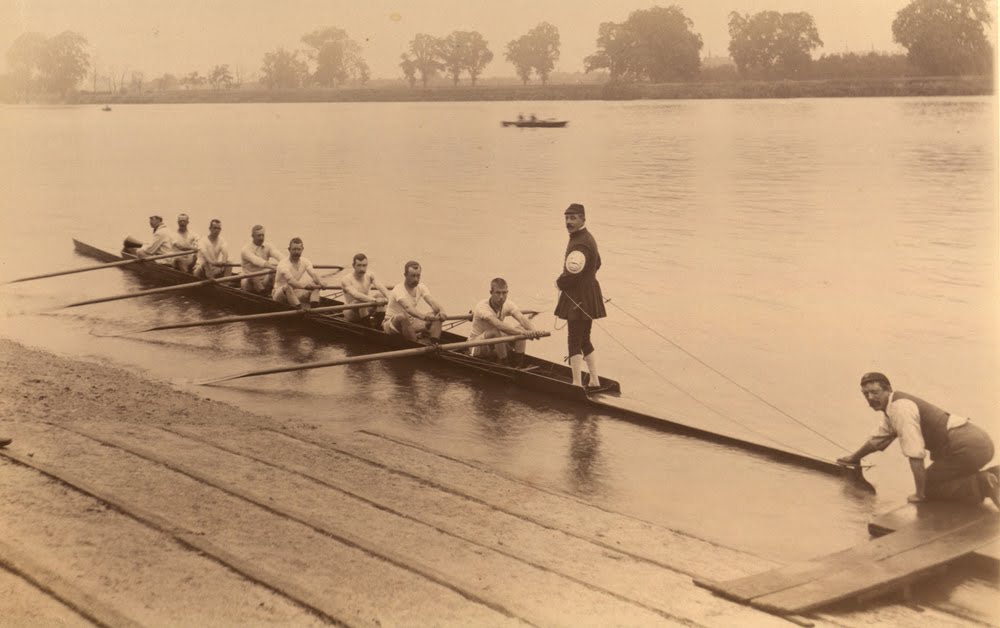 Courtesy The National Rowing Foundation
In HTBS correspondent Tim Koch excellent report on the Wingfield Sculls (see entry on 26 August, “Anna and Alan Take the 2010 Wingfields”) he writes, “One of the idiosyncrasies of the Wingfields is that the competitors can legally be ‘steered’ by signals from following boats. Until at least the 1920s this was done by the bowmen of following eights, not rowing and facing the wrong way.”
As this might be a little confusing for some readers, allow me to give you an example, a photograph from the 1898 Wingfields, when Harry Blackstaffe (Vesta RC) met the upcoming sculler Hunting Howell (Trinity Hall, Cambridge). A few weeks earlier, young Howell (in articles and reports always referred to as ‘B.H. Howell’) had easily over-come Blackstaffe in the Diamonds Sculls at Henley. Although, Howell also beat the sculler from Vesta RC in the Wingfields that year, it was not with the same ease.
The interesting photograph on top, which is from Hunting Howell’s private photo album, now kept in The National Rowing Foundation’s archives at Mystic Seaport Museum in Connecticut, shows Howell’s ‘pilot boat’: seven oarsmen, one Doggett winner coxswain, and the ‘pilot’ in the bow seat, facing forward. In a couple of minutes he is going to steer Howell over the Championship Course from Putney to Mortlake.
(I am hoping to have an article published in Rowing & Regatta later this autumn about Hunting Howell, who was from New York. He took up rowing and sculling when he was studying at Trinity Hall, Cambridge in the late 1890s.)
Thursday, September 2, 2010
Not A Rowing Book
 The reason Gail Caldwell’s book Let’s Take the Long Way Home caught my eye was because the free paper Book Page (August 2010) had a cover story about the book. The cover picture, symbolizing the book, was of two women rowing in a double scull. Reading the Book Page interview, I quickly understood that this is not a ‘rowing book’, but a memoir of the friendship between Gail Caldwell and Caroline Knapp. Not only did these ladies had writing in common, but also the love of books and dogs, and water, as Caldwell swam and Knapp rowed; they also united in having a drinking past.
Even if there seem to be episodes in the book where Knapp takes Caldwell sculling on the Charles River in Boston, this is not a book for me. However, for you readers who would like to make up your own minds, here is the review of the book in The New York Times (22 August 2010).
Wednesday, September 1, 2010
Pocock Newsletter
 Pocock Racing Shells Newsletter for this autumn is now available on-line. There are a lot of interesting things to read about. Go to it by clicking here.
Tuesday, August 31, 2010
Mystic Weekend Of Rowing 2010
 For many younger and older rowers in the southern parts of New England the Coastweeks Regatta on the Mystic River is the start of the autumn rowing and racing season. The 19th annual Coastweeks Regatta will be held on Sunday 19 September at Mystic Seaport Museum in Mystic, Connecticut.
Rowers of all ages and capabilities are welcome to participate on the 2,000-metre long course from the start north of the I95 Highway Bridge rowing downriver to the finish line at the museum’s North End. There are races for singles, doubles, coxed fours, and quadruple sculls for Youths, Open Class, Masters, and Veterans. For more information and to register please click here.
The day before, on Saturday 18 September, the 8th annual Battle Between The Bridges Invitational Regatta will take place in Mystic. The participants – all top elite U.S. scullers – will row an almost 500-metre course just north of AMTRAK railroad bridge upriver to the drawbridge in the historical downtown of Mystic. Good places to watch these sprinter races are the lawn outside the Mystic Art Center or the Mystic River Park.
To read last year’s HTBS report, please click here. Both these rowing events are part of what popular is called the Mystic Weekend of Rowing, MWOR.
Monday, August 30, 2010
FISA Survey
If you are a rower, The International Rowing Federation, FISA, would like to have your help. FISA has a survey on its website where Matt Smith, FISA Executive Director, is asking you to fill out an on-line questionnaire. He writes,
 “In view of adjusting to the rapidly changing and increasingly challenging global environment, World Rowing, the media and marketing arm of the international governing body of rowing, has been conducting a full internal review of the sport in all its form, the events and the organisation.
Now, we would like to broaden this review by asking our wider rowing audience to contribute to the process.
We would be grateful if you could take the time to fill out our on-line questionnaire; it should not take more than fifteen minutes to complete. Please be forthright and honest. Your views will be extremely valuable in helping us to shape the future of World Rowing.
Thank you very much in advance, for your valuable time and input.
Yours, Matt Smith, FISA Executive Director”
Go to the survey by clicking here.
Sunday, August 29, 2010
Steve Gladstone New Yale Coach
 Yale Bulldogs, the official site of Yale University Athletics, writes that Steve Gladstone, one of the U.S.'s most famous rowing coaches, has been appointed new coach for Yale Heavyweight Crew. It will be very interesting to see if Gladstone, who has 11 IRA championships under his belt, will manage to rock the Yale's heavyweight's boat first over the finish line in their annual battle against Harry Parker's Crimsons crew. Read the Yale Bulldogs article here.
Saturday, August 28, 2010
Wingfields' Champions
 Above is a nice photograph of this year's winner of the men's Wingfield Sculls, Alan Campbell, and his coach and trainer, Bill Barry. This was Campbell third Champion title in the Wingfields, as he also won in 2006 and 2009. Barry, on the other hand, became Champion in the Wingfields in 1963, 1964, 1965, and 1966. (HTBS's Tim Koch took the photograph.)
Computer problems
Dear HTBS readers - it seems some of you had a problem earlier reading Tim Koch's report from Thursday of this year's Wingfield Sculls. I apologise, some 'junk', bad codes etc., put a stop to your reading. I put my computer savvy wife on the task, and it seems that she has solved the problems. If you still have some trouble reading it, please contact me, at: gbuckhorn@gmail.com Thank you!
Thursday, August 26, 2010
Anna And Alan Take The 2010 Wingfields
 Marcus Bateman chasing Alan Campbell in this year's Wingfield Sculls on the Thames.
HTBS's special correspondent, Tim Koch in London, gives here a brilliant report of this year's Wingfield Sculls. Tim writes:
On Tuesday, 24th August 2010 the title of ‘Champion of the Thames’ was contested for in the 170th Wingfield Sculls. In 1830, lawyer Henry Colsell Wingfield presented a pair of miniature silver sculls ‘to be held by the best’ as long as they agreed to race in single sculls on his birthday, 10th August, ‘for ever’. Eighty six men and, since 2007, three women have held the title ‘Champion’ The course is the 4 ½ mile (6.8 km) ‘Championship Course’ (most famously used by the Oxford–Cambridge Boat Race) from Putney to Mortlake complete with tide, bends, shallows, rough water, driftwood and other river users. I was lucky enough to be in the umpire’s launch for this year’s race.
The Wingfields is organised by a committee of former winners who also appoint an umpire from their number. This year it was Rory Henderson (Champion, 1990). The present Hon. Secretary is Wade Hall-Craggs (1993) who organises the event with great passion and who has also done a marvellous job in collecting and preserving the race archive. Interestingly, the Hon. Treasurer, Guy Pooley (1991, 92), told me that one of the main sources of income for the event is from shares in the Guinness brewing company which were donated by Lord Iveagh (Rupert Guinness, Champion 1896) in 1962 (HTBS 24th August 2010). There has also been generous support from the Wingfield Family Society. They have presented the race with a new flag and, when the Women’s Race was started in 2007, with a silver trophy based on the 1830 original awarded for the men’s event.
The 180th anniversary produced a rare and unexpected event, in-depth newspaper coverage of a sculling race that is obscure even within the sport. On 24th August The Times published a full page preview by Patrick Kidd and, on the following day, a half page race report. Unfortunately, you have to pay Rupert Murdoch a pound to view this online but, as it is such a rare occurrence, it is probably worth it.
In his race preview, Patrick Kidd writes: “[The race is] above all…about athletes being taken out of their comfort zone. Baron Pierre de Coubertin, the founder of the modern Olympics, once said that rowing was the ideal sport because it was so hard for people to watch and thus worth doing purely for its own sake. In the Wingfield Sculls, that vision of glorious amateurism remains alive…”
Kidd also quotes Wade Hall-Craggs: “Top class rowers today are used to racing on plastic lakes where so many of the variables have been taken out and it is just a battle of limb and lung size. This is a different challenge.”
 This was illustrated in the 2009 race when Alan Campbell beat Mahe Drysdale. At that time, and on a ‘plastic lake’, most people would have expected the result to be different but, in rough conditions on a ‘living river’, Campbell was the better waterman. He demonstrated this again in 2010. One of the idiosyncrasies of the Wingfields is that the competitors can legally be ‘steered’ by signals from following boats. Until at least the 1920s this was done by the bowmen of following eights, not rowing and facing the wrong way. The picture above shows the three boats steering the competitors in the men’s race. The gentleman standing in the far boat is Bill Barry, coach of Alan Campbell and great nephew of Ernest Barry (HTBS 19th March 2010).
The 2010 Women’s Race was between Sophie Hosking (London) Champion, 2008 and 2009, Beth Rodford (Gloucester), Anna Watkins (Leander), and Ro Bradbury (Leander).
Rachel Quarrell, rowing correspondent of The Daily Telegraph, webmaster of The Rowing Service and a Henley Royal Regatta winning coxswain saw the race like this: “Anna and Ro were quickest off with Sophie a little behind and Beth surprisingly far back, I think she was very cautious about her rate. Anna got ahead along the Putney Embankment. For the next three minutes Sophie and Ro were pretty much side by side (in joint second). Just after the Mile Post, Beth did a huge push which moved her from fourth to second [...] which was very impressive […] Anna always led but Beth remained two to three lengths behind.”
 Anna Watkins won in 23’07’’ with Beth Rodford five seconds behind.
The men’s race was between Alan Campbell (Tideway Scullers) Champion 2006 and 2009, Marcus Bateman (Leander), and Brendan Crean (Agecroft).
Rachel Quarrell again: “All three had a quick start, Alan going off at his usual very high rate. One of the most crucial parts of the race came in the first two minutes. Alan pushed slightly ahead of Marcus and encroached on his water. Race rules allow this as long as they do not actually touch - and Alan just avoided it. He stayed a few feet ahead until the Mile Post when they were both hit by the wash of a cruiser. Alan realised that he was going through it well, put in a big push and moved away from Marcus. After that it was a fairly straightforward race. It was very rough around Chiswick and anyone could have fallen in. Huge credit to all three of them that no one did so. A fascinating race but one that was over very early.”

 Alan Campbell won in 22’34’’ with Marcus Bateman fifty one seconds behind.
 Anna, Jurgen, and Alan.
In my entry on rowing medals of 15th January 2010 I forgot that the Wingfields gives such an award to every first time winner. GB coach Jurgen Grobler presented Anna with her ‘Champion’ medal and Alan with a 2010 bar to join the 2006 and 2009 ones on the ribbon of the ‘gong’ he first won in 2006.
 WS medal and bar.
 WS trophies.
The evening of the race saw eighteen past winners meet at London Rowing Club for their decennial dinner. My entry of 26th March 2010 mentions the first winners’ dinner in 1930 and attached are pictures of three of the previous four dinners. They nicely echo the one seventy years earlier. Soon I hope to post a picture of the 2010 celebration which will have its female champions present for the first time. What would the gentlemen of 1930 have made of that?
 WS winners at the 1959 WS Dinner.
 WS winners at the 1980 WS Dinner.
 WS winners at the 2000 WS Dinner: (l.t.r.) T.J. Crooks (1977, 78, 80); M.D.A. Carmichael (1979); G.R. Pooley (1991, 92); R. Henderson (1990); O.W. Hall-Craggs (1993); M.J.B. Kettle (1997); G.M.P. Searle (1998, 99); P.M. Haining (1994, 95, 96, 2000); B.T.H. Bushnell (1947); S.C. Rand (1954); D.V. Melvin (1955, 57); A.J. Marsden (1956); J.M. Russell (1959); W.L. Barry (1963, 64, 65, 66); N.P. Cooper (1967); K.V. Dwan (1968, 69, 70, 71, 72, 75); G.A. Mulcahy (1976).
In conclusion, I think that, while few winners of the Wingfields have not been worthy champions, often the event has not been contested or has been a token contest. I would suggest that this is because of a lack of depth that has almost always existed in British sculling. Occasionally we have produced outstanding individuals but, historically at least, I think the British have regarded sculling as ‘second’ to sweep rowing. Thankfully though, things seem to be changing. Whatever happens, it looks as though the Wingfield Sculls will continue, as Henry wished, ‘for ever’.
Tuesday, August 24, 2010
German Rigging, Italian Rigging, Or?
 Earlier today, rowing historian Bill Lanouette of Washington DC sent me an e-mail with an interesting article from today's Washington Post. Consultant editor at New Scientist, Justin Mullins, is writing about the German rigging and the Italian rigging. You can read Mullins's article "Physicist's efficiency study may not make a big splash in rowing circles" by clicking here. On the same subject, Bill Rafter wrote "A Rowing Story" at Daily Speculations on 17 February 2009. (The illustration above is from Rafter's entertaining article.)
My thanks to Bill Lanouette for pointing me in the direction of Mullins's article in the Washington Post.
The Sculling Earl To Be
 The photograph above shows twenty-one year old Hon. Rupert Guinness (1874-1967), who was educated at Eton College and Trinity College, Cambridge. During the mid-1890s, he was chasing the Nickalls’ brothers for either the title in the Diamonds or the Wingfields. In 1895, Guinness (sculling for Leander) defeated Guy Nickalls with a length and a half to take the Diamond Sculls, but was over-powered by Guy’s brother Vivian some weeks later for the Wingfield Sculls. The previous year had ended with the same result, Vivian overcoming Rupert in the Wingfields. However, in 1896 Rupert Guinness did take both the Diamonds and the Wingfields, in the latter race beating Vivian Nickalls.
In his Life’s A Pudding (1939), Guy Nickalls writes about Guinness (by then the Earl of Iveagh) “Rupert Guinness, although not what any one would term a born sculler, confined himself to sculling and obtained useful proficiency by dint of long and careful practice with East.” East, that Nickalls is mentioning, is the professional oarsman William G. East, Doggett winner (1887), sculling champion of England (1891), and author of Rowing and Sculling (1904).
 Rupert Guinness would later be elected president of Thames RC, and in 1927, he succeeded his father as Earl of Iveagh and as chairman of the family’s famous brewing company in Dublin. When Guinness was depicted by Spy for Vanity Fair in November 1905 (on the right), he had become a little rounder all-over. Earl of Iveagh is also mentioned in an entry by Tim Koch on 26 March 2010, and a follow-up entry on 27 March 2010, and Hélène Rémond's entry from 8 April 2010.
Monday, August 23, 2010
The Poet On 107 Water Street
 And upon water rapt and sheer
A single eye of fire held sway;
A single rower just off shore
Could sit becalmed day after day,
A world from oar to dripping oar;
 This stanza, from a poem called “The Day of the Eclipse”, was written by James Ingram Merrill (1926-1995), a famed poet who won the Pulitzer Prize in 1977. In 1955, he relocated from New York City to the village of Stonington, Connecticut, together with his partner, David Jackson. They moved in to 107 Water Street and from the apartment's windows and from the terrace above the apartment they had a lovely view over the harbour of Stonington with its fishing fleet and the waters of Fishers Island Sound.
Merrill bought the whole house and today the James Merrill House is maintained by the Stonington Village Improvement Association, which is also running a Writers-in-Residence programme which began in 1995. During the past Saturday and Sunday the association invited the public to see the James Merrill House. One of the docents was Michael Snediker, writer-in-residence during the autumn of 2006.
 The weather was beautiful and the little village was crowed with tourists and visitors, and one would think that the apartment would be packed with people who would like to see this wonderful colourful flat with its memorabilia which once belonged to one of America’s most famous poets during the late twentieth century, but no, during my one hour visit, not more then ten ‘locals’ found their way up the stairs.


 From the terrace one can see water both east and west, so anyone who is working on a collection of rowing poems maybe should look into James Merrill Writers-in-Residence programme. I cannot remember being in a more charming spot for that purpose.


Subscribe to:
Posts (Atom)