Photograph: Werner Schmidt

Tuesday, March 2, 2010

Berry And The 'Demon'

Now, I have said it before and I will say it again: Tim Koch of Auriol Kensington RC in London is a man you can trust. In an e-mail from yesterday Tim writes about my entry about Julius ‘Berry’ Beresford, “With reference to your recent item on Jack Beresford Senior ('Berry'), do you know the 'Demon of the River' photograph? The attached copy is from a 1950 edition of Rowing magazine and shows the spray forming what seems to be a little devil attacking his boat.” No, although I have seen this photograph earlier, I have to confess I have never heard about the ‘Demon’ – great photo!

Tim continues in his e-mail, “We have a fine picture of Jack Senior at Auriol Kensington. He wanted to make Kensington a rival to Thames and London but the club was not as ambitious and so he went to Putney to become what Geoffrey Page called the best Captain Thames ever had. Page should know, his father, Freddie, signed him up as a cadet member of Thames RC at the age of six weeks. He would later write the book Hear the Boat Sing: A History of Thames Rowing Club and Tideway Rowing (1991). Good title!” I was a little slower than Geoffrey’s father, I signed up my daughter Ingrid as a member of my Swedish rowing club, Malmö Roddklubb, when she turned 1 year.

Tim finish up his nice e-mail with a very promising note: “My Henley Stewards' Enclosure badge arrived in the post today - a sign that summer is on its way.” Now, there's a summer sign! Thank you, Tim!

Monday, March 1, 2010

Some Hints About Sculling

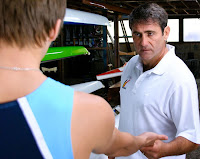
The other day I came across a very nice photograph of Ted Phelps and Robert Taylor. It is from the filming of the movie A Yank at Oxford from 1938, which I have written about in an entry on 3 August 2009. The British professional sculling champion Ted Phelps is in this photograph seen giving the American film star Robert Taylor some hints about sculling. Especially note the old-fashioned foot stretcher (or clogs), rowlock (oarlock), and the hard, wooden sliding-seat. Of course, the riggers are the good old non-aerodynamic, non-wing ones of metal.

Sunday, February 28, 2010

Berry's Rowing Instructions

Julius Beresford, born in 1868 with the surname Wiszniewski which he later dropped, was a fine sculler who began his rowing career at Kensington RC. He failed to win the amateur title at the Wingfield Sculls and would never win the Diamond Challenge Sculls at Henley Royal Regatta. However, after moving to Thames RC, he did win the Stewards’ Challenge Cup for coxless fours twice, in 1909 and 1911 at Henley; the latter year, Beresford also won the Silver Goblet’s & Nickalls Challenge Cup together with Arthur Cloutte.

At the 1912 Olympic Games in Stockholm, Great Britain sent a Thames RC coxed four with the 44-year old Beresford in the bow seat. They lost the final and got the silver medal. Julius Beresford, by his fellow crew and club members called ‘Berry‘ or ‘Old Berry’, would for the rest of his life be involved in the sport of rowing. He would serve as Captain and a Vice President of Thames RC, and for decades be a devoted and strong-willed coach.

In the mid-1920s, Beresford had the infamous quarrel with the club's legendary coach Steve Fairbairn, which made Fairbairn leave the club to instead coach the London RC. Decades later, this would still be remembered at Thames RC as ‘The Row’. In 1954, Thames RC published a small, 4-pages pamphlet, Rowing Instructions by J. Beresford. One might guess that this was written by Beresford’s son, the celebrated oarsman, Jack Beresford, Jr., but it was not. The two last sentences go: “But if a crew is physically fit it need never lose its form or Rhythm. This is true and so says BERRY.” Julius Beresford died in 1959.

Nowadays, Berry’s little pamphlet is almost impossible to find in second-hand bookshops.

Saturday, February 27, 2010

A Tribute To Bert Bushnell!

Bert Harold Thomas Bushnell, born 3 September 1921, was a famous British oarsman who won the Wingfield Sculls in 1947 and became the Olympic champion in the double sculls in Henley in 1948 together with Richard ‘Dickie’ Burnell. Bert Bushnell died on 9 January 2010. At his funeral on 27 January the following Tribute was read.

Bert Bushnell, known to everyone who knew him, including his daughters and grand-daughters, simply as “Bert”, lived nearly all his life near the river Thames. He was a man of passions and the three greatest of his life were sport, the river and his family.

Sport dominated his life, not only because he won an Olympic gold medal in the double sculls in 1948 here in Henley, but simply because he loved just about anything to do with sport. While he never excelled academically at school, he excelled in anything sporting. He loved athletics and football and of course as a boy of the river – his family had lived and worked on the Thames for generations – he was destined to make his mark in some sport involving boats and water. But after the Olympics he abandoned sculling and was to turn his talents to a variety of other sports, all of which he embraced with passion. Golf was to be the one to which he probably devoted most time and energy over the next few decades. He would often get up at five in the morning to go to the driving range at first light or to go to a secret spot halfway round the golf course so he could put in a few holes before work. To the bemusement of friends and neighbours (and, one might add, the despair of the gardener) he constructed an authentic golf bunker on his back lawn so he could perfect his bunker shots. His wife was a very tolerant woman. The hall carpet in the family home became a substitute putting green, where birdie and eagle winning putts would be practised and perfected while family life continued around him. And it paid off. For Bert won an impressive array of trophies in tournaments on courses all over the United Kingdom, Europe and beyond. Then there was a time when ballroom dancing became a passion, and the family home would resound to the strains of Pepe Jaramillo, Master of the Maracas, and his Latin American band, as he cha-cha-ed round and round the kitchen, or samba-ed his way across the dining room with his wife Margaret.

He married his wife Margaret in September 1948, just after his Olympic win, and spent the first few years of his married life on a Thames sailing barge, moored up outside the boathouse in Maidenhead that was to become the focus of his life for several decades. Later he moved to a house across the road, which became as well as a family home, an extension of his boating business, the dining room doubling up as a booking office and the rear sitting room as a storeroom for holiday cruiser equipment of all sorts from crockery to cushions and chandlery – a magnificent Aladdin’s cave for his daughters to show off to their friends. For it should be mentioned that Bert, very much a man’s man, had three daughters and no sons and six grand-daughters and no grand-sons. It appeared that the Maidenhead Bushnell branch just didn’t “do” boys.

Living next to the river Bert was determined his daughters would be water babies and to make sure they were safe near water he threw each one into the centre of the river when they were still very small and made them swim to the bank, before giving them a dinghy and a pair of oars to ensure the river and boating would become as much a part of their lives as it had been of his.

Later, Bert’s passion became gardening, the back garden became a mini market garden complete with greenhouse laden with an impressive array of tomatoes, cucumbers and whatever Mediterranean vegetables he could find seeds for, the lettuces grew in neat rows all over what had once been the lawn – and the golf bunker was converted in to a bed for growing mushrooms. This newfound interest in gardening coincided with a new passion for gastronomy, consisting mainly of tabletop cookery on a professional silver burner, where flambéing to rival a north sea oil rig flame resulted in a range of impressive seafood dishes or crepes suzettes, which would send his guests over the breathalyzer limit after one mouthful. His ice creams were legendary. His signature “rum and raisin” packed quite a punch, as guests retiring semi-conscious to the sitting room after a Bert dinner would attest. If they could remember it, that is.

Bert was a very social man. He loved entertaining and he was a generous host. His drinks cabinet was always open to anyone who cared to drop round for a chat and a drink… or two … or three… and he would invite anyone and everyone out for lunch or dinner to his favourite restaurants of the moment. It was always “Open House” at Bert’s house, and his friends in the Thames Valley will be the poorer for the loss of such a warm and welcoming host – as, no doubt will be the local restaurants he loved so much.

I would like to thank Bert Bushnell’s three daughters, Jacqueline Page, Sue Bushnell, and Pat Pueschel, for sending me the Tribute and the photographs, and allowing me to publish them on my blog.

Friday, February 26, 2010

Thomas Keller Medal 2010

FISA's World Rowing is calling for nominations for the 2010 Thomas Keller Medal. All nominations must be submitted via the online form by 9 March 2010.

As you might already know, the Thomas Keller Medal is the most prestigious honour in international rowing and awards an outstanding rowing career. Nominations must be submitted taking into consideration five factors, which you will be able to read by clicking on the following link.

Thursday, February 25, 2010

Stanley Garton's Letter

I thought it might interest the readers of this blog to see both the front and the back of Stanley Garton's letter of 4 November 1930, which I wrote about the other day, and which Tim Koch in London so elegantly solved the mystery of. There might have been other sheets of this letter, especially as it is not signed, but I am only in the possession of this sheet. Either way - enjoy!


Wednesday, February 24, 2010

Film review: La Régate

I am incredibly happy to introduce my blog’s first guest writer, mademoiselle Hélène Rémond of France. Among many things, Hélène is a journalist, and interested in all kind of aspects of rowing. You might have seen her name in my entries earlier as she, now and then, has sent me material or come up with ideas that I have tried to elaborate and present in my blog. Here is a film review of Bernard Bellefroid’s new film La Régate, which has just been released in a couple of countries in Europe, that Hélène has specially written for this blog. My warmest gratitude goes to her for doing so!


La Régate (‘The Boat Race’) by filmmaker Bernard Bellefroid

With Joffrey Verbruggen, Sergi Lopez, Thierry Hancisse (from the Comédie Française) and Pénélope Lévèque.

Belgian director Bellefroid’s first feature film La Régate has been shown since last Wednesday in France. The Belgian public could see it today. As to Luxembourg, the film will be on the big screen on 26th this month. Where else will the story of 15 year-old Alexandre be projected? Time will tell. This is a moving, touching, sensitive film in an original environment usually not given much coverage: rowing. The actors’ performance is very convincing. Inspired by Bellefroid’s own experience, it is a social drama, the poignant story of Alex beaten by his father with whom he is living. He finds the way of getting out of this violence by being involved in rowing to win the Belgian championship.


The setting of the Meuse river where he rows is radiant. The rock soundtrack illustrates well Alex’s rage used in a positive way, to surpass himself in the boat. It contrasts with the dark side of the apartment where much tension is felt. It is the story of a harsh relationship between a father and his son, the inability to show love when suffering is overwhelming. At the Rowing Club, with the help of the coach, Sergi, and Murielle, the girl he’s in love with, Alex will learn how to regain human values, to exchange with others, to love... He is initiated to the values of rowing: willpower, surpassing of oneself, solidarity, team spirit. It is a sport requiring strength and endurance and Alex needs these qualities to be able to escape his suffocating past. The film ends on this quote: “To the men who'll never be sons. To the sons looking for their dads. To the dads who don't know their sons no more To my future children I can finally dream of.”


La Régate
has won prizes at Namur Film Festival 2009, at the International Rome Film Festival and at Angers Film Festival 2010.

Hélène Rémond

Stanley Garton: The Letter Writer

Of course, the brilliant Tim Koch (how else can I describe him?), rowing historian and rower at Auriol Kensington RC in London, has solved the mystery with the letter writer, whom I wrote about yesterday.

Tim writes in a message from this morning, that “The letter is from rower and coach, A. Stanley Garton, who has a nice Stockholm connection for you. Arthur Stanley Garton (31 March 1889 – 20 October 1948) was a British rower who competed in the 1912 Summer Olympics [see photo]. He was born in Worcester Park and educated at Eton College where he was an outstanding member of the Eton crew and, later, the crew at Magdalen College, Oxford. He rowed in the winning Oxford boats in the Boat Race in 1909, 1910, and 1911. He was also in the Magdalen boat that won the Grand Challenge Cup at Henley Royal Regatta in 1910 and 1911. He joined Leander Club and in 1912 he was a member of the Leander eight which won the gold medal for Great Britain rowing at the 1912 Summer Olympics.”

Tim continues to write that “Garton won the Grand for the third time in 1913, in the colours of Leander. He coached the Oxford eight in 1925 and 1930. Garton's daughter, Jean, married Sir Edward Imbert-Terry, 3rd Baronet and after his death, Lionel Sackville-West, 6th Baron Sackville. Garton's youngest daughter, Helen, married Thomas Gervers, grandson of the infamous Lord Kitchener, while Garton's older daughter, Rosalind, married the famous Dickie Burnell, in 1940. Burnell took a gold medal in the doubles in the 1948 Olympic rowing in Henley. Rosalind’s and Dickie’s son, Peter Burnell, rowed for Oxford in 1962.”

In an old extract from The Times it shows that Garton lived at Wood Lodge, Burgh Heath from (at least) 1920 until 1939, Tim says in his message. Tim has even found an old race report of the coxless fours on 30 October 1930 in The Times, which should be the race Garton mentions in his letter, “I saw him [Donald Crum] race against Balliol last Thursday”.

“I think that the word you cannot read is ‘Fours’ – ‘I have been watching him rather carefully in ‘Fours’”, Tim writes. He goes on saying, “Who was the letter to? I can only speculate. The Oxford President, until January 1931, was D.E. Tinne, perhaps it was him? His successor was P.C. Mallam, another possible contender.”

Many, many thanks to Tim for cracking this case. And doing so, I feel that Tim and I have added a foot note to the rich history of rowing!

Tuesday, February 23, 2010

Oxford Rowing In The 1930s

In an old rowing pamphlet I bought a couple of years ago, I found an old letter (or the first page of a letter; as it is not signed there might have been more pages) from 4 November 1930. Although, I can make out most of what it says, the handwriting makes it hard to read some names and words. Maybe there is someone out there that might be able to help me to identify the writer of the letter and the recipient?

The writer of the letter is using a sheet with a printed letter-head: “Wood Lodge, Burgh Heath, Tadworth, Surrey.” The writer, who seems to be a coach, maybe for Christ Church College, or the Oxford coach, is addressing the letter to: “My dear Gladder[?]” It goes on by saying: “What do you think about young [Donald Erskine-] Crum? I have been watching him rather carefully in [unreadable] and saw him race against Balliol last Thursday, when they got beaten.”

Donald Erskine-Crum, Eton & Christ Church College, rowed in three losing Oxford boats in the Boat Race in 1931, 1932, and 1933. Lewis Clive, Eton & Christ Church College, is also mentioned, sitting in this boat. Clive rowed in the losing Oxford boat at the Boat Race in 1930 and 1931, but won the Silver Goblets at Henley in 1931 and 1932, both years with ‘Jumbo’ Edwards. Later in 1932, they became Olympic champions in the coxless pair at the Los Angles’ Games (rowing being held at Long Beach).

About Clive, the writer states: “Lewis Clive was heaving himself about like a landslide (which didn’t give Crum a chance), & Forester [?] at ‘2’ was following Lewis in his antics!”

Now, is there anyone who can enlighten me or give me a qualified guess, whom the letter writer and the recipient, Gladder [?] might have been? Thank you in advance!

Below, you will find a newsreel from 1931 from British Pathé showing Oxford training on the Thames at Henley. According to official results from the Boat Race that year, Lewis Clive rowed at No. 6 and Donald Crum in seat No. 7. A blurred photograph in a book is showing Lewis Clive at the Olympic rowing in 1932, that might match the oarsman in 6-seat in the newsreel…

"IT'S NO WALK OVER FOR THE LIGHT BLUES THIS YEAR!"

Sunday, February 21, 2010

The First Rowing Bibliography & Elements Of Rowing

Anyone who has the intention to write either a light or a serious study on rowing literature should consult Frederick Brittain’s Oar, Scull and Rudder, a masterly rowing bibliography published in 1930. Although the first work on rowing – according to Brittain, A Treatise on the Art of Rowing as Practised at Cambridge by “A Boating Man” – was published already in 1842, it took ninety years for the first bibliography to be published, making Freddy Brittain a pioneer as the first rowing bibliographer. In his introduction, Brittain, a don of Jesus College at Cambridge University, describes the deep research behind his work, which contains around 240 books and pamphlets, and 700 articles on rowing in periodicals and encyclopedias. Most of the items on the list came from his own collection of rowing literature, but he also gainfully included entries of works that he had never seen, but read about or heard of.

Thomas E. Weil, one of the world’s leading rowing historians and collectors, shows the impressive range of rowing literature in Oar, Scull and Rudder in his excellent essay "The Don’s List – Extracts from and notes on Frederick Brittain’s Oar, Scull and Rudder (the first rowing bibliography)", published on the Friends of Rowing History’s web site Rowinghistory.net. However, Weil does point out some weaknesses in the book. While Frederick Brittain “happily listed volumes of verse with rowing content, the don did not include rowing-related prose fiction, passing up a host of juveniles, including the important American favorite by ‘Oliver Optic,’ The Boat Club, and such classics as Hughes’ Tom Brown at Oxford, Jerome’s Three Men in a Boat, Grahame’s The Wind in the Willows (“simply messing about in boats”), and Beerbohm’s Zuleika Dobson.”

Brittain also left out popular works by American authors like Ralph Paine, Ralph Barbour, and Albertus Dudley, to mention a few, who had written juvenile sport books – including rowing – since the turn of the century and onward.

Nowadays, eighty years after it was published, Oar, Scull and Rudder is hard to come by in the antiquarian book trade. So are almost all of the publications that Brittain mentions in his book. One example is Reginald S. de Havilland’s Elements of Rowing, a little pamphlet published in 1913 by Eton College where de Havilland, or “Harvvy” as he was known, was the rowing coach. The pamphlet is only 11 pages [Brittain states 77 pp, but that must be a misprint] and it has “suggestions […] to helping those boys who are engaged in coaching junior fours at Eton” as stated in the foreword. It has short chapters on: “body”, “feet”, “hands”, “swing”, “forward like a spring bent down”, “finish”, “straps”, “the oar”, and “summary”.

Elements of Rowing was reprinted in The English Style of Rowing by P. Haig-Thomas & M. A. Nicholson (1958), a book that pays homage to the old English orthodox style taught by de Havilland and his predecessor, Dr. Edmond Warre, head-master and rowing coach at Eton. In Haig-Thomas’s and Nicholson’s book, de Havilland’s text has two “extra” headings, “slide” and “in the water” following “summary”.

Saturday, February 20, 2010

A Sure Spring Sign

First Juvenile Spectator (as the Oxford crew go out to practice). “There Y’Are, ‘Erb – Wot Did I Tell Yer? They ‘Ave Got Only One Oar Each!”
Second ditto, “You Wait Till The Day Of The Race!”
[From Punch, 24 March 1920]

The Boat Race is a sure sign that Spring is here. This year the Boat Race between Oxford and Cambridge is on 3 April, and with the hard winter we have had both in Europe and the USA, I can hardly wait…

Friday, February 19, 2010

Bert Bushnell Obituary

Finally, a major British newspaper has published an obituary about Olympic rowing gold medalist, Bert Bushnell, who died on 9 January (see also my entries on 18 and 26 January 2010). The Independent published a nice piece by Janie Hampton last Monday, 15 February. Reading the obituary, it is clear that Bushnell was a real character; read this article by clicking here. Earlier the local newspaper, Henley Standard, had published an obituary, on 25 January, click here to read that.

Thursday, February 18, 2010

FISA Interviews Bernard Bellefroid

Yesterday, The International Rowing Federation, FISA's, web site posted an interview with the Belgian filmmaker Bernard Bellefroid about his rowing movie, La Regate, which Hélène Rémond flagged already in November last year (see my 11 November entry). The film has just been released in France at a few theatres. You can read the full interview by clicking here.

Tuesday, February 16, 2010

I, A Movie Star...?

While I am at it, posting entries about rowing films and rowing characters in films, I almost ended up as a ‘sculling extra’ in a Swedish police film, Polis, polis, potatismos (1993; Eng. title Murder at the Savoy).

Maj Sjöwall and Per Wahlöö are probably the most famous Swedish crime writers outside of Sweden, that is, before Henning Mankell had his debut as a crime writer with his police inspector Kurt Wallander. Sjöwall and Wahlöö, a married couple, wrote several books about Martin Beck, a police inspector in Stockholm.

In one of their books, a prominent industrialist is killed at the Hotel Savoy restaurant in Malmö (my old home town). Beck is called down from Stockholm to help the local police to solve the murder. The book is called Polis, polis, potatismos (1970), which is a title based on a Swedish children’s rhyme: ‘polis, polis, potatisgris’ – ‘police, police, potato pig’ – but the book title is changed to ‘police, police, mashed potatoes’, called out by a 3-year old boy, who sees some policemen, who have stopped at a hot dog stand, having a hot dog with mashed potatoes.


In the beginning of the 1990s, a Swedish film company (with the help of a German company) began to film the Martin Beck books, with the famous Swedish actor Gösta Ekman in the lead role (see picture). When it was time to film Murder at the Savoy, the film team when to Malmö to shot some scenes at Hotel Savoy and in and around town.

So, one dreary morning when I had been out sculling in the rain before work, the phone rang at the club house. I was the only one there, so I picked up the phone. It was a person from the film team who needed a sculler to pass under one of the town’s bridges, where Ekman/Beck was standing with one of his detectives. Could I be there in 25 minutes to do the scene?, the fellow from the film team asked. Well, no, I said, as I had to attend a very important meeting at the publishing company where I was working at the time. Just then another member, a teenage boy, showed up. I told the fellow at the other end of the line that I had someone that would be there in 25 minutes.

Although it would be fun to be in the movie, which was released in 1993 (and it is not very good, I am sorry to say), the sculler had to scull back and forth eight times in the rain, because the director was not happy with the actors' performances on the bridge. I guess that is the life of a movie extra…

The Actor Jack Beresford, Jr.,


In the current issue of Rowing & Regatta, No. 40 (January/February, 2010), in my piece ‘In this month…’, I am writing about my rowing hero Jack Beresford, Jr. And talking about rowing in movies, he actually had a small part in the film Half a Sixpence (1967) with Tommy Steele in the lead role. Beresford, with a grand moustache and side-whiskers, was playing the umpire on a launch at the Henley Royal Regatta, a memorable moment for the history of rowing. This could not, however, save this movie.