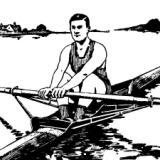
Photograph: Werner Schmidt

Sunday, July 26, 2009

Good Writing On Rowing 2

Here are some more poems and “sayings” on the sport of rowing.

11)
I was the pride of all the Thames
My name was Natty Jerry
The best of smart and flashy dames
I’ve carried in my wherry.

For then no mortal soul like me
So merrily did jog it,
I lov’d my wife, my friend, d’ye see
And won the prize of Doggett.

I Coat and Badge so neat and spruce
I row’d all blithe and merry
And every Waterman did use
To call me Happy Jerry.
From “Happy Jerry” by Charles Dibdin

12)
Strong daughters of the golden south!
With health and beauty for your dower
Sure pledge of grander womanhood,
We hail with you this joyous hour.

We meet this day to dedicate
A noble craft to noble waters,
Sealed by these brief and simple rites,
To ten of San Diego’s daughters.

Manned by a crew as leal and true,
As e’er pulled oar or sailed a smack,
So let all other craft beware,
Nor try to sail athwart “The Zlac.”
From Philip Morse’s “Lines Written for the Launching of the ZLAC”, a barge that was launched 3 August 1895 at the ZLAC Rowing Club

13)
I don’t care, you know, a bit how they row,
Nor mind about smartness of feather;
If steering is bad, I’m not at all sad,
Nor care if they all swing together!
Oh why do they shout and make such a rout,
When one boat another one chases?
‘Tis really too hot to bawl, is it not?
Or bore oneself over the Races!
I DON’T CARE A RAP FOR THE RACES! –
MID ALL THE REGATTA EMBRACES –
I’M THAT SORT OF CHAP, I DON’T CARE A RAP,
A RAP OR A SNAP FOR THE RACES!
From “A Regatta Rhyme” (On board the ‘Athena’, Henley-on-Thames) by Joseph Ashby-Sterry, published in Punch

14)
If you want a receipt for that popular mystery,
known to the world as a ‘Varsity crew,
take all the redoubtable athletes in history,
tub them and coach them and clothe them in blue.
The giant physique of a Samson or Hercules,
skill of Apollo in steering the sun,
the custom of noted ascetics to shirk all ease –
e.g. St. Anthony, second to none –
the doggedness deep of the stone-rolling Sisyphus,
speed of a Hutchens when started to run;
a force irresistible used without busy fuss,
like sixty Hanlans rolled into one;
From “The ‘Blue’ Fever” by J. Maycock (with special thanks to ‘Hélène’)

15)
Down the river the light fours roll
Like a tramp in the trough of a heavy sea,
Like a rakish elephant on a spree,
Striking despair to the inmost soul
Of the coach on his tow-path bike or gee,
Watching their plunging, staggering motion,
(As though they were not on the Cam, but the ocean).

Behind rides a man who is quite ignored,
“Out one … You’re straight … Out one again!”
But the steerer sneer with superb disdain –
Crash! And a sculler falls overboard,
And the four leaves a ruinous wake in the train,
Tubs, scullers and pairs – fairly makes one shiver –
And now Trail Eights are on the river!
“Light Fours” by R. E. Swartwout

16)
I met a solid rowing friend, and asked about the race,
“How fared it with your wind,” I said, “when stroke increased the pace?
“You swung it forward mightily, you heaved it greatly back;
“Your muscles rose in knotted lumps, I almost heard them crack.
“And while we roared and rattled too, your eyes were fixed like glue,
“What thoughts went flying through your mind, how fared it, Five, with you?”
But Five made answer solemnly, “I heard them fire a gun,
“No other mortal thing I knew until the race was done.”
From “A Trinity Boating Song” by R. C. Lehmann

17)
In future when the windless lake is still,
And sounds of evening bells float from the hill,

When skimming shells in straining practice fly
Up past the western shore, with coxswain’s cry

And rowlock’s rhythmic throb and wash of oar,
“The Old Man’ in his launch will come nor more.

He dwelt among us without blame or fear,
And trained his oarsmen many a zealous year;

He taught them manhood also; how to meet
Their fate, unspoiled by triumph or defeat.

“Row hard! And may the best crew win,” he said;
And victory hovered ever ‘round his head.

Alas, the crew, the lake, the changing shore
Shall see “The Old Man” in his launch no more.
“Charles E. Courtney” by Albert W. Smith

18)
Come, my friends.
'Tis not too late to seek a newer world.
Push off, and sitting well in order smite
the sounding furrows; for my purpose holds
To sail beyond the sunset, and the baths
Of all the western stars, until I die.
It may be that the gulfs will wash us down;
It may be that we shall touch the Happy Isles,
And see the great Achilles, whom we knew.
Though much is taken, much abides; and though
We are not now that strength which in old days
Moved earth and heaven, that which we are, we are---
One equal temper of heroic hearts,
Made weak by time and fate, but strong in will
To strive, to seek, to find, and not to yield.
From "Ulysses" by Lord Tennyson

19)
What after all, is a sportsman? As I understand the breed he is a one who has not merely braced his muscles and developed his endurance be exercise of some great sport, but has, in the pursuit of that exercise learnt to control his anger, to be considerate to his fellowmen, to take no mean advantage, to resent as a dishonour the very suspicion of trickery, to bear aloft a cheerful countenance under disappointment, and never to own himself defeat until the last breath is out of his body.
R. C. Lehmann

20)
[“Stilton’s”] entire formative years, therefore, as you might say, had been spent in dipping an oar into the water, giving it a shove and hauling it out again. Only a pretty dumb brick would fritter away his golden youth doing that sort of thing.
Bertie Wooster about G. D'Arcy “Stilton” Cheesewright in P. G. Wodehouse’s Joy in the Morning

Tuesday, July 21, 2009

Steve Fairbairn - The Master of Sayings

The master of “sayings” when it comes to rowing is without doubt the Australian Steve Fairbairn, who coached Jesus College, Cambridge, Thames RC, and The London RC. Although he died seventy years ago, his books on rowing, which are now all out of print, are very sought after. Be prepared to pay a lot of money for second-hand copies. Fairbairn’s famous maxims were compiled by his friend Freddy Brittain, and given the title Slowly Forward. The following is a piece about Fairbairn and Brittain.

In 1929, Steve’s loyal friend Freddy Brittain, then a year away from a lectureship at Jesus College, selected and arranged 366 of Steve’s sayings, a maxim for each day of the year, starting with “Don’t start the next stroke too soon” (1 January), and ending with “Sit back at the finish till the cows come home” (31 December). I have many favorites among the 366 aphorisms, but if I have to pick only one, it is “Enjoy your rowing, win or lose”, which is what I have done ever since I began to row. It was much later, that I realized that this saying actually falls on my birthday.

Freddy gave the book the title Slowly Forward, which surprised Steve. To Steve’s question where the title came from, Freddy answered that it was Steve’s favorite expression when he was coaching his crews. Steve denied this, saying that he always said “Slow Forward.” Freddy explained that an adverb was essential in that position. “Adverb!” Steve blurted out, amused. “Adverbs! You are like the bloody dons – specialized idiots.”

Steve never seemed to forget this, Freddy tells in [his autobiography] It’s a Don’s Life, “whenever he introduced me to anyone – in the Stewards’ Enclosure at Henley, or anywhere else – he used to add solemnly, ‘He knows a lot about adverbs, he does’; and when he wrote to me he often ended his letter with
‘Yoursly everly,
Stevely’ “

The following year, in 1930, Freddy was going to publish his Oar, Scull, and Rudder, and offered it first to Cambridge University Press, who required financial assistance from the author. Freddy did not have any money to spare, so he sent his manuscript to Oxford University Press, who decided to publish it. Steve immediately offered to write the introduction to the book.

Freddy mentions in his autobiography that he was worried about Steve’s offer as “his style of writing, influenced as it inevitably was by years spent in the backwoods of Australia out of touch with books or educated men, was hardly in keeping with a staid University Press, but I could not refuse his offer.” A couple of days later Steve handed his piece to Freddy to read. Steve sat down opposite Freddy when he read it. When Steve saw Freddy getting some twitches around his eyes and evidently saw his face drop, he said, “You don’t like my Introduction?” Freddy began to stammer, “These University Presses are a rather a highbrow lot, you know.”

Then Steve got an idea. Both Steve and Freddy knew another Jesus don, the King Edward VII Professor of English Literature, Sir Arthur Quiller-Couch - know as “Q” - who was a famous poet, novelist, literary critic, and anthologist (The Oxford Book of English Verse, 1900; 1939); and for certain a real man of letters. Q had, as an undergraduate, rowed at Trinity College at Oxford and written the introduction to The Jesus College Boat Club, Vol. I. He was also, according to Freddy in his Arthur Quiller-Couch - A Biographical Study of Q (1947; 2nd ed. 1948), “the best-dressed man in Cambridge.”

“All right. I will tell you what to do,” Steve said. “Q knows something about English. Get him to knock it into shape.” Freddy went to Q’s room and said, “Steve says you know something about English.” Q answered that it was very kind of Steve to say so, and what could he help him with. Freddy handed Steve’s introduction to Q and said that Steve wanted him “to knock it into shape.” Q started to read, and Freddy could now see how Q’s face dropped. Q turned to Freddy and, letting out a deep sigh, said it was impossible to make anything out of it. However, Q took a second look at the manuscript. “All right,” he said. “Tell Steve I will knock it into shape.”

“When the book was published,” Freddy writes in It’s a Don’s Life, “the title-page asserted that it had an Introduction by Steve Fairbairn. It is true that Q had used the same twenty-six letters of the alphabet as Steve, but he had re-arranged them in his own inimitable style.” Steve’s opening sentence had been something like “Me and Freddy have had a lot of talks about rowing,” which in the printed Introduction reads “In our discussions ‘frequent and full’ on the principles of Rowing it has occurred to my friend Mr. Brittain, as to me, to wonder why a scientific Bibliography of the great Art has never yet been compiled.”


Extract from a yet unpublished essay, “Freddy and Stevely – and the Quest for Perfect Rowing”, about the Cambridge rowing coach Steve Fairbairn (1862-1938) and his friend Frederick “Freddy” Brittain (1893-1969), a don at Jesus College, Cambridge.

Monday, July 20, 2009

Good Writing On Rowing 1

There is a lot of good writing about rowing. And here I mean short, powerful, witty, and intelligent phrases, poems, and deep thoughts that tell a reader about our sport, how it is and how we would like it to be seen and remembered.

Here is a list of 10 “sayings”. I have not listed them in a special order, although I believe No. 1 should be regarded as the top one. I will be back with more of them in a near future.

1)
There is nothing – absolutely nothing – half so much worth doing as simply messing about in boats.
Ratty in Wind in the Willows by Kenneth Grahame

2)
He keeps his sturdy legs applied
Just where he has been taught to,
And always moves his happy slide
Precisely as he ought to.
He owns a wealth of symmetry
Which nothing can diminish,
And strong men shout for joy to see
His wonder working finish.
From “The Perfect Oar” by R. C. Lehmann

3)
Dead-heat to Oxford by five feet.
‘Honest’ John Phelps, the 1877 finishing judge at the Boat Race

4)
It’s a great art, is rowing.
It’s the finest art there is.
It’s a symphony of motion.
And when you’re rowing well
Why it’s nearing perfection –
And when you reach perfection
You’re touching the Divine.
It touches the you of you’s
Which is your soul.
George Pocock

5)
The three ‘R’s of rowing are: Rowing, Rowing, and Rowing.
Stan Pocock

6)
There is no disgrace being beaten when you are trying to win.
Jack Beresford, Jr.,

7)
From stretcher to oar with drive and draw,
He speeds the boat along.
All whalebone and steel and a willowy feel –
That is the oarsman’s song.
From “The Oarsman’s Song” by Steve Fairbairn

8)
If anybody sees me near a boat again, they have my permission to shoot me.
[Later Sir] Steve Redgrave after winning his fourth consecutive Olympic gold medal. However, he would become Olympic Champion again, in Sydney in 2000.

9)
Nothing as beautiful as rowing, the records of how we have used it to test ourselves and each other, and the reasons it should be preserved for future generations, should be so neglected, so forgotten, or so unsung.
Thomas E. Weil in his essay “The dangerously neglected legacy of rowing”

10)
Jolly boating weather,
And a hay harvest breeze,
Blade on the feather,
Shade off the trees,
Swing, swing together
With your bodies between your knees.
"Eton Boating Song" by William Cory

There are many different versions of Cory’s ‘Jolly boating weather’. When Hugh Laurie was asked to sing it on television, he could not help referring to it as a ‘homoerotic anthem’ – look this up on: Youtube.com > "hugh laurie homoerotic anthem"

Sunday, July 5, 2009

Shame On Me!

Today, Sunday the 5 July, it was the final day at the Henley Royal Regatta in Henley-on-Thames. Although, I have been to the town of Henley several times, for rowing business or vacation, I have to confess that I have never been to the Henley Royal Regatta - and for that I am embarrassed. A friend of mine, a rowing fellow in London, expressed in an e-mail, when he heard that I had not attended the regatta, how shocked he was that I had not been to “Henley Royal”. And I agree. I mean, I regard myself to have a fairly good all-round education, but not having been to Henley (the regatta) leaves my education with a big dent. Last time I was in Henley with my family to visit the River and Rowing Museum – and what a lovely tribute to rowing it is - my then 19-months old daughter was sick and our stay ended up to be the worst holiday ever!!!

But, as I wrote, today was the last day of the “Henley Royal”. Although, I was not there, I like to know the results of the different events. This year there were some world-class scullers competing in The Diamond Challenge Sculls, and I was curious which of them would end up in the final heat. Early on, when it was clear that the Diamonds holder from 2008, Ian Lawson of Great Britain, was overpowered by the Kiwi Duncan Grant (lightweight single world champion), the trophy was going to be between Olaf Tufte of Norway, Mahe Drysdale of New Zealand, and the young, very talented British sculler, Alan Campbell. All moved up through the heats, and in the semi-final it was Tufte against Campbell, and the British sculler won. According to the British newspapers, it was a thrilling race, perfectly executed by Campbell. However, in the final race Drysdale was too difficult to beat. If you would like to get all the results from this year’s Henley, please click here.

The excuse that I had not to go to Henley this year is a good one. My friend Per Ekström and his family were visiting us here in Connecticut during the “Henley Days”. Not only is Per a dear friend of mine and a fellow of the Swedish rowing club where I am a member, Malmö Roddklubb, he is also the editor – or, Editor-in-Chief, if you like – of the Swedish rowing magazine Svensk Rodd, which we started in 1990. So I took all the Ekströms to the National Rowing Hall of Fame and to the rowing exhibit “Let Her Run”, and gave them a VIP-tour of the Boat Storage Space of Mystic Seaport Museum where the National Rowing Foundation’s nice collection of Pocock shells are hidden. They all seemed to like it.

Now, I have been thinking how I am to illustrate this entry to give it both a little dash of “Henley Royal” and a dash of Per Ekström and me. Spring in 1997, I think it was, my rowing club in Sweden bought a new eight, a British Aylings. For the première outing, we were nine fellows all “dressed up” to show her off on the water. From the bow: Jan Andersson, Bengt Ryberg, Håkan Christensson, Per Ekström, Ian Nicholls, Timo Ulfskans, Thomas Barge, Peter Kauranen (stroke), and Göran R Buckhorn (coxswain). And yes, the club got some publicity in the local newspapers as buying a new eight is always something special.

It is special to go to the regatta in Henley, too. And one of these years, I am going to go, by golly.

Monday, June 29, 2009

Mystic Mystery Boat

What an event it was, this year’s WoodenBoat Show at Mystic Seaport during this past weekend. We had three glorious days with weather much better than the weather guys promised in their forecast. I met some of the local rowing celebrities, but also some non-locals. Two different young ladies rowing teams came to visit the Rowing Hall of Fame, and they were amazed at the very nice wooden eight that hangs from the ceiling in the museum’s Visitor Center.

Other non-local aquatic aficionados were Tom Weil of Woodbridge (CT) and Peter Mallory of San Diego (CA), two of America’s most well-known rowing historians, and Directors of Friends of Rowing History. Both gentlemen were working hard on their research at the Rowing Hall of Fame. Graeme King of Putney (VT), famous wooden boat builder - he once restored the eight in the Visitor Center - was visiting the Show together with two friends from Australia. I was also happy to see my dear friend Fred Roffe, who is maybe not an oarsman or a prominent historian within the field of rowing, but should be regarded as nobility within the rowing family. Fred is a descendant of the famous British professional rower and boat builder Harry Clasper. Very generously, some years back, Fred donated some “Clasper stuff” to the National Rowing Foundation. These Clasper memorabilia can now be viewed in the rowing exhibit “Let Her Run” (please click here).


Furthermore, I had a short and pleasant chat with WoodenBoats Book publisher, Scot A. Bell, about Darryl Strickler’s coffee table book, Rowable Classics – Wooden Single Sculling Boats & Oars (2008). I had hopes that Strickler would be present at the Show, but unfortunately he was not. Right now, I am working on a little piece, a book review, for the Swedish rowing magazine, Svensk Rodd, about his book.

I also had the great pleasure of talking to Steven Ferlauto, owner of Riverschoolboats. He showed me a “mystery boat”, which brand name "tag" regrettably was unreadable (please see photos). At my rowing club in Sweden, we had a lot of shells built by old famous boat builders in Europe: Sims in England, Pirsch in Germany, Karlisch in Germany, and Stämpfli in Switzerland, etc. But this single was a mystery to me. Is there anyone out there that has an inkling where this shell was built and by whom?

Tuesday, June 23, 2009

18th WoodenBoat Show coming soon!


It is time again – for the WoodenBoat Show at Mystic Seaport Museum in Mystic, Connecticut. The 18th annual WoodenBoat Show will be held on 26, 27, and 28 June, and for sure there will be a lot for rowing history buffs to see and do. Of course, among the traditional classics and contemporary wooden boats you will find all kinds of oarpowered vessels. There will be close to 200 exhibitors all around the museum’s 17 acres. You will find more information about this great event and which exhibitors will be present by clicking here.

Do not forget to visit the National Rowing Hall of Fame and the rowing exhibit “Let Her Run” in the G. W. Blunt White Building (Exhibit building No. 54). The first thing you will see in the lobby if you look up is the wonderful wooden single scull By George, built by George Pocock in 1966 for the Olympic champion Duvall Hecht (1956 Coxless Pair). Hecht was so impressed by the shell’s beauty that he decided not to use her! Instead, he hanged By George up in his house, and bought a second-hand boat to scull in. He later gave the shell to the National Rowing Foundation, NRF, who has donated it to Mystic Seaport Museum.

Mystic Seaport Museum with the WoodenBoat Show will be open on 26, 27, and 28 June between 9:00 a.m. and 5:00 p.m. For museum admission prices, etc, please click here.

Saturday, June 13, 2009

Well Rowed, Harvard!


The results for the 144th Harvard – Yale Race ended with a clean sweep for Harvard. The freshman race was more or less sealed after one of the Yale oarsmen caught a crab. Yale’s second varsity chased Harvard down the 3-mile course in a thrilling race, but fell short to pass them. Harvard won with a 20 second margin in the varsity eight. The rain stayed away during the races, but the Thames water was rough and the wind hard. Harvard has now won nine of the 10 last races in the varsity boat, and it was the 40th win for Head Coach Harry Parker.

Not since 1999 have the races been rowed downstream, with the finish line just under the Gold Star Memorial Bridge. First, I had a problem finding my way down under the bridge on the New London side of the river, but after some turns here and there a parking area opened up. It was mostly Yale fans that had found their way to this spot on the shoreline. Among Yale oarsmen and their parents, brothers, sisters, and friends, I also caught a glimpse of rowing historian Tom Weil (Yale ’70) and local rowing celebrities. Weil wrote a very interesting history article about the Harvard - Yale Regatta programmes in this year's programme.

Friday, June 12, 2009

Harvard - Yale Regatta

The 144th Harvard – Yale Regatta is coming up this Saturday, June 13, on the Thames River, Connecticut. All three races - the 2-mile Freshman Race (at 2:30 p.m.), the 3-mile Second Varsity (at 3:15 p.m.), and the 4-mile Varsity (at 4:15) – will be held downstream and end at the Gold Star Bridge.

Last year, Harvard won the Varsity race, 18:54.1, Yale’s time, 19:01.6. The previous year, 2007, Yale managed to pass their rivals when there were only 20 strokes to go. Harvard leads the overall battle with 89 victories against Yale’s 54. Yale’s head coach is John Pescatore, who was named head coach in 2002. Harvard’s head coach is, of course, still Harry Parker, who is in his 47th season as the head coach of Harvard heavyweight crew.

To read more about the Harvard crew, please click here. To read more about the Yale crew, please click here.

Wednesday, June 10, 2009

Ted and Eric Phelps: Two Professional Sculling Brothers


In my entry of June 1, I briefly mentioned Eric Phelps (to the left). Here is a little more about him and his famous brother, Ted Phelps (to the right, wearing his Thomas Doggett’s coat with the badge).

Of course, telling any story about the Phelps brothers, one should begin with their father, J. T. “Bossie” Phelps, who according to Hylton Cleaver, was the “last great professional coach, certainly so far as tideway rowing is concerned…”. Although, it seems Bossie Phelps was a magnificent rowing coach, he did not have any champion sculling title himself to back it up with; not that he actually needed one. He passed on his skills to his two sons, Ted, born in 1908, and Eric, born in 1912.

When Bossie died at the age of 64, during the Second World War, he had seen both his sons become sculling champions. At the age of 18, Ted won the Newcastle Handicap, which at the time was the prime professional race in Northern England. Two years later, in 1928, Ted went to South America for a coaching job in Montevideo, but returned to London in 1930 to challenge Ernest Barry’s nephew, Bert Barry, for the World Sculling Championship title. Ted won the title, and three months later he entered the Thomas Doggett’s Coat and Badge Race, which is the oldest rowing race in the world, instigated by the Irish comedy actor Thomas Doggett, and sculled for the first time in 1715 on the Thames. Ted Phelps did not have a difficult time winning this race. Normally, of course, winning Doggett’s coat and badge was a good start of your professional rowing career, where the height might have been to crown it with the world title. Here Ted did it in the reverse order, which was rare.

Ted retained the world title against Bert Barry (seen on the left) later that year, and also kept it successfully against Major Goodsell of Australia in 1932. One year later, Ted lost the title to the Australian Bobby Pearce, who was living in Canada. In 1935, Ted Phelps raced against Bert Barry for the British Championship between Putney and Mortlake on the Thames. Ted won, but lost the title the next year to Bert’s brother, Lou Barry.

As Bossie had forbidden Ted and Eric to race each other for a champion title, Eric, who had won the Thomas Doggett’s Coat and Badge Race in 1933, took the opportunity to challenge Lou Barry for the British title later in 1936. Eric was triumphant and beat Lou for the title. Half a year later they met for a return match, and again Eric came out on top. In 1935, Eric Phelps went to Germany to become a private coach to Georg von Opel. When the war broke out, he was interned. After the war had ended, Eric worked in Argentina as a coach for three years, between 1947 and 1950.

Back in London, in 1950, a race between Eric Phelps and Eric Lupton (a Thomas Doggett Coat and Badge winner in 1947 for the postponed 1940 race) was set up in Frankfurt, Germany for a European Championship. Phelps won the title this time, but later lost it to Lupton, who became the last European Professional Champion.

Saturday, June 6, 2009

With "Göta" on the Mystic River

It is easy to find the house. It is the only house in Noank built of Scandinavian design – the other houses in the village carry the easily distinguished style of New England. I ring the door bell and soon Frederic Anderson, a friendly, tall, trim gentleman in his early seventies, opens the door and welcomes me. He is shortly joined by his Swedish-born wife, Anita.

Frederic Anderson’s ancestors were, for generations, the owners of the Palmer Shipyard in Noank, the old, little fishing village located where the mouth of the Mystic River meets Fishers Island Sound in the southeast corner of Connecticut. Between 1827 and 1914 nearly 700 vessels were launched by the Palmers. The Andersons’ house is on the very site of the shipyard. Fondly remembering his boyhood years when he and his younger brother ‘Chip’ were messing about in boats on the Mystic River, Frederic – Freddy to his friends – keeps a boat docked at their house.

In 2000, during a trip to Sweden, the Andersons saw an article about a boatbuilder, Roland Persson, and his small boatyard, Lilla Kålviks Båtbyggeri, on the island of Orust on the west coast of Sweden. Later, they set out to visit the yard and found docked there an old local type of rowing boat, a Bohus eka – Bohuslän is a province on the west coast and an eka is traditionally built of oak (ek in Swedish). The Andersons were impressed by her graceful lines and Mr Persson’s description of her seaworthiness in the open waters of the North Sea.

A year later, Anita and Freddy were back again, trying to order their own eka from Mr Persson. ‘He explained that he never built boats on commission,’ Freddy says and smiles. ‘Persson was only building boats he was inspired to build and, at the same time, following an old tradition not to use any boat plans.’ Before the Andersons left the yard, they expressed interest in buying the next boat that came from Persson’s hands.

In 2002, on their yearly visit to the boatyard on Orust, the Andersons found an almost complete eka. Although beautiful, they had second thoughts because of her size and weight out of the water. However, after trying a boat that Persson had built a couple of years earlier, ‘she proved to be everything we wished for,’ Anita says. When they asked Persson how much he wanted in deposit for the boat, he said a handshake would do. The Andersons decided to name their boat after Anita’s mother, Göta.

Almost finished, Göta was on display at the Gothenburg Boat Show in February 2003 where she was a great success. Later that autumn, the sad news reached the Andersons that Roland Persson had been killed in a car accident on Orust. The following July Anita and Freddy travelled back to Lilla Kålviks Båtbyggeri to arrange the shipping with Persson’s daughter Christina Andersson, who was now building boats together with her son, Johnny. The Andersons decided to use a small shipping company, Fallen & Lyrstrand Shipping AB, on the mainland of Bohuslän. Christina built a crate for Göta, which was shipped out from Göteborg.

‘Everything went so smoothly working with the Swedes,’ Freddy says, ‘but it became a minor disaster when Göta reached Port Elisabeth in New Jersey.’ Anita explains: ‘Göta had been banged around a lot, so she arrived in Noank with some $1,500 worth of damage to her hull. Luckily, it was only cosmetic damage which was covered by insurance.’

Freddy invites me to go on an outing with Göta. It is a warm, sunny day, and the busy traffic of pleasure boats on the river creates waves that make the eka bob gently up and down. She is beautifully varnished and the reflections of the sun in the water make her sparkle even more. I take the bow seat and, looking aft, see four shiny letters below the stern thwart: G-Ö-T-A.

Oars in tholepins, we start to row upriver. My rowing and sculling experience is from narrow racing shells with a sliding seat, but it does not take long before I am in the ‘swing’. A bit out from land the wind picks up and comes in from starboard, but that hardly upsets Göta at all. Freddy informs me that Göta is 13'9" long, 5'3" in the beam, and weighs 385lb. ‘A sturdy boat,’ he says proudly. Göta is well-balanced, easy to row and manoeuvre. During the almost two hours we are out on the river, she gets envious looks from passers-by as her robust Nordic design makes her a remarkable sight on the Mystic River. Göta is a beautiful boat that gives glory to her Swedish boatbuilder, Roland Persson; an appreciation that the old Palmers would have understood.

This article was published in Maritime Life and Traditions, No. 32, Autumn 2006. A slightly longer version, in two parts, was published in the Swedish rowing magazine Svensk Rodd, No. 2 and 3, 2006.

Thursday, June 4, 2009

Hugh Laurie's Henley article


As I mentioned in an entry on May 31, the actor Hugh Laurie has published a funny article, “Traffic, trivia and daylight snobbery”, about the Henley Royal Regatta in The Sunday Telegraph on July 2, 1990. Here is the beginning of the article.

“Well, Henley Royal Regatta has come round again. If the two words that spring to your lips on hearing this news are “so” and “what”, more or less in that order, I shall not hold it against you. Although I have competed in the Regatta three times, and been a spectator since I was cork-high to a Jeroboam, I’d be the first to admit that Henley is a very peculiar institution.
The last time I raced at Henley was in 1980, in the final of the Silver Goblets. It was a very bad year to pick. The regatta had been overrun by the American Olympian squad who were looking to kick some sand into English faces after their boycott of the Moscow Games.
With my partner, James Palmer, I squared up to two brothers by the name of Borscheldt, [sic M. & F. Borchelt] who were 19 feet tall and made entirely of Kevlar. Or maybe they were called Kevlar and made of Borscheldt, I can’t remember. Anyway, they were munching canapés on the flight back to Boston by the time we finished.
Soon after that defeat I hung up my rowing trousers and beat my oar into a ploughshare, but to this day I cannot shake off a considerable fascination with Henley. It is, as I said, a very peculiar institution.
But by golly it is a popular. Nowadays, something like half a million people visit it each year. You could explain this by saying that Henley is an important part of the ‘social calendar’, but how many of us own one of those, or would even know where to buy one?"

Monday, June 1, 2009

Ran Laurie & Jack Wilson

Inspired by the comment made about “the spear attack” on Jack Wilson, this is how the story is told by Hylton Cleaver in his book A History of Rowing (1957; p. 110):

Jack Wilson “had gone trek in the course of his duties, as District Commissioner. He came out of his tent after lunch one day and immediately felt a heavy blow in his back. Turning, he saw an old woman holding a spear. The blow had in fact been a spear thrust so savagely that it had nearly transfixed him. Having withdrawn it, the old woman struck again but missed, and as she made a third attempt Jack grabbed the shaft and disarmed her. The old woman had been put up to this attack on the District Commissioner by a witch doctor to rid herself of some misfortune.
A Sudanese medical officer, who was in his party, rushed up, after a brief professional examination, and made a memorable prognosis: ’By God, your Excellency, after this you will be no more good.’
Wilson was carried back to his base on a stretcher, a journey of twenty-four hours. He was rushed to hospital, and somebody who knew Laurie was his closest friend sent him a message. Laurie arrived at the hospital with flowers and fruit expecting Wilson to be at death’s door. On asked with hushed voice how Wilson was, he heard that he was ‘out playing tennis.’ ”

Christopher Dodd tells another story about the “Desert Rats” in his obituary of Ran Laurie (The Independent, 10 October 1998). When Ran Laurie was out on one of his rounds in the Sudan desert, he came upon a car that had broken down. In the car were Maurice von Opel, a member of the German car-making family, and his wife. The third person in the car was von Opel’s driver, Eric Phelps, a member of the famous family of Thames watermen. Eric Phelps, British professional champion, was now and then coaching George von Opel in the single scull. Phelps had also coached Jack Beresford Jr., and Dick Southwood to an Olympic gold medal in the double sculls at the Berlin Games in 1936. “Laurie managed,” writes Dodd, “running repairs and gave the party the address of a refuge in Khartoum, where, of course, Wilson was to be found.”


As I have mentioned in the previous entry about Hugh and Ran Laurie, Jack Wilson and Ran Laurie were great friends. Laurie once wrote a letter to Hylton Cleaver about his friendship with Wilson. Laurie wrote: “It was my privilege to be his second fiddle. He was a genius and had no twin.”

If only a clever fellow could make a movie about the pair “Laurie & Wilson” and their friendship – what a grand film it could be! (And we already know who could play the role as Laurie, don’t we?)

Sunday, May 31, 2009

The Rowing Lauries

One of the most popular TV-series in America right now is House, where the British actor, Hugh Laurie, plays the very rude but brilliant-minded Dr. Gregory House. I have been a fan of Laurie for a long time, and although I enjoy watching him in House, as a P. G. Wodehouse reader, my favourite TV-series, with Laurie in the lead role, is Jeeves and Wooster. In an interview with the magazine Parade in April 2009, Laurie says that his father was a respected doctor, but that he, Laurie the younger, has “made a lot more money as a fake doctor than my father ever did for all his hard work.”

Like his father, William George Ranald Mundell Laurie - “Ran” Laurie, for short – Hugh Laurie rowed for Cambridge getting his Blue in 1980, where his boat lost to Oxford with a trifle of 1,5 metres. Click below to see a couple of seconds of that race:


Hugh Laurie also competed at the Junior World Championships in 1977, and at the Henley Royal Regatta in the coxless pairs in 1980. About the last race, and his “fascination with Henley”, he wrote a very funny article in, I think, The Sunday Telegraph on 2 July 1990:

“The last time I raced at Henley was in 1980, in the final of the Silver Goblets. It was a very bad year to pick. The regatta had been overrun by the American Olympian squad who were looking to kick some sand into English faces after their boycott of the Moscow Games.
With my partner, James Palmer, I squared up to two brothers by the name of Borscheldt, [sic M. & F. Borchelt] who were 19 feet tall and made entirely of Kevlar. Or maybe they were called Kevlar and made of Borscheldt, I can’t remember. Anyway, they were munching canapés on the flight back to Boston by the time we finished.”

If Hugh Laurie is now a famous actor, his father will still be the more famous oarsman of the two. Ran Laurie, born in 1915, rowed in three victorious Cambridge boats, 1934, 1935, and 1936. Laurie stroked the two last ones to easy wins. Jack Wilson, who would become a great friend of Laurie’s, was in the same three crews. When Laurie stroked the British eight to a fourth place at the Olympic Games in Berlin in 1936, with Wilson not in the boat, Laurie “attributed the difference between first and fourth place at the Olympics to Wilson’s absence from the crew,” Christopher Dodd writes in his obituary of Ran Laurie (The Independent, 10 October 1998).

Both Laurie and Wilson joined the Sudan Political Service in 1936. Two years later, in 1938, when both men were on leave, they entered the Silver Goblets at Henley for fun, and won the final easily. Laurie had earlier won the Grand Challenge Cup for eights at Henley in 1934. Laurie and Wilson both stayed in Sudan during the Second World War, but when they both came back to England with their families, they returned to Henley in 1948 for a second go at the Silver Goblets – and won easily again! As Henley was a qualification regatta for the Olympic rowing events in Henley later that year, the “Desert Rats”, as they came to be known, suddenly found themselves representing their country at one of the prime rowing races in the world. They trained at Cambridge for four weeks – and drew extra food rations – and in the Olympic race they managed, according to Laurie, to have “the best row we ever had” winning the Olympic title with a length.

Their shell is now on display at the River and Rowing Museum in Henley-on-Thames. It would take 40 years before another British boat would take an Olympic gold medal in the coxless pairs, this time the winners were Steve Redgrave and Andy Holmes in Seoul in 1988.

Jack Wilson, born in 1914, died a year before Ran Laurie, in 1997. As a matter of fact, Wilson was born in Bristol, Rhode Island of British parents. Next time my family and I drive through Bristol, I will take off my hat in respect.

Thursday, May 28, 2009

A Nice Rowing Evening

Maybe not a large group, but a very strong one, gathered at Bank Square Books in Downtown of Mystic on Tuesday, May 26 for “A Rowers Evening”. Dana Avery of Mystic River Boathouse in Noank and representatives from almost all the organizations that are involved with rowing in the Mystic area were there. Dana had brought a single scull and a rowing machine, and while the movie True Blue (for some unknown reason in the U.S. called Miracle at Oxford) was running on a computer in the background, rowers, coaches, customers – especially a very nice couple from England – and bookstore owners and staff were chatting about the wonderful sport of rowing.

I was very happy to see that the bookstore had managed to get some copies of Frank Cunningham’s book The Sculler at Ease, first published in 1992, and re-published in paperback in 1999. If you would like to get hold of a copy of Cunningham's wonderful book, please call the bookstore at 860-536-3795. In stock right now are also hard-to-find books like Tom Weil’s Beauty and the Boats and Ed Monahan’s Rowing Retrospections.

Sunday, May 3, 2009

A Rowing Room With A View

One of Sweden's most famous authors, Frans G. Bengtsson, wrote in one of his essays: "... for if a man is to live happily he must have water to look at..."

My study has only one window, facing east towards the Mystic River. It is not a grand view; if you would like to see the water, you have to stand by the window and peer above the rooftops and through the branches of the trees belonging to the neighbours. And if there are few or no leaves on the branches you can catch a glimpse of the river. Again, maybe not a great view, but knowing that the river is there, makes all the difference...

It is in this study - by the rest of the family called "The Rowing Room" - I write my entries to this blog and other pieces on rowing. It is not strange that my family has given the room that name as I am surrounded by "rowing stuff" there: rowing posters, rowing books, rowing magazines, and some few pieces of rowing memorabilia, etc. It is also here on the bookshelves that I keep my books by Frans G. Bengtsson.

Bengtsson was born in 1894 and was a poet, essayist, critic, and novelist - a true man of letters. Nowadays, Bengtsson is best remembered for his Viking novel about Röde Orm (Röde Orm, two volumes 1941 and 1945), which was given the title The Long Ships when it came out in an English edition in 1954, the same year Bengtsson died. And let it be said at once, the translation by Michael Meyer is brilliant. Michael Meyer (1921-2000), an Oxford poet and one-title novelist (The End of the Corridor; 1951), was asked to translate Bengtsson's Viking novel. Many other English translators had refused to translate it, as, Meyer writes in his witty essay "Frans G. Bengtsson to his translator", the "money offered was so pitifully low, ten shillings [...] a page." But Meyer decided to have a go at it, and the Swedish author, who had a degree in English, promised to check Meyer's translation. The result is luminous. If you decide to only read one Swedish novel in your lifetime, The Long Ships has to be it!

I had the great pleasure to meet Michael Meyer at a lecture and dinner given by the "Frans G. Bengtsson Society" in Lund, Sweden in September 1995. It was the most funny and enjoyable lecture and dinner party I have ever attended. Two years later, in a small pamphlet printed by the society, Michael Meyer had his essay "Frans G. Bengtsson to his translator" published, together with a piece about Bengtsson and the Scottish author Eric Linklater written by - I am honoured to say - yours truly. After translating Bengtsson's book, Meyer would later translate plays by Strindberg and Ibsen, and also write highly praised biographies about these two Scandinavian playwrights. Meyer would also write a couple of plays himself. If you are interested in Meyer and the London theatre life in the 1950s, 1960s, and 1970s, do read his very entertaining autobiography Not Prince Hamlet - Literary and Theatrical Memoirs (1989).

It is not a coincidence that Chris Dodd mentions The Long Ships in his The Story of World Rowing (1992) as the Vikings were known to both sail and row their mighty ships. In The Long Ships Röde Orm and his friends are taken as slaves to row one of the Caliph's ships. At this hard time at the oar, Bengtsson writes,

"In his old age, Orm used to say that this period in his life was lengthy to endure, but brief to tell of, for one day resembled another, so that, in a sense, it was as though time was standing still for them. But there were signs to remind him that time was, in fact, passing; and one of these was his beard. When he first became a slave, he was the only one among them so young as to be beardless; but before long, his beard began to grow, becoming redder even than his hair, and in time it grew so long that it swept the handle of his oar as he bowed himself over his stroke. Longer than that it could not grow, for the sweep of his oar curtailed its length; and of all the methods of trimming one's beard, he would say, that was the last that he would choose."

After Orm and his men have managed to escape and are back home on the Nordic waters, they are invited to celebrate Yule at King Harald Bluetooth's court. Here King Harald calls them to drink ale, but asks Orm and his friend Toke to compose a poem each about their drink. Toke, who has not tasted better ale for many years, empties his vessel with delight and thereafter declares with strong voice:

"Thirsting I rowed for many a year,
And thirsting I did good slaughter.
All praise to thee, Gorm's gracious heir!
Thou knowest my favourite water!"

I have earlier written an article about Frans G. Bengtsson, Vikings and how my old rowing coach, Tore Persson, at my rowing club in Malmö, Sweden, ended up in a Hollywood movie by Kirk Douglas, The Vikings. If you would like to read the article, please click here.