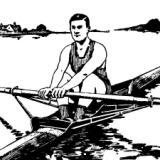
Photograph: Werner Schmidt

Friday, May 7, 2010

Sydney Swann Sr: Oarsman, Sportsman, Motorist, Airman

The always reliable rowing historian Tim Koch of Auriol Kensington RC, London, sent me some information about Sydney Swann Jr.,’s father, Sydney Swann Sr., (1862-1941), both whom I mentioned in my entry yesterday. Tim is forwarding The Times’s obituary from 1941. According to the piece in the paper, Rev. Sydney Swann was not only a great sportsman, he was also a pioneer motorist and airman. Rev. Swann could also add some rowing innovations to his long list of achievements. Among other things, he came up with a special ‘flap’ under the sliding seat to stop water from moving back and forth in the boat. The below newsreel, ‘A Rowing Novelty’ from 1927, will show you how it would work.

A ROWING NOVELTY


Rev. Sydney Swann Sr., rowed at Trinity Hall and rowed for Cambridge in the Boat Race in 1883, 1884, and 1885; winning in 1884. He also won the Cambridge Sculls, and was in the winning crews in the Pairs and the Grand (1886 and 1887) and the Stewards’ (1885 and 1887). In 1890, Rev. Swann went to Japan as a missionary, and there he won a numerous of sporting events, including pole-jumping, running, and hurdling. He returned to England seven years later. Back in England, he was the vicar for several parishes during the years.

The obituary reads “A man of remarkable physical strength, he cycled from Land’s End to John o’ Groats in record time, riding from Carlisle to London in a day, and was the first to cycle round Syria. Another fear of his was to canoe from the head of Crosby Beck down to the Eden and thence to the Solway.” The Times’s obituary then continues, “In 1911 he rowed across the Channel in three hours 50 minutes, a faster time […] than any one had ever gone between England and France by muscular power.” During the war, Swann drove an ambulance in Belgium, the paper writes, and it also says “One thing at which he was not so successful was flying. In the early days he built several of his own machines, but they did not fly very far and after considerable expense he decided that the hobby was too costly.”

At the age of 55, Rev. Swann cycled, walked, ran, paddles, rowed and swam six consecutive half miles in competition with a lieutenant Muller of the Danish Army. They both did it in 26 min. and 20 sec.

In 1934, Swann was elected President for the National Amateur Rowing Association, NARA, at the time a governing body for working class men who wanted to row, but was banned to join a club belonging to the Amateur Rowing Association, ARA. Both organizations merged in 1956 into the British Amateur Rowing Association, BARA, which shortly thereafter was shortened back to ARA.

Thursday, May 6, 2010

'Row, My Son...'

Here is a photograph of one of the successful Leander eights Harcourt ‘Tarka’ Gold coached, the 1912 Olympic champions. From the stern: coxswain Henry Wells, stroke Philip Fleming, 7 Alister Graham Kirby, 6 Arthur Stanley Garton, 5 James Angus Gillan, 4 Ewart Douglas Horsfall, 3 Leslie Graham Wormald, 2 Sidney Ernest Swann, bow Edgar R. Burgess. In the final, Leander beat New College, Oxford, for the Olympic gold medal.

No. 6, Stanley Garton, is the famous ‘letter writer’ whom I have written about before. No. 2, Sidney Swann, is the only Cambridge man in the crew. Swann came from a rowing family. His father, Rev. Sydney Swann, rowed for Cambridge in the Boat Race in 1883-1885. According to Susan Saint Sing, in her The Wonder Crew (2008), when Sydney Swann Jr., entered Trinity Hall, he sent a letter to his father asking what he should do on his spare time, Swann Sr., sent him a telegram back with the short reply: “AT THE HALL, THEY ROW.” And so he did, becoming one of the greatest English oarsmen before the First World War.

Wednesday, May 5, 2010

'To Charm The Ladies'

On 10 May 1879 there was a boat race between Stockholm’s Nation and Göteborg’s Nation (‘Nations’ here means student organizations at Uppsala University) on the river Fyris in Uppsala, north of Stockholm. Stockholm’s Nation’s Boat Club was founded in the autumn 1877 and the Göteborg’s Nation’s Boat Club was founded the following spring. Both clubs ordered their boats from England, two coxed out-rigged fours, 38 feet long, clinker-built with fixed seats. At the boat race in May 1879, both crews were rowing with white gloves “probably to charm the ladies on the shores,” one newspaper wrote. It is not known which boat won.

Tuesday, May 4, 2010

Shell Game

Shell Game

The wake caused by the passing
Of the yacht
Set the shells bobbing
In the habor.
To my mind they appeared
To be laughing
At the wake, the wake
An unexpected
Opportunity to play.

The sky spread somberly above them,
Matching in color the somber water
In the bowl of the habor.
Yet the somberness
Of the moment did not phase
The shells happy with color,
Blue, red, green.
A wake seldom passed their way.
They rode it, oblivious,
To the scowl encircling them.

Philip Kuepper
(Spring, 2010)

Monday, May 3, 2010

Romance At Henley

Rowing man: "Charming Girl, Your Cousin, Such Eton Eyes; Such Leander Cheeks."
[From Punch 6 July, 1921]

Sunday, May 2, 2010

'Tarka' - The First Sir Of Rowing

Sir Steven Redgrave was not the first person to be knighted for services to rowing. He was actually the second oarsman. The first one was one of my ‘rowing heroes’: Sir Harcourt Gilbey Gold (1876-1952). Harcourt Gold, known by the English rowing world as ‘Tarka’ (it seems at an early age he had a problem pronouncing his first name, which came out as ‘Tarka’- a name that stuck), was a master of whatever he decided to accomplish in rowing.

Tarka, who was called by R.C Lehmann, “one […] of really great strokes” in his Rowing (1897), stroked three Eton eights to victory in the Ladies Plate in 1893-1895, and Leander in the Grand 1896, 1898-1899. He won the Stewards twice (for Leander in 1898 and Magdalen in 1899), and stroked Oxford in The Boat Race at four occasions, in 1896-1899, only losing the last year. In his first Boat Race, in very rough water, Oxford was behind almost at the first stroke. With 200 yards to go, the dark blues managed to squeeze past Cambridge, winning with a 2/5 length. A contemporary source wrote about Tarka, among other things, “He has wonderful knees; and his legs are always loudly appreciated by the crowd at Putney.” You can study his legs in the drawing by SPY, published on 23 March 1899, in Vanity Fair up on the right.

After his active rowing career was over, Tarka began a successful coaching career. He coached Magdalen and Oxford for many years, and he coached two Leander eights to Olympic gold in 1908 and 1912. During the First World War he served in the Royal Flying Corps. In 1909, he had become a Steward at Henley, and after the war, in 1919, he was elected to the regatta’s management where he oversaw the making of the Stewards’ Enclosure. The next year, Tarka published his little pamphlet The Common Sense of Coaching* (1920).

After the Second World War, in 1945, he was elected Chairman of the Henley Royal Regatta, and three years later Chairman of the Amateur Rowing Association, ARA. In 1949, he received the first knighthood for services to rowing. At the first Henley regatta after the war, in 1946, Tarka had the great pleasure to welcome and escort princesses Elizabeth and Margaret. In the following newsreel, he can be seen with the princesses at this occasion, when the coming Elizabeth II, was handing out the prizes to the winning crews.

(HENLEY REGATTA)


What is maybe even more interesting is the following newsreel that is showing the unused, cut material that did not make it into the newsreel above. Here, for example, you will see a few seconds of the Diamonds final when Jean Sepheriades beat Jack 'Kell' Kelly.

HENLEY REGATTA


Tim Koch has sent me an old Rowing article from the beginning of the 1950s by Hylton Cleaver. In the article, Cleaver wrote about Tarka’s family history where his mother, Charlotte, came from the famous Gilbey gin dynasty. He married Helen Maclagan, sister of the 1899 Oxford cox, G.S. Maclagan. Tarka’s elder sister, Ellen, married legendary ‘oar’ Guy Nickalls and their rowing son ‘Gully’ had Tarka as his godfather and married his daughter Rachel. Gully succeeded his uncle, Tarka, as Chairman of the ARA. (I think I got that all right…) – My thanks to Tim!

* If anyone has The Common Sense of Coaching for sale, I would be very happy to buy it!

Saturday, May 1, 2010

First American Woman To Row Across The Pond

Here in the south-east corner of Connecticut is a special book project called ‘One Book, One Region’. This is, as their web site says, “a project that encourages residents of eastern Connecticut to read the same book during the spring and summer months and then to come together to discuss what they've read.”

I have to confess that after, long ago, finishing up my university studies in literature and culture science, I decided that I was never going to read something that someone else told me to read, unless I really wanted to. However, I might read this year’s pick A Pearl in the Storm: How I Found My Heart in the Middle of the Ocean by Tori Murden McClure, who was the first American woman to solo row across the Atlantic, in 1998.

The other day it was announced that Tori Murden McClure will give a talk on Sunday 16 May, 5:00 p.m., at Mystic Arts Center on 9 Water Street in Mystic, Connecticut. Of course, she will also sign her book. This is organized by the local bookstore, Bank Square Books.

Wednesday, April 28, 2010

A Swedish Rowing Foot Note In Philadelphia

Let us stay in Sweden for a while, or that is, with a Swedish connection.

One of the most famous rowing spots in the USA is Philadelphia with its Boathouse Row along the Schuylkill River. Of course, way back when, rowing in Philadelphia was not only about the Boathouse Row clubs, there were other rowing clubs in town, too. For a short period, between 1882 and 1885, there was even a rowing club founded by Swedes living and working in Philadelphia. Not all Swedes who immigrated to America ended up in Minnesota, many settled in the Philadelphia area.

Atlantic Works Inc., which was a machine factory in Philadelphia, had a lot of Swedes working on all kinds of levels. Stephan Rozycki, who was born in Paris by Polish parents and grew up in Sweden, was an engineer at Atlantic Works who, together with seven other Swedes in October 1882 founded The Swedish Rowing Club of Philadelphia. The Swedes shared the boathouse with an older club, The Riverside Club. Back home in Sweden, Rozycki’s sister made and sent him a flag which would be used as the club flag. The Swedes’ uniform was yellow with blue striped shirt, blue trousers, and a blue cap with a yellow star. “Svea”, their first boat, bought in June 1884, was a six-oared gig with the oar blades painted in blue with a yellow star. Later in 1884, the club acquired a coxed out-rigged four, “Göta”, and a single scull, “Thule”. All boats were frequently used by the fifteen members of the club, especially during the summer days of 1884 and 1885.

The Swedes particularly concentrated on long-distances rows on the Schuylkill, and through Point Breeze and down the Delaware River. The Swedes were known to row also during extremely hot summer days, which made spectators on the river banks cry: “There come the crazy Swedes!” According to a 1934 article by Fredrik Arsenius, The Swedish Rowing Club was invited to join the Schuylkill Navy at several occasions, but the club declined as its members were afraid that they would lose their ‘Swedishness’.

The Swedes last outing was on a very hot summer day, 17 July 1885. By then Stephan Rozycki had already left the club to join the US Navy. He was later stationed at the US Torpedo Station in Newport, Rhode Island. The Swedish Rowing Club in Philadelphia is a little foot note in the rowing history along the Schuylkill.

Sunday, April 25, 2010

Home Again...

At last, we are home in Connecticut again after a two-week visit to Sweden. It was supposed to have been only an eight-day stay, but ash clouds from the volcano Eyjafjallajökull in Iceland closed most airports in Europe. To be honest, I am not complaining as we stayed at my mother’s place in Malmö, in the south of Sweden, so we did not have to camp-out at an airport or sit in an over-crowded bus for two, three days to go to an open airport, or any other horror story that there are plenty of in the wake of Eyjafjallajökull erupting. Not even when our flight from Copenhagen to Boston was changed to go via Glasgow airport, instead of via Keflavik airport in Iceland, did I get disturbed. Instead, I saw it as a great opportunity to get some of those British magazines that are hard to find here in the U.S. Well, although the news agency at Glasgow airport had a ton of magazines, they did not, for example, have Literary Review which I was looking for, and the ladies working there had not even heard of it.

There was also one disappointment in Malmö: the doors at my local rowing club remained closed during my visit. My mother’s flat is only a couple of blocks away from the canal where the boat house is located, so I had the opportunity to pass the house several times. At one time it was open, so I could at least go in to get a whiff of the boat house, but there was no activity, maybe due to the chilly weather, who knows?

Saturday, April 24, 2010

Over The Atlantic In Ash Clouds...

So, if everything goes well, when this is posted in the afternoon, European time, my family and I will be over the Atlantic flying home to the U.S. A one-week stay in Sweden turned out to be a two-week stay due to the volcano activity in Iceland. At home, everything goes back to 'normal'. After all, there are many rowing stories to tell...

Friday, April 23, 2010

Mark Twain On Rowing

Earlier today, rowing historian Bill Lanouette sent me an e-mail with a very interesting piece of literary and rowing history: a rowing race report from author Mark Twain from November 1868. The article is about the race between the famous professional oarsmen the Ward brothers (see illustration) and the St. Johns crew. Many thanks to Bill for this great culture find!

San Francisco
Alta California, November 15, 1868

LETTER FROM "MARK TWAIN."

[FROM THE SPECIAL CORRESPONDENT OF THE ALTA]

A Lively Boat Race - The Wicked "Wickedest Man" - On the Wing - Something About Chicago - Story of a Rail - Personal Gossip

International Boat Race.

HARTFORD, October 22, 1868.

I went up to Springfield, Mass., yesterday afternoon, to see the "International boat race" between the Ward brothers and the "St. Johns" crew, of New Brunswick. We left here at noon, and reached Springfield in about an hour. It was raining. It seems like wasting good dictionary words to say that, because it is raining here pretty much all the time, and when it is not absolutely raining, it is letting on to do it. I assembled on the bank of the river along with a rather moderate multitude of other people (moderate considering the greatness of the occasion), and waited. A flat-boat was anchored in midstream, and on it were collected the judges, the boats' crews, and some twenty of their friends. A dozen skiffs and shells were hovering in the vicinity. The conversation of the crowd about me seemed to promise that I had made this journey to little purpose, since all the talk was to the effect that the idea of anybody attempting to conquer the Ward brothers on the water was simply absurd. Everybody appeared to think that the St. John's gentlemen would be so badly beaten that it could hardly be proper to speak of the contest as a race at all. My sympathies always go with the racer that is beaten, anyhow, and so I began to warm toward those New Brunswick strangers in advance. The cries of "Two to one on the Wards!" "Ten to one on the Wards!" "Hundred to five on the Wards!" I felt like resenting as so many personal affronts. Shortly two "shells" were brought to the front -- long, narrow things like telegraph poles shaved and sharpened down to oar blades at both ends. The contestants took their places -- the four St. John's boys dressed in pink shirts and red skull-caps, and the four Ward's in white shirts and with white handkerchiefs bound round their heads. They were all find looking men. They rowed away a hundred yards, easily and comfortably. I had never seen such grace, such poetry of motion, thrown into the handling of an oar before. They ranged up alongside each other, now, abreast the judges. A voice shouted

"Are you ready?"

"Ready!" and the two shells almost leaped bodily out of the water. They darted away as if they had been shot from a bow. The water fairly foamed in their wake. The Wards had a little the start, and made frantic exertions to increase the advantage but it was soon evident that, instead of gaining, they were losing. The race was to be a very long one - three miles and repeat. When the shells were disappearing around a point of land, half a mile away, the St. John's were already a trifle ahead. The people in my vicinity made light of this circumstance, however. They said "them Ward's" knew what they were about. They were "playing" this thing. When the boats hove in sight again "them Ward's" would be in the lead. And so the betting against my martyrs went on, just as before. Finally, somebody suggested that appearances seemed to indicate that the race was "sold." It had its effect. the most enthusiastic shortly began to show a failing confidence, and to drop anxious remarks about the chances of the race having really been betrayed and sold out by the Wards. But, notwithstanding all this talk was so instructive, the next twenty minutes hung heavily on my hands. There was nothing in the world to look at but five hundred umbrellas and occasionally a fleeting glimpse of the water -- and even umbrellas lose their interest in the long run, I find. there is nothing exciting about umbrellas -- nothing thrilling. One's pulse beats just as calmly in the presence of umbrellas as if they were not there. And they don't really amount to anything for scenery, being monotonous when there are so many. But in the midst of these reflections some one shouted:

"Here they come!"

"Whoop! St. John's ahead!"

"For fifty dollars it's the Wards!"

"Fifty to twenty-five it's the Wards!"

"Take them both! - hundred to a hundred it's _____"

"Three cheers for - Oh, the suffering Moses, the St. John's are ahead!"

It was so. It was easy to distinguish the pink shirts, now, flashing back and forth. On they came, dividing the water like a knife, and the white shirts far in the rear. In a few minutes they came flying past the judge's stand, every man of them as fresh and bright and full of life as when they started, and handling the oars with the same easy grace as before. A cheer went up for the gallant triumph, but there was little heart in it. The people on the shore were defeated, in pride and in pocket, as well as the opposing contestants. The Wards came in rather more than a hundred yards behind -- and they looked worn and tired. The race was over, and Great Britain had beaten America. Time, 39:38. there was but one consolation, and that was, that in a six-mile race on the same water, last year, the Wards made it in 39, thus beating the present time by 38 seconds. The Wards went into the contest yesterday in inferior condition. Their mainstay, Joshua, had been sick and was still unwell. However, these boys behaved in an entirely becoming manner. They said that they were badly beaten, and fairly beaten, and they wanted no excuses made to modify their defeat or diminish the brilliancy of the St. John's victory.

On 21 April, it was exactly 100 years ago Mark Twain died. 'Mark Twain' was pen name for Samuel Langhorne Clemens (30 November 1835 – 21 April 1910).

Thursday, April 22, 2010

Eric Linklater's Rowing Poet

Does anyone read Eric Linklater nowadays? Linklater (1899-1974) wrote novels, short-stories, poems, biographies, travelbooks, and children’s books, and was very popular, especially during the 1930s and 1940s. He had some rowing in his novel The Men of Ness (see No. 24 in the entry on 29 July 2009), which was translated into Swedish by my favorite author Frans G. Bengtsson, who wrote about the Viking Röde Orm (The Long Ships). Bengtsson also translated Linklater’s Poet’s Pub (1929), Poeten på Pelikanen (1933).

I happened to flip through this novel the other day (actually, I flipped through both the English and the Swedish versions as they were standing next to each other on the book shelf). The Poet’s Pub is about Saturday Keith who, in the beginning of the novel, is reading an unfavourable review in The Times Literary Supplement about his latest collection of poems. The reviewer is mocking Keith, comparing his bad poetry to his poor performances as a stroke in three losing Oxford crews in the Boat Race, “Mr. Keith is, as he always was, indomitable. But here he is bucketing badly and a long way from Mortlake – or Parnassus.” We are given an example or two of his meager poetry, and regarding the poem “The Blue Scarf” the reviewer writes, how Keith's “long service with the Oxford University Boat Club finds an echo in lines which apparently reproduce the obedient rhythm of a crew with ears agape for the coach’s next remark. ‘Then through the wood the wind came with a shout,/ And like blue wings her long blue scarf flew out,/’ writes Mr. Keith, and we may pardonably think of such a couplet as the response to an injunction to ‘Give her ten’ – though Mr. Keith exceeds his instructions and give us twenty.”

A career as a poet seems not to be in sight for Saturday Keith, so when his friend Quentin Cotton offers to make him the manager for his mother’s newly-purchased pub, ‘The Pelican’, Keith jumps at the offer. And how could he fail, after all he is an Old Blue…

Tuesday, April 20, 2010

Harry Tate - The Music Hall Star And Oarsman

Earlier today, the reliable Tim Koch responded to my question from Sunday's entry about Blackie's friend at the oar, Harry Tate. From London Tim writes,

"Here is a picture of Harry Tate the music hall star. It seems to be the same person as Harry Blackstaffe's partner. I am impressed that he could lead the life of an itinerant performer and still be a good enough rower to partner the great man. Nothing to do with rowing, but Harry Tate's catch phrases are interesting. 'Goodbyeee' inspired a very popular song of the First World War and beyond. 'How's your father?' was commonly used in Britain as a euphemism for sex until fairly recently. 'I don't think' used ironically (as in 'He's a nice chap - I don't think') was unknowingly revived in the form 'Not!' in the Mike Meyer's film, Wayne's World in 1992."

Thank you, Tim for solving the 'Harry Tate Mystery'!

Sunday, April 18, 2010

Blackie's Rowing Partner Harry Tate


When I wrote about Harry Blackstaffe’s charming little drawing of a sculler after his name on the dinner list of the winners of the Wingfield Sculls in 1930, I could not remember where I had seen it previously. But the other day, when I was going through some old rowing post cards, I came across Blackstaffe’s signature again. Blackstaffe, or ‘Blackie’ as he was called, rowed and sculled for Vesta RC, and in the photograph above, we can see him together with Harry Tate in a pair. Looking in H. B. Wells’s Vesta Rowing Club: A Centenary History (1969), I can only find Blackie’s partner mentioned twice, in the Foreword, written by Thames RC’s Freddy Page, and by Wells, who writes, “The No. 2 in the crew was R. M. Hutchison, later a famous figure on the music hall stage under the name ‘Harry Tate’.” [p.5] But maybe that is not Blackie’s partner in the boat, although the name is the same. Anyone who knows?

Friday, April 16, 2010

Rowing Limericks: 'There was a young sculler from...'

In his Boating (in the Small Oxford Books series, published in 1983), rowing historian Chris Dodd writes about poetry on rowing, that “A volume of good rowing poetry would be a slim one, indeed.” I agree, although Dodd shows in his little book that it is not impossible to find some good poems on oarsmanship. And I have tried to show some good ones in earlier entries (click on ‘Rowing Poetry’ under Labels in the green-colour column on the right).

However, I have found it hard to come across rowing in limericks. This kind of poem has five lines, anapestic or amphibrachin metre with a strict rhyme scheme: aabba, so that line one, two and five rhyme; and line three and four rhyme. Traditionally, the first line introduces a person and often a geographic place, the latter at the end of the first line. It seems, though, as in many limericks nowadays ‘the place’ has been dropped. One important element in limericks is that they should be witty and humorous, and even risqué at times. A ‘poor’ versemonger is even allowed to sacrifice a good quality rhyme if the final result produces a funny limerick.

Here are some rowing limericks:

A certain rowing historian at Yale
whose varsity training made him pale,
cried out in space
- blue in his face -
“Cox, get me the god damn pail.”

There was an old sculler of Mystic
whose style was very ancient and rustic.
When he got a boat with a slide,
he complained about the ride:
“This going back and forth makes me seasick.”

And then a little naughty one:

A young handsome lad from Mystic
was out rowing with a beautiful ‘hot chick’.
Though she was not very bright
he found the outing a delight
as she was steering the boat with his ‘joystick’.

The Tideway Slug actually posted a whole page with rowing limericks once upon a time. Read them by clicking here.