Photograph: Werner Schmidt
Showing posts with label Bobbie Bourne. Show all posts

Saturday, July 16, 2011

The Great Bourne Family

On Wednesday 13 July, in an HTBS entry, I asked for help to identify a small pamphlet called Oarsmanship, which I have in my rowing library. This 15-page brochure has not a cover, no printing year, and no name of the author. So far an 'anonymous' reader has suggested that it might be G.C. Bourne, who went up to Oxford in 1881. It is not a bad suggestion, but I am not sure if it really matches Bourne, who published his famous book A Text-Book of Oarsmanship in 1925. I have taken a good look in my copy of that book, but the writing style differs from the one in Oarsmanship. It is true that both authors mention old master Dr. Warre, but that would have been common practise during this time as Warre had such a major impact on the rowing style at Eton and Oxford for many years. I guess my question still is unanswered.

However, by coincident I just received an old article from 30 March 1946 (published in the Picture Post) about the the Bournes, "The Greatest Rowing Family": Dr. Gilbert C. Bourne, his son Robert 'Bob' C. Bourne, who stroked four winning Oxford crews in the Boat Race 1909-1912, and his son, Robert 'Bobbie' M.A. Bourne, who was awarded his Blue in 1939, but had to give it up ten days before the Race due to hurting his hand. When World War II broke out he joined the 4th Oxfordshire and Buckinghamshire Light Infantary but was captured before Dunkirk. He spent five years as a P.O.W. After the war, he went up to Oxford again and earned his second Blue. At first his stroked but was moved to No. 4. The 1946 Boat Race was won by Oxford. (In the 1947 Boat Race, Bobbie Bourne was also rowing at No. 4, but that year the Race was won by Cambridge.)

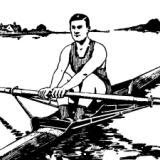
On top is a sketch from 1882 when Gilbert C Bourne rowed bow in the winning Oxford crew in the Boat Race. The following year, still at bow, Bourne took his second victory in the Race.

Thursday, January 6, 2011

Who Will Win The Boat Race?

It's a new year and I am happy to report that HTBS's Tim Koch has some interesting Boat Race stuff to bring to the table. Tim writes:

It is interesting to compare the pre Oxford - Cambridge Boat Race coverage recently posted here (HTBS 3 January 2011) with this 1939 offering.

WHO WILL WIN ?


The commentator of seventy years ago may not have known that 'bow' of a boat, rhymes with 'cow' not 'hoe' but I am sure that he would not have used the pointless expression 'kind of' five times in thirty seconds as George Nash, the Cambridge President, did. On hearing him speak I was like 'duh' but I am like sure he would be like 'whatever'. It is one of the perils of sharing a common language with the Americans.

Like best wishes for the New Year!

Tim

I would like to add some foot notes: Cambridge won the race with 3 lengths in 19 min,. 3 sec. The news reel shows Bobbie Bourne as Oxford's stroke, but he never rowed in the race. Both his father and grandfather were famous Blues. Bourne would later row in the winning 1946 Oxford boat. 'Dickie' Burnell, the tall fellow compared with the very short Oxford stroke in the news reel, would become famous as a 1948 Olympic champion in the double scull with Bert Bushnell. Burnell would write several great books on how to row and scull, but also history books on The Boat Race and the Henley Royal Regatta. - G.R.B.

Sunday, June 6, 2010

The Bournes: 5 - Carring The Family Tradition

Here is the fifth and final entry about The Bournes.

It must have weighed heavily on a young man’s shoulders to be the grandson of the famous coach Gilbert C. Bourne and the son of the great stroke Bob Bourne. In the book The Boat Race, Gordon Ross states that “R.M.A. Bourne was a great disappointment to his father because he could not get into the Eton boat.” R.M.A. (‘Bobbie’) Bourne, who was born in 1919, only made it into the 2nd eight at Eton which indeed must have felt as a dissatisfaction coming from a renowned rowing family like the Bournes. However, during his last summer at Eton, Bobbie Bourne did reach the final of the School Pulling (pair), and he did win the School Mile which both his grandfather and father had done before him.

After Eton, Bourne went up to New College in 1937, but the following year, he joined the Army. During the Battle of Dunkirk in 1940, Bobbie Bourne was captured by the Germans and he spent the rest of the War in a prison camp. When the War ended, he went back to study at Oxford, and, although “thin and wiry as ever”, as John Langfield writes in his obituary about Bourne, published in Regatta in March 1996, Bobbie Bourne made it into the Blue boat in 1946. The dark Blues won The Boat Race by 3 lengths in 19 min. 54 sec. The same year, he was in the Leander eight that took the Grand and on the same day he won the Stewards’. In 1947, his eight lost The Boat Race to Cambridge.

Here is a newsreel of Oxford training in 1946. Young Bourne can be seen early on, 5 seconds into the film, before the crew goes on the water.

OXFORD BOAT RACE AND TRAINING


Bobbie Bourne was soon elected a Henley Steward, and he went back to Eton to become a classical master. He was very well liked at Eton, though he got himself into trouble, Langfield writes in his obituary, “having set his classes to compose limericks on the four evangelists.” Of course, Bourne also coached rowing at Eton and his crews had great success winning Princess Elizabeth Cup and the Ladies’ Plate. Bobbie Bourne died in 1996.