Photograph: Werner Schmidt
Showing posts with label WWI. Show all posts

Tuesday, August 12, 2014

F.S. Kelly on the BBC

F. S. Kelly in 1903. Picture: Wikipedia.

Tim Koch writes:

Regular readers will know that HTBS has written many times about one of its heroes, Fredrick Septimus Kelly, a rower and sculler who won eight Henley medals between 1897 and 1906 and an Olympic Gold in 1908 and who was also a gifted musical composer and a gallant and decorated soldier, killed in action in 1916. In 2009, we posted a two-part biography (which is here and here) and our most recent post concerning the great man was last week when we linked to a YouTube video containing Kelly’s Elegy for String Orchestra, written at Gallipoli in memory of his friend and fellow soldier, the poet Rupert Brooke.

In the single scull, Kelly won the Wingfields in 1903 and Henley's Diamonds in 1902, 1903 and 1905. His record time for the latter, 8 minutes and 10 seconds, lasted for 30 years.

There is no shortage of accounts of a man who touched people’s lives in a variety of ways. For example, the Australian Dictionary of Biography gives a nice overview of his life while the auction sale details of his war medals naturally gives a fuller description of his military career. In 2004, the National Library of Australia published Race Against Time: The Diaries of F.S. Kelly, edited by T. Radic, and sections appear online on Google books.

Kelly’s last and perhaps greatest race was the 1908 Olympic Final in which his Leander crew beat the Belgians. Here he is standing on the far left of the crew known as ‘The Old Crocks’.

The most recent tribute to Kelly has been by BBC Radio. On 10 August they broadcast an hour long programme fronted by Steve Williams who won Gold in the GB coxless four in both the Athens and Beijing Olympics. It was in a series entitled “Heroes at War” (though “Sporting Heroes at War” would have been more descriptive). Those in the UK who missed it can hear it through the ‘on demand’ site, BBC iPlayer which will have it available for a week, until 11am on Sunday, 17 August. While iPlayer TV programmes can only be viewed by those with British Internet Service Providers, radio (for some reason) can be accessed (also only until the 17th) from anywhere in the world through www.bbc.co.uk/radio (though only via a desktop computer, not a smart phone). Unfortunately, the end of the online version seems to have been clipped.

Steve Williams, later accompanied by BBC Northampton sports editor, Graham McKechnie, records his thoughts ‘on location’ in Henley, Marlow, Gallipoli and the former battlefields of northern France, frequently quoting from Kelly’s diary and with the man’s music forming the underscore. The result is an atmospheric and moving insight into a very complex personality. I particularly like the story that Williams tells of Kelly conducting his battalion’s band as they perform Tchaikovsky’s 1812 Overture at the Front, presumably within the sound of real artillery. Famously, the ‘1812’ is best known for its finale fanfare of chimes, brass and ‘cannon’. It is, as Williams observes, a very ‘cinematic’ image, and I would suggest that were it a product of a piece of fiction, it could be considered too contrived.
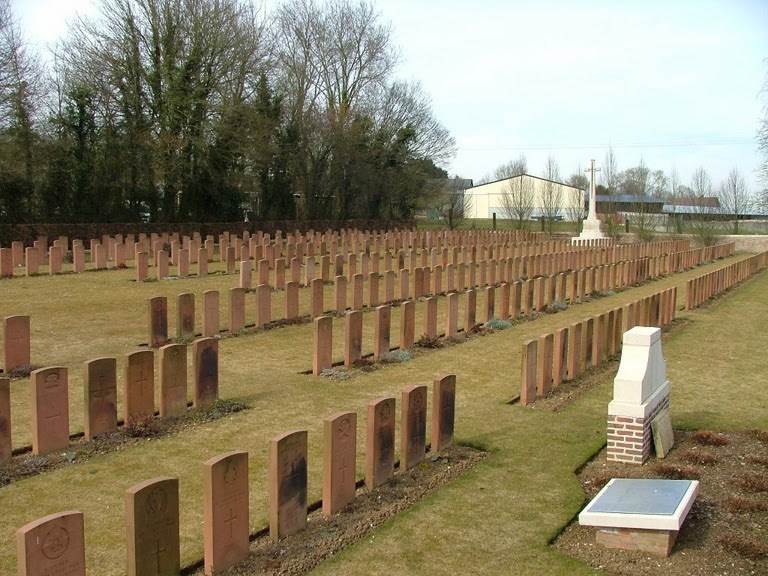
The Martinsart British Cemetery near Albert in Picardie where Kelly is buried. Picture: Commonwealth War Graves Commission.

Put aside an hour and enjoy this tribute to a great athlete, artist and soldier.

Thursday, August 7, 2014

In Memory of Oarsmen who Died in the Great War

Martinsart's British Cemetery, where F. S. Kelly is buried.

This year media are writing celebratory pieces on the First World War that began 100 years ago, on 28 July 1914 to be more exact. The River and Rowing Museum in Henley-on-Thames has just started a very promising blog, Home Front Henley, about the War. Read it here.

HTBS has several times written about oarsmen who fell in the Great War. To mention a few of the more famous ones: Frederick Septimus Kelly, Julian Grenfell, Eric Fairbairn, Guiseppe Sinigaglia and Bernhard von Gaza. We have also posted articles on War Monuments at rowing clubs and other places and war recruitment posters.

In his book The Boat Race: The Story of the First Hundred Races between Oxford and Cambridge (1954) author Gordon Ross lists 42 names of British Blues who paid the ultimate price during the 1914-1918 War - twenty-one Dark Blues and twenty-one Light Blues.

On 1 August Martin Cross published a wonderful piece on FISA’s World Rowing website about the First World War and oarsmen who fought on the battlefields around the world. Read his piece here and watch his video (below) on how he, in May, sculled the River Somme in France to commemorate the brave oarsmen who died:


In the June/July issue of British Rowing’s magazine Rowing & Regatta, Cross also had a well-written piece about his Somme row.

Though the following video has been posted on many places around the web during the last couple of weeks, it is worth watching and listen to over and over again. This is oarsman and composer F. S. Kelly’s Elegy for String Orchestra, written at Gallipoli in memory of Rupert Brooke, the poet and fellow soldier, who had died on board a French hospital ship just off the Greek island of Skyros, where Kelly and his comrades buried Brooke.

Wednesday, March 5, 2014

Bring your WWI Story to RRM!

For an August 2014 exhibition on the First World War in Henley-on-Thames and along the River Thames, the River and Rowing Museum is asking people to share stories, photographs, objects or documents with the Museum at a drop-in session between 2 p.m. and 4 p.m. on Sunday 9 March. The River and Rowing Museum would like to record it for future generations.