Showing posts with label Women Rowing. Show all posts
Saturday, June 21, 2014
Women Racing at Marlow 95 Years Ago
Today, it was both the Marlow Regatta, held at Dorney Lake (this year only a one-day regatta), and Henley Women's Regatta at Henley, of course. We will hopefully put links up for the results tomorrow, but in the meantime enjoy a ninety-five-year-old little film from Marlow, where women of Newnham College, Cambridge University, met London School of Medicine.
Monday, April 21, 2014
Ida Bet She Was the Darling of the Waves
Rowing historian Thomas E. Weil writes:
Physicists will argue that two people cannot be in the same place at the same time, but a marvelous piece of rowing memorabilia may provide an exception to the rule. A small commercial albumen photograph, possibly published about 1870, and mounted on a piece of card (commonly called a carte de visite, or cdv), shows a picture of a young lady with wind-tossed hair sitting alone at the oars in a boat in heavy seas (see image above). While neither the photograph nor the side of the card to which it is affixed bear any identifying labels, the reverse of the card does. At the extreme opposite edges of that back side are printed two names: “Grace Darling” and “Ida Lewis” (see image below). While physics insists that the lady in the boat cannot be both, our intriguing cdv suggests otherwise. Whazzup?
From the collection of Thomas E. Weil.
Darling and Lewis were two popular heroic female figures of the nineteenth century. Each was a lighthouse keeper’s daughter who rescued shipwrecked unfortunates. There most similarities end, but that was all our anonymous cdv publisher needed to try to make one equal to two.
While Grace Darling (1815-1842) appears to have been more widely lionized, her fame arose from just one incident. Spotting the wreck of the steamship Forfarshire on a nearby island, on the morning of September 7, 1838, Darling, then 22, and her father rowed their 21-foot, 4-man Northumberland coble from the Longstone Lighthouse on the Farne Islands a mile out to the site in seas that were too heavy for the local lifeboat to brave. Upon reaching the remains of the vessel, Darling manned the oars while her father assisted four men and a woman into the boat, and her father and three of the men then rowed the coble back to the lighthouse. Four years later, without additional heroics, Grace was dead of tuberculosis.
From the collection of Thomas E. Weil.
The Grace Darling Monument, Bamburgh. Photo: Wikipedia.
Darling’s story fired England’s imagination, and produced articles, sheet music, books, poems, prints, paintings, memorabilia, a lifeboat named after her, a large monument in the cemetery in which she was buried and a recent musical. One of the first books, Grace Darling, or the Maid of the Isles, published the year following the rescue, praised “the girl with windswept hair”, which became a mainstay of the legend and most subsequent images. William Wordsworth celebrated her in his eponymous 1843 poem. Her fame has endured, generating several books in the 175 years since her feat, and a museum in the town of Bamburgh, which is dedicated to her memory as well as the story of local coastal life.
The improbably named Idawalley Zorada Lewis’s story presents a very different picture, as it were. Her exploits covered a lifetime. Lewis (1842-1911) was a young girl at Lime Rock Light in Newport, Rhode Island, when her father fell ill, leaving her mother and her to run the station until 1879, when her mother also fell ill. Lewis carried on all on her own. Over the years after her first rescue (1858), she saved between 18 and 36 people (many of whom found trouble while pleasure boating on Newport Bay), in most cases by rowing alone to the boat and pulling the victims from the water. Lewis’s recognition came mostly from newspapers and from lifesaving institutions, which gave her medals and pensions. While she did not inspire as many literary efforts as Grace Darling, Lime Rock was re-named Ida Lewis Rock in her honor, and the Coast Guard named a class of buoy-tenders after her. Interestingly, the same image shown on top is included as a picture of Ida Lewis in the Wikipedia article on her.
Ida Lewis with the tool of her trade. Photo from the online magazine Ocean Happening.
So what can we conclude about this cdv? We know nothing of the publisher, or the place or year of publication, but it is obvious that the publisher wished to take advantage of both of the Grace Darling and Ida Lewis markets if possible. The smaller photo was placed on the mounting card such that, depending on how close one trimmed the mount to the image, one could cut away either printed name on the reverse (or both) without damaging the photo, and market the cdv to suit the remaining “title”.
And the fidelity of the image? To begin with, it is an illustration (whether a drawing, watercolor or painting is not clear, but it is not a woodcut as described on Wikipedia), so it is a product of imagination. Darling rowed out with her father, so any depiction of her alone in the boat in the open seas is pure fiction. On the other hand, between the age of the person shown and the state of the waves, the image seems unlikely to represent Lewis.
I would posit that this was originally a fanciful (and inaccurate) glorification of Grace Darling, “the girl with windswept hair”, which was then appropriated to serve as a souvenir of Ida Lewis … or, as this publisher shows, either or both women. The truth was beside the point, because the legend was the point. That the stories of Darling and Lewis were publicized at the time as extraordinary performances by singularly unusual women rather than to suggest that these feats might demonstrate the capability of women to not just survive, but excel at, strenuous physical activity at the oars, is, in a way, rather sad. In addition to demonstrating their bravery, had these women been recognized a century and a half ago as showing that, contrary to popular belief, women might be strong enough to engage in competitive rowing, our sport and its history would have been much the better for it.
Monday, March 24, 2014
Good Times in a Rat Infested Shack - Tom Green’s Boathouse
Female rowers with their ‘cute purses’ (‘purses’ are ‘handbags’ or ‘shoulder bags’ in British-English.)
Tim Koch writes:
The recent HTBS posting ‘Female Rowers With Their Cute Purses’ showed a 1939 photograph of a group of women taking their oars to the river’s edge while carrying cardboard boxes containing gas masks strung around their necks. Britain officially declared war on 3 September 1939 but ‘Air Raid Precautions’ to protect the civilian population had been going on for some time before that. There was a real fear that gas bombs would be used in air raids on cities and the distribution of civilian gas masks had started in June 1939. By September, 38 million masks had been issued.
As the war progressed, the risk of gas attack diminished and masks were carried less and less. However, some men found that being able to carry a socially acceptable ‘manbag’ was too convenient a thing to give up and kept their cigarettes, spectacles, wallet, sandwiches etc. in their gas mask case. While gas bombs were never used in air raids, some people allegedly died when they ‘tested’ their masks by wearing them and putting their head in a gas oven. The mask filters (which contained white asbestos) were not designed to deal with the coal-gas used in heating and cooking.
Some of the boxes in the picture have been decorated by their owners and other women even knitted covers for their gas mask container.
A knitting pattern of 1940 for gloves, scarf and gas mask container. It is strange that there were concerns about such things when, by June 1940, the Nazis were in France poised for invasion across the English Channel. Perhaps it says something about the British ‘stiff upper lip’ and the spirit of Mrs. Miniver.
A range of commercial gas mask bags were produced for sale by enterprising manufacturers, though not all were as sophisticated as these.
Following the posting of the 1939 picture, rowing historian Colin Cracknell wrote in the comments section:
Any idea where this was taken? It looks as if it could be the foreshore at Tom Green’s Boathouse, Barnes Bridge. Alpha Ladies boated from there, but I’m informed that those are not their blades.
I do not know which club the blades belonged to, but I can confirm that it was taken on the Thames outside Tom Green’s Boathouse next to Barnes Bridge, half a mile from the finish of the Oxford-Cambridge Boat Race course. The recent picture posted below shows the same spot – though it covers a much wider angle.
The double steps in the top right of the 1939 picture are shown above the coaching launch here. They were to gain access to the police launches that were moored opposite Tom Green’s, one of which can be seen in the old photograph. Also in the black and white picture, the windows of the red brick mansion (apartment) block opposite are reflected in the water. The colour picture shows Barnes Bridge on the left and next to it the distinctive ‘Tower House’ which was once the home of Geoffrey Page, rowing historian and rowing correspondent of the Daily Telegraph.
Boat Christening at Tom Green’s showing much the same view across the river as today. Picture: River and Rowing Museum.
Tom Green’s Boathouse, c.1937.
The core of the boathouse that was to become Tom Green’s existed before 1876, but it was in this year that it was taken over by the Thomas George Green and it stayed in the family until its demise ninety-nine years later. By accident or design, it seems to have attracted those whom most of the amateur rowing world marginalised. In the words of a 1947 newspaper ‘Green's boat-house provides for "homeless" tradesmen, artisans and women who like the river’.
Some ‘women who like the river’ at Tom Green's sometime in the 1930s. Picture: River and Rowing Museum.
Tom Green’s, sometime between the Wars. The women wearing the ‘club’ symbol are members of Alpha Rowing Club, based at Green’s. I think that the woman standing second from the right is Amy Gentry, a famous advocate of women’s rowing. She and the other non-Alpha RC women would be members of Weybridge Ladies Amateur Rowing Club. Picture: River and Rowing Museum.
The ever fascinating Pathe Newsreel website has a couple of wonderful films showing women rowing out of Green’s in the 1920s and 1930s. Eve on the River was shot in 1921 and River Girls in 1931. I think we see Tom Senior in the first film and Tom Junior in the second. There is also a 1927 film of Bert Barry training out of Green’s for the World Championship.
Before I attempt a brief history of Tom Green’s Boathouse, I would like to finish off the ‘wartime’ aspect that started this story. In the Cygnet Rowing Club newsletter of 2004, Rene Rawkins gave a wonderfully frank account of rowing out of Green’s during the 1939-1945 War. I reproduce it here with the permission of her son, Paul, who has written a history of Cygnet RC (click here and then on the ‘history’ link on the left).
Rene wrote:
Tom Green’s Boathouse was a rat infested wooden shack situated immediately adjacent to Barnes Bridge on the Chiswick side, close to the site where Thames Tradesmen’s Rowing Club now stands. There were no showers... Ma Green – Tom Green’s wife – cooked on a large (bottled gas) stove, there being no electricity either. Needless to say, no insurance company would touch the place.... For all that, we had some good times there.
A large number of clubs boated out of Tom Green’s during the war, some of them refugees from the Civil Service Boathouse, which had been requisitioned as a morgue in 1939. My own club, the Savings Bank.... moved to Green’s in 1935. Other incumbents were Alpha and St George’s [both women’s clubs, TK]. Come the war, we were joined by the likes of the Ministry of Pensions and the Ministry of Health.
Tom Green was one of the river’s great characters; a professional boatmen, he was given to binge drinking and frequently disappeared for days at a time, before being brought back much the worse for wear on the ferry that ran between Barnes and Chiswick. Ma Green was forever purloining our sweaters and shoes while we were out on the water. Yet, if you enquired about the whereabouts of a missing item of clothing she’d swear blind that she’d never seen it, even when she was standing before you actually wearing it....
Ma Green: ‘I don't know anything about a missing beret.... or earrings’. Picture: River and Rowing Museum.
Despite the war, rowing at Tom Green’s followed a very familiar pattern with outings during the week and on Saturday afternoons and Sunday mornings. On just one such Sunday morning in mid May 1940, I remember standing on the foreshore and watching a whole flotilla of brightly decorated craft.... heading down river.... Two weeks later less than half their number made their way back up river, all painted in battle grey and very battered – the remnants of Dunkirk.
Women’s rowing flourished during the war, most men having been called up..... There was a very full regatta programme right the way through the war...... mostly held in aid of the services and the Red Cross. We ventured as far afield as Torquay. I still have the trophy to show for our first encounter with coastal rowing and damned hard work it was too!
A pre-war picture of Green’s and Barnes Bridge.
The same view today. Green’s was where the trees now are. The modern boathouse belongs to Thames Tradesmen’s Rowing Club.
The story of this historic boat house starts with Tom Green Senior, that is Thomas George Green. At age 16, in 1864, he was apprenticed as a waterman to his father. He completed his apprenticeship and became a member of the Watermen’s Company in 1871 and won the Doggett’s Coat and Badge in 1872. He had a successful rowing career including winning the Champion Fours (‘The Championship of England’) at the Thames Regatta at least four times in the early 1870s. In September 1876 Tom’s waterman's four went to the United States where they raced on the Schuykill in Philadelphia and beat crews from New York and Halifax for a prize of $2,500. Tom also got $500 for second place in the Open Sculls. In later life he became a King’s Waterman.
Perhaps using his American prize money, in 1876, Tom Green bought a rundown boathouse next to Barnes Bridge and set to rebuilding it while also building a fleet of boats. Green’s eventually had sixty boats to hire to serious and not so serious rowers and it became the headquarters of several rowing clubs and the base for a number of regatta committees. In those days a rowing club did not have to own any boats, many survived by hiring craft as they were needed and this made the sport accessible to ordinary working people. In a short history of Green’s written by John Powell, a copy of which is with the River and Rowing Museum, it is recoded that the clubs using the boathouse at one time included: Cobden, Gaiety, Nelson, Temple, Metropolitan Police, Helen Smith’s, The Times, Daily Mail, News Chronicle and Star, University of London Medical School, The Ladies Boat Club of the UC Hospital, The Ladies Boat Club, Simpson’s on the Strand and Grosvenor. Powell later quotes from a history of Thames Tradesmen’s Rowing Club which adds that ‘Barnes Bridge, Amalgamated Press, Alpha Ladies, London Transport and St George’s Ladies made their home with Tom Green.’
Tom Senior was also an accomplished coach. He trained Bill Beach, the Australian who was undefeated as World Professional Sculling Champion from 1884 to 1887, when he undertook a series of challenges over the Thames Championship Course, Putney to Mortlake, in 1886. In his book A History of Rowing (1957), Hylton Cleaver reports the extraordinary story of Beach’s race against the Canadian, Jacob Gaudaur, when each sculler in turn stopped from exhaustion and slumped in his boat:
At Barnes Bridge.... Beach was exhausted. (Tom Green Snr.) the man who trained him.... shouted to his man to stop and to come to him at the raft – rather like a naughty schoolboy. Beach wearily pulled in as ordered; his trainer splashed him full in the face with water and spoke these words: ‘Now, Bill! Think of your wife and children, and go after him, for he’s as bad as you!’ Such were the effect of the cold shower and these orders that, in an unforgetable finish, Beach did win on the post.
A great story – a pity that it is not true. The Times carried a full report on the race and does not mention this incident. What it does say is that Beach led by half a length passing Green’s boathouse and extended this to three lengths at the finish. Further, Tom was not on the bank but was following the Australian in a pilot boat, acting as his steersman. However, the report does acknowledge that Tom’s motivational calls aided Beach greatly and that the sculler acted ‘in obedience to the earnest entreaties of Green’.
Tom Green Senior in later life. Picture: River and Rowing Museum.
Cleaver also records that Tom Senior trained Charles ‘Wag’ Harding to victory in both his races against the considerably larger Tom Sullivan of New Zealand for the English Sculling Championship in 1895. Many other professionals used Green’s as a base when preparing for Tideway races. The great Ned Hanlan trained from there in his race against Trickett for the World Professional Championship in 1880, and Ernest Barry often used Green’s, first in his race against Towns for the English Championship in 1908. No doubt all received the benefit of Tom’s advice and, in their races, many were steered by him from a pilot boat. Tom steered amateurs as well as professionals, notably in the Wingfield Sculls of 1887 when he guided Steve Fairbairn.
Tom Senior had five sons and six daughters. Three of the boys became Watermen, but it was Thomas George Edward Green (‘Tom Green Junior’ or ‘Young Tom’) who took over the boathouse on the death of his father aged 77, in 1925. Young Tom never weighed more than 8 1/2 stone / 120 lbs / 54 kg but came second in the Doggett’s of 1897. Cleaver says that he had a Clasper boat made that was 31ft / 9.44 m long, 8.5 ins / 22 cms wide and which weighed 21 lbs / 9.5 kg. In this he won the London Coat and Badge.
A rare picture of Young Tom Green (centre) without his cap. The man on the left is B.C. Fisher, described by Hylton Cleaver as 'a devout and long standing disciple of Steve’s [Steve Fairbairn]'. He was involved with Fairbairn in establishing the Head of the River Race. The man on the right is Geoffrey Carr, an Anglian RC cox from 1903 to 1914. He won the Thames Cup with Anglian at Henley Royal in 1910 and a silver medal steering a famous Thames four in the 1912 Stockholm Olympics.
In the fifty years between 1925 and 1975 Green’s seemed to have carried on as if the world was not changing, particularly as regards health and safety and ideas on basic sanitation. The history of Thames Tradesmen’s notes that at some time:
Toilet facilities were very primitive consisting only of a canvas enclosure ‘out in the woods’. Guests were confronted by a board with two apertures and the entertainment provided by the birds, bees, and other denizens of the trees.
Rita Cramp (née Dennis) joined Alpha as a schoolgirl in the early 1950s. She recalls:
I used to take a filled hot water bottle so I could have a warm wash after our outings or evening runs. It was then used for others to wash their feet in. It was all so taken for granted, it’s amazing when one thinks of it now.
A contemporary of Rita’s, Nina Padwick, remembers' the cold water and big sink and the oil heater on which we could stand a kettle (and) the way that the leathers we used on the boats got ‘eaten by rats’ (though John Hart found many tucked away after Mrs. Green died)'.
John Hart was responsible for rescuing the extensive ‘Green archive’ (now held by the River and Rowing Museum) from certain destruction after Ma Green died.
Young Tom and his redoubtable wife, Kate, universally known as ‘Ma and Pa’, continued regardless, the premises decaying around them. Even so, in 1957 rowing journalist Hylton Cleaver wrote that ‘today sixteen men’s clubs and two women’s clubs use the quarters’.
When Tom became infirm in his late seventies, Ma continued the business, personally dragging the boats for hire in and out of the boathouse. Colin Cracknell recalls Ma making him stand outside in the rain when he arrived early one day because ‘Anglian’s time is two o’clock’. Colin continues:
I boated from Tom Green’s in 1961/62, before Anglian and Mortlake merged and moved into their new premises by the crematorium. By that time the accommodation at Green’s was rather Spartan, (perhaps it always was), but Anglian had a reasonably comfortably club room and bar.... there were showers although they were rarely used. People just sluiced down out of old enamel bowls after an outing. The mud on the foreshore was something to behold, (not like the gas mask picture, when it seems to have been well cared for with shingle etc.), and you could easily lose your (boots) there.
Young Tom died in 1958 in the rooms about the boat racks where he was born 84 years earlier.
Young Tom Green, possibly just back from the pub... Picture: River and Rowing Museum.
In 1923 the land upon which Green’s stood had been purchased from the Duke of Devonshire by the local government body, Chiswick Urban District Council, who became Tom’s landlord. Shortly after the Second World War, the council had made an effort to close down Green’s, so they could build a communal boathouse on the site. However, it would take more than the massed resources of local government to shift Ma Green and it was only on her death in 1975 that the authorities got their way. Sadly, they were assisted by the fact that the boathouse burnt down in 1977. It was, until then, as it was twenty years earlier when Hylton Cleaver wrote ‘Tom Green’s Boathouse today is a relic of the days when Putney Bridge was wooden and horse-drawn coaches crossed it...’
The trees mark where Tom Green’s stood. Thames Tradesmen’s Rowing Club boat from the undistinguished boat house in the centre. Across the river are the distinctive white double balconies of the 1899 White Hart pub in Barnes, a fine viewing point for races on the Championship Course and once the temporary base of many professionals training out of Green’s.
I found this decorative ironwork in the undergrowth alongside the railway embankment that ran alongside the boathouse. Is this the last, sad remains of Tom Green’s, a relic of Victorian rowing that lasted until 1975?
If you wish to find out more about Tom Green’s Boathouse, the River and Rowing Museum has put their extensive Green archive online.
Tim Koch writes:
The recent HTBS posting ‘Female Rowers With Their Cute Purses’ showed a 1939 photograph of a group of women taking their oars to the river’s edge while carrying cardboard boxes containing gas masks strung around their necks. Britain officially declared war on 3 September 1939 but ‘Air Raid Precautions’ to protect the civilian population had been going on for some time before that. There was a real fear that gas bombs would be used in air raids on cities and the distribution of civilian gas masks had started in June 1939. By September, 38 million masks had been issued.
A poster of 1939.
As the war progressed, the risk of gas attack diminished and masks were carried less and less. However, some men found that being able to carry a socially acceptable ‘manbag’ was too convenient a thing to give up and kept their cigarettes, spectacles, wallet, sandwiches etc. in their gas mask case. While gas bombs were never used in air raids, some people allegedly died when they ‘tested’ their masks by wearing them and putting their head in a gas oven. The mask filters (which contained white asbestos) were not designed to deal with the coal-gas used in heating and cooking.
Some of the boxes in the picture have been decorated by their owners and other women even knitted covers for their gas mask container.
A knitting pattern of 1940 for gloves, scarf and gas mask container. It is strange that there were concerns about such things when, by June 1940, the Nazis were in France poised for invasion across the English Channel. Perhaps it says something about the British ‘stiff upper lip’ and the spirit of Mrs. Miniver.
A range of commercial gas mask bags were produced for sale by enterprising manufacturers, though not all were as sophisticated as these.
Following the posting of the 1939 picture, rowing historian Colin Cracknell wrote in the comments section:
Any idea where this was taken? It looks as if it could be the foreshore at Tom Green’s Boathouse, Barnes Bridge. Alpha Ladies boated from there, but I’m informed that those are not their blades.
I do not know which club the blades belonged to, but I can confirm that it was taken on the Thames outside Tom Green’s Boathouse next to Barnes Bridge, half a mile from the finish of the Oxford-Cambridge Boat Race course. The recent picture posted below shows the same spot – though it covers a much wider angle.
The double steps in the top right of the 1939 picture are shown above the coaching launch here. They were to gain access to the police launches that were moored opposite Tom Green’s, one of which can be seen in the old photograph. Also in the black and white picture, the windows of the red brick mansion (apartment) block opposite are reflected in the water. The colour picture shows Barnes Bridge on the left and next to it the distinctive ‘Tower House’ which was once the home of Geoffrey Page, rowing historian and rowing correspondent of the Daily Telegraph.
Boat Christening at Tom Green’s showing much the same view across the river as today. Picture: River and Rowing Museum.
Tom Green’s Boathouse, c.1937.
The core of the boathouse that was to become Tom Green’s existed before 1876, but it was in this year that it was taken over by the Thomas George Green and it stayed in the family until its demise ninety-nine years later. By accident or design, it seems to have attracted those whom most of the amateur rowing world marginalised. In the words of a 1947 newspaper ‘Green's boat-house provides for "homeless" tradesmen, artisans and women who like the river’.
Some ‘women who like the river’ at Tom Green's sometime in the 1930s. Picture: River and Rowing Museum.
Tom Green’s, sometime between the Wars. The women wearing the ‘club’ symbol are members of Alpha Rowing Club, based at Green’s. I think that the woman standing second from the right is Amy Gentry, a famous advocate of women’s rowing. She and the other non-Alpha RC women would be members of Weybridge Ladies Amateur Rowing Club. Picture: River and Rowing Museum.
The ever fascinating Pathe Newsreel website has a couple of wonderful films showing women rowing out of Green’s in the 1920s and 1930s. Eve on the River was shot in 1921 and River Girls in 1931. I think we see Tom Senior in the first film and Tom Junior in the second. There is also a 1927 film of Bert Barry training out of Green’s for the World Championship.
Before I attempt a brief history of Tom Green’s Boathouse, I would like to finish off the ‘wartime’ aspect that started this story. In the Cygnet Rowing Club newsletter of 2004, Rene Rawkins gave a wonderfully frank account of rowing out of Green’s during the 1939-1945 War. I reproduce it here with the permission of her son, Paul, who has written a history of Cygnet RC (click here and then on the ‘history’ link on the left).
Rene wrote:
Tom Green’s Boathouse was a rat infested wooden shack situated immediately adjacent to Barnes Bridge on the Chiswick side, close to the site where Thames Tradesmen’s Rowing Club now stands. There were no showers... Ma Green – Tom Green’s wife – cooked on a large (bottled gas) stove, there being no electricity either. Needless to say, no insurance company would touch the place.... For all that, we had some good times there.
A large number of clubs boated out of Tom Green’s during the war, some of them refugees from the Civil Service Boathouse, which had been requisitioned as a morgue in 1939. My own club, the Savings Bank.... moved to Green’s in 1935. Other incumbents were Alpha and St George’s [both women’s clubs, TK]. Come the war, we were joined by the likes of the Ministry of Pensions and the Ministry of Health.
Tom Green was one of the river’s great characters; a professional boatmen, he was given to binge drinking and frequently disappeared for days at a time, before being brought back much the worse for wear on the ferry that ran between Barnes and Chiswick. Ma Green was forever purloining our sweaters and shoes while we were out on the water. Yet, if you enquired about the whereabouts of a missing item of clothing she’d swear blind that she’d never seen it, even when she was standing before you actually wearing it....
Ma Green: ‘I don't know anything about a missing beret.... or earrings’. Picture: River and Rowing Museum.
Despite the war, rowing at Tom Green’s followed a very familiar pattern with outings during the week and on Saturday afternoons and Sunday mornings. On just one such Sunday morning in mid May 1940, I remember standing on the foreshore and watching a whole flotilla of brightly decorated craft.... heading down river.... Two weeks later less than half their number made their way back up river, all painted in battle grey and very battered – the remnants of Dunkirk.
Women’s rowing flourished during the war, most men having been called up..... There was a very full regatta programme right the way through the war...... mostly held in aid of the services and the Red Cross. We ventured as far afield as Torquay. I still have the trophy to show for our first encounter with coastal rowing and damned hard work it was too!
A pre-war picture of Green’s and Barnes Bridge.
The same view today. Green’s was where the trees now are. The modern boathouse belongs to Thames Tradesmen’s Rowing Club.
The story of this historic boat house starts with Tom Green Senior, that is Thomas George Green. At age 16, in 1864, he was apprenticed as a waterman to his father. He completed his apprenticeship and became a member of the Watermen’s Company in 1871 and won the Doggett’s Coat and Badge in 1872. He had a successful rowing career including winning the Champion Fours (‘The Championship of England’) at the Thames Regatta at least four times in the early 1870s. In September 1876 Tom’s waterman's four went to the United States where they raced on the Schuykill in Philadelphia and beat crews from New York and Halifax for a prize of $2,500. Tom also got $500 for second place in the Open Sculls. In later life he became a King’s Waterman.
Perhaps using his American prize money, in 1876, Tom Green bought a rundown boathouse next to Barnes Bridge and set to rebuilding it while also building a fleet of boats. Green’s eventually had sixty boats to hire to serious and not so serious rowers and it became the headquarters of several rowing clubs and the base for a number of regatta committees. In those days a rowing club did not have to own any boats, many survived by hiring craft as they were needed and this made the sport accessible to ordinary working people. In a short history of Green’s written by John Powell, a copy of which is with the River and Rowing Museum, it is recoded that the clubs using the boathouse at one time included: Cobden, Gaiety, Nelson, Temple, Metropolitan Police, Helen Smith’s, The Times, Daily Mail, News Chronicle and Star, University of London Medical School, The Ladies Boat Club of the UC Hospital, The Ladies Boat Club, Simpson’s on the Strand and Grosvenor. Powell later quotes from a history of Thames Tradesmen’s Rowing Club which adds that ‘Barnes Bridge, Amalgamated Press, Alpha Ladies, London Transport and St George’s Ladies made their home with Tom Green.’
Tom Senior was also an accomplished coach. He trained Bill Beach, the Australian who was undefeated as World Professional Sculling Champion from 1884 to 1887, when he undertook a series of challenges over the Thames Championship Course, Putney to Mortlake, in 1886. In his book A History of Rowing (1957), Hylton Cleaver reports the extraordinary story of Beach’s race against the Canadian, Jacob Gaudaur, when each sculler in turn stopped from exhaustion and slumped in his boat:
At Barnes Bridge.... Beach was exhausted. (Tom Green Snr.) the man who trained him.... shouted to his man to stop and to come to him at the raft – rather like a naughty schoolboy. Beach wearily pulled in as ordered; his trainer splashed him full in the face with water and spoke these words: ‘Now, Bill! Think of your wife and children, and go after him, for he’s as bad as you!’ Such were the effect of the cold shower and these orders that, in an unforgetable finish, Beach did win on the post.
A great story – a pity that it is not true. The Times carried a full report on the race and does not mention this incident. What it does say is that Beach led by half a length passing Green’s boathouse and extended this to three lengths at the finish. Further, Tom was not on the bank but was following the Australian in a pilot boat, acting as his steersman. However, the report does acknowledge that Tom’s motivational calls aided Beach greatly and that the sculler acted ‘in obedience to the earnest entreaties of Green’.
Tom Green Senior in later life. Picture: River and Rowing Museum.
Cleaver also records that Tom Senior trained Charles ‘Wag’ Harding to victory in both his races against the considerably larger Tom Sullivan of New Zealand for the English Sculling Championship in 1895. Many other professionals used Green’s as a base when preparing for Tideway races. The great Ned Hanlan trained from there in his race against Trickett for the World Professional Championship in 1880, and Ernest Barry often used Green’s, first in his race against Towns for the English Championship in 1908. No doubt all received the benefit of Tom’s advice and, in their races, many were steered by him from a pilot boat. Tom steered amateurs as well as professionals, notably in the Wingfield Sculls of 1887 when he guided Steve Fairbairn.
Tom Senior had five sons and six daughters. Three of the boys became Watermen, but it was Thomas George Edward Green (‘Tom Green Junior’ or ‘Young Tom’) who took over the boathouse on the death of his father aged 77, in 1925. Young Tom never weighed more than 8 1/2 stone / 120 lbs / 54 kg but came second in the Doggett’s of 1897. Cleaver says that he had a Clasper boat made that was 31ft / 9.44 m long, 8.5 ins / 22 cms wide and which weighed 21 lbs / 9.5 kg. In this he won the London Coat and Badge.
A rare picture of Young Tom Green (centre) without his cap. The man on the left is B.C. Fisher, described by Hylton Cleaver as 'a devout and long standing disciple of Steve’s [Steve Fairbairn]'. He was involved with Fairbairn in establishing the Head of the River Race. The man on the right is Geoffrey Carr, an Anglian RC cox from 1903 to 1914. He won the Thames Cup with Anglian at Henley Royal in 1910 and a silver medal steering a famous Thames four in the 1912 Stockholm Olympics.
In the fifty years between 1925 and 1975 Green’s seemed to have carried on as if the world was not changing, particularly as regards health and safety and ideas on basic sanitation. The history of Thames Tradesmen’s notes that at some time:
Toilet facilities were very primitive consisting only of a canvas enclosure ‘out in the woods’. Guests were confronted by a board with two apertures and the entertainment provided by the birds, bees, and other denizens of the trees.
Rita Cramp (née Dennis) joined Alpha as a schoolgirl in the early 1950s. She recalls:
I used to take a filled hot water bottle so I could have a warm wash after our outings or evening runs. It was then used for others to wash their feet in. It was all so taken for granted, it’s amazing when one thinks of it now.
A contemporary of Rita’s, Nina Padwick, remembers' the cold water and big sink and the oil heater on which we could stand a kettle (and) the way that the leathers we used on the boats got ‘eaten by rats’ (though John Hart found many tucked away after Mrs. Green died)'.
John Hart was responsible for rescuing the extensive ‘Green archive’ (now held by the River and Rowing Museum) from certain destruction after Ma Green died.
Young Tom and his redoubtable wife, Kate, universally known as ‘Ma and Pa’, continued regardless, the premises decaying around them. Even so, in 1957 rowing journalist Hylton Cleaver wrote that ‘today sixteen men’s clubs and two women’s clubs use the quarters’.
When Tom became infirm in his late seventies, Ma continued the business, personally dragging the boats for hire in and out of the boathouse. Colin Cracknell recalls Ma making him stand outside in the rain when he arrived early one day because ‘Anglian’s time is two o’clock’. Colin continues:
I boated from Tom Green’s in 1961/62, before Anglian and Mortlake merged and moved into their new premises by the crematorium. By that time the accommodation at Green’s was rather Spartan, (perhaps it always was), but Anglian had a reasonably comfortably club room and bar.... there were showers although they were rarely used. People just sluiced down out of old enamel bowls after an outing. The mud on the foreshore was something to behold, (not like the gas mask picture, when it seems to have been well cared for with shingle etc.), and you could easily lose your (boots) there.
Young Tom died in 1958 in the rooms about the boat racks where he was born 84 years earlier.
Young Tom Green, possibly just back from the pub... Picture: River and Rowing Museum.
In 1923 the land upon which Green’s stood had been purchased from the Duke of Devonshire by the local government body, Chiswick Urban District Council, who became Tom’s landlord. Shortly after the Second World War, the council had made an effort to close down Green’s, so they could build a communal boathouse on the site. However, it would take more than the massed resources of local government to shift Ma Green and it was only on her death in 1975 that the authorities got their way. Sadly, they were assisted by the fact that the boathouse burnt down in 1977. It was, until then, as it was twenty years earlier when Hylton Cleaver wrote ‘Tom Green’s Boathouse today is a relic of the days when Putney Bridge was wooden and horse-drawn coaches crossed it...’
The trees mark where Tom Green’s stood. Thames Tradesmen’s Rowing Club boat from the undistinguished boat house in the centre. Across the river are the distinctive white double balconies of the 1899 White Hart pub in Barnes, a fine viewing point for races on the Championship Course and once the temporary base of many professionals training out of Green’s.
I found this decorative ironwork in the undergrowth alongside the railway embankment that ran alongside the boathouse. Is this the last, sad remains of Tom Green’s, a relic of Victorian rowing that lasted until 1975?
If you wish to find out more about Tom Green’s Boathouse, the River and Rowing Museum has put their extensive Green archive online.
Saturday, March 8, 2014
International Women’s Day - That is Why
(Click on the image to enlarge it)
Tim Koch writes:
Following today’s earlier post for International Women’s Day, the caption on the cover of the Rowing magazine of December 1960 is a reminder of why such a thing is necessary.
A Morning Row...
Today, on International Women’s Day, I though we should relax and watch a beautifully shot rowing video from South America. A woman setting out in a single scull in the morning from the club Grêmio Náutico União, which was founded in 1906 in Porto Alegre, in the south of Barzil. Enjoy!
Saturday, February 8, 2014
Female Rowers with their Cute Purses
Talking about rowers’ knees and legs, as HTBS did yesterday, well, male ones, it is time to show some female rowers in shorts. However, the most interesting thing with this photograph, depicting some young women carrying their oars down to the River Thames in London in 1939, is the women’s cute little purses. Do you think that these women are vain, bringing their purses with lipstick, face powder, a little mirror perhaps and…? Well, you are wrong. They are only trying to save their lives - in their cute purses are gas masks.
Friday, December 20, 2013
The 2013 Oxford - Cambridge Women’s Trial Eights: Races To The Finish
Maintaining form. Anastasia Chitty and OUWBC President Maxie Scheske, Stroke and 7 of Boudicca.
Here is Tim Koch’s report from Oxford and Cambridge Women’s Trial Eights which were rowed yesterday. Tim writes:
A small piece of history was made on Thursday, 19 December, when the Oxford and Cambridge Women’s Trial Eights were held over the full Tideway course for the first time. I was lucky enough to get a place in the press launch on a windless, mild and bright winter’s day with beguine river conditions. My only concern was that I would get bored after the first few minutes of each trial, fearing a five-minute race and a fifteen-minute procession. Be assured that this apprehension was not a result of any archaic ideas about women’s rowing, rather it was based on the fact that long running injustices can take a long time to put right.
In my report on the 2012 Henley Boat Races I referenced a piece written in the event programme by the rowing journalist and historian, Chris Dodd. To quote myself:
The men in (Chris’s) view, ‘struggled for 180 years to make a really good, nail biting contest of it for 4 miles and 374 yards’. He says that, until they received proper funding and professional coaching in the 1980s, the men were not fit enough to race the full distance. The result was a mad scramble to reach Hammersmith Bridge, by which point the winner usually emerged and the loser followed in their puddles in the long row to the finish. Chris says that this has now changed and that the Boat Race ‘has come of age as a superb event’.
‘Proper funding and professional coaching’ came to the Oxford and Cambridge Women last year, giving them two years preparation before they race on the Tideway in 2015. The question is, will this be enough time to produce crews that can make a race of it over the full distance? I am pleased to say that, judging by the four crews at Thursday’s Trials, the answer could well be ‘yes’. The Oxford race was particularly impressive, fought through to the last stroke. I do not envy the coach who has to choose a crew out of these two boats. Former BBC sports reporter Martin Gough @martingough22 said on Twitter:
Key question over Women’s Boat Race answered decisively. Can WBR be a contest over the full course? Both Trials lasted past Chiswick Steps – more than most men’s races until 15 or so years ago.
None of the four coxes who raced today, or the two who raced with the CUBC men the day before, were faultless. The Boat Race, more than any other, is a coxswain’s race and perfection is what is really required.
As I cannot better the excellent race reports published on the official Boat Race website, I am reproducing them verbatim below, interspersed with my photographs.
The Oxford Trial VIIIs
Cleopatra, with the experienced Harriet Keane rowing at 5, won the toss and chose the Surrey station, leaving Middlesex to Boudicca, with Oxford president Maxie Scheske in the 7 seat.
With three-times Boat Race winner Sarah Winckless taking charge in the umpire’s launch, the crews set off in perfect racing conditions, with Cleopatra rating 39 strokes a minute and Boudicca at 38.
Oxford off the start at Putney Pier. Cleopatra left and Boudicca right.
Past the boathouses Boudicca was already looking the more together crew, settling at 36 strokes a minute and leading Cleopatra by half a length. The women in Boudicca used the inside of the Middlesex bend to good advantage, increasing their lead to ¾ length before cox Erin Wysocki-Jones cut off the corner at Craven Cottage, and Cleopatra were able to get back in to the race.
Barn Elms
Harrods
Cleopatra, on Surrey, began to claw back the deficit, despite underrating the leaders, until they reached Hammersmith Bridge where the crews were level.
Hammersmith Bridge
St Pauls School
Despite steering wide, Boudicca held their ground, and the crews were still level as the race entered the rougher water off the top of Chiswick Eyot. With the race still level at Chiswick Steps, Cleopatra pushed on hard approaching the Crossing where they led by half a length, but Boudicca found a new rhythm and lengthened out their stroke, still at 30, to regain the lead approaching the bandstand.
Chiswick crossing
The Bull at Mortlake
There was a full boat length in Boudicca’s favour at Barnes Bridge where the leaders were able to sit up confidently and increase their lead, eventually crossing the line 3 lengths clear, to win a well-fought race.
Barnes Bridge
The finish
The Cambridge Trial VIIIs
The first Cambridge women’s crews to trial over the full Boat Race course were Nudge Nudge, coxed by their president, Esther Momcilovic, and Wink Wink, with double Blue Caroline Reid in the 5 seat.
Cambridge off the start. Wink Wink on the left, Nudge Nudge on the right.
Passing Thames RC
Nudge Nudge won the toss and chose the Middlesex station, setting off at 40 strokes a minute against Wink Wink at 41, but it was the Surrey crew who drew ahead past the boathouses, maintaining a high rate at 37 while Nudge Nudge had already settled at 35.
At Barn Elms
Approaching the Mile Post
Rowing in a solid style, Wink Wink increased their lead to 2/3 length at Barn Elms, rating 34 to Nudge Nudge at 32 but the Cambridge President steered a better line than the Oxford crew on Middlesex had done an hour earlier. Now it was Nudge Nudge who looked the more rhythmic crew, and past Harrods the crews were level once again.
Passing Harrods
With both crews rating 33 beneath Hammersmith Bridge Nudge Nudge now pushed on hard and gained half a length around the outside of the bend.
Hammersmith
They maintained the same margin to the top of Chiswick Eyot and then made the move that would determine the outcome of the race. Upping the rate a couple of pips they took a further half a length off the opposition in about ten strokes and past the Crossing they led by a full length.
Approaching Chiswick Crossing
Mortlake
Through Barnes Bridge
With both crews at 31 strokes a minute Nudge Nudge gradually extended their lead, but a spirited finish by Wink Wink closed the gap a little as the finish line approached.
Last few strokes
Nudge Nudge were declared the eventual winners by three lengths, rounding off a day of excellent racing which bodes well for The Newton Women’s Boat Race itself in just over three months’ time.
On returning to Putney we found one of the things that they don’t teach you at Cambridge – tides go out and tides come in.
Photographs © Tim Koch
Here is Tim Koch’s report from Oxford and Cambridge Women’s Trial Eights which were rowed yesterday. Tim writes:
A small piece of history was made on Thursday, 19 December, when the Oxford and Cambridge Women’s Trial Eights were held over the full Tideway course for the first time. I was lucky enough to get a place in the press launch on a windless, mild and bright winter’s day with beguine river conditions. My only concern was that I would get bored after the first few minutes of each trial, fearing a five-minute race and a fifteen-minute procession. Be assured that this apprehension was not a result of any archaic ideas about women’s rowing, rather it was based on the fact that long running injustices can take a long time to put right.
In my report on the 2012 Henley Boat Races I referenced a piece written in the event programme by the rowing journalist and historian, Chris Dodd. To quote myself:
The men in (Chris’s) view, ‘struggled for 180 years to make a really good, nail biting contest of it for 4 miles and 374 yards’. He says that, until they received proper funding and professional coaching in the 1980s, the men were not fit enough to race the full distance. The result was a mad scramble to reach Hammersmith Bridge, by which point the winner usually emerged and the loser followed in their puddles in the long row to the finish. Chris says that this has now changed and that the Boat Race ‘has come of age as a superb event’.
‘Proper funding and professional coaching’ came to the Oxford and Cambridge Women last year, giving them two years preparation before they race on the Tideway in 2015. The question is, will this be enough time to produce crews that can make a race of it over the full distance? I am pleased to say that, judging by the four crews at Thursday’s Trials, the answer could well be ‘yes’. The Oxford race was particularly impressive, fought through to the last stroke. I do not envy the coach who has to choose a crew out of these two boats. Former BBC sports reporter Martin Gough @martingough22 said on Twitter:
Key question over Women’s Boat Race answered decisively. Can WBR be a contest over the full course? Both Trials lasted past Chiswick Steps – more than most men’s races until 15 or so years ago.
None of the four coxes who raced today, or the two who raced with the CUBC men the day before, were faultless. The Boat Race, more than any other, is a coxswain’s race and perfection is what is really required.
As I cannot better the excellent race reports published on the official Boat Race website, I am reproducing them verbatim below, interspersed with my photographs.
The Oxford Trial VIIIs
Cleopatra, with the experienced Harriet Keane rowing at 5, won the toss and chose the Surrey station, leaving Middlesex to Boudicca, with Oxford president Maxie Scheske in the 7 seat.
With three-times Boat Race winner Sarah Winckless taking charge in the umpire’s launch, the crews set off in perfect racing conditions, with Cleopatra rating 39 strokes a minute and Boudicca at 38.
Oxford off the start at Putney Pier. Cleopatra left and Boudicca right.
Past the boathouses Boudicca was already looking the more together crew, settling at 36 strokes a minute and leading Cleopatra by half a length. The women in Boudicca used the inside of the Middlesex bend to good advantage, increasing their lead to ¾ length before cox Erin Wysocki-Jones cut off the corner at Craven Cottage, and Cleopatra were able to get back in to the race.
Barn Elms
Harrods
Cleopatra, on Surrey, began to claw back the deficit, despite underrating the leaders, until they reached Hammersmith Bridge where the crews were level.
Hammersmith Bridge
St Pauls School
Despite steering wide, Boudicca held their ground, and the crews were still level as the race entered the rougher water off the top of Chiswick Eyot. With the race still level at Chiswick Steps, Cleopatra pushed on hard approaching the Crossing where they led by half a length, but Boudicca found a new rhythm and lengthened out their stroke, still at 30, to regain the lead approaching the bandstand.
Chiswick crossing
The Bull at Mortlake
There was a full boat length in Boudicca’s favour at Barnes Bridge where the leaders were able to sit up confidently and increase their lead, eventually crossing the line 3 lengths clear, to win a well-fought race.
Barnes Bridge
Approaching Mortlake Brewery
The finish
The Cambridge Trial VIIIs
The first Cambridge women’s crews to trial over the full Boat Race course were Nudge Nudge, coxed by their president, Esther Momcilovic, and Wink Wink, with double Blue Caroline Reid in the 5 seat.
Cambridge off the start. Wink Wink on the left, Nudge Nudge on the right.
Passing Thames RC
Nudge Nudge won the toss and chose the Middlesex station, setting off at 40 strokes a minute against Wink Wink at 41, but it was the Surrey crew who drew ahead past the boathouses, maintaining a high rate at 37 while Nudge Nudge had already settled at 35.
At Barn Elms
Approaching the Mile Post
Rowing in a solid style, Wink Wink increased their lead to 2/3 length at Barn Elms, rating 34 to Nudge Nudge at 32 but the Cambridge President steered a better line than the Oxford crew on Middlesex had done an hour earlier. Now it was Nudge Nudge who looked the more rhythmic crew, and past Harrods the crews were level once again.
Passing Harrods
With both crews rating 33 beneath Hammersmith Bridge Nudge Nudge now pushed on hard and gained half a length around the outside of the bend.
Hammersmith
They maintained the same margin to the top of Chiswick Eyot and then made the move that would determine the outcome of the race. Upping the rate a couple of pips they took a further half a length off the opposition in about ten strokes and past the Crossing they led by a full length.
Approaching Chiswick Crossing
Mortlake
Through Barnes Bridge
With both crews at 31 strokes a minute Nudge Nudge gradually extended their lead, but a spirited finish by Wink Wink closed the gap a little as the finish line approached.
Last few strokes
Nudge Nudge were declared the eventual winners by three lengths, rounding off a day of excellent racing which bodes well for The Newton Women’s Boat Race itself in just over three months’ time.
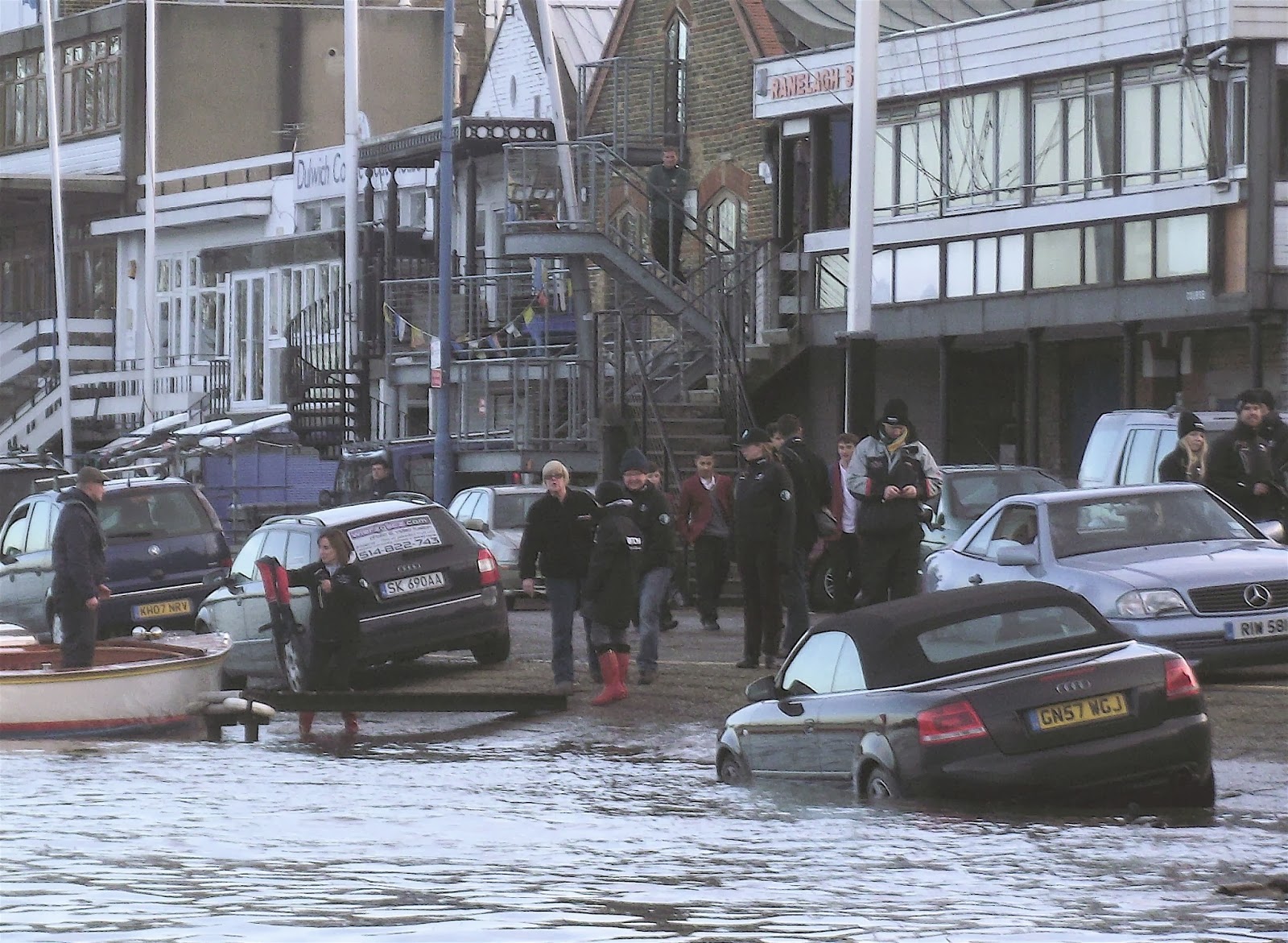
On returning to Putney we found one of the things that they don’t teach you at Cambridge – tides go out and tides come in.
Photographs © Tim Koch
Saturday, March 23, 2013
A Blow To The Head
Not this year. Molesey go off Number One in 2011.
HTBS's Tim Koch reports from London,
On the day before four hundred men’s eights, many from overseas, were due to race the Mortlake to Putney course in the 2013 Head of the River Race, the organisers’ website made the following announcement:
The Committee of the Head of the River Race regrets to advise that the 2013 Race on Saturday 23rd March has been cancelled. After detailed consultation and consideration of the weather forecasts, the Committee consider the river conditions over parts of the course could be unsafe due to the expected strong easterly winds throughout the day.
The Veterans (Masters) Head, due to be held the next day, was also cancelled. The British Rowing website expanded on the HoRR’s decision:
Organisers of the HoRR announced this morning (Friday 22nd) that the race would not be run, due to the combination of wind direction and speed, the strength of the stream, and the low temperatures forecast over the weekend. The stretch of river between the bottom of Chiswick Eyot and St. Pauls School was of particular concern to HORR organisers, with easterly 15-30mph winds, freezing temperatures and strong stream leading to potentially dangerous conditions for the 400+ crews taking part in the event - many of whom have little experience rowing on the Tideway.
The race has been cancelled due to the weather and stream conditions twice before, in 2004 and 2007. The organisers were no doubt influenced by the experience of the Hammersmith Head held on 10 March. This was run from Mortlake to Hammersmith (i.e. just over half of the traditional Mortlake to Putney ‘Championship’ Course) and attracted 100 men’s eights. Despite having the most experienced people on the Thames Tideway in charge of safety, the water around Chiswick Pier unexpectedly became very rough, very quickly and the result was that most boats filled with water and at least three had to be rescued. Not surprisingly, the craft that suffered the most seemed to have buoyancy tanks that were not water tight. In one case this was because holes had been drilled in the tanks to allow cox box wiring to be threaded through!
The unusually cold and wet winter has badly effected rowing in the UK. Just looking at 2013, head races including Weybridge, Boston, Northampton, Stourport, Peterborough, Durham, The Severn, Hampton, Henley, Molesey, Worcester, Burway, and Cardiff have been cancelled due to stream and weather conditions. The Environment Agency (the body responsible for Britain’s rivers) have ‘red boarded’ most of the none tidal Thames. This means that they strongly advise powered and non powered craft to stay off the water. This has severely curtailed rowing at clubs such as Marlow, Molesey, Maidenhead, Henley, Staines and Kingston. There is no procedure for ‘red boards’ on the tidal Thames below Richmond Lock but this does not make it any the less hazardous. I have coxed the Tideway for 25 years and there have been a few times this winter when the strength of the stream has required all my experience to keep control.
Nothing is new - Oxford practice in the floods of 1872.
The organisers of the Henley Boat Races, the Oxford - Cambridge races for heavyweight, reserve heavyweight and lightweight women and lightweight men, have pre-empted the problem and, on 20 March announced:
The organising committee... has made the decision to move this year’s event to Dorney Lake. In view of the strong stream conditions at Henley and the forecast direction and strength of wind for race day, Sunday 24th March, it was deemed unlikely that conditions will improve sufficiently by the weekend for a safe event to take place.
Dorney was, of course, the venue for the rowing events in the London 2012 Olympics. While not as an attractive venue as Henley, it does mean that the event is fairly certain to take place. All this gives rise to the question, could THE Boat Race, due to held on the Tideway on 31 March, be cancelled? I think it unlikely. Even with a higher risk to both boats than would normally be tolerated, the ‘danger’ would probably be accepted as there is obviously a massive rescue operation available.
The women have had more luck with the weather. The 73rd Women’s Head of the River Race was held on 9 March, a mild day with little wind. Race Co-ordinator Guin Batten wrote on the WHoRR website:
The 73rd Women’s Eights Head of the River was the largest in the event’s history and coming one day after International Women’s Day, highlights that women are out there doing sport and doing it to a very high standard. On a rather dull day the stream was fast and the wind slight, allowing number of records to fall. Well done to the pennant winners, the 200 volunteers and marshals, to the 90 women’s novice crews and their coaches and to the 2,727 rowers that made it over the course, in such style.
Imperial College BC ‘A’ came ‘head’ in a time of 18:16:57. Other results are here.
The School’s Head also managed to take place on the Championship Course on 7 March with Hampton going ‘head’. Other results are here.
It has been a long, hard winter. Let us hope that those clubs who have spent a lot of time on the ergos and little time on the water will have a better summer.
Saturday, January 19, 2013
Grace, Grit and Glory...
Richard Butler, who is USRowing’s Inclusion Manager, writes and discusses hot topics related to diversity in rowing in a blog on USRowing’s website. Yesterday’s post had the title: “Grace, Grit and Glory – A Celebration of Women in Rowing” which also was the title for an event organised by Community Rowing, Inc.’ Read his blog post here, and do not forget to go to Facebook to check out some pictures from the event, here.
Sunday, December 30, 2012
Time for Lists...
Not on this list...
At the end of a year, the media always publish their 'lists' of who was the best, most beautiful, or who wore the ugliest whathaveyou... Jacquelin Magnay, the Daily Telegraph's Olympic Games Editor, today published her list of the 12 top sportswomen of 2012. Of course several of GB Team female rowers are to be found on her list. Read her article here.
Subscribe to:
Posts (Atom)