Photograph: Werner Schmidt
Showing posts with label Dermot St John Gogarty. Show all posts

Saturday, April 14, 2012

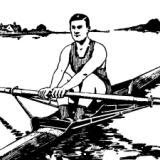
The College Rower

The College Rower
(For Oliver St. John Gogarty)

Jesus, at first light,
Shivered, collectively,
Standing next the river
Gauzed in fog,

Buck Mulligan thinking to dip his oar
In Heraclitus’s river,
River streaming Joycean time,
River gauzed

In the fog of departure,
The fog of return,
Ulysses pulling his stopwatch
From the pocket of his voyage

To time the time
It takes to take
Him to row the tolling
Thames from Putney to Mortlake,

Row the Irish
Sea all the way to the azure
Ionian, where he will morph
Back into Odysseus,

Row the fog-gauzed
River of Existence,
Odysseus, Ulysses, Jesus,
Row the tolling river until

They break through
The dimension of time.

Philip Kuepper
(March 2012)

See also entries on Oliver St. John Gogarty’s son Dermot.

Thursday, March 15, 2012

Dermot St. John Gogarty at Trinity College, Dublin

Rowing historian Greg Denieffe has more information about Dermot St. John Gogarty. Greg writes,

Following on from Tim Koch’s enquiry on 12 March and Göran Buckhorn’s follow-up on 13 March, I have found some information on Dermot St. John Gogarty’s involvement with Dublin University Boat Club (Trinity College, Dublin).

In the late 1920s Trinity adopted Steve Fairbairn’s methods and found them to their liking. To implement the new style they needed a coach who was fully conversant with these methods and Dermot St. John Gogarty fitted this requirement perfectly. Gogarty first appeared at Islandbridge in 1933 and was an immediate success as Trinity’s senior coach. They retained the Irish Senior Eight Championship in 1933 having earlier won the University Grand Challenge Cup at Trinity Regatta. In the final of the ‘Grand’, they beat their alumni club, Lady Elizabeth Boat Club, a crew stroked by Gogarty.

The 1933 Trinity College senior eight, Irish champions with Coach Dermot Gogarty wearing his London RC cap. (This photograph is from Michael Johnston’s book The Big Pot.)

Gogarty also kept his hand in by sculling for Lady Elizabeth and won The Emerald (senior) sculls at Trinity Regatta in 1933 and 1934. According to Raymond Blake in his wonderful book In Black & White, A History of Rowing at Trinity College, Dublin: “All this was only a sideshow compared to the serious preparation that was being undertaken for Henley”.

Gogarty was obsessed with winning the Ladies’ Plate and drawing on the experience of previous years Trinity only entered one event at Henley in 1934 and that, of course, was the Ladies’ Plate. They had earlier finished fourth in the Head of the River in London and won the senior eight at Boyne, Cork, and Limerick as well as at their home regatta.

Trinity progressed steadily to the final of the Ladies’ Plate and faced Jesus College, Cambridge, in the final. A contemporary account captured the excitement of the occasion:

“The greatest race of the day was the Ladies’ Plate. Jesus started at 11, 20½, 40. Trinity College, Dublin, at 10½, 20½, 39. Dublin got off very fast, and was half a length ahead at the top of the Island, and three quarters at the first signal. At the Barrier, reached in 1 minute 59 seconds, the same time as the Grand, they were rowing 35 to the 35 of Jesus. At Fawley (3 minutes 18 seconds) three seconds inside the record, Jesus went up a little, and at the next signal were only half a length behind. Here Jesus spurted at 38 against 36 and came up very fast to get level below the mile. Then Dublin gained a few feet at the mile and kept it till 100 yards from the finish. Jesus were a little better together, and in two splendid ‘tens’ at 40 up the enclosure which Dublin could not answer, they just got three feet ahead to reduce the record by seven seconds in 6 minutes 48 seconds. Nowhere over the course would Leander (the Grand winners) have been really clear of Jesus. They were the neatest, quickest, and longest Jesus crew since the Great War, and they improved with every day’s racing.”

The 1934 senior eight, Ladies’ Plate finalists, photographed at Henley. Standing (left to right), R.M. Halahan (2), J.A.F. Montgomery (4), D. St. John Gogarty (coach), J.A. Shillington (captain, 1933), A.B.K. Tyndall (bow), T. Shillington (3). Sitting: J. Richards-Orpen (6), M. Horan (7), D. McGillycuddy (stroke), R.J. O’Neill (cox, in front), G.C. Drinkwater (coach), J.C.F. MacCarthy-Morrogh (5). (This photograph is from Raymond Blake’s book In Black & White.)

The Henley adventure took a lot out of the Trinity crew and they were beaten in a heat of the 1934 Irish championship. However the foundation for an amazing sequence of results in the event was now in place and between 1935 and 1946 Trinity won ten out of twelve Irish senior eight championships.

It would seem that Gogarty was coaching at Trinity College, Dublin, University College, Dublin, and the London Rowing Club at the same time as well as sculling and stroking the ‘Lizzy’ eight. Architecture was certainly a lucrative and forgiving career in the 1930s! After his time with DUBC, he coached in Galway where he moved to in 1948.

(This post was corrected at 10 p.m. on 15 March, 2012)

Tuesday, March 13, 2012

Easy To Pick A Crew

The London RC’s eight competing on the Yarra River, Melbourne, in 1934. The crew, who was racing in the Grand Challenge Cup in the Australian Henley, had Dermot St John Gogarty as coach. Gogarty also raced on the Yarra, but when he was in the lead, his shell sunk. The photograph is from Chris Dodd’s book about the London RC, Water Boiling Aft.

In yesterday’s entry on HTBS, Tim Koch wrote about Dermot St John Gogarty’s homage to Rudyard Kipling and his poem “If”. Tim asks for more information about Gogarty. In a comment the same day, Greg Denieffe gives some information about Gogarty. Greg replied that Gogarty was “born in 1908, […] the second son of Oliver St. John Gogarty, the Irish poet, author & Senator (Wikipedia has a good entry on him). Dermot was a well known architect who went to Pembroke College, Cambridge and was a rowing coach at University College, Dublin. He coached their maiden eight in 1933 to wins at Bann and Derry.” Greg also writes that it would be nice with some more information on his rowing connections at Pembroke and UCD.

I am happy to report that I have found some additional information about Dermot St John Gogarty and his rowing and coaching career.

After leaving Pembroke College, Gogarty joined the London Rowing Club and rowed in two Grand races in 1931 and 1932, winning the Cup in 1931. In Chris Dodd’s eminent Water Boiling Aft: London Rowing Club The First 150 Years, 1856-2006 (2006) it states that “The 1930s was a golden age for London at Henley, and a decade marked by expeditions to Paris, Copenhagen, Denmark, Portugal and Australia.” In 1934, for the centenary regatta of Henley-on-Yarra, Melbourne, London RC received an invitation and decided to go. With Gogarty as coach, seven oarsmen plus the cox boarded the Ormonde which set sail for Australia. The eighth oarsman, Donald Wilson, an Australian, was already in Australia and was ordered to get fit.

Dodd tells an entertaining story about the Londoners’ voyage to Australia in his book. On the web, I actually also found an article about Gogarty, published in the Melbourne’ newspaper The Argus on Saturday, 13 October 1934. Under a head-line that reads: “Easy to Pick a Crew" -

“Take four Loyalists, add four Republicans, and you will have the ideal rowing eight. Mr. Dermot St. John Gogarty, coach of the London Rowing Club, comes from Dublin, and the “recipe” is his. “You put the Loyalists on one side of the boat, the Republicans on the other, and the result is a tough crew,” he explains. It is not so easy to select an English eight. Mr. Gogarth did some hard thinking on the way out to Australia. One day – it was in the Indian Ocean – he had an inspiration. It dawned upon him that he had two Australians in the crew. By seating them on one side of the boat it was easy to fix the rest of the crew.

“Gogarty entered Pembroke College, Cambridge, in 1927, and obtained a diploma in architecture four years later. He did a great deal of rowing, and although selected in trail crews for Cambridge, he never obtained a seat. As a member of the London club, he rowed in the 1931 and 1932 Grand Challenge Cup races at Royal Henley, being successful in the 1931 eight. For the last Royal Henley, he coached Trinity College, Dublin, for the Ladies’ Challenge Plate, and the crew was defeated in the final by only 3ft. in record time for the race.

“Mr. Gogarth is a keen fisherman, particularly for trout. He will be sculling at Henley in the Yarra Challenge Cup race.”

One thing differs from the information in Dodd’s book and the newspaper article: Dodd has it that only Wilson was Australian, while the article says Gogarty had two Australians in his crew.

So, how did the English oarsmen do ‘down under’? In the Grand Challenge Cup, London beat the Hawthorn Rowing Club in their first heat, Richmond Rowing Club in the semifinal, and won by four lengths over Wanganui of New Zealand in the final. And how did Coach Gogarty do in the sculls? Dodd writes, Gogarty “met with disaster in the first heat when his boat suddenly broke in half when he was in the lead”. Dodd continues to write, “A week later, London won the seven-abreast two-and-a-half mile Victoria State Championships by thirteen lengths in 14 minutes 20 seconds. Second-placed Melbourne University were awarded the state title.”

Some questions remains, though, Gogarty’s rowing connections at Pembroke and UCD, and did he write any more rowing poems?

Monday, March 12, 2012

Tim Koch: “If” (with apologies)

Tim Koch writes,

I much enjoyed the recent HTBS posting linking to a video of Kipling’s “If” poem illustrated by rowing pictures on Bryan Kitch’s entertaining and well informed blog, Rowing Related. The posting noted that:

'“If” was written in 1895 and is still very popular, not the least as a parody, which confirms its status amongst the British people.’

There is a rowing version of “If” which I prefer to call a ‘homage’ rather than a ‘parody’ as the former implies respect while the latter could imply mockery. It was written in 1931 by Dermond* St John Gogarty ‘with apologies to Rudyard Kipling’. It is quoted in Chris Dodd’s anthology of rowing writing and poetry, Boating (Oxford University Press, 1983):

If you can force your heart and nerve and sinew
To drive your legs long after they are done
And so row on when there is nothing in you
Except the will that says ‘Now on’;
If you can fill the unforgiving minute
With forty strokes, and let the boat full run,
Yours is the earth and everything that’s in it.
And what’s more you’ll be an oar my son.

Does anyone know who Dermond* St John Gogarty was and if he wrote any other rowing poetry?

* See comment 1.