Showing posts with label Bill East. Show all posts
Thursday, January 3, 2013
Rowing History Footnote: The Race that Ended with a Fight
Thames RC's William Fernie and ‘Bogie’ Bogle trying to row each other round while they are in the lead in the final of the 1898 Silver Goblets, where they easily beat ‘Old Hutch’ and Steve Fairbairn of Jesus College BC. A race that ended with a fist fight....
The Thames Rowing Club was founded in 1860 as the City of London Rowing Club. At a meeting in February 1862, the name of the club was changed to the Thames Rowing Club. In 1866, the Thames RC had acquired a boathouse at Putney which belonged to the boat builder William Styles of Isleworth. Manager for the boathouse was William East, Sr., William ‘Bill’ East’s father. The professional champion Bill East had strong connections to Cambridge University BC as he acted as their ‘waterman’, taking the Light Blue coxes in a boat for many years to show them how to steer on the sometimes unruly waters of the Thames with its tides and streams between Putney and Mortlake.
With Bill East around Thames RC, many of Cambridge’s rowers went to the club after they left the university and got a job in the city. This was what happened in 1898 when some Trinity Hall oarsmen, William Fernie, William Bieber and Hunting Howell, joined the club. Some ‘Hall’ rowers, including Richard Croft, were already members. Croft took the Colquhoun Sculls in 1893 and the Lowe Double Sculls in 1894 (together with Adam Bell), and he also rowed in the Hall’s first eight winning the Head in 1894 (with Fernie and Bieber) and in 1895 (with Fernie, Bieber and Howell). Also the Hall’s David Campbell-Muir, who got his Blue at the same time as Howell, would become a member of the club.
For the 1898 Silver Goblets at Henley, Fernie raced in the pair with A. ‘Bogie’ Bogle who was ‘a very difficult and aggressive crew member’ Geoffrey Page writes in his history book on the Thames RC, Hear The Boat Sing (1991). For some unknown reason Bogie was not on speaking terms with his partner in the boat on the day of the final, where they were going to race against A. M. Hutchinson ‘Old Hutch’ and Steve Fairbairn of Jesus College BC (yes, the famous coach to be). On the way to the start, Bogie and Fernie tried to pull each other round which they continued to do during the race. Old Hutch and Fairbairn took an early lead at a high rate which was doomed to fail. The Thames pair soon was in the front and won comfortably.
Page writes: ‘They did not stop at the line. Legend has it that they continued to Marsh Lock, where they got out and fought it out on the bank. It is not recorded who won the fight, but the boat was left for the boatman to collect.’
Friday, December 23, 2011
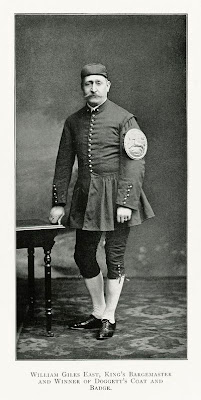
Bill East: Doggett's Winner, Professional Rower And Coach
In yesterday’s entry, Bill East, the Doggett’s Coat and Badge winner who later became the King’s Bargemaster, was mentioned. I believe he is worthy of an HTBS entry of his own, so here we go:
William Giles East was born in 1866, and the legend says that he was born in his father’s boathouse at Putney, but he was actually born close to Lambert Pier in London. He spent his whole life on or by the Thames, and became a waterman's apprentice in 1882, which was the year he won the Putney Badge. In 1887, Bill won the Doggett’s Coat and Badge Race, and in 1891, he won the Sculling Championship of England. Seven years later, in 1898, he was appointed a waterman to the Queen. In June 1906, he became the King’s Bargemaster (although, an article, here, in the Black and White Budget of 28 September, 1901 claims that he was appointed ‘Royal Bargemaster’ that year). He also stroked in the winning Champion Fours in the National Regattas of 1890 and 1891, and also won the Champion Pairs.
Bill seems to have been a very popular person on the Thames and was early on connected to Cambridge University BC, as mentioned in yesterday’s entry about R.E. Swartwout, to train and coach the crews. In 1904, he published the ‘how-to’ book Rowing and Sculling. Later in life he also kept the Prince’s Head and then the Pigeon Hotel at Richmond. Bill East died in January 1933.
What is not that much known is that Bill East coached Trinity Hall’s famous rower and sculler, the American Benjamin Hunting Howell, to victories in the Wingfield Sculls in 1898 and 1899; the same years Howell also won the Diamond Challenge Sculls at Henley. Below is a wonderful picture of the two scullers from Howell’s private photo album, now kept in the NRF’s National Rowing Hall of Fame at Mystic Seaport in Mystic, Connecticut.
Subscribe to:
Posts (Atom)